Showing posts with label kat ghastly. Show all posts

Saturday, December 28, 2024

45 Days Of CCS, #28: Robyn Smith, Dylan Sparks, Kat Ghastly


Kat Ghastly's I Hunger may be short, but she packs a lot of conceptual power into its very silly punchlines. Its central idea--"What upset Cthulhu's tummy?"--is very dopey but also funny, and her gross-out drawings match the grossness of her puns. "Cult chowder," "Peopleroni pizza," and finally "This comic" are all culprits. This is like a wonderful Lovecraftian Garbage Pail Kids set. The sickly green cover is a nice indicator of its contents.


Robyn Smith's Night Fever won an Ignatz award for Outstanding Artist in an issue of the anthology Gladiolus. This is just an eight-page story, but it packs a wallop. Smith is best known for illustrating other people's stories, but she's actually an excellent writer in any number of genres. Her work has an edge that's certainly evident in this story of a group of college friends who drop acid at an outdoor Halloween party. They invite their friend Leanna to come out and meet them, and through a series of chaotic events, something horrible happens: she is dosed without her knowledge by a man she doesn't know. Smith cuts the story off before the inevitable consequences of this (something she's especially adept at--her own writing is filler-free), but the nightmarish visuals tell the reader all they need to know. 


Gallant Valor is Dylan Sparks' senior thesis, and it's one long play on gender and fantasy tropes. It's about a romance between a knight named Serim and an anthropomorphic dragon named Pet. That romance, as we learn in flashbacks, was born out of controlling and abusive relationships. For Pet, it was the king who treated her as more of a thing than someone who belonged in his court. For Serim, it was her devotion to the queen that obliterated boundaries by using her as a sex object. In both examples, it was a case of unequal power relationships taken to extreme levels. For Serim, the queen's need for total devotion led to the knight's death. For Pet, she defied her surrogate father's control and threats that she'd never fit in so she could find her own way. Finding and accepting each other was the key to their own personal transformations, as they started on their goal of marauding through the kingdoms. This was an ambitious comic, and some of the storytelling felt muddled. That includes some of the character design, which was a bit all over the place, but Sparks' line was also inconsistent. That said, Sparks nails the big shocks in this comic, and the romantic (and unsettling!) ending feels entirely earned. 

Monday, December 26, 2022

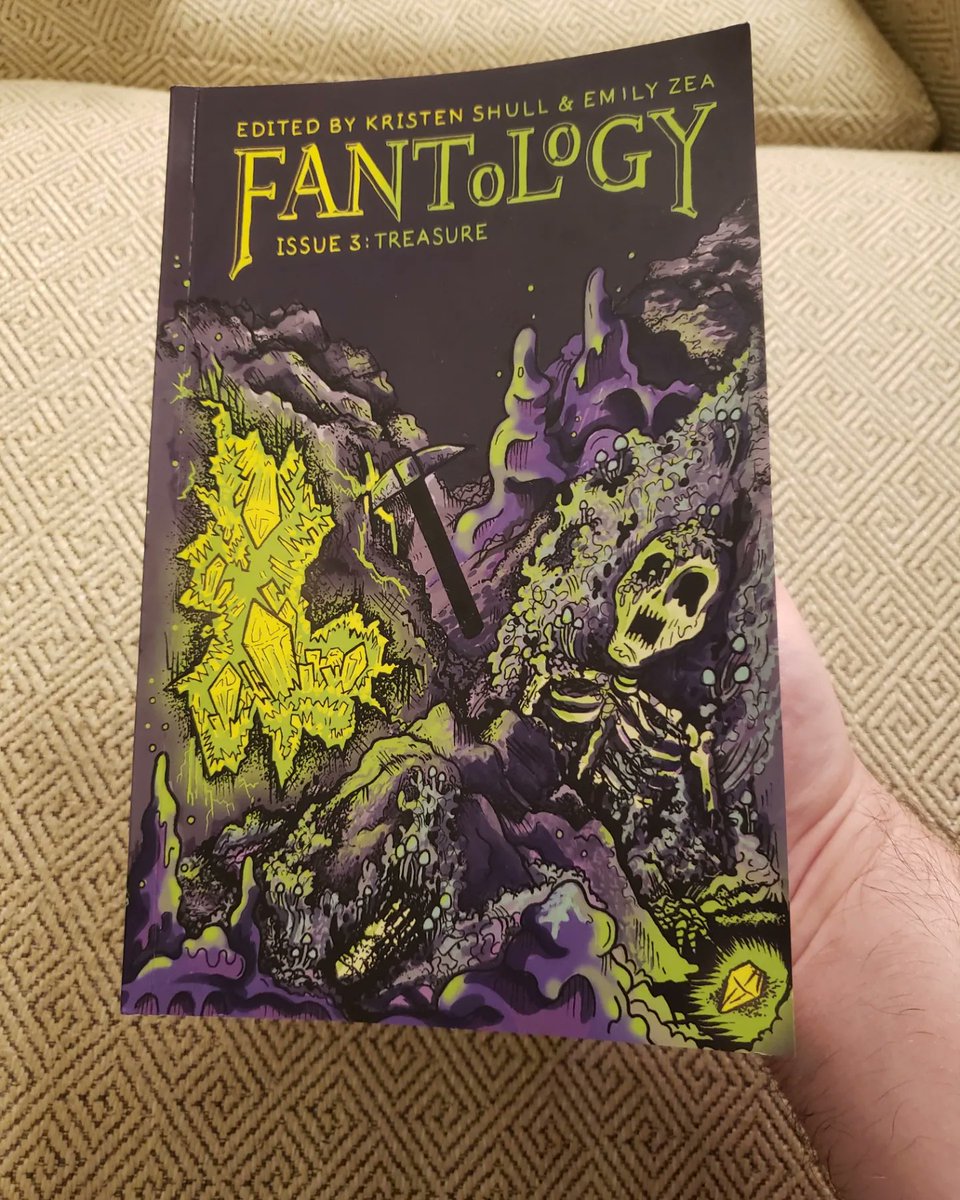
31 Days Of CCS, #26: Fantology Volume 3

Kristen Shull and Emily Zea have produced another winning edition of Fantology, with probably the strongest issue from top to bottom. Its central conceit is that the artists have to work within an established world delineated by a map, which of course is similar to but not as rigidly prescribed as the fantasy minicomic series Cartozia Tales. The theme for this issue is "treasure," and that's a solid basis for stories because it instantly gives protagonists something to want.  


Kat Ghastly's "Lore" kicks things off, and their inventive layouts and page composition make this piece truly stand out. It's as much horror as it is fantasy, as it details a deadly prophecy concerning the new sorceress of the kingdom. Ghastly uses open page layouts, zooms in and out on key characters, uses tiny details to provide narrative and decorative flourishes, and provides rich and provocative characterization. This feels like a long book in the offing. Tay James' work is text-heavy, but the weird lettering choices and bonkers page design help with the light-hearted humor of the piece. Sage Clemmons' entry alternating illustrations with hand-written letters detailing a couple separated by life circumstances is deeply emotional, and ideal for an anthology. Natalie Norris' wordless tale of two mermaid lovers discovering a trove of human treasure is the emotional and narrative opposite: two lovers with no regard to the outside world, inseparable. The treasure amounts to simple baubles for them, instead of life-or-death plunder, and if there's one thing Norris is aces at drawing, it's slender, elegant, beautiful women. 


Emily Claire's piece about disaffected undead employees in a dungeon is funny and has a sharp punchline, although the dependence on grayscale shading made the visuals bland. A pet is a major aid in that story and in Chelsi Fiore's entry about an elf and his small steed being trapped in an underground city. These are breezy transition pieces that lead to the third chapter of Shull's ongoing fantasy story about two accidental traveling companions who both carry secrets. Shull's boisterous and bawdy style of fantasy is propulsively fun, as she pairs a serious (but horny) character with a light-hearted (but also horny) character who loves carousing, singing, dancing, and playing games of chance. Shull has a way of adding a slice-of-life touch to fantasy proceedings that centers the story around her protagonists, and both of them are memorable--both in terms of how they're drawn and their personalities. Hopefully, this makes it into a book one day. 


Michael Beachy's treasure-hunter story is a little visually overwrought, but he reins it in just enough to tell a clear and funny story. Mona's story about a bored wizard staging a tournament because he loves violence is heavy on pen-and-ink pyrotechnics, but her command over her line and clever storytelling techniques makes this fun, right on down to its cut-off ending. I get that it's part of a larger story, but not having any real closure in the story was distracting. The scratchiness of that story is followed by Stephen Pellnat's painstaking detail in service of some dynamic storytelling about a cat adventurer getting more than he bargained for on his adventure, and learning a valuable lesson along the way. There's another stylistic shift, to a sketchy, hatching-heavy story by Jackson Maceo Schleicher about a lack of honor among thieves as they look for a wishing egg. 


Rainer Kannenstine's piece is yet another visual shift, as it looks like scratchout white-on-black, with a simple, blocky line to tell this story of a grappler named Urta whose use of brute force eliminates the need for skill or magic in taking a dragon's treasure. She also has no problem declaring herself the sole recipient of the treasure and turns the dragon into her pet. My vote for most improved feature is Alex Washburn's newest entry about Clan Zargs. These ragtag adventurers get into genuine trouble, and Washburn tightens up everything here: his line, the storytelling, and even the characterizations. On the other hand, co-editor Zea's piece about a pirate challenging her family's lineage with the help of her hostage/protege/niece feels overblown and self-indulgent. She seems so delighted in her Captain Trub character that everyone else in the story is a means to the end of extolling her awesomeness. The story is still well-drawn, although the use of digital lettering takes me out of the actual story. 

While that story was a misfire, Fantology 3 not only holds up well on a story-to-story basis, the sequencing is also fluid and creates contrasts that make each story stronger. For an anthology with an open submissions policy, they did a remarkable job of putting together such a strong group of creators. It helps that there are regulars to anchor it, but this was the best all-around group to be featured in an issue so far. The conceit of Bartlebee the Bard introducing each chapter is fun, but it seems wholly unnecessary for one-shots. Given that some strips are in their third chapter, a summary of prior chapters would have been useful for readers. This volume will definitely delight readers looking for something a bit off-beat in their fantasy comics. 

Thursday, December 31, 2020

31 Days Of CCS, #33: Fantology Issue 2

The second issue of Kristen Shull and Emily Zea's Fantology arrived just under the gun for inclusion in this feature. Unsurprisingly, this issue was generally superior to the first, often in surprising ways. For editors figuring out how best to assemble an anthology, the second issue is the one where all the kinks are generally hammered out in terms of process and production. In an anthology where very little is at stake in terms of money but a lot is at stake in terms of editorial credibility, young editors have to take risks on the kind of work they accept. There were a few newcomers in this issue and the returns were fairly positive on them; indeed, some of these stories were the best in the whole volume. 


One of the more surprising and delightful aspects of this volume is that the shared-world conceit of the first volume not only carried over here, but that some artists used the creations of other artists from the first volume to strong effect. This is another similarity to the Cartozia Tales series edited by Isaac Cates, only without the OuBaPo-style rigidity with regard to rules and switching every issue. This felt like a relaxed and fun one for artists to play together in the same world. Speaking of relaxed, the issue's theme of "Flora & Fauna" struck a nice balance between having no theme and having one that produced too much of the same thing. Each artist was simply compelled to come up with a new animal or plant during the course of their story. Some of them were incidental, and some of them drove the plot. 

While fantasy stories often devolve into world-building exercises, it was clear that Fantology's artists were generally far more interested in character-building. The characters drove the plots, and in the cases where they were returning characters, the stories served to expand on their histories and personalities. All of this is also tightened up by the anthology's narrator and gimmick Bartlebee the Bard, who not only informed the readers as to the anthology's theme, but also introduced each story and served as a natural piece of interstitial material. Unfortunately, one thing that got by the editors was matching up page numbers and the table of contents, which only had a passing resemblance to each other for many entries. 
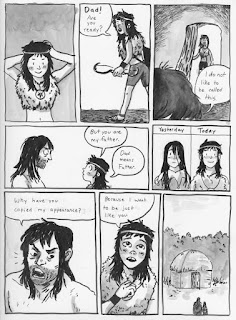


The continuing adventures of several characters were certainly highlights. Shull's own saga of Sabi and Kata (the elf and the wizard) once again had an episode that was not only entirely satisfying on its own merits but also moved along the larger plot. It even hooked in a character from a group introduced by Leise Hook in the first issue. Given that the main characteristic of the character was his lusciousness, this was right up Shull's alley. Catalina Rufin's continuing adventures of Brono and Satu, the barbarian and his child, continued to be pitch-perfect. While retaining a rough fantasy aesthetic, the gentle quality of the story belied its concept. Filipa Estrela's gentle saga of Frill and Frond, the mushroom person and goblin who became partners in the first issue, is expanded here as the parameters and boundaries of their relationship are tested. Indeed, this is less a fantasy comic than it is a comic about relationships with fantasy trappings, although Estrela made those trappings delightful. Emily Zea's "Troubled Waters" continues the adventures of Princess Trudy and pirate captain Troub. It's a funny and compelling story, as it's made clear that Troub is more closely connected to Trudy than she first let on. Zea's linework here seems considerably more rushed in this issue than the first, however. Alex Washburn's story about a group of dysfunctional explorers maintained its humor thanks to Washburn's thick line and irreverent storytelling. 


The most interesting artists that were new to me were Tao Tao Jones and Chelsi Fiore. The former wrote a compelling story about the Pea from the "Princess and the Pea" becoming a cherished heirloom to a family of servants, until one of them broke away and created her own country based around the pea's growth. Jones' line is thin and scribbly, which suits the material, although I found myself wishing her script was a bit larger. Fiore's story about a desert traveler encountering a fuzzy little potato-like animal was imaginatively drawn and worked well with its short length. It was not just a story about reuniting a child with their family but also about an explorer who respected the environment they traveled in. 

This anthology was filled with pleasant interactions in this particular world, proving that not every fantasy story has to be about conflict. Eddie O'Neill and Kay Brand told a story about a couple going hunting for eggs and herbs so they could have brunch together; the plot was thin, but it was all about fleshing out their dynamic as a couple. Emily Bradfield's story had a little more action, but it was about a witch and a new witch wishing to be her friend and work comrade and how routine can often prevent us from making connections. Rainer Kannenstine's story is a send-up of boastful fantasy tropes. Kat Ghastly offered up more of a psychedelic bit of lore than a story, but it worked as a visually impactful opener. 


There were three stories that particularly stood out. Keren Katz's detailing of how the coin-people introduced in the first issue reversed their process and undid everything that was purchased with them was both conceptually fascinating and heart-rending. In terms of style, there's no one who draws with her level of detail and conceptual power. Kevin Fitzpatrick's meaty story about a potions-master and his imprisonment was full of fascinating character details, ethically thorny dilemmas, and extensive mastery of light and dark contacts. Emil Wilson's story about hunters discovering a bear with an orange tree growing on it not only had an exciting blend of naturalism and weirdness, it also was emotionally complex and touching. 

At 252 pages, the volume felt a little bloated. There were several stories that were had to parse or process visually that could have been eliminated. While the slighter stories were enjoyable, this issue felt unbalanced in that direction. The more complex stories really stood out in this volume, but their tone was subdued by the lighter fare in some of the other stories. Creating a balance in an open-call anthology is extremely difficult, but it's a credit to Shull and Zea that they were able to sequence things in such a way that they were nearly able to pull it off. 

Thursday, December 19, 2019

31 Days Of CCS #19: Brainworm 3-5

Brainworm continues to distinguish itself as part of the continuum of CCS anthologies led by students over the years. So much of the CCS experience encompasses opportunities that are difficult to come by later in one's career, and the ability to easily collaborate is one of them. Having access to one's peers as critics, accountability partners, and creative partners as part of a difficult but rewarding experience is one of the biggest draws of living in White River Junction. There's also often an urge for a creative person when faced with an assignment or deadline to want to work on anything except their assignment. I've always had the sense that being able to blow off steam like that in a creative and productive way is a big reason why there have been so many anthologies at CCS over the years, but I'd also imagine having the opportunity to make something as good as Irene or Sundays presents its own challenge.

Brainworm's editor is Kat Ghastly, a second-year student. One can always tell that Ghastly's got a lot of different gears going, and her ability to wrangle consistently solid and interesting contributions is a credit to her as an editor. Brainworm is also a record of sorts that touches four different graduating classes, giving it its own unique identity regarding a specific period of time. Each issue is themed, and the third issue's theme is "Surprises." There are some fun incidental drawings from Leise Hook and Emily Zea, followed by a cute strip from Erienne McCray. The latter involves an octopus trying to get adopted as a pet, and McCray's line and use of blacks drives the cute factor home. Katz's strip combining the myth of Noah and the Trojan War was absolutely hilarious, especially with regard to the mumbled dialogue.

Cuteness and weirdness are interspersed neatly by the editors throughout the comic. Emma Hunsinger's dryly humorous bit about a skeleton woman who maintains high-fashion status is its own self-reflective commentary. Surprise monster payoffs from A.C. Rooks and Rainer Kannenstine mash that cute/horror dichotomy effectively. There's a long series of drawings from a number of artists for a "Trickster Battle Royal" that looks like it was drawn on post-it notes, but the reproduction was too small to discern most of the details. That's too bad, because there seemed to be a lot of clever ideas here. The two MVPs of the issue are Kristen Shull and Tim Patton. The former's autobio comics are among the most heartfelt and authentic I've read, especially with regard to sex and relationships. This one's about the horrible feeling of knowing that someone is in love with you when you don't feel the same way in a casual relationship. Patton's scrawled pencils start with a cutesy metaphor about a monster eating orange-creatures and then quickly turns the subtext into text by way of narrative captions. The reader is informed that all of his comics are really all about sex, love, and above all else: survival. "Absurdist constraints" are just there to hold into place that essential idea of barely being able to hold it all together, with one's vices both helping and hurting. This is as raw as it gets and Patton goes all the way while using an interesting layout that also harmonizes his text with funny drawings.

The theme for #3 is "Bad Romance," which is a wheelhouse category for a number of these contributors. Issy Manley's story takes the theme and bends it first toward romance comics tropes and then to EC horror comics. Of course, it's all about a relatively mundane event (power going out in winter, neighbor being sent to help) that's ratcheted up in everyone's imaginations to create tension and paranoia. Katz's comic uses a combination of extremely spare cartooning in some parts of its open page layout and then beautifully intricate linework to tell the story of an old woman receiving care from a volunteer. The story grows increasingly strange until the truly bizarre climax. Not surprisingly, Shull's comic on the subject is excellent. This is less about a specific relationship and more about her relationship between herself and her own body as she felt herself aging a little. More to the point, it's about the persona she felt she created in response to her feeling less desirable; it worked so well in attracting friends and lovers that she felt it wasn't ever really "her;" she had become her own shadow. Shull's line is perfectly suited for this kind of story. It's clear and slightly cartoony without being overly stylized.

Catalina Rufin, Jess Johnson, and Liz Young all tell variations of the same story. It's about younger versions of themselves finding themselves in abusive relationships where partners told them what to do, what to like, and what to say. They were demeaned and insulted. For each artist, they had to find their own journey to self-actualization. Johnson's story is interesting because she was so shaken by her experience that she wasn't even sure what she liked anymore, so she undertook a furious self-tutorial to figure it out that culminated in getting a cute Adventure Time-themed dress. There's also a trio of monster/horror -related strips from Rainer Kannenstine, Tim Patton, and William Prentiss. Ghastly's own strip involves a couple going to hell that feels highly autobiographical.

Issue #5's theme is "Doppelgangers." This was the most interesting and consistent issue to date. Zea and Daniel Foulfellow both use variations on doppelgangers pursuing or threatening the original versions with dramatic tension. Ivy Allie takes that idea and turns it on its head in a hilarious way. Lillie J. Harris' story about a brother and his twin is a story I've already reviewed back in her recent entry on High-Low, but I wanted to note how it really anchored the rest of the issue, along with Andi Santagata's "The Time Knife". Johnson and Shull both offer stories about how apparently twin versions of themselves were wandering around town, but Johnson at least met hers in real life while Shull was left wondering if they blacked out and dressed like a banana for a weekend.

Tristan Scilipoti's "What It's Like To Have Sex With Yourself" starts as an "erotic visual essay" but winds up being about dysmorphia and self-loathing. It's an unflinching, raw story. Ghastly's "Horrorshow" is about that feeling of "someone else driving the bus" when feeling disconnected and detached from the world. Patton's "Gemini" strip is a variation on Aristophanes' speech on androgyny from Plato's Symposium (humans being one being split into two). Coco Fox's strip about a murderous doppelganger takes a hilarious turn with a beautifully expressive line. Overall, the balance between horror, comedy, and personal stories made this the most fully-realized issue of Brainworm to date.

Saturday, December 7, 2019

31 Days Of CCS #7: Kat Ghastly

Kat Ghastly's comics are a mix of bracing autobio and light entertainment. Even in the most personal of comics, their instincts as an entertainer are front and center, and I get the sense that their creative instincts lie in the intersection between scorching personal honesty and weird fantasy/fiction/horror. Starting with the landscape-printed What To Drink When Everything Is Nightmares, this is ostensibly a breezy review of disgusting energy drinks. This is rocket fuel for cartoonists pulling all-nighters and seems like a layup to do something light and funny. Well, the result is kind of light and funny, but Ghastly also alludes to their getting divorced, chronic pain, and the many things that make them sick. However, they need drinks like this to stay awake and had a job to do as a cartoonist for this comic, and they certainly delivered. Their reviews are funny and their mix of naturalism and cartoony gore is memorable.

Snakes Will Be Snakes is an even better mix of horror and personal trauma. Based on a fable by Aesop (a standard CCS assignment), the premise is Ghastly's weakness for snakes: "If I see that a snake is in trouble, I feel compelled to rescue it." Snakes here are wounded but toxic people who repay kindness with selfishness--or worse. It is, after all, their nature. They take this visual metaphor all the way, and it's cleverly done. It's funny when the snakes do absurd things like burn down a house and disturbing when they bite down deep and draw blood. In either case, the harm here is at a visceral level of trauma; there's an illustration at the end of Ghastly's naked body filled with serpents wriggling out of their flesh. What's especially fascinating is that Ghastly doesn't paint themself as a victim, noting that they're drawn to these kinds of people--and may well have been transformed into one.

Burn The Witch I is their most straightforward autobio comic, yet even here the intersection between memoir and horror is blurred. This is the first in a memoir series, and it's about how they coped with childhood bullying. A bookish child, people made fun of their name; their fascination with books, magic, and cats; and their general but vague lack of fitting into cultural norms. Their cartooning here is excellent, as their figure work is highly stylized. They alternate between ultra-simple stick figures in some panels and dense linework in other panels. Different emotions and events have different visual codes, and Ghastly guides the reader's eye easily across the page. The comic ends with Ghastly not being cowed by the bullying; if anything, they had a desire to get even. This led them to witchcraft (inspired by the movie The Craft, who had a vengeance-seeking character Ghastly wished she could be), and there's an allusion that getting into it led to far more trouble than their actual bullies brought them. I've never read a memoir quite like this one, and I'm fascinated to see where the talented Ghastly takes it.

Wednesday, December 26, 2018

Thirty One Days Of CCS #26: Brainworm 1-2

Anthologies have always been the lifeblood of CCS. In addition to work that's assigned to the students, there have often been cartoonists who have chosen to put together work with fellow students and alums. How the work is put together is often up to whichever cartoonist takes it upon themselves to edit the anthology, and in the case of the two recent volumes of Brainworm, that person is Kat Ghastly. She billed this anthology as "a catalog of obsessions for the obsessed" and themed both issues, giving them a nice sense of loose coherence. The table of contents in the first issue contains a sign-up sheet where most artists who said yes agreed at the expense of sleep or possibly quality, which speaks to the work ethic of the average CCS cartoonist.

The theme of the first issue is Endings. Tim Patton's stylish strip is about a couple of friends who visit an out-of-the-way coffee shop on its last day, and it's all about that sense of wistfulness that one feels in moments like that. The use of steam lines speaks to the ephemeral nature of the moment and then the memory. Hachem Reslan's silent strip is clever; it starts from heavily rendered as we see two hands: one holding a knife and other other an orange. As there is a surprise thing that is cut, the rendering and lighting gets lighter and less distinct, as though the cut hand is the one that's drawing the strip. Kristen Shull's cartoonish line is a delight in her story about songs that she can't get out of her head; it's a bit of fun that she braces with the final observation that banishing lingering thoughts is much more difficult. Sage Persing makes use of the dark in talking about their childhood OCD thoughts. Leise Hook's obsession with knowing how stories end was also cleverly drawn, with literalizations of the metaphors she was using. Bailey Johnson's drawing of a camera they took apart spoke to the way that working with its parts was soothing.

Unsurprisingly, CCS fellow Keren Katz's contribution was hilarious, odd and unsettling. It mixes drawings and photos (with a curly mustache drawn on Katz's face!) as the story follows a curator trying to figure out how to display the new heads. Each image is very typical of Katz, in that she's interested in exploring the way images in motion flatten themselves vs the ways in which still images can be arranged so as to create a strange synthesis. Ghastly's own strip is an amusingly cathartic story where she imagines people she hates falling into an open sewer grate, and then she thinks about what that fate may be. Her use of blobby figures reminiscent of Keith Haring drawings gives her story a strong visual charge.

The second issue isn't quite as interesting, in part because the topic ("The Undead") is a bit played out, and thus there was less variety on display. Katz once again takes an eccentric approach to an idea by taking three different documents (instructions for taking care of a cat, an origami instruction book and a book on making bubbles) and challenges people to come up with the first sentence of each book. It's all for reviving a monster. Katz is a walking idea machine, her brain and/or her body in constant motion as part of her relentless project to brighten the world with whimsical, bizarre and thought-provoking art.

There are some nice illustrations provided throughout by CCS instructor and horror master Steve Bissette, but they clashed with the generally lighthearted fare in the rest of the anthology. For example, Kurt Shaffert's "Bioethics and Zombie-care" is a funny take on how the rules of research (autonomy, beneficence, etc) would apply to dealing with zombies. Ghastly's own strip is about her own actual fear of zombies, or rather, that someone she loved would try to destroy her unexpectedly. Reslan and Persing's collaboration follows a sort of mannered, doomed romance, only one half of the couple is a zombie. Andres Catter's zombie gag is a funny one, using an image per page for maximum impact. Leise Hook's comic about a plant she revived and then might have killed again is a clever take on the theme, and its understated visual approach blends nicely with the text.

Saturday, December 8, 2018

Thirty One Days Of CCS #8: Emma Hunsinger, Hachem Reslan, Kat Ghastly

I spent the first week of my CCS reviews mostly looking at the work of old favorites. Now it's time to turn my eye to the classes of 2018, 2019 and 2020.

The Last Mather, by Kat Ghastly. Subtitled "Inherited Karma", this is a short shaggy dog joke of a story about a ragged homeless man (derisively referred to as "the trash king" by a local) having a horrible day. He gets bitten by a wild boar and loses his shoe, he steps on a nail, he gets soaked with a bag of piss, etc. The final scene, where he confronts a famous ancestor, is actually a pretty hilariously complicated reference having to do with the concept of predestination. Ghastly's cartooning is spare but expressive, pointing the reader to every portion of each snowballing misfortune.


Under The Sun, Trickle Down, and Karantina, by Hachem Reslan. These are all short, weird minicomics made by an artist clearly interested in the absurd and horrific. Under The Sun I starts as a story about a lovers' quarrel. The comic is set in a nine panel grid, but there are no panel borders set, giving it an open feel. Reslan uses a number of interesting perspective tricks, like putting a door in the upper right hand of a panel to indicate its distance, but not moving the “camera” closer as a figure approaches it—he gets smaller on the page as he moves further away. It's an effective device for showing the emotional distance between the man and woman having a fight. Then a vampire appears in the woman's room, whom she mistakes for her lover at first. The eventual conflict is told with a series of shifting perspectives, the use of shadow and light, and the eventual collapse of panels on the final page. It's a short, smart comic told with a fine but steady line.

Karantina is about a woman surviving in a war-ravaged area. The comic is all about rituals of survival, focusing on water above all else. When that runs out, she has to move on. She finds a stream but also a dead, decaying dog, which she shoves into the stream in an act of mercy. The comic is about her attempts at not just survival, but dignity, and it's told with that same steady hand. Trickle Down is pure nonsense, as Reslan channels Joe Daly and possibly Cowboy Henk in talking about Ronald Reagan's exploits rolling skating and subsequent disappointments. It's pure absurdity, from the interactions of the main characters to the use of Reagan's image over various other people in the end pages. Reslan's work is imaginative, strange and well-executed.

The Pipe Family, by Emma Hunsinger. This oversized comic (about 12" x 8") is pure, glorious nonsense from beginning to end. Hunsinger's over the top ridiculousness, grotesque cartooning and distorted images form a weird, funny but logically consistent story about the Pipe family moving to "No River Junction". The Pipes have a monopoly on both pipes used for plumbing and smoking, and a couple of curious kids investigate why they've moved to their dusty old town. Hunsinger heightens everything here--dialogue, character design, plotlines--in order to make the narrative particularly silly. There are creepy-eyed children, impossibly large mustaches, non sequiturs, and plot twists to go with hilarious, deadpan dialogue. This comic is raw in the best possible way, as it looks like it just popped fully formed from Hunsinger's head.