Showing posts with label robyn smith. Show all posts

Saturday, December 28, 2024

45 Days Of CCS, #28: Robyn Smith, Dylan Sparks, Kat Ghastly


Kat Ghastly's I Hunger may be short, but she packs a lot of conceptual power into its very silly punchlines. Its central idea--"What upset Cthulhu's tummy?"--is very dopey but also funny, and her gross-out drawings match the grossness of her puns. "Cult chowder," "Peopleroni pizza," and finally "This comic" are all culprits. This is like a wonderful Lovecraftian Garbage Pail Kids set. The sickly green cover is a nice indicator of its contents.


Robyn Smith's Night Fever won an Ignatz award for Outstanding Artist in an issue of the anthology Gladiolus. This is just an eight-page story, but it packs a wallop. Smith is best known for illustrating other people's stories, but she's actually an excellent writer in any number of genres. Her work has an edge that's certainly evident in this story of a group of college friends who drop acid at an outdoor Halloween party. They invite their friend Leanna to come out and meet them, and through a series of chaotic events, something horrible happens: she is dosed without her knowledge by a man she doesn't know. Smith cuts the story off before the inevitable consequences of this (something she's especially adept at--her own writing is filler-free), but the nightmarish visuals tell the reader all they need to know. 


Gallant Valor is Dylan Sparks' senior thesis, and it's one long play on gender and fantasy tropes. It's about a romance between a knight named Serim and an anthropomorphic dragon named Pet. That romance, as we learn in flashbacks, was born out of controlling and abusive relationships. For Pet, it was the king who treated her as more of a thing than someone who belonged in his court. For Serim, it was her devotion to the queen that obliterated boundaries by using her as a sex object. In both examples, it was a case of unequal power relationships taken to extreme levels. For Serim, the queen's need for total devotion led to the knight's death. For Pet, she defied her surrogate father's control and threats that she'd never fit in so she could find her own way. Finding and accepting each other was the key to their own personal transformations, as they started on their goal of marauding through the kingdoms. This was an ambitious comic, and some of the storytelling felt muddled. That includes some of the character design, which was a bit all over the place, but Sparks' line was also inconsistent. That said, Sparks nails the big shocks in this comic, and the romantic (and unsettling!) ending feels entirely earned. 

Friday, December 22, 2023

45 Days of CCS, #22: Robyn Smith

Robyn Smith is one of the most talented and successful of all the graduates of CCS. Be it mainstream work like Nubia for DC, award-winning illustration jobs like Wash Day Diaries, or their own, more personal work, Smith's command both over color and line is expressive and beautiful. Their recent entry in the Short Box Comics Fair, Roast Or Fry, is a story about her native Jamaica that starts out in one place and swerves in a rather incredible way. Smith crams an entire book's worth of pettiness, infighting, intrigue, mystery, and mayhem in under thirty pages, with a repeating visual motif that embodies the entire story. 


The story follows the day after a big party with drunken consequences. The protagonist is a young woman named Trelawney, who's part of a group chat with a bunch of old school friends who were in the same home room. Smith sets the scene with Trelawny waking up after a drunken night where she was roped into celebrating her rich school friend Aisla opening up a new spa in honor of a friend she had made over the internet as a child named Paolo. A hung-over Trelawney tries to reconstruct the night by going back over her texts, which was an incredible storytelling device because it put the reader in the same boat that she was. What was her relationship with these people? She referenced guilt--over what? It was made abundantly clear that she didn't have much money by Aisla herself. Immediately, the reader wonders where all of this is going, which details are important, and why. 

A running theme is the huge fruit, possibly a guinep, that falls from a tree. As it slowly dawns on Trelawny what happened the previous night, the attention she's paying toward cooking up the fruit starts to wane. Using a series of flashbacks cleverly accentuated by different color patterns, Smith slowly starts to reveal the significance of what seem to be anecdotal or incidental bits of trivia. Instead, Smith's fiendish attention to detail unravels a jaw-dropping revelation whose ramifications continue to spiral even as the story ends. As always, Smith's figurework and use of gesture could carry entire pages even without text. However, it's their page composition that was truly impressive in this comic. Inset panels, decorative elements surrounding panels, panels at odd angles, the use of a rear-view mirror as a panel--every page has something new and slightly disorienting to challenge and engage the reader. Smith's writing is so sharp and has a nasty cynicism that serves her characters well. 

Friday, December 9, 2022

31 Days Of CCS, #9: Robyn Smith and The Mesozine #2


Ding Dong, by Robyn Smith. Noted as a "sketchbook zine," this mini shows off some of the things that Smith does best. Her character design, her understanding of how to draw clothing, her incredible detail with regard to hair are all on display, to be sure. Smith could ditch comics tomorrow and have a successful career as an illustrator, because her style is so lush and attractive. However, Smith never abandons what also makes her a great cartoonist, which is her understanding of gesture, expression, and the relationship between bodies in space. That's true in even the roughest pencils for some of her strips; Smith is especially adept at using a head tilt to convey meaning and affection. There are other drawings that give hints at untapped aspects of her talents, like movement and physical struggle, but Smith is best at drawing highly stylized figures in various states of repose talking to each other. While I've enjoyed Smith's collaborations with other writers, I'm eager to see her write her own material down the line. 


The Mesozine, Issue 2, edited by Denis St. John. St. John loves drawing monsters and dinosaurs, and this zine is a gathering place for his friends to also draw dinosaurs. St. John was in the second graduating class of CCS, and there are a lot of older grads in this mini. It also includes fellow co-workers in the Schulz Studio. the highlights of the mini include a serial from Morgan Pielli (whose bizarre sci-fi comics are greatly missed), drawing a dinosaur combat from three different species, and a thoughtful strip from Ross Wood Studlar (a forest ranger and cartoonist) discussing how the Oviraptor got a bad reputation as an egg thief. There's a wonderful image from Donna Almendrala-Joel and a slightly cartoony story from St. John that adds a touch of Carl Barks cuteness while still maintaining Carl Barks action and movement. This is the story of more dinosaur fights, this time with a mother trying to protect her children from predators. Bryan Stone, another early CCS grad, contributes some pin-ups, as does the legendary Steve Bissette, who was a faculty member at CCS for many years. Non-CCS alum Alena Carnes has a memorable but brief story about being on a dig open to the public, and what it meant for her. Overall, there's something loving and fun about doing this kind of drawing that's at once highly technical in its illustration style but also freeing in terms of the sheer nature of the visceral quality of these animals. Those who love dinosaurs will get a kick out of this zine. 

Monday, December 27, 2021

31 Days Of CCS, #27: Robyn Smith

Publishing, and comics publishing, in particular, is a funny place. A publisher will reject a work from the margins sometimes, not because of its quality, but because "there's no audience for this." That's especially for true with regard to non-genre comics about women and girls. Once extremely commonplace during comics' first 25 years or so, they were almost completely systematically eliminated by super-hero comics. Those who ran comics deliberately tried to make comics deliberately aimed at boys; if some girls happened to like them, that was an accident. 

It always shocks Hollywood or the publishing world when something explicitly aimed at a Black or Asian audience is a smash hit. It's even more surprising that with something like Black Panther, it was a huge cross-over hit. A lesson that seemingly needs to be re-learned on a near-constant basis is that the more specific a story is with regard to its details, the more universal its appeal. It's a paradox, but it's true because a narrative with exquisitely-detailed specifics (even if it's foreign to one's experience) is more appealing than a narrative aimed at being broadly appealing that's entirely generic. In any genre, "truth" is irrelevant. What is important is the appearance of authenticity, and authenticity is generated by describing the minutia of a situation. Raina Telgemeier's Smile was a story about a middle-school girl, her problems with friendship, and her dental issues. It was aimed at the tween girl audience desperate for this kind of story because no one was aiming work at them that they could relate to. It was also a big hit with boys because while they couldn't relate to the specifics of Raina's narrative, it was so highly detailed that it highlighted universal issues with regard to health and friendship. 
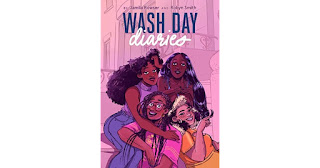


This brings us to Jamila Rowser and Robyn Smith's Wash Day Diaries. Rowser related Toni Morrison's quote ("If there's a book that you want to read, but it hasn't been written yet, then you must write it.") in describing her goals as an author: creating (and publishing) books for Black women. In Smith, she has a collaborator who's more than up to the challenge of depicting these stories--especially with regard to hair. Wash Day started as a mini-comic and was expanded into a full-color book precisely because an audience "magically" appeared that was hungry for stories about Black joy and friendship among women. The original mini was about a moment in time about self-care that was highly specific; the expanded book tells interlocking stories that touch on a number of topics. 

The book opens with the "Wash Day" story, featuring a steely young woman named Kimana (nicknamed Kim) coming home from a night out, and then waking up and washing her expansive hair. That initial image of a seemingly unflappable Kim with her keys splayed in her fingers in case she had to defend herself speaks volumes about not just her, but a specific understanding of what it's like to be a woman walking on the street. Much of this story is about Kim dealing with the daily forces that assail her: casual misogyny in catcallers, a man who won't stop texting her, and her local bodega being affected by a rent increase and passing it on to her. For a moment, for a day, time stands still as she buys some milk and breakfast and takes care of her hair in a very specific manner. Smith shines here in the way she draws hair along with the way she draws different kinds of bodies. She's also aces at body language. 
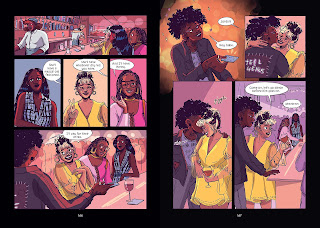


Each chapter follows the story of a different friend. Tanisha relates the hilarious story of being in an inadvertent love triangle and how she gets out of it; it's once again connected to hair as she tells it in a group chat with Kim and her other two ride-or-die friends as she's getting her hair done. An increasingly self-isolating Davene calls Cookie to cornrow her hair because she missed her hair appointment and reveals that she's gripped by depression--something that Cookie doesn't fully understand. Cookie visits her father's mother in a nursing home, a woman who refused to recognize her as her granddaughter because of her father's affair. The final story ties all of these threads together as the friends gather at one of Kim's concerts and chase off the guy who had been harassing her. The whole thing winds up in a sleepover at Kim's house. 

The overlying plot is pretty thin; one gets the sense that it was reverse-engineered to give some small sense of structure to each story, and that was especially true in the final segment. None of that really matters, because it was the small moments in each story that were important. Davene's interactions with Cookie were particularly interesting. Davene revealed to her friend that her career as a social worker wasn't working out, and there was an implicit reference that going into work wearing her natural hair was going to be problematic. While this is a book about Black joy and friendship for this group of women, it doesn't pretend that racism and misogyny don't exist. The threat of violence from Kim's ex-boyfriend, the aforementioned catcalls, and hateful stares from white people on the subway are all part of the backdrop. It's par for the course, with the weight of it affecting each woman in different ways. Davene clearly feels it the hardest as it contributes to her already-present direction, and Cookie's initial attempt to minimize it and rejecting Davene's thoughts of getting on anti-depressants with a crystal reflected a lack of understanding and actual empathy in that moment. Cookie redeemed herself by actually noticing what Davene needed at Kim's concert and pulled her out of there for the sleep-over. 

Again, Rowser set it up, but Smith knocked it down with her unerring depiction of body language that was easy to interpret without being intrusive or ham-fisted. Each story is involved with hair in some way, with each character helping or being helped with hair, an act of profound compassion and intimate connection. It's both emblematic and symbolic of their connections in a tangible way, mixing aesthetics and ethics together at a fundamental level. That's especially true because Rowser goes out of her way to make each character radically different in terms of personality, weaknesses, desires, and ambitions while still sharing crucial connections as friends. Each story is tonally different, from comic relief (mixed with an unvarnished depiction of sexual freedom) to familial drama & pain to the sheer loneliness of mental illness. It's a book that needed to be created, one that will hopefully open up avenues for others like it. 

Friday, December 7, 2018

Thirty One Days Of CCS #7: J.P. Coovert, Robyn Smith


Simple Routines, Volume #7, by J.P. Coovert. For his daily, 4-panel autobio comics, Coovert channels his sense of joy and positivity into each one. Even for sad strips like where his beloved dog London dies, Coovert just lets it all out there on the page. The strength of this comic is the strength of Coovert's cartooning: it's clear, fluid and strong. Even as Coovert uses a simplified style of character design, the actual drawings themselves are not only bold and confident, they are filled with life. His drawings of his dogs in particular are not only cute as images, they come to life on the page with a few strokes of his pen, thanks in part to his understanding of how objects interact in space. Coovert works mostly as an illustrator, but it's clear that he is really a cartoonist. These comics clearly serve to keep his head in the game while riffing on the things and the people he loves.

His comics with and about his wife Jacie are particular treats, as are those comics where he gets together with one of his friends. There's an undercurrent of sadness in his strips sometimes, as the various moves around the country have cut off some of his friendships. There's also the sadness of being away from childhood and college friends, and the intensity of those reunions in his comics is tinged by the sense that it's something that won't last. That said, one can frequently see Coovert circle around and remember the good things about his life and concentrate on them, and it seems clear that these comics aid in that as well. Simple Routines in many respects is an exercise in finding the positive by writing about the positive, and the results are uplifting for the reader as well.


Wash Day, by Jamila Rowser & Robyn Smith. There are any number of striking and beautiful images in this comic drawn by CCS alum Smith, but the most striking is the second panel on the first page. The main character of the story, Kimana, is coming home off the subway and walking to her apartment. That second panel shows her with her keys splayed out of her fingers like miniature knives, as her best form of defense in case she's harassed or worse. This is a comic both about the essential dignity of black women and the ways in which men seek to tear it down. In both instances, there is great restraint and subtlety in exploring both ideas. Kimana is endlessly calm and patient in the face of catcalls and insults on the street as well as dealing with a trifling man sending her endless texts, apologizing for something he did.

As she explains at the end, this was not a day to deal with annoying lovers or give the time of day to a catcaller: it was wash day. Smith shined throughout the comic in terms of giving us a full understanding of Kimana's personality strictly through he body language and the way she relates to other people. Obviously, the images of Kimana slowly and methodically washing her hair, adding conditioner, brushing it out and putting it in clips is compelling and fascinating to watch. There's a specificity regarding what is clearly an important ritual that is striking in the sequence, one rarely seen or discussed in pop culture that is still overwhelmingly white. While those images are striking, Smith's drawing Kimana going about her morning as she walks to the local bodega, interacting with the manager as a regular and then passing the time with her flatmate Cookie are equally important in their own way. This is the story of a black woman giving herself permission to negotiate that particular day on her own terms, no matter what.

Tuesday, December 13, 2016

Thirty-One Days of CCS #13: Robyn Smith

Robyn Smith's The saddest angriest black girl in town is a fascinating expression of self and a nuanced understanding of context with regard to race. It deals with a number of related issues: the concept of being othered, how anxiety and mental illness are further exacerbated by these issues, and the paradoxical idea of having her identity both erased and highlighted at the same time. Living in mostly-white Vermont amplified what Smith would feel anywhere as a person of color in the US, especially as a non-native (she's from Jamaica). Smith's expression of her feelings is raw and powerful, just as her skill with a pencil is delicate and expressive. The comic is also exceptionally well-written; it is a howl against forces both external and internal, but it's her tremendous sense of restraint on each page that leads to so much tension.

The comic is divided into three sections: "sad", "angry" and "black". The first section is about her acute awareness of how being black in a white space is uniquely discomforting for many of the white people she encounters. At the same time, that constant level of what ranges from open hostility to negation caused her to doubt her own personal narrative. Consensus societal opinion and behavior is powerful, even when it's turned against you. There's a brutal sequence where a co-worker sees a supply sign that says "Black matting" and adds the word "lives" after "black" in front of Smith, and then he cheerily addresses it by saying "Sorry! I just couldn't help myself.!" Her drawings in this section practically leap off the page with regard to the emotion she puts on the page--especially when she's smiling and being friendly to a white customer who literally walks away without a word. Once again, it's a total negation of her as a person.

"angry" is all about the resentment she feels because she's never had a choice but to be constantly made aware that she's black. She even cops to the idea that even if she's making it all up, "it's the potential that's killing me. It's me not knowing how uncomfortable my blackness is making you." Smith then rattles off a series of incidents that seemed innocent at first but that started to build as even well-meaning people were still in the practice of othering her on a regular basis. There's a remarkable sequence where she talks about hearing the n-word in several different contexts in White River Junction, feeling angry and incapable of expressing that anger. Each instance is different: academic, quoting music, in a meta way, and in a joking way. Each time, it doesn't matter, because the white people who said the word didn't know or care what effect saying that word might have. Words are weapons, and racial slurs historically have been stand-ins for a threat of violence so as to put a person of color in their place.

"black" is a statement about her role in the lives of white people, simply asking to exist as a person, not a symbol or metaphor. Smith emphasizes that while she may make other people uncomfortable by the mere fact of her existence, it's not her job to make people feel comfortable. The comic has an existential quality to it in that Smith addresses the concern not just that white people are othering her, but that at a fundamental level she may never be able to know if white people aren't othering her. That essential doubt is what leads her to want the space not just to exist freely in a space, but to demand that her feelings should be respected with regard to her experiences. Smith is remarkably adept at aligning words and images in unusual ways. She uses the grid for mini-narratives, uses open-page layouts and dissolves panel borders on other pages as a reflection of an anxiety attack. The cover uses translucent vellum, cleverly finding ways to express that feeling of erasure. On the back cover, for example, there's a nicely-drawn image of a street in White River Junction. If you turn the page, you can see Smith's own image on the page underneath it, barely visible. This comic is succinct, visually striking and powerful on a number of different levels. It's an excellent early work for a promising artist.