Here's another look at work from Center For Cartoon Studies (CCS) students new and old. Included are works by Sam Gaskin, Kubby, Jeff Lok, G.P. Bonesteel, Morgan Pielli, and Joshua Rosen.

OPHESTIOS, 1890 by
Joshua Rosen. Rosen is currently entering his second year at CCS, and this pleasing little mini faked me out at first. Given the sort of alternate-world explication of the city of Orphestios as capital of the "Northern Empire", I expected some sort of political world-building story. The story started off as what seemed to be a comedy of manners, and then we got another fake-out: this was a rehearsal of a play that was going badly. It's not until we're introduced to the character of Iosif, an itinerant playwright, that the story really begins. It took me a while to warm up to Rosen's scribbly character design and extensive use of grey and black for backgrounds. I think the dreariness it created was intentional, given that this was supposed to be a Russia-like country in the winter. The consistency of Rosen's visual language eventually won me over, especially with the expressiveness of his characters.
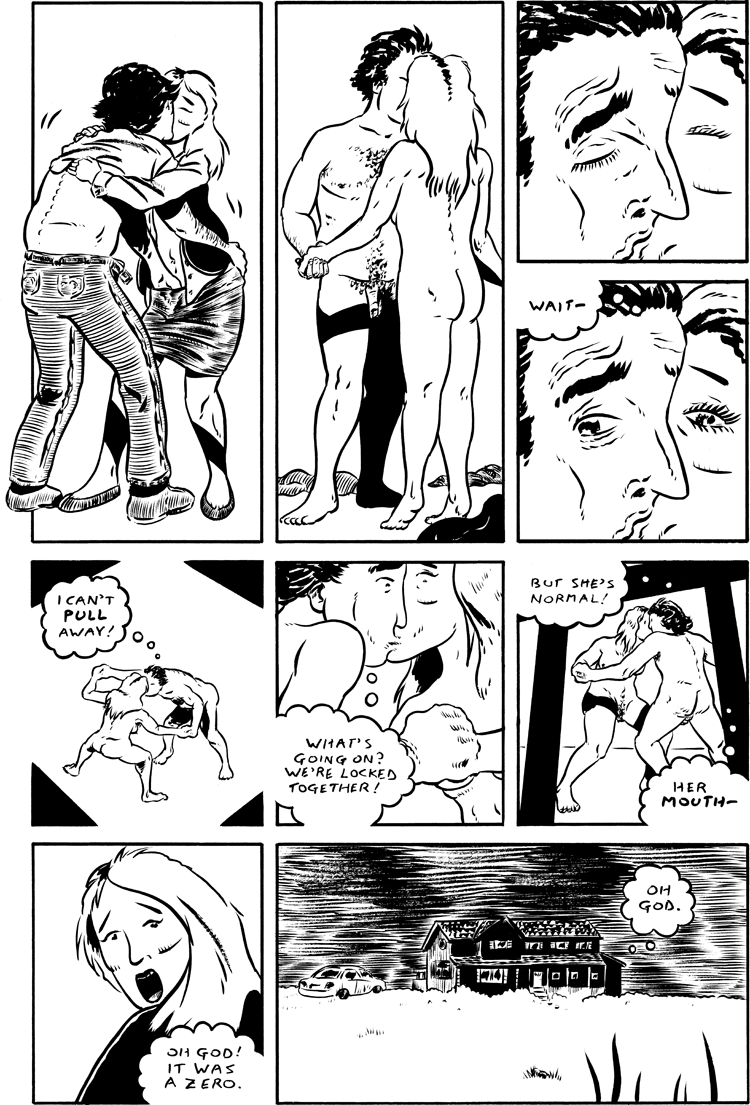
This is a story about the intersection between art and love, and the quest to link the two. Iosif is a celebrity of sorts back in Orphestios, but he hates the attention, hates talking about his work and especially hates people talking to him about what they think art really is. He's fascinated by a singer at a club and starts to obsess over her, only to learn that they were childhood friends--and feelings still ran deep. What I liked most about this story is that ultimately Iosif is not a sympathetic character, even if he is the protagonist. Given the opportunity to grab onto something truly meaningful in his life, he instead gives into temptation and tries to slough off his regret by saying "Fuck it". That interesting turn came during a clever, silent two-page sequence where Iosif and an actress hook up. We see close-ups of the couple with grey backgrounds, alternating with white-on-black squiggles depicting sex and then dissolving into unconsciousness. This is a solid if modest early effort, and I'll be curious to see if Rosen continues to build more stories in this environment.

KILLER INK COMICS #1, ICE CREAM and THE SURVIVING LIFE OF HANZE ENEFFER, by
G.P. Bonesteel. Bonesteel is a humorist somewhat in the vein of a Johnny Ryan, with a particularly deadpan and dry sense of humor combined with a tendency to go over the top (and beyond). ICE CREAM is a tiny minicomic wherein Bonesteel uses a minimalist line to depict what happens when an ice cream truck doesn't stop for a group of kids: rocks, guns and flaming arrows are deployed. This is essentially a bit of extended slapstick, with all sorts of clever background eye-pops. HANZE ENEFFER is another minimal-line comic featuring an anthropomorphic rabbit's pathetic dating life. This one feels more than a little familiar, with the lonely loser finally scoring but eventually feeling even worse about his life. It's nowhere near as provocative as his other work.
The real draw here is KILLER INK COMICS #1, especially the first story. This is the tale of "Abortion Andy", a for-hire aborted baby who lectures teenagers about the perils of teen sex. In this story, he interrupts a young couple with his bizarre lecture, complete with two pages of working in track listings from Grease into his warnings. It's an audacious idea, hilariously executed with as straight a face as possible. The backup story features a man on the run from Cupid on Valentine's Day and the collateral damage their conflict causes (including a man falling in lust with a newspaper vending machine). This story is a bit more predictable (and I've seen a similar idea in the pages of PROJECT: ROMANTIC) but still funny. Bonesteel's line is a bit crude at this point but still effective in getting across his gags. I'll be curious to see just where he takes the Abortion Andy series in future episodes.

INDESTRUCTIBLE UNIVERSE QUARTERLY #1 & #2, by
Morgan Pielli. These are grab bag collections of CCS grad Pielli's stories for assorted anthologies and other odds & ends. These are really nicely assembled, with beautiful silkscreened covers, striking design and nice paper. The art in the first issue is all angles and interesting formal tricks. Pielli often dips into sci-fi type stories, like "For Want Of An Oomplip", wherein a punctuation error on an alien sign nearly sets off a war. A longer story in the first issue features a chase between two characters across, through and between the gutters of panels.
The second issue also features a story with some unusual panel configurations. "The Watchmaker's Dance" reimagines earth's creation story as carried out by three alien robots. The use of tiny panels and sketchy line makes this story work well; in fact, it's the most attractive and successful of all the stories featured in these two issues. Pielli abandoned that more angular style of character design for the rest of the issue in favor of a softer, fuzzier line that was a bit less interesting. His stories continued to have a certain tortured quality to them, like "The Terror In Choices", featuring a man who loses everything after he loses his ability to choose. "The Trial of Narcissus" features an irresistible hook: everyone realizes that god is coming in three days, but the revelation of its true form drives everyone insane. At the moment, it seems like Pielli is experimenting with different drawing approaches, looking for the most comfortable style. I thought the more angular approach was more interesting, but it's clear that Pielli really thinks through his pages carefully. I especially like the way he straddles genres without owing allegiance to any one in particular.

SAM 'N DAN, by
Jeff Lok. A quick look at Lok's work reveals that while he doesn't have the drawing facility of some of his fellow CCS grads, he overcomes that with the use of various techniques and a total commitment to the dark absurdity of his concepts. This is the story of a bank-robbing dog and cat duo named Sam and Dan. The cat speaks with a faux-elegant dialect, as though he were an early 20th century con man. The dog, a truly disturbing characters, says little but does much. After they rob a bank, the dog shoots the sun with his gun, bringing on darkness and an encounter with a wood witch, ancient prophesies, fireflies that shoot lasers out of their eyes and a commandment to duel each other to the death. To set the mood, Lok makes extensive use of hatching and cross-hatching. That creates an oppressive atmosphere with his otherwise funnily-drawn anthropomorphic characters. Sam the dog in particular has a Droopy-like expression no matter his mood or situation, which cracks me up in spite of his psychopathic personality. Dan the cat is an oily smooth talker who talks loud but says nothing, and it's fun to watch him sweat, slant his mouth and otherwise squirm while otherwise looking quite cheerful. The wood witch, an amorphous-looking creature, later tries to disguise itself as a farmer in the least-convincing costume of all time.
Lok brings all sorts of weird, comedic touches to a piece that has apocalyptic overtones, making its overall tone hard to pin down but compelling. His matter-of-fact absurdism reminds a little of what Chuck Forsman is doing, but Lok brings a different sensibility to his work. It's more clearly calculated and less improvisatory than Forsman's comics (especially in SNAKE OIL). Both artists are world-builders where the reader is deliberately kept in the dark, but there is certainly a logic of sorts behind the weirdness. Forsman's work is more about the telling of tales through the mundane execution of a journey, while with Lok it's about a series of bigger moments. I look forward to fat collections of comics by both artists in the future.

THE MUD BOG, POCKET PORN #1, r, THE UGLY PLACE and BEAUTY PATROL, by
Kubby. Kubby's comics are beautiful, intensely personal little art objects. All stops are pulled out as we see full color, silkscreened covers, interesting paper, etc. THE UGLY PLACE is a 24-hour comic that's one of the best-looking of it's kind that I've seen. It's a silent story about a farmer who puts in a hard day's work threshing a field, only to be overcome by a memory of a lost love. The stoic farmer tucks the memory away when he gets home, only to wistfully see the image of his lover in the door. This looks like it was done only in pencil with no inks, but Kubby goes to town on creating gradations of texture, especially in the close-up shots of the farmer's face. The viscerality and sweat of the farmer's toil on page after page is a nice contrast to the real pain he feels.
r is a very personal little mini that details the death of someone very close to the artist, printed on purple paper with what looks like colored pencil. There are some striking images, like the cartoonist-as-bear hunched over a sheet of paper with slitted eyes. THE MUD BOG is an experiment in color, detailing a funny memory of hiding out and watching guys driving their pick-up trucks into a mud pit, gunning the gas and getting it covered with mud. Why they do this and why people secretly watched it is besides the point; it was clearly something that both groups loved for different reasons. POCKET PORN was something Kubby drew collaborating with another writer and drawn with a brush, giving it a scratchy quality not seen in the artist's other work. It's a story of fetishes gone slightly awry, as a dominant woman and a more submissive woman who likes feet meet behind a dumpster. As the dominant woman is using her foot to pleasure the sub, the sub makes the mistake of suggesting that she be "rocked like a baby". That angers the dominant, who then uses her feet to slap her legs and ass raw. It's a visceral, ugly series of moments that clearly bring mixed feelings to the sub. The brush works both for and against the artist here: the scratchy quality of the line and the way it blurs reinforces the nature of the experience, but there are points at which there's a lack of overall clarity. It's still one of the more interesting examples of comics erotica I've read.

The artist's most-distributed comic is BEAUTY PATROL, a delightful series of fake-outs, science lectures, psychedelia, long-distance longings and time dilations. The book starts with a comic called "Beauty Patrol", about a bear making his way around the world. It's promptly crumpled mid-page by the artist of the strip, Cody Roder. The rest of the comic finds Cody going about her day off, meeting a strange person with whom she shares a connection they don't understand. It's there that Cody starts to wonder if deja vu is simply our understanding that time isn't a straight line. Meanwhile, we also follow the day of Cody's long-distance love Roxie Dagger, who who is on a more deliberate quest (to see her favorite band) but winds up in circumstances as unexpected as Cody. There's a spontaneity to Kubby's line here that I enjoy that carries it through some of its rougher pages; indeed, the more scribbly the line, the more the images burst off the page.

PIZZA WIZARD #2, CALL ALL MY DAWGS #3, and SUGARCUBE by
Sam Gaskin. Gaskin's PIZZA WIZARD and other humor comics are sort of like Mat Brinkman on Pop Rocks. They carry fantasy elements, ludicrous quests and earthy & dense foregrounds and backgrounds. Gaskin's imagery is a bit simpler and easier to process than Brinkman's, and much sillier. There's definitely a story going on in these one-page episodes, revolving around the title character's quest for a magic pizza, but they're really an excuse for propulsive world-exploration in the Fort Thunder tradition. Gaskin is also working in the tradition of classic Sunday comic strips, supporting the main strip with shorter strips at the bottom of the page (usually tangential to the main story), wacky puzzles, and even hand-made advertisements (the weirdest of which was a straightforward ad for a fast food restaurant that winds up playing a significant role later in the story.

That's an apt metaphor, because Gaskin's work has a delightful junk food quality to it. In CALL ALL MY DAWGS #3, Gaskin gives us his ode to the schlock comedian Sinbad. Of course, it's filtered through Gaskin's demented imagination, so we see Sinbad bemused by the Cheshire Cat, posing in various outfits, having his TV son defecate on a toybox to spite him and dream about Kenan 'n Kel and barbecue sauce, wondering if he's become a "ghost dad". It's simultaneous a perfect tribute and deconstruction of a familiar but awful pop culture figure. It's comics like these that make Gaskin a singular figure as a humorist, even when he wears his visual inspirations on his metaphorical sleeve.

SUGARCUBE stands as a very surprising and personal work for Gaskin, and a wholly unexpected one. The story's protagonist, Andy, learns at age 20 that he has type-1 diabetes; and his whole life changes. This comic is less about the disease than the way it made Andy feel like his youth was over. By the end of the story, his earnest recklessness felt out of place, but he was no happier being forced to grow up so quickly. Gaskin eschews the more textured approach of his other work and instead uses a minimalist approach: clear lines, sparse backgrounds and iconic character work. Gaskin is trying to get across a lot of pain here, and I'm guessing he went this route so as not to overdo it. He also intersperses some of the heavier moments of depression with quotidian anecdotes about the mechanics of testing for blood sugar and injecting insulin as well as funny anecdotes about how and why he started smoking marijuana. That actually winds up as a significant plot point when he and his best friend are caught smoking by a policeman, the single event that effectively ended Andy's whimsical childhood. This is a comic without a neat and tidy ending; Andy feels trapped and the comic ends with an absurd fantasy sequence about becoming a subsidy farmer, living a quiet life. This isn't so much an ending as an escape, a denial; Andy has a long way to go to becoming a fully-realized person.




 Posts
Posts


