Showing posts with label alex washburn. Show all posts

Friday, January 10, 2025

45 Days Of CCS, #41: Fantology 4

The fourth volume of Fantology is probably the weakest volume overall, but there's still plenty of interesting material in there. A lot of it felt strangely rushed; there were numerous spelling errors and the margins were so tight that I couldn't read some of the stuff toward the middle. Some of the pieces were so sloppy that I was surprised they were published, and the sequencing of the stories also felt somewhat off-kilter. That said, the best stories were excellent, and the overall concept remains sound. 


This is an anthology of fantasy stories set in the same world, based around a central map. Some of the stories are continuing serials, and others are one-shots. This volume's theme is "maps," which is a great theme for a fantasy anthology. There are a number of non-CCS folks in here as well, but I'll start with CCS artists first. Whiteley Foster kicks off the book with a 7-page story that simultaneously feels like it's too long and totally insubstantial. It's about two characters arguing about taking a job as surveyors. Her character design is so Disney-cute and exaggerated that it was hard to see them as characters. Alex Washburn's latest Clan Zargs chapter is something I covered earlier in this feature, but suffice it to say that he makes great use of the map to further his narrative, and the focus on surprising character twists added a lot of spice. 


Carl Antonowicz's unsurprisingly downbeat story follows a religious pilgrim and two servants going on a quest in a deadly desert. The attention he lavishes on world-building is actually a clever misdirection, as the quest itself ends in failure. It's the relationship between the characters that's most interesting. I wasn't crazy about his use of a digital font considering how sketchy his linework was. 


Catalina Rufin has another winning entry in her Barbarian Family series. With the burly barbarian dad Brono and his teen daughter Satu going on a map-led quest, Rufin explores family dynamics in a way that transcends the usual limits of the genre. With Brono harshly critical of Satu's ideas, Satu is vulnerable to a deep gnome's sweet words and promise of magic. Rufin asks some tough questions here, and her character design is sharp and expressive. 


Rainer Kannenstine sketchy and cartoony story about a lonely explorer in over his head in a dungeon takes advantage of old-school Dungeons & Dragons map construction to build the narrative. The looseness of the art gives it a lot of energy and helps play up its whimsical, funny aspects. It even has a genuinely emotional end.


It was such a pleasure to see co-editor Kristen Shull return to her serial. It's about a down-on-her-luck mage and her unlikely partnership with a princess whose quest is to assassinate a god to save her people. Even switching over to drawing digitally and working with a surprising lack of detail, Shull shines doing fantasy work in a way she doesn't in other genres. Her pacing, her understanding of how to depict action, her sense of humor, and her flair for the dramatic make each chapter a rousing success. 


As for the rest, there are a few highlights. F.Ostby's story about young rabbits exploring a forest at night for a treasure rachets up the tension but has a delightful payoff, with a pleasant mix of cartoony characters and a naturalistic setting. Niloufar Lari & Soroush Elyasi have perhaps the best-looking strip in the book, and it's about a quest of transformation and the intimacy of dance; only the digital font detracts from its elegance. Emily Claire's short story about a soldier finding his way back to his lover after three years is quietly devastating. PMK's bar crawl story is hilarious and exceptionally well-cartooned, and it embraces the map concept fully. Finally, Stephen Pellnat's story is a masterful piece of narrative misdirection. The cartooning is excellent, and the swerve is set up early on in a way that is easy to ignore. I missed a few serials from previous issues, which likely led to some replacements, but hopefully, they will be followed up on in the next volume. 


Friday, December 20, 2024

45 Days Of CCS, #20: Alex Washburn

Published in the pages of the Fantology anthology, Alex Washburn's serial Clan Zargs works well a solid fantasy story, a romantic serial, and a humorous narrative. There's a frantic energy to it where the plot can take sudden, massive, and unpredictable shifts while never veering from the glue that holds it together: the character relationships. Clan Zargs IV follows the ragtag team of adventurers as they've gotten in way over their heads, captured by the Missionaries of Jahk. One of Clan Zargs, Sasha, has agreed to join the missionaries, but it's part of a plan to break out their fellow clan members. 


Here's what makes this story interesting: Washburn abandons the action of the plot and takes a detour into interpersonal drama for seven pages. As it turns out, Sasha wanted to try something new and genuinely wanted to join the missionaries, though she wanted to free her friends as well. This was such an interesting left turn for the story, as Washburn defied typical fantasy conventions in breaking up a team in this way. The story then takes another sudden turn as the threat of violence arises, only to be quelled by another new character. There's a lot of talking and backstory in this episode, but it never supercedes the emotional narrative that runs through it. Washburn's line is thick and chunky, but you can see the confidence in his drawing increasing episode by episode. That thickness allows for rubbery, exaggerated action, like in Washburn's two-page short, Azzy's Pork Buns. That quality is ideally suited for comedic storytelling, which is true of this story about a side character hunting a pig for a recipe, but it's also true of the main series as well. 

Monday, January 8, 2024

45 Days Of CCS, #39: What The Gnomes Know

What The Gnomes Know is an anthology centered around artists from CCS and the Columbus scene. There's a good mixture of both, and there are a number of artist-writer combos that are somewhat unusual for an alt-comics anthology, but it works to good effect here. What's interesting is that a couple of the collaborations are between partners. It was organized and selected by CCS grads Rainer Kannenstine and Ben Wright-Heuman, both of whom have a lot of different projects they've been involved in, both solo and in terms of collaborative efforts. It was edited and designed by Columbus mainstay Kelci Crawford. 


Writer Ian M. Klesch collaborated with Wright-Heuman on a post-apocalyptic story following an elder gnome navigating a ruined city, looking for parts. This is an elegantly-constructed story using a recording of the gnome's dead son to push the narrative, as we learn just what caused the apocalypse in the first place. Wright-Heuman's art is moody and stylish, but it pushes the frantic action of the second half of the story clearly. It's a great use of world-building to set up a character-driven narrative with a satisfying resolution that still leaves the reader wanting more. 

Catalina Rufin's "Gnome Pizza" was cleverly assigned right after that story, and it's the contrast that make both stories stand out. Using a delicate line and extensive use of watercolors, Rufin establishes an interesting narrative when a woman moves into an apartment that was originally gnome territory, and then turns the plot on its head by turning what could have been a conflict into an appeal for connection from a desperately lonely person. 


Writer C.M. Clemence and artist Kelly Swann offer up what seems to be a typical D&D-inspired quest by two gnomes seeking out their friend. They acquire allies along the way until the rescue, but the swerve at the end that reveals what's really happening is clever. Swann's art shot straight from her scratchy pencils is the highlight here. Eddie J. O'Neill and Kaz G.M. Lukacs collaborated on a story of a group of gnomes adopting a misfit kobold that's cute, but whose use of color feels garish throughout. Angela Boyle took a lot of risks with "Gnoir With A Silent G," a parody of detective tropes featuring a gnome. The big risk was making this illustrated text with a stylized font. There were just enough illustrations (and enough sequential art) to make this work, especially since the art belied the hard-boiled cliches of the lead character. Boyle's drawings are also lovely, with an effective combination of grit and delicate color. 


Alex Washburn's story about humans who can transform into gnomes was a mix of what felt like a personal story of frustration around identity and a ripping fantasy story involving the danger of possibly being turned into stone. Washburn's use of color was way over the top and would have looked better muted, but his expressive characters drawn in a thick line match up with their emotional natures. The collaboration between Erienne McCray and Kannenstine leans into the density of its colors in a deeply expressionistic manner, especially since so much of the story revolves around dark magic. However, it's still essentially a story about a mother and daughter's connection, and that's what ultimately gives the story its real impact in the end. 

The non-CCS stories included a clever entry from Jess Tweed about two friends dealing with dark magic in order to save someone else, and the clever way a seemingly iron-clad contract was dealt with. There's also a text piece written by Jack Wallace with moody illustrations by J.M. Hunter that's nearly unreadable because of its use of stylized text. The illustrations became almost incidental. Overall, it's a fairly strong anthology that could have toned down some of its use of color and has a wide variety of genre types despite revolving around a highly particular genre theme 


Monday, December 26, 2022

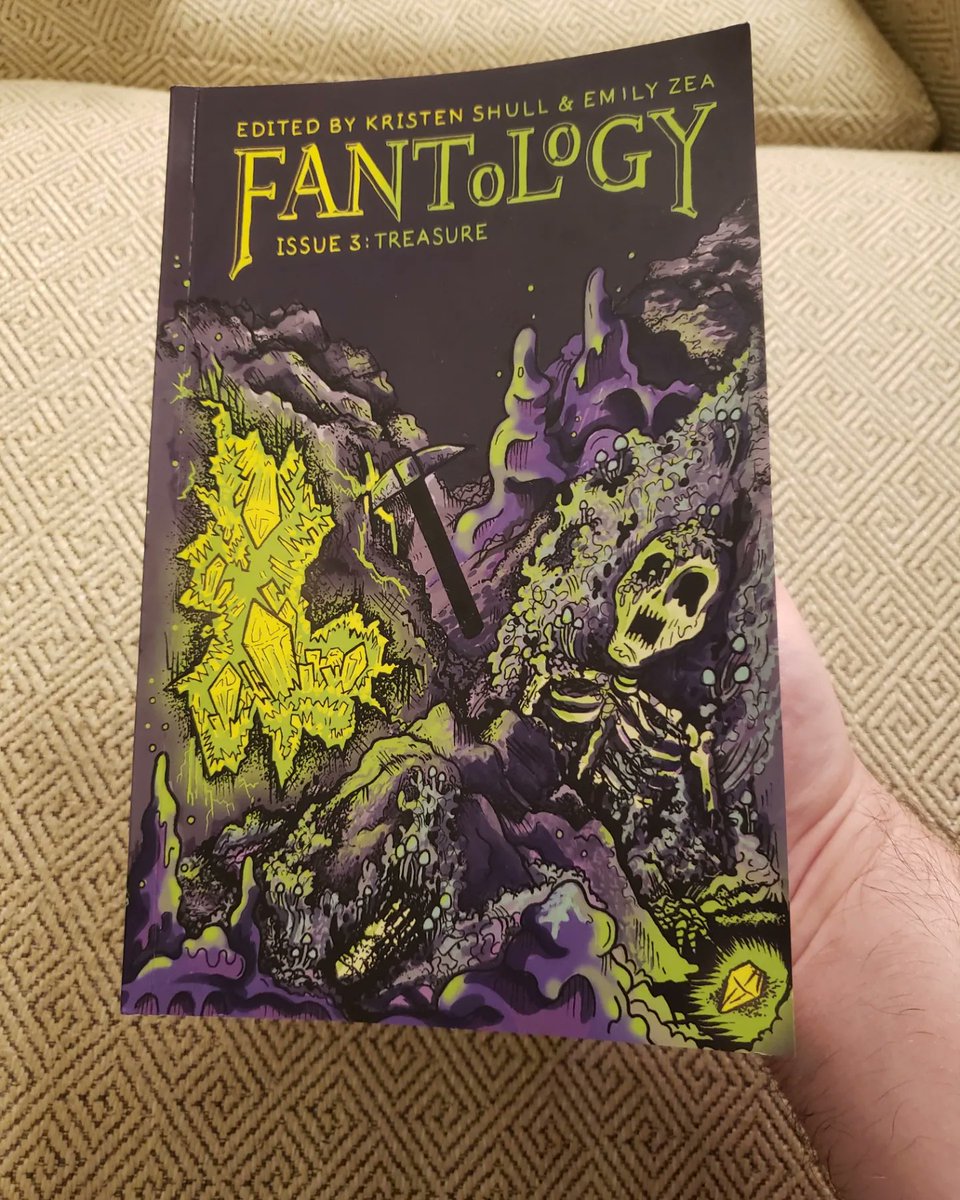
31 Days Of CCS, #26: Fantology Volume 3

Kristen Shull and Emily Zea have produced another winning edition of Fantology, with probably the strongest issue from top to bottom. Its central conceit is that the artists have to work within an established world delineated by a map, which of course is similar to but not as rigidly prescribed as the fantasy minicomic series Cartozia Tales. The theme for this issue is "treasure," and that's a solid basis for stories because it instantly gives protagonists something to want.  


Kat Ghastly's "Lore" kicks things off, and their inventive layouts and page composition make this piece truly stand out. It's as much horror as it is fantasy, as it details a deadly prophecy concerning the new sorceress of the kingdom. Ghastly uses open page layouts, zooms in and out on key characters, uses tiny details to provide narrative and decorative flourishes, and provides rich and provocative characterization. This feels like a long book in the offing. Tay James' work is text-heavy, but the weird lettering choices and bonkers page design help with the light-hearted humor of the piece. Sage Clemmons' entry alternating illustrations with hand-written letters detailing a couple separated by life circumstances is deeply emotional, and ideal for an anthology. Natalie Norris' wordless tale of two mermaid lovers discovering a trove of human treasure is the emotional and narrative opposite: two lovers with no regard to the outside world, inseparable. The treasure amounts to simple baubles for them, instead of life-or-death plunder, and if there's one thing Norris is aces at drawing, it's slender, elegant, beautiful women. 


Emily Claire's piece about disaffected undead employees in a dungeon is funny and has a sharp punchline, although the dependence on grayscale shading made the visuals bland. A pet is a major aid in that story and in Chelsi Fiore's entry about an elf and his small steed being trapped in an underground city. These are breezy transition pieces that lead to the third chapter of Shull's ongoing fantasy story about two accidental traveling companions who both carry secrets. Shull's boisterous and bawdy style of fantasy is propulsively fun, as she pairs a serious (but horny) character with a light-hearted (but also horny) character who loves carousing, singing, dancing, and playing games of chance. Shull has a way of adding a slice-of-life touch to fantasy proceedings that centers the story around her protagonists, and both of them are memorable--both in terms of how they're drawn and their personalities. Hopefully, this makes it into a book one day. 


Michael Beachy's treasure-hunter story is a little visually overwrought, but he reins it in just enough to tell a clear and funny story. Mona's story about a bored wizard staging a tournament because he loves violence is heavy on pen-and-ink pyrotechnics, but her command over her line and clever storytelling techniques makes this fun, right on down to its cut-off ending. I get that it's part of a larger story, but not having any real closure in the story was distracting. The scratchiness of that story is followed by Stephen Pellnat's painstaking detail in service of some dynamic storytelling about a cat adventurer getting more than he bargained for on his adventure, and learning a valuable lesson along the way. There's another stylistic shift, to a sketchy, hatching-heavy story by Jackson Maceo Schleicher about a lack of honor among thieves as they look for a wishing egg. 


Rainer Kannenstine's piece is yet another visual shift, as it looks like scratchout white-on-black, with a simple, blocky line to tell this story of a grappler named Urta whose use of brute force eliminates the need for skill or magic in taking a dragon's treasure. She also has no problem declaring herself the sole recipient of the treasure and turns the dragon into her pet. My vote for most improved feature is Alex Washburn's newest entry about Clan Zargs. These ragtag adventurers get into genuine trouble, and Washburn tightens up everything here: his line, the storytelling, and even the characterizations. On the other hand, co-editor Zea's piece about a pirate challenging her family's lineage with the help of her hostage/protege/niece feels overblown and self-indulgent. She seems so delighted in her Captain Trub character that everyone else in the story is a means to the end of extolling her awesomeness. The story is still well-drawn, although the use of digital lettering takes me out of the actual story. 

While that story was a misfire, Fantology 3 not only holds up well on a story-to-story basis, the sequencing is also fluid and creates contrasts that make each story stronger. For an anthology with an open submissions policy, they did a remarkable job of putting together such a strong group of creators. It helps that there are regulars to anchor it, but this was the best all-around group to be featured in an issue so far. The conceit of Bartlebee the Bard introducing each chapter is fun, but it seems wholly unnecessary for one-shots. Given that some strips are in their third chapter, a summary of prior chapters would have been useful for readers. This volume will definitely delight readers looking for something a bit off-beat in their fantasy comics.