Showing posts with label natalie norris. Show all posts

Friday, December 27, 2024

45 Days Of CCS, #27: Natalie Norris, Keena

From the very first, the comics I read from Natalie Norris dealt with trauma. Regardless of the assignment, it was clear that Norris had a burning need to work through her trauma through her art. That culminated in the first half of her memoir about a horrific sexual assault titled Dear Mini. She's currently working on part two of that story (about the aftermath of the incident), but she did a mini-comic for Paper Rocket's Mini Memoir Project. It's called Scar Tissue that I Wish You Saw, and it's about what happened when she was sent to an inpatient facility for mental illness. It's laid out plainly on page one: various forms of pain, including endometriosis, along with major depressive disorder. 


At the same time, Norris tells the story from her perspective as a 16-year-old, where her major problem was that she was in love with her older sister's boyfriend Shane. Young Natalie is the picture of the unreliable narrator, as she refuses to discuss her trauma with her doctors and seethes with anger when her doctors take away her Percocet. She sneers at another teen for being an alcoholic because she "ruined partying for the rest of your life," noting that of course, she could "handle my shit." There's a lot of two-track narrative used in this comic as she visually recalls a lifetime of medical trauma while denying trauma to her therapist. Natalie in this story is certain that she and Shane (an older drug dealer) are a perfect match, and she fumes when she reveals that her mom told him to stay away from both her daughters. This is one of Norris' best comics, as her storytelling is subtler than much of her earlier work, and it makes the depiction of her trauma all the more effective. This version of Natalie in the story is wounded but bratty, not capable of loving herself or feeling worthy of love, and the subsequent acting out is captured in such a direct but not overly obvious way.


Speaking of feeling worthy of love, her comic Belles Heures ("Book of Hours") is less a narrative than it is a series of immediate sensory impressions of the early days of a loving relationship with a man named Ima. Generally, someone's diary entries of a loving relationship are as tedious as any anecdote, but Norris is going for something else. These are loose, immediate drawings that are a revelation for Norris precisely because they had never experienced anything quite like this before. It's as though she had to capture these experiences as quickly and directly as possible, not just for fear of forgetting them, but as a way of concretizing them. In this way, it's a sort of way to prove that it wasn't all just a dream. It's a form of devotional study.


Keerthana Srinivasan, aka Keena, is a CCS student who came to cartooning by a rather circuitous path. In her early 50s, she began doing art after a lifetime in IT when her children grew up and her husband took a job in another city. Prior to CCS, she did a book in collage form using basic color shapes to tell this story, and it's called Journey. Despite featuring no drawing, it's actually a well-done piece of cartooning whose meaning is easy to grasp. She's a red shape, her husband a blue shape, and their kids yellow and green shapes, respectively. When the kids go on their own journeys, there's an especially poignant page where the red shape is shown to be old and wrinkled. When her husband goes on his own journey, she finally attempts her own on a turbulent ocean. She sees her children fly away, but her husband arrives again to act as a sail to steady her own, new journey. It's a lovely and touching story. Keena also contributed a two page piece that was more illustrated text than comics about her father near death, wanting to make sure that the suitcase that had represented his livelihood was safe. Keena has a great storytelling voice, and I'm curious to see her make something more in the vein of traditional comics. 

Saturday, January 13, 2024

45 Days Of CCS, #44: Natalie Norris

Natalie Norris has been producing memoir about trauma since before she started at CCS. Even in her earliest assignments at the school, she turned standard first-year assignments like adapting a fable from Aesop or doing a comic in the style of Ed Emberley into frank, bold, and highly vulnerable narratives about her traumatic experiences. It's no surprise that her first long-form memoir, Dear Mini, should not only expand on her struggles, but it's also the one where she reveals, in an achingly intimate manner, her most formative traumatic experience. 


Norris uses a very clever narrative technique in making this an epistolary memoir for a number of reasons. The most obvious one is that it allows her to comment on events from the past from the perspective of the future, which is what differentiates it from the most obvious comparable book, Ulli Lust's This Is The Last Day Of The Rest Of Your Life. That's another memoir about a teenage girl out of her depth in Europe who is raped, but Lust chooses to convey that experience in the present tense for a different kind of impact. Norris not only adds commentary from the future in the form of huge, floating decorative lettering, but her dreamy open-page layout style gives the entire memoir a magical storybook feel until things start to go very wrong. 


Secondly, by addressing it to her Austrian friend Mini, whom she feels inadvertently betrayed her, she puts the narrative power in her own hands rather than grant it to her nameless rapist. This is an unflinching account of being sexually assaulted and its aftermath and reverberations across the years, but more importantly, it's an attempt to connect and truly reach out to someone who meant a lot to her. This narrative is Norris's own, and she's sharing it with Mini.


Norris noted in the afterword of this first volume that she had reams of diaries and photos that documented her time in Europe, but for the most part, she chose to rely on her memory. This made for a much more emotionally rich narrative, as it followed the path of memories that she allowed herself to unlock by drawing them rather than compelling her to commit to a more "true" account of those events. Of course, even a diary or journal from that time, while more immediate, isn't necessarily more accurate. Indeed, as Norris points out, she deliberately downplayed most of the key moments of trauma in those journals.


The plot summary for part one of Dear Mini goes like this: Natalie is 17 years old and suffers from chronic pain and depression, among other issues. Natalie was quite used to the attention given to her by older men, which was a form of flattery she sometimes chased but was also frequently repulsed by it. Her mother suggested that she try a language immersion summer program in France as a way of trying to push her away from getting drunk and high with local older guys. Upon arriving, she met an Austrian girl named Mini, and they became thick as thieves, constantly pushing against the rules in order to go out dancing and drinking as well as meeting guys. Norris was young enough to conflate desire with love in an environment where sex, generally speaking, was treated as far more casual than in American culture. 

This invoked the key line of the book: as she found herself treated with contempt by the boys who used her sexually, she convinced herself that "this was just what happened to girls like me." That her desire made her worthless and unworthy of expressing her own agency. That lesser forms of horrible treatment by men were somehow OK because they were "nicer" to her than out-and-out assailants. The flip side of constantly wanting to be drunk or high as a way of numbing these feelings had the double whammy of not only being ultimately ineffective, it also made her far more vulnerable. Eventually, after the program, Natalie spent time in Italy and then made a side trip to see Mini in Vienna.

That's where the bulk of the narrative really picks up and slows down, as Norris goes day by day in great detail with regard to this fateful visit. She alludes to the event, the birthday party of one of Mini's friends, multiple times (even referring to it as an execution), yet her depiction of the rape itself is far more harrowing, direct, and graphic than I could have imagined, even given how frank she was about everything else. It reads as though Norris was disgorging a malignant tumor in the most painful way possible; an excruciating experience in every way as a reader and one would imagine, as an artist, yet one where at least the malignancy was out in the open. As awful as this depiction of this all was, the events afterward (where she internalizes everything and hides it from Mini and then winds up fooling around with another guy just to not be alone with her thoughts) are terrible in their own way. All of this is made even more devastating in Norris' bright, colorful, and dreamy style. 

Norris alludes to having discussed this with Mini over the years, with Mini not understanding Norris' anger to not only being abandoned at this party but virtually being pushed into the clutches of her rapist. The nature of this disconnect is something that I imagine will be discussed in part two. While I can understand the split, it feels like doing this in a single volume would have done more justice to the narrative as a whole. There are some other problems with the book that reveal Norris as a relatively inexperienced cartoonist, but this is stuff that should have been corrected by an editor. Basic design issues like word balloon flow, word balloon blocking, large lettering being split by a figure and making it hard to read, and even a typo are all distractions. Norris' character design for figures other than herself seems a bit undercooked at times, which is not unusual for young artists having to introduce multiple characters in a longer narrative. 

Those are mostly nitpicks. What Norris does here is unlock a tremendously powerful narrative about the ways in which memory can be warped and poisoned as it is obliterated by shame, trauma, and misogyny. Her use of color, her understanding of how using decorative drawings can influence the narrative, and her strong & distinctive authorial voice all drive this memoir to an unflinching place that eventually grants herself and women who have similar stories a sense of grace and absolution that no one else has given them.


Monday, December 26, 2022

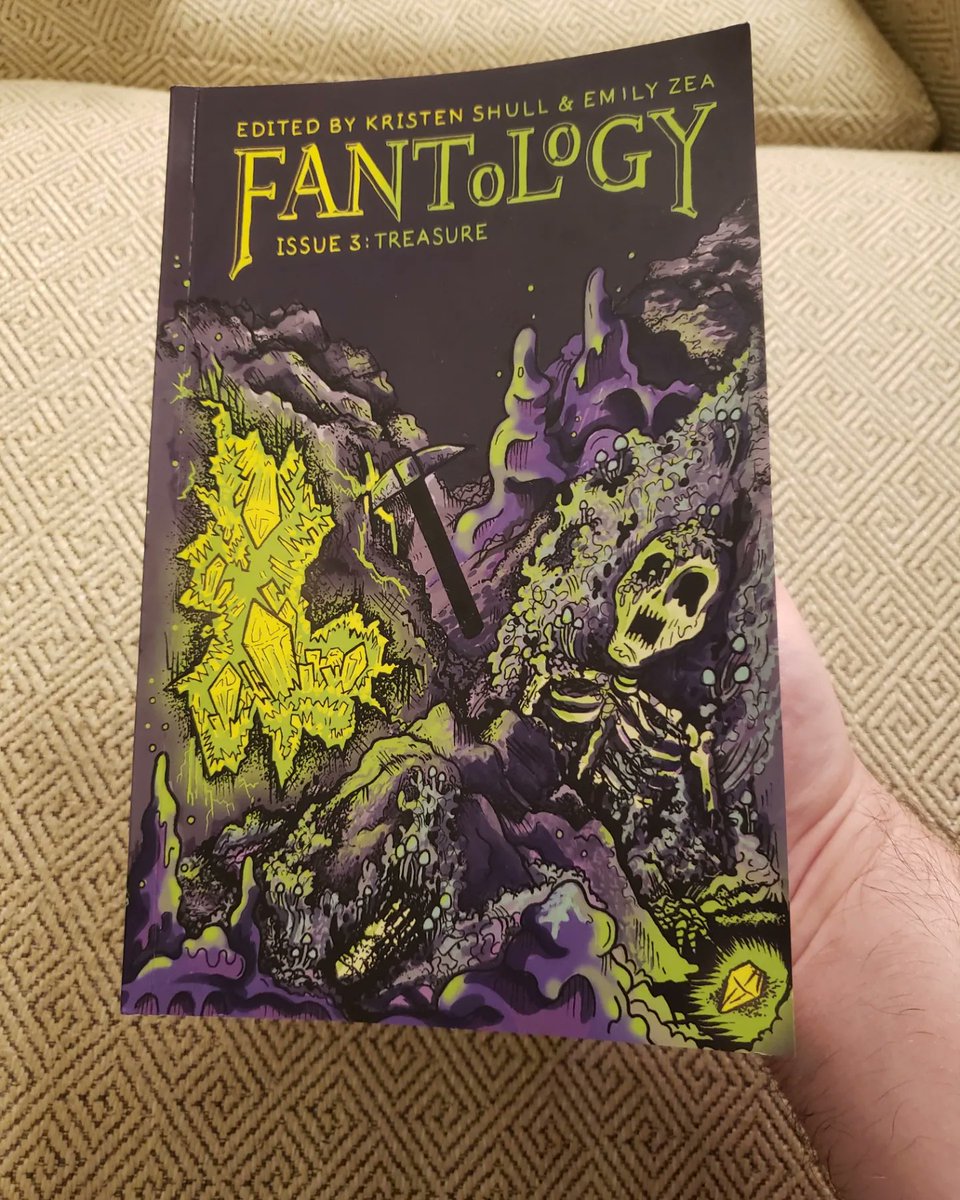
31 Days Of CCS, #26: Fantology Volume 3

Kristen Shull and Emily Zea have produced another winning edition of Fantology, with probably the strongest issue from top to bottom. Its central conceit is that the artists have to work within an established world delineated by a map, which of course is similar to but not as rigidly prescribed as the fantasy minicomic series Cartozia Tales. The theme for this issue is "treasure," and that's a solid basis for stories because it instantly gives protagonists something to want.  


Kat Ghastly's "Lore" kicks things off, and their inventive layouts and page composition make this piece truly stand out. It's as much horror as it is fantasy, as it details a deadly prophecy concerning the new sorceress of the kingdom. Ghastly uses open page layouts, zooms in and out on key characters, uses tiny details to provide narrative and decorative flourishes, and provides rich and provocative characterization. This feels like a long book in the offing. Tay James' work is text-heavy, but the weird lettering choices and bonkers page design help with the light-hearted humor of the piece. Sage Clemmons' entry alternating illustrations with hand-written letters detailing a couple separated by life circumstances is deeply emotional, and ideal for an anthology. Natalie Norris' wordless tale of two mermaid lovers discovering a trove of human treasure is the emotional and narrative opposite: two lovers with no regard to the outside world, inseparable. The treasure amounts to simple baubles for them, instead of life-or-death plunder, and if there's one thing Norris is aces at drawing, it's slender, elegant, beautiful women. 


Emily Claire's piece about disaffected undead employees in a dungeon is funny and has a sharp punchline, although the dependence on grayscale shading made the visuals bland. A pet is a major aid in that story and in Chelsi Fiore's entry about an elf and his small steed being trapped in an underground city. These are breezy transition pieces that lead to the third chapter of Shull's ongoing fantasy story about two accidental traveling companions who both carry secrets. Shull's boisterous and bawdy style of fantasy is propulsively fun, as she pairs a serious (but horny) character with a light-hearted (but also horny) character who loves carousing, singing, dancing, and playing games of chance. Shull has a way of adding a slice-of-life touch to fantasy proceedings that centers the story around her protagonists, and both of them are memorable--both in terms of how they're drawn and their personalities. Hopefully, this makes it into a book one day. 


Michael Beachy's treasure-hunter story is a little visually overwrought, but he reins it in just enough to tell a clear and funny story. Mona's story about a bored wizard staging a tournament because he loves violence is heavy on pen-and-ink pyrotechnics, but her command over her line and clever storytelling techniques makes this fun, right on down to its cut-off ending. I get that it's part of a larger story, but not having any real closure in the story was distracting. The scratchiness of that story is followed by Stephen Pellnat's painstaking detail in service of some dynamic storytelling about a cat adventurer getting more than he bargained for on his adventure, and learning a valuable lesson along the way. There's another stylistic shift, to a sketchy, hatching-heavy story by Jackson Maceo Schleicher about a lack of honor among thieves as they look for a wishing egg. 


Rainer Kannenstine's piece is yet another visual shift, as it looks like scratchout white-on-black, with a simple, blocky line to tell this story of a grappler named Urta whose use of brute force eliminates the need for skill or magic in taking a dragon's treasure. She also has no problem declaring herself the sole recipient of the treasure and turns the dragon into her pet. My vote for most improved feature is Alex Washburn's newest entry about Clan Zargs. These ragtag adventurers get into genuine trouble, and Washburn tightens up everything here: his line, the storytelling, and even the characterizations. On the other hand, co-editor Zea's piece about a pirate challenging her family's lineage with the help of her hostage/protege/niece feels overblown and self-indulgent. She seems so delighted in her Captain Trub character that everyone else in the story is a means to the end of extolling her awesomeness. The story is still well-drawn, although the use of digital lettering takes me out of the actual story. 

While that story was a misfire, Fantology 3 not only holds up well on a story-to-story basis, the sequencing is also fluid and creates contrasts that make each story stronger. For an anthology with an open submissions policy, they did a remarkable job of putting together such a strong group of creators. It helps that there are regulars to anchor it, but this was the best all-around group to be featured in an issue so far. The conceit of Bartlebee the Bard introducing each chapter is fun, but it seems wholly unnecessary for one-shots. Given that some strips are in their third chapter, a summary of prior chapters would have been useful for readers. This volume will definitely delight readers looking for something a bit off-beat in their fantasy comics.