Showing posts with label audra stang. Show all posts

Monday, May 13, 2024

CRAM, Part 4: CRAM #3

CRAM #3 has one of the funniest covers I've ever seen for an anthology. In an image that encompasses both front and back covers, artist Laura Lannes (her work is missed!) has a fairly familiar image on the right-hand (front) side: a young woman, lying down, reading a comic. It's something out of NON from some years ago. However, a closer look reveals that the image is...odd. Her legs are up in the air and there's a random hand on her left thigh. Opening the whole thing up reveals that someone is going down on her while the cover woman's attention is on the comic. It's a solid gag. 


There's the usual array of vastly different styles on display here, Alexander doesn't have any art in this issue, which isn't surprising, considering how hard putting together an anthology is. Angela Fanche opens up the issue on the inside front cover with a short comic; it's a good space for this kind of tightly-compacted storytelling. Her style continues to evolve, going from more basic diary comics to this slightly fantastical anecdote about a memory that acts as a song stuck in her head. She plays on this metaphor until it transforms into music and nearly suffocates her partner. Fanche's drawing is so delightfully scratchy and spare in some panels, and then she swoops in with big swathes of black patterns in others. It's a fascinating strip to attempt to decode. 


Steve Grove's "Potboilers" is done in the sort of unfussy, slightly cartoony naturalism that I see in a lot of comics these days. It's the kind of story where the characters have one narrative, but there's another narrative at play with the visuals and backgrounds, in particular. The premise of the story is that there's an agency that will send someone over to boil water for you so when you arrive back home, you have a boiling pot of water ready to go for cooking. While this is an absurd and funny idea, the premise is far less interesting than the interplay between the employees. The strident Peggy, trying to make a sale over the phone, has to deal with the distraction of boil specialist Bumphus' failure out in the field. She loses the sale, he goes off the deep end, and she does a "reset" by looking at violent imagery on the internet and then fantasizing about him being killed in a variety of ways. All around them, the house they're working out of is mysteriously dilapidated, and the final scene sees Bumphus on the sidewalk, slumped over after he's clearly slit his wrists with a broken bottle. Everything about this story is off-kilter and anxious in a way that requires multiple readings to absorb its nuances. 


Audra Stang's short comic features a couple of her "Star Valley" characters cozily watching a fantasy show of some kind. In pages with a 20-panel grid, Stang offers pieces of the show with no dialogue, creating a sort of bubble of fascination for the duo that's broken when a commercial comes on and they make a crude joke about it. Stang has an uncanny sense of recreating that sense of mundane magic felt at that age when two friends can share a common obsession together; it's a sort of ritual that still lets them be teens. 


Jack Lloyd's cartoony "Pickles" fantasy story reminds me a lot of Vaughn Bode's stuff, down to the color scheme and eccentric character design. It also has a touch of futuristic urban stories that touch on graffitti as a cornerstone aesthetic. It's one of many stories in the anthology where that aesthetic is more important than the actual narrative. Michelle Kwon's "Autobio" is another such story and self-consciously so. She starts off by declaring that she's tired of drawing herself and so chooses to draw herself as a sort of cute anthropomorphic animal. This is after she turns down other potential character designs, as though she's building a character in a video game. The comic itself is all about treasuring memories on her travels despite her anxiety about the future, and the cute characters turn what is otherwise a routine diary comic into something that's fun to look at visually. 


Steven Christie's "Punchline Sinker" might be my favorite story in this issue. It's a sci-fi story abot a young woman named Zander who recalls her first job, which was a fulfillment center in a satellite orbiting Earth. She worked the job with her friend Peanut, and at first the story seems like a pleasant bit of slice-of-life fiction. She announces to Peanut that she's going to quit in order to get married at precisely the same time Peanut's girlfriend breaks up with her. This leads Peanut to snap as she comes up with a theory: whenever something goes well for one of them, something bad happens to the other. This leads to a surprising and clever turn of events, which turns the story from slice-of-life to a tense action story. Christie uses a classic 9-panel grid to create a particular tempo, and then stays with it as the tension ramps up, but the reader (and protagonist) are unclear on where this is all going. Christie's thin line and limited pallette all help play into this aesthetic repetition. 


After the first half of the issue was mostly conventional narrative, Alexander returned to the weird stuff in the second half. Nicole Rodrigues' "We Hold On To Things" is a colorful bit of comics poetry, using an open page layout and a narrative mostly told in captions that illustrate the feelings of the narrator. She's depicted as a monarch in her own mind, even as she has to fend off her own destructive feelings. The textual meter sets the pacing in this comic, as opposed to a truly integrative approach between word and image. Grayson Bear's "Relatable Richard" is a lampoon of diary comics, featuring a lisping protagonist who sets off on a date, only to slip on a banana peel, fall down a mountain, and get sliced to pieces. The Riso colors are all jacked up to neon levels in four pages of pain hilariously piled on its protagonist. 


After non-traditional-narratives, Sam Sharpe offers "Annie and Alex at the Heartland Cafe." It's one of those narratives that appears to be one thing at first, then quickly becomes something else. A waiter is having a normal day at his job until a man and woman dine at a table outside. It quickly becomes apparent that he's autistic and she's his aide, taking him out for a meal. However, he's disregulated, which manifests as shouting, then throwing his food on the ground, and then eventually punching his aide in the face. All of this is being seen from the waiter's point of view, who is at a loss at what to do, until the aide tells him pointedly: "Don't get involved and do not touch him!" She calms him down, they pay, and then leave. What makes the story interesting is that the waiter can't let this go, and when he sees the woman at the train station, he expresses his remorse for not doing anything. She reminds him that it had nothing to do with him--all of his machismo, all of his need to be a main character (so to speak), was irrelevant. Sharpe's cartooning is top notch as always, blending a slightly cartooning quality into what is otherwise naturalistic work. 


The anthology ends with a trio of stories that are more about sensory impressions than story. "Rangers," by Ethan Means & Ashton Carless, is a gritty black & white war story that may be in some kind of post-apocalyptic setting. A group of soldiers (or prisoners?) sets out to tag things with bright yellow happy faces, until they try and head back. Brendan Leach (a welcome presence!) offers up "Storm and Stress," about a violenist who sees one of her colleagues menaced by a guy on a subway car, but she winds up looking away despite her colleague's pleading eyes. The bright splashes of color contrasted with the black & white images of her anxiety lead to a loose, free-floating sense of guilt and despair. Finally, Aidan Fitzgerald's "Contestants" uses deliberately crude, 8-bit digitally-created color images of contestants in some bizarre game show. The game is about slowly rising while recounting a memory, with that memory being judged by a panel. Fitzgerald is riffing on the public distillation of memory and identity (on social media, presumably) but doing it in a way that doesn't repeat the obvious downsides to social media participation. 

Alexander seems determined to never do the same issue twice, and the result is an anthology that's greater than the sum of its parts. The pieces by Bear, Rodrigues, Means/Carless are somewhat slight on their own, but they make a great deal of sense within the context of the issue. Alexander is adept at pairing more conventional (if odd!) narratives with more experimental pieces, resulting in an anthology that's challenging at points but also entirely readable. 

Monday, March 18, 2024

Poison Pill

Poison Pill was one of the more exciting comics of 2023 because it had this kind of young guns energy going for it, as six young cartoonists who are all entering mature phases of their careers made this anthology together. The fact that it's all women doesn't really come as much of a surprise, given how much the demographics of young cartoonists have shifted so much in the last decade. There's not much that this line-up--Caroline Cash, M.S. Harkness, Sam Szabo, Victoria Douglas, Audra Stang, and Heather Loase--have in common with each other in terms of style or subject matter, other than the fact that all of these stories were autobiographical. Each approaches memoir in a completely different way, aiming for different effects. 


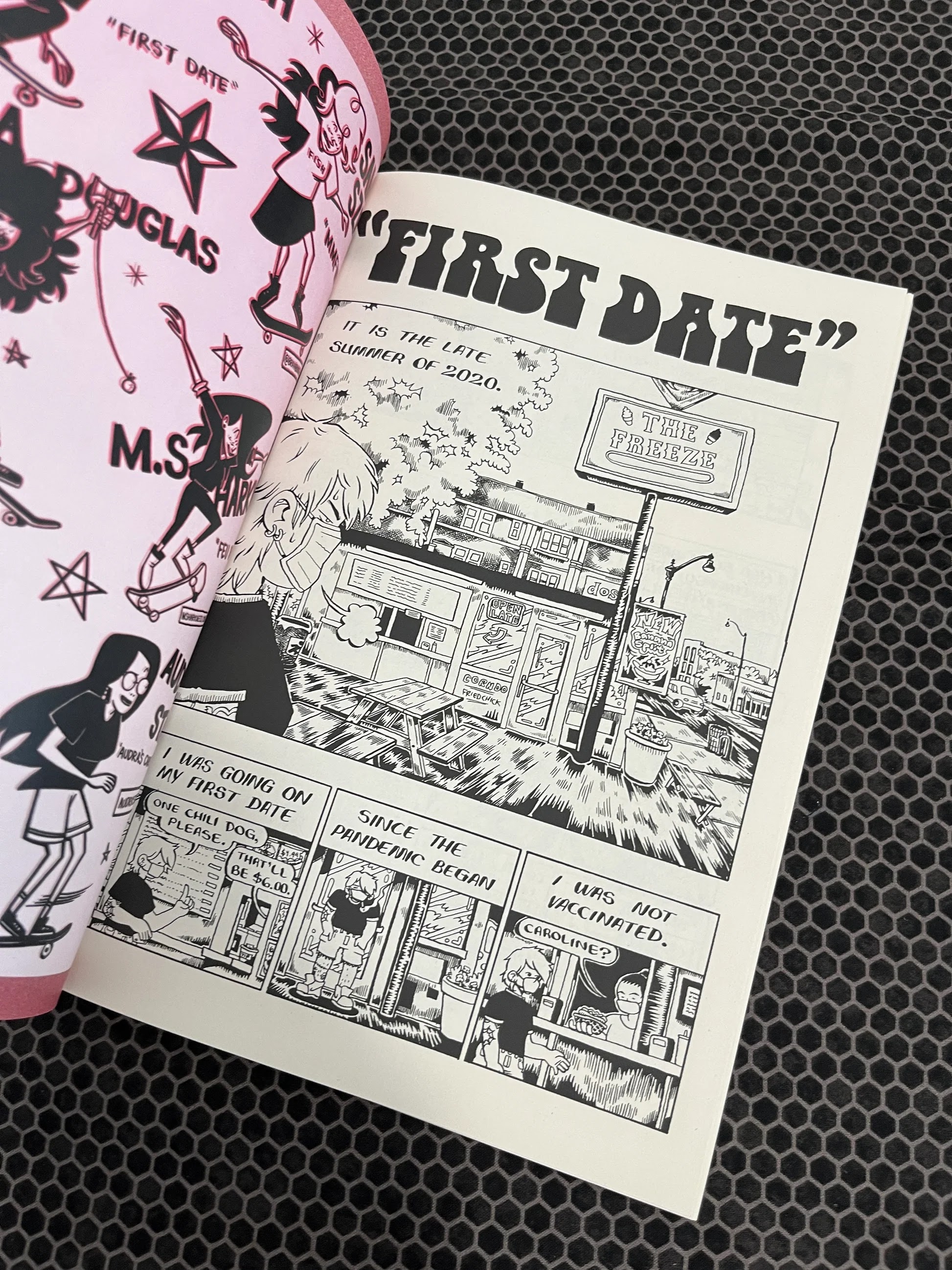
Caroline Cash's art has an inherent coolness that's still charged with genuine emotion, but that coolness is a distancing device. "First Date" is actually a rather sweet story about Cash's first date with a woman in Octoboer 2020; it's also her first date since the COVID quarantine began. Cash dials up stylized figures, simplified figures, and cartoony figures as a way to modulate emotion, mixing her manga influences with modern alt-comics style. The story itself is completely straightforward and is more of an anecdote about a particular moment and feeling than an actual narrative. That's what Cash seems to be going for her--relating this one, wonderful, strange moment in all of its awkward, sweaty glory. The stacked horizontal panels where Cash and her date kiss start off as tender, but Cash can't help herself and goes cartoony-zany in the last panel. It all fits, because it's the payoff to an idea about living in a time and place where hesitating is no longer a luxury we possess. 


Sam Szabo's story was next, and the transition between stories couldn't have been more jarring. The slick precision of Cash was succeeded by the expressive scrawl of Szabo. The small moment of intimacy in Cas's comic was followed by a huge turning point in Szabo's life, when they realized they were trans when wearing a dress as "a bit" for an Insane Clown Posse concert. If there was a little distance in Cash's style, Szabo immediately lays it all on the line as everything they knew about their reality and identity changed right before their eyes. Szabo's line is so energetic that the reader can't help but get swept up. However, that crude line belies rock-solid storytelling and clear page & panel composition. The six-panel grid, the thick line that highlights every drawing, and Szabo's sharp sense of timing gives this story a beautiful flow. The tonal shift between existential crisis, hilarious plot happenings (dropping acid alone at an ICP concert), and a gradual but beautiful sense of self-acceptance are all part of Szabo's smart storytelling. 


Victoria Douglas' social media lament was the most technically dazzling and visually exciting story in the anthology, but it was also the most predictable and cliched entry as well. While her concept of being loaded into the "content cannon" on social media was funny and cleverly executed, the idea of someone being fed up with social media engagement isn't exactly original or very interesting. Even the follow-up punchline doesn't land, and the story might have been better off without it. 

M.S. Harkness is certainly the cartoonist in this anthology who's on the biggest roll at the moment, with her Fantagraphics-published memoir Time Under Tension earning a number of accolades in 2023. Her "Feu de Joie" ("fire of joy") is a cleverly assembled series of anecdotes about the 4th of July told in chronological order. The brief snapshot of a holiday and the hot, sticky unpleasantness that is July allow Harkness to include crucial context clues about her life at that time. Told in her typical dense, black-heavy style with highly stylized character designs, the first story reaches back to her childhood and the clear sense of just how unsupervised she was as a pre-teen: playing with M-80s, watching adults have a fistfight, sneaking in jello shots. The next story finds her in her early 20s as a summer camp counselor, breaking the heart of a date who had become fond of her while fireworks fired over a lake. The next one came during the tumultuous summer of 2020 in Minneapolis as she was biking her way through smoke and read all of the local complaints about fireworks. The final story is a sweet exchange between Harkness and her fiance as they watch fireworks on a bridge. Pretty much every aspect of Harkness' storytelling is bawdy, crude, direct, and gross, as she's not interested in pulling any punches. This was partly a mechanism to deflect her true feelings, which she'd parcel out to the reader a bit at a time. Despite her in-your-face style, there is an essential sweetness and yearning in all of her comics, and this short story features a little bit of both.


Heather Loase's comic about being obsessed with breast-related porn as a teen similarly doesn't pull any punches, working in a frank, funny, and filthy space similar to Gina Wynbrandt (as well as Cash and Harkness). Her line is probably most similar to Szabo's although Szabo's figures are scratchier and more angular (sort of like Kaz) and Loase loves big, exaggerated, curvy lines and figures. It's a dense style of storytelling but she also has deft control over her composition, making each page intense but easy to follow. Loase's story is a familiar one: being drawn to same-sex attraction and researching it online only to be condemned by her parents. As she describes it, it led to her burying "all homoerotic fantasies for the next decade" as she turned her attention to male figures like hobbits and Derek Jeter. She concludes by saying there were still some TV shows, like the ridiculously lurid MTV Spring Break specials, that brought back "that weird feeling." This story, like several of the others in the anthology, is about a turning point regarding identity. Unlike the other stories, Loase's is about losing that sense of finding out who you are, but only up to a point. 


Finally, Audra Stang contributes a fairly rare work of memoir. Recent issues of her series The Audra Show have seen her do more of these sorts of stories after mostly doing fiction in her young career, but they've all been uniformly excellent. This story about Christmas and her family is no exception. It's an understated and nuanced account of horrible family dysfunction and the traumatic effects of poverty. Stang's page composition really takes advantage of the larger page size of Poison Pill (8 x 11 3/4") on pages like one where she's talking about how her schedule would change during Christmas break as she stacked eight horizontal panels on top of each other, each with a small image of young Stang, a caption, and shading filler. It gets across the way that a lack of structure seeped into her life, and how it was a welcome experience. The final pages, where she's away from her judgmental father and helps her mother (desperate to cope with life) on her paper route, culminating in a cup of coffee at a local diner. Her descriptions are matter of fact to the point of being almost icy, but it's a distancing technique that allows the reader to absorb the way she gets across the feelings of despair through her figure work. 

It's a strong ending to a varied collection of stories that are mostly contemplative and even sweet. The interstitial drawings help unite the disparate drawings, with Cash (I think) doing her take on the famous B.Kliban "A cartoonist is coming!" drawing. There are several different drawings featuring each of the artists, which helps contribute to the rock star mythology they're creating for themselves. Poison Pill is a mission statement, a concerted attempt at intimate and challenging storytelling, and a strong visual buffet of different styles.


Friday, December 31, 2021

31 Days Of CCS, #36: Rust Belt Review Vol 1

Rust Belt Review is an anthology edited and published by CCS grad Sean Knickerbocker, an artist whose work I greatly admire. The first volume opens with a story by his collaborator Andrew Greenstone. kicked it off with a bizarre mix of a cult exit interview and Squid Game with "Prof. Livingston's Labyrinthine Trivia Trials." It kicks off with an FBI raid and an ensuing shootout of a bizarre underground complex. It then segues into a Wikipedia entry on the cult, founded by the titular Professor with the best of ideals. Like most cults, it devolved into a violent, perverted group of extremists that worshipped its leader. Unlike most cults, they started kidnapping people to put them through a series of grueling physical and mental tests involving trivia and physical feats. The story centers around its sole survivor, leaving it on a cliffhanger as it seems the cult has caught up with her after their setback. Greenstone's linework is grotesque and distorted, with a heavy use of effects like zip-a-tone and spotting blocks. They both give the story an especially gritty quality, like watching a fuzzy black-and-white surveillance video. 


Caleb Orecchio's "Kids Playing Outside" reminds me a lot of Steven Weissman's work. The scratchy art and the wiseass kids who are getting up to shenanigans, including a couple of different alpha characters who inevitably come into contact. The drawing is the main attraction here, as the story meanders in ways that aren't especially interesting. Some of the characters feel underwritten, like they're background characters in an animated series. The final, horrifying sequence is jarring, though there's a sense throughout of reality being bent in different directions. 

M.S. Harkness' "The Uncut Gem" takes off from her comics about her sexual encounters with assorted losers to make a comedic detour into a fantasy sequence. When a guy tells her he's uncircumcised and asks if she can "handle" him, she imagines them robbing a bank together and getting trapped on the roof. They're forced to blow up the uncircumcised tip of his penis like a balloon to float away, but a one-eyed police marksman named "Ellen Rage" shoots him down. That pops the fantasy but not before she asks him about banks. Harkness never shies away from hilariously cartoony and explicit images, and she certainly goes all out to get this joke across. 

"The Wind Cries Maria" is an experimental comic by Juan Jose Fernandez, a CCS grad who spends a lot of time in comics education. This comic was done in a 12-panel grid with what looks like ASCII art, interpolated with the lyrics of a song. It's a rumination on life, death, and existence, with each panel acting as its own complex space, frequently with multiple actions occurring. 


Knickerbocker's "Best Of Three" continues his streak of superb writing about scumbags and losers in small-town America. He just has a knack for the kind of guys who go out in the forest and drink beer on discarded furniture. The central character is David Kelly, a mean lowlife who is about to be kicked out of his old friend's house after he decides to move back to town, after years of "almost" getting a landscaping business off the ground. He's a leech and a mooch who happens to inherit a great deal of money after his father died. His father more-or-less abandoned him after he got rich playing the card game Magic: The Gathering. The lawyer who informed him of this seems to have some hidden agenda, as he follows him to the forest in the story's cliffhanger. Knickerbocker's character design speaks volumes for his characters: the stubble, the ratty haircuts, the unkempt beards, and other touches get across a real sense of how morally repulsive his characters are. At the same time, he makes the reader feel a tinge of sympathy for them as well, as so many of them seem to have been doomed from the start. 

Audra Stang's "Tunnel Vision" is part of her Star Valley stories, featuring teen-age girls Bernie and Adelaide. Bernie is trying to find out more about the sea-themed amusement park in town that fell into disuse from a boy whose great-grandfather built them. Stang's portrayal of teen-age dialogue is painfully raw and often hilarious. Jokes about autoerotic asphyxiation, inappropriate sandbox behavior, and teenage boys scheming to get laid all make sense in the context of this larger story. The way Stang writes about kids reminds me of the Hernandez Brothers. There's Gilbert's willingness to get gross in the way that kids get gross, and Jaime's uncanny ability to depict tension in teen relationships. Her cartooning is lively and expressive, skirting the line between naturalism and caricature. Like many of the other features in this volume, it's part one of a longer story. 

I like the idea of this anthology as mixing a steady line-up of contributors with continuing stories with rotating guest-stars in each issue. The CCS feel is welcome, but giving bright young cartoonists like Stang a steady outlet is certainly also a good thing. Knickerbocker has had an interesting career as a working cartoonist, an editor, and a publisher--and he's good at all three things. 

Monday, October 1, 2018

Some SPX Minis: J. Baylis, A. Stang, R. Ullman

I can never resist reading minis from old favorites right after SPX. Here are some examples...

So Buttons #9, by Jonathan Baylis, et al. Baylis writes with increasing confidence and a Harvey Pekar-like ability to pick the right artists for the right kind of stories. That's not a coincidence, as Pekar is one of his major influences. Baylis and long-time collaborator Noah Van Sciver in "So...Carl" play on the structure of the famous Pekar/R.Crumb story "The Harvey Pekar Name Story", yet the structure actually serves a purpose in discussing his father Carl and his same-named cousin. While Baylis often plays his personal anecdotes for laughs, there's often a deeply personal and even cathartic quality to many of them as well; in this case, it was going to the funeral of his uncle with his sick father and freaking out that "Carl Baylis" was dead.

Two other long-time Baylis collaborators also shine in different ways. The simplicity of T.J. Kirsch is perfect for an anecdote about Baylis' young son talking about how he loved The Flash, his mom...and that's it. Thomas Boatwright returned in a follow-up about Baylis' old ambition of being a horror movie make-up artist, with exaggerated, cartoonish figures and a bright use of color contributing to an upbeat story of meeting one of his heroes and having it go well. Summer Pierre was a perfect choice for a sweet story about Baylis talking to his son about music. A story about getting rare roast beef from the Second Avenue Deli in New York was fittingly done by one of the best in depicting the city in James Romberger. Fred Hembeck continues to illustrate Baylis' time as an intern in comics, which was littered with disastrous stories. This time around, it was at Valiant Comics, where he watched staffer after staffer get fired by despondent publisher Bob Layton. Hembeck's deep knowledge of comics was put to good use in some clever panels, like one where he referenced the famous image of an alcoholic Tony Stark from an issue of Iron Man that Layton co-wrote and inked. I'm not sure if Baylis suggested that connection or if Hembeck came up with it, but it's the sort of thing that happens all the time in Baylis' comics. Baylis has a love of comics and its history that's coupled with an eyes-wide-open understanding of the industry's foibles. Combining that with an intuitive sense of not only what kind of anecdotes from his life make for a good story, but how to tell that story economically, has made him one of my favorite recent memoirists.

The Audra Show #1, by Audra Stang. Everything about this little mini is perfectly designed, from Stang's cheery self-caricature on the cover to the intense use of reds, blues and yellows. It was clear from the beginning that Stang was a talent to watch, and it's interesting to see her stretch out and work so extensively with color. Her biggest strengths remain dialogue and character interaction, as there's a great degree of verisimilitude. This comic begins with a wink to Daniel Clowes' Ghost World in that there are two teenage girls at a diner in 1988 who harass a schlubby, mustachioed waiter named Owen. The story takes place from the point of view of the waiter, who has a crush on a waitress named Bea. When they part after hanging out after work one night, she happens to see him him jump off the dock into the ocean...and when he doesn't come up after several minutes, she gets worried. The ending is a sublime moment of magical realism that nonetheless is a smooth fit with the rest of the story and even resolves the romantic tension between the two characters.

Old-Timey Hockey Tales #3, by Robert Ullman. Ullman's sports comics get more and more confident as he wrings out every bit of story and character to be found in the oft-eccentric National Hockey League. With this third issue, he's close to putting together enough material to assemble a book (around 70 pages so far). Ullman's clear, smooth line is ideally suited for this kind of storytelling, as he varies line weights to emphasize contact and action. The comic picks and chooses between the ridiculous, the beautiful, and the horrifying, as the early NHL had a Wild West feel in terms of its on-ice violence but also featured an intensity that created a deep connection with fans.

This issue featured statistical oddities embodied by players like Ken Doraty, whose career was notable for his overtime heroics and little else. The story of the "Curse of Muldoon", which supposedly prevented the Chicago Black Hawks from finishing in first place, was hilariously revealed to be a newspaper-created hoax. Ullman uses a grey wash to create an old newsreel feel in telling the story of Larry Kwang, the first Chinese-Canadian (and minority of any kind) man to play in the NHL. It's a story that's predictably filled with racist incidents, yet Kwang found different ways to rise above them in his life. In recent years, his story has been more widely told. There's also the story of Ace Bailey, who nearly died in an on-ice fight after taking a blind cheap shot, but later forgave the man who struck him. Ullman crams a lot of stories into 26 pages, and his ability to snappily get at the heart of each story without wasting a line makes this one-man anthology a compelling read.

Thursday, November 3, 2016

Old North State Comics: Audra Stang, Triangle Printed Matter Club

There's a small but growing scene in North Carolina, clustered in its larger towns like Durham, Greensboro, and Asheville. Durham's neighbors, Chapel Hill & Raleigh, are also important cultural centers thanks to the university communities in those towns, but scenes are popping up all over, featuring drink and draws, readings and other social groups that emphasize drawing.

Love Me Like An Autograph, April 2008, June 2008, and Pale, Sick & Magic, by Audra Stang. Stang is an artist from Greensboro who's been through Frank Santoro's Comics Workbook Rowhouse Residency program. It's evident from her most recent work that she's really studied the grid and taken its lessons to heart. Stang has an exceptional ear for dialogue and has an ability to bring a scene to life (in the case of these comics, either high school or the milieu of a traveling band). Her figure drawing has all the right elements: attention to body language, attention to the way characters interact in space, the nuances of gesture, etc. She also shows an enormous amount of restraint as a storyteller, sometimes even leaving backstories deliberately oblique. Stang has little interest in backstory, except when she's ready to reveal a detail that has an especially pertinent impact on the story at that moment.

Love Me Like An Autograph follows a tour of a fairly popular indy band, focusing on its lead singer and guitarist, a chubby, big guy named Oliver. He is a talented singer and performer with a crippling fear of playing before crowds, so much so that he pukes on stage at the beginning of the story. That push-pull with the crowds, with himself and with his best friend and fellow bandmate Luke. Their relationship is the key to this story, as it's clear that they've been in each other's lives forever and have that unique ability to both call each other out on their bullshit as well as needle the other in very specific ways. That aggression is a mask for their mutual affection, as it's clear their friendship runs deep. Their are physical altercations, screaming matches, bouncing on hotel beds, drinking cheap bar and roaming around the towns they're touring in in search of fun (some of Greensboro's key cultural hotspots, like Acme Comics and Ed McKay's books are name-dropped). The story is really about how Oliver has trouble processing being an artist who is actually loved by a small group of fans; indeed, he seems to have trouble processing any emotions that run counter to his obvious lack of self-esteem. The one guy in his corner at all times is Luke, even if Luke is an asshole and has trouble expressing his affection in ways that aren't hyper-aggressive and obnoxious. The story follows them slowly working it out, with the end of the story mirroring the beginning as the band goes on for another show. There's so much going on here formally that's interesting: the use of an eight-panel grid on every page except a page at the beginning and at the end when Oliver's performing, when the grid is broken up; this reflects Oliver's dreamy entrance into the bliss of actually playing and accepting himself in the moment. The comic is a downward-scrolling read, and there are all sorts of clever references, like a big fight taking place in a motel off Battleground Avenue in Greensboro. It looks like this was originally done in color for the web, and the smudgy greyscaling doesn't look great on a lot of the pages, but Stang's line is strong enough to counteract that.

As a sort of prequel to Love Me Like An Autograph, Stang did two short minis, April 2008 and June 2008. Both are set in the early years of high school and feature characters named Bryson and Adelaide, the latter of whom is a cartoonist. The first mini once again really plays to Stang's strengths: setting a scene, using body language and gesture to convey information, and then supplementing and contrasting that with pitch-perfect dialogue. Her use of a sort varying color wash for each character in each panel quietly adds to the sense of mood without taking the reader out of the story. The story is simply about character interactions: a bigger guy named Jesse wants Adelaide to draw him a picture. There's some tension between Adelaide and Bryson regarding a potential mutual attraction framed in such a way that depicts them declaring their lack of interest. Stang just nails that awkward sense of longing mediated by aggression and disinterest as a shield. June 2008 adds Oliver to the still-awkward friendship pairing of Adelaide and Bryson, as the three of them go off to set off home-made fireworks. In the span of a few months, Adelaide's energy is very different; she has a mischievous and impish quality to her not unlike Little Lulu; in fact, she even looks a little like her. This one's not in color and it loses a little in that translation, but once again Stang's character design is so distinctive that it doesn't matter much.

Pale, Sick and Magic is Stang's best work to date. It features some of that oblique storytelling at first, but later adds greater clarity to the proceedings without sacrificing storytelling restraint. Stang is simply more confident and assured in this comic, and it shows in terms of her character design and sharper plotting skills. Simply put, there's no waste or anything superfluous in this story, yet it still unfolds at Stang's usual languid pace. The plot concerns a missing high school boy and two girls who knew him, but Stang subverts typical reader expectations in terms of whom the protagonist of the story is. When he eventually is found dead, the person he haunts (in their dreams) is Lindsey, a popular mean-girl type who is trying to leave that past behind. Melanie used to be close to the boy, named Michael, before they had a falling-out. Initially, it's unclear why Melanie is so hostile to Lindsey, who seems like a perfectly nice person. When it's revealed that Lindsey used to torture Melanie about her weight and really put the boot in after Melanie confessed her feelings toward Michael and was rejected, Stang skillfully finds a way for the reader to feel sympathetic towards all parties. The scenes with Lindsey and Michael are wonderfully awkward; he's happy to talk to anyone at this point, but the two really have nothing to say to each other. Melanie's scored-earth reactions as Lindsey desperately tries to atone for her past are pitch-perfect, especially since Lindsey had so much to do with Melanie developing and honing her verbal defenses over the years. There is no magical, happy ending. Something bad happened, and it was too late for someone else to make up for their own bad behavior. Stang uses the nine-panel grid here, and each center panel is used to either provide a pivot point for the rest of the page in terms of raising its energy, or conversely providing a single resting point for an otherwise busy page. Stang clearly carefully thinks her way through each page, and her development at this point is simply a matter of further refinement and slightly greater clarity as she continues to develop her own, distinctive style.


Conversations with Strangers, by the Triangle Printed Matter Club. Local to Durham, this group of zinesters, cartoonists and general aficionados of small press comics meets twice a month to discuss comics, share their work and collaborate. This anthology was the result of the club's first major collaboration. The theme does a great job of uniting the many different kinds of short entries in this zine, from comics to prose to collage to poetry. It's fairly crude in execution in a lot of spots, but there's a tremendous sense of cohesion, as it's a surprisingly fluid read. Some of the highlights include C. May Spivey's cleverly-designed two-pager about helping out a man while she was camping, despite her well-founded fears. Creating a trail between two circular panels on opposite pages and surrounding them with thought balloons created tension and balanced the pages nicely. Michelle Dove and Jeff Stern both did "overheard conversations" text pieces, while KBlanK did a provocative photo collage centered around fishing and objectification. Julia Harmon's "Getting To Know You" is an intriguing image of three women in bed together, rendered in greyscaled watercolors. Rio Aubry Taylor used zir trademark "wide-hatching" technique to create a swirling set of figures and buildings melting into each other, while Ije O'ma's pregnancy and childbirth images were created solely out of text. Allie Mullin's mix of text and image really gets at how empaths can be overridden by strangers who take over their emotional space with their own toxic, narcissistic stew. It's the quintessential piece for this book, as it mixed comics and text in a visually striking and powerful manner.