Showing posts with label caroline cash. Show all posts

Friday, April 26, 2024

CRAM, Part 3: CRAM #2

Editing and publishing one anthology is hard. Doing multiple issues is a thankless task that requires equal parts vision and determination. It's clear that Andrew Alexander has both, because CRAM #2 once again is on the cutting edge of up-and-coming cartoonists. Alexander takes a step back and only provides the cover, with a mix of colors that highlights how vivid and beautiful the Risograph process can look if you are careful with color separations. Way too often, Riso comics are sloppy and off-grade, and it can be distracting. Alexander is careful to make the anthology as intentional as possible in terms of its production values. 


Alexander wisely starts this issue off with "Herpes Outbreak," by Allee Errico. Errico would later publish her first collection with CRAM, but I'll get to that later. She and fellow CRAM artist Angela Fanche are two of the most compelling autobiographical cartoonists working today, and it's not because of any particular formal innovations. Indeed, both often use the tried-and-true diary comics format that's tedious in the hands of many other cartoonists. What sets Errico apart is a clear affinity for a highly personal, sloppy, and even smeared line and use of color. This is the lens she uses to express her clear, direct, questioning, and impassioned point of view. Like fellow young memoirist Juliette Collet, Errico seems to owe a lot more to late 80s and early 90s alternative & underground artists like Julie Doucet, Aline Kominsky-Crumb, and perhaps Dori Seda than most comics that have come out in the past 20 years. One of her teachers was Lauren Weinstein, and you can see that same painterly mix of grotesque character designs, expressive cartoooning, and highly intuitive storytelling. Weinstein didn't care much about doing things "right," even as she brought new skills to bear in her first major work "Girl Stories," but she somehow made it feel right. Errico is quite similar.


This story is about waking up with an oral herpes outbreak and a recollection of how she contracted it in the first place back in high school. Errico looks like she used charcoal and pastels here, and her line varies from detailed and naturalistic to cartoony, depending on what was needed. Her visual approach is so compelling that she's able to cram in twelve panels on a page with a ton of dialogue without it feeling cramped. Indeed, the mix of her solid lettering, understanding of the relationship between bodies in space, and overall pacing give the pages an almost propulsive feel. Errico approaches the issue of herpes with her typical and unaffected candor, casting aside shame as she understands just how common herpes is. Indeed, this isn't so much a PSA or rant on herpes as it is mourning a particularly complicated relationship. Then Errico turns that around with a couple of funny side observations about her boyfriend accidentally giving her a backpack with a gun and then segueing into the modern day where she talks about this with other cartoonists. She does a funny drawing of monstrous little herpes sores about to burst through the skin of her lips and then compares them to memories, saying "the past is right here in the beautiful present." It's just an exquisite ending that ties up a lot of different emotional threads and adds a sense of resonance to a story about gossip, shame, teenage drama, and human connection. 


CRAM then pivots to Cedar Van Tassel's "Pleistocene Dreams," a story that is unlike Errico's in nearly every conceivable way. Van Tassel's images and use of color are designed to flatten everything, including affect. Van Tassel makes extensive use of negative space in this autobiographical story about him picking up a friend at an airport and nattering on about the effects of the ice age on Minnesota. Using light pastels (the one piece of continuity with Errico), Van Tassel and his friend have an interesting exchange about why the Pleistocene Era was so interesting and why some people turn this into a deeper thought in their place in civilization today. The story ends with a hilarious, disgusting swerve involving overfed vultures that turns what had been a talking heads story into a gag sequence with thematic resonance. 


Caroline Cash continues the previous story's visual aesthetic with her clear and cartoony style that meshes cartoony exaggeration with solid naturalistic elements to create a polished, breezy diary comic. Indeed, it's an example of Hourly Comics Day, which tends to generate highly forgettable and indulgent anecdotes. Cash plays around with the form, taking advantage of the generous page space to create expansive and exaggerated compositions that usually tend to look much smaller in typical presentations of these sorts of diary strips. As usual in a Cash story, there are equal parts sincere and smart-ass, with nuggets addressing deeper feelings mixed with silly anecdotes. This story feels especially breezy, reveling in moments of mundane amusement. 

Next up is A.T. Pratt, taking the anthology in a dramatically different direction. In an extended parody of te famous "Toronto Three" cartoonist friend group of Joe Matt, Seth, and Chester Brown, Pratt obliterates the clean graphic design style of those three with chaotic, nightmarish, and grossly visceral visuals that pack as many as twenty panels on a page. This story is about as inside baseball as it gets with regard to how much of the humor is based on a reader's familiarity with those cartoonists, but it's clear that Pratt couldn't care less. It's really a story that's about (literally) destroying idols and this kind of chummy best-friends-artists storytelling that is sometimes seen in the work of Matt in particular. The Toronto Three all die grisly, horrible, and funny deaths (I imagine this was done before Matt's actual death) in the story, which doesn't seem to bother Pratt's stand-in all that much. 


The chaotic, cluttered approach continues in the next two stories, starting with Nick Bunch of Reptile House. It's a highly clever way of dealing with two variations on the same gag surrounded by visual clutter that is smartly contextualized by the nature of the joke. As two young women walk to their job at a diner in the city, one of them endlessly natters on about whether or not the whales were saved and then if the rainforest was saved. Her friend has no time for her nonsense as these two brightly-colored figures are surrounded by dense (jungle-like) clutter that's colored a bit more dimly. Bunch's character design is deliberately flat and cartoonish, matching the stylized action on the page. Everything is exaggerated, dense, and over the top in service to a familiar gag of an authority figure being frustrated by the cluelessness of young people. 

Floyd Tangeman (editor of dense underground anthology Tinfoil Comix) brings this dense, cartoony progression to its logical end, as his "Projection Dance" interpolates the 23rd Psalm into a four-panel grid featuring a grotesque, constantly changing and mutating figure that never reaches a goal despite being shown walking left to right in every single panel. The gritty use of pastels induces cognitive dissonance in every panel while never disrupting the overall flow of the story. 

Pete Faecke reverses this trend in the final story while committing to the totally nonsensical quality of the back half of this issue of CRAM with a story about Mr. Bimbo. This was an invisible, unseen character who supposedly lived on Fozzie the Bear's index finger in the film Muppet Treasure Island. The character of Mr. Bimbo is strong, talented, and capable were Fozzie is a goofball. In this story, set in the old west (???) Mr. Bimbo has a feud with another "eligible bachelor" named Tim Timbers. The story concludes with Mr. Bimbo playing Ramones and Lou Reed songs for a group of admiring women. What I like best about this bit of total nonsense is Faecke's absolute commitment to the aesthetics and details of the bit, no matter how silly it is. Indeed, it's that commitment that makes it funny, similar to the sort of thing that Rick Altergott does.

The subtitle of this issue is "casual conversations for brain-fog drunks," and the back half of the issue feels increasingly like the stories becoming increasingly (but deliberately) intoxicated and incoherent, while still never leaving the realm of readability. Nothing here matches Errico's opening story in terms of overall impact and artistry, but it all makes sense together. 

Monday, March 18, 2024

Poison Pill

Poison Pill was one of the more exciting comics of 2023 because it had this kind of young guns energy going for it, as six young cartoonists who are all entering mature phases of their careers made this anthology together. The fact that it's all women doesn't really come as much of a surprise, given how much the demographics of young cartoonists have shifted so much in the last decade. There's not much that this line-up--Caroline Cash, M.S. Harkness, Sam Szabo, Victoria Douglas, Audra Stang, and Heather Loase--have in common with each other in terms of style or subject matter, other than the fact that all of these stories were autobiographical. Each approaches memoir in a completely different way, aiming for different effects. 


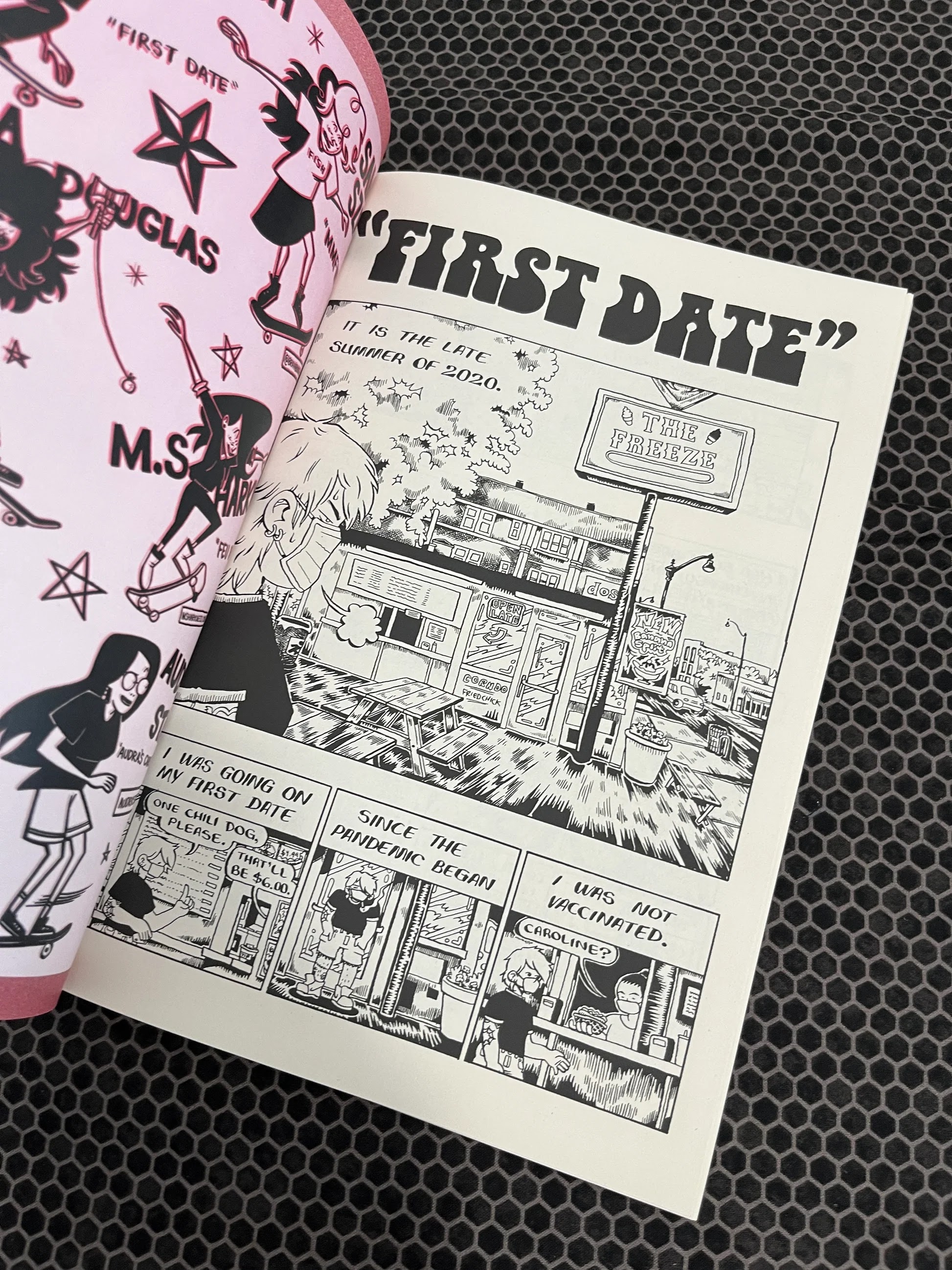
Caroline Cash's art has an inherent coolness that's still charged with genuine emotion, but that coolness is a distancing device. "First Date" is actually a rather sweet story about Cash's first date with a woman in Octoboer 2020; it's also her first date since the COVID quarantine began. Cash dials up stylized figures, simplified figures, and cartoony figures as a way to modulate emotion, mixing her manga influences with modern alt-comics style. The story itself is completely straightforward and is more of an anecdote about a particular moment and feeling than an actual narrative. That's what Cash seems to be going for her--relating this one, wonderful, strange moment in all of its awkward, sweaty glory. The stacked horizontal panels where Cash and her date kiss start off as tender, but Cash can't help herself and goes cartoony-zany in the last panel. It all fits, because it's the payoff to an idea about living in a time and place where hesitating is no longer a luxury we possess. 


Sam Szabo's story was next, and the transition between stories couldn't have been more jarring. The slick precision of Cash was succeeded by the expressive scrawl of Szabo. The small moment of intimacy in Cas's comic was followed by a huge turning point in Szabo's life, when they realized they were trans when wearing a dress as "a bit" for an Insane Clown Posse concert. If there was a little distance in Cash's style, Szabo immediately lays it all on the line as everything they knew about their reality and identity changed right before their eyes. Szabo's line is so energetic that the reader can't help but get swept up. However, that crude line belies rock-solid storytelling and clear page & panel composition. The six-panel grid, the thick line that highlights every drawing, and Szabo's sharp sense of timing gives this story a beautiful flow. The tonal shift between existential crisis, hilarious plot happenings (dropping acid alone at an ICP concert), and a gradual but beautiful sense of self-acceptance are all part of Szabo's smart storytelling. 


Victoria Douglas' social media lament was the most technically dazzling and visually exciting story in the anthology, but it was also the most predictable and cliched entry as well. While her concept of being loaded into the "content cannon" on social media was funny and cleverly executed, the idea of someone being fed up with social media engagement isn't exactly original or very interesting. Even the follow-up punchline doesn't land, and the story might have been better off without it. 

M.S. Harkness is certainly the cartoonist in this anthology who's on the biggest roll at the moment, with her Fantagraphics-published memoir Time Under Tension earning a number of accolades in 2023. Her "Feu de Joie" ("fire of joy") is a cleverly assembled series of anecdotes about the 4th of July told in chronological order. The brief snapshot of a holiday and the hot, sticky unpleasantness that is July allow Harkness to include crucial context clues about her life at that time. Told in her typical dense, black-heavy style with highly stylized character designs, the first story reaches back to her childhood and the clear sense of just how unsupervised she was as a pre-teen: playing with M-80s, watching adults have a fistfight, sneaking in jello shots. The next story finds her in her early 20s as a summer camp counselor, breaking the heart of a date who had become fond of her while fireworks fired over a lake. The next one came during the tumultuous summer of 2020 in Minneapolis as she was biking her way through smoke and read all of the local complaints about fireworks. The final story is a sweet exchange between Harkness and her fiance as they watch fireworks on a bridge. Pretty much every aspect of Harkness' storytelling is bawdy, crude, direct, and gross, as she's not interested in pulling any punches. This was partly a mechanism to deflect her true feelings, which she'd parcel out to the reader a bit at a time. Despite her in-your-face style, there is an essential sweetness and yearning in all of her comics, and this short story features a little bit of both.


Heather Loase's comic about being obsessed with breast-related porn as a teen similarly doesn't pull any punches, working in a frank, funny, and filthy space similar to Gina Wynbrandt (as well as Cash and Harkness). Her line is probably most similar to Szabo's although Szabo's figures are scratchier and more angular (sort of like Kaz) and Loase loves big, exaggerated, curvy lines and figures. It's a dense style of storytelling but she also has deft control over her composition, making each page intense but easy to follow. Loase's story is a familiar one: being drawn to same-sex attraction and researching it online only to be condemned by her parents. As she describes it, it led to her burying "all homoerotic fantasies for the next decade" as she turned her attention to male figures like hobbits and Derek Jeter. She concludes by saying there were still some TV shows, like the ridiculously lurid MTV Spring Break specials, that brought back "that weird feeling." This story, like several of the others in the anthology, is about a turning point regarding identity. Unlike the other stories, Loase's is about losing that sense of finding out who you are, but only up to a point. 


Finally, Audra Stang contributes a fairly rare work of memoir. Recent issues of her series The Audra Show have seen her do more of these sorts of stories after mostly doing fiction in her young career, but they've all been uniformly excellent. This story about Christmas and her family is no exception. It's an understated and nuanced account of horrible family dysfunction and the traumatic effects of poverty. Stang's page composition really takes advantage of the larger page size of Poison Pill (8 x 11 3/4") on pages like one where she's talking about how her schedule would change during Christmas break as she stacked eight horizontal panels on top of each other, each with a small image of young Stang, a caption, and shading filler. It gets across the way that a lack of structure seeped into her life, and how it was a welcome experience. The final pages, where she's away from her judgmental father and helps her mother (desperate to cope with life) on her paper route, culminating in a cup of coffee at a local diner. Her descriptions are matter of fact to the point of being almost icy, but it's a distancing technique that allows the reader to absorb the way she gets across the feelings of despair through her figure work. 

It's a strong ending to a varied collection of stories that are mostly contemplative and even sweet. The interstitial drawings help unite the disparate drawings, with Cash (I think) doing her take on the famous B.Kliban "A cartoonist is coming!" drawing. There are several different drawings featuring each of the artists, which helps contribute to the rock star mythology they're creating for themselves. Poison Pill is a mission statement, a concerted attempt at intimate and challenging storytelling, and a strong visual buffet of different styles.


Thursday, February 8, 2024

Caroline Cash's Peepee Poopoo Issue 80085

There's an extent to which this run of very funny and varied issues of the ridiculously titled Peepee Poopoo feels like a warm-up for Caroline Cash. Sure, she's self-consciously harkening back to the tradition of one-person anthologies like Eightball, but I think the better comparison is Michael DeForge's classic series Lose. She's getting her feet wet by allowing herself to go on flights of fancy, gags, diversions, pin-ups, and a letters page without having to worry about doing her big Graphic Novel. Frankly, I wish more young cartoonists still did this. It's nice to see a resurgence in this format, both in terms of minicomics but also cartoonists and publishers starting to return to the comic-book format. 


It also helps that Cash **is** actually ready to do something long-form if she's ready and feels like doing it. (Plenty of artists simply don't like the format.) Cash has a knack for turning the puerile into something deeply personal. The title of the comic is funny and ridiculous, and it stands for both a genuine affinity for these kinds of comics as well as a satire of some of underground comics' more puerile tendencies--especially from men. It's also a deeply regional comic--it's Chicago through and through, though a version of Chicago very specific to her experiences. Nights spent in dive bars, going to house parties in nearby flats, walking around town--it's a love letter to some times that are just recently past. 

It's also a highly matter-of-fact and amusing take on her life as a lesbian, past and present, in all of its frequently awkward glory. The very "number" of this issue, "80085" is a reference to those numbers resembling the word "boobs" on a calculator. It's juvenile, but Cash plays with this throughout, starting with noting that boobs are one of the simplest, best things about being a lesbian. This isn't exactly a revelation, but it's her cartooning, using an almost chibi style, that sells it. She then pivots to an autobiographical story about going to Victoria's Secret as a teenager in order to buy a bra, after years of being afraid she'd be outed as a pervert if she was caught staring at its window. There are interesting notes throughout the issue, as she mentions being obsessed with manga as a teen, and you can see more of a DeForge influence in a one-pager about a guy who only listens to his own band's cassettes, but Cash has also carved out her own style that I suspect will be highly influential.


In "Dudes Rock," for example, there's a sort of throwback feel in the title font, size, and presentation to the underground era, but the actual page composition and character design feel decidedly modern and unique to her. Cash leans somewhere between grotesque and cute on every page and with every figure, zooming out to make characters more cartooning and zooming in to provide more (and frequently gross) detail. It's also making fun of scenesters without making it painfully obvious since that's generally like shooting fish in a barrel. 


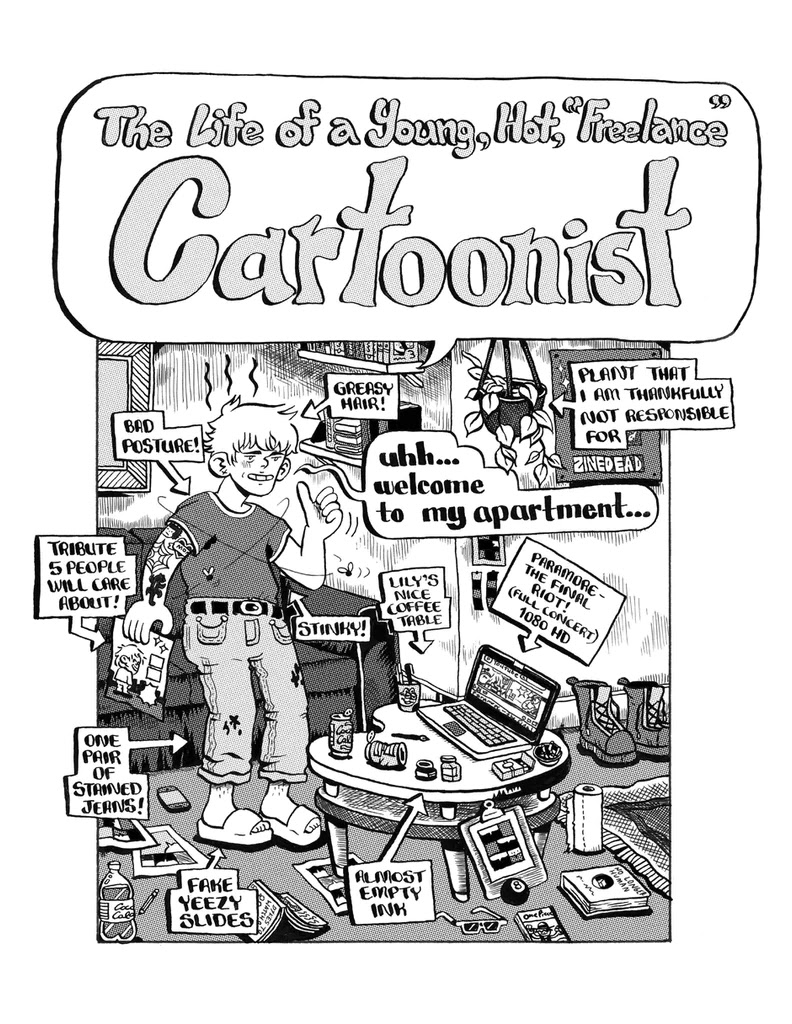
Another thing I like about Cash's work is the delicate balance she maintains between sincerity and smartassery. Her strips about her schedule and life as a freelancer are one part self-deprecating gags and one part genuine reflection. The same is true about her ode to a defunct bar called Danny's; the meandering strip is less a story than a series of anecdotes about the kind of feeling one develops for a place that's the backdrop for one's own personal evolution. Her continuing narrative, "Come Home To Me," is (like the Danny's story) another ode to Chicago, this time with a Liz Phair song as the background for a return to the city and memories of hazy nights spent with questionable company under questionable circumstances. 

Tack on a letters column, some stickers (!), and another full-page illustration done in yet another visual style, and the issue shows the breadth and depth of Cash's style and influences. Her comics are self-assured and funny, even as one gets the sense that she has a few more developmental leaps to make.