Showing posts with label m.s. harkness. Show all posts

Monday, March 18, 2024

Poison Pill

Poison Pill was one of the more exciting comics of 2023 because it had this kind of young guns energy going for it, as six young cartoonists who are all entering mature phases of their careers made this anthology together. The fact that it's all women doesn't really come as much of a surprise, given how much the demographics of young cartoonists have shifted so much in the last decade. There's not much that this line-up--Caroline Cash, M.S. Harkness, Sam Szabo, Victoria Douglas, Audra Stang, and Heather Loase--have in common with each other in terms of style or subject matter, other than the fact that all of these stories were autobiographical. Each approaches memoir in a completely different way, aiming for different effects. 


Caroline Cash's art has an inherent coolness that's still charged with genuine emotion, but that coolness is a distancing device. "First Date" is actually a rather sweet story about Cash's first date with a woman in Octoboer 2020; it's also her first date since the COVID quarantine began. Cash dials up stylized figures, simplified figures, and cartoony figures as a way to modulate emotion, mixing her manga influences with modern alt-comics style. The story itself is completely straightforward and is more of an anecdote about a particular moment and feeling than an actual narrative. That's what Cash seems to be going for her--relating this one, wonderful, strange moment in all of its awkward, sweaty glory. The stacked horizontal panels where Cash and her date kiss start off as tender, but Cash can't help herself and goes cartoony-zany in the last panel. It all fits, because it's the payoff to an idea about living in a time and place where hesitating is no longer a luxury we possess. 
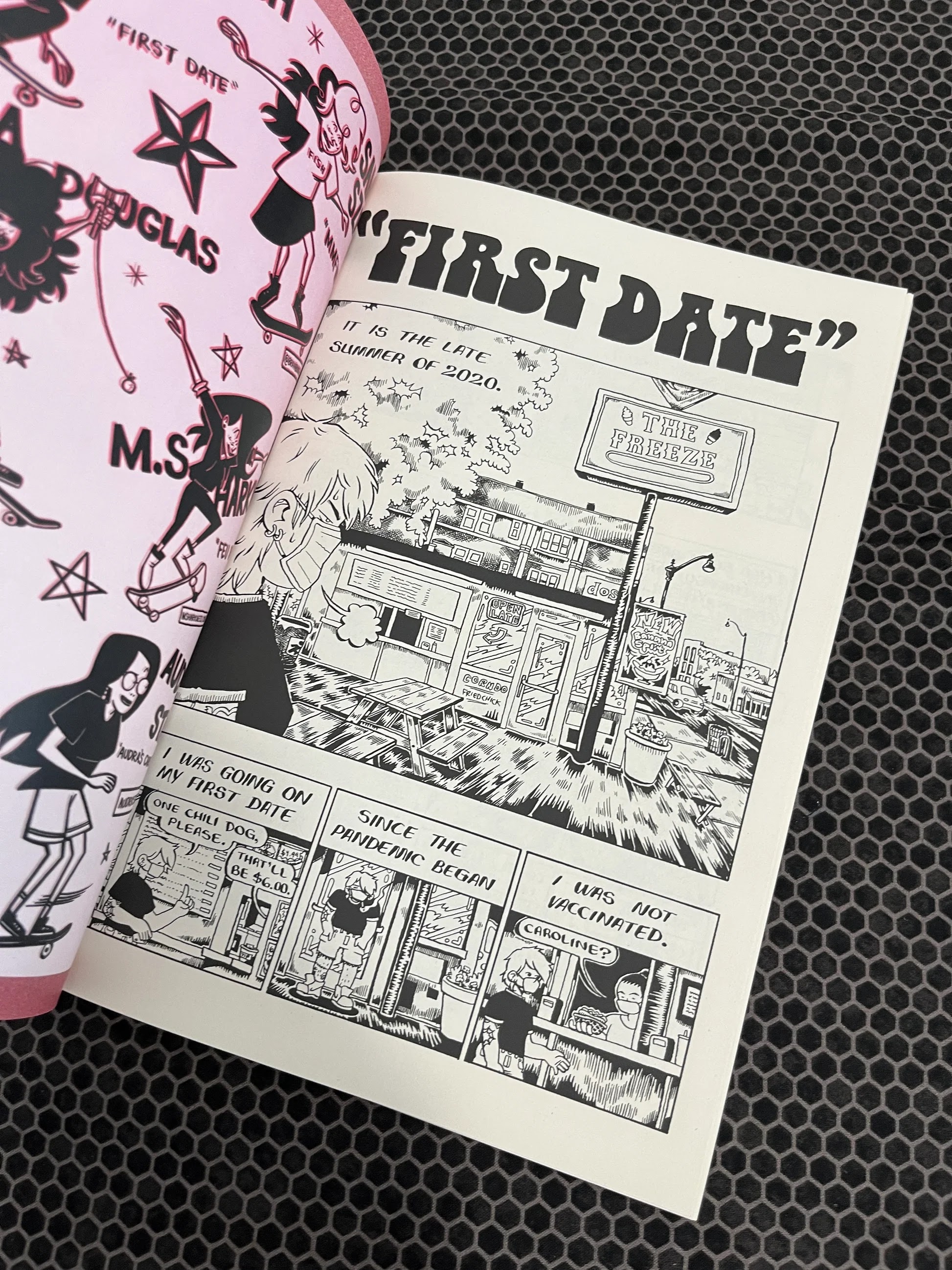

Sam Szabo's story was next, and the transition between stories couldn't have been more jarring. The slick precision of Cash was succeeded by the expressive scrawl of Szabo. The small moment of intimacy in Cas's comic was followed by a huge turning point in Szabo's life, when they realized they were trans when wearing a dress as "a bit" for an Insane Clown Posse concert. If there was a little distance in Cash's style, Szabo immediately lays it all on the line as everything they knew about their reality and identity changed right before their eyes. Szabo's line is so energetic that the reader can't help but get swept up. However, that crude line belies rock-solid storytelling and clear page & panel composition. The six-panel grid, the thick line that highlights every drawing, and Szabo's sharp sense of timing gives this story a beautiful flow. The tonal shift between existential crisis, hilarious plot happenings (dropping acid alone at an ICP concert), and a gradual but beautiful sense of self-acceptance are all part of Szabo's smart storytelling. 


Victoria Douglas' social media lament was the most technically dazzling and visually exciting story in the anthology, but it was also the most predictable and cliched entry as well. While her concept of being loaded into the "content cannon" on social media was funny and cleverly executed, the idea of someone being fed up with social media engagement isn't exactly original or very interesting. Even the follow-up punchline doesn't land, and the story might have been better off without it. 

M.S. Harkness is certainly the cartoonist in this anthology who's on the biggest roll at the moment, with her Fantagraphics-published memoir Time Under Tension earning a number of accolades in 2023. Her "Feu de Joie" ("fire of joy") is a cleverly assembled series of anecdotes about the 4th of July told in chronological order. The brief snapshot of a holiday and the hot, sticky unpleasantness that is July allow Harkness to include crucial context clues about her life at that time. Told in her typical dense, black-heavy style with highly stylized character designs, the first story reaches back to her childhood and the clear sense of just how unsupervised she was as a pre-teen: playing with M-80s, watching adults have a fistfight, sneaking in jello shots. The next story finds her in her early 20s as a summer camp counselor, breaking the heart of a date who had become fond of her while fireworks fired over a lake. The next one came during the tumultuous summer of 2020 in Minneapolis as she was biking her way through smoke and read all of the local complaints about fireworks. The final story is a sweet exchange between Harkness and her fiance as they watch fireworks on a bridge. Pretty much every aspect of Harkness' storytelling is bawdy, crude, direct, and gross, as she's not interested in pulling any punches. This was partly a mechanism to deflect her true feelings, which she'd parcel out to the reader a bit at a time. Despite her in-your-face style, there is an essential sweetness and yearning in all of her comics, and this short story features a little bit of both.

Heather Loase's comic about being obsessed with breast-related porn as a teen similarly doesn't pull any punches, working in a frank, funny, and filthy space similar to Gina Wynbrandt (as well as Cash and Harkness). Her line is probably most similar to Szabo's although Szabo's figures are scratchier and more angular (sort of like Kaz) and Loase loves big, exaggerated, curvy lines and figures. It's a dense style of storytelling but she also has deft control over her composition, making each page intense but easy to follow. Loase's story is a familiar one: being drawn to same-sex attraction and researching it online only to be condemned by her parents. As she describes it, it led to her burying "all homoerotic fantasies for the next decade" as she turned her attention to male figures like hobbits and Derek Jeter. She concludes by saying there were still some TV shows, like the ridiculously lurid MTV Spring Break specials, that brought back "that weird feeling." This story, like several of the others in the anthology, is about a turning point regarding identity. Unlike the other stories, Loase's is about losing that sense of finding out who you are, but only up to a point. 


Finally, Audra Stang contributes a fairly rare work of memoir. Recent issues of her series The Audra Show have seen her do more of these sorts of stories after mostly doing fiction in her young career, but they've all been uniformly excellent. This story about Christmas and her family is no exception. It's an understated and nuanced account of horrible family dysfunction and the traumatic effects of poverty. Stang's page composition really takes advantage of the larger page size of Poison Pill (8 x 11 3/4") on pages like one where she's talking about how her schedule would change during Christmas break as she stacked eight horizontal panels on top of each other, each with a small image of young Stang, a caption, and shading filler. It gets across the way that a lack of structure seeped into her life, and how it was a welcome experience. The final pages, where she's away from her judgmental father and helps her mother (desperate to cope with life) on her paper route, culminating in a cup of coffee at a local diner. Her descriptions are matter of fact to the point of being almost icy, but it's a distancing technique that allows the reader to absorb the way she gets across the feelings of despair through her figure work. 

It's a strong ending to a varied collection of stories that are mostly contemplative and even sweet. The interstitial drawings help unite the disparate drawings, with Cash (I think) doing her take on the famous B.Kliban "A cartoonist is coming!" drawing. There are several different drawings featuring each of the artists, which helps contribute to the rock star mythology they're creating for themselves. Poison Pill is a mission statement, a concerted attempt at intimate and challenging storytelling, and a strong visual buffet of different styles.


Tuesday, September 5, 2023

Six Mini Comics from M.S. Harkness

There's no question that M.S. Harkness is on a hot streak right now. Her latest memoir, Time Under Tension, is about to be published by Fantagraphics. Her willingness to be totally vulnerable and totally ridiculous about her sex life and body is the set-up for the raw, emotional vulnerability she expresses throughout. Her recent self-published collection, Six Mini Comics, collects a number of stories outside of the narratives in her longer memoirs, but they certainly are a snug fit with her overall project. 


Harkness mixes in photos of many of the events and people we see in these stories. The most wholesome was from a story from NOW #10, "Go Big Then Stay Home." It's a COVID/lockdown story, and unlike 95% of comics about this topic, it's extremely engaging. It's a departure for Harkness, as most of their stories tend to delve into their cynical relationships with others or else their own issues. This is about Harkness supporting her power-lifting friend Elis at a competition that was held in March of 2020, just as the lockdown began. The competition (the "Arnold Expo") still went on, and the support Harkness gave her friend was endearing. It was also a detailed look at competitions that aren't a part of the popular consciousness and the mechanics behind them, especially as a competitor. Harkness has really honed her character design style to a fine point, and her visual cartoony silliness is a sharp contrast to the visceral qualities of much of her subject matter. A lot of them may be about sex or bodies, but none of them are sexy. She's very much in the Peter Bagge school of exaggerated, rubbery figures that allow for a highly expressionistic style of cartooning. 

Speaking of sex, "Six Foot Six" plays on Harkness' character often choosing sexual partners for purely aesthetic, rather than intellectual reasons. The himbo she hooks up with in this story is fooled by her joking suggestion that she might be famous art provocateur Banky, and the last panel connects one of Banky's latest outrages with her own personal desires. Above all else, Harkness is hilarious, even when writing about painful subjects. Perhaps especially when writing about painful subjects. 

Along the same lines is "The Uncut Gem," which takes some idiot asking her if she can "handle" an uncircumcised guy and turning it into a hilarious heist fantasy where she blows up his foreskin like a balloon. It is an absolutely absurd image that once again transforms the almost cartoonist machismo she finds in many of her partners into comedy fodder. 

"Plunderbird" is part of this short suite of stories, but it opens up the discussion of Harkness' past experiences with "sugar dating, " which she hilariously addresses in a setting where her character is sitting in a plush overstuffed chair by a fireplace with a glass of wine, as though she were on "Masterpiece Theater" or something. She immediately brings up the elephant in the room of "you must have so many stories!" by relating a somewhat slight anecdote that's worth it for the ridiculous Native American tattoos he had all over his body. 


Harkness saves the real storytelling for two epic shorts that pretty much epitomize her most frequently-discussed topics: drugs and her vagina. Of course, there's much more to these stories than these crude reductions, and Harkness' wit and exaggerated line is what makes them interesting, but it is true that they start from that place. "A Savage Journey To The Heart Of An Anime Convention" is her take on gonzo, Hunter S. Thompson-style storytelling. Shortly after getting her BFA, Harkness accompanies a friend to an anime convention, where the friend makes bank doing commissions and selling art. Harkness only agrees to come along if she can be high, but some highly questionable edibles turn the experience into a stomach-churning, mind-destroying ordeal. It doesn't help that the con hotel is one where she had had a number of clients as a sugar baby. This is an especially fun story because Harkness gets to dial up the exaggerated quality of her line all the way, in a manner that she can't in her more serious, longer narratives. 


Finally, the true anchor piece is "Rotten." It's pretty much got everything. There are art school-era shenanigans, including a party that's right out of HATE. Only this time, it's Harkness and her friend Pete who are the (hilarious) assholes at the party, as they do a wrestling routine that concludes with Pete pumping off the roof of the house. There is an extensive discussion of Harkness' struggles with endometriosis, including almost unimaginable pain and indifferent doctors. There are dope sales to WWE wrestlers. there's the lead-up to the US Presidential election in 2016 and its horrifying result. There is inexplicable vaginal bleeding/discharge/odor amidst a harrowing trip to a quasi-celebrity sugar daddy client. There's Harkness barely paying attention at her lifeguard job. Most of all, there is the unforgettable scene of a tampon stuck way up inside of her causing all of these problems. The scene where the doctor is examining her, drawn as though it's a mechanic getting under the hood of a car, is exactly the kind of absurd, visually clever, and yet narratively resonant cartooning that she's so good at. Harkness, at heart, is all about the gag, even (and usually especially) when the joke's on her. 


Friday, December 31, 2021

31 Days Of CCS, #36: Rust Belt Review Vol 1

Rust Belt Review is an anthology edited and published by CCS grad Sean Knickerbocker, an artist whose work I greatly admire. The first volume opens with a story by his collaborator Andrew Greenstone. kicked it off with a bizarre mix of a cult exit interview and Squid Game with "Prof. Livingston's Labyrinthine Trivia Trials." It kicks off with an FBI raid and an ensuing shootout of a bizarre underground complex. It then segues into a Wikipedia entry on the cult, founded by the titular Professor with the best of ideals. Like most cults, it devolved into a violent, perverted group of extremists that worshipped its leader. Unlike most cults, they started kidnapping people to put them through a series of grueling physical and mental tests involving trivia and physical feats. The story centers around its sole survivor, leaving it on a cliffhanger as it seems the cult has caught up with her after their setback. Greenstone's linework is grotesque and distorted, with a heavy use of effects like zip-a-tone and spotting blocks. They both give the story an especially gritty quality, like watching a fuzzy black-and-white surveillance video. 


Caleb Orecchio's "Kids Playing Outside" reminds me a lot of Steven Weissman's work. The scratchy art and the wiseass kids who are getting up to shenanigans, including a couple of different alpha characters who inevitably come into contact. The drawing is the main attraction here, as the story meanders in ways that aren't especially interesting. Some of the characters feel underwritten, like they're background characters in an animated series. The final, horrifying sequence is jarring, though there's a sense throughout of reality being bent in different directions. 

M.S. Harkness' "The Uncut Gem" takes off from her comics about her sexual encounters with assorted losers to make a comedic detour into a fantasy sequence. When a guy tells her he's uncircumcised and asks if she can "handle" him, she imagines them robbing a bank together and getting trapped on the roof. They're forced to blow up the uncircumcised tip of his penis like a balloon to float away, but a one-eyed police marksman named "Ellen Rage" shoots him down. That pops the fantasy but not before she asks him about banks. Harkness never shies away from hilariously cartoony and explicit images, and she certainly goes all out to get this joke across. 

"The Wind Cries Maria" is an experimental comic by Juan Jose Fernandez, a CCS grad who spends a lot of time in comics education. This comic was done in a 12-panel grid with what looks like ASCII art, interpolated with the lyrics of a song. It's a rumination on life, death, and existence, with each panel acting as its own complex space, frequently with multiple actions occurring. 


Knickerbocker's "Best Of Three" continues his streak of superb writing about scumbags and losers in small-town America. He just has a knack for the kind of guys who go out in the forest and drink beer on discarded furniture. The central character is David Kelly, a mean lowlife who is about to be kicked out of his old friend's house after he decides to move back to town, after years of "almost" getting a landscaping business off the ground. He's a leech and a mooch who happens to inherit a great deal of money after his father died. His father more-or-less abandoned him after he got rich playing the card game Magic: The Gathering. The lawyer who informed him of this seems to have some hidden agenda, as he follows him to the forest in the story's cliffhanger. Knickerbocker's character design speaks volumes for his characters: the stubble, the ratty haircuts, the unkempt beards, and other touches get across a real sense of how morally repulsive his characters are. At the same time, he makes the reader feel a tinge of sympathy for them as well, as so many of them seem to have been doomed from the start. 

Audra Stang's "Tunnel Vision" is part of her Star Valley stories, featuring teen-age girls Bernie and Adelaide. Bernie is trying to find out more about the sea-themed amusement park in town that fell into disuse from a boy whose great-grandfather built them. Stang's portrayal of teen-age dialogue is painfully raw and often hilarious. Jokes about autoerotic asphyxiation, inappropriate sandbox behavior, and teenage boys scheming to get laid all make sense in the context of this larger story. The way Stang writes about kids reminds me of the Hernandez Brothers. There's Gilbert's willingness to get gross in the way that kids get gross, and Jaime's uncanny ability to depict tension in teen relationships. Her cartooning is lively and expressive, skirting the line between naturalism and caricature. Like many of the other features in this volume, it's part one of a longer story. 

I like the idea of this anthology as mixing a steady line-up of contributors with continuing stories with rotating guest-stars in each issue. The CCS feel is welcome, but giving bright young cartoonists like Stang a steady outlet is certainly also a good thing. Knickerbocker has had an interesting career as a working cartoonist, an editor, and a publisher--and he's good at all three things. 

Wednesday, June 30, 2021

Escaping The Labyrinth: M.S. Harkness' Desperate Pleasures

The experience of childhood sexual trauma is one that rewires one's brain to such a degree that the result is going through life walking through a labyrinth. It's an especially insidious labyrinth because one can't perceive the walls around you or even that you're in a labyrinth at all. However, one still backtracks, goes off-kilter, chooses dead-ends, and repeats the same paths even if they tend to wind up in the same monstrous predicaments. M.S. Harkness writes about this experience in great detail in her memoir Desperate Pleasures, and it points to the way how different people respond to this kind of trauma in different ways. Not unsurprisingly for her as a young adult, it meant a hypersexual focus coupled with difficulty in actually experiencing true love or intimacy. While that was partly rooted in the kind of emotionally unavailable men that she chose to pursue, her choice to pursue them was intrinsically wrapped up in the feelings of worthlessness that trauma creates.

Harkness explored this in a more lighthearted way in her comic Tinderella, which focused more on the weirdoes she dated and several men she knew were bad for her emotionally but whom she couldn't stop seeing. Desperate Pleasures is thematically richer and features greater formal complexity, especially in the way she repeats certain scenes and memories and adds new contexts to them throughout the book. The book is set a few years earlier, where Harkness is in and out of school and trying to figure out what to do with her life. To make ends meet, she engages as a "sugar baby," meaning that she dated older men who would give her money. It's not unlike being an escort, only without the formal labels. It's often referred to these days as a "mutually beneficial relationship," and the dating aspect of it is as important as the sexual aspect, which distinguishes it from more traditional sex work.

Using a jet-black sense of humor, she noted that she also fucked lots of other guys, "Unpaid. For exposure, I guess." Any freelancer has to grimly laugh at that concept. Sex, once she realized t was a genuine act of pleasure (and ANY pleasure was one to grasp onto), became her outlet for her trauma. The problem was that the men thought of her, to quote Heidegger, as Zuhandenheit or "Ready-to-hand." This means seeing the people and objects we encounter in the world solely for their use-value. With regard to people, it means not seeing their existence as beings. The key sequence in the book ends with the two guys Harkness was sleeping with asking if they could buy weed from her--and she invited both of them over at the same time, as a petty, passive-aggressive way of striking out at their treatment of her as an object at hand.

That sequence followed a hilarious, bleak, and crucial imaginary one-woman-show she was putting on called "Tinderella," wherein she talked about discovering that her abuse hadn't damaged her ability to feel pleasure, but rather that her father was so bad at sex that he didn't know how to touch her. When she went to the gynecologist for the first time, she discovered to her great surprise how sensitive she was. Harkness depicts her audience walking out on her while telling this story, saying, "If you're not laughing, I can't do anything for you." This also hits on the concept of those traumatized as being "brave." There is no bravery or valorization in being sexually assaulted, especially as a child. There is only survival or death. There is only finding a way to cope, no matter how unhealthy it might ultimately be, or not. 

This is a stark realization, but when one is made aware that you're in a labyrinth, one can act on it--although it is very difficult. Harkness goes back and forth in time and cleverly changes her rendering style a number of different times. Her base style is a highly-cartoony rendering of herself where her eyes and mouth are barely perceptible as dots. It's a self-image that's easy to get behind, since it's abstracted from reality. Her hair is more fully-defined than her facial features. In other portions of the book, when things get a lot more "real," he uses a highly naturalistic style. The irony is that this more realistic version of herself is in many ways a put-on, an illusion for the rest of the world. She uses a hazy, dreamy style that relies heavily on shadows for flashbacks to her parents, including how her mother reacted to her abusive father. Harkness ties it back to seeing her father coming back from shore leave or deploying again, clearly as moments of simultaneous dread and excitement. There is a fundamental confusion and sense of cognitive dissonance in coming to terms with abuse at that age, and Harkness depicts it as reality-warping. 

Harkness early on drops hints as to the things that can help her escape the labyrinth. First, despite everything, she desperately wants to make a connection that goes beyond sex. When she tells one of her lovers that she's in love with him on the phone, it's clear he's incapable of reciprocation. Actually telling him this, however, was the one true act of bravery she performed in the book. Second, the warmth she shows to her younger brother in helping him on physical training extends his role from Tinderella; he gives Harkness unconditional love and never judges her. The most important key is hinted at at the beginning and followed through at the end: Harkness' decision to become a physical trainer. While Harkness is a smart and sensitive artist, her stories are always about her need to express herself physically. She escaped the labyrinth not through her own workouts but rather through guiding others through their own journeys. Harkness might be self-deprecating with regard to her self-worth and rejects the idea of her courageousness, but there's a tremendous generosity of spirit and a desire to build others up that seems integral to her self-narrative. How does she help herself? By trusting herself enough to help others and breaking her tendency to go in circles. 

Thursday, October 11, 2018

Minis: K.Roberts, M.S. Harkness/Y.Kwon, G.Vasile

Once more into the minicomics breach...

We Watched Wrestling, by M.S. Harkness and Yewon Kwon. There is certainly an intersection between alt-comics and wrestling fandoms, and there has been for a long time. Jaime Hernandez is a great example of this, understanding the relationship between telenovelas and lucha libre in his Love & Rockets stories. One of the key characters in Reilly Hadden's Astral Birth Canal is a female wrestler. The titular character in Ed Luce's death metal romance Wuvable Oaf is a retired wrestler. For M.S. Harkness, best known for her autobio comic Tinderella, it's all about fandom. She & fellow fan Yewon Kwon decided to do a weekly diary of the WWE shows leading up to their big Summerslam event.

Harkness and Kwon both watch wrestling in part because of its sex appeal, and they both fully understand and embrace the total silliness of it. Harkness watched the RAW wrestling show, and it's in red ink because that's the trademark color of the brand. Her commentary was hilarious and often personal, like fantasizing about a wrestling faction consisting only of "brunette, bearded babes". Harkness' angular character design mixed with fluid page composition made for a consistently entertaining read, even if the reader didn't know what was happening. There's a measured balance her genuine interest and investment in what she's watching and her mockery of same; the former is what allows her to do the latter without seeing too snarky. Kwon's comics are a bit more naturalistic than Harkness' and use a thinner line weight. The commentary is also more spare and more serious, but it's a nice complement to what Harkness did. The centerfold is about a wrestling tournament in Japan by an artist named Chaack, which provides yet another color-coding for the comic and a more rapid-fire accounting of events. All told, this is probably best enjoyed by wrestling fans, but it certainly made me want to read weekly recaps of the matches by this duo.


Paintings, by Keiler Roberts. Roberts posted some of these on Facebook, and they are an interesting companion piece to her comics in part because they hearken back to an earlier creative outlet of hers in painting. Some of the paintings are direct recreations of panels that appeared in her comics, like the funny and heartbreaking image of Roberts laying down in the laundry, crying, as her husband encourages her to take a walk. The image here is a little more vague, and her muted color palette is interesting because it conjures up an image of suburban living. This is an ordinary person in a nice home who is clearly struggling. The image of her crying while lifting weights in the basement is telling in that regard, for example. At the same time, there are images of a woman trying to take joy in life and routine as well, as she plays with her dog and daughter. There are images of houseplants, the despair of a dirty stove, the solace of her dog as she's curled up on the couch. The cheerfulness of the colors often belies the sadness of the situation, and I think that's intentional. Mental illness can't be seen, and there's often no "reason" why someone should be depressed. At the same time, Roberts is also simply living her life as best she can.

It's interesting to look at these, both in and out of context with the rest of Roberts' work. They tell their own story, but it's a more simplified version of what Roberts writes about. What they tend to lack most out of context is Roberts' sense of humor and the immediacy of her drawing style. That said, the paintings are lively on their own thanks to their own lack of fussiness with regard to form combined with a great deal of thought regarding the choices of color. There's also the matter of still lives of domestic objects behind on the left-hand side of each double-page spread, and images of her and her family on the right. While meant to be looked at in a non-sequential manner, they nonetheless are part of a greater whole. This was an interesting experiment, and it would be fascinating to see Keiler use spot color in her books in the future, perhaps with the chapter-demarcating images she drew in her most recent book Chlorine Gardens.

I'm A Bad Person And So Are You & It Was Fun While It Lasted, by Geoff Vasile. I'm a long-time fan of Vasile's fiction, but his diary comics are just as good. He establishes very quickly that he's not here to talk about what he had for lunch, as he immediately addresses his frustration with his career, his depression, his stressful job in the service industry, his substance use (and abuse), and his frustration with dating. That said, Vasile has the instincts of a humorist, and these four-panel daily strips are continuously funny and have strong punchlines, even when he's writing about something that's fairly dark. There's one especially brutal strip where the woman he's dating casually is jealous over him paying attention to another friend at a bar and gets angry at him, and later wakes up apologetically wanting to have sex. The final thought balloon of his, "Sex is no longer worth the effort it takes to have." is both grim and exactly the sort of thing a middle-aged man might think in that situation.

At the same time, he depicts himself as immediately off-putting and cynical, telling a date that he cherished a memory of a one-night stand where neither person even pretended that they were going to contact them again. Vasile isn't afraid to show himself, warts and all, but not in a way that's begging for sympathy nor in a way that is self-aggrandizing. The second collection goes even deeper into bad dates (one woman tells him to come up with his third-favorite painting in a museum date), bar fights, oversharing of feelings, his own "scummy" behavior with women, quitting his horrible job, self-hatred of various kinds, misanthropy, suicidal ideations, his horrible relationship with his dead parents, going to therapy and getting medicated. All of this is executed in his crisp, clear line (with shades of Jaime Hernandez in his character design) and is far more entertaining than it sounds, because of his tremendous wit. Vasile simply knows how to tell a story, whether it's directly about him or not.

Wednesday, September 12, 2018

Fifteen Artists And Publishers To Seek Out At SPX 2018

As always, it's a pleasure to compile my annual list of artists and publishers to seek out at SPX. I always make an effort never to repeat a name, and that's a tribute to the continuing depth of talent in alt-comics these days. There are also a few veterans here and there who are making their first appearance.

1. Laura Lannes. Table B11-B. This Brazilian autobio cartoonist made a big splash with By Monday I'll Be Floating In The Hudson With The Other Garbage, a painfully honest account of a doomed relationship. Her acidic sense of humor and sharp observations about life as a single person combined with her loose, fuzzy line made for a remarkably coherent & memorable series of vignettes. I believe she'll have a new comic at this show. 

2. Leila Abdelrazaq. Table M13-A. She's a Palestinian cartoonist based in Detroit who specializes in personal and political strips about alienation, persecution and identity. She recently finished as the first-runner up for the Locher Award, given to editorial cartoonists under the age of 25.

3. Conundrum Press. Table W66-B. They are one of the most underrated publishers in comics, consistently releasing daring, unusual comics. They're known for publishing works in English for the first time, giving a platform for young Canadian cartoonists, reprinting key comics and collecting truly strange comics. I don't think publisher Andy Brown will be there, but Max de Radigues will be there, repping his book Weegee.

4. Richie Pope. Table E11-A. Pope's magnificent issue of Frontier about fatherhood was one of the most memorable of the entire series. I'm eager to see his other comics.

5. Perfectly Acceptable Press. Table N13-A. Publisher Matt Davis is one of the premier purveyors of exquisitely-produced art objects (via Risograph) that are also excellent comics.

6. Rina Ayuyang. Table W1-4. Rina's a long-time favorite of mine who is debuting a book from Drawn & Quarterly soon called Blame This On The Boogie. I also have the pleasure of being the moderator for a panel she's on.

7. Silver Sprocket. Table J1. Avi Ehrlich's punk DIY aesthetic is the engine behind this burgeoning publishing concern. He publishes the personal and the political.

8. Iona Fox. Table D13. She's one of the brightest young voices in the embarrassment of riches we as readers are enjoying with regard to memoir and diary comics. She draws from experiences that are quite different from the average city dweller.

9. Matt Emery. Table F2. He's the brains behind Pikitia Press from Australia, and he's introduced me to a number of excellent cartoonists.

10. Summer Pierre. Table I11-A. In a year where the theme of the programming is memoir and there are so many great cartoonists in that area, Pierre stands out as one of the best of the best. Her line is as engaging as her storytelling, which is full of wit and warmth.

11. M.S. Harkness. Table M12-B. Her Tinderella was a hilarious but poignant autobiographical book that was remarkably frank and upfront about desire, loneliness and the sheer indignity of dating.

12. Maria Hoey. Table L14. One half of the Coin-Op team, she will be there with a recent issue of the comic as well as the collection from Top Shelf. She's one of the best illustrators around.

13. Julia Kaye. Table N1-A. Her book Super Late Bloomer is one of my favorites regarding the experience of transitioning. Her line is endlessly fun to look at.

14. Taneka Stotts. Table I1-A. A fine writer in her own right, Stotts is also a superb editor. Her Elements: Fire rightfully won the Eisner award.

15. Fred Noland. Table G5-A. This is "Fredo's" first SPX in some time. His minis from the early 2000s were some of my favorites.

Monday, August 13, 2018

Kilgore: M.S. Harkness' Tinderella

For M.S. Harkness, it's all about the angles. She begins her first book, Tinderella, about dating using the infamous Tinder phone app about an encounter in a gym where she eyes a hot guy like a predator, her eyes squinting into laser focus and corners of her mouth curling up to expose her teeth. It's a look of pure, deranged lust that depicts a face drawn in a hardened and jagged manner--not softly focused. The next scene sees her fucking a guy on a running tanning bed, hilariously making only half of her body slightly tan for a few days. In this story, Harkness is a college student who is devoted to her time in the classroom as well as the gym, but she wants something between random gym sex and a devoted relationship that takes up a lot of time. So she reactivates her Tinder account, an app that specifically is aimed at enabling hook-ups.

The arc of this book is interesting. It starts from the most anonymous sex scene possible (we know nothing about her at the beginning) and transitions into a hilarious series of depictions of the kind of sleazebags one finds on a dating app. Harkness makes it clear that while she may be demanding in the kind of guy she wants (cut, full beard, fully employed), she slowly starts to reveal her vulnerability as the book proceeds and she opens up to the reader and those around her. That juxtaposition between Harkness' flinty, sarcastic defense mechanisms and her later vulnerability and loneliness is telling. The fact that there is no easy remedy to this makes the book all the more devastating.

The trail of weirdos and perverts who dog her on Tinder is already funny, but Harkness makes them funnier by depicting the men as ghosts and even fish. When she meets someone semi-sane and had a night date with him, it seems as though she's found what she's looking for. Despite a reasonably nice date and hot sex (depicted in ways both graphic and hilarious), he eventually ghosted her after he offered to help her move. Everything seemed fine even then, but he simply stopped talking to her. That's when Harkness starts heaping bad luck on her character, like getting pink eye and finding herself alone on Christmas Eve.     

That led to the bad decision of succumbing to the seductive powers of the man she nicknamed "Night Call", who only ever called her up for random sex. This is a masterful yet totally ridiculous bit of storytelling, as they watch an old Wrestlemania event that involved a battle between company owner Vince McMahon and his son Shane. With that blaring in the background, Night Call asked about her dad, leading to a horrifying flashback where her mother was trying to change their last names away from their father's who was convicted for molesting children. Suddenly vulnerable, she reached out for emotional support & empathy and got met with a dude who went to sleep ten minutes after he had an orgasm. Things get even more devastating when she goes home, finds herself locked out, finds a way in and defiantly masturbates as she yells about not needing anyone. The final panel where her face is twisted in both agony and ecstasy is particularly telling. At the same time, Harkness mixes her pain with well-timed gags, like her vibrator having a rip cord like a chainsaw.

Harkness bookends things nicely with another lunch with her brother and a knowing look from that same guy at the gym she had fucked before. This time around, the final scene sees her phone flying across the room and breaking. She didn't find love or something even resembling it. She revealed that her emotional needs are far deeper than she wanted to admit. At the same time, she did get over a huge emotional trigger point in Christmas and went back to her regular routine. Tossing that phone meant she wasn't going to waste time chasing something that simply wasn't in the cards for her at that point in time. Harkness made it clear that it was her only inner conflict regarding what she needed (intimacy and connection without commitment) that made it so difficult to find someone, yet she also made it clear that the odds were against her in general with regard to finding someone that she liked. It was a surrender to this reality, one that she made clear wasn't going to change anytime soon. It's a downbeat but not depressing ending that simply acknowledged the way things had to be, but it was still jarring after the series of laughs throughout the book. Harkness shows that whatever solace one takes in being alone also brings about pain, while being with someone can lead to huge compromises and heartbreak. That she approaches both scenarios with a sharply developed wit and an aggressive style of art makes this book a great success.