Strange Growths #16 1/2, by Jenny Zervakis. Zervakis threw this one together shortly before the Zine Machine show so as to have something new, so it's a bit shorter than a usual issue at just twelve pages. Zervakis hasn't been able to do many comics in recent years, so getting this issue was a treat. Most of the issue is about a beach trip she took with her daughters and a friend & her daughters. The cover is one of her best: a drawing of her daughters on vacation, the wind near the beach whipping through the palm trees and their hair. It's the perfect blend of Zervakis' knack for drawing vegetation and capturing the likeness, personality and body language of her girls.
There's always been a reserved quality to Zervakis' work. There's not much in the way of surface flash in her drawing or writing style. However, I'm inexorably drawn to it because of her quirky, meditative observations and her spontaneous, expressive line. Even pondering such quirky Americana like the tourist trap South of the Border, Zervakis manages to imbue it with a poetic quality. Most of what she writes about in this story is fairly quotidian: what she and her daughters did on their vacation in Myrtle Beach. That said, the essence of her daughters' personalities comes through both in terms of how she draws them as well as little quirks regarding the things they wanted to do. Zervakis' zines have always been personal and intimate while usually being deliberately spare regarding specific details, but this issue finds her opening up a little about her divorce and the ways in which certain rituals and public appearances may seem routine to others but trigger sadness in her.
There are also a few sketches of her kids and pets, along with a series of cartoons from her older daughter Penelope that are darkly hilarious. Everything about this issue feels spontaneous and loose, as Zervakis noted to me that she was doing it on a time crunch. To my eye, that freed her up to not fuss over things and instead trust in her instincts as a storyteller. Zervakis played to her strengths here as an artist, and the result was a series of images that were lovely on their own and even more effective in conjunction with the text.
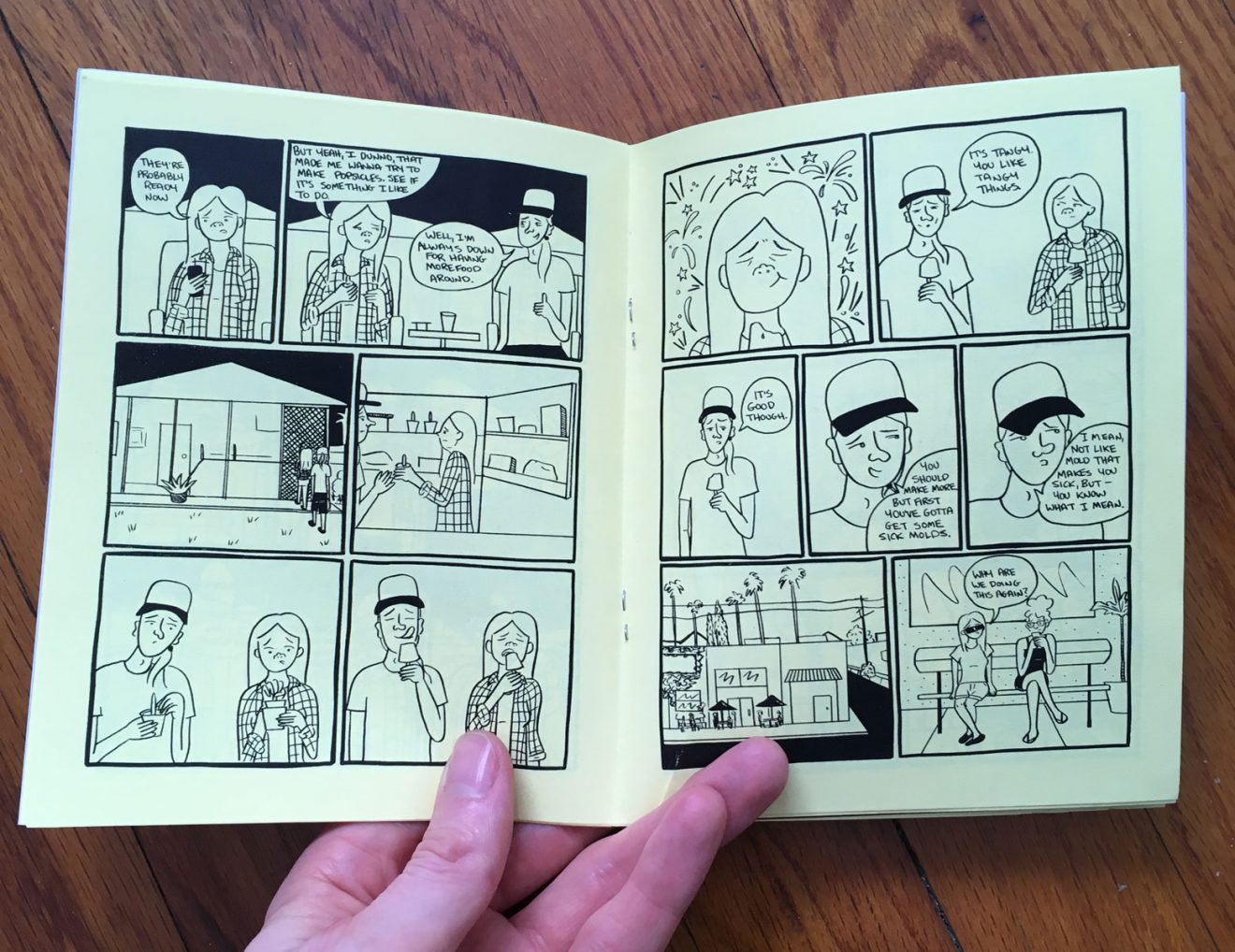
Fizzle #2, by Whit Taylor. The second issue of Taylor's slice-of-life series about a disaffected young woman named Claire. She works in a boutique tea shop, she has a rich stoner boyfriend, and she has no idea what to do with her life. One of the questions that Taylor raises here is if there's a difference between existential malaise and depression. After all, there's nothing "wrong" with her life, but it's made clear that she's desperate to have a "thing" to make her own. A hobby, a belief, a creative outlet--something. Taylor seems to suggest that there is certainly a link between the two concepts of malaise and depression, with the former leading to the latter at times. Indeed, many therapists recognize situational depression as a diagnosis different than major depression. That said, the character of Claire is in more of a holding pattern in this comic, trying to fight the feeling of "meh", with anything, even something as silly as making gourmet popsicles.
There's a panel where Claire made her popsicles out of different kinds of fruit, she tries it and fireworks go off around her head. It's a brief, sublime moment. There's that moment of possibility that's then spoiled by her boyfriend and her awful boss, but it's a memorable moment nonetheless. A Shark Tank-style reality show introduced toward the end makes me think the comic will go in that direction, but even if it doesn't Taylor's wry comedic chops are on display here, as her send-up of popular and youth culture in general is sharp. She's really locked into her style as an artist as well, with expressive faces that center around lips and eyebrows. There's a smooth confidence to her work that can be seen all-around in her page design and backgrounds. In a comic that's mostly talking heads, her ability to make create compelling expressions was the key to the comic's success.
Friday, October 26, 2018
Thursday, October 25, 2018
Minis: Ed Luce
WANC: Hell On Ice Special, by Ed Luce. This is a black & white version of what will be a full color feature in Luce's upcoming Wuvable Oaf volume for Fantagraphics. One thing I've always liked about Luce's work is that he's innovated all sorts of clever gimmicks (not unlike a wrestling gimmick) in self-publishing his work. From special lanyards for the bands featured in the comic to centerfolds and all sorts of special editions, Luce has always had an eye on catching the eye of casual fans with something spectacular. Here, he mimics the old WWF magazine as the story follows Oaf from his days as a professional wrestler in WANC (Wrasslin' Association of National Champions). It even has a centerfold featuring Goteblud and Luce as a referee.
While Wuvable Oaf has always been a romance comic first and foremost, it's also been a comic about pro wrestling and a comic about death metal, all with queer themes. It's been Luce's mission to show queer characters doing things you wouldn't necessarily see in either mainstream or queer-themed work. He goes out of his way to feature characters who are "bears", for one thing, and the model on the cover of the magazine portraying Oaf (as his wrestling character Goteblud) is there in all his hairy glory. Luce also has a strong understanding of the ring psychology and storytelling that are a part of wrestling, only his imaginary territory is one far more open to queer characters than most wrestling associations these days. (That is changing a bit, though...)
Most of the issue is an absurd gimmick match between Goteblud and his opponent, Dr. Avalanche, in a "Hell on Ice" match where the ring was coated in ice. The entirety of the issue features this match, but Luce also works in a romance angle, a backstage business intrigue angle, and the tension that Dr. Avalanche wasn't going to let his young foe "get over", i.e., he wasn't going to let him win even thought that's what the script said. Where Luce was most successful here was presenting absurd, over-the-top action while still making the story all about character and incorporating queer themes throughout. Now, those themes are somewhat subordinated to this particular story, but that will even out in the upcoming book, I would imagine. Fans of the Oaf will want this no matter what; casual fans can wait til the book comes out. That said, it's a pleasure to see the fine details of Luce's line art on display.
While Wuvable Oaf has always been a romance comic first and foremost, it's also been a comic about pro wrestling and a comic about death metal, all with queer themes. It's been Luce's mission to show queer characters doing things you wouldn't necessarily see in either mainstream or queer-themed work. He goes out of his way to feature characters who are "bears", for one thing, and the model on the cover of the magazine portraying Oaf (as his wrestling character Goteblud) is there in all his hairy glory. Luce also has a strong understanding of the ring psychology and storytelling that are a part of wrestling, only his imaginary territory is one far more open to queer characters than most wrestling associations these days. (That is changing a bit, though...)
Most of the issue is an absurd gimmick match between Goteblud and his opponent, Dr. Avalanche, in a "Hell on Ice" match where the ring was coated in ice. The entirety of the issue features this match, but Luce also works in a romance angle, a backstage business intrigue angle, and the tension that Dr. Avalanche wasn't going to let his young foe "get over", i.e., he wasn't going to let him win even thought that's what the script said. Where Luce was most successful here was presenting absurd, over-the-top action while still making the story all about character and incorporating queer themes throughout. Now, those themes are somewhat subordinated to this particular story, but that will even out in the upcoming book, I would imagine. Fans of the Oaf will want this no matter what; casual fans can wait til the book comes out. That said, it's a pleasure to see the fine details of Luce's line art on display.
Wednesday, October 24, 2018
Minis: Haleigh Buck's I Feel Weird #3
I Feel Weird, Haleigh Buck's continuing series about "depression, anxiety and hopefully getting over it!" is about as raw and real as it gets. That's both in terms of talking about those feelings as well as the long, hard process of therapy. Buck sharing about what brought her to bottoming out in previous issues was certainly harrowing, but that's a narrative that is a familiar one in a sense. Lots of attention is paid in mental health narratives to "this is where I was, I needed help, and I got help" (which is valid and important, certainly), but much less is paid to the long, incremental process of getting better. That's especially true thanks to how frequently difficult it is to actually get therapy in a time when getting health insurance in general is so difficult, especially if one doesn't have the means to do so.
Issue three is her most ambitious, centered and focused effort to date. It must first be said that her level of craft is just outstanding. She can go cartoony to hyperrealistic naturalism and it all fits together. Her page design choices are consistently interesting, using blacks as a way of overpowering the reader and getting across that sense of anxiety that permeates every bit of her work. Buck jams a lot of words onto each page and even makes that crowding a decorative aspect of her work. With dense hatching and cross-hatching to add detail and depth to her work, Buck just likes slinging ink and makes it work for her. In the Will Elder tradition, she also adds a lot of funny eye pops to each page. Indeed, while Buck's work is visually dense, by no means is it dour. She's a funny writer who can take the darkest topic and make it funny. For example, the back cover has a bunch of comics and a coffin with an interesting and particular shape that's captioned "Thanks for keeping me out of life's longbox." It's a great image, and Buck's attention to detail, as always, is important in getting the joke to land.
In the rest of the issue, Buck goes back and forth from the psychotherapy session that began in the previous issue and other stories. The first story is about a New Year's Eve hookup that disappoints because the guy she's with announces that he doesn't want a relationship the next day. She tries to laugh it off in the story itself while informing the reader that she is upset. There's a brief strip about the sort of responses one gets when others learn that you've tried to commit suicide, which is scorched-earth on-point and darkly hilarious at the same time. There's an anecdote about Buck's especially dysfunctional younger sister who had just had a baby--and Buck's other sister was understandably concerned for the baby's welfare. The anecdote concerns some psychopathic behavior evinced by their younger sister as a child, and it's an understandable concern. The art here slides between caricature and near-photorealism, and the effect is astounding.
Of course, the main attraction in this issue is the therapy session, with a therapist who's using a prescribed method (including tagging patients as being a particular kind of tree?) and is not exactly the essence of empathy. The therapy session runs in a narrow row of panels at the top of the page, and the rest of the page is taken up by the history of depression and its treatment from antiquity to now. It's a sobering reminder of just how primitive medicine was (and still is, in some ways), especially with regard to mental health. Buck's illustrations are funny and weird, giving the reader a lot to look at. In the next therapy chapter, her anxiety is addressed, and there's an amazing page where her therapist asks her what makes her anxious. Buck replies, "Everything" and then spends an entire page, with white lettering atop a black page, listing dozens and dozens of triggers. It's page that doesn't even need to be read from top to bottom--the simple acknowledgment of the scope of her triggers makes it a powerful image, with a small self-caricature in the bottom left-hand corner of the page. Incredibly, the story ends with the therapist asking how often Buck prays. What separates this issue from the earlier two is Buck's focus is much sharper, allowing her to really zero in on key issues and render them in the form of a narrative. There's no question that she's a major talent, as this comic shows off her storytelling, drawing and writing chops.
Issue three is her most ambitious, centered and focused effort to date. It must first be said that her level of craft is just outstanding. She can go cartoony to hyperrealistic naturalism and it all fits together. Her page design choices are consistently interesting, using blacks as a way of overpowering the reader and getting across that sense of anxiety that permeates every bit of her work. Buck jams a lot of words onto each page and even makes that crowding a decorative aspect of her work. With dense hatching and cross-hatching to add detail and depth to her work, Buck just likes slinging ink and makes it work for her. In the Will Elder tradition, she also adds a lot of funny eye pops to each page. Indeed, while Buck's work is visually dense, by no means is it dour. She's a funny writer who can take the darkest topic and make it funny. For example, the back cover has a bunch of comics and a coffin with an interesting and particular shape that's captioned "Thanks for keeping me out of life's longbox." It's a great image, and Buck's attention to detail, as always, is important in getting the joke to land.
In the rest of the issue, Buck goes back and forth from the psychotherapy session that began in the previous issue and other stories. The first story is about a New Year's Eve hookup that disappoints because the guy she's with announces that he doesn't want a relationship the next day. She tries to laugh it off in the story itself while informing the reader that she is upset. There's a brief strip about the sort of responses one gets when others learn that you've tried to commit suicide, which is scorched-earth on-point and darkly hilarious at the same time. There's an anecdote about Buck's especially dysfunctional younger sister who had just had a baby--and Buck's other sister was understandably concerned for the baby's welfare. The anecdote concerns some psychopathic behavior evinced by their younger sister as a child, and it's an understandable concern. The art here slides between caricature and near-photorealism, and the effect is astounding.
Of course, the main attraction in this issue is the therapy session, with a therapist who's using a prescribed method (including tagging patients as being a particular kind of tree?) and is not exactly the essence of empathy. The therapy session runs in a narrow row of panels at the top of the page, and the rest of the page is taken up by the history of depression and its treatment from antiquity to now. It's a sobering reminder of just how primitive medicine was (and still is, in some ways), especially with regard to mental health. Buck's illustrations are funny and weird, giving the reader a lot to look at. In the next therapy chapter, her anxiety is addressed, and there's an amazing page where her therapist asks her what makes her anxious. Buck replies, "Everything" and then spends an entire page, with white lettering atop a black page, listing dozens and dozens of triggers. It's page that doesn't even need to be read from top to bottom--the simple acknowledgment of the scope of her triggers makes it a powerful image, with a small self-caricature in the bottom left-hand corner of the page. Incredibly, the story ends with the therapist asking how often Buck prays. What separates this issue from the earlier two is Buck's focus is much sharper, allowing her to really zero in on key issues and render them in the form of a narrative. There's no question that she's a major talent, as this comic shows off her storytelling, drawing and writing chops.
Wednesday, October 17, 2018
Minis: E.Lindner
Pitching A Fit In The Big City was partly a walk down memory lane for me, as I've been reading Ellen Linder's work since the very beginning of her career. This collects stories from 2001-2016, published in various minis and anthologies, as well as a couple of new stories. Lindner has always been a great writer in particular, even in her earliest stories like "Pieces", where she talked about the memory of her grandfather talking at her, cutting her to metaphorical bits because of her relative unimportance in the interaction. Lindner used a big, chunky line in the early days, like in her memoir about 9/11. It was a striking approach, but she's evolved and has used a number of different approaches. Her story about working at the Museum of Modern Art was fun because of the way she incorporated so many of the holdings as visual elements in her narrative.
Then there's "Hygienic Sex", a bawdy and hilarious memoir about a past relationship and its complications. Lindner's autobiographical tone has often had an amusingly formal feel to it, especially when she's deliberately trying to be funny. The tone is almost that of an old-time romance comic, paired with a raunchy and crude series of events. Lindner is a long-time city dweller, and her settings are often in flats, subways and the claustrophobic living conditions in a city. "What The Iguana Saw" was about dealing with a peeping Tom, an apathetic police response, and a totally random question asked by a cop. Lindner has a way of supporting funny moments, crystallizing the essence and leading it up to it with amusing details.
Lindner is also great at taking on a specific topic and building a story around it. In "Me And My Sari", Lindner talks about the garment given to her by her mother-in-law, the times she's worn it and why, and responses she's received by wearing it. "Bill Murray's Doughnut" is interesting because it details her experience as an extra on a film set, hoping for an encounter with Murray. A story about a facebook connection became interesting when she realized that a close friend of hers in England knew someone she dated in high school. Lindner took that coincidence and realized that a lot of negative perceptions she had about her experience weren't his fault. "Goodbye" was the most recent story in the issue and certainly the most devastating and raw. Here, Lindner talked about her tendency to used bake goods as a way of showing affection and recalling a time when a misunderstanding regarding this made an abusive ex-boyfriend flip out and put his hands around her throat. Lindner details her naivete and trusting nature, and how she was so baffled and stunned and hurt by the experience. Lindner then abandoned her typical, fluid line and switched to herself in the present day, drawn in a naturalistic style with a gray wash, as she talked about coming to terms with this story. This was a beautiful and haunting story that was a fantastic capper for this one-woman anthology, demonstrating Lindner's growth as an artist.
Then there's "Hygienic Sex", a bawdy and hilarious memoir about a past relationship and its complications. Lindner's autobiographical tone has often had an amusingly formal feel to it, especially when she's deliberately trying to be funny. The tone is almost that of an old-time romance comic, paired with a raunchy and crude series of events. Lindner is a long-time city dweller, and her settings are often in flats, subways and the claustrophobic living conditions in a city. "What The Iguana Saw" was about dealing with a peeping Tom, an apathetic police response, and a totally random question asked by a cop. Lindner has a way of supporting funny moments, crystallizing the essence and leading it up to it with amusing details.
Lindner is also great at taking on a specific topic and building a story around it. In "Me And My Sari", Lindner talks about the garment given to her by her mother-in-law, the times she's worn it and why, and responses she's received by wearing it. "Bill Murray's Doughnut" is interesting because it details her experience as an extra on a film set, hoping for an encounter with Murray. A story about a facebook connection became interesting when she realized that a close friend of hers in England knew someone she dated in high school. Lindner took that coincidence and realized that a lot of negative perceptions she had about her experience weren't his fault. "Goodbye" was the most recent story in the issue and certainly the most devastating and raw. Here, Lindner talked about her tendency to used bake goods as a way of showing affection and recalling a time when a misunderstanding regarding this made an abusive ex-boyfriend flip out and put his hands around her throat. Lindner details her naivete and trusting nature, and how she was so baffled and stunned and hurt by the experience. Lindner then abandoned her typical, fluid line and switched to herself in the present day, drawn in a naturalistic style with a gray wash, as she talked about coming to terms with this story. This was a beautiful and haunting story that was a fantastic capper for this one-woman anthology, demonstrating Lindner's growth as an artist.
Monday, October 15, 2018
Minis: G. Fawkes
Hitting some more interesting minis...
Exit Archaeology, by Glynnis Fawkes. This is both a self-contained work and a sequel to her much longer Greek Diary as well as a companion piece to her other comics about being an illustrator at an archaeological site in Greece. Greece is a country that holds a great deal of meaning for Fawkes, and Kenchreai in particular. That's the eastern port of Corinth, where she had for nearly a decade worked drawing pottery shards and other items from an excavation site of Roman items. One of the running themes in Fawkes' comics is the notion of how difficult agency can be as a creative person. While artistic freedom and freedom in general is important, Fawkes found herself drawn to a job that had no creative nor academic value to her personally. She was an artisan, paid to do a job as an illustrator. No more, no less.
Being freed from the pressure of academia or comics deadlines--and even the responsibilities of having a family--was hard to give up. She could simply work, swim, sketch, drink and explore the area with friends. One gets the sense that Fawkes is constantly restless, her mind going in a million different directions. Only a mindless physical activity like her job or walking around seemed to soothe that buzzing brain. Even at that, the fact that she knew that she couldn't justify another trip out for this job ate at her a little, as time suddenly became a limiting factor for what was usually a more open-ended experience.
Her sketches of the local area are delightfully vivid and loose, as are her drawings of her friends. Indeed, the one major change is that this comic was much less of an interior exercise than some past efforts, and the second half of the comic focuses on the camaraderie of her work group. It wasn't just the labor that was important to her but also the fact that she was part of a team. She was an important cog making the machine run smoothly, and she took great pleasure in bouncing off of people who had become close friends over the years. More than anything, that's what Fawkes emphasized in this comic. Just as working in Corinth had become something she did for herself, so too is this comic a gift for herself. It's slowly paced and has a number of sketches of local sights. It lacks the interpersonal or family drama of her other comics set in Greece, and its only structure is that of the time spent in Greece itself. It's a breezy read at 44 pages, but it could have been even shorter without losing the essence of the story. Of course, self-indulgence was not only a theme of the comic, it was also the format of the comic. This is a comic that invites the reader to stop, slow down, and breathe as we join Fawkes soaking it all in as much as she could.
Exit Archaeology, by Glynnis Fawkes. This is both a self-contained work and a sequel to her much longer Greek Diary as well as a companion piece to her other comics about being an illustrator at an archaeological site in Greece. Greece is a country that holds a great deal of meaning for Fawkes, and Kenchreai in particular. That's the eastern port of Corinth, where she had for nearly a decade worked drawing pottery shards and other items from an excavation site of Roman items. One of the running themes in Fawkes' comics is the notion of how difficult agency can be as a creative person. While artistic freedom and freedom in general is important, Fawkes found herself drawn to a job that had no creative nor academic value to her personally. She was an artisan, paid to do a job as an illustrator. No more, no less.
Being freed from the pressure of academia or comics deadlines--and even the responsibilities of having a family--was hard to give up. She could simply work, swim, sketch, drink and explore the area with friends. One gets the sense that Fawkes is constantly restless, her mind going in a million different directions. Only a mindless physical activity like her job or walking around seemed to soothe that buzzing brain. Even at that, the fact that she knew that she couldn't justify another trip out for this job ate at her a little, as time suddenly became a limiting factor for what was usually a more open-ended experience.
Her sketches of the local area are delightfully vivid and loose, as are her drawings of her friends. Indeed, the one major change is that this comic was much less of an interior exercise than some past efforts, and the second half of the comic focuses on the camaraderie of her work group. It wasn't just the labor that was important to her but also the fact that she was part of a team. She was an important cog making the machine run smoothly, and she took great pleasure in bouncing off of people who had become close friends over the years. More than anything, that's what Fawkes emphasized in this comic. Just as working in Corinth had become something she did for herself, so too is this comic a gift for herself. It's slowly paced and has a number of sketches of local sights. It lacks the interpersonal or family drama of her other comics set in Greece, and its only structure is that of the time spent in Greece itself. It's a breezy read at 44 pages, but it could have been even shorter without losing the essence of the story. Of course, self-indulgence was not only a theme of the comic, it was also the format of the comic. This is a comic that invites the reader to stop, slow down, and breathe as we join Fawkes soaking it all in as much as she could.
Thursday, October 11, 2018
Minis: K.Roberts, M.S. Harkness/Y.Kwon, G.Vasile
Once more into the minicomics breach...
We Watched Wrestling, by M.S. Harkness and Yewon Kwon. There is certainly an intersection between alt-comics and wrestling fandoms, and there has been for a long time. Jaime Hernandez is a great example of this, understanding the relationship between telenovelas and lucha libre in his Love & Rockets stories. One of the key characters in Reilly Hadden's Astral Birth Canal is a female wrestler. The titular character in Ed Luce's death metal romance Wuvable Oaf is a retired wrestler. For M.S. Harkness, best known for her autobio comic Tinderella, it's all about fandom. She & fellow fan Yewon Kwon decided to do a weekly diary of the WWE shows leading up to their big Summerslam event.
Harkness and Kwon both watch wrestling in part because of its sex appeal, and they both fully understand and embrace the total silliness of it. Harkness watched the RAW wrestling show, and it's in red ink because that's the trademark color of the brand. Her commentary was hilarious and often personal, like fantasizing about a wrestling faction consisting only of "brunette, bearded babes". Harkness' angular character design mixed with fluid page composition made for a consistently entertaining read, even if the reader didn't know what was happening. There's a measured balance her genuine interest and investment in what she's watching and her mockery of same; the former is what allows her to do the latter without seeing too snarky. Kwon's comics are a bit more naturalistic than Harkness' and use a thinner line weight. The commentary is also more spare and more serious, but it's a nice complement to what Harkness did. The centerfold is about a wrestling tournament in Japan by an artist named Chaack, which provides yet another color-coding for the comic and a more rapid-fire accounting of events. All told, this is probably best enjoyed by wrestling fans, but it certainly made me want to read weekly recaps of the matches by this duo.
Paintings, by Keiler Roberts. Roberts posted some of these on Facebook, and they are an interesting companion piece to her comics in part because they hearken back to an earlier creative outlet of hers in painting. Some of the paintings are direct recreations of panels that appeared in her comics, like the funny and heartbreaking image of Roberts laying down in the laundry, crying, as her husband encourages her to take a walk. The image here is a little more vague, and her muted color palette is interesting because it conjures up an image of suburban living. This is an ordinary person in a nice home who is clearly struggling. The image of her crying while lifting weights in the basement is telling in that regard, for example. At the same time, there are images of a woman trying to take joy in life and routine as well, as she plays with her dog and daughter. There are images of houseplants, the despair of a dirty stove, the solace of her dog as she's curled up on the couch. The cheerfulness of the colors often belies the sadness of the situation, and I think that's intentional. Mental illness can't be seen, and there's often no "reason" why someone should be depressed. At the same time, Roberts is also simply living her life as best she can.
It's interesting to look at these, both in and out of context with the rest of Roberts' work. They tell their own story, but it's a more simplified version of what Roberts writes about. What they tend to lack most out of context is Roberts' sense of humor and the immediacy of her drawing style. That said, the paintings are lively on their own thanks to their own lack of fussiness with regard to form combined with a great deal of thought regarding the choices of color. There's also the matter of still lives of domestic objects behind on the left-hand side of each double-page spread, and images of her and her family on the right. While meant to be looked at in a non-sequential manner, they nonetheless are part of a greater whole. This was an interesting experiment, and it would be fascinating to see Keiler use spot color in her books in the future, perhaps with the chapter-demarcating images she drew in her most recent book Chlorine Gardens.
I'm A Bad Person And So Are You & It Was Fun While It Lasted, by Geoff Vasile. I'm a long-time fan of Vasile's fiction, but his diary comics are just as good. He establishes very quickly that he's not here to talk about what he had for lunch, as he immediately addresses his frustration with his career, his depression, his stressful job in the service industry, his substance use (and abuse), and his frustration with dating. That said, Vasile has the instincts of a humorist, and these four-panel daily strips are continuously funny and have strong punchlines, even when he's writing about something that's fairly dark. There's one especially brutal strip where the woman he's dating casually is jealous over him paying attention to another friend at a bar and gets angry at him, and later wakes up apologetically wanting to have sex. The final thought balloon of his, "Sex is no longer worth the effort it takes to have." is both grim and exactly the sort of thing a middle-aged man might think in that situation.
At the same time, he depicts himself as immediately off-putting and cynical, telling a date that he cherished a memory of a one-night stand where neither person even pretended that they were going to contact them again. Vasile isn't afraid to show himself, warts and all, but not in a way that's begging for sympathy nor in a way that is self-aggrandizing. The second collection goes even deeper into bad dates (one woman tells him to come up with his third-favorite painting in a museum date), bar fights, oversharing of feelings, his own "scummy" behavior with women, quitting his horrible job, self-hatred of various kinds, misanthropy, suicidal ideations, his horrible relationship with his dead parents, going to therapy and getting medicated. All of this is executed in his crisp, clear line (with shades of Jaime Hernandez in his character design) and is far more entertaining than it sounds, because of his tremendous wit. Vasile simply knows how to tell a story, whether it's directly about him or not.
We Watched Wrestling, by M.S. Harkness and Yewon Kwon. There is certainly an intersection between alt-comics and wrestling fandoms, and there has been for a long time. Jaime Hernandez is a great example of this, understanding the relationship between telenovelas and lucha libre in his Love & Rockets stories. One of the key characters in Reilly Hadden's Astral Birth Canal is a female wrestler. The titular character in Ed Luce's death metal romance Wuvable Oaf is a retired wrestler. For M.S. Harkness, best known for her autobio comic Tinderella, it's all about fandom. She & fellow fan Yewon Kwon decided to do a weekly diary of the WWE shows leading up to their big Summerslam event.
Harkness and Kwon both watch wrestling in part because of its sex appeal, and they both fully understand and embrace the total silliness of it. Harkness watched the RAW wrestling show, and it's in red ink because that's the trademark color of the brand. Her commentary was hilarious and often personal, like fantasizing about a wrestling faction consisting only of "brunette, bearded babes". Harkness' angular character design mixed with fluid page composition made for a consistently entertaining read, even if the reader didn't know what was happening. There's a measured balance her genuine interest and investment in what she's watching and her mockery of same; the former is what allows her to do the latter without seeing too snarky. Kwon's comics are a bit more naturalistic than Harkness' and use a thinner line weight. The commentary is also more spare and more serious, but it's a nice complement to what Harkness did. The centerfold is about a wrestling tournament in Japan by an artist named Chaack, which provides yet another color-coding for the comic and a more rapid-fire accounting of events. All told, this is probably best enjoyed by wrestling fans, but it certainly made me want to read weekly recaps of the matches by this duo.
Paintings, by Keiler Roberts. Roberts posted some of these on Facebook, and they are an interesting companion piece to her comics in part because they hearken back to an earlier creative outlet of hers in painting. Some of the paintings are direct recreations of panels that appeared in her comics, like the funny and heartbreaking image of Roberts laying down in the laundry, crying, as her husband encourages her to take a walk. The image here is a little more vague, and her muted color palette is interesting because it conjures up an image of suburban living. This is an ordinary person in a nice home who is clearly struggling. The image of her crying while lifting weights in the basement is telling in that regard, for example. At the same time, there are images of a woman trying to take joy in life and routine as well, as she plays with her dog and daughter. There are images of houseplants, the despair of a dirty stove, the solace of her dog as she's curled up on the couch. The cheerfulness of the colors often belies the sadness of the situation, and I think that's intentional. Mental illness can't be seen, and there's often no "reason" why someone should be depressed. At the same time, Roberts is also simply living her life as best she can.
It's interesting to look at these, both in and out of context with the rest of Roberts' work. They tell their own story, but it's a more simplified version of what Roberts writes about. What they tend to lack most out of context is Roberts' sense of humor and the immediacy of her drawing style. That said, the paintings are lively on their own thanks to their own lack of fussiness with regard to form combined with a great deal of thought regarding the choices of color. There's also the matter of still lives of domestic objects behind on the left-hand side of each double-page spread, and images of her and her family on the right. While meant to be looked at in a non-sequential manner, they nonetheless are part of a greater whole. This was an interesting experiment, and it would be fascinating to see Keiler use spot color in her books in the future, perhaps with the chapter-demarcating images she drew in her most recent book Chlorine Gardens.
I'm A Bad Person And So Are You & It Was Fun While It Lasted, by Geoff Vasile. I'm a long-time fan of Vasile's fiction, but his diary comics are just as good. He establishes very quickly that he's not here to talk about what he had for lunch, as he immediately addresses his frustration with his career, his depression, his stressful job in the service industry, his substance use (and abuse), and his frustration with dating. That said, Vasile has the instincts of a humorist, and these four-panel daily strips are continuously funny and have strong punchlines, even when he's writing about something that's fairly dark. There's one especially brutal strip where the woman he's dating casually is jealous over him paying attention to another friend at a bar and gets angry at him, and later wakes up apologetically wanting to have sex. The final thought balloon of his, "Sex is no longer worth the effort it takes to have." is both grim and exactly the sort of thing a middle-aged man might think in that situation.
At the same time, he depicts himself as immediately off-putting and cynical, telling a date that he cherished a memory of a one-night stand where neither person even pretended that they were going to contact them again. Vasile isn't afraid to show himself, warts and all, but not in a way that's begging for sympathy nor in a way that is self-aggrandizing. The second collection goes even deeper into bad dates (one woman tells him to come up with his third-favorite painting in a museum date), bar fights, oversharing of feelings, his own "scummy" behavior with women, quitting his horrible job, self-hatred of various kinds, misanthropy, suicidal ideations, his horrible relationship with his dead parents, going to therapy and getting medicated. All of this is executed in his crisp, clear line (with shades of Jaime Hernandez in his character design) and is far more entertaining than it sounds, because of his tremendous wit. Vasile simply knows how to tell a story, whether it's directly about him or not.
Labels:
geoff vasile,
keiler roberts,
m.s. harkness,
yewon kwon
Wednesday, October 10, 2018
Retrofit/Big Planet Comics: Summer Pierre's All The Sad Songs
Summer Pierre's short autobiographical vignettes in her minicomics series Paper Pencil Life have established her as a sensitive, philosophical and quirky presence in the ever-growing comics memoir genre. Her dedication to exploring her interior life creates its own set of narratives, often complete with punchlines. All The Sad Songs is her first extended work at over a hundred pages, and it's on the surface a love letter to the role that music has played in her life. Of course, what becomes evident about halfway through is that the book is really about Pierre's unprocessed PTSD and her subsequent treatment.
Pierre's art emphasizes a heavy use of black, dense hatching and a strong sense of atmosphere. At the same time, her figures are warm and inviting to look at, drawn in a beautifully clear style that accentuates gesture and expressiveness. The result is deeply intimate, as Pierre warmly welcomes the reader into her story and invites us to be there with her through every moment of pain and joy. There's little use of negative space, as Pierre asks the reader to immerse themselves into her world and memories. It's a daring approach for an entire book, but Pierre's gentle wit assures the reader that the experience will not be a suffocating one.
The running theme throughout the book is not just that music was something that had a powerful effect on her, even as a teen, but that it was something she felt the urge to share with others. As such, the book pays loving attention to the clunky old mix tape. It's a format that's now dead, but at the time, having the power to record music off the radio or an LP was remarkable, especially when portable formats became available. Moreover, a mixtape was a personal message: a juxtaposition of songs given new meaning by the intentionality of the person making them. It's a testament to the fact that editing is its own art form and means of expression, like a good editor with an anthology.
Mixtapes were a way of expressing excitement, affection (especially for new crushes) and friendship. And the technology had something to do with this particular expression, because it was often a tedious, long process to make a mix tape. Furthermore, when you listened to a mix tape, it wasn't easy to simply skip a track and go to another one if you didn't like a song. Listening to a mix tape was just as much of a commitment as making one. There were no other options for recording music until the CD burner came along and the digital music revolution. It's in this setting that Pierre's book takes place.
If her book is really about PTSD, then its twin themes are intentionality and seeking meaning. As a child of a musician and someone in the rock business, music was just something that was part of her natural atmosphere. It was like breathing; she didn't even have to think about it. As such Pierre notes that a lot of the mix tapes she made in her youth and young adulthood were a reflection of that river of music that was was floating down. It surrounded and carried her, rather than being something that felt like it was hers. For a young person, finding that song or band that just gets you can be a crucial process, one that she didn't achieve until the riot grrrl movement of the early and mid 1990s. More to the point, it pushed Pierre from the passive act of listening to actually learning how to play guitar.
That led her to become a part of Boston's folk music scene. She played every open-mic night, every bar, every shop that would let her play. The key section of the book is her articulating chasing the feeling "of being found, of being known, of being heard in songs", looking for a specific kind of sublime aesthetic experience that can't be forced; you must be lucky enough for it to reveal itself to you. It's an experience that binds song and listener together, conjuring from thin air a combination of words and melodies that explains how they feel as someone living in this world. For a moment, that itch in the back of one's brain is finally scratched. We have peeked behind the curtain and saw the glory of creation, and we get to remember it for a little while.
That feeling does not make us immune to pain and trauma, nor is it a cure for it. Leaning on it too heavily can be like any form of self-medication: effective until it reaches the point of diminished returns--and then no longer effective. Pierre describes in detail how denying one's own pain eventually comes at an enormous cost, one with somatic as well as psychological symptoms. For Pierre, she described this feeling of anger and betrayal that led to "the brick"--a feeling in the pit of her stomach that made it hard to breathe. It was a panic attack, brought on by years of PTSD being exacerbated by a continuous loop of bad relationship choices.
Music is something that was recommended to her by her first therapist, who used the "talking cure". At the time, music was the only thing that gave her pleasure and didn't cause anxiety. Her former loves writing and drawing led to those somatic experiences of PTSD as well. The problem was that Pierre sought validation, redemption and tranquility by chasing relationships, no matter how ill-advised they were. The more she chased the sublime as a means of self-medicating, the further away it got from her. It was only when she picked up, moved across the country and got a new therapist who focused on how her mind and body were out of synch that she began to get better. Focusing on mindfulness of her body when she felt anxious, breathing techniques and other meditative therapy made all the difference.
The book emphasizes that the experience of art, and music in particular, is an essential part of what it means to be human. Be it listening for that song that hears you or performing music as an expression of living in that joy, music has powerful, positive effects on us. What Pierre points out is that these effects are not the same thing as therapy, no matter how much we channel our emotions into it. Pain has to be dealt with openly and in a therapeutic setting as a way of putting us on the right course, and/or with the intervention of medication. Doing so allowed Pierre to write her first love song for a man who was leaving town and couldn't get involved with her.
It was a song about that feeling of sadness "without rage", without trying to get someone to do something, without trying to wound or lick a wound. It's a beautiful grace note of an ending, especially with the sly use of the book's framing device. The book was told in past tense as Pierre looked over her old mixtapes and letters, and one of the final images is a current image of her husband and son--and her husband looks an awful lot like that man who had to leave her many years ago. It's a beautiful grace note as she offers up music not as a cure, but as a hook--something that lets us know that we are alive, we are heard and we are seen. Sometimes that's all we need to point us in the right direction to make our lives better.
Pierre's art emphasizes a heavy use of black, dense hatching and a strong sense of atmosphere. At the same time, her figures are warm and inviting to look at, drawn in a beautifully clear style that accentuates gesture and expressiveness. The result is deeply intimate, as Pierre warmly welcomes the reader into her story and invites us to be there with her through every moment of pain and joy. There's little use of negative space, as Pierre asks the reader to immerse themselves into her world and memories. It's a daring approach for an entire book, but Pierre's gentle wit assures the reader that the experience will not be a suffocating one.
The running theme throughout the book is not just that music was something that had a powerful effect on her, even as a teen, but that it was something she felt the urge to share with others. As such, the book pays loving attention to the clunky old mix tape. It's a format that's now dead, but at the time, having the power to record music off the radio or an LP was remarkable, especially when portable formats became available. Moreover, a mixtape was a personal message: a juxtaposition of songs given new meaning by the intentionality of the person making them. It's a testament to the fact that editing is its own art form and means of expression, like a good editor with an anthology.
Mixtapes were a way of expressing excitement, affection (especially for new crushes) and friendship. And the technology had something to do with this particular expression, because it was often a tedious, long process to make a mix tape. Furthermore, when you listened to a mix tape, it wasn't easy to simply skip a track and go to another one if you didn't like a song. Listening to a mix tape was just as much of a commitment as making one. There were no other options for recording music until the CD burner came along and the digital music revolution. It's in this setting that Pierre's book takes place.
If her book is really about PTSD, then its twin themes are intentionality and seeking meaning. As a child of a musician and someone in the rock business, music was just something that was part of her natural atmosphere. It was like breathing; she didn't even have to think about it. As such Pierre notes that a lot of the mix tapes she made in her youth and young adulthood were a reflection of that river of music that was was floating down. It surrounded and carried her, rather than being something that felt like it was hers. For a young person, finding that song or band that just gets you can be a crucial process, one that she didn't achieve until the riot grrrl movement of the early and mid 1990s. More to the point, it pushed Pierre from the passive act of listening to actually learning how to play guitar.
That led her to become a part of Boston's folk music scene. She played every open-mic night, every bar, every shop that would let her play. The key section of the book is her articulating chasing the feeling "of being found, of being known, of being heard in songs", looking for a specific kind of sublime aesthetic experience that can't be forced; you must be lucky enough for it to reveal itself to you. It's an experience that binds song and listener together, conjuring from thin air a combination of words and melodies that explains how they feel as someone living in this world. For a moment, that itch in the back of one's brain is finally scratched. We have peeked behind the curtain and saw the glory of creation, and we get to remember it for a little while.
That feeling does not make us immune to pain and trauma, nor is it a cure for it. Leaning on it too heavily can be like any form of self-medication: effective until it reaches the point of diminished returns--and then no longer effective. Pierre describes in detail how denying one's own pain eventually comes at an enormous cost, one with somatic as well as psychological symptoms. For Pierre, she described this feeling of anger and betrayal that led to "the brick"--a feeling in the pit of her stomach that made it hard to breathe. It was a panic attack, brought on by years of PTSD being exacerbated by a continuous loop of bad relationship choices.
Music is something that was recommended to her by her first therapist, who used the "talking cure". At the time, music was the only thing that gave her pleasure and didn't cause anxiety. Her former loves writing and drawing led to those somatic experiences of PTSD as well. The problem was that Pierre sought validation, redemption and tranquility by chasing relationships, no matter how ill-advised they were. The more she chased the sublime as a means of self-medicating, the further away it got from her. It was only when she picked up, moved across the country and got a new therapist who focused on how her mind and body were out of synch that she began to get better. Focusing on mindfulness of her body when she felt anxious, breathing techniques and other meditative therapy made all the difference.
The book emphasizes that the experience of art, and music in particular, is an essential part of what it means to be human. Be it listening for that song that hears you or performing music as an expression of living in that joy, music has powerful, positive effects on us. What Pierre points out is that these effects are not the same thing as therapy, no matter how much we channel our emotions into it. Pain has to be dealt with openly and in a therapeutic setting as a way of putting us on the right course, and/or with the intervention of medication. Doing so allowed Pierre to write her first love song for a man who was leaving town and couldn't get involved with her.
It was a song about that feeling of sadness "without rage", without trying to get someone to do something, without trying to wound or lick a wound. It's a beautiful grace note of an ending, especially with the sly use of the book's framing device. The book was told in past tense as Pierre looked over her old mixtapes and letters, and one of the final images is a current image of her husband and son--and her husband looks an awful lot like that man who had to leave her many years ago. It's a beautiful grace note as she offers up music not as a cure, but as a hook--something that lets us know that we are alive, we are heard and we are seen. Sometimes that's all we need to point us in the right direction to make our lives better.
Subscribe to:
Posts (Atom)


