Tuesday, December 19, 2023

45 Days Of CCS, #19: Betsey Swardlick

Betsey Swardlick's punk and slightly ramshackle humor comics have always been a highlight of this feature, because she never fails to make me laugh. Whether it's vegan werewolves in Failwolves or queer monsters with Glamera, Swardlick not only is good with a gag, she knows how to spin it into a narrative. In her anthology series Spaghetti Punch, issue #3 features a number of shorter works, many of them from the pandemic. The stories are either anthropomorphic creatures chatting about various topics or Swardlick's anecdotes from being a babysitter. The former really show off her drawing chops, as these are well-conceived and just plain strange character designs, and the conversations themselves are hilariously weird. A surfing duck trying to convince a skating bird to try surfing is especially funny, with the question "What if you opened yourself up to new experiences" being answered by "What if I didn't?" 


The babysitting strips are great because Swardlick essentially opens herself to kid logic with regard to playtime. When a kid wants to be a dumpling, Swardlick wraps the kid up in a carpet, and then does it again after initial resistance and a request for it to be "dark." Swardlick instantly understands that kid logic and reactions can turn on a dime, but her flexibility in dealing with it is what makes these stories funny. Swardlick's story about a house that Ween lives in, hanging with her roommate, and other total nonsense is delightful because of her incredible use of gesture and expressive line.


Issue #4 is a standalone story featuring characters introduced in a prose story in the third issue: Moussa and Omar. These friends/lovers are metal-loving musicians and producers who covet working with a local hoss wrestler named Povo whose gimmick incorporates singing in a tender falsetto right before he powerbombs them into oblivion. Swardlick excels at precisely this kind of slice-of-life story mixed in with absurd action. The climax, when Omar steps into the ring in order to get Povo to work with them, kept escalating into further silliness before its happy resolution. The asides in this comic, like the spacy food delivery guy Jay Jay or monster truck driver CV were almost as good as the main story itself. I could easily see a series' wort of shenanigans featuring this cast. 


Monday, December 18, 2023

45 Days Of CCS, #18: Dan Nott

Dan Nott's Hidden Systems is a remarkable achievement for journalistic and advocacy comics. It's thoughtful, intricately drawn, cleverly designed, meticulously researched, and deeply humanistic. Like many works of comics journalism, Nott himself is the inquiring figure, wondering out loud precisely how things we take for granted--water, electricity, the internet--really work. What are the physical processes that are required to harness each of them? What are the hidden costs with regard to their use? Who benefits most from these resources?


The book has a built-in limitation: it is published by Random House KidsGraphic, so it's aimed at a younger audience. This is a limitation that's hurting comics in general, as YA/middle grade/kids comics are the only growth market in publishing at the moment. However, Nott is a fairly restrained artist in terms of hyperbole and content to begin with, even with regard to advocacy, so I don't know if a version of this book aimed at adults would have been significantly more different. Certain areas of inequity could have been hit harder, like more detail regarding the lack of potability with regard to Flint's drinking water, for example. Still, Nott goes out of his way to mention the ways that indigenous populations have been repeatedly screwed when it comes to both electricity and water, as well as the ways in which Africa has largely been ignored relative to other countries with regard to the internet. 


The internet chapter was the basis of Nott's senior thesis at CCS, which I was able to read and review at length, and it's still a remarkable achievement on its own. Nott grounds a service that is deliberately regarded as enigmatic and treated with airy metaphors in the reality that the internet is grounded in cables that are underwater, buildings that house rows of computers, and intersections where data is exchanged. Only a tiny portion of the internet is truly wireless, and the internet's existence uses a great deal of natural resources. The concept of the internet transcending borders is only true so much as these centers are in countries with a great deal of wealth; it's one reason why much of Africa, parts of Asia, and even Central and South America are not nearly as wired. 


Nott gets more pointed with electricity and water, as he admits that electricity as a force is difficult to describe and understand. However, its impact is obvious and life-changing, and its pursuit also can wreak havoc on ecological systems. For example, rivers were dammed up worldwide to generate hydroelectric energy, but in so doing it stopped the flow of the rivers, displaced indigenous populations, and disrupted their relationship with the land in a way that prevented them from getting the food and water they needed. He goes even deeper with water, as he notes the use and redirection of water has been the basis of civilization for millennia. However, doing it on a wide scale and for a rapidly escalating population is one of many factors leading to global warming, which in itself tends to disproportionately affected marginalized populations. Some of Nott's references to colonialism, while valid, feel a bit on the shallow side in terms of critical analysis. That's a limit of the publishing format, I suspect, but for a book that is otherwise so carefully researched and its concepts explained, Nott makes a lot of claims regarding colonialism that he doesn't explain in much detail. Still, I admire Nott advocating for and expanding on how a different future is possible in a way that makes complex concepts easy to parse thanks to the diagrammatic quality of his layouts and a relentless battle for clarity. 

Sunday, December 17, 2023

45 Days Of CCS, #17: Mannie Murphy and Dean Sudarsky

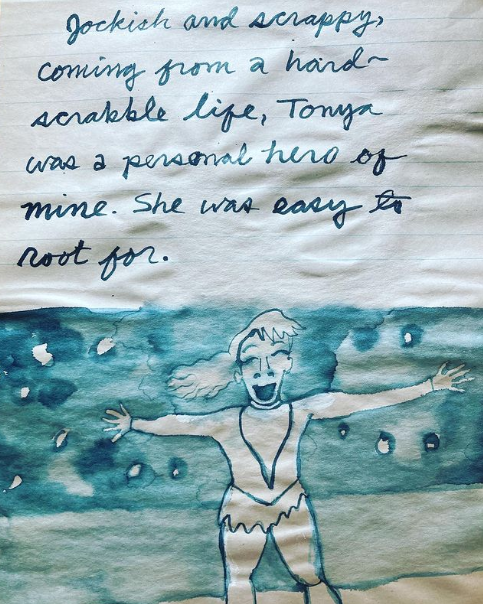
Mannie Murphy's impassioned tour through the seedier and racist aspects of their hometown Portland in I Never Promised You A Rose Garden became one of my favorite books. Of course, that book had its origins as minicomics first, and they've released a sixth chapter as a follow-up: The Tonya Issue. In the same style as in their book, Murphy's watercolor technique is presented here in grayscale, and the lined paper they drew on gives this the feeling of a high school student goofing off from their real assignment in order to write about the things that mattered. The issue indulges in Murphy's childhood obsession with disgraced figure skater (and Portland native) Tonya Harding, a figure that in the early 90s drew an astounding media frenzy after her skating rival Nancy Kerrigan was injured in an attack staged by Harding's abusive boyfriend. However, no matter how avid a fan she was, Murphy's clear-headed and even judgment regarding the facts of the matter are what add even greater depth to the story.


The story is so familiar that Murphy doesn't even bother introducing Kerrigan with her full name, referring to her simply as "Nancy." Like the other stories Murphy tells in this narrative, it's one with a great deal of personal meaning to them. Murphy reveals their obsession with figure skating as a child, and the sport was never more dramatic (not more beset by racism and classism) than it was then. Murphy recalls trying to get Harding's autograph at an art show featuring portraits of her, only to be denied. Murphy called it a tragic fall from grace from a figure who in many ways, never really had a chance. Much of this series is about detailing the cultural touchstones and figures that Portland got to call its own, and Murphy's reference to the Portland Trail Blazers NBA team makes me wish they'd tackle that topic next. 


Published by the excellent Entropy Editions, Dean Sudarsky's 65 Bugs is reminiscent of early Michael DeForge comics. This is a series of titled comic strips, most of which are three panels, following the lives of anthropomorphic insects. The way Sudarsky draws their bodies with human anatomy twisted into insectoid poses (most similar to a praying mantis or cricket) is genuinely unnerving, and his treating their speech completely within the context of what the insects would actually do is a stroke of genius. My favorite strip was "Crab," where we see an anthropomorphic crab (complete with oversized hands in place of claws) amused by a tiny insect until a bird picks it up and carries it off, with the crab helplessly yelling "Face me!" to its avian captor. The strips are about mating, trying to avoid mating or thinking about mating, devouring, being devoured, and even trying to seek out a few moments of peace. Sudarsky's line is fine and delicate as he carefully renders each figure with great clarity, emphasizing the expressive nature of each insect's faces as well as their twisted body language. 

Saturday, December 16, 2023

45 Days Of CCS, #16: Ria "Air" Garcia and Annabel Driussi


Ria "Air" Garcia has been making boldly experimental art for well over a decade, blending abstract and psychedelic art into a variety of dark fantasy scenarios that center around trans issues. Her latest comic, Dark Piss, chucks any pretense of subtlety out the window and instead zeroes in on brutal, pitch-black, hilarious satire regarding the status of trans women in the current culture. With text on the left side of the page and abstract, undulating lines (all in yellow on black, befitting the theme) on the right side, Garcia details a ludicrous yet conceptually plausible scenario where all of the self-described "hot trans bitches" must use a single bathroom in the city to piss in. All of the trans women agree with this measure because otherwise, there's a risk that cis people might get grossed out. Things escalate from there, as they all note they are treated as objects: objects of scorn & loathing as well as objects of (hidden, shameful) desire. The end sequence, where it's revealed just why they are all forced to go to a single building, is screamingly funny and terrible all at once. The abstract art is a reflection of how the women are seen: as signifiers of a particular, objectifying, point of view. 


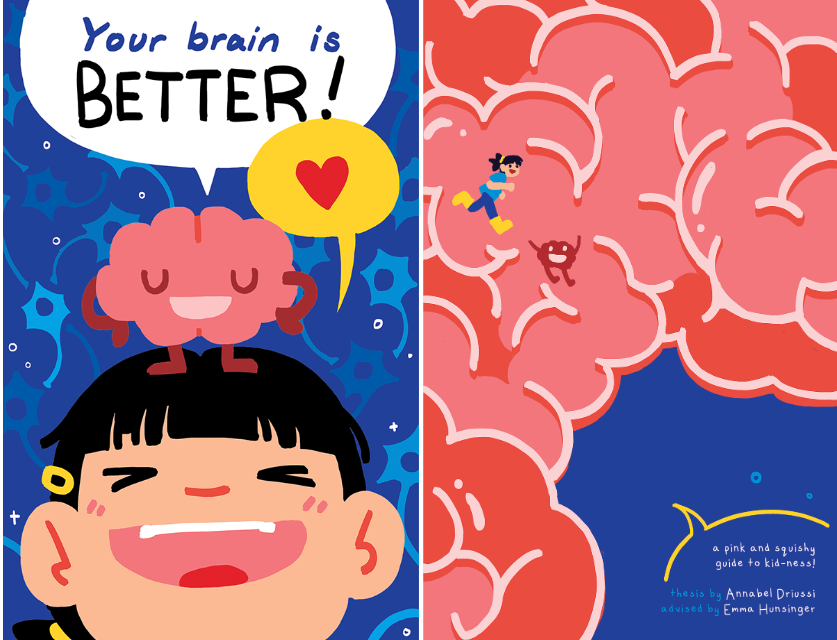
Annabel Driussi's field of expertise is neuroscience, but they've done a wide variety of comics and in different styles, from using clay to create fumetti to comics about sex to memoir and now a middle-grade graphic novel incorporating neuroscience into a teen girl's difficult life. That book, still in progress, will be titled Your Brain is Better. I read a mini that was part of her thesis package that's mostly thumbnails, and Driussi displayed an ability to blend fine details of neuroscience and neuroanatomy in a way that's easy to understand and attached to a character narrative. Following a middle-school girl named Kat who has trouble understanding why she loses her temper so easily, she's transported inside her brain, where she meets a cute avatar of the pre-frontal cortex (the thinking part of the brain) as well as "Amy," the amygdala (the feeling part of the brain). A crisis comes up (being accidentally hit by some soccer players) which puts the brain on red alert, and Driussi's clear storytelling shows just how the underdeveloped cortex can lead to the amygdala to panic. The similarity to the film Inside Out is obvious, but in this case, it's all 100% neurologically accurate while still pushing a satisfying emotional narrative. 

Driussi's at the 7/11 outside Club Q is a devastating personal memoir regarding the queer nightclub that was the subject of a hate crime shooting in 2022. In beautiful colored pencil, Driussi first notes how formative the club was for her, recalling some fond memories as well as forcing herself to deal with the aftermath of the shooting. Not all is despair--there's an account of mutual aid by trans radicals and a promise to visit. This comic is an intention, an invocation, a prayer, and the brightness of its colors feels intentional for just that very reason. 


Friday, December 15, 2023

45 Days Of CCS, #15: Kit Anderson and Andy Lindquist


Kit Anderson is one of the most interesting artists to emerge from CCS in recent years, as she's been doing visually innovative and clever comics with unusual themes. Anderson's comics often focus on the relationship between memory, character, and a sense of place. Their House (a MICE mini-grant winner) is very much about this. The unnamed narrator (presumably Anderson) is describing, from memory and nothing else, the appearance of a house whose owners are unspecified, but the assumption once again is that it's her grandparents' house. This is a comic-as-diagram, an interesting subgenre that connects the concept of a descriptive map with an emotionally revealing drawing. The narrator goes room by room, describing them by memory. The most evocative rooms have smells associated with them (like the laundry room) or repeated, pleasant memories of feeling safe and loved. To indicate her own ghostly presence as a narrator, Anderson draws herself as a kid in a cartoony style in black & white, while the house itself is in vivid and varied color. There are some memories the narrator clearly attempts to ignore, while they hold others tight, such as a Parcheesi board and the kitchen she played it in. One of Anderson's great strengths is formal curiosity blended with emotional resonance, and this comic, modest as it is in its ambitions, is a perfect example of this.


Andy Lindquist's comic What You Owe And What You Own is a powerful story not just about being trans but about what it means to be gendered as a woman. Lindquist's narrative voice is assured and powerful, while their line, though mostly spare, does the job in expressing the frequently awkward and anxiety-producing situations that he found himself in prior to his transition. The comic takes a hard look at Lindquist's teenage years as a self-described "lovely young woman" who was the best soprano in school. Lindquist notes that a narrative that often forms around trans men is that of cis people mourning the loss of a beautiful girl, which Lindquist cynically describes as a "public good." This gets into not just the male gaze and being desired as an object (though that is a big part of it), but also an understanding of being an exemplar for cis women as well. Mostly though, as Lindquist explains through the many arias that involve women being objects of desire where the outcome of that desire is almost always ruin or death, he had no concept of what it formerly meant to be a woman without having to bear that constant, unrelenting burden. The thematic and decorative touches of the comic heighten its themes, with the swelling aria matching the almost inchoate rage and doubt that had plagued them. 

Thursday, December 14, 2023

45 Days Of CCS, #14: Rachel Dukes, Kori Michele Handwerker, Penina Gal

Some shorter works for today's entries.


Kori Michele Handwerker, by their own admission, is an artist who isn't quite sure what kind of cartoonist they should be. In their solo collection, I Would Like To Experience Less, Thanks., Handwerker gets to this very problem right away in "True Form." They lament that while they have experience at all levels of creation and production with regard to comics, they have yet to establish their identity as a cartoonist. They rattle off a half-dozen different kinds of things they could be doing but don't feel drawn to any one of them more than another. In the end, they conclude that they are making comics in order to figure themselves out, and that's enough for now. As a reader, however, this claim is belied by some of the other work in this collection. "Little Things" is a piffle of an anecdote; it's the kind of story that's amusing to the author but doesn't have enough bite to draw in a reader. "True Form" itself is so text-heavy that it fairly drowns out the images in many panels. On the other hand, "Rite Hand" is an astoundingly composed story about their husband's traumatic stay in the hospital for a liver transplant. It takes a fairly standard diary comic format and reworks it such that it begins in the middle and flips various days around to create a tense, compelling narrative. In this instance, when Handwerker found something they really needed to talk about, their skill as a cartoonist became obvious. 

The same is true of I Like Masking, Actually. Handwerker's character design and line are both so assured for a story that's essentially a series of throwaway observations about the pandemic. It's fine, and it makes sense that Handwerker seems drawn to these sorts of small, bite-sized stories, but it also seems obvious that they have the chops for something more ambitious. As a reader and fan of their work, I'm excited to see what this could be. 


Rachel Dukes details their own health difficulties and how it's affected their work as a cartoonist. In Poppy Seeds, Dukes did a series of diary comics as they started to emerge from an illness-induced absence from cartooning. Some of them veer away from comics and are more of illustrated zine-writing, but on the pages where they get down to drawing again, it's easy to see the incredible charm of their line. Dukes has been cartooning for a long time, and I recall reviewing their Side A and Side B anthologies they edited when they were still a teenager, in addition to their best-known comics about their cat Frankie. Their cartooning, even after struggling with illness, remains elegant, expressive, and versatile in approach. Dukes is also an excellent illustrator, as their interview zine with Lauren Denitzio makes clear; they are as comfortable with naturalistic approaches as they are with the most cartoony of techniques. 


Penina Gal is another longtime favorite who started their career with a YA fantasy story then veered over into comics-as-poetry. Their mini Baller Baby represents a move toward YA-style memoir, as it's about growing up in 1990s New York as a fan of the Knicks and the game in general, but also as someone who hated dresses and being feminized in very specific ways. Part of Paper Rocket's Mini Memoir Project, Gal's line here mixes sketchy immediacy with bold, thick ink lines. The drawings are lively and rubbery, which helps accentuate the way that the younger version of Gal loves to move with the ball. The contrast with their cousin E. sets a perfect thematic tone, as the active E allows Gal to be brave and try things they might not have otherwise, because they were shy. (The panel where they talk about that has a wonderful drawing of an engaged and curious but slightly shrinking Gal.) Gal took what was essentially a series of anecdotes and imbues it with thematic resonance without sacrificing any of the innocent exuberance that was at their heart. 


Wednesday, December 13, 2023

45 Days Of CCS, #13: Rachel Bivens

Rachel Bivens is a clever cartoonist who expresses a great deal of emotional vulnerability in her comics. She's leveled up considerably in the last year or so, with all three of her more recent releases looking sharper in terms of both drawing and cartooning than her earlier work. She still also pursues a lot of different kinds of cartooning, from memoir to absurdist humor to surreal slice-of-life comedy about anthropomorphic fruit.


Fruitlings! features said anthropomorphic characters, and Bivens has really hit on something here. These are 4-panel comic strips, and Bivens printed it as a landscape side-scrolling minicomic. It's an attractive and effective format for these full-color comics, which start off cute and then veer into some different directions. The fruit shyly have crushes, appeal to other fruit for relationship advice, and talk about their feelings. They are also eaten by birds, have worms burst out of them, and deal with breaking away from bunches. That combination of very cute horror and quotidian interactions makes for an unpredictable reading experience, as it whiplashes from one extreme to another, but that's what makes it fun. Bivens' line is simple and inviting, but it's her bright use of color that heightens these extremes. 

DLG is a black-and-white strip about how one's relationship with one's parents can become strained and even invasive during the transition between childhood and young adulthood. The title acronym, of course, stands for "Daddy's little girl," and it refers to the protagonist's father needing her to acknowledge him via text when he asks "SNS?" That stands for "safe and sound," and while a parent's need to know their child is safe is understandable, the context of this comic reveals that it's an invasive form of control. Bivens tells the story with a lot of fairly still images as the protagonist is at the drawing table, receiving the dreaded "SNS" message. There are a series of flashbacks with the protagonist at camp, with a reasonable expectation of earing from a kid, but it persists through college and beyond. In the end, the protagonist ponders options (automatic replies?) and eventually leaves him hanging, creating a necessary boundary. Here, the otherwise silent comic is economically drawn, going deliberately sketchy and expressive as a way of expressing a series of sense memories. The gaps and negative space do a lot of narrative work as the protagonist balances just how to solve this problem. 


Finally, there's Milk. This is a triumph of formal play, as the mini is shaped like a mini milk cartoon and the purple ink and thick cardstock simply make it pleasing to hold and look at. The story is an absurdist account of a Bivens stand-in queueing up at a giant carton of milk for a drink. Along the way, a soccer game bursts into the middle of the line, spills milk out of the enormous carton, and causes mayhem. The end is tense, as things don't go the protagonist's way. This is a silly but well-constructed and cartooned comic with a line reminiscent of Charles Schulz in terms of both its simplicity and expressiveness.