Mannie Murphy is one of those ten-year overnight successes as a cartoonist. Her comic that she completed after her one year at the Center For Cartoon Studies, I Still Live, was absolutely astounding in how fully-formed, thoughtful, and restless her voice was as a creator. Murphy has a towering, probing intellect that is both deliberate and intentional in the way she dissects her subject matter, because it's all personal. There is a barely-restrained sense of fury in the way she addresses many topics, even appearing dispassionate at times. Murphy is simply careful and thorough in how she researches her subjects, scrupulously fair in how she approaches them from multiple angles. But make no mistake: Murphy keeps all the receipts, as the saying goes, and she is devastating once she lays them all out and connects the dots.

If systematic oppression is sometimes a kind of shell game, where the oppressors distract their victims in hopes that they'll forget certain events, Murphy is a dutiful observer who knows where the ball is at all times. All of this leads up to her first book, I Never Promised You A Rose Garden. Even the title has multiple layers. The original phrase comes from singer Lynn Anderson, and it's a sort of glib way of talking about how bad times are going to come. That phrase was later adapted into a semi-autobiographical story about a teen girl's battle with schizophrenia. For Murphy, the International Rose Test Garden is a huge tourist attraction in her hometown of Portland. The local home arena with Portland's beloved NBA team, the Trail Blazers, was named the Rose Garden for many years. They are symbols of Portland's affluence, the flip side of the quirky "Portlandia" narrative that's been nurtured by the city ("Keep Portland Weird.")

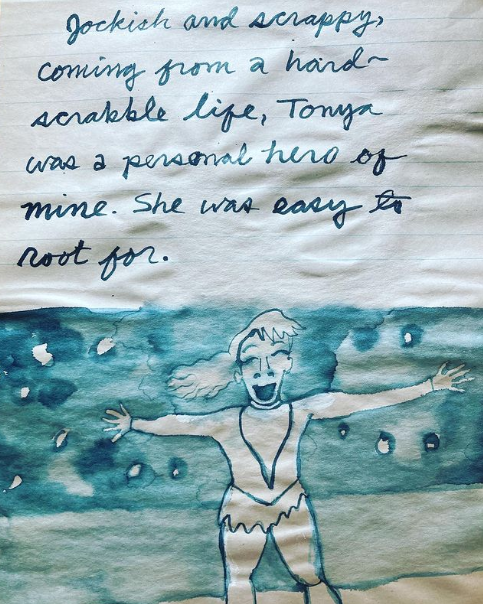
Murphy's wide-ranging narrative connects her own personal experience of a particular high school, various Hollywood stars, the rise of white supremacy, murders, and the real history of Portland and Oregon. It's written like a journal or a diary, with each page featuring her handwriting on lined paper, accompanied by blue-wash illustrations so dense that there are parts where the bleed-through is emphasized. It's almost a watery image (hence the bleed), as though she had scratched the image into the page and let the wash flow over it as though it was her tears. I read and reviewed the minicomics that contained the bulk of the book that Murphy started publishing six years ago. While not materially different in terms of content, the design, the paper, and the use of color make it a completely different work. It's the difference between a series of zines and a book designed to look like a journal, and the result is something that feels more intimate. It's as though Murphy is taking us aside and sharing secrets.

In a sense, she is. Starting with the death of River Phoenix, Murphy connects the dots to his hometown of Portland and his relationship with director Gus Van Sant. It's here that the dots she connects become very interesting, as she delves into Portland's history of pressing young queer men seeking a new life into being sex workers. Queer men who "acted" and looked straight were especially prized. Van Sant loved surrounding himself with young men, offering them money and luxury in exchange for their youth and cool. Among these men included Ken "Death" Mieske, a charismatic young white supremacist who was a disciple of Tom Metzger, a neo-Nazi skinhead and former Klan member. Mieske and two other skinheads and members of East Side White Pride murdered Mulugeta Seraw and were in a high-profile trial that wound up making them martyrs for the movement.

Murphy connected the skinheads to the punk scene in Portland and certain benefactors like Van Sant and a club owner she referred to as Mr. X. Far from an outlier or coincidence, Murphy connected the dots back to the founding of Portland and Oregon. The whites who settled there aimed to make it a white utopia, intentionally settling on native land and using their diseases to wipe out that population. When some natives killed some settlers in retaliation, the white settlers were able to use that to their advantage and not only gain statehood, they also wrote laws forbidding Blacks and Asians into their constitution. Not just racism, but actual white supremacy was nakedly baked into the very fiber of Oregon. Murphy argues that this has never been truly reckoned with, despite fierce protests by some of its citizens, and it perpetuated itself in the face of the KKK in the early 20th century and the skinhead movement of the late 20th century. What was most frightening about the latter, Murphy revealed, was that despite the image of Nazi punks being outlaws and rejected by society, the reality is that this group signed up for the police and military in droves--and it was Metzger himself who coldly declared his victory when he was on trial.

Murphy wrote about this six years ago. The national wave of police violence against Black people and other minorities and their sympathy for white supremacists made this observation even more chilling with the book published in March of 2021. Murphy doesn't make a direct connection here, but there's also an extremely laissez-faire attitude that pervades Portland, one that favors those who already carry a lot of privilege. It's the attitude of unchecked capitalism and an abandonment of protecting the weak and vulnerable. Murphy's high school was run under experimental rules encouraging free thought and questioning authority. It also created an environment where skinheads like Ken Death were allowed to roam unchecked. The difference between an atmosphere where creativity and free thinking are encouraged and one where all attempts at exploring and instilling community virtues could be plainly seen. It's a false binary and an abandonment of education, especially for those populations who were vulnerable. Murphy does note that in Portland's culture, being queer certainly didn't make one enlightened, especially if you were white, male, and in contact with privilege. Murphy's own connection to the school, her classmates who died there, and a disastrous camping trip where those who listened to authority died revealed that no adult ever gave them a good reason to trust them. The quirky freedom of "Portlandia" was a myth and harbored snakes in its bosom.
Much of the book is devoted to a discussion of cults, especially in terms of power exchanges. River Phoenix grew up in the predatory Children of God cult, which emphasized incest and underage sex as part of its teachings. The white supremacists were hucksters who offered homeless, frequently queer, young hustlers a line of bullshit they knew they would believe. That they wanted to believe, because it freed them of personal responsibility and transferred the blame to different races, nationalities, and religions. Murphy points to groupthink as a kind of collective way of frequently making horrifying moral decisions, because it defuses personal responsibility and warps simple logic.
Murphy's dissection of the mechanics of how this works is flawless, just as the thoroughness of her research with regard to history is staggering. However, she's a native. This is all personal to her, because she's seen how all of this can and has been resisted, even against unbelievable odds. She's not an unbiased observer and has no interest in that role, often adding personal comments to her record of historical events. This doesn't weaken her arguments, because she's not arguing emotively. She's calmly laying down connection after connection and creates a sophisticated historical argument rooted in primary documents. Even the personal aspects of the narrative, like her recounting River Phoenix's story, prove to be recapitulations of her larger arguments in microcosm. Murphy doesn't attempt to simplify or minimize the problems she raises; she simply provides context and shines a light on them. In many ways, going back to the title, the "you" refers to Portland itself, as she strips away its mythos and lays bare its rot. It's up to everyone to clean away that rot. It's not quite a hate letter to Portland (because there are things she loves and wants to fight for)...but it's close.


 Posts


