Showing posts with label annabel driussi. Show all posts

Thursday, December 19, 2024

45 Days Of CCS, #19: Annabel Driussi, Tom O'Brien, Ashley Jablonski


When Natalie Norris wrote her sexual assault graphic memoir Dear Mini, she dedicated it to "girls like us." In Dear Natalie, Annabel Driussi tells her own story in epistolary form to Norris, because of how much Dear Mini meant to her. Driussi's mini-comic is very different from Norris' deeply detailed account of the experiences leading up to and after her assault, in that many of the events are alluded to off-panel. The candy-colored hues of the mini and the anecdote about her telling one of her stuffies about her secret masterfully signify that the 14-year-old Driussi was a child when she experienced her own trauma--both literally and emotionally. At the same time, she "hated my childish body" and wanted to look like a woman. She was neither here nor there, and boys took advantage of this. This looks like it was done in crayon, which does much of the narrative heavy lifting, but Driussii's thin and tender line aptly reflects her own vulnerability. 


Ashley Jablonski is mostly doing very short minis these days about their experience teaching art to very young children. They delight in Jablonski as much as Jablonski delights in them, and this is reflected in their Life As An Elementary Ghost mini-comics. Jablonski draws everyone as cute ghosts and essentially relates funny anecdotes, like a kid saying "I made that shot," with an asterisk of "Definitely did not make that shot." Kids ask to spell words like "googleplexian," jump into piles of leaves and encourage Jablonski to do so, and play choose your own adventure. I also quite liked Jablonski's Apples As People, wherein she imagines what Granny Smith, McIntosh, and Baldwin might look like. Here, Jablonski's use of color is especially effective and evocative. 

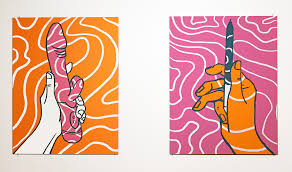
I hadn't seen anything from Tom O'Brien in a while before I saw him at CAKE. He's working away at an illustrated guide to knives called The Knife Guide, and he gave me a mini of Chapter 4 to look at. This chapter covers different ways to hold a knife and cutting techniques, mostly for the kitchen. As someone who likes to cook but who knows very little about knives, I found it fascinating. It was helpful that he was careful with his image-to-text ratio, keeping the captions in each panel to five lines at a maximum. Anything beyond that would not only be too much text to read and absorb, it likely would have gone beyond the actual illustration in each panel and would have demanded another image anyway. O'Brien uses a six-panel grid as a base, collapsing panels along rows as per needed. The best thing about this was just how particular O'Brien was about illustrating fine details, like precisely how to handle and wield a knife to get a particular kind of cut, be it a mince or a chop. Not being afraid of these details is exactly what a beginner needs to see. The minicomic used grayscale shading but the actual art is in color (see above), which heightens the contrast of the object to its background; however, the constantly shifting color backgrounds are distracting. 

Saturday, December 16, 2023

45 Days Of CCS, #16: Ria "Air" Garcia and Annabel Driussi


Ria "Air" Garcia has been making boldly experimental art for well over a decade, blending abstract and psychedelic art into a variety of dark fantasy scenarios that center around trans issues. Her latest comic, Dark Piss, chucks any pretense of subtlety out the window and instead zeroes in on brutal, pitch-black, hilarious satire regarding the status of trans women in the current culture. With text on the left side of the page and abstract, undulating lines (all in yellow on black, befitting the theme) on the right side, Garcia details a ludicrous yet conceptually plausible scenario where all of the self-described "hot trans bitches" must use a single bathroom in the city to piss in. All of the trans women agree with this measure because otherwise, there's a risk that cis people might get grossed out. Things escalate from there, as they all note they are treated as objects: objects of scorn & loathing as well as objects of (hidden, shameful) desire. The end sequence, where it's revealed just why they are all forced to go to a single building, is screamingly funny and terrible all at once. The abstract art is a reflection of how the women are seen: as signifiers of a particular, objectifying, point of view. 


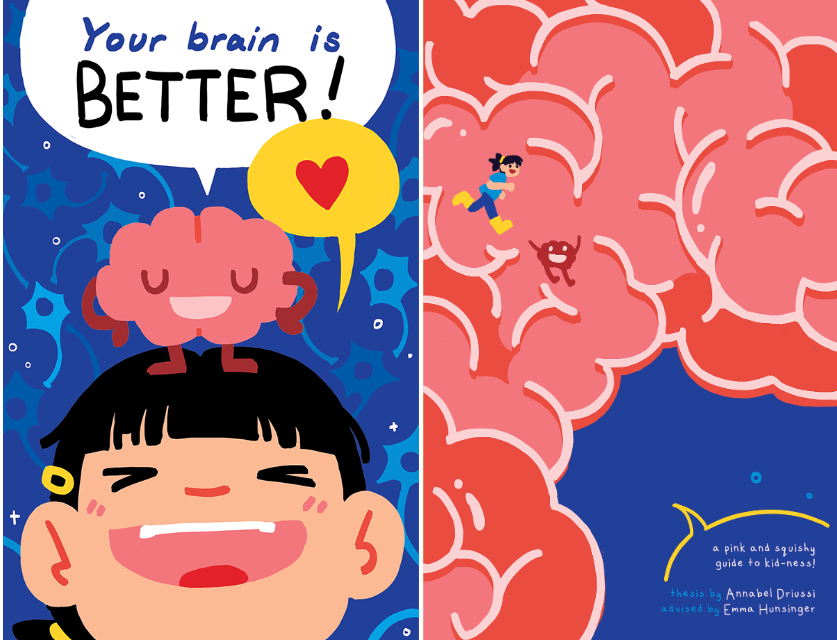
Annabel Driussi's field of expertise is neuroscience, but they've done a wide variety of comics and in different styles, from using clay to create fumetti to comics about sex to memoir and now a middle-grade graphic novel incorporating neuroscience into a teen girl's difficult life. That book, still in progress, will be titled Your Brain is Better. I read a mini that was part of her thesis package that's mostly thumbnails, and Driussi displayed an ability to blend fine details of neuroscience and neuroanatomy in a way that's easy to understand and attached to a character narrative. Following a middle-school girl named Kat who has trouble understanding why she loses her temper so easily, she's transported inside her brain, where she meets a cute avatar of the pre-frontal cortex (the thinking part of the brain) as well as "Amy," the amygdala (the feeling part of the brain). A crisis comes up (being accidentally hit by some soccer players) which puts the brain on red alert, and Driussi's clear storytelling shows just how the underdeveloped cortex can lead to the amygdala to panic. The similarity to the film Inside Out is obvious, but in this case, it's all 100% neurologically accurate while still pushing a satisfying emotional narrative. 

Driussi's at the 7/11 outside Club Q is a devastating personal memoir regarding the queer nightclub that was the subject of a hate crime shooting in 2022. In beautiful colored pencil, Driussi first notes how formative the club was for her, recalling some fond memories as well as forcing herself to deal with the aftermath of the shooting. Not all is despair--there's an account of mutual aid by trans radicals and a promise to visit. This comic is an intention, an invocation, a prayer, and the brightness of its colors feels intentional for just that very reason. 


Monday, December 5, 2022

31 Days Of CCS, #5: The Ladybroad Ledger #5

The Ladybroad Ledger is a broadsheet anthology by women, femmes, and nonbinary cartoonists in Vermont. So says its back page. The original version of this folded a few years ago after four issues, but three CCS students revived it with a bunch of their fellow students and alumni, along with other local cartoonists. The editors are Violet Kitchen, Annabel Driussi, and Sofia Lesage, and it looks like Kitchen handled the editing and Driussi the design. Kitchen took the cover chores and she came up with a powerful, vivid strip filled with violent reds and oranges that exemplified her anger regarding the Supreme Court overturning Roe v. Wade and endangering a woman's right to her own body. It's an eye-catching, righteous bit of fury that demonstrates her considerable skill as a cartoonist. She's got every tool needed to become great. 


One of the fun things about a broadsheet is that cartoonists get to work big. Coco Fox's strip about her struggles with gardening is a 16-panel grid that still has plenty of room to breathe because there's so much room on the page. Her loose, scribbly style and extensive use of decorative flourishes along her panel borders aid in depicting the slightly out-of-control nature of gardening and how difficult it is to control. Kristen Shull's autobio comic addresses the problem of worrying about her readers and audience reactions in general. It also has a lot of interesting visual flourishes that reflect her other cartooning interest of fantasy, and the panel design is chaotic in ways that aid its overall aims. 

A lot of Daryl Seitchik's work involves wide-open spaces, and so working big in her story "How To Become A Mermaid" does a great job of using negative space and black/white contrasts. Masha Zhdanova's comic about summer and falling in love has a nice visual gestalt effect that encapsulates a brief, fleeting feeling. Sofia Lesage's comic about summer goes in a radically different direction: it's a depression journal that's an absolute howl. It's a comic about being trapped in one's own worthless, horrifying mind and body, where the possibility of communication that doesn't poison everyone around you seems impossible. Where one's creative impulses are self-muted and whatever distractions that can be generated are fleeting and foolish. She captures all of these feelings and more in a loose grid that emphasizes body language above all else. 

Leda Zawacki's "29 Miles" suffers from murky grayscale reproduction, marring an otherwise spare, emotionally resonant story about a desperate young woman making a hail Mary play to get a ride. Sarah Woodard's "Open Heart" is a slightly heavy-handed but certainly pointed story about the ways in which the absurdity of racism is highlighted in a medical care facility, with people of all backgrounds providing care and treatment. Driussi's own piece spreads across two pages, depicting the raw, visceral, and erotic experience of experiencing live music. The clashing and clanging images and density of the lettering all play into creating this experience for the reader. 

Sarah Oak's strip about her "Daisy Duke" character grossing out a guy who's hitting on her at work is funny, although her cartooning style is cloyingly stylized. Jen Jolls' piece about someone whining regarding a class has a funny punchline, although the cartooning is all over the place. Keilani Lime and Amy Burns' graphic medicine comic about giving blood (I think; it might be just getting a shot) is funny, reflecting how chronic illness can disrupt any experience. Franky Frances Cannon's full page strip about favorite Vermont bars is cluttered and disorganized, but the drawings are so charming and the actual reviews are so funny that it won me over. Finally, Gabrielle Tinnirello's piece on dresses beautifully uses up the space provided with a host of delicate, decorative elements in a fluid, open page layout. 

There are also essays on why making bad comics is a good thing, how to become a cartoonist, an interview with Kitchen, and a long interview with musician and comics fan Neko Case. Overall, the level of cartooning is superior to the original publication, and more of the cartoonists take advantage of the format to produce work that's outside of their normal comfort zones. 

Thursday, December 1, 2022

31 Days Of CCS, #1: Annabel Driussi

Annabel Driussi's Sensitive Man, to use a technical term, is absolutely bonkers. This is ultimately a story about longing and restitution, but it's so bizarre and hilariously over-the-top that this only scratches the surface. What makes it work, ultimately, is Driussi's absolute commitment to her cute aesthetic. The first strip is a statement of purpose: the titular character drawing, with all due grave attention, a smiley face. He smiles at his work.


The next segment, "The Ice Cream Paradox" details Sensitive Man taking a walk with a young child (daughter? sister? who knows?), and she is profoundly saddened when a passing car honks its horn, causing her to lose her ice cream cone. Sensitive Man then goes to college, invents a new branch of physics, crafts, a time machine, and uses it to go back in time to stop the driver from honking his horn. Thus, sadness is averted. There's a Rube Goldberg-esque quality to the extreme silliness and complicated nature of these proceedings, but Driussi's character design and extensive use of spot blacks and negative space to emphasize the cuteness of her characters never wavers. 


After establishing a visual storytelling rhythm, Driussi goes totally off the rails in "Man Of Your Dreams." The dimensions of this comic are important; it's a full 8.5 x 11 inches, and this allows Driussi to stretch out and emphasize that negative space in the first half of the comic. In this story, Sensitive Man has a dream about a mysterious lover, and is so shaken by the experience that he breaks up with his boyfriend. Wiping his tears in a broken heart word balloon, he sees that it's full of color. He stretches it open, steps through, and walks into another dimension. Visually, the story goes from the line art seen throughout the comic to a fumetto with the characters now depicted entirely in clay. It's a wonderfully bonkers move that retains all of the qualities of Driussi's drawing while adding this fantastical element of Sensitive Man literally taking a stroll on the artist's desk, until he finds an unfinished clay version of his dream man. He gives him eyes and a mouth, bringing him to life, and they have a moment of pure joy together until Sensitive Man realizes how much he misses. In some absolutely ingenious panels, they build a portal together, as Driussi mixes line and clay, until the dream man realizes he can't travel through it and pushes Sensitive Man back. 

It's a genuinely moving story on top of the berserk levels of craft and problem-solving on each page. While Driussi tweaks Sensitive Man and his big feelings, there's a high level of sincerity at work here as well. There's a new wave of cute comics like this that also serve to explore complicated emotions that reminds me of the "cute-brut" movement of 20 years ago in comics, but it's far more expansive and diverse. Driussi truly strikes gold with her efforts here. 

Wednesday, December 22, 2021

31 Days Of CCS, #22: Annabel Driussi

Annabel Driussi's comics delve into some serious topics surrounding love, intimacy, and vulnerability. However, there is an upbeat quality to almost all of her work that shines through, even in the most difficult of reads. Driussi has a background in neuroscience and has done a lot of science illustration work, but her personal comics here are frequently funny, sexy, dark, probing, and horny. While she has a particular aesthetic that carries over to all of her projects, she's also capable of truly varied work, especially in terms of tone. 

Fig Leaf was her first minicomic, and it showed in terms of layouts, lettering and sequencing. However, Driussi's style was quickly in place and the black/white flip in terms of negative space was highly effective in this harrowing conversation between father and daughter about sexual preference and their own fraught relationship. Sure On This Shining Night is an assured howl of anger, depicting (presumably) the artist riding a bike at night, being sexually harassed and then followed by a man in a car, and her frustration and anger once she was safe. The fact that she even had to ponder being safe when she was just trying to get from point a to point b was the reason for this explosion. The use of color is meant to add a sense of visual dissonance to the proceedings, doubling as a way of expressing the emotional narrative of the story. 

Deeper! is sort of Voyage To The Bottom Of The Sea meets H.P. Lovecraft, only as lesbian erotica. It takes itself exactly as seriously as you would expect, to its great benefit. There's not any actual sex or nudity depicted, but the salaciousness is amusing, as is the genius virgin-related gag the defeats the deranged villain. Driussi was forced to work a little small, as she crammed a lot of panels onto each page. That sometimes hurt her character renderings, as she couldn't quite decide at times when to drop out detail and when to do a more detailed rendering, and the results were mixed. 

The Bull & The Gnat was the Aesop's Fable assignment, but it was completed with her left (non-dominant) hand because of an injury to the other hand. It looks like it was done with colored pencils, and it speaks to the idea of cartooning and illustrating being two related, but different skills. The rendering was actually quite good, even if the lettering was rough, but the whole story is really about the gnat's actions being irrelevant to the bull, so the gnat may as well do what it wants. Rice Krispies is the Ed Emberley assignment, and Driussi made this a sort of stoner break-up story, where the main character is hung up on his ex, regrets his actions, and later learns he was totally forgotten. The animal heads of every character turn out to be a result of his being high. Driussi really nails the setting and these particular character types, and their style was well-suited to work in the stripped-down Emberley style. 


Finally, Touch Your Self! was Driussi's most interesting comic. Not because of the obviously salacious subject matter regarding masturbation, but because of her incredible vulnerability and the critical faculties she brings to bear on the idea of not only catering to male fantasies by her very existence, but that masturbation for her was always performative and never only for her. She then turns the tables and asks the reader to think about masturbation and what it means to them. In so doing, she is both engaging the reader in an intimate connection and also putting the reader in that same performative space that she finds it hard to get out of. The visuals are frank and stark, tinged with the slightest touch of humor but mostly played completely straight. 

Driussi is a thinker as a cartoonist. It's interesting take her work in a vastly different direction from her applied comics work with regard to science, yet still use that sense of composition in some of her work. It's also fun to see her loosen up while zeroing in on these issues related to intimacy and vulnerability. I'm curious to see what her thesis will look like and what she pursues in the future.