Showing posts with label kit anderson. Show all posts

Tuesday, January 14, 2025

45 Days Of CCS, #45: Kit Anderson


Kit Anderson's Avery Hill collection of her short stories, Safer Places, is a big, warm hug of a book. Sure, it's barbed, haunted, and even desperate at times, with some characters who are yearning for comfort that never comes. But it's also resolutely compassionate toward all of their dreams, with unusual links between seemingly unrelated stories that build a tapestry of empathy or a house full of the titular safer (not always safe, but safer) places. 


I've reviewed many of the stories in this collection in their original minicomic or short story form, so I'm mostly going to comment on the sequencing and the way the themes were built. There are two different interstitial features in the book, both of which are fantasy-related in their own way. The first is "Quest," a series of anecdotes about a tiny wizard and the shopkeeps who wonder what he does all day. One sneers at this small being doing anything useful with mushrooms and twine, while the other is resolutely certain that the wizard is more capable and powerful than he looks. The wizard is a Radagast-type figure, taking care of nature and helping things grow and heal in the face of war and disaster. Quest appears as the comic the sole protagonist is reading in "The World's Biggest Ball of Twine," which happens to be about a desperately lonely man who is clinging to the memory of a tourist trap trip he spent with a loved one, connecting moments to memories like snapshots. 


The other track of interstitials is the "Sleep Tape" grouping. Each of them is a two-track comic with a narrative that's a classic meditative (and functionally soporific). Each story has a different tone and function for these tapes. "Country Lane" is a story about someone who's unable to fully commit to a relationship, but the gentle tape somehow gently taps into their subconscious to lead them inevitably to the warmth of connection. "Forest Walk" is a futuristic story that grounds an isolated character through their day, substituting the cold efficiency of their routine with the pleasant ambling of a walk in the woods. "At The Seaside" repeats this idea, this time with a man trapped in rigid, cold routine being allowed to expand his consciousness into the night sky. 


There are other stories that explore variations on this theme. "The Basement" uses dream logic and a cat guide in order to have a boy work out grief and the anxiety of living in a transitional period. "Deep Breath" offers a brief glimpse of an underwater world. "Lookout Station" is about a lone scout at a station on another world whose sentient computer tries to guide it in a guided meditation but is resisted by the desperate pull of potential connection. "Wallpaper" similarly uses computer backgrounds in an attempt to enter this meditative state that promises freedom, escape, and safety. "Ride" uses a bike ride to escape an undesired move. "Wonders Of The Lost City" goes in the opposite direction, as the fantastical goal of a quest is too much to absorb, and the characters hastily retreat back to their mundane life.
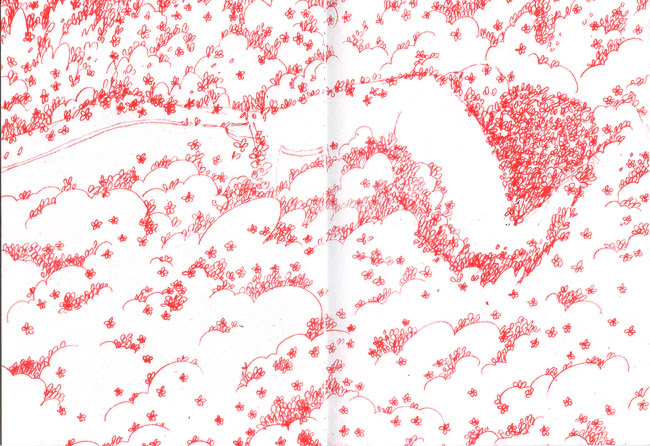


"Weeds" is the centerpiece of the collection, about a college student who contracts a disease that causes her to sprout flowers from her body. The disease will eventually cause her to turn fully into a plant, so much of the story revolves around where she wants to end up. There's a sweet friend who offers her a place on her table, her overbearing mom wants her in her backyard, and the student is just trying to finish her poetry dissertation. Ultimately, she chooses to lie down in a park, but the transformation is not quite what she expects, as she transitions to a new, unknown phase of her life. Anderson works in a wide variety of visual styles here: sumptuous color for the wizard stories & "Wonders", colored pencil for "Weeds", spot color, color washes, and black & white. It all goes to the same conclusion: nothing ever stands still, no matter how much we might want it to. We either move on or we risk being trapped. 

Friday, December 15, 2023

45 Days Of CCS, #15: Kit Anderson and Andy Lindquist


Kit Anderson is one of the most interesting artists to emerge from CCS in recent years, as she's been doing visually innovative and clever comics with unusual themes. Anderson's comics often focus on the relationship between memory, character, and a sense of place. Their House (a MICE mini-grant winner) is very much about this. The unnamed narrator (presumably Anderson) is describing, from memory and nothing else, the appearance of a house whose owners are unspecified, but the assumption once again is that it's her grandparents' house. This is a comic-as-diagram, an interesting subgenre that connects the concept of a descriptive map with an emotionally revealing drawing. The narrator goes room by room, describing them by memory. The most evocative rooms have smells associated with them (like the laundry room) or repeated, pleasant memories of feeling safe and loved. To indicate her own ghostly presence as a narrator, Anderson draws herself as a kid in a cartoony style in black & white, while the house itself is in vivid and varied color. There are some memories the narrator clearly attempts to ignore, while they hold others tight, such as a Parcheesi board and the kitchen she played it in. One of Anderson's great strengths is formal curiosity blended with emotional resonance, and this comic, modest as it is in its ambitions, is a perfect example of this.


Andy Lindquist's comic What You Owe And What You Own is a powerful story not just about being trans but about what it means to be gendered as a woman. Lindquist's narrative voice is assured and powerful, while their line, though mostly spare, does the job in expressing the frequently awkward and anxiety-producing situations that he found himself in prior to his transition. The comic takes a hard look at Lindquist's teenage years as a self-described "lovely young woman" who was the best soprano in school. Lindquist notes that a narrative that often forms around trans men is that of cis people mourning the loss of a beautiful girl, which Lindquist cynically describes as a "public good." This gets into not just the male gaze and being desired as an object (though that is a big part of it), but also an understanding of being an exemplar for cis women as well. Mostly though, as Lindquist explains through the many arias that involve women being objects of desire where the outcome of that desire is almost always ruin or death, he had no concept of what it formerly meant to be a woman without having to bear that constant, unrelenting burden. The thematic and decorative touches of the comic heighten its themes, with the swelling aria matching the almost inchoate rage and doubt that had plagued them. 

Thursday, December 22, 2022

31 Days Of CCS, #22: Andy Lindquist and Kit Anderson

Slipping, by Kit Anderson. Anderson has such a great knack for portraying loneliness, longing, alienation, and liminal places in a way that feels lived-in, gritty, and authentic. There's a question of the connection between reality and insanity and what exactly is real in her comics, a question that is rarely answered directly. Take Slipping, for example. This comic follows the monologue of a character (what seems like a trans man or non-binary person) as they explain the titular concept of "slipping." As relayed by their mother, it's a lack of awareness of one's surroundings that causes the Other Place to reach out and get us. Whether it's hell, oblivion, or something else is unimportant; what is clear is that it represents non-being at an ontological level. Anderson's scratchy line immerses the reader in every slow, painful moment, from stray body hair to pocked skin to slumped gestures. 

The monologue is aimed at a woman named Monday, who lived with the narrator until their neuroses (in the form of filling every empty second with sound) drove them away. Anderson imbues every quotidian moment in the comic (waking up, making breakfast, smoking a cigarette, taking a walk) with unspoken menace, as the reader is led to expect a "slip" for the narrator. When it comes, it hits especially hard because the narrator is making one, last desperate attempt to connect. The character's existential self-absorption inadvertently leads to their final, tragic fate, even as Monday is revealed to be worried about them. 


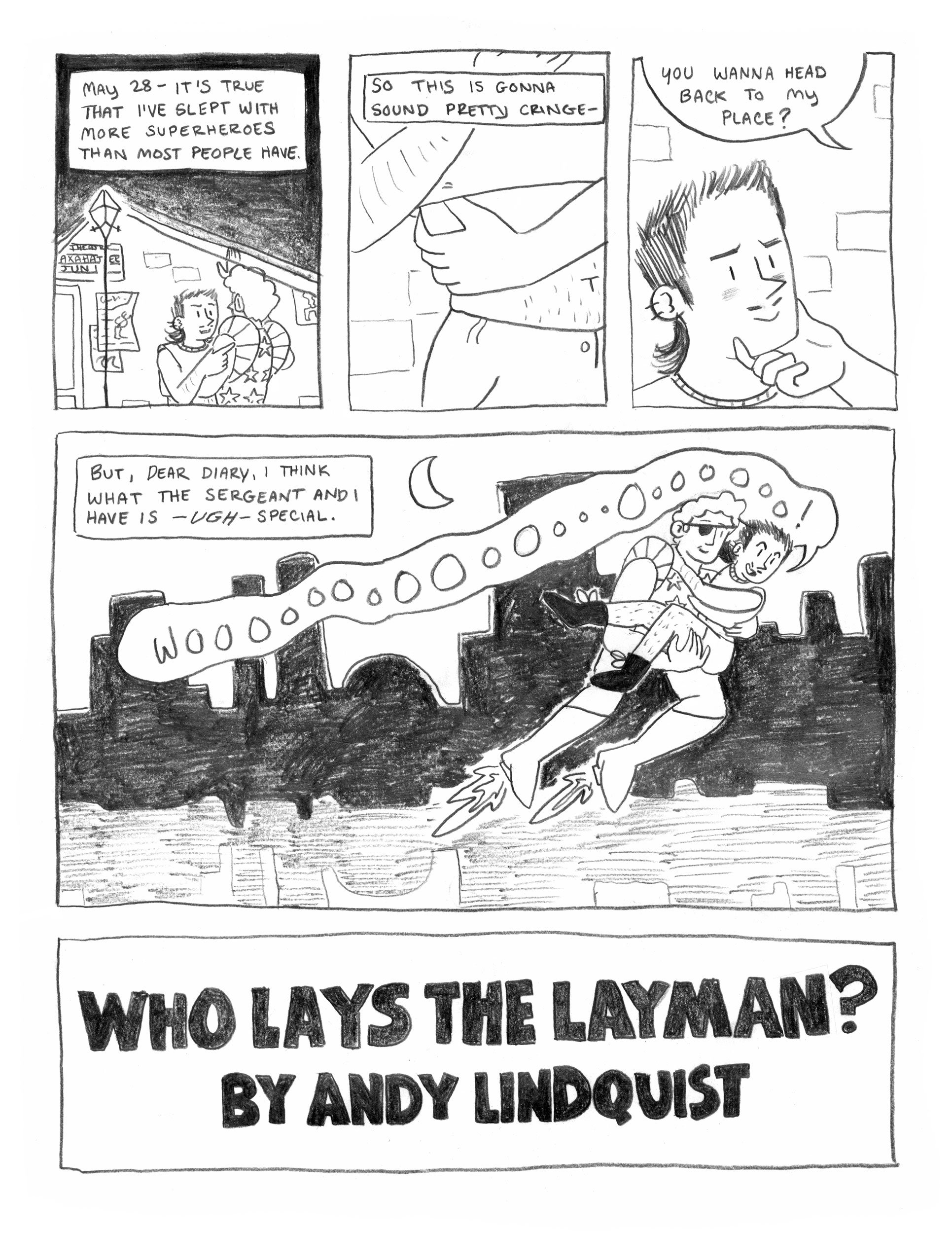
It's Going Fine and Who Lays The Layman? by Andy Lindquist. Lindquist's own takes on alienation are quite arresting. Lindquist zeroes in on character design, and it's got that slightly grotesque and distorted quality that Dash Shaw and Lillie Carre' both possess. In It's Going Fine, for example, the character of the mother is weathered and bespectacled, hiding years of pain behind those glasses. The story is about her daughter trying to talk to her in a very intentional way, trying to draw out her mother and engage with her as an equal instead of simply being ignored and lectured at. The daughter blows it by losing her tempo, leading her mother on an interesting segue: she tells her daughter about hearing about Sylvia Plath's death as a teenager. It was a shattering experience, so much so that she avoided the kitchen for weeks. It shaped her approach to fear: don't look. When her daughter asks if she's afraid of her, the other simply says that she loves her without answering the question. The horrifying last image is a visual representation of the mother's fear as she sees her daughter walk away. This is a sophisticated and devastating portrayal of generational trauma. 

Who Lays The Layman? is funny and sad, as it's about a superhero groupie who frequently uses a grindr-style app to hook up with a variety of metahumans. When they (a trans man) fall for a gritty superhero named the Sergeant, they feel the foolish, flushed feelings of connection that may not be real. When promises of meeting up again fade and a flirty text gathers dust, the groupie finds other company, and finds it lacking. One of the heroes, Glamorpuss, is hot and outgoing, but is not only lacking in bed, but is chatty in a way that the groupie doesn't connect with. Indeed, they are casually cruel to poor Glamorpuss, who wants to hang out and watch funny videos after sex, but the protagonist just wants to go home. 

There's a remarkable sequence where the protagonist compares being lonely at night and looking at dating apps like being high and watching fast food ads. Nothing seems better in that moment than getting that cheeseburger--and nothing makes you feel worse afterward. That materializes when they meet a hero named Funny the Strongman, who is not only weird about being queer, he also misgenders them (twice), and then claims that his condom broke. It all ends as horribly and awkwardly as one would think, with our hero swearing off apps for a bit, only to get a text from the Sergeant. Lindquist touching on the essential queerness of superheroes is an homage to Watchmen, of course, but by touching on trans issues and issues related to both BDSM and consent, they take it a step further. In both of their comics here, Lindquist demonstrates razor-sharp storytelling instincts with interesting swerves, bringing a touch of horror into a story about family trauma and bring grief and deep alienation into a story about sex and superheroes. 

Tuesday, December 21, 2021

31 Days Of CCS, #21: Kit Anderson

Kit Anderson is an exceptional young talent. With years of graphic design experience, it's obvious that her comics are well-considered in terms of composition. However, despite her obvious skill as an illustrator, there's a welcome lack of slickness in her work. It is just visceral enough to really draw in the eye instead of repelling it. Anderson is also the rare CCS artist explicitly interested in literary/alternative comics, a form of comics storytelling that's become less dominant in the past few years. It's clear that they excel in this milieu. 

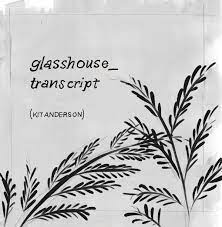
Anderson is interested in the emotional ramifications of being caught betwixt and between. Her comics also deal explicitly with memory and identity. "Glasshouse Transcript" is an interview with a woman about a past memory of meeting with a friend during the lunch break of her job. Formally, Anderson does a number of interesting things here. Each page is a single image. We never see any people, except in faint outlines as part of memories. The narrative captions are one-sided, entirely from the woman's point of view. We never learn why she's being interviewed or by whom. The focus of the "action" is on a bench in the glasshouse, a visual metonym for longing, happiness, and then loss. The ink wash gives the entire thing an atmosphere of nostalgia and regret, and the slightly enigmatic ending doesn't mute the sense of what was lost--and why, as this was a queer relationship that could never be. 


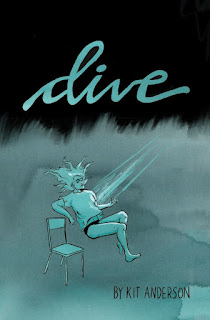
Dive, an entry for a CCS anthology, is another story about an in-between space in a journey. One can see Anderson experimenting with figure work possibilities, with some drawings more successful than others. The real attraction here is a quiet, desperate kind of storytelling as Anderson depicts an abusive relationship defined by poor communication, a crisis that becomes literal as a woman at first seems to drown, and a surreal ending that metaphorically depicts the end of a transformative journey. There's more than a little touch of David Lynch here, and the blue color wash that appears highlights that use of light and color as a transformative narrative element. 

Quests is something completely different. It's cartoony, but also carefully cross-hatched. It's in full color, but the colors are muted and restrained. The short story here may as well be a metaphor for being an artist: it's an eccentric man who may be a wizard and whose motivations are unclear. He works to save a baby bird using certain techniques, including some yarn he's purchased, then moves on. It's a story about the ways in which narratives brush against each other, briefly existing in the same orbit before moving on. 

Country Lane is about another relationship and another liminal space. It's about a couple where one half isn't ready to fully commit by moving in, in part because that adds a certain finality to the decision. She also has trouble sleeping (a symptom of being betwixt and between to be sure), and her partner downloads the sort of sleeping-guide app that is familiar to anyone who's ever had trouble sleeping. The comic concludes with her listening to the recording and it turning into something else, concluding with standing outside out of a house at night, seeing someone waiting for them. The guiding voice asks, "Are you going to go in?" It's a brilliant, subtle exploration of the subconscious, where one knows what the right answer to the question is but can't quite pull the trigger. The narrative is left unresolved, because the story is about this indecision and self-inflicted misery. The use of yellow as a spot color is careful, because the girlfriend's shirt is yellow, and that color is repeated throughout the story. 


The Whorl is the first part of a larger story that also stands on its own. Here, Anderson dips further into horror. Not so much gore or monsters, but the ways in which the unexplained and a loss of identity is a terrifying experience. It's about two sisters going through a morning routine. One of them (Allie) is an early riser who loves to go running, and the other (Claire) prefers to get up later. One morning, Allie finds something unusual out in nature: some kind of whorl phenomenon. Whether it's light or energy or water or sound or something else is unclear and irrelevant. However, when she photographs it and sends it to Claire, there's a gap of time. The only clue that there's something amiss is that the cat freaks out. Later, Claire shows the unusual photo of Allie and the whorl to a friend...but has no idea who Allie is. She has never existed. It's a moment of existential terror to lose track of one's own identity, but it's just as bad for the reader when someone close to her disappears as well. Anderson uses a graywash here as well and a naturalistic approach, but this time it's all used to establish mood. 

Anderson seems like she's trying to figure out exactly what kind of cartoonist she wants to be, as she dips in and out of genre in interesting ways. Each mini is quite good on its own, but taken together it really informs the reader that this is a restless, probing talent matching her themes against her use of technique in genre in a restrained, mature fashion. 


Thursday, December 17, 2020

31 Days Of CCS, #17: Kit Anderson

Kit Anderson brings a completely different set of skills and experiences than most of the other CCS students whose work I've seen. A graphic designer and illustrator, Anderson is applying these skills to cartooning. What's interesting is that Anderson has the eye of a formalist, paying a lot of attention to elements like page design and panel design, and how the two can be related to theme. For example, in Crossings, there's a page that starts with a single horizontal panel of mountains running across the first quarter of the page. The second panel is a smaller map of that territory, also in a single panel. That map is inset as part of a larger image of a car driving toward the mountains, with other panels strategically placed to reveal the driver of the car. The other comics here are similar in intent, although this one was the most effective. 


Minis 2020 is four different one-page strips, each with a different narrative done in a different style. One emphasizes the passage of time in the same place by using different gradations of light and color. Another is a black and white experiment about someone using a match for light in a dark basement, met only by the reflective eyes of a rat. Another used a stark black and white contrast to ultimately express the seriousness of leaving a biosphere behind and the choices that led up to that. The final strip is a COVID commentary, where the text consisted of typical sentiments about bingeing TV and reading books, only each image is that of a scene in nature, oblivious to what humans were doing. Anderson is a thinker as a cartoonist, combining word and image in a deliberate manner to create a feeling, rather than concentrating on a narrative.

With The Snow Well, Anderson went way out of her comfort zone in a number of ways. This was the CCS Aesop's fables assignment, and she chose to adapt "The Fox And The Goat," wherein a fox trapped in a well lured a goat into it with promises of delicious water and jumped on its back to escape, leaving the goat there. This is an old West-style story set in winter, wherein a messenger appeared at a bar, and a man who knew her sat down for a drink and a story with her. She told a story about a messenger who took refuge in a cabin in the middle of nowhere during winter, thanks to the kindness of a woman living there, only to find that the woman stole her horse and left her there.

This comic looks like it was drawn mostly by hand, and it seemed like Anderson tends to do everything with electronic tools. She went all out in terms of various drawing tricks, with grayscale shading, dense hatching and cross-hatching, and her typical use of highly contrasted light and shadow. It's a cleverly-told story with a slight variation on Aesop that provided a clever twist. The one area where Anderson seemed less confident was her figure drawing. They were stiff and she didn't have a tight grasp on how bodies interact in space. Her thin line seemed ill-matched for the material and made her characters look wobbly. There's a great deal to like about Anderson's cerebral approach, especially with regard to panel design and page-to-page transitions, and it's clear that this mini is the first step of many in merging her formal sophistication with more basic character drawings and narrative.