Thursday, May 11, 2023

Time for more Van Scivering!

As a teacher and editor, Noah Van Sciver is one of my favorite examples to bring up of a cartoonist who had to work hard to find his voice, hone his craft, and relentlessly face rejections until his talent simply became too undeniable. He simply set his mind to being a cartoonist and never stopped, studying countless other artists in order to help develop his own style. As a result, Van Sciver has now entered a groove in his career that sees him releasing monster tomes like his Joseph Smith And The Mormons while still working on multiple side projects and collections. 

Van Sciver's always had a restless curiosity to his work, never settling on any one style of storytelling. He's worked on a number of illustration jobs, he's written biographies, he's done slice-of-life fiction, he's done plenty of gag work, and also a great deal of autobiographical work that often dips into metafiction. Cartooning about cartooning can easily become dull and played-out, but Van Sciver constantly finds new ways to examine the art and profession of cartooning from fresh angles. In fact, his 2022 collection from Fantagraphics, As A Cartoonist, is all about Van Sciver dipping into his weird childhood and revisiting it here as a cartoonist who is constantly examining his own status as a creative professional. 


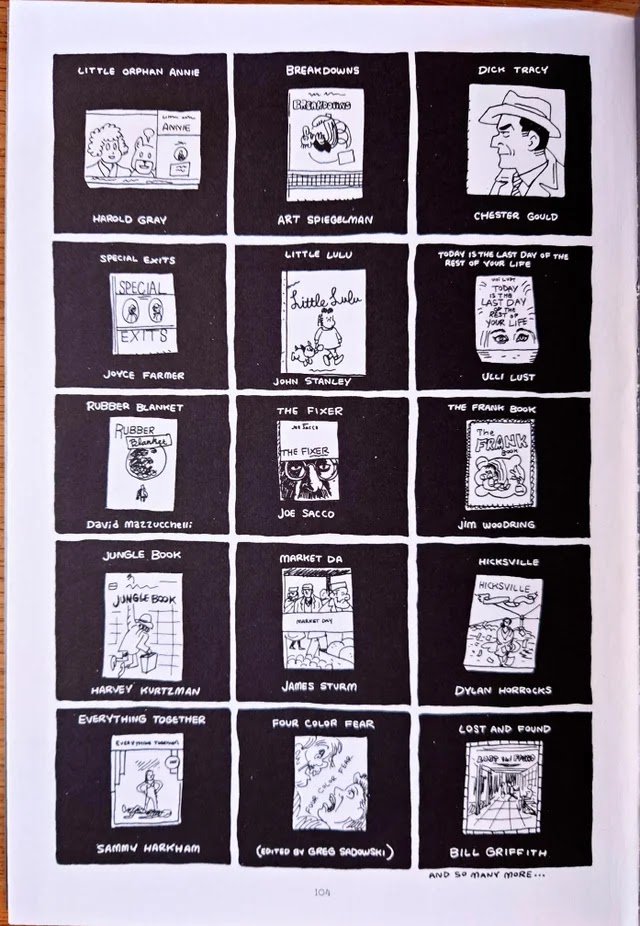
Van Sciver has become a master at creating a rhythm in his anthology work, and there's a sense in which this book is kind of an extended version of his anthology series Blammo! Indeed, it collects a few stories from the comic that fit snugly in here, as well as stories from the Fantagraphics anthology NOW and other stuff. There's also a great deal of previously unpublished work that forms a through-line for the other stories. This book is about cartooning, cartoonists, and what led Van Sciver down this path. It opens with several portraits of cartoonists like Jackie Ormes and Bill Mauldin and ends with Van Sciver delineating a number of comics and cartoonists that meant a lot to him (along with small doodles of those books). However, Van Sciver is a master of transitioning between sincere expressions of appreciation and setting up gags, as his "19th Century Cartoonist" character follows that initial lineup of cartoonists as he once again reveals his own general awfulness. This character is Van Sciver taking the piss out of the frequent overpraising of older cartoonists like this who were pretty much just hacks, but it's also of course a cautionary tale for himself and how he sees himself as a cartoonist now and how others will see his work in the future. 

The through-line for the book is "Mellow Mutt," a dinosaur toy that young Van Sciver is given that becomes a sort of personal totem. Van Sciver's strips about living in a ramshackle house in New Jersey made up his memoir One Dirty Tree, and they are the backbone of his new series with Uncivilized, Maple Terrace. Van Sciver has really struck gold with these depictions of life with a checked-out dad and multiple siblings who are all too happy to let him know his place in the pecking order as the second-youngest kid. They are funny and terrible all at once, and while young Noah is certainly put-upon, he's also presented as kind of a self-tormenting asshole as well. The "Mellow Mutt" stories in As A Cartoonist offer a brief window into Van Sciver's young life, as most of the book's stories focus more on his career as a cartoonist as an adult. 


For example, "White River Junction" is a perfect example of a modern-day Noah unable to relate to virtually anyone, in part because he's not sure what he believes in. He inadvertently manages to offend a number of students at the Center for Cartoon Studies when he tells them he used to be a Mormon, and Van Sciver really plays the awkwardness of those scenes for laughs in an exquisite manner. He's an accidental tormenter (which is rare for Van Sciver in a strip), but also the tormented. The way the strip resolves in nature is the beginning of a growing sense of peace for his character that slowly develops as the book proceeds. 

Van Sciver bookends a single-page strip titled "Fante Bukowski" (his poet character who is sort of like an obnoxious alter ego of his) where he asks Jules Feiffer for advice at a signing with "Comics Festival 2016," a highly self-conscious homage to Woody Allen's film Stardust Memories. Van Sciver is a successful cartoonist going to a show in Europe, but he has celebrity-level fame and is constantly being asked for sketches and favors. A callback to an earlier strip finds aliens saying they prefer his "earlier, funnier" comics and the story ends with a gag about not being able to provide good endings for his stories. There's something else at work here, though: an appearance from his father. In a later strip where Noah visits him, it's revealed that his dad abandoned the family at a time when Noah was in desperate need of guidance as a child. While much of As A Cartoonist is about Van Sciver coming to terms with cartooning as a profession, it's also about finding ways to grow up and come to terms with his past. 


One can see that in strips about moving to Columbus and his initial loneliness, and later strips about meeting his wife Amy and the birth of their son Remy. The story "Jonah" is also about finding ways to accept his siblings (especially his buffoonish and outlandish younger brother) as they are, warts and all. The climax of this story is at an art opening featuring Van Sciver's work, and his brother (not invited to the event) makes a ridiculous spectacle of himself, hitting on random women. What's funny is how Van Sciver lampoons himself and his own pretensions, as the story imagines him talking to art world wheeler-dealers and a writer from the New York Times. "Saint Cole" is a much more down-to-earth account of a foreign tour, where a stop in Paris yields just one fan at a signing but also the realization that cartooning has taken him to a lot of places. For Van Sciver, the disease of more gave way to an understanding of what he had made for himself and his family, as well as the grace to not only forgive his father but to make his stories part of his source material. 

This was also the period of time when Van Sciver went from good to great in terms of his cartooning and draftsmanship. The White River Junction story is so effective when he calls out for good in the forest because he had moved beyond his limitations as a draftsman and put in the work to give his work a decorative sense of beauty it had never before possessed. That's especially true of his nuanced and restrained use of color; even on the brightest pages, there's a naturalism at work that never overwhelms his linework. However, at heart, Van Sciver has always been and will always be a gag man, and his cartooning reflects a style that mixes the ridiculous and the sublime. Van Sciver's mustache is practically a character of its own, adding an arsenal's worth of expression to the face of his self-caricature. Van Sciver namechecks David Collier as an influence, and you can see it in the increasingly-gentle way he's gone about describing his world. Van Sciver, like Collier, is an observer, but he has drifted away from his put-upon schlub persona that so many cartoonists influenced by Robert Crumb seem to adopt. That keen eye, combined with his wit, has allowed Van Sciver to make a deeper dive into older ideas with renewed gusto.


That takes us to Maple Terrace #1, published by Uncivilized Books. Uncivilized is one of the few publishers releasing well-designed comics in something akin to the mini-comics format. They've already done a few series like this, with comics by the likes of Gabrielle Bell, Craig Thompson, and Tom Kaczynski himself. Van Sciver's Maple Terrace is in this vein, giving Van Sciver another low-pressure format akin to Blammo!, but with a much tighter focus. Each issue will have a single story dating back to Van Sciver's childhood at around age eight. (I wouldn't mind seeing him revisit his skater boi persona as a teen featured in My Hot Date, however.) There's a funny throughline in this comic: virtually every male character depicted reads comics. This being the early 90s and the rise of the speculator's market surrounding early Image comics, there was a mix of people reading because comics were a wise investment opportunity and people reading these dumb, quasi-literate masterpieces done by the likes of Todd McFarlane and Jim Lee because of the cool factor. The "value" of the comics, as well as Van Sciver wanting to read something scary in Spawn, provides the key to the plot. 


Mostly, this comic is about Noah trying to negotiate life with his family, being regarded as worthless by the parents of his friends, and the terror of his father and older brother Ethan. There's one amazing scene that I hope is based entirely on real life when Noah's father tells him, "Todd McFarlane is for boys, son. Barry Windsor-Smith is for men." Pious young Noah wants to avoid the wrath of his older brother when he accidentally rips the cover of his Spawn comic, and things happen to work out for the best when a bully gets his just desserts and Noah benefits. The essence of the comic is that creeping sense that children have when they sort of have to accept their surroundings and get used to, for example, sleeping on the floor like Noah does because there aren't enough beds to go around. 

However, they also get the sense that while this is what they're used to, it's not normal, like when the kids see the moldy, leaking roof and cockroaches run across Noah's face every night. It's a sort of recurring form of PTSD that has to be ignored for the sake of survival. In Van Sciver's case, he's reworking it into a kind of cringe-inducing gag strip, where his bushy head of hair and spindly limbs are all part of the visual humor of the series. The bigfoot humor and slice-of-life looks at poverty is somewhere between Don Martin and Dave Berg on the MAD scale, and Van Sciver makes it work. Above all else, this is a funny comic, even if it's frequently heartbreaking. Van Sciver spent a lot of time as an artist making his drawings like tight with tons of cross-hatching and other techniques; with Maple Terrace, he's learned to loosen up again, resulting in some of the liveliest drawing of his career.

Friday, April 21, 2023

Keith Knight's Good On Both Sides

Gentleman Cartoonist Keith Knight is a polymath. From his days as a musician, to his TV show Woke (based on his own life), to his prolific career as a cartoonist, he's always been doing it all, all the time. As a cartoonist, he has three different outlets. The Knight Life is his syndicated strip, and he has the three or four panel approach for the punchline down pat. The K Chronicles is his classic single-page strip, usually with multiple panels that talk about something personal or cultural. Then there's (th)ink, his single-panel editorial strip. While political and cultural issues are essential to all of his work, especially with regard to race and police brutality, (th)ink is notable because of its format. Knight excels at clever turns of phrase and images with regard to some contemporary issue.


His latest (th)ink collection, Good On Both Sides, tackles the fertile subject of the latter years of the Donald Trump presidency. Reading a collection of these strips, one understands that Trump was almost too fertile a subject for scorn and parody. When you have a person who feels no shame whatsoever, loves attention, and changes the outrage narrative every single day, it makes a satirist's job nearly impossible. As such, some of the comics in Good On Both Sides reference events that I can't remember. The tidal wave of toxic nonsense was just too great to keep track of everything, and there's only so much a political cartoonist can do to explain a reference without it resulting in literally spelling out every aspect of a joke. 


Knight mostly manages to get around that problem by using clever visuals to take a specific reference and apply it to Trump's wider universe of greed, sexual harassment, white supremacy, anti-intellectualism, out-and-out lies, and the general alternate reality that the ex-president and his supporters live in. If Trump's an easy target, it's because he's too vast to possibly ignore, and too crudely stupid to resist direct hits. Knight's skill is taking an outrage point (like Trump saying there were "very fine people on both sides" with regard to a white nationalist rally) and shifting the joke (there's an angel and a devil on either side of him, and Trump is feeling up the angel). Knight's stumpy, cartoony figures are exaggerated and rubbery, giving his characters a kind of sweaty, neurotic energy. Knight is not only funny, he draws funny, and he rarely varies from this style in all of his material. There's an almost gentle, welcome quality to his drawing style, providing a little distance for when he goes all-in, like his incredible "White Power Rangers" gag. He's also proficient at taking a news item (like a golf club calling the cops on a group of black women playing on the course) and pulling out a dagger of a punchline ("...they're swinging at something WHITE!")


There are also moments of sincerity, as Knight honors figures like Bill Nunn, Billie Holiday, and Thurgood Marshall with naturalistic portraits and key quotes. In this political climate, simply honoring Black figures from American history is a political act. Knight suggests that like it or not, simply being Black is a political act, and he's not afraid to say this out loud. He's even more unsparing in his lectures about police violence; if anything, he mostly pulls his punches and goes for gags in (th)ink; he could be a lot meaner. The final comics in the collection address the then-incipient Coronavirus; he nailed the conspiracy thinking surrounding it from the very beginning. Despite the fact that so much of this book is so contemporaneous of roughly 2018-2020, the strips relating to race are not only still relevant but are even somewhat understated when one considers right-wing attempts at whitewashing everything. Knight's foresight, comic timing, and cartooning skill elevate Good On Both Sides from a standard collection of editorial cartoons.

Tuesday, April 18, 2023

Julia Gfrörer's bleak Vision

An underlooked part of evaluating comics (and a highly subjective one) is the sheer visual appeal of the art. What is appealing is subjective, as some people can love the ligne claire style of drawing, some love Gary Panter's ratty line, and others like exaggerated and rubbery cartooning like Peter Bagge. As both a reader and critic, I appreciate a style that is idiosyncratic and personal for the artist, especially after reading so many mainstream graphic novels that use the same line weight, styles, and color schemes. (Note to YA cartoonists, in particular: mix it up!) As such, there are some artists whose lines are simply a sheer pleasure for me to look at, regardless of story or subject matter. One of them is most definitely Julia Gfrörer.


Having followed her career from the beginning, I've always appreciated her fragile, ratty line that often seems like it's about to disintegrate at any given moment. Given that she loves to explore the intersection between sex, bodies, and horror, her drawings have a visceral quality that is at once erotically charged, disturbing, and desperately familiar. All of this is on display in Vision, her 2020 book from Fantagraphics. At its heart, this is a story about desperate loneliness and yearning, mixed with a series of betrayals and boundary violations. It's also deeply steeped in BDSM concepts, as the lead character Eleanor is a widow tending to her perpetually-ill sister-in-law and her distracted brother. She also regularly talks to a demonic spirit in a mirror, who orders her to strip naked and pleasure herself, even as he calls her out as someone who desperately wants to be used and degraded. 


Set in the 19th century, Eleanor's choices are even more limited because of the era, and how her voice is constantly silenced by those around her. All the while, her vision is starting to go thanks to cataracts, leading to an encounter with the eye doctor that is at once a violation and arousing because it is a violation. One of the best things about Gfrörer's work is that her narrators are often unreliable, and that the reader must follow what they do rather than what they say. For Eleanor, despite all of her stiff-upper-lip performative strength, she's a shattered woman clinging only to her desire for meaning. That desire is toxic and unsustainable, whether one takes the supernatural elements of the story at face value or sees them as a manifestation of her own insanity. In the end, it doesn't matter. 


She's not allowed to grieve her husband openly, and any emotions she feels are immediately shot down by her sister-in-law Cora and her brother Robert. While the book opens with her talking to her magical, quasi-demonic mirror that is her effective voyeur dom, she really does have the best interests of her family at heart. Her brother, it is implied visually, is sexually assaulting his physically and mentally ill wife in her sleep, tearing open her nightshirt that Eleanor rebuttons. For both Eleanor and Robert, there's a sense that their desires cannot be contained and are making both of them want to act with no restraint. Only Robert is allowed to get away with it openly, however.  

When Eleanor tells the ghost in the mirror that she wants to go where he is, it's a desire to be touched and act on her sexual impulses--but it's also implied that this is a self-annihilating act. The ghost is dead, in hell, or someplace even worse, and Eleanor has a firm suspicion that she's hellbound no matter what. With her self-cutting early in the book, it's clear that she's trying to externalize the pain and scarring she feels emotionally, but the ghost feels like a chance to evade this. The ghost makes her feel desired and reads her for what she truly is: a submissive who seeks out pain, seeks out degradation, seeks out and wants to revel in sexual debasement. For a sub, being able to access this kind of emotional space with a trusted partner can be deeply healing; for Eleanor, she only has more pain to look forward to. 


When the doctor treats her cataract, the ghost demands she describe the pain in detail, with the procedure described in such a way as a dom controls and gives pain to a sub. The ghost's reaction mirrors her own in a way; it cracks, mimicking Eleanor cutting herself earlier. The mirror is possessive and jealous of Eleanor, and what remained her sole outlet for her desire is cruelly cut off. The leads to her spiralling, as her tolerance for her situation evaporates. She welcomes advances from the doctor (despite the ghost smashing a paperweight in protest), poisons her sister, and gets lost in laudanum dreams as she fantasizes about joining her ghost lover. In the end, her ghost lover never returns, and she makes a fateful decision for her brother and herself. 

This is perhaps the grimmest of all of Gfrörer's stories, and the one with the least humor. While her protagonists either tend to be in bleak situations, victims of outside forces, or predators in their own right, Eleanor is doomed from the beginning. She's grieving but given no space to grieve; her desire, need, and loneliness are all subsumed to the needs of her family; and there's no real way out. Even the doctor who wants her cares less about social calls (despite his veneer of respectability) and more about dominating her. A soft dom, perhaps, but a dom nonetheless. The only being who understands her is either a figment of her imagination or a largely malignant spirit. In the end, it doesn't matter, given the hopelessness that she understands all too well. She chooses self-annihilation over misery, as she can't see a way out. The pain expressed in this book lingers long after it's read. 

Tuesday, March 28, 2023

The Indy Life: Leslie Stein's Brooklyn's Last Secret

Leslie Stein's work has veered between direct memoir and her "Eye Of The Majestic Creature" series, which is essentially fabulist memoir. Brooklyn's Last Secret represents a fictional story that nonetheless is deeply personal. It's about a slightly aging indy rock band from Brooklyn (hilariously named Major Threat) that embarks on a tour of America that operates out of a van. Stein has written a number of books, but she's also been a professional guitarist for a number of years as well. This book feels like an ode to a thousand road trip stories that she and many people she knows have collected over a lifetime. It's affectionate and wistful, as some of the characters are filled with regrets as they grow older while the younger characters are trying to imagine their futures. 


I've often thought that the indy rock and indy comics scenes had some similarities. Beyond the obvious comparison in that many cartoonists are also musicians, and that many cartoonists have done rock posters or album art, there's a deeper level here. There's not a lot of money to be made in publishing a book or releasing an album. Self-releases have limited reach and costs that have to be covered by the artists, while label/publisher releases have costs built into limiting royalty payouts. To compensate for this in music, there's a national network of clubs that host bands, where they might get a cut of the gate but also get a chance to sell merchandise. The past 25 years have seen a similar rise in smaller shows aimed at zines and small press comics, running nearly year-round now for cartoonists who want a chance to move their books directly to an interested audience. Touring and tabling are both frequently frustrating and demeaning, but every now and they have transcendent moments. 

There is a key difference that Stein highlights near the end. The "band dad" Ed, who's now in his 40s, is a professional tech guy in his day job. He's not especially fond of his co-workers and their smarmy attitudes about being a musician. At the same time, he hates being on the road, hates being hit on, and is pretty much a ball of anxiety. When bandmate Lilith calls him out on this, his reply is simple: I like to play the drums, and it is not a solitary pursuit. Charlie Watts of the Rolling Stones used to say much the same thing, where when he was at home, all he wanted to do was go out and play drums, and when he was on tour, all he wanted to do was go home. The joy of music is performance, and unless you're playing on your own, you're dependent on others. This is in striking contrast to the solitary existence of the cartoonist; part of the fun of shows is simply being with other cartoonists. 


The structure of Stein's book is beautifully and conveniently episodic. It starts off with the band's agent setting their tour itinerary, and there's a running joke where the drunk/stoned members of the band fell asleep and they didn't get good food guarantees as part of their rider. The first show is a hometown show, and Stei elegantly reveals details about each of the four main characters organically as the tour proceeds. Ed never feels comfortable in any world, as the biracial son of academics who's a coder and rock drummer. When the band drives in Montana and they're stopped by police, he makes sure to sit in the back. Lilith is recovering from heartache and wondering what to do next in life as she realizes she's starting to get older as well. Marco is the young new singer, full of energy but also cagey about his life outside the band. Dave is the bass player who is mostly quiet and enigmatic, floating through a charmed life. 


By the end of the book, Stein unravels their backstories and mysteries to give the story more structure. None of that was really necessary, though. The real attraction here is the aggregation of anecdotes, the shared experiences on the road with this group of artists. What they share is not exactly friendship; indeed, Lilith points out that the road is no place for expressing your feelings. There's a hilarious sequence where she is upset and about to talk about her breakup with her bandmates, before she catches herself and instead "confesses" that she's "really into progressive electronic music right now." This elicits far more sympathy and understanding than a confession about her love life would. As in all of the book's vignettes, Stein's expressive cartooning is absolutely masterful. Her control over her spare line that suggests forms more than actually depicts them, is augmented by her tasteful and restrained use of color that furthers the narrative on several fronts.

As Stein describes it, being on the road is a long series of inconveniences, humiliations, tight quarters, drunken numbness, and the occasional transcendent moment. All of these things are endured to get to those moments as artists, seeking the sublime, as well as a few moments of mutual understanding from their peers and energy from the audience. Musicians need to play, cartoonists need to draw, and sometimes life is just picking up the mess that's made in between these fleeting, but deeply connected, moments of beauty. When the musicians in the book have on of those moments, they aren't just experiencing that one moment, but rather a continuum of that beauty across time, for every instance that they were in touch with the sublime. Being an artist is a mix of the sublime and the ridiculous, and Stein depicts both with comedic grace and deep sensitivity.

Wednesday, March 8, 2023

The Perverseness of Nick Maandag: Harvey Knight's Odyssey

As a comedic writer, Nick Maandag follows a kind of logic that defies standard expectations of what a comic narrative should be like. In his new book, Harvey Knight's Odyssey, he's downright perverse about taking readers down blind alleys, subverting expectations, telling shaggy dog stories, and otherwise refusing to end his stories on anything resembling a conventional punchline. For Maandag, the humor is found in that repeated defiance of reader expectations that follows its own torturous logic. It reduces personal narratives to banalities at best and deluded acts of violence at worse. He is absolutely ruthless with regard to the concept of the quotidian, slice-of-life story, satirizing it like a wrecking ball. He's even meaner when it comes to the cruel pointlessness of religion and work culture, even if the satire doesn't seem to be his main objective. Maandag engages in vicious absurdity for its own sake, escalating absurd premises beyond a reader's comfort level until they go so far off the rails that they deliberately abandon the story's original idea and frequently reason itself. 


Maandag starts small in "The Plunge," the first of three stories in the book. It starts with a simple premise: Nick Maandag, in his office job, decides to start using a French press to work in order to make coffee instead of getting it from Tim Horton's. He's hesitant for a moment, for fear of being seen as pretentious, but then he reasons: why would anyone care or notice? Maandag takes that premise and takes it in an unexpected direction. In dialogue that is bone-dry and deliberately, maddeningly banal, his coffee-making goes in a different direction. His curious coworkers watch him go through the steps of using a French press and are fascinated by it, as he goes through a little narrative. Soon, his coffee-making becomes a ritual, as onlookers are excited for "the plunge," when he pushes the press down. Maandag even starts to become more elaborate in his narrative. The whole thing takes on a life of its own, until the entire office comes to watch. It ends on a newcomer saying, "That's it?", but the whole point of the story is not that this is interesting, but that so many people in this desperately soul-crushing environment gain the slightest bit of solace from a community experience that celebrates a moment of pleasure. It also attains a cult-like status (one co-worker says "We're always accepting new members"), even if the object of this cult is unbelievably trivial. 


Maandag runs with that idea in the title story. It starts with a crazy premise--a cult called the Church of the Holy Radiance--and goes in directions that utterly deflate the dogmatic qualities of the religion and reduce it to simple human greed and other base emotions. The religion believes that certain creatures are beings of light and others are beings of darkness, and humans are somewhere in-between. The Church aims to increase the light in humans (through obeying doctrines but also tanning beds), but this creates evil shadow beings that Church members now have a legal right to murder. There's an excruciating sequence where there's a lecture on which insects are dark and which are light that's every bit as arbitrary as any religious dogma. However, the titular Harvey Knight conspires against the cult's leader, steals his tanning bed, and eventually murders him. Harvey also hires a new assistant to do "experiments" that include skinning the old leader and turning that skin into a prop for a musical that includes maggots doing a can-can dance. The story and its characters get distracted and bored by their own narratives, forgetting to run their church or go to their own play. The ending is more of the same in terms of non-sequiturs, as a distracted and possibly addled Harvey decides to go explore the sewers. The "Odyssey" here rambles and makes no sense; it's like the antithesis of a Joseph Campbell Hero's Journey. Maandag's plain and simple line accentuates this, as he draws absurd things (Harvey's misshapen head is an inherently funny drawing) in a nonchalant fashion. 


The final story, "Full Day," is a recapitulation of both of the first two stories in the book. It's an "Odyssey" of its own, only it's far removed from the absurd premise of the "Harvey Knight" entry and more in line with the first story. It's a "day in the life" wherein Maandag goes through a series of extremely silly and annoying obstacles. A sweeping machine that only clears sidewalks in the daytime deliberately sucks up his hat because he's walking too slowly. An elevator closes on him repeatedly. A lecture from the boss on work-as-family is an obvious pretext to start firing people. Maandag faces a dumb and arbitrary performance review metric and gets increasingly in the weeds with it as the company sends someone to evaluate him in the middle of the task; Maandag gets in trouble for using folders wastefully. In the middle of the evaluation, he's asked to evaluate the evaluator in the most mind-numbingly awful survey ever. Maandag's failure to complete a task leads to a shaggy dog story of dead ends, pointless conversations, kidnapping, and abject failure. A homeless woman flashing him on the train leads to him being pulled into a complaint of being harassed, ending with a grief counselor chasing him to give him condolences.. The day is a pointless one: nothing is learned, nothing is gained, and all of it is a waste of time. 

It's a waste of time for everyone but the reader, that is, as Maandag's deadpan humor and drawings are a perfect conflation of ennui, absurdity, and total meaninglessness. This one doesn't quite have the more visceral belly laughs of his other recent work, but it's also fair to see that this book is much more conceptual in nature than his past comics. There's no hope or meaning to be found here, and that gleeful nihilism and total subversion of narrative expectations can be a gut punch at times. Maandag knows it too, and just when you think there's going to be a moment of character growth, Maandag short-circuits it with something absurd happening or that character (literally) choosing violence.

Saturday, December 31, 2022

31 Days Of CCS, #31: Rust Belt Review 2-4

Sean Knickerbocker has been regularly releasing an interesting anthology that's taken work from open calls, and the results have been uniformly fairly strong. He's also had a few serials running throughout, including one of his own. I reviewed the first issue last year, but there are three more he submitted for this year's CCS call. I'm going to review it in much the same way I used to review batches of issues of the old MOME anthology from Fantagraphics: I'm going to sort them by cartoonist, since so many of them appear in every issue. 


Sean Knickerbocker: The editor of the anthology and CCS grad is doing a great job in putting together these anthologies. First off, the actual page size is huge, something around 10 x 12". Each page is given a lot of room to breathe, which helps a number of artists whose style is densely packed. Knickerbocker publishes stories from others that are tonally and stylistically different, and he deftly balances one-offs with serials. Each 100-page issue is a satisfying read, in part because there's variety and some heft to them, but without the problem of feeling padded. None of these comics are a chore to read.

Knickerbocker is serializing a story called "Best of Three," which feels set in the kind of small industrial towns featuring desperate losers featured in all of his comics. This is a story about gamblers, grifters, and gangsters, only it revolves around a deadbeat dad who became a big-time and successful Magic: The Gathering player. The absurdity of this nerdy game replacing things like blackjack or poker is only matched but how absolutely true this scenario is. Magic tournaments have even been televised on ESPN. The story follows a narcissistic loser named David who inherits money from his supposedly dead father, but as the story goes on, more characters emerge from the woodwork in search of the real motherlode of money that he hid. The mobster angle gives this story a bit more frisson than the typical Knickerbocker story, which is not to say he doesn't have conflict. It's just that the conflicts are social ones and don't tend to intersect with genre tropes. That said, even the criminals in this story are grimy and desperate, accentuated by Knickerbocker's cartoony line, complete with exaggerated facial features and lumpy bodies. Each chapter takes its own unexpected twist, making it a fitting anchor for the anthology. 

Michael Sweater mixes his anthropomorphic animals with slacker punk aesthetics to tell a story that's more emotionally resonant than his stories elsewhere. "No Regrats" (in #3) is  about two rabbit friends, Timmy and Charles, and a wild night on the town that results in Timmy getting a tattoo on his chest that says "Simp." Timmy has no memory of this, so he goes with Charles to complain at the tattoo parlor, and the proprietor reveals that Charles told him to give him this tattoo. This leads to a comical fight, but the cliffhanger scene ends with Timmy saying that after the tattoo is removed, they are done. Much of Sweater's work is about being friends with horrible people who take advantage of you and what kind of impact this has on one's life, but this story is unusual in that it leads to such a direct break. As always, his storytelling chops are fundamentally sound; his scratchy line is a nice match for his cute figures, diluting some of that saccharine quality they possess. That solid storytelling allows him to focus on making his characters as expressive as possible. 


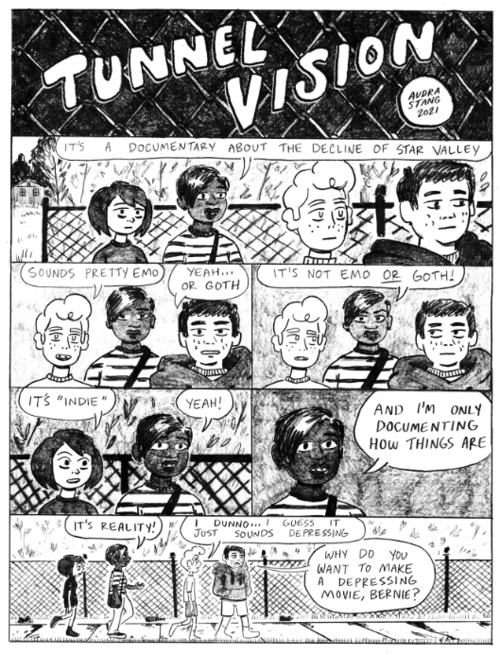
Audra Stang is someone whose Star Valley stories I'm reviewing elsewhere, but she's another regular from the first volume. This is a side story involving her young stand-in Adelaide and her friend Bernie, as they explore the tunnels underneath Magic Waters, the decrepit resort that used to make the town a tourist attraction. Stang's mix of a highly cartoony line in the vein of a Dell or Archie comic and intense greyscale shading provides a nice atmosphere for this journey underground. Paired with her friend and secret crush Bryson and his friend Jesse, Stang has a painfully acute understanding of teenage dynamics and how teens both wear their hearts on their sleeves and pretend they are completely detached. The plot revolves around Bernie wanting to take photos for a story, convincing Bryson to take them down there, but the result is both a fleshing out of every character and a bit more lore concerning Star Valley itself. Stang's stories about the conflict between working-class people and the wealthy make this a nice fit in the anthology. 


Andrew Greenstone greatly benefits from working on such a big page, because his art is dense, grotesque, and distorted. Working so big allows his art to have maximum impact, like a page where one character falls off a bike and hits the ground hard. Volume 2 continues the story of the twisted psycho who kidnapped a young woman for a demented game show, as the story mostly follows her paranoid boyfriend who's trying to protect her and reestablish their relationship. There's just enough of the first story's weirdness here to provide a strange flavor, but Greenstone swerves into the boyfriend's own madness. Greenstone's story in Volume 3 is unrelated but every bit as strange, as a zoo creates new animals thanks to the bizarre "Lemur Man" who comes out and turns humans into animals. What's great about the story is that it starts as a ridiculous urban legend that is very quickly revealed to be true, and the sort of grotesque transformation that the story demands is right in Greenstone's macabre wheelhouse. 

Brian Canini Canini is a very good cartoonist and his stories in volumes 3 and 4 were both highlights. "Silk Stockings" in #3 is a brutal family story that mixes the main character's (a teenage boy) general confusion and horniness with his parents' marriage starting to fall apart. There are just so many interesting character moments here, as the conflict centers around his father's lack of financial success coming to the forefront as they stay at his successful childhood friend's house. His friend very consciously "treats" his dad with lavish dinners, even as his mom seethes that it's not something he could pay for. Bruised egos and long-held resentments go side-by-side with the boy accidentally seeing the friend's attractive young wife put on silk stockings, sending him into a whirl of confused hormones. There's another scene where the friend's teen son expresses his loneliness by his eagerness to play hide-and-seek instead of play a video game. The simple line almost mimics something like a syndicated newspaper cartoon like "Hi And Lois" creating a tension between the conflict and the seeming happiness underneath. 

"False Flag" is a hilarious story that starts with a confusing scene with a young man half-dressed in the cold, then rewinds to a meet-cute romance, and then barrels into a spy story. The deflections and distractions work nicely in a story that utterly deflates the romantic premise, with the cute and squiggly line pushing the romantic aspect until it doesn't. 

Alex Nall's mix of naturalism, the grotesque, and the cartoonish is sometimes a mixed bag for me as a reader, but there's no question he's a thoughtful cartoonist. I can see what he's doing in terms of the style clash, but it often reads as purely dissonant instead of creating a carefully-constructed tension. However, his work in Rust Belt Review resonates, as his line seems a bit simplified for some of the stories. In "License To Kill," for example, Nall leans heavily on a thick line weight, carefully balanced black and white contrasts, and character design that emphasizes ugliness without going all the way to comically grotesque. The story follows a doomed high school crush that metastasizes into pure exploitation, until it transforms into some just desserts (literally and figuratively). "Facilities" is a sweet story about people working at a doomed mall, trying to find some solace and hope in each other. Like with Knickerbocker, there's always a sense of desperation in Nall's stories. Unlike Knickerbocker, Nall usually allows for a bit of hope. "Wall Of Fame" is a funny story about a conflict between a bartender and a regular, and it's ultimately about boundaries and space while despairing of one's ultimate fate. Nall, along with Stang and Knickerbocker, are truly the anchor artists of this anthology. 

Ian Densford & the Bros. McGovern This writer/artists team are another beneficiary of the sheer size of each page, because the Bros. use a highly smudged and messy style that's heavy on both lines and greyscale shading. Like many stories in the anthology, there's an interesting swerve in these stories. In "Soggy Landing," that smudged style is highly evocative of the muddy, messy war story that it depicts. Everyone is covered in mud and filth as a company tries to survive, waiting to be saved by reinforcements. Near the end, there's a huge swerve toward horror that's almost funny in its outrageousness, but Densford and the Bros never break character. Making the characters anthropomorphic goats somehow made the ending even more effective. The story in Vol 4 is also supernatural, swerving a bit from a coming-of-age country story. Densford is creating an interesting shared universe in these short stories, making them not quite a serial, but rather a series of thematically connected sketches.

Will Dinski has a couple of stories featuring his Eat Street Diners Club characters, who are regularly featured in an email newsletter. Dinski's weird, angular characters with minimal shading look constructed as much as they are drawn. This silly and mannered story about one of the characters finding a gun and the cop who chases him down is weird, lacking the usual sense of irony inherent in Dinski's story. He's playing this one loud and broad, and it feels a bit like filler compared to the rest of the stories in the volumes it appears in. 


Asia Bey Bey's "Open Roads" uses a four-panel grid (with amusing author comments at the bottom of each) page that really takes advantage of all the space on the page. This allows them to focus on their two leads, two young women hitch-hiking in the desert. The guy who picks them is a creep who then starts masturbating, which leads them to jump out of the car. The story really serves as a showcase for Bey's excellent and expressive figure work. While this looked to be a serial, only one entry has been published (in #2). 

Evan Salazar A number of these stories mix grounded, naturalistic settings with supernatural elements, and Salazar's story combines the lonely life of a young adult with a bit of video game fabulism. The idea of cursed games, magical games, and games that have some kind of deeper intelligence behind them is not an uncommon theme in fiction (especially in comics), and this one has a more benign one, as a strange game winds up summoning a cat that becomes the young man's companion for many years. It's not explicitly stated, but Salazar, using a sketchy and cartoony style befitting a video game, makes it work. 

Sienna Cittadino Their line is a bit wobbly at times and their character design is similarly shaky, but Cittadino is an excellent storyteller who understands tone and subtlety. It is a (presumably) autobio story that sees "Sienna" as a teen go to a pool party, only to be a largely ignored introvert. They are much more at home on a soccer field, but their mom is berating them to be happy and cheerful, and resents Sienna's lack of enthusiasm at her presence in their life. Cittadino says a lot without having to spell things out, and the solid storytelling allows them to use a paucity of dialogue.

Mike Freiheit This was a strong story by Freiheit, that starts from a fairly ridiculous place and gets exponentially funnier, weirder, and more outrageous. It's about the funeral of an awful person who plans to have their body turned into diamond and then preserved as an NFT. This was all planned by his brother, who proceeds to give the most vicious eulogy of all time, culminating in revealing that he cloned his brother and will raise that child as his own, defeating him in combat when he's 18. Of course, the bullied becomes the bully in this story, but it's so outrageous that it's hilariously satisfying. This isn't meant to teach a lesson; rather, it's one long rant against toxic masculinity. 

Sam Grinberg The best shaggy dog stories and escalating jokes start from the most absurd of premises. So it is with Grinberg's "Pancake Jake," a story about three friends. Two are ghost-hunter types who see the significance in everything, and the other is a skeptic. When they convince him of the diner monster legend Pancake Jake, who appears if you say his name three times after ordering funny face pancakes at a diner. This then actually happens (and the reveal of the monster is simultaneously terrifying and hilarious), leaving the story on a cliffhanger. Grinberg's stylized character design is appealing, especially with the way he uses blacks to provide contrast. Hopefully, this serial continues after Vol 4. 

Gina Lerman This is the first part of a serial and very little happened, as it's about a young woman going to an art residency in Vermont, being informed that aliens abducted a couple, and then not finding her friends at the remote cabin. Lerman also benefits from the big pages, as she employs a nice, thick line with a simplified line. 

Matt MacFarland MacFarland excels at slice-of-life stories, and this is a good one: recalling some summers spent as a waiter in a family-owned Italian restaurant filled with insane characters. MacFarland's line is functional and stands out when he's exaggerating character moments. The story fits snugly with the many other working-class settings for stories in the anthology. 


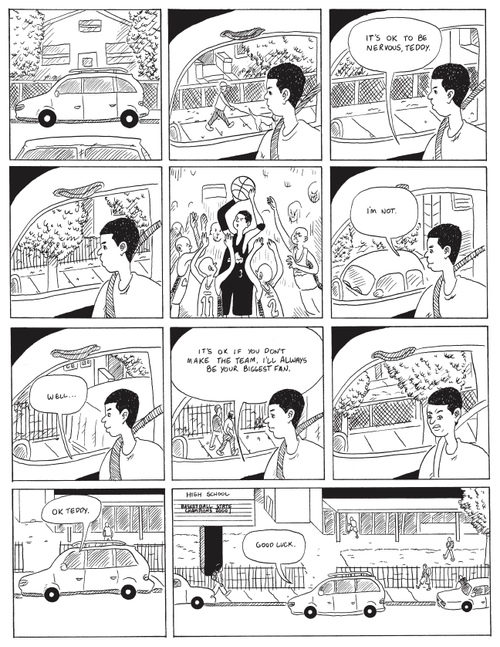
Raziel Puma Using a 12-panel grid (Santoro-style), Puma uses a clear-line approach to this story about a kid inspired by Allen Iverson in trying out for basketball. It's really a story about sibling rivalry that ultimately becomes a story about empathy, and freezing in the moment. Puma's drawing and storytelling are both excellent, as the story is well-paced and features a lot of expressive figures that hang together nicely on the page.

Jordan Speicher-Willis brings some punk energy to the proceedings in telling a story about a bunch of kids who pull an elaborate prank in order to help pay for school lunches for the rest of the year for everyone. That punk anarchist hatred of the system but desire for help and mutual aid is baked into the story, mixing direct action that flirts with violence but never violence for its own sake. The scribbly line from Speicher-Willis dips in and out of hatching, spotting blacks, and other techniques to keep things flowing, but it's that clear-line energy that adds clarity to the proceedings. 

Andrew White I can't imagine a better candidate to do one and two-page interstitial pieces than White, who skirts the line between pure comics-as-poetry and work that has some of these qualities but trades more in narrative. Regularly working with a 12-panel grid, White creates a poetic rhythm in his panels, often alternating word and image in each one. His use of negative space in that rhythm gives his text-only panels their own sense of weight that keeps them firmly attached to the narrative instead of taking the reader out of it. Almost every strip tends to be about environments, as you see sky, mountains, and clouds, until the final strip in the book, following a quietly tortured figure as she collects honey or syrup from trees. There's a beautiful delicacy and precision to the lightness of White's line and approach. (Full disclosure: Fieldmouse Press will be publishing a book from White.)