Showing posts with label noah van sciver. Show all posts

Saturday, August 15, 2026

Jonathan Baylis' So Buttons #15

Jonathan Baylis has been writing comics for about a decade now, working with cartoonists to relate anecdotes from his life in the tradition of Harvey Pekar. What's changed for him over the years? Well, as evidenced by the latest issue of his anthology series So Buttons, he's starting to think like less as a writer and more as an editor. What I mean by that is that the way he sequences has become more sophisticated and his themes are more emotionally resonant. 


In So Buttons #15 (with a cover by C.M. Campbell that pays homage to a Barry Windsor-Smith cover from a Machine Man miniseries in the 80s), Baylis quickly establishes his theme as fathers and sons. Frequent collaborator Noah Van Sciver is a perfect choice for a loose and expressive story about a younger Baylis going with his father to visit his father's old neighborhood in Brooklyn. The message of the story ("be yourself") was a little pat, but the details of his affection for his father, along with how Baylis was frequently mystified by him, are what linger. The follow-up story, where TJ Kirsch draws a brief anecdote about solid advice on take-out, is a good gag strip that gives further color with regard to their relationship.


Baylis is a film and TV guy, having worked in the industry for a number of years. As such, he often drops interesting anecdotes about various encounters but also describes how and why film has had an impact. Sometimes, like in this issue, it leads to interesting stories, like how David Lynch's films and shows made him feel like a little less of an outsider but also indirectly helped him land a job. (Bhanu Pratrap's angular, distorted cartooning was a perfect match for this subject.) When Baylis stays away from played-out, tedious references like Star Wars or superhero stuff (essentially, Kevin Smith territory) and focuses instead on more personal and meaningful work, it's easier to see how and why it is so resonant for him. 


The stories about his time as an intern at October Films (as drawn by Danny Hellman, Karl Christian Krumpholz, and Nathan Gelgud) are not only interesting on their own as anecdotes, but they also reveal a lot about what's important for him aesthetically and how it bleeds into his personal life. That focus on movie segues into a beautiful story about his recently-deceased mother's love for West Side Story, drawn by Becky Hawkins. What represents a step up for Baylis as a writer is that this isn't simply a sentimental, emotional anecdote (although that is part of it); it's also an examination of the lacuna that now exists about why his mother felt a certain way about things. It's something he will never really know, as there are many mysteries that parents leave behind. The single-page drawing from Eleanor Davis about his mother-in-law is the single best page in the whole comic; it's a beautiful visual explication of not feeling one's own age. 

The only real misstep was Baylis' text explaining his themes at the end. I get why he might have done this, but it felt unnecessary. The themes and how they connected were clear to any reader willing to read closely. That aside, Baylis was right in asserting that this was his most cohesive issue of So Buttons to date. As a writer and as an editor, this is a clear sign that Baylis has hit his stride, and I'm excited to see his work continue to evolve. 


Monday, February 12, 2024

Noah Van Sciver's Maple Terrace #2

Noah Van Sciver remains in his productive groove of comics with the second issue of Maple Terrace, from Uncivilized Books. The series picks up on Van Sciver at a young age, living in a ramshackle house in New Jersey with his family. Maple Terrace is about poverty, alienation, and cruelty. It's also hilarious, as Van Sciver makes his younger counterpart the tragic target of a number of ridiculous scenarios. What makes it worse is that what seemed to be the temporary triumph of the first issue, built on deceit and theft, comes back to bite him in the ass in a perfectly melodramatic way. 


There's a sense in which these comics are a kind of second cousin to Evan Dorkin's classic Eltingville Club comics, featuring a bunch of guys with an intense shared passion for their niche and nerdy interests turning that passion into petty oneupmanship, petty gatekeeping, and the most pathetic kind of status-seeking imaginable. For Van Sciver in this story, he desperately wants to be considered cool by the people he knows at school, but this is constantly foiled by both his poverty and general weirdness. He's an oversensitive kid from a religious family that is scorned by pretty much everyone on his block, and every attempt at improving his status is foiled. 


In this issue, the comics he stole after an enemy seemingly got his just rewards are suddenly in jeopardy, as someone saw him stealing them. What's worse, this seems to corroborate the idea that he stole food from the house of his best friend, disqualifying him from playing with him again (and going to his farcically awesome birthday party). As he falls further into the web of his own "lies, deceit, and bullshit" (to quote Larry David), he's given an ultimatum to return the comics--only to get into a fight with his younger brother that destroys them. Van Sciver conflating their titanic conflict with the infamously dumb "Death of Superman" comic from the early 90s makes this even funnier. 


Visually, Van Sciver is in total control. His line is deliberately pretty loose here--much looser than in most of his other work. It's a deliberate way to give it a kind of little-kid feel without it devolving into little-kid scrawl (which he amusingly has on the back cover). His character design is varied and interesting, and I especially like his puffy hair matching that of his mother. The capricious art teacher at the school is another marvelous design, with shaggy male-pattern baldness and a walrus mustache, bestowing and taking away "art god" status on a whim. The color looks great on the coarse paper that mimics old comics. Van Sciver continues to mine autobiographical gold from his youth, even as he works on multiple projects at once. 

Thursday, May 11, 2023

Time for more Van Scivering!

As a teacher and editor, Noah Van Sciver is one of my favorite examples to bring up of a cartoonist who had to work hard to find his voice, hone his craft, and relentlessly face rejections until his talent simply became too undeniable. He simply set his mind to being a cartoonist and never stopped, studying countless other artists in order to help develop his own style. As a result, Van Sciver has now entered a groove in his career that sees him releasing monster tomes like his Joseph Smith And The Mormons while still working on multiple side projects and collections. 

Van Sciver's always had a restless curiosity to his work, never settling on any one style of storytelling. He's worked on a number of illustration jobs, he's written biographies, he's done slice-of-life fiction, he's done plenty of gag work, and also a great deal of autobiographical work that often dips into metafiction. Cartooning about cartooning can easily become dull and played-out, but Van Sciver constantly finds new ways to examine the art and profession of cartooning from fresh angles. In fact, his 2022 collection from Fantagraphics, As A Cartoonist, is all about Van Sciver dipping into his weird childhood and revisiting it here as a cartoonist who is constantly examining his own status as a creative professional. 


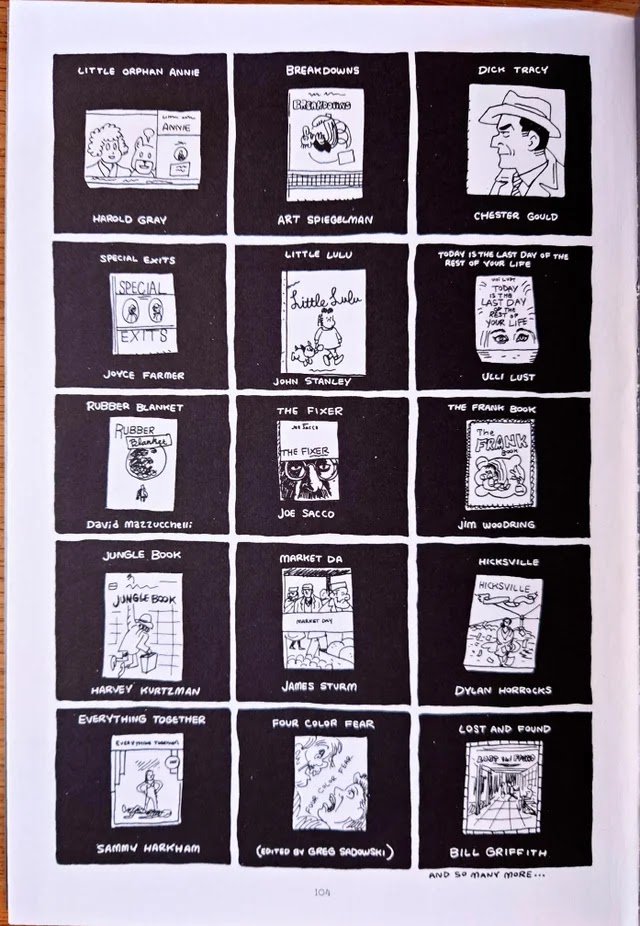
Van Sciver has become a master at creating a rhythm in his anthology work, and there's a sense in which this book is kind of an extended version of his anthology series Blammo! Indeed, it collects a few stories from the comic that fit snugly in here, as well as stories from the Fantagraphics anthology NOW and other stuff. There's also a great deal of previously unpublished work that forms a through-line for the other stories. This book is about cartooning, cartoonists, and what led Van Sciver down this path. It opens with several portraits of cartoonists like Jackie Ormes and Bill Mauldin and ends with Van Sciver delineating a number of comics and cartoonists that meant a lot to him (along with small doodles of those books). However, Van Sciver is a master of transitioning between sincere expressions of appreciation and setting up gags, as his "19th Century Cartoonist" character follows that initial lineup of cartoonists as he once again reveals his own general awfulness. This character is Van Sciver taking the piss out of the frequent overpraising of older cartoonists like this who were pretty much just hacks, but it's also of course a cautionary tale for himself and how he sees himself as a cartoonist now and how others will see his work in the future. 


The through-line for the book is "Mellow Mutt," a dinosaur toy that young Van Sciver is given that becomes a sort of personal totem. Van Sciver's strips about living in a ramshackle house in New Jersey made up his memoir One Dirty Tree, and they are the backbone of his new series with Uncivilized, Maple Terrace. Van Sciver has really struck gold with these depictions of life with a checked-out dad and multiple siblings who are all too happy to let him know his place in the pecking order as the second-youngest kid. They are funny and terrible all at once, and while young Noah is certainly put-upon, he's also presented as kind of a self-tormenting asshole as well. The "Mellow Mutt" stories in As A Cartoonist offer a brief window into Van Sciver's young life, as most of the book's stories focus more on his career as a cartoonist as an adult. 


For example, "White River Junction" is a perfect example of a modern-day Noah unable to relate to virtually anyone, in part because he's not sure what he believes in. He inadvertently manages to offend a number of students at the Center for Cartoon Studies when he tells them he used to be a Mormon, and Van Sciver really plays the awkwardness of those scenes for laughs in an exquisite manner. He's an accidental tormenter (which is rare for Van Sciver in a strip), but also the tormented. The way the strip resolves in nature is the beginning of a growing sense of peace for his character that slowly develops as the book proceeds. 

Van Sciver bookends a single-page strip titled "Fante Bukowski" (his poet character who is sort of like an obnoxious alter ego of his) where he asks Jules Feiffer for advice at a signing with "Comics Festival 2016," a highly self-conscious homage to Woody Allen's film Stardust Memories. Van Sciver is a successful cartoonist going to a show in Europe, but he has celebrity-level fame and is constantly being asked for sketches and favors. A callback to an earlier strip finds aliens saying they prefer his "earlier, funnier" comics and the story ends with a gag about not being able to provide good endings for his stories. There's something else at work here, though: an appearance from his father. In a later strip where Noah visits him, it's revealed that his dad abandoned the family at a time when Noah was in desperate need of guidance as a child. While much of As A Cartoonist is about Van Sciver coming to terms with cartooning as a profession, it's also about finding ways to grow up and come to terms with his past. 


One can see that in strips about moving to Columbus and his initial loneliness, and later strips about meeting his wife Amy and the birth of their son Remy. The story "Jonah" is also about finding ways to accept his siblings (especially his buffoonish and outlandish younger brother) as they are, warts and all. The climax of this story is at an art opening featuring Van Sciver's work, and his brother (not invited to the event) makes a ridiculous spectacle of himself, hitting on random women. What's funny is how Van Sciver lampoons himself and his own pretensions, as the story imagines him talking to art world wheeler-dealers and a writer from the New York Times. "Saint Cole" is a much more down-to-earth account of a foreign tour, where a stop in Paris yields just one fan at a signing but also the realization that cartooning has taken him to a lot of places. For Van Sciver, the disease of more gave way to an understanding of what he had made for himself and his family, as well as the grace to not only forgive his father but to make his stories part of his source material. 

This was also the period of time when Van Sciver went from good to great in terms of his cartooning and draftsmanship. The White River Junction story is so effective when he calls out for good in the forest because he had moved beyond his limitations as a draftsman and put in the work to give his work a decorative sense of beauty it had never before possessed. That's especially true of his nuanced and restrained use of color; even on the brightest pages, there's a naturalism at work that never overwhelms his linework. However, at heart, Van Sciver has always been and will always be a gag man, and his cartooning reflects a style that mixes the ridiculous and the sublime. Van Sciver's mustache is practically a character of its own, adding an arsenal's worth of expression to the face of his self-caricature. Van Sciver namechecks David Collier as an influence, and you can see it in the increasingly-gentle way he's gone about describing his world. Van Sciver, like Collier, is an observer, but he has drifted away from his put-upon schlub persona that so many cartoonists influenced by Robert Crumb seem to adopt. That keen eye, combined with his wit, has allowed Van Sciver to make a deeper dive into older ideas with renewed gusto.


That takes us to Maple Terrace #1, published by Uncivilized Books. Uncivilized is one of the few publishers releasing well-designed comics in something akin to the mini-comics format. They've already done a few series like this, with comics by the likes of Gabrielle Bell, Craig Thompson, and Tom Kaczynski himself. Van Sciver's Maple Terrace is in this vein, giving Van Sciver another low-pressure format akin to Blammo!, but with a much tighter focus. Each issue will have a single story dating back to Van Sciver's childhood at around age eight. (I wouldn't mind seeing him revisit his skater boi persona as a teen featured in My Hot Date, however.) There's a funny throughline in this comic: virtually every male character depicted reads comics. This being the early 90s and the rise of the speculator's market surrounding early Image comics, there was a mix of people reading because comics were a wise investment opportunity and people reading these dumb, quasi-literate masterpieces done by the likes of Todd McFarlane and Jim Lee because of the cool factor. The "value" of the comics, as well as Van Sciver wanting to read something scary in Spawn, provides the key to the plot. 


Mostly, this comic is about Noah trying to negotiate life with his family, being regarded as worthless by the parents of his friends, and the terror of his father and older brother Ethan. There's one amazing scene that I hope is based entirely on real life when Noah's father tells him, "Todd McFarlane is for boys, son. Barry Windsor-Smith is for men." Pious young Noah wants to avoid the wrath of his older brother when he accidentally rips the cover of his Spawn comic, and things happen to work out for the best when a bully gets his just desserts and Noah benefits. The essence of the comic is that creeping sense that children have when they sort of have to accept their surroundings and get used to, for example, sleeping on the floor like Noah does because there aren't enough beds to go around. 

However, they also get the sense that while this is what they're used to, it's not normal, like when the kids see the moldy, leaking roof and cockroaches run across Noah's face every night. It's a sort of recurring form of PTSD that has to be ignored for the sake of survival. In Van Sciver's case, he's reworking it into a kind of cringe-inducing gag strip, where his bushy head of hair and spindly limbs are all part of the visual humor of the series. The bigfoot humor and slice-of-life looks at poverty is somewhere between Don Martin and Dave Berg on the MAD scale, and Van Sciver makes it work. Above all else, this is a funny comic, even if it's frequently heartbreaking. Van Sciver spent a lot of time as an artist making his drawings like tight with tons of cross-hatching and other techniques; with Maple Terrace, he's learned to loosen up again, resulting in some of the liveliest drawing of his career.

Saturday, October 1, 2022

Minis: Jonathan Baylis And Friends Return For So Buttons #12

Jonathan Baylis continues his series of mostly affable and funny autobiographical stories with an all-star cast of cartoonists as his collaborators in So Buttons. Working in the tradition of Harvey Pekar, Baylis has refined his storytelling and matched his ideas to his illustrators with an intuitive editorial sense that rarely goes astray. Anyone who's met him in person knows that his upbeat and ebullient personality perfectly matches the mensch he writes about on the page. He's less concerned about narrative than he is in precisely nailing an anecdote, often to set up a particular punchline. 


Every new issue features upgraded production values; the cover stock and the paper for it are both top-notch. Baylis has been at this awhile now, and he continues to add new features even as his stories begin to shift from childhood and young adulthood to more stories about his wife and son. In one story, drawn by Lance Ward, Baylis ponders his own place in the comics world. This is a perilous question that can usually only end badly, but this story is less about worry about one's accolades and more about connecting with people in the community. As a side note, this thirst for community was a big theme at SPX this year, as the artists were giddy to be back out with their peers and fans. The story is set at an earlier SPX, where Baylis sat with the late Tom Spurgeon (one of the great writers about comics) and Carol Tyler (one of the greatest cartoonists of all time) and made them laugh. This anecdote led into Baylis learning that Tyler had many pages of unpublished art; he not only printed one in this issue, but he made prints of this to sell in order to help fund her late husband Justin Green's memorial. 


Another fun thing was seeing a comic from his young son, Lucas. While every parent obviously loves seeing their children's art, the deep love that Baylis has for the medium has clearly been communicated and shared with his son--another example of this theme of community that marks this issue. 


Like Pekar, Baylis has turned himself into a cartoon character, with his cap and facial hair being iconic elements he directs his artists to use. He plays on this in a strip about his facial hair, noting that his wife liked it on their first date, so he's kept it that way. That look is a bit like the actor Ethan Hawke, who he happens to work with later in life. Here, Baylis lets slip something that otherwise has nothing to do with the rest of the story (he was bullied in childhood), but the strip ends with a punchline about he and Hawke both wearing the same sneakers. 

Baylis has worked in television and also the Make-A-Wish foundation, and his wife is a stand-up comedian who had a show on NPR for a long time. As a result, he's met a lot of famous people, and they often provide fodder for his stories. One such story involved meeting punk legend Ian MacKaye in a green room, and he told him about being on Saturday Night Live as part of a mosh pit for the band Fear. Drawn by J.T. Yost, it's both naturalistic and slightly on the grotesque side, befitting the subject matter. Baylis pokes fun at himself for dropping names in a story drawn by frequent collaborator Noah Van Sciver, but it's genuinely interesting to see Baylis draw lines between meeting Chris Claremont, Jay Lynch, and the director Mike Dougherty. Creative circles can be pretty tight. 


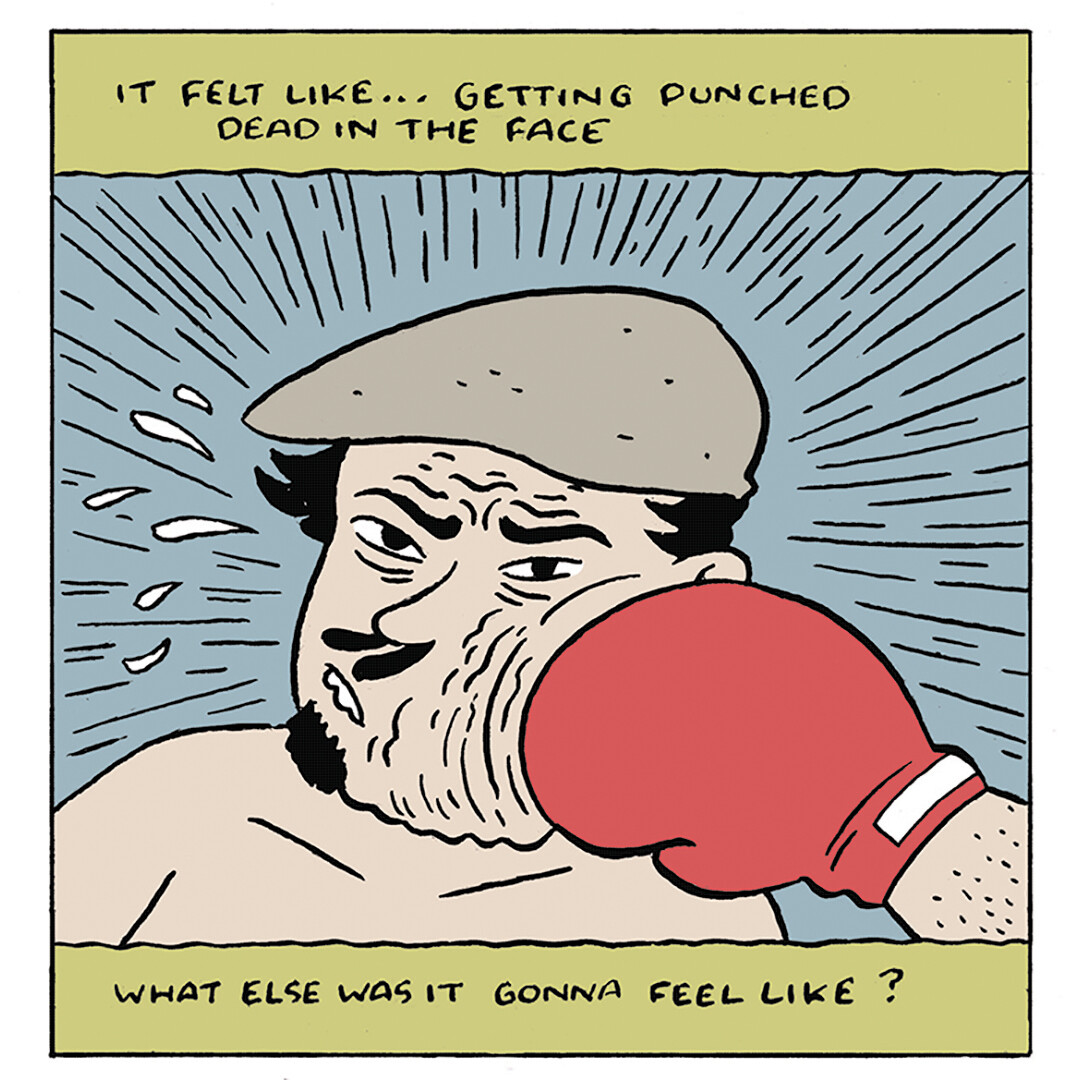
To be sure, Baylis has written about personal things before, especially with regard to his relatives. This issue feels a little different, though. In one story, he goes into greater detail about being bullied and talks about learning how to spar in a boxing gym. With Josh Pettinger giving the story just enough cartoony distance to soften the subject matter, Baylis talks about how literally learning how to take a punch in a boxing ring. In a series of increasingly-visceral panels where Baylis' face swells up with each blow received, he unleashes a torrent of grief: disease, death, job loss, and family crises over a relatively short span of time. A more naturalsitic approach would have been unbearable, but Pettinger nails this litany of blows landed, just as Baylis lays it out plainly. There's not a happy ending per se, but he ties it back into boxing by learning how to take a shot and keep moving. 

On a lighter night, strips about his son reading his comics and being absolutely delighted to see the word "shit," much to Baylis' consternation, is fun at his own expense, but he also clearly enjoys this dynamic. A strip where he helps a pregnant woman get to a hospital is given some soulful emotion when he realizes it's the place where his wife gave birth. The montage of images from the husband-wife duo of Kevin Colden and Miss Lasko-Gross is especially effective in portraying the profound gratitude he has for this place and that time. As with many of Baylis' comics, the whole tends to be greater than the sum of its parts, which is a testament to his editing and sequencing of his pieces. 

Monday, April 5, 2021

Mass Market Noah Van Sciver

Noah Van Sciver has become such an interesting cartoonist because he's so versatile. He can do straight-up illustration jobs like his Johnny Appleseed or Grateful Dead books and bring them to life in interesting ways. He's adept at interesting biographies, like Abraham Lincoln in The Hypo and his upcoming epic about Joseph Smith. He excels at dramas about doomed losers like Saint Cole. He's a funny and self-effacing autobiographical cartoonist. At heart, however, Van Sciver is a gag man. That was true of his earliest comics and it's still true now, as his choices as an artist take him down some unusual detours. Drawing random comics for the newspaper Columbus Alive!, each one on their own ranges from hilarious to mildly amusing.


However, their collective impact is greater than the sum of its parts, especially when fruitfully paired with frequent collaborator and ace designer Keeli McCarthy. Van Sciver's vision of creating something like an old Peanuts paperback filled with random strips is brought to life with every element of the design. Even the absurd title, Please Don't Step On My JNCO Jeans, is evocative of the kind of snappy title that you might see for a random collection of some comic strip. The generic yellow background and the absurd image of an adult Van Sciver (complete with trademark mustache) wearing these faddish jeans from the 90s. The cliched yet entirely accurate copy on the back cover, complete with nonsensical poses of a dancing Van Sciver, also contributes to this aesthetic, which is simultaneously nostalgic and utterly square. Even the size and embossed edges of the pages are all part of the fun.

The actual comics are a glorious hodgepodge. In addition to that, there are a host of funny interstitial drawings of Van Sciver as various monsters: Dracula, Frankenstein, the Creature from the Black Lagoon, and others. There are funny (and usually embarrassing) stories from his childhood, along with the occasional triumph like a TastyCake driver randomly throwing him an entire box of baked treats. There are funny moments with his partner, Amy, including a long riff on the tool and phrase "stud finder" that deliberately steers into dad joke territory before a hilarious final swerve. A running gag throughout the book is Van Sciver trying to do something new and finding himself drawing fencing, French-speaking cats. His ability to find different ways to work a gag reflects the relentless nature of his cartooning. In a collection that is essentially just a lark, Van Sciver's serious commitment to a coherent aesthetic package elevates the work in a way that he didn't have to do. However, the design, careful sequencing, and the illustrations all reflect a desire to make sense of seemingly disparate material over a span of time. If the newspaper strips reflected his fancy at that moment in time, the book represented his overall aesthetic understanding of his own work during this period as well as a personal journal of sorts.

Wednesday, June 5, 2019

Noah Van Sciver's One Dirty Tree

Noah Van Sciver's One Dirty Tree earned him an Eisner Award nomination, and it's certainly well-deserved. This 2018 release from Uncivilized Books is self-revealing and honest in a way that Van Sciver has been hinting at for a long time with regard to his family. The structure of the book is interesting, as Van Sciver's autobiographical comic bounces back and forth between 1994 and 2014. This is a book about the ripples of childhood trauma reverberating down through the years, affecting mental health and personal choices. It's blisteringly funny and honest but recognizes the humanity in even the most problematic of figures. Van Sciver doesn't hold back in his depictions but isn't interested in passing judgment on others. Indeed, one of the central ideas in the book is the ways in which poverty has a profoundly detrimental effect on long-term mental health and stability.

One Dirty Tree focuses on the build-up to two significant life events: the steady erosion of his family in 1994 (when he was eight years old) and the erosion of his relationship with his girlfriend in 2014. That's when Van Sciver was just starting to taste some success as a cartoonist but still had to work full-time at a Panera in order to make ends meet. The book focuses on some of the last days spent in their dilapidated New Jersey home, called "One Dirty Tree" by his older brothers because it was on 133 Maple Terrace and there was a dead, gnarled oak tree in the front yard. Van Sciver expands on what it was like to grow up as one of eight siblings in tight, shabby quarters as part of a Mormon family, a rarity in New Jersey at the time.

As one might guess, it wasn't pleasant. His depiction of his family's life is matter-of-fact, just as one's own view of one's family life isn't informed by outside sources until much later in life. Both of his parents were religious up to a point, but they were also sort of hippies and started to become less and less religiously observant. His father, a lawyer, grew his hair out long and started to become disinterested in actually working. As a result, the Van Sciver family was dependent on their church for food, a car, and other charity items. At the same time, they Van Sciver's father grief for having long hair and he pushed back.

All of this led to a lifetime of shame for Van Sciver, especially since his vocation as a cartoonist wasn't exactly poised to make him get rich. His girlfriend Gwen was well-off financially and he lived with her in an environment that was unusually affluent for him. While he loved her and dreamed of a future with her, he always dreaded a break-up because their needs and backgrounds were so different. When trying to explain his background to a friend of Gwen's Van Sciver drew himself as a monster, because that's what he felt like: ugly, abhorrent, and abjected. While Van Sciver was not religious, he was tired of constantly being looked at like a freak for growing up Mormon, not to mention being judged solely on his income.

Again, Van Sciver isn't looking to lay blame. Even his father, who abandoned his family, is someone Van Sciver later reconnected with. Both his mother and father were people expected by society and religion to fill certain roles and found themselves chafing against those roles. His mother was an art student before she dropped out to get married, but she never gave up on writing. While there are no villains in this story, Van Sciver's mother is undoubtedly given the warmest treatment. The ways in which she stepped outside norms (laughing at a drawing her son made in church, giving Noah a high-five instead of punishing him when he kissed a girl) brought her closer to her children, and it's obvious that Van Sciver never forgot it.

Van Sciver implies that like his parents, he just isn't very good at being normal and doing what's expected. He's a free spirit who took his drawing obsession and turned it into his life's work. The problem is that he found it hard for others to take it seriously, conflating artistic ambition with not just laziness, but being a scammer or fake of some kind. What's worse is that it's clear that there will always be a part of him that believes this to be true. Being raised to feel ashamed is hard to take, and while he accepts the how and why of it happened, it doesn't make it any easier to feel stable and secure as an adult.

Thinking about it in terms of Maslow's hierarchy of needs, a child who grows up without basics like food and a reliable shelter will struggle later in life. What makes the book so compelling is the way that Van Sciver ties these struggles to specific kinds of homes and reflects on how the everyday experience of these environments had a profound effect on him. His old house had decaying floors filled with splinters. His father ripped out the kitchen and never replaced it, meaning that they had to do dishes in the bathtub. The close quarters made everyone irritable all the time. Living with Gwen in her nice place made him feel like an impostor or a tourist in a life he didn't really belong to. While the last line of the main text is Van Sciver saying "These are the cleanest walls I've ever lived inside," implying a sort of heartbreaking paralysis, the afterword finds him breaking that cycle of shame a little. He returns to his old home as an adult three years later, and while there are no major epiphanies, there is a sense of closure in facing this place that had such a profound and lasting impact. The final image is a cutaway drawing of Van Sciver's self-image inside his head saying, "Life is weird." The wounds might still be deep, but Van Sciver's realized that he had to accept where he came from: what other choice did he have?

Monday, May 20, 2019

The End Of The Tour: Noah Van Sciver's Fante Bukowski 3

It's funny to think of Noah Van Sciver as a grizzled veteran of the comics scene, but that's truly what he's become. The guy who once wrote a strip fantasizing about winning an Ignatz award was just nominated for two Eisners. He's among the most versatile of cartoonists, equally at home doing satire, historical fiction, autobiographical comics, gags, and literary fiction. He's someone who clearly takes his work seriously but can also poke fun at himself and his own ambitions. That's most clearly evident in his series of Fante Bukowski books, which are about the world's worst and least self-aware writer. The magic in these books is not that Van Sciver hilariously satirizes the literary and art worlds, but that he manages to craft sympathetic characters along the way.

Each book in the series has been carefully designed to mimic a classic paperback design. This time around, it's meant to mimic David Foster Wallace, down to a "Genius Award" sticker on the cover. That attention to detail is thanks to Keeli McCarthy, one of the best book designers in the business. The subtitle of the book is "A Perfect Failure," and that sums up Fante's character to a T. The vain, glory-seeking, and delusional Fante set out to be a writer because he wanted to be famous, not because he wanted to actually do the work of being a good writer. He was more obsessed with the macho but sensitive trappings of what he saw as writing (hence his love of Charles Bukowski and John Fante) than actually coming up with coherent ideas. At the end of the second book, he and one of his zines got a degree of fame and success thanks to a critic Fante had done a sordid favor for.

At the beginning of the third book, Fante receives an offer to be a ghostwriter for a Disney starlet's autobiography. After leaching off his family (including a disapproving father), he actually got paid for his work, but he immediately ignored the parameters of the assignment. For the first time, Fante's own bizarre sense of integrity came to the fore, even if what he chose to write instead was nonsense. Indeed, while Fante continues to be a blowhard, Van Sciver does have him complete a sort of emotional journey. To be sure, Fante remains a privileged asshole who on the one hand rejected his father's career path in law, but didn't reject his desire for the trappings of wealth. He simply wanted it not only on his own terms but generated entirely from his own talent. A lifetime of living with someone who constantly put him down resulted in Fante (nee' Kelly) coping by creating his own fantasy world where he was actually good at something.

The structure of the book is interesting because while there's actually a tight plot and structure, Van Sciver allows many of his pages to act as separate vignettes, complete with their own punchlines. While the reader is exposed to Fante's essential incompetence and vanity, the flashbacks provided establish a bit of context for his behavior, to the point where his willingness to live in the scummiest of environments and associate with the worst of people is more than just a pose. It's part of his own essential nature to vacillate between comfort and disruption, self-absorption and sympathy. Indeed, the key relationship in the book is that of the friendship between Fante and Norma, a weirdo performance artist with an unsettlingly dark background. She has her own subplot where she's in conflict with the other major performance artist in Columbus, Ohio that winds up being murderous (art is cutthroat!) but tender with regard to Fante. His return to see her last performance is humanizing for both of them. Fante has sort of figured himself out, Norma made a collection that lasted, and even the prostitute who manipulated Fante's career behind the scenes gets her own reward. It's both genuinely earned as a happy ending as well as a parody of same, and Van Sciver's skill mixing sincerity and satire makes it all work.

Tuesday, March 20, 2018

All-Time Comics: Blind Justice #2

In some respects, Josh Bayer getting Fantagraphics to publish his line of 80s throwback superhero comics may have been a bad thing for the project. It put a sheen of respectability on a project that was inherently bizarre and trashy. Indeed, it's odd that these are now Bayer's best-known comics, considering how much better his Raw Power and Theth series are. They also trade in on superhero tropes but from a completely different perspective, incorporating the juvenile aspects of reading them as part of the experience and warping them through Bayer's "cover versions" of obscure comics. Bayer's idea to mix alternative cartoonists with older mainstream cartoonists was an interesting one in theory, but there have been a lot of hiccups along the way. Indeed, the first issue of Blind Justice, to be penciled by Rich Buckler and his son, is one of the most incoherent comics I've ever read.

The over-the-top violence and misogynistic elements of the other All-Time comics, combined with the fact that the entire first wave was done by men, made them an easy target for criticism. Bayer's attempt to combine frequently nihilistic and raw 80s comics with the dumb ultraviolence of 80s cinema as a kind of goof removed both Bayer's own satirical viewpoint as well as artists like Ben Marra, whose work walks a fine line between satire and sexism. The character Justice is in the tradition of inexorable, intelligent, vengeance-seeking crusaders. The twist is that his secret identity is that of a unresponsive cranial injury victim living in a ward. When he hears about crime, he builds himself armor out of things like old newspapers and phone books, cobbles together a club, and looks like a bulky, bandaged figure in a suit. Having a hero literally built out of decay and newsprint is a fun metaphor, especially one as single-minded as an avenging Steve Ditko character.

The second issue follows a psychopathic killer who enters a home and asks "Hey buddies...who wants to lay down and make this easier for me? Who wants to lay down on my altar?" The killer, named Miller, is a kind of goof on Bayer's version of G. Gordon Liddy, ranting about raw power and viewing killing as a part of nature, that he exists to eliminate weaker species. Of course, he's gone rogue from a typically evil corporation. The first big action piece is Justice infiltrating the company to get information and escaping from a small army of guards. The clever thing about the storytelling here is Justice essentially bullshitting his way through his enemies with a combination of trickery and outrageous confidence, as he proceeds as though he's invincible even though he has no powers. The same was true for his showdown with Miller, except this time the villain saw through the disguise but underestimated Justice's cleverness and relentlessness.

The story, while violent, actually tracks quite nicely. Part of this is due to the unlikely but highly efficient art team of Noah Van Sciver and Al Milgrom as penciler and inker, respectively. Van Sciver goes to town with all sorts of weird page grids and formal oddities, like the bottom of a panel "giving out" underneath a punk's foot. Milgrom's inks essentially smooth Van Sciver out a bit, adding a bit of fluidity to fight scenes, while retaining the essential character of Van Sciver's work. Milgrom was the essence of the meat-and-potatoes Marvel inker and penciler who could work super fast and tell a story, even if the art itself wasn't flashy or attractive. The eccentric coloring job by Paul Lyons and Jason T. Miles (whose work is about as far away from this as one can imagine) only increased the weirdness of the book, as Miller was purple, Justice's shirt was yellow, and the sky during the showdown ranged between yellow, orange and red. The use of color was so deliberate, yet they kept it the same four-color flat colors of early 80s comics in order to duplicate that atmosphere, only the sheer wonkiness of it served to remind the reader of the comic book essence of the proceedings. It was meant to be anything but realistic and a little bit ugly and weird as well. It feels like Bayer also really nailed the tone of this comic in a way he hadn't in other All-Time issues. I have a feeling that the second run of All Time Comics will wind up being much more interesting in the first, especially with comics drawn by Gabrielle Bell and Julia Grfoerer.

Wednesday, November 8, 2017

Minis: N. Van Sciver, E.Luce/M.Wobensmith


His Last Comic, by Noah Van Sciver. This is Mini-Kus! #60, and it's a jokey story from Van Sciver that he ran on his Facebook page. Van Sciver excels at drawing schlubs and losers, and this is a sort of second cousin to Dan Clowes' old Dan Pussey stories. It's about a worker drone who's been self-publishing his shitty superhero comics to no acclaim for years, and he wonders if he should just give up on his dreams of being famous and getting to go out with this particular woman at his job. In a plot twist that hinges on EC Comics' Old Witch selling him a magical potion which will solve all of his problems. When he pours the potion into the ink that's used to print his comic, he finds that no one can resist the actual object...but no one cares about the story. This is a hilarious send-up of comics as a speculator's item, wherein their perceived "value" was more important than their feelings about the story and art. The main character is an exaggerated loser with no redeeming qualities (even Van Sciver's sad-sack narcissist character Fante Bukowski was likable in some ways), existing to serve a gag and to get his just desserts with an EC-style twist ending. For such a goof of a story, Van Sciver can't help but make beautiful pages that actually add pathos to the narrative. The above image of the artist walking in the snow is gorgeously rendered, giving the reader a sense of the fully-developed world that the artist lives in but can't quite see because his imagination is occupied by adolescent nonsense.


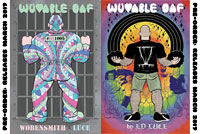
Wuvable Oaf #5, by Ed Luce & Matt Wobensmith. Three years in the making, this 40 page comic book-formatted effort sees Luce going in some different directions, even as he continues to be a genre and boundary-smashing artist. It's not just that this is a gay romance comic; it's a gay romance comic that's about death metal, pro wrestling and features a number of characters who are "bears", or large, hairy men. There's also a strong magical realist component to the comic which resembles Jaime Hernandez's work a bit, only in a different context. Oh, and kitties.

The first few issues of the series focused on the titular Oaf, a former professional wrestler, who developed a huge crush on Eiffel, the diminutive lead singer of death metal band Ejaculoid. The last issue featured their (despite all sorts of weirdness) adorable first date, and the back-up story beginning in this issue deals with the ramifications of Oaf and Eiffel being in a couple while Ejaculoid is on tour. There's a reason why the story is titled "Yokoaf Onoaf", which is one of my all-time favorite story puns. Luce is a skilled illustrator and cartoonist, and there's an astonishing two page spread filled with literally flowery detail when Oaf walks into the hotel holding the gig and finds it filled with flowers and ferns. It's precisely the opposite of the sort of grit and grime usually seen in this comic and it's a marvelous comedic turn. After singing "Fatty Daddy Baby Batter" (an ode to sexy, chubby dads), we are introduced to Marx, who apparently commands black, magical mind-control tentacles but is mostly looking to get laid on Ejaculoid's tour as its manager. (He hooks up with Simon Hanselmann's Megg character here, for instance.) It's silly, it's weird, and it's funny, even as Luce cooks up some band melodrama for further episodes.

On the other hand, the other side of the comic (it's a flip book) follows Smusherrrr, the "artist" who once was obsessed with Oaf to the point of stalking and is now obsessed with Oaf's friend Bufu. This section was written by Wobensmith, and Smusherrrr is presented as a character who is desperately in search of an identity, and often tries to find that identity in his obsessions with others. There's a hilariously creepy scene where Bufu, who is African-American, is "accidentally" run into by Smusherrrr and his grocery cart, which contains nothing but chocolate items. After an over-the-top and uncomfortable scene where Smush essentially begs Bufu to be his, there's a hilarious drug sequence (inspired by smoking hair of various people and animals) where he confronts aspects of himself that he was unwilling to come to terms with. This leads up to his attending a support group for fake people; in other words, people who appropriate or fetishize other cultures and races. The best character there is Killrrrrr, who is drawn like a grown-up Charlie Brown (including using the same lettering style as Schulz!) wearing a Dodgers jersey and a do-rag whose biggest ambition is to break into "the inner circle of Hollywood gangster character actor extras." Satirizing racial and ethnic  stereotypes & appropriation is a tricky matter, but Luce does a lot to make it work with his exaggerated, cartoony drawings. He's an exceptional caricaturist (it's perhaps his greatest skill) and putting in jokes like adding in the Tupac hologram (from Coachella 2012) as a literally fake racial persona went a long way in making the situation funny, rather than relying on drawing a lot of stereotypes. I'm not sure what the ultimate point of this storyline will be (an epiphany for Smusherrrr? a tour of racist appropriations throughout history? leaving Smusherrrr as a clueless, narcissistic parasite?), but Luce has thus far heightened the humor and defused what could have been a number of problematic elements.

Tuesday, July 25, 2017

Fantagraphics: Noah Van Sciver's Fante Bukowski 2

Noah Van Sciver took punches at writing, publishing and the macho, bullshit pretensions often wrapped up in both as well as himself by proxy in his satire Fante Bukowski. Van Sciver doubles down on all of this in the book's sequel, only he introduces himself as an actual character to beat up on, which was funny on any number of levels but primarily because it turned the book into a romantic comedy. At the same time, Van Sciver address a lot of issues about writing itself: What does it mean to be "good"? What does it mean to be "successful"? How do these factors influence the act of writing itself?

That's the constant push and pull of this book. The titular character is a no-talent blowhard  who nonetheless walks away from a cushy job in order to pursue his dream as a writer, naming himself after two famous masculine/sensitive writers. The reason why Fante is so pathetic is not that he's a bad writer (though he is), but that he writes for all the wrong reasons. He wants to be rich and famous because of his writing. He wants respect, money and accolades from his writing. He's bought into the American myth of the writer as the swaggering, rugged individual who struggles but ultimately succeeds because of his sheer talent and authenticity. He doesn't actually love writing; he loves being a writer and all that entails. Or at least, all that he feels it should entail, as this book is pretty much a constant smackdown on poor Fante until the very end, with a hilarious twist that reminds me a little of the Martin Scorcese film The King of Comedy.

The book begins with Fante going to Columbus, OH (where Van Sciver currently resides) to make his fortune. Soon, this poseur has his credit card cut off by his parents and he's out on the streets, desperately trying to sell copies of his self-published poetry zine. Meanwhile, his ex-girlfriend Audrey has written a spectacularly successful second novel that makes her the toast of the literary world. Her success only makes her more miserable, despite the open loathing her first novel evinced. Her publisher pressures her to sell the movie rights and to get to work on her next novel. She hangs around people wanting her opinion on things who couldn't have cared less about her before she published her book, like a sleazy agent, a starfucking fellow author and a tedious critic.

At a book-signing, she meets cartoonist "Noah Van Sciver", and they begin dating. As I noted in my review of the first volume, "Punching down is frowned upon, punching up can be pretentious, but punching yourself is always funny." Van Sciver doubles down on this idea by introducing a needy, whiny and selfish version of himself as Audrey's new love interest. He's jealous of her success and needles her to put in a good word with her agent and with critics. He won't even help Audrey with her luggage because of his delicate cartoonist hands. A running sub-theme of the book is gratitude, with each of the more successful characters in the book unable to feel it because of their need to chase something else: fame, fortune, or a return to a more innocent time. For Audrey, Fante represents that more innocent time, as she actually even based one of her characters on him. She can't appreciate what she's achieved because of the demands that have been placed on her, "Van Sciver" can't appreciate his success as a cartoonist because he wants that same brass ring that Fante wants: money, fame, Hollywood. He's also incapable of taking joy in the success of anyone around him.

Van Sciver structures this book in a way that rambles much less than the first (much of which was improvised), laying down a story template that draws characters in and out in funny ways. When Audrey starts looking for Fante, the latter is trying to get away from her because by the shambles his life has become. Van Sciver really pummels Fante, as he's kicked out of his hilariously sketchy motel room (complete with dozens of peep holes) and later burns it down by accident. He has sex with a prostitute named Lady, whom in the mythology of Van Sciver's Columbus has sex with every famous writer (of whom there are dozens) that live there or pass through town. He berates a poor copy shop worker into helping him make his zine perfect way after he was supposed to get off work (and on his birthday, no less!). His staggering lack of self-awareness in some ways is almost endearing; there's a purity to his delusions of grandeur despite his lack of both talent and work ethic.

Of course, as Van Sciver implies throughout the book, talent and work ethic aren't a guarantee for success beyond one's own satisfaction and sheer need to express oneself. The rest is often kind of random, as the end implies when a suspiciously favorable review helps Fante reach the level of hack instead of homeless person. In many ways, what led Fante to getting that review was the one truly selfless act he commits in the book (helping a famous critic get out of a jam with his wife), and it's what winds up helping him the most. The rom-com structure leads to Audrey and Fante meeting up again, with Fante's cowardice and lack of integrity putting him in a hilarious position (stuck in a bathroom window, trying to escape from her). At least this time around, Audrey gets the final word, until Fante's magical rise.

This book is very much about literary authors and their books as commodities. As such, the design serves to remind the reader of this fact at every turn, with genius book designer Keeli McCarthy basing the cover image on the Black Sparrow Press edition of Charles Bukowski's novel Factotum. The whole book is designed to give off a used bookstore feel, from the texture of the cover's paper to the sticker on the back to the handwritten "1st ed/rare OOP" inside the front cover. It's joking that it's a bust even before it came out, doomed to the dusty and increasingly rare used bookstores in town. And yet, it was published. For whatever self-deprecation Van Sciver throws at himself, the sheer enthusiasm he has for the material is palpable on every page. I've never seen his figures look more alive and active than in this book; they're expressive and big, as some of Van Sciver's time as a gag artist at MAD seems to be in operation here as well. The colors are lush and saturate every page. The figures are almost caricatures but grab on to the reader's eye and don't let go. Van Sciver even "draws funny" in an effort to get laughs on some page, something he's mostly avoided in his mature style. Here, it works. He may be mean to his characters, but it's obvious he has a lot of affection for figures with genuine (if fucked up) motivations like Fante & Audrey, and it shows in their body language, the way they're drawn and the way they interact.

Monday, June 26, 2017

Two More From Kilgore: Noah Van Sciver & Glynnis Fawkes

Slow Graffiti #3, by Noah Van Sciver. This is a minicomics version of Van Sciver's daily diary strip that his Patreon readers get to see. This one's from November of 2015 through April of 2016, when he was a fellow at the Center for Cartoon Studies. He famously fictionalized his experience in Blammo #9, depicting his own alienation from the students and how he unintentionally further alienated them, but these diaries depict a somewhat different experience. The reality was that he felt nervous about having to perform and teach, but at the same time, he wanted to connect with them as well. He goes into some detail about how much of this is related to anxiety, and how one student went out of his way to to offer someone to talk to if he needed it. Van Sciver then connected by helping students with a task; at heart, he's always shown that he's a team player.

There are stories about pushing through on drawing tasks, going out in the forest, going to an impromptu Thanksgiving dinner, going to lectures, meeting weird people at shows, and more. This is Van Sciver at his roughest and rawest, and there's a powerful immediacy on each page as a result of that. A cartoonist grappling with depression and anxiety on the page is almost a cliche' at this point, yet the way Van Sciver finds ways out of these states seems directly linked to his ability to draw and write about it. Quite contrary to the cliche' of the whiny autobio cartoonist, Van Sciver's strips are almost always solution-oriented, introspective or self-deprecating in the search of a really good joke. For lack of a better word, the sketchbook reveals a real sense of maturity for Van Sciver, both as an artist and person who is trying to be the best version of himself possible.

Reign of Crumbs, by Glynnis Fawkes. Fawkes has written about her children before, but much of her work tends to focus on either mythology or archaeology. Not in this book, as Fawkes expertly and honestly captures the ways in which children (and pre-teens in particular) are both terrible and wonderful. Her husband makes the occasional appearance as well, but most of the book is about her interacting with her eleven year old son Sylvan and her nine year old daughter Helen. Much of the book looks like it was drawn with a brush pen, giving her spare drawing style a lot of weight and power on each page. The characters are all well-defined as a result, and she fills in other details with a tool that produces a thinner line. There's a real sense of ease and looseness on each page, though it's obvious that she spent a lot of time considering the composition of each individual panel.

Her children are depicted as loving, funny, creative, intelligent and silly. They are also depicted as lazy, incredibly entitled, messy, picky eaters, argumentative and hypersensitive. In other words, human beings at a particularly dramatic stage of development, one where the tug of dependence and the need to be independent create some personality conflicts. It doesn't help that her two children want nothing to do with each other, each (correctly) thinking that the other will monopolize the conversation--especially when they are with their mom. The best scenes were the bedtime tuck-ins, especially when they demand better tuck-ins that she's given. Fawkes points out the ways in which her children are still very much children, and the ways in which they are pushing her away. She depicts herself as a pushover mom who perhaps spoils her kids a bit too much (especially with regard to their eating habits), but she's also aware of this tendency and makes fun of her kids when they take advantage of her or her husband. When "little Helen" requests a last glass of water after being tucked in, Fawkes makes fun of her and Helen simply moves on by yelling "Daddy!". There's a real sense of joy in this comic as the kids are still at an age where the kids are still demanding her presence even if they're pushing back a bit, and Fawkes can still get silly with them and draw a reaction.

Friday, October 21, 2016

Noah Van Sciver: Blammo #9

Blammo #9, by Noah Van Sciver. It was interesting re-reading Van Sciver's recent comics in writing reviews of them, because while they are quite good, his work in Blammo #9 is noticeably better. This dense, 40+ page collection of recent works is as satisfying a comic as I've ever read. Van Sciver's dark sense of humor is on full display here, but it's his willingness not so much to be self-deprecating but to doubt himself and everything around him that makes this such a compelling read. For Van Sciver, serious character work and gags can go hand-in-hand. He applies movie parodies to his own life and yet manages to make powerful and honest revelations about himself in the process. He uses long-form improv techniques in the form of unexpected callbacks. In the midst of critiquing his own lack of craft, he unleashes a series of images that are as profoundly beautiful as anything I've ever seen in a comic book. Above all else, there's a sense of a mind that's constantly searching, questioning and seeking. He's a cynic who wants to be believe, but has yet to find anything to believe in.

In this comic, Van Sciver has at last managed to achieve what he set out to do as a cartoonist: tell stories packed with detail like Will Elder and Julie Doucet, overwhelming the reader with the intensity of his work while still retaining narrative clarity. Van Sciver's use of autobio in this issue is fascinating, as he writes about himself in the present day, flashes back to his childhood and later writes a fictionalized version of himself that is nonetheless no less authentic. The time Van Sciver spent in White River Junction at the Center for Cartoon Studies was time he used wisely, as his drawing schools noticeably improved. It's important to understand that Van Sciver didn't want to improve his draftsmanship simply for the sake of creating a flashier style; instead, Van Sciver wanted more control over what he was able to draw in order to draw out certain reactions from his readers through the power of his images. Van Sciver was going after creating a powerful aesthetic reaction in the context of his cartooning, a reaction that's mystical as much as anything else, and he got at that in the first story of the book.

Van Sciver really takes advantage of the periodical nature of his comic by including features like letters pages (including one from Robert Crumb!) and a funny, annotated catalog in the back, including a bonus strip where he looks at a bizarre, "hot" comic that Van Sciver describes as "a thesis project from an art student who wants to fuck New York." The opening and closing pieces answer the question, "Mommy, where do Blammo comics come from?" Van Sciver takes a poke at self-mythologizing in an absurd story about a head without a body that twice winds up setting up variations on the same dopey gag. It's Van Sciver deflating himself by showing that he's still very much a humorist at heart, even as he's greatly expanded his storytelling range.

The first full story is "White River Junction, Vermont". It's based on his experiences as as a fellow at CCS and the ways in which he felt uncomfortable with the students. While Van Sciver isn't afraid to torch some bridges here, this isn't really a bitch session about CCS or the people he met there. Rather, it's a meditation on belief, and the ways in which even the most progressive of people can stereotype others. When he reveals to a group of students at a barbecue that he's an ex-Mormon because they were spreading misinformation about church practices, they aren't exactly convinced by his explanations. That leads to the first of many flashbacks, where Van Sciver is stuck inside the house to study scriptures, but all he wanted was to play outside. Then he saw a strange UFO.

That leads to a hilarious page where he helps a student move, only to have the student say "I consider myself to be all-inclusive and everything, but someone told me that you're Mormon or something?" A frustrated Van Sciver snaps at the person, who then treats Van Sciver as though he were victimized, leading Van Sciver to utter the line "You're just a 30 year old with a wacky top hat who loves teen girl manga. I don't know you..." which leads to the student flinching and replying "You're assaulting me with your microaggressions!" Van Sciver here is frustrated precisely because the supposedly all-inclusive CCS environment is playing "Telephone" with his story and making precisely the kind of assumptions that are harmful. If this had been an early Dan Clowes story, the nastiness of that exchange would have stood as the story's climax. Instead, it leads to soul-searching on Van Sciver's part, as he realizes that he overreacted and thinks back to when his mother told him there was no hell, and how hard it was for him to shake that concept.

Van Sciver is called in by a school official, who received a complaint that Van Sciver was intolerant and had "negativity toward manga and expressive clothing". Once again, Van Sciver's inherent  introverted character worked against him, and the students there ran with misconceptions. Van Sciver goes back and forth to the past and back to the present, ruminating on the other artifacts being a Mormon left on his life, like a desire to wait til marriage to lose his virginity. He also considers his techniques as an artist, honing in on the ways his level of craft improved over the years and the internal debate between continuing to work on sharpening his detail or to simplify. That leads him out to the forest (after yet more difficulties with White River Junction), where he chides himself for drawing terrible trees ("sticks in the ground"), and he starts praying for god to appear to him. It's a beautiful, transcendent moment that adroitly answers his own question regarding the use of detail, as the lush, silent beauty of the forest is expertly rendered by Van Sciver. The final, silent panel represents his mind being stilled at last, if only just for a moment.

There are a number of excellent short pieces that act as palate-cleansers, including true tales from his dad's time hitchhiking out in the desert and pulling a horrible prank on his brother, the decline and fall of his hilarious "19th Century Cartoonist" character, and an adaptation of Aesop's "City Mouse and Country Mouse" fable. The 19th Century Cartoonists represents his broadest use of humor in this issue, even as the feature gets at certain truths about the status of cartoonists in society and how that's changed over time along with the self-delusion of hacks. All of these features are full-formed and thought-provoking and are far from throwaways or space-fillers; as I noted, they serve not just as a quick diversion between the main features, but they work to fully reset the reader's attention each time.

"Little Bomber's Summer Period" may be Van Sciver's single best work of fiction to date. He really steps out of his comfort zone in depicting the lives of "Bomber" and Jenny. Bomber is a security guard at an art museum who's just been left by his girlfriend after he bought a house. He's in therapy in an effort to deal with these issues, which is a smart way for Van Sciver to quickly catch the reader up on the character's problems and challenges. Essentially, his inability to express emotion and his need to put up protective walls leads his therapist to suggest a material way of tearing down those walls, by leaving his front door unlocked at night. Jenny is a graphic designer at the museum who's constantly being dumped on by her boss and ignored by her husband. The two of them are friends who commiserate regarding feeling stuck and helpless.

The story is about that sense of desperation and finding ways out of it. Bomber is inspired to start painting thanks to the story of a fictional artist named James Markinson, an abstract expressionist type who retreated to a cabin in order to clear his head. This was a case of someone badly wanting a myth to be true in order to set up a foundational change for themselves. Jenny winds up quitting her job and leaving her husband, asking Bomber for a place to stay while she figured things out. There's a sweetness to their friendship that never quite turns into romance, but they found ways to bring out the best in each other as friends. Bomber was comfortable enough to open up to her in ways he never did with his ex, while Jenny found an affirming, positive presence in Bomber, something she didn't get elsewhere. They are certainly co-protagonists in this story, with each of their narratives running into each other. The outrageous and funny end of the story is very cleverly presaged by all sorts of incidental clues in the narrative (Van Sciver never wastes a line of dialogue), adding a touch of comedy that's more in the realm of EC Comics than anything else. The final panel actually touches on the first story in the book, as despite everything else that happens, Bomber is clearly starting to see the world in a different way. He's starting to see the world as an artist, in all its beauty and terror, just as Noah in the first story stops and stares at the first, with his understanding forever altered.

The final story, "Comics Festival 2016", is a sequel to the first story in the book and also a very clear homage to the Woody Allen film Stardust Memories. A now-famous Van Sciver is the star of a comics festival, complete with a limo ride from the airport and constant demands on his time from his fans. At the same time, that attention is bittersweet, as his fans tell him they prefer his "earlier, funnier comics" (a bit straight from the film) even as he feels slightly adrift in his career. The UFO from the earlier story comes back and the aliens tell him, when he asks for the meaning of life and if he should become a missionary: "You're not the missionary type. You're a cartoonist. You wanna do mankind a service: write better comics." That's also from the movie, yet Van Sciver cleverly planted this callback earlier in the comic in a seemingly unrelated way. The book-long quest for meaning and that sense of wandering fits neatly into the structure of the parody, giving the story an authentic and emotional spine beyond the simple beats of the gags. The real achievement of this issue of Blammo is the way Van Sciver has managed to blend humor and pathos in equal measure in the same stories, each one supporting the other in unexpected and clever ways. Even the most mean-spirited of jokes is leavened by moments of true empathy, and even the least sympathetic of characters is given a fair shake. It's Van Sciver's clear confidence as a draftsman, cartoonist and storyteller that makes his explorations of self-doubt, faith and belief all the more convincing.

Thursday, October 20, 2016

Noah Van Sciver: Disquiet

Disquiet, by Noah Van Sciver. This is an elegant collection of short stories culled from his own Blammo! series, various anthologies, short one-shots, illustrations and features made just for this book. Designer Keeli McCarthy outdid herself working with Van Sciver, as every aspect of this book is simply beautiful. The quality of the work itself varies, as it's a mix of his better and more recent stories as well as some sillier but still interesting material. That said, Van Sciver does a great job, working with editor Eric Reynolds, of sequencing the stories and interspersing them with interesting interstitial material. The most striking of this sort of material was a series of silhouette head shots of Van Sciver, each one a more fantastic rendering of what's really going on inside of his head: a lush forest, a series of lightning bolts, a rugged farm, a desolate and wind-swept cityscape, a mountain fortress filled with soldiers, and a strange contraption. In many respects, these illustrations and others are a sort of career mile-marker for Van Sciver, demonstrating the ways in which his drawing skills have improved.

Van Sciver has always favored a detail-rich approach to his comics, which made his early comics feel cluttered and messy. Usually, most cartoonists learning on the job figure out they need to simplify and stop over-drawing. Being a cartoonist doesn't mean you need to make every image a representational triumph; instead, what's important is the clarity of the storytelling. Counterintuitively, Van Sciver took the harder road: improving his skill as a draftsman through patience and practice, and then applying what he learned to his storytelling. The story, "The Death Of Elijah Lovejoy" (originally published by 2dcloud), is an example of that kind of learning lab. His first book, The Hypo, saw Van Sciver make a big jump with regard to both storytelling and techniques like his hatching and crosshatching. This story, a sort of companion piece to The Hypo, was essentially a series of drawing problems that Van Sciver tried to solve on every page, as a lynch mob that had killed a black man was now setting their sights on an abolitionist newspaper and its printing press. The story is the greatly outnumbered writers trying to defend themselves at sunset. So Van Sciver balances the colors in the sky against a densely-rendered house, horrific acts of violence on nearly every page, and the grotesquely-rendered participants. He uses a dizzying array of page design techniques, carving up panels at weird angles in order to keep the reader off-balance and fully inserted into the chaos of the event.

Most of the stories in the book combine Van Sciver's expertise in depicting the lives of the abjected, the desperate, the doomed and the delusional with his fascination with twists in the vein of E.C. Comics or The Twilight Zone. "The Lizard Laughed", for example (based in part on Van Sciver's father), is about a man whose son contacts him years after he walked out on his family. Here, Van Sciver uses a false climax (the son confronting the father, only to be brushed off) to set up a darker one (where the son weighs the decision of whether or not to kill his father in his sleep with a gun he had brought with him for just that purpose). The story works because of Van Sciver's unerring ability to balance the mundane aspects of his characters' lives with the unusual thing that happens in each story. "The Cow's Head" is a grimy fairy tale that's true to the unsanitized tradition of violence and punishment inherent in such stories but that's also given a level of absurdity true to Van Sciver's sense of humor. "Down In A Hole" is about a suicidal clown who's been fired from his TV show who falls into a deep hole while exploring a cave, finding a tyrannical society of mole men living below. The final twist, after what appeared to be a heroic escape, makes perfect sense as he realizes he has to accept his punishment. That urge to escape, a thirst for justice or a desire to go back to a simpler time is present in every story in the collection, and Van Sciver rarely grants his characters what they want.

"Punks V. Lizards" represents a merger of Van Sciver's older interests as a cartoonist with his new understanding of how to emotionally modulate a story. Indeed, it's a perfect example of a character wanting to go back to a simpler time when they were happier with other people. "Night Shift" and "Untitled" find Van Sciver experimenting with making women the protagonists of his stories, often in roles that are compelling but also juxtaposed against more colorful characters with far greater problems. Overall, the material in this book is a step above his first collection, Youth Is Wasted. Everything is sharper, smarter, better drawn, more complex and more interesting. Before Van Sciver won his Ignatz, I told him and anyone else who would listen that Van Sciver has had a good an eighteen months as any cartoonist in the world, based on this collection, My Hot Date, Fanta Bukowski and other work. What is obvious, and is evident by my review of tomorrow's entry, is that Van Sciver hasn't come close to peaking yet.