Showing posts with label sean knickerbocker. Show all posts

Sunday, January 12, 2025

45 Days Of CCS, #43: Rust Belt Review 6


Sean Knickerbocker is always willing to take a lot of chances when putting together an issue of Rust Belt Review. Some of them don't pay off, but some of the anthology's best entries are often among the best comics of the year. In this issue, that's certainly true of Ivy Lynn Allie's story, "The Kingdom." Allie tells what's sort of an anti-coming-of-age story about two pre-teen girls, Nico and Chrissy. Nico is the narrator, and she talks about playing during the summer with a clearly surly Chrissy, who is a horrible friend and a borderline bully. There are a series of events and characters--a sleazy handyman, an overbearing mother, minor crimes--that would seem to indicate a major trauma. Except none of that happened, and things went back to normal. It's a story that is defiantly anecdotal, yet there are aspects of it that hint at lingering personal issues for Nico. As always, Allie's cartooning is expressive and cartoony, with just enough of a fine control on line to contain Allie's flourishes. 


Knickerbocker's own "Best Of Three" serial reaches its penultimate chapter, and the exceedingly seedy quality of the narrative is matched only by the pathetic and self-delusional quality of its cast. It's Knickerbocker's best-realized long narrative, and I'm excited for the final chapter. Knickerbocker's swerves and desperate characters remind me of the film work of the Coen Brothers. 


There are several other very good stories in the anthology. Valerie Light's "How To Walk" is an exceptionally well-drawn and cartooned takedown of the femininity industrial complex, especially with regard to how young women and girls are taught certain "standards" of how to walk, dress, act, etc so that they can successfully marry. Maggie Umber's "Those Fucking Eyes" is another triumph for her, with a series of splash page drawings that tell a loose narrative about desire and being desired. Andrew Greenstone's "Lemurman 2" is a successful bit of horror pastiche that's notable for his grotesque, exaggerated cartooning. Ana Pando's interstitials are all intriguing and enigmatic, especially the piece about finding a double of herself and getting no explanations. 

The rest of the stories are less memorable like Matt MacFarland's unfortunate entry in the "dudes gettin' laid" genre; slight pieces from John Sammis and David Caldwell, a horror parody piece by Brian Canini that felt repetitive in comparison to Greenstone; and a gritty piece by Alex Nall that felt a bit too much like Knickerbocker's piece. There are more misses in this volume than in most of the other issues, but the best pieces are truly outstanding. 

Friday, January 12, 2024

45 Days Of CCS, #43: Rust Belt Review, Beth Hetland

The latest issue of Sean Knickerbocker's Rust Belt Review (#5) is light on CCS content but heavy on other interesting stories. Knickerbocker runs a blend of one-shot stories as well as serials, with his own "Best of 3" being the most prominent serial. It's probably my favorite story by Knickerbocker to date, as he incorporates the usual small-town losers, sleazebags, and lowlifes into a story that escalates into a genuinely thrilling murder mystery. His drawing has leveled up to match his ambition, as the yacht and other background details are drawn with a level of intense accuracy that enhances the action. This particular episode featured a yacht on fire thanks to a Molotov cocktail, a daring escape by the villains, and the start of a stressful quest. 

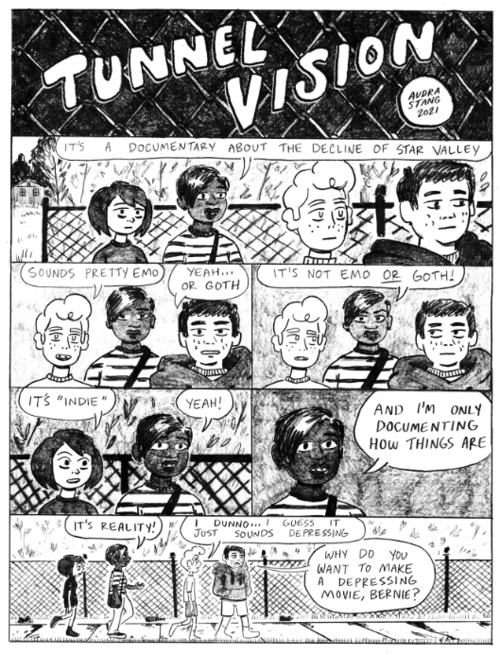
Audra Stang's excellent "Tunnel Vision" serial concludes in this issue, focusing on the character of Bernie, the young documentarian who followed around more familiar characters in the abandoned theme park tunnels that are an essential part of her Star Valley lore. There's an incredible page where Bernie is in the car with her hostile stepmother and then going in the other direction every other panel, talking to her mom. Stang's comics tend to fundamentally be about huge lacks in not just communication, but a willingness to listen and try to understand others. This is personified in power struggles through relationships, as those who are least willing to listen are those that hold tightest to the reins of power. This story would have benefited from (at a minimum) spot color, as the shading here crosses over into being muddy at times, but it's otherwise another great story from a cartoonist who works intentionally in a way that I really enjoy. 

Andrew Greenstone unveils some more wrinkles in his crazy story about cultists, a trivia expert who escaped a nightmarish experience, federal hearings, an attempt at normalcy, and a lot of other stuff. Balancing the craziness with an attempt at normalcy is what gives this serial some serious stakes and balances out his frequently grotesque and absurd character designs (and references to Image artists). The conclusion of Sam Grinberg's "Pancake Jake" gets funnier and more absurd with each passing page. The first part focused on the silliness of urban legends, until two friends who tried to scare their friend Sid with the legend of a breakfast monster called "Pancake Jake" discover its somehow real. This swerves into a witch who owns a diner, an abandoned tower, gentrification, magical constructs, and the healing power of IHOP. Grinberg's art is sharp and the spot blacks really pop on the page, while the character design is rubbery and playful. 

Other stories include Sienna Cittadino's story about a trans teen play soccer and the pointless, hurtful controversy this creates; it's done in a scratchy style with lots of blotchy greyscale shading that reflects the expressiveness of the characters. Alex Nall has his usual story of small-town, awful people drawn in a wacky style that seems to work at cross-purposes with the story. Pat Rooks has a full-color mini that's inset featuring a hilarious, over-the-top bit of slapstick where the futuristic workers inevitably get fucked over. Jordan Speicher-Willis has an interesting story about kids working in the library and trying to complete a quest; the character interactions are very well-observed here. Andy Wieland's story is a Rust Belt special, meaning miserable people oppressed by capitalism being miserable and then dying. John Sammis' line reminds me a bit of Tim Hensley, as he tries to think about differentiating two old Hollywood actors. Finally, Matt MacFarland contributes the first part of a serial devoted to the unfortunate genre of "dudes talking about getting laid." At least his cryptid-inspired art looks good.


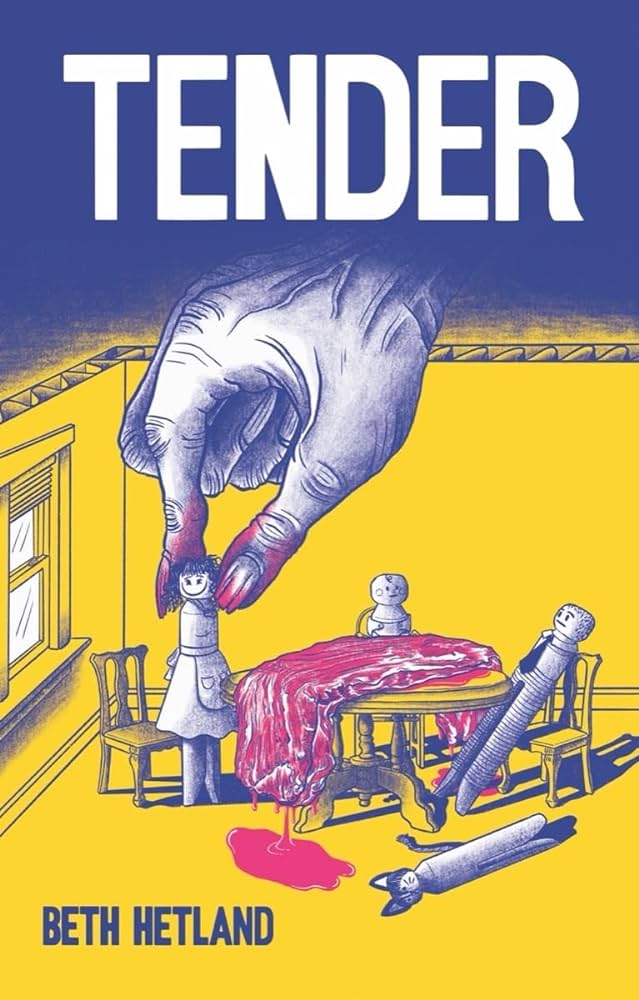
Beth Hetland's solo debut graphic novel Tender isn't what it seems at first, but the horror that's touched upon in the story's build-up informs the totally fucked-up events in the back half. The book opens with a creepy shot of the protagonist, Carolanne, softly singing to what appears to be a bundled-up baby. Hetland takes us back and forth in time and reveals that, while Carolanne is clearly a psychopath, the societal and cultural forces that shaped her and her horrific choices are also clearly to blame. 

Tender is a brutal critique of gender roles, social media, cultural pressures & expectations, and the isolation fomented by capitalism. I tend to be bored by horror that seeks to elicit shock value based on breaking taboos that were shocking fifty years ago. I'm talking about random gore, violence rooted in racism or misogyny, and other surface-level shock value tricks that embrace and reinforce cultural mores rather than challenge them. Tender is very much the opposite of this. Even as Carolanne's actions become more extreme and horrifying in her obsession with having a baby, her psychosis has a terrifying logic to it in how it reinforces not just what she has always wanted, but what she thinks is essential to being a woman. 


The narrative follows Carolanne as she seeks to get pregnant with her husband, Lee. It's all very cute and wholesome, as it then quickly cuts to her quitting her job so she can be a full-time mom. Slowly, using a dark blue wash with dense hatching and shading gradients, Hetland starts to reveal that Carolanne's approach to relationships is one where fantasy is more important than reality. She sets out to marry Lee, a co-worker, because it will help her accomplish her goal of the perfect wedding and lead her to the perfect life--all captured by Instagram posts. Hetland doesn't even have to try very hard to critique social media; indeed, social media isn't the issue so much as conflating it for reality is. In the first unsettling sequence of the book, she goes to his Facebook page, prints out a photo, cuts out his head and creates a collage where she and Lee are on their wedding day. All for a person she hadn't yet even spoken to. 

Every time she goes to a friend's engagement party, Carolanne has to practice smiling and rehearse what she's going to say. It's a mechanical response meant to mimic appropriate social behavior, which she's good at enough to garner a real group of friends. About a third of the way through, Hetland introduces a particular coping method she uses--biting off little bits of skin and eating them as a response to anxiety. Hetland periodically modulates the color scheme with purples, reds (especially for chewing on flesh or pulling skin), and yellows to indicate conflict or anxiety. Hetland also uses this creepy upward angle where we see Carolanne looming over something, usually with a blank or grim expression. 

Despite Hetland slowly unveiling not just increasingly unhinged behavior, but a genuine sense from Carolanne that she knows her behavior would frighten others, she and Lee marry, she is pregnant, and then in a devastating and terrifying scene, their baby is stillborn. This sets the events of the last third of the book into motion, as Carolanne increasingly loses touch with reality, drives away Lee, and then starts to become truly unhinged in her destructive and self-destructive behavior. She deludes herself into thinking she's pregnant, denies the death of her first child, and by the end, is in a psychotic world of her own. The visceral, awful, and genuinely unsettling scenes of her carving up her own flesh are all established and amplified by the rhythms Hetland established early in the book. 

Tender is ultimately a tragedy, where a person who simply has no conception of how to actually connect with others finds herself creating a conception of self entirely dependent on cues that are ultimately limiting, shallow, and fleeting at best. The images of self-consumption and total alienation are fitting, given that she never had a real chance of meaningfully interacting with others. Her total lack of empathy manifested in rage mostly aimed at herself, but also at the one creature she had thought of as being connected to her in her cat. It made sense in terms of the plot, but it was also the point where Hetland very deliberately wanted the reader to both cease having sympathy for Carolanne and simultaneously think about the ways in which society's guideposts brought her to that point. Having followed Hetland's career for years, Tender is a massive leveling-up visually, as she brought to bear the increasingly dense storytelling she used in Half-Asleep as well as a sophisticated and affecting color palette. This is the first major project she's written since her CCS days, and there's no question that it's a triumph. 

Saturday, December 31, 2022

31 Days Of CCS, #31: Rust Belt Review 2-4

Sean Knickerbocker has been regularly releasing an interesting anthology that's taken work from open calls, and the results have been uniformly fairly strong. He's also had a few serials running throughout, including one of his own. I reviewed the first issue last year, but there are three more he submitted for this year's CCS call. I'm going to review it in much the same way I used to review batches of issues of the old MOME anthology from Fantagraphics: I'm going to sort them by cartoonist, since so many of them appear in every issue. 


Sean Knickerbocker: The editor of the anthology and CCS grad is doing a great job in putting together these anthologies. First off, the actual page size is huge, something around 10 x 12". Each page is given a lot of room to breathe, which helps a number of artists whose style is densely packed. Knickerbocker publishes stories from others that are tonally and stylistically different, and he deftly balances one-offs with serials. Each 100-page issue is a satisfying read, in part because there's variety and some heft to them, but without the problem of feeling padded. None of these comics are a chore to read.

Knickerbocker is serializing a story called "Best of Three," which feels set in the kind of small industrial towns featuring desperate losers featured in all of his comics. This is a story about gamblers, grifters, and gangsters, only it revolves around a deadbeat dad who became a big-time and successful Magic: The Gathering player. The absurdity of this nerdy game replacing things like blackjack or poker is only matched but how absolutely true this scenario is. Magic tournaments have even been televised on ESPN. The story follows a narcissistic loser named David who inherits money from his supposedly dead father, but as the story goes on, more characters emerge from the woodwork in search of the real motherlode of money that he hid. The mobster angle gives this story a bit more frisson than the typical Knickerbocker story, which is not to say he doesn't have conflict. It's just that the conflicts are social ones and don't tend to intersect with genre tropes. That said, even the criminals in this story are grimy and desperate, accentuated by Knickerbocker's cartoony line, complete with exaggerated facial features and lumpy bodies. Each chapter takes its own unexpected twist, making it a fitting anchor for the anthology. 

Michael Sweater mixes his anthropomorphic animals with slacker punk aesthetics to tell a story that's more emotionally resonant than his stories elsewhere. "No Regrats" (in #3) is  about two rabbit friends, Timmy and Charles, and a wild night on the town that results in Timmy getting a tattoo on his chest that says "Simp." Timmy has no memory of this, so he goes with Charles to complain at the tattoo parlor, and the proprietor reveals that Charles told him to give him this tattoo. This leads to a comical fight, but the cliffhanger scene ends with Timmy saying that after the tattoo is removed, they are done. Much of Sweater's work is about being friends with horrible people who take advantage of you and what kind of impact this has on one's life, but this story is unusual in that it leads to such a direct break. As always, his storytelling chops are fundamentally sound; his scratchy line is a nice match for his cute figures, diluting some of that saccharine quality they possess. That solid storytelling allows him to focus on making his characters as expressive as possible. 


Audra Stang is someone whose Star Valley stories I'm reviewing elsewhere, but she's another regular from the first volume. This is a side story involving her young stand-in Adelaide and her friend Bernie, as they explore the tunnels underneath Magic Waters, the decrepit resort that used to make the town a tourist attraction. Stang's mix of a highly cartoony line in the vein of a Dell or Archie comic and intense greyscale shading provides a nice atmosphere for this journey underground. Paired with her friend and secret crush Bryson and his friend Jesse, Stang has a painfully acute understanding of teenage dynamics and how teens both wear their hearts on their sleeves and pretend they are completely detached. The plot revolves around Bernie wanting to take photos for a story, convincing Bryson to take them down there, but the result is both a fleshing out of every character and a bit more lore concerning Star Valley itself. Stang's stories about the conflict between working-class people and the wealthy make this a nice fit in the anthology. 


Andrew Greenstone greatly benefits from working on such a big page, because his art is dense, grotesque, and distorted. Working so big allows his art to have maximum impact, like a page where one character falls off a bike and hits the ground hard. Volume 2 continues the story of the twisted psycho who kidnapped a young woman for a demented game show, as the story mostly follows her paranoid boyfriend who's trying to protect her and reestablish their relationship. There's just enough of the first story's weirdness here to provide a strange flavor, but Greenstone swerves into the boyfriend's own madness. Greenstone's story in Volume 3 is unrelated but every bit as strange, as a zoo creates new animals thanks to the bizarre "Lemur Man" who comes out and turns humans into animals. What's great about the story is that it starts as a ridiculous urban legend that is very quickly revealed to be true, and the sort of grotesque transformation that the story demands is right in Greenstone's macabre wheelhouse. 

Brian Canini Canini is a very good cartoonist and his stories in volumes 3 and 4 were both highlights. "Silk Stockings" in #3 is a brutal family story that mixes the main character's (a teenage boy) general confusion and horniness with his parents' marriage starting to fall apart. There are just so many interesting character moments here, as the conflict centers around his father's lack of financial success coming to the forefront as they stay at his successful childhood friend's house. His friend very consciously "treats" his dad with lavish dinners, even as his mom seethes that it's not something he could pay for. Bruised egos and long-held resentments go side-by-side with the boy accidentally seeing the friend's attractive young wife put on silk stockings, sending him into a whirl of confused hormones. There's another scene where the friend's teen son expresses his loneliness by his eagerness to play hide-and-seek instead of play a video game. The simple line almost mimics something like a syndicated newspaper cartoon like "Hi And Lois" creating a tension between the conflict and the seeming happiness underneath. 

"False Flag" is a hilarious story that starts with a confusing scene with a young man half-dressed in the cold, then rewinds to a meet-cute romance, and then barrels into a spy story. The deflections and distractions work nicely in a story that utterly deflates the romantic premise, with the cute and squiggly line pushing the romantic aspect until it doesn't. 

Alex Nall's mix of naturalism, the grotesque, and the cartoonish is sometimes a mixed bag for me as a reader, but there's no question he's a thoughtful cartoonist. I can see what he's doing in terms of the style clash, but it often reads as purely dissonant instead of creating a carefully-constructed tension. However, his work in Rust Belt Review resonates, as his line seems a bit simplified for some of the stories. In "License To Kill," for example, Nall leans heavily on a thick line weight, carefully balanced black and white contrasts, and character design that emphasizes ugliness without going all the way to comically grotesque. The story follows a doomed high school crush that metastasizes into pure exploitation, until it transforms into some just desserts (literally and figuratively). "Facilities" is a sweet story about people working at a doomed mall, trying to find some solace and hope in each other. Like with Knickerbocker, there's always a sense of desperation in Nall's stories. Unlike Knickerbocker, Nall usually allows for a bit of hope. "Wall Of Fame" is a funny story about a conflict between a bartender and a regular, and it's ultimately about boundaries and space while despairing of one's ultimate fate. Nall, along with Stang and Knickerbocker, are truly the anchor artists of this anthology. 

Ian Densford & the Bros. McGovern This writer/artists team are another beneficiary of the sheer size of each page, because the Bros. use a highly smudged and messy style that's heavy on both lines and greyscale shading. Like many stories in the anthology, there's an interesting swerve in these stories. In "Soggy Landing," that smudged style is highly evocative of the muddy, messy war story that it depicts. Everyone is covered in mud and filth as a company tries to survive, waiting to be saved by reinforcements. Near the end, there's a huge swerve toward horror that's almost funny in its outrageousness, but Densford and the Bros never break character. Making the characters anthropomorphic goats somehow made the ending even more effective. The story in Vol 4 is also supernatural, swerving a bit from a coming-of-age country story. Densford is creating an interesting shared universe in these short stories, making them not quite a serial, but rather a series of thematically connected sketches.

Will Dinski has a couple of stories featuring his Eat Street Diners Club characters, who are regularly featured in an email newsletter. Dinski's weird, angular characters with minimal shading look constructed as much as they are drawn. This silly and mannered story about one of the characters finding a gun and the cop who chases him down is weird, lacking the usual sense of irony inherent in Dinski's story. He's playing this one loud and broad, and it feels a bit like filler compared to the rest of the stories in the volumes it appears in. 


Asia Bey Bey's "Open Roads" uses a four-panel grid (with amusing author comments at the bottom of each) page that really takes advantage of all the space on the page. This allows them to focus on their two leads, two young women hitch-hiking in the desert. The guy who picks them is a creep who then starts masturbating, which leads them to jump out of the car. The story really serves as a showcase for Bey's excellent and expressive figure work. While this looked to be a serial, only one entry has been published (in #2). 

Evan Salazar A number of these stories mix grounded, naturalistic settings with supernatural elements, and Salazar's story combines the lonely life of a young adult with a bit of video game fabulism. The idea of cursed games, magical games, and games that have some kind of deeper intelligence behind them is not an uncommon theme in fiction (especially in comics), and this one has a more benign one, as a strange game winds up summoning a cat that becomes the young man's companion for many years. It's not explicitly stated, but Salazar, using a sketchy and cartoony style befitting a video game, makes it work. 

Sienna Cittadino Their line is a bit wobbly at times and their character design is similarly shaky, but Cittadino is an excellent storyteller who understands tone and subtlety. It is a (presumably) autobio story that sees "Sienna" as a teen go to a pool party, only to be a largely ignored introvert. They are much more at home on a soccer field, but their mom is berating them to be happy and cheerful, and resents Sienna's lack of enthusiasm at her presence in their life. Cittadino says a lot without having to spell things out, and the solid storytelling allows them to use a paucity of dialogue.

Mike Freiheit This was a strong story by Freiheit, that starts from a fairly ridiculous place and gets exponentially funnier, weirder, and more outrageous. It's about the funeral of an awful person who plans to have their body turned into diamond and then preserved as an NFT. This was all planned by his brother, who proceeds to give the most vicious eulogy of all time, culminating in revealing that he cloned his brother and will raise that child as his own, defeating him in combat when he's 18. Of course, the bullied becomes the bully in this story, but it's so outrageous that it's hilariously satisfying. This isn't meant to teach a lesson; rather, it's one long rant against toxic masculinity. 

Sam Grinberg The best shaggy dog stories and escalating jokes start from the most absurd of premises. So it is with Grinberg's "Pancake Jake," a story about three friends. Two are ghost-hunter types who see the significance in everything, and the other is a skeptic. When they convince him of the diner monster legend Pancake Jake, who appears if you say his name three times after ordering funny face pancakes at a diner. This then actually happens (and the reveal of the monster is simultaneously terrifying and hilarious), leaving the story on a cliffhanger. Grinberg's stylized character design is appealing, especially with the way he uses blacks to provide contrast. Hopefully, this serial continues after Vol 4. 

Gina Lerman This is the first part of a serial and very little happened, as it's about a young woman going to an art residency in Vermont, being informed that aliens abducted a couple, and then not finding her friends at the remote cabin. Lerman also benefits from the big pages, as she employs a nice, thick line with a simplified line. 

Matt MacFarland MacFarland excels at slice-of-life stories, and this is a good one: recalling some summers spent as a waiter in a family-owned Italian restaurant filled with insane characters. MacFarland's line is functional and stands out when he's exaggerating character moments. The story fits snugly with the many other working-class settings for stories in the anthology. 


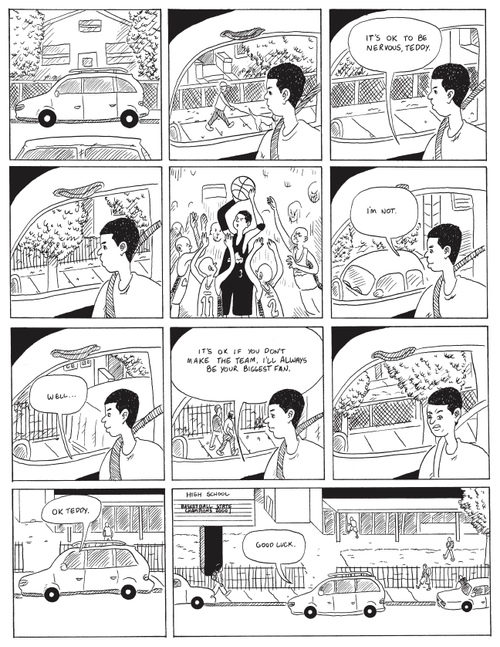
Raziel Puma Using a 12-panel grid (Santoro-style), Puma uses a clear-line approach to this story about a kid inspired by Allen Iverson in trying out for basketball. It's really a story about sibling rivalry that ultimately becomes a story about empathy, and freezing in the moment. Puma's drawing and storytelling are both excellent, as the story is well-paced and features a lot of expressive figures that hang together nicely on the page.

Jordan Speicher-Willis brings some punk energy to the proceedings in telling a story about a bunch of kids who pull an elaborate prank in order to help pay for school lunches for the rest of the year for everyone. That punk anarchist hatred of the system but desire for help and mutual aid is baked into the story, mixing direct action that flirts with violence but never violence for its own sake. The scribbly line from Speicher-Willis dips in and out of hatching, spotting blacks, and other techniques to keep things flowing, but it's that clear-line energy that adds clarity to the proceedings. 

Andrew White I can't imagine a better candidate to do one and two-page interstitial pieces than White, who skirts the line between pure comics-as-poetry and work that has some of these qualities but trades more in narrative. Regularly working with a 12-panel grid, White creates a poetic rhythm in his panels, often alternating word and image in each one. His use of negative space in that rhythm gives his text-only panels their own sense of weight that keeps them firmly attached to the narrative instead of taking the reader out of it. Almost every strip tends to be about environments, as you see sky, mountains, and clouds, until the final strip in the book, following a quietly tortured figure as she collects honey or syrup from trees. There's a beautiful delicacy and precision to the lightness of White's line and approach. (Full disclosure: Fieldmouse Press will be publishing a book from White.)

Thursday, September 1, 2022

31 Days Of CCS, 2021-22, The Index

Well, it took an absurdly long time to finish, but I'm declaring my 31 Days of CCS feature, dedicated to comics from students and graduates from the Center for Cartoon Studies, to finally be over. This is partly because with SPX coming up, I expect to get a whole bunch more soon. The list got long in part because I was slow, but also because new books kept coming out. Here's the entire list, with links to each individual review provided.


1. Denis St. John

2. Cuyler Keating

3. Masha Zhdanova

4. Mercedes Campos Lopez

5. Leda Zawacki

6. Sofia Lesage

7. Madi Baker

8. Meg Selkey

9. Maya Escobar

10. Faith Cox

11. Rebecca Schuchat

12. Mac Maclean

13. Daryl Seitchik

15. Erika Bloomdahl

16. Reilly Hadden

17. Violet Kitchen

18. Leeah Swift

19. Emil O Melia

20. Ross Wood Studlar

21. Kit Anderson

22. Annabel Driussi

23. Al Varela

24. Ashley Jablonski

25. Kori Michele Handwerker

26. King Ray

27. Robyn Smith

28. Jarad Greene

29. Kat Leonardo

30. Rachel Bivens

31. Josh Rosen

32. Less Than Secret anthology

33. Luke Kruger-Howard

34. Ben Wright-Heuman

35. Michael Sweater

36. Rust Belt Review Vol 1

37. Steve Theuson

38. Ian Richardson

39. Luke Healy

40. Aaron Cockle

41. Good Boy! Magazine


Friday, December 31, 2021

31 Days Of CCS, #36: Rust Belt Review Vol 1

Rust Belt Review is an anthology edited and published by CCS grad Sean Knickerbocker, an artist whose work I greatly admire. The first volume opens with a story by his collaborator Andrew Greenstone. kicked it off with a bizarre mix of a cult exit interview and Squid Game with "Prof. Livingston's Labyrinthine Trivia Trials." It kicks off with an FBI raid and an ensuing shootout of a bizarre underground complex. It then segues into a Wikipedia entry on the cult, founded by the titular Professor with the best of ideals. Like most cults, it devolved into a violent, perverted group of extremists that worshipped its leader. Unlike most cults, they started kidnapping people to put them through a series of grueling physical and mental tests involving trivia and physical feats. The story centers around its sole survivor, leaving it on a cliffhanger as it seems the cult has caught up with her after their setback. Greenstone's linework is grotesque and distorted, with a heavy use of effects like zip-a-tone and spotting blocks. They both give the story an especially gritty quality, like watching a fuzzy black-and-white surveillance video. 


Caleb Orecchio's "Kids Playing Outside" reminds me a lot of Steven Weissman's work. The scratchy art and the wiseass kids who are getting up to shenanigans, including a couple of different alpha characters who inevitably come into contact. The drawing is the main attraction here, as the story meanders in ways that aren't especially interesting. Some of the characters feel underwritten, like they're background characters in an animated series. The final, horrifying sequence is jarring, though there's a sense throughout of reality being bent in different directions. 

M.S. Harkness' "The Uncut Gem" takes off from her comics about her sexual encounters with assorted losers to make a comedic detour into a fantasy sequence. When a guy tells her he's uncircumcised and asks if she can "handle" him, she imagines them robbing a bank together and getting trapped on the roof. They're forced to blow up the uncircumcised tip of his penis like a balloon to float away, but a one-eyed police marksman named "Ellen Rage" shoots him down. That pops the fantasy but not before she asks him about banks. Harkness never shies away from hilariously cartoony and explicit images, and she certainly goes all out to get this joke across. 

"The Wind Cries Maria" is an experimental comic by Juan Jose Fernandez, a CCS grad who spends a lot of time in comics education. This comic was done in a 12-panel grid with what looks like ASCII art, interpolated with the lyrics of a song. It's a rumination on life, death, and existence, with each panel acting as its own complex space, frequently with multiple actions occurring. 


Knickerbocker's "Best Of Three" continues his streak of superb writing about scumbags and losers in small-town America. He just has a knack for the kind of guys who go out in the forest and drink beer on discarded furniture. The central character is David Kelly, a mean lowlife who is about to be kicked out of his old friend's house after he decides to move back to town, after years of "almost" getting a landscaping business off the ground. He's a leech and a mooch who happens to inherit a great deal of money after his father died. His father more-or-less abandoned him after he got rich playing the card game Magic: The Gathering. The lawyer who informed him of this seems to have some hidden agenda, as he follows him to the forest in the story's cliffhanger. Knickerbocker's character design speaks volumes for his characters: the stubble, the ratty haircuts, the unkempt beards, and other touches get across a real sense of how morally repulsive his characters are. At the same time, he makes the reader feel a tinge of sympathy for them as well, as so many of them seem to have been doomed from the start. 

Audra Stang's "Tunnel Vision" is part of her Star Valley stories, featuring teen-age girls Bernie and Adelaide. Bernie is trying to find out more about the sea-themed amusement park in town that fell into disuse from a boy whose great-grandfather built them. Stang's portrayal of teen-age dialogue is painfully raw and often hilarious. Jokes about autoerotic asphyxiation, inappropriate sandbox behavior, and teenage boys scheming to get laid all make sense in the context of this larger story. The way Stang writes about kids reminds me of the Hernandez Brothers. There's Gilbert's willingness to get gross in the way that kids get gross, and Jaime's uncanny ability to depict tension in teen relationships. Her cartooning is lively and expressive, skirting the line between naturalism and caricature. Like many of the other features in this volume, it's part one of a longer story. 

I like the idea of this anthology as mixing a steady line-up of contributors with continuing stories with rotating guest-stars in each issue. The CCS feel is welcome, but giving bright young cartoonists like Stang a steady outlet is certainly also a good thing. Knickerbocker has had an interesting career as a working cartoonist, an editor, and a publisher--and he's good at all three things. 

Friday, December 20, 2019

31 Days Of CCS #20: Colleen Frakes, Sean Knickerbocker

Ten years ago, Colleen Frakes published her breakthrough comic, Woman King. It earned her a Promising New Talent Ignatz award, and she's been producing excellent work ever since then. Woman King came out in various minicomics forms until its final original iteration was published, and I reviewed that here. Frakes just published an expanded tenth-anniversary edition for which I wrote the introduction. The book is printed at a larger size, giving Frakes' brushwork even more of a chance to breathe. There are also two new stories. There's a full-color story that was printed in mini-comics form back in 2008 that's almost psychedelic in its construction, as Frakes forgoes line in favor of white outlines of intense color bursts. The story itself is based on the same kind of logic that drove the war in the main story: winning the war is everything, and the otherwise innocent girl must be driven to do horrible things to help win it. In this case, it's killing a dragon and having her eat its brain. Of course, the "dragon" was a car and its "brain" was its engine block.

The final story is a sort of recapitulation of the story as well as an expansion of its mythos. A young man travels to find the child who will lead them to freedom against the animal army led by the bears and its Woman King, only to see that some beasts were fighting on the child's side. There's then a long interlude as the pilgrim reads about the ways in which different cultures regarded bears and their relationships with women. It was enough to get him to distrust all bears (and eventually get chased by one). It's an interesting denouement because it essentially does two things. First, it establishes that as a result of the events of the story, a mythology was built around it. That mythology only served to further create a sense of us and them through its twisting of ideas and events. Fake news, as it were. Second, it reveals that the cycle of violence hinted at in the end of the main narrative came to pass, becoming all the more terrible in each new iteration. Trauma handed down through generations causes an exponential amount of harm, as the farther from the initial trauma and the truth around it one becomes, the more important it is to rely on myth and unreliable oral histories. When you're living in a permanent state of emergency, it becomes impossible to discern what is truly dangerous.

I've been reviewing Sean Knickerbocker's Rust Belt minis for nearly a decade now, and they were just recently collected by Secret Acres. While the individual issues and stories were quite good on their own, the collection has a poignancy that's greater than the sum of its parts. Like Chuck Forsman and Dakota McFadzean, Knickerbocker writes stories about the desperate, the hopeless, the doomed. The cover, featuring what looks like a double-wide at dusk, gives the reader a visual taste of the stories found within. The first couple of stories follow Chad, a high school loser who's picked on by assholes because they think he looks like Kurt Cobain. There's no happy ending for him, as the girl he has a crush on has to move away, he ignores the girl who clearly has a crush on him, and his posed disaffection bites him on the ass in school. When we see him again, he's a vagrant hanging out with a sketchbook in a grocery store parking lot. That sense of continuity in the book makes each individual story more effective and memorable, as the reader is interested in seeing how things are connected.

When Knickerbocker shifts to stories about adults, their fates are even grimmer. Bradley is a store assistant manager who is demoted when new ownership comes in. David is a drunk who can't get past childhood trauma. Jason is a plumber whose alt-right rants go viral and gets manipulated by media trolls. Knickerbocker presents them warts and all, as they are all deeply flawed. They lack empathy, especially for those who care about them. They blame others for their problems. They rightly bemoan a lack of resources and fairness but can't see outside their own needs. Knickerbocker seems to be arguing that "real people" have it hard in part because of the forces of global capitalism, but he also seems to be saying that personal solipsism and an inability to see from someone else's point of view are also culprits for misery. In the last chapter, Jason's wife Meghan asserts her personal agency while allowing for her husband's beliefs, but is justly angry when he gets doxxed and they have to scramble to make a living. Her own anger at how she's treated at work because she's a woman add an important element to the story. All throughout, Knickerbocker silently comments on the idea that no matter the struggles of these characters, they still don't understand their own levels of privilege, either as men or as white people. Most of the characters have the ability to alter their circumstances but are unwilling to do so, never once allowing that others might have it worse than them.

Tuesday, December 4, 2018

Thirty One Days Of CCS #4: Kevin Reilly & Sean Knickerbocker


Mothball 88, by Kevin Reilly. This delightfully weird comic is a triumph of design, a fascinating trip through the mechanics of games and sports with its own internal language and logic, and a political statement about the way spectacle is used as a societal anesthetic. Every detail of this Ignatz-nominated comic adds to its aesthetic, from the orange-and-blue spot colors, to the quality of the paper,and the stippling effects that add a gritty quality to the storytelling. The story itself is not just a game, it's a game televised worldwide on the planet Bombyxia. Reilly gets the unctuous patter of the announcers just right for the 88th Mothball Championship as he slowly unfolds how the game is played.

At first, the absurd action of the comic is whimsically delightful as the three competitors each enact their own strategies. The game involves pre-teens using various methods to hatch special moths in order to score points. The mechanics of the sport are fascinating, and Reilly spins a genuinely gripping story where the outcome of the game produces suspense. That makes the conclusion so fascinating, as the initially vaguely creepy details (a silent crowd comprised of what looks like clones described as being "glued into the action") start to become horrifying. Two of the competitors are disintegrated by a bathtub full of a corrosive that happens to be part of the field. The teenage winner wishes only to kill Mothus, the alien ruler of the planet. It quickly becomes clear that the humans on the planet play this game to amuse their rulers, who frame the whole thing as entertainment for all. There is hope implied at the end but no real resolution, ending the comic as it began--right in the middle of a larger story. This is very much in the tradition of using violent sports as a political/cultural social satire, like Death Race 2000 or Rollerball, and it succeeds because Reilly's precise art and storytelling nails every tiny detail to provide a level of authenticity that feels lived in.


Rust Belt #4, by Sean Knickerbocker. Knickerbocker smartly writes stories about frustrated people in dead-end situations in Midwestern small towns. Most have been about younger people looking to leave town and improve their situations. This issue, "Internet Persona", is an incisive look into the life of a small-town, alt-right type Trump supporter and his burgeoning internet fame. The thing that really stands out about this issue is the way that Knickerbocker resists turning the vlogger, Jason, into a caricature without making him a sympathetic character. He's just a regular guy with a nice wife who hosts her family on Thanksgiving. He even takes the hint when his wife suggests everyone leave their politics behind at the dinner table.

Knickerbocker has a wonderfully ratty line, and his design for Jason--a pickle nose, patchy stubble, and squinty eyes--is absolutely spot-on. The story is fascinating because what it's really about the way that internet provocateurs take advantage of gullible dupes to further their own agendas (read: money and fame). Jason records right-wing rants on facebook (using typical language like "snowflakes" and "facts don't care about your feelings"), and one of his videos gets picked up by a right-wing media troll nicknamed "Burnt Toast". It goes viral as a result, and the undercurrent of the comic changes from his personal frustration and desire to speak on it to his delight that he's become famous.

Burnt Toast contacts him, flatters him and gives him advice. When he comes to Jason's town, he invites him out for dinner. He invites him to "contribute" to his website, providing content without being paid, other than a vague offer of "we'll see." There's a fascinating sequence where Burnt Toast has Jason watch a "reenactment" of a "stolen valor" video, one where a veteran confronts someone wearing a fake uniform looking for handouts. It's the kind of manufactured crisis that alt-right sites love to propagate and got to the heart of the shit-stirring, disingenous provocative nature of this kind of media in a naturalistic way. When his wife points out the general creepiness of Burnt Toast, it's less an affront to Jason's beliefs than it is his vanity, and it's pointedly the first time in the book that they have a significant argument. A provocateur's job is to make people angry ("own the libs!"), not to make cogent arguments--it's all about heat, not light. Knickerbocker demonstrates just how easily a frustrated person can get swept up into this kind of rhetoric, no matter how extreme it might become.

Thursday, December 14, 2017

Thirty Days of CCS #14: Rachel Dukes, Sean Knickerbocker

Frankie Comics #4, by Rachel Dukes. Dukes has done a lot of different kinds of comics in her career, both personal and work-for-hire. Her best executed comics continue to be about her cat, in part because she achieves perfect balance between naturalist and iconic drawing, and in part because she makes sure to impart a central truth about cats: they are awful. They will mess with you just for fun, because they are mischievous, spiteful creatures. They are frequently either oblivious or indifferent to the needs of their humans. Mining humor out of these essential feline facts is what makes Dukes comics about them funny, because the truth about cat-loving humans is that they don't care. Cats are actually remarkably affectionate and intelligent if they feel like it, and their need to play as a function of hunting makes them extremely entertaining.

That said, as Dukes' partner points out in this issue, cats train humans to feed them, pet them and play with them--not the other way around. Dukes starts playing a game with Frankie where she throws a rubber band, but Frankie never returns it. Instead, Frankie has trained Rachel to keep playing the game precisely as she wanted! For all her mischievousness, Dukes portrays Frankie as a genuinely sweet cat who loves her people and wants their near-constant attention. These strips have become even stronger as Dukes has started to write longer narratives instead of just doing one-off gags, depicting a truly symbiotic relationship. And to be sure, the way Dukes draws Frankie is absolutely irresistible. It feels like Dukes is about half way through a serious collection of these comics, which will make for a formidable and fun book.

Killbuck, by Sean Knickerbocker. Knickerbocker has been writing stories about disaffected teens in cold, nowhere towns for pretty much his entire career. Killbuck represents the apotheosis of this work, distilled into a single narrative that unwinds to become surprisingly emotionally complex in unexpected ways. Killbuck is the name of the shit town these teens live in, and its very name is spoken of with venom. It's a thing to be derided and a place to leave as soon as possible, which means finding ways to pass the time until such a thing is possible. In towns like this where there's nothing to do, that often leads teens to do stupid things. In the case of Eric, Jesse and Kris, Knickerbocker has set up a classic teen friendship structure. Eric is the obnoxious, abusive alpha male dealing with his own abuse at home. Kris is the classic beta male: he's a fantasy role playing gamer in the early 90s (as his hinted by the lack of cell phones and the prominence of VCRs) who is constantly taking shit from his friends but is also kind of whiny. Jesse is somewhere in-between, going along with pranking Kris but also regretting it at times. He's at the center of the Venn diagram that connects them to Gracie and Sam, two girls who work at a diner and buy pot from Jesse.

The story begins with the friendship among the boys immediately starting to fracture. Eric finds a cabin abandoned for the winter and they break in, and immediately think of bringing the girls over for a party. When the girls realize that they are in the cabin illegally when Kris accidentally spills the beans, they leave and an ugly confrontation between Kris and Eric ensues. It's a line-crossing event whose repercussions are such that Eric not only cuts off all of his old friends and acquaintances, he starts to isolate himself from everyone while still remaining an object of abuse by others. Eric is ignored by Jesse even as he tries to keep an eye on Kris, as he's haunted by his brother brutalizing him and making him cry just as he did to Kris. Gracie becomes better friends with Jesse after he scores her some pot, but the last scene of the book reveals that for all his talk of leaving, he's still very much emotionally trapped in the town.

Indeed, Knickerbocker suggests that Killbuck is a state of mind as much as it is a place. It's a mean, petty and limited state of mind that is simultaneously resentful and entitled. Despite the behavior of his characters, Knickerbocker has empathy for all of them, even Eric, though it's unclear if any of them will take responsibility for their own actions and find a way clear of Killbuck. With this book, Knickerbocker's true style has emerged, with fully-assimilated accents of a dozen cartoonists but a finished look all his own. The emotions of his characters are raw and they wear them on their sleeves, but Knickerbocker's ability to modulate emotion and mood from the extremes of violence to dealing with sheer boredom is his greatest talent as a creator. That sense of verisimilitude, paired with his slightly bigfoot character design, provides a contrast that complements both storytelling aspects.


Saturday, December 9, 2017

Thirty Days of CCS #9: Girl Talk & My Pace 2

My Pace Volume 2 is an anthology edited by Iona Fox and Anna McGlynn under their Rod & Cone aegis.


Girl Talk is a classic CCS anthology: hand-made and aggressively bold in terms of its theme and structure. This time around, an artist adapted part of another artist's diary, fictionalizing it to create a narrative. The hand-cut cover with various punched-out skeletons is beautiful and a nice touch. Anna McGlynn took an entry from Fox and turned it into a visceral slice-of-life story centered summer in the city. Our protagonist, Vivian, is sick of being in her cramped, hot apartment while getting calls from friends smoking weed and hooking up with random guys. McGlynn drew Vivian in such a way that she was irritated with anyone having a good time with a potential romantic partner, eventually drawing in x's for eyes. When a loser guy she has a crush on won't even hit on her because her breasts were "consumed with sadness", that's her breaking point, one that only snack cakes will alleviate. The rawness of McGlynn's storytelling is a nice fit for depicting the kind of daywhere people feel like they're melting.

Fox illustrating Cooper Whittlesey's psychedelic insights was a particular pleasure, as her quirky character design, decorative touch and oft-sketchy line were perfect for a comic about walking around and listening to music. Whittlesey and first-time cartoonist Alyse Burnside were inspired by McGlynn's diary, an office story about a young woman named Jane who is frequently sexually harassed and humiliated by her boss. It's revealed that she's the result of her father having sex with his mother, a fact she tries to work through with fantasy (both in real life and with porn). The battle between her trying to assert her worth as a human being that deserves love and the abuse she receives culminates in her taking a bus to the end of the line and meeting a naked woman next to a run-off pipe and perceiving her as someone connected to her. Nothing is explicitly revealed regarding this identity or even reality in this situation, and that ambiguity charges the strip even more. With 16 panels per page, Whittlesey & Burnside pummel the reader with tiny print, grotesque drawing and oblique angles, yet the horror and absurdity of it all is strangely hypnotic in its own way. Kaplan drew a convoluted account of a story from Fox, as it's about a day she was supposed to get a stitch out from someone who turned out to be an ex-girlfriend of an ex-boyfriend. There are amusing rabbit-hole details that emerge from the story, but this story was fairly lightweight compared to the others. That's not surprising since it's just four pages, as it served as a digestive more than as a crucial part of the anthology.

My Pace, an anthology about marching to one's own drummer, had a tight seven-person lineup. It's not as conceptually interesting as Girl Talk and is more uneven, as the editors went wide and took some risks with their contributors, not all of which paid off. Sam Szabo's silly ant piece feels like something out of a 1980s Steve Willis minicomic, but the way in which she sticks to the premise of the ant janitor and its mystic implications won me over by the end, although this slight story was way too long. Collage artist Sara Hebert contributed clip art with statements about her anger about not asking for anything regarding her needs when having sex. It's short, stark and bold, and quite a shift from the first story. Sean Knickerbocker's crisp line art was another nice change of pace, as he wrote a story about a guy going back to the desolate area in which he grew up. Knickerbocker takes a wrecking ball to ideas like nostalgia and closure, as coming back to his old house was walking through a minefield of triggers. The kicker is that the friend who came told him that this was, in fact what he wanted--to relive the trauma instead of learning how to move past it.

Iris Yan's anthropomorphic autobio is always dryly witty, and even this story about the death of her mother is no exception. When she gets a wreathe "from the team", she imagines her mother was on a secret soccer team. Having her librarian mother's ashes on a shelf so she could read whenever she wanted was a sweet touch. Mississippi's text lettering was distracting, especially for a comic that was so roughly drawn. There were points where this meditation on loneliness was rough in a way that was lovely and expressive, and other points where it let down the story's flow. The more abstract nature of Megan Snowe's comic made that text feel more suitable, since it was a comic about texting, the hand and arm broken down in such a way so as to render them into almost abstract shapes. Finally Summer Pierre's piece about how she came to comics is one I've read elsewhere, but it was a perfect choice for ending this particular volume. It's a sweet, funny story about Pierre meeting "comics' (an anthropomorphic character accounting for all of the art form), having flirtations with music, art and poetry, and then one night coming back to comics ("It's you! It's always been you!"). Her use of the grid highlights her whimsical self-caricature design by featuring it in every panel, almost invariably in a different pose and position each time. It's a subtle way of making the reader work a little in every panel and keep their eye fresh when they absorb new text.

Sunday, November 9, 2014

Thirty Days of CCS, Day 9: Sean Knickerbocker and April Malig


Rust Belt #3, by Sean Knickerbocker. Knickerbocker's comics have always struck me as what happens when the teens from Chuck Forsman's comics grow up and have to deal with real life. The answer is: poorly. Drawing in a style similar to Forsman's emulation of cartoonists like Dik Browne, Rust Belt #3 details a man being confronted in a bar by a friend regarding his drinking. It quickly escalates into the police being called and his long-suffering caretaker sister once again being disappointed by her brother. The story ends with the man recalling his sister always sticking up for him and him always repaying her with selfish behavior. It's a story about patterns repeating, again and again, and the title of the series is indicative of that certain sense of hopelessness and being one of, as Hunter Thompson would say it, The Doomed. Knickerbocker's use of zip-a-tone gives the comic a bit more substance and structure on the page. The back-up story, originally printed in an anthology, is a sort of more extreme version of the idea of being doomed. A couple goes into their house, douse themselves in gasoline, and (with a pentagram revealed on the floor), set themselves on fire. Without a single word and using deep pencil shadings to get across a sense of melancholy, Knickerbocker takes us to the end for this particular couple, who clearly see themselves way past any other solution. While slightly less rooted in reality than the first story, it's simply a warped reflection of how quickly things can go south. Knickerbocker walks the tight rope of empathizing with his down-on-their-luck characters (they are not played up for sport) and excusing their actions.


Bananas 2, by April Malig. Malig's visual approach couldn't be more different from not only Knickerbocker's, but virtually every other CCS grad whose work I've read. Influenced in part by manga, Malig uses swirling lines, distinctive patterns and bright colors in bringing her poetic narratives to life. Her work is highly immersive, like in the opening strip, "Mission Statement", which depicts her breathing out "a tiny piece of me/and have it/find its way to you". That journey across the page and a landscape is beautiful, especially in the way that her use of color is non-naturalistic and frequently counter-intuitive. "Inelegant Structures" reimagines a lost relationship as a series of sound-like waves, a series of circuit boards turned into a maze, and ultimately a last barrier preventing intimacy. Her black and white journal comics perfectly illustrate particular frames of mind, providing the reader with new information rather than simply providing a picture to reiterate a particular set of words. Playing it straight,narratively-speaking, with her "Vampire Princess Cat" story is almost jarring compared to the rest of the comic. It's a cute, whimsical and quite meta story that mixes slice-of-life touches with manga send-ups, all with a narrator and lead character who comment on each other throughout the story. Malig's figure drawing is less interesting than her other types of drawing, and they look flat and awkward at times when interacting. It was interesting to see her flex a different kind of storytelling muscle, however.

Tuesday, November 26, 2013

Thirty Days of CCS #26: Awesome Sound, Can't Lose, Stranger Knights 4


Awesome Sound is an anthology published by Sean Knickerbocker. The low-fi cover belies the beautiful contents within, which look like they were printed on a risograph. DW's endpapers, which forcefully push both text and image to the point of violent distortion, are fitting for a comic that's so visceral and unsettling. Dan Rinylo's "Beast" is told with an Ernie Bushmiller-style simplicity, as the young boy's face here is two big black dots for eyes, a black line for a nose and a mouth that goes from black line to black oval, depending on his emotions. Using a nine-panel grid after an initial splash page that establishes the boy at the edge of a forest, each page is interesting because the central panel is almost always a scene of stillness: we see the boy looking, see him smiling, see him in the middle of walking and then see him running from right to left when wild dogs start chasing him. That sets the story from amusing to frenetic, but the final middle panel is an image of an empty street--right before a wild dog who is chasing the boy is run over by a car. It's both dark and comedic, given the x over the dog's eye and the generally cartoony nature of the story, but the bright red blood on a page that's mostly black and white adds a level of terror to the proceedings.

Knickerbocker's "Do You Still Feel Alone?" begins with a brother and sister in the woods, on the run from something unseen. The way he throws the reader right into a chase scene propels the story right along, heightening its tension from the very beginning. That tension is ramped up when they are assaulted by a nude man, who is stabbed to death by the sister. Knickerbocker pulls back further, revealing that this is an island where a plane has crashed, its inhabitants reduced to life-and-death struggle. It's a brutal, unforgiving little tableau that has no pat ending, and the fact that it's drawn in that cartoony style reminiscent of Chuck Forsman and Sammy Harkham makes it all the more unsettling. Indeed, the later story where a young couple sets themselves on fire in a house (revealing a pentagram on the floor) is a sort of cousin to the sort of thing Forsman did in The End Of The Fucking World. Finally, Juan Fernadez's red ink two-pager is a perfect fit, as his scribbled-out faces go through a progression of consumption. This mini is short but every image packs a punch.


Can't Lose is an old-fashioned fanzine dedicated to the TV show Friday Night Lights. It's everything a fanzine should be: in-jokey, craft-conscious, and gently mocking in a reverent manner. "Coached" by superfan Melissa Mendes, this zine has an interesting sprinkling of well-known cartoonists. Popular topics include the Christian speed-metal band that the character Landry starts ("Crucifictorious"), the comically awful Billy, younger brother of lead character Tim (Henry Eudy does a fine job of pointing out just how weaselly he is while Nomi Kane posits a magical night the two share in the desert), and how doubters often come around to becoming obsessed with the show. Jon Shaw's "Friday Nightlife" speaks to this, as a character who mocks a couple mourning the last episode starts to watch it and eventually enters his own weird world of living out other, self-imagined seasons. Sam Spina actually made me laugh out loud in a strip where he and his wife are asked why South Carolinians are buying Texas beer, and they reply in unison "Texas forever". My favorite strips were Dan Zettwoch's hilarious story about Dillon getting routed because Saracen used photocopies from the playbook to hang up Crucifictorious flyers (lovingly designed and drawn by Zettwoch, of course) and Jeff Lok's tale of escalating terrible behavior being excused "They're good kids". Can't Lose even has a cut-out Tim Riggins paper doll. While bits of it might me mystifying to those in the dark, the premise is laid out clearly enough for the jokes to land.


Stranger Knights 4 was published, as always by Bill Volk. This light-hearted fantasy/sci-fi/superhero anthology has always been on the uneven and amateurish side. This issue is the first to look good from cover-to-cover, and each story is funny to boot. Volk's "Brega and Snurrd" sees him use a cleaned-up, simplified version of his line that emphasizes character expressiveness above all else. The story follows familiar Dungeons & Dragons/fantasy tropes, but it's really about the relationship between a mother and her teenaged daughter. Of course, the mother here is a bearded dwarf and her daughter is trying to pass as human at her wizarding school. When the mother demands the presence of her daughter for an adventure (ie, bonding session), tension arises in an amusing manner. This is a crisply-paced story that actually gets across real feelings in its fantasy context. I'd love to see more from these characters and their world. The Volk-written "Thousand Year Grudge" (drawn by Bryan Stone) is a denser, grittier story involving anthropomorphic animals, thievery, romances gone bad and multiple double-crosses. The thickness of Stone's line is coupled with cross-hatching, lots of spotted blacks and other noir visual effects to counter the funny animals and the wonderfully ludicrous character of Maggie, the young bird who decides to be a thief. Ann Lewis' "Headless" is a bit on the cruder side in terms of rendering, but her use of humorous body language in telling a story about an empty but animated suit of armor sells it effectively. Finally, the Volk-Mary Soper continuing collaboration "Incantrix X" continues to be a reliably amusing story with idiosyncratic character design and odd design choices.

Monday, July 23, 2012

Life Doesn't Turn Out As Expected: Moose, Rust Belt

This post kicks off five straight days of discussing work from artists who graduated from or had a residency at the Center for Cartoon Studies. 

Moose, #6 and #7, by Max de Radigues. This fine series about a high school boy who is relentlessly bullied but refuses to tell anyone about takes an interesting turn in these two issues. Issue #6 of this humbly-produced yet attractive minicomic (the minimalist cover featuring a few thick lines and a few big dots for a face is augmented by a zip-a-tone pattern and augmented by a wide swath of negative space) sees our protagonist, Joel, outsmarted at every turn by his tormentor Jason. Face to face with the boy who has made his life hell out in the hallway, he even asks why he's doing this without an audience. Chillingly, Jason has simply come to enjoy inflicting cruelty on someone else. Joel gets a reprieve when he's sent to the school nurse, an oasis that is further explored in issue #7. The nurse, Sarah, is the only one who clearly sees that he's being bullied but also understands that Joel doesn't want to discuss it. Partly because of this, but mostly because she's more-or-less presented as the apotheosis of cool, she's the one adult that Joel trusts implicitly.  His crush on her is also quite obvious. As always, de Radigues' wonderfully fragile line and use of angles makes his comics wonderful to simply look at. The fragility of his line is an apt method of illustrating the fragility of a young life.

Rust Belt Spring 2012, by Sean Knickerbocker. This issue concerns brad, a middle-aged middle-manager at a Wal-Mart type of store. The cover pretty much expresses it all: Brad takes a long look at his life lived in "quiet desperation", wanting to scream all along. Upon meeting a former lover and flashing back to scenes ambiguously describing why they didn't work out, he takes stock of how miserable his daily existence is, living with his disabled mother. Things get worse when he's given the choice of being demoted or fired (with a severance package), swallowing what little is left of his pride and accepting the demotion. Brad is a classic sad sack character in that he's miserable but selfish to the point of near-solipsism. He ignores his wheelchair-bound mother while smoking pot and reading porn, very much like a teenager would. Knickerbocker's cartoony line is perfect for depicting these sorts of sad sacks, with bulbous noses and blank eyes. I've compared his figures to Dik Browne in the past, but there were also flashes of Ron Rege' in the flashback sequences. His use of greyscaling is restrained but effective, adding just enough dreary atmosphere to an oppressively dull environment.