Showing posts with label rainer kannenstine. Show all posts

Friday, January 10, 2025

45 Days Of CCS, #41: Fantology 4

The fourth volume of Fantology is probably the weakest volume overall, but there's still plenty of interesting material in there. A lot of it felt strangely rushed; there were numerous spelling errors and the margins were so tight that I couldn't read some of the stuff toward the middle. Some of the pieces were so sloppy that I was surprised they were published, and the sequencing of the stories also felt somewhat off-kilter. That said, the best stories were excellent, and the overall concept remains sound. 


This is an anthology of fantasy stories set in the same world, based around a central map. Some of the stories are continuing serials, and others are one-shots. This volume's theme is "maps," which is a great theme for a fantasy anthology. There are a number of non-CCS folks in here as well, but I'll start with CCS artists first. Whiteley Foster kicks off the book with a 7-page story that simultaneously feels like it's too long and totally insubstantial. It's about two characters arguing about taking a job as surveyors. Her character design is so Disney-cute and exaggerated that it was hard to see them as characters. Alex Washburn's latest Clan Zargs chapter is something I covered earlier in this feature, but suffice it to say that he makes great use of the map to further his narrative, and the focus on surprising character twists added a lot of spice. 


Carl Antonowicz's unsurprisingly downbeat story follows a religious pilgrim and two servants going on a quest in a deadly desert. The attention he lavishes on world-building is actually a clever misdirection, as the quest itself ends in failure. It's the relationship between the characters that's most interesting. I wasn't crazy about his use of a digital font considering how sketchy his linework was. 


Catalina Rufin has another winning entry in her Barbarian Family series. With the burly barbarian dad Brono and his teen daughter Satu going on a map-led quest, Rufin explores family dynamics in a way that transcends the usual limits of the genre. With Brono harshly critical of Satu's ideas, Satu is vulnerable to a deep gnome's sweet words and promise of magic. Rufin asks some tough questions here, and her character design is sharp and expressive. 


Rainer Kannenstine sketchy and cartoony story about a lonely explorer in over his head in a dungeon takes advantage of old-school Dungeons & Dragons map construction to build the narrative. The looseness of the art gives it a lot of energy and helps play up its whimsical, funny aspects. It even has a genuinely emotional end.


It was such a pleasure to see co-editor Kristen Shull return to her serial. It's about a down-on-her-luck mage and her unlikely partnership with a princess whose quest is to assassinate a god to save her people. Even switching over to drawing digitally and working with a surprising lack of detail, Shull shines doing fantasy work in a way she doesn't in other genres. Her pacing, her understanding of how to depict action, her sense of humor, and her flair for the dramatic make each chapter a rousing success. 


As for the rest, there are a few highlights. F.Ostby's story about young rabbits exploring a forest at night for a treasure rachets up the tension but has a delightful payoff, with a pleasant mix of cartoony characters and a naturalistic setting. Niloufar Lari & Soroush Elyasi have perhaps the best-looking strip in the book, and it's about a quest of transformation and the intimacy of dance; only the digital font detracts from its elegance. Emily Claire's short story about a soldier finding his way back to his lover after three years is quietly devastating. PMK's bar crawl story is hilarious and exceptionally well-cartooned, and it embraces the map concept fully. Finally, Stephen Pellnat's story is a masterful piece of narrative misdirection. The cartooning is excellent, and the swerve is set up early on in a way that is easy to ignore. I missed a few serials from previous issues, which likely led to some replacements, but hopefully, they will be followed up on in the next volume. 


Monday, January 8, 2024

45 Days Of CCS, #39: What The Gnomes Know

What The Gnomes Know is an anthology centered around artists from CCS and the Columbus scene. There's a good mixture of both, and there are a number of artist-writer combos that are somewhat unusual for an alt-comics anthology, but it works to good effect here. What's interesting is that a couple of the collaborations are between partners. It was organized and selected by CCS grads Rainer Kannenstine and Ben Wright-Heuman, both of whom have a lot of different projects they've been involved in, both solo and in terms of collaborative efforts. It was edited and designed by Columbus mainstay Kelci Crawford. 


Writer Ian M. Klesch collaborated with Wright-Heuman on a post-apocalyptic story following an elder gnome navigating a ruined city, looking for parts. This is an elegantly-constructed story using a recording of the gnome's dead son to push the narrative, as we learn just what caused the apocalypse in the first place. Wright-Heuman's art is moody and stylish, but it pushes the frantic action of the second half of the story clearly. It's a great use of world-building to set up a character-driven narrative with a satisfying resolution that still leaves the reader wanting more. 

Catalina Rufin's "Gnome Pizza" was cleverly assigned right after that story, and it's the contrast that make both stories stand out. Using a delicate line and extensive use of watercolors, Rufin establishes an interesting narrative when a woman moves into an apartment that was originally gnome territory, and then turns the plot on its head by turning what could have been a conflict into an appeal for connection from a desperately lonely person. 


Writer C.M. Clemence and artist Kelly Swann offer up what seems to be a typical D&D-inspired quest by two gnomes seeking out their friend. They acquire allies along the way until the rescue, but the swerve at the end that reveals what's really happening is clever. Swann's art shot straight from her scratchy pencils is the highlight here. Eddie J. O'Neill and Kaz G.M. Lukacs collaborated on a story of a group of gnomes adopting a misfit kobold that's cute, but whose use of color feels garish throughout. Angela Boyle took a lot of risks with "Gnoir With A Silent G," a parody of detective tropes featuring a gnome. The big risk was making this illustrated text with a stylized font. There were just enough illustrations (and enough sequential art) to make this work, especially since the art belied the hard-boiled cliches of the lead character. Boyle's drawings are also lovely, with an effective combination of grit and delicate color. 


Alex Washburn's story about humans who can transform into gnomes was a mix of what felt like a personal story of frustration around identity and a ripping fantasy story involving the danger of possibly being turned into stone. Washburn's use of color was way over the top and would have looked better muted, but his expressive characters drawn in a thick line match up with their emotional natures. The collaboration between Erienne McCray and Kannenstine leans into the density of its colors in a deeply expressionistic manner, especially since so much of the story revolves around dark magic. However, it's still essentially a story about a mother and daughter's connection, and that's what ultimately gives the story its real impact in the end. 

The non-CCS stories included a clever entry from Jess Tweed about two friends dealing with dark magic in order to save someone else, and the clever way a seemingly iron-clad contract was dealt with. There's also a text piece written by Jack Wallace with moody illustrations by J.M. Hunter that's nearly unreadable because of its use of stylized text. The illustrations became almost incidental. Overall, it's a fairly strong anthology that could have toned down some of its use of color and has a wide variety of genre types despite revolving around a highly particular genre theme 


Monday, December 26, 2022

31 Days Of CCS, #26: Fantology Volume 3

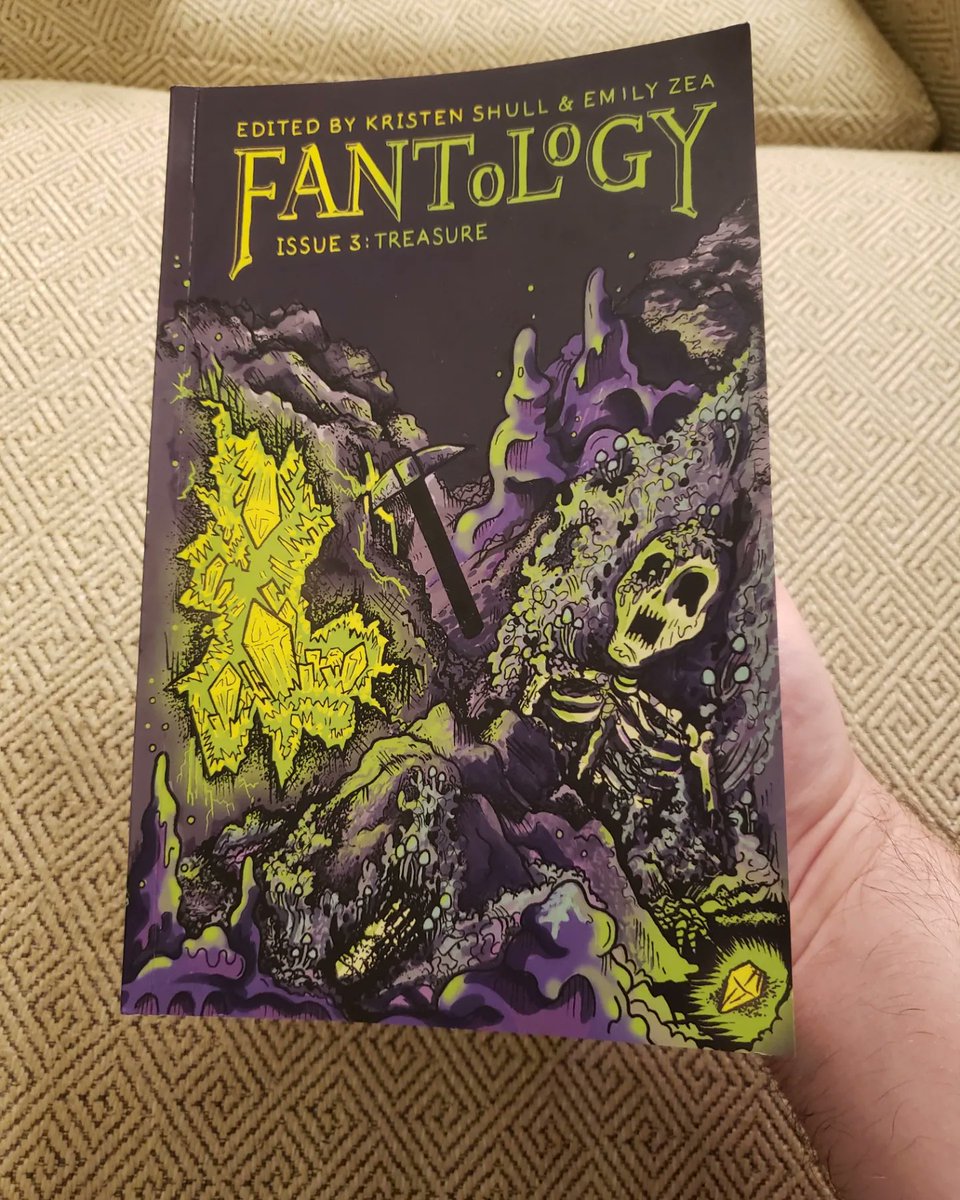
Kristen Shull and Emily Zea have produced another winning edition of Fantology, with probably the strongest issue from top to bottom. Its central conceit is that the artists have to work within an established world delineated by a map, which of course is similar to but not as rigidly prescribed as the fantasy minicomic series Cartozia Tales. The theme for this issue is "treasure," and that's a solid basis for stories because it instantly gives protagonists something to want.  


Kat Ghastly's "Lore" kicks things off, and their inventive layouts and page composition make this piece truly stand out. It's as much horror as it is fantasy, as it details a deadly prophecy concerning the new sorceress of the kingdom. Ghastly uses open page layouts, zooms in and out on key characters, uses tiny details to provide narrative and decorative flourishes, and provides rich and provocative characterization. This feels like a long book in the offing. Tay James' work is text-heavy, but the weird lettering choices and bonkers page design help with the light-hearted humor of the piece. Sage Clemmons' entry alternating illustrations with hand-written letters detailing a couple separated by life circumstances is deeply emotional, and ideal for an anthology. Natalie Norris' wordless tale of two mermaid lovers discovering a trove of human treasure is the emotional and narrative opposite: two lovers with no regard to the outside world, inseparable. The treasure amounts to simple baubles for them, instead of life-or-death plunder, and if there's one thing Norris is aces at drawing, it's slender, elegant, beautiful women. 


Emily Claire's piece about disaffected undead employees in a dungeon is funny and has a sharp punchline, although the dependence on grayscale shading made the visuals bland. A pet is a major aid in that story and in Chelsi Fiore's entry about an elf and his small steed being trapped in an underground city. These are breezy transition pieces that lead to the third chapter of Shull's ongoing fantasy story about two accidental traveling companions who both carry secrets. Shull's boisterous and bawdy style of fantasy is propulsively fun, as she pairs a serious (but horny) character with a light-hearted (but also horny) character who loves carousing, singing, dancing, and playing games of chance. Shull has a way of adding a slice-of-life touch to fantasy proceedings that centers the story around her protagonists, and both of them are memorable--both in terms of how they're drawn and their personalities. Hopefully, this makes it into a book one day. 


Michael Beachy's treasure-hunter story is a little visually overwrought, but he reins it in just enough to tell a clear and funny story. Mona's story about a bored wizard staging a tournament because he loves violence is heavy on pen-and-ink pyrotechnics, but her command over her line and clever storytelling techniques makes this fun, right on down to its cut-off ending. I get that it's part of a larger story, but not having any real closure in the story was distracting. The scratchiness of that story is followed by Stephen Pellnat's painstaking detail in service of some dynamic storytelling about a cat adventurer getting more than he bargained for on his adventure, and learning a valuable lesson along the way. There's another stylistic shift, to a sketchy, hatching-heavy story by Jackson Maceo Schleicher about a lack of honor among thieves as they look for a wishing egg. 


Rainer Kannenstine's piece is yet another visual shift, as it looks like scratchout white-on-black, with a simple, blocky line to tell this story of a grappler named Urta whose use of brute force eliminates the need for skill or magic in taking a dragon's treasure. She also has no problem declaring herself the sole recipient of the treasure and turns the dragon into her pet. My vote for most improved feature is Alex Washburn's newest entry about Clan Zargs. These ragtag adventurers get into genuine trouble, and Washburn tightens up everything here: his line, the storytelling, and even the characterizations. On the other hand, co-editor Zea's piece about a pirate challenging her family's lineage with the help of her hostage/protege/niece feels overblown and self-indulgent. She seems so delighted in her Captain Trub character that everyone else in the story is a means to the end of extolling her awesomeness. The story is still well-drawn, although the use of digital lettering takes me out of the actual story. 

While that story was a misfire, Fantology 3 not only holds up well on a story-to-story basis, the sequencing is also fluid and creates contrasts that make each story stronger. For an anthology with an open submissions policy, they did a remarkable job of putting together such a strong group of creators. It helps that there are regulars to anchor it, but this was the best all-around group to be featured in an issue so far. The conceit of Bartlebee the Bard introducing each chapter is fun, but it seems wholly unnecessary for one-shots. Given that some strips are in their third chapter, a summary of prior chapters would have been useful for readers. This volume will definitely delight readers looking for something a bit off-beat in their fantasy comics. 

Thursday, September 1, 2022

31 Days Of CCS, 2021-22, The Index

Well, it took an absurdly long time to finish, but I'm declaring my 31 Days of CCS feature, dedicated to comics from students and graduates from the Center for Cartoon Studies, to finally be over. This is partly because with SPX coming up, I expect to get a whole bunch more soon. The list got long in part because I was slow, but also because new books kept coming out. Here's the entire list, with links to each individual review provided.


1. Denis St. John

2. Cuyler Keating

3. Masha Zhdanova

4. Mercedes Campos Lopez

5. Leda Zawacki

6. Sofia Lesage

7. Madi Baker

8. Meg Selkey

9. Maya Escobar

10. Faith Cox

11. Rebecca Schuchat

12. Mac Maclean

13. Daryl Seitchik

15. Erika Bloomdahl

16. Reilly Hadden

17. Violet Kitchen

18. Leeah Swift

19. Emil O Melia

20. Ross Wood Studlar

21. Kit Anderson

22. Annabel Driussi

23. Al Varela

24. Ashley Jablonski

25. Kori Michele Handwerker

26. King Ray

27. Robyn Smith

28. Jarad Greene

29. Kat Leonardo

30. Rachel Bivens

31. Josh Rosen

32. Less Than Secret anthology

33. Luke Kruger-Howard

34. Ben Wright-Heuman

35. Michael Sweater

36. Rust Belt Review Vol 1

37. Steve Theuson

38. Ian Richardson

39. Luke Healy

40. Aaron Cockle

41. Good Boy! Magazine


Friday, December 31, 2021

31 Days Of CCS, #32: Less Than Secret

I enjoy anthologies that are a true team effort. This is something that's one of the major first-year requirements at CCS, as students are split into teams to make an anthology in a particular style, like Golden Age adventure or romance comics or 90s style Shonen Jump manga work. Because most alternative cartoonists are solo acts, forcing this kind of collaboration can be useful and teach a lot of lessons. Less Than Secret is an anthology from several CCS grads and several other cartoonists. Beyond their contributions in terms of the stories they drew, many of the book's cartoonists had other duties related to publishing. 


CCS grads Rainer Kannenstine and Ben Wright-Heumann served as its publishers. They were there to make sure the book was on schedule, obtain funding and consider distribution. JD Laclede was the editor, working directly with talent and sequencing the stories. Erienne McCray did the design, while Kelci Crawford acted as the crowdfunding manager. Angela Boyle was an anthology consultant, which makes sense considering her years assembling the Awesome Possum anthology. That collective sense of responsibility on what was clearly a labor of love is present and strengthens the overall anthology. 

The theme here is cryptids, or animals that some people claim to exist but whose existence has never been proven. It's fitting that Steve Bissette, the master monster-maker, penned a funny intro explaining his interest in monsters from a young age. Crawford's "A Day In The Life Of Mothman" is played for laughs, as a woman is followed by the legendary creature, whose presence foretells potential disaster. However, she can sense him, and it allows her to prevent a guy from being killed by a car, avoiding a fight at a diner, and preventing her from eating a bad hot dog. Crawford's line is crisp and expressive, with a lot of grayscale shading to add weight to the page. 


McCray's comic about the "Fresno Nightcrawler" (essentially a big baseball with legs) is also played for laughs, as this cryptid is more ridiculous than scary. They added a nice touch having the Loch Ness Monsters as its roommate and Bigfoot taunt it. McCray's line is fluid and a nice match for the kind of dynamic silliness that this ridiculous creature (wearing a fedora, even!) demands. Wright-Heumann is a horror guy, and he did a sort of Western/fantasy fusion with a family of Elves fending off a group of chupacabra mysteriously attacking them. The ending is grimly clever. His scratchy line was appropriate for the subject matter, though the extensive use of grayscale was distracting at times. This was a story that cried out for color. 

I'm not crazy about comics that insert huge blocks of typewritten text, but Angela Boyle's cartooning is so sharp in her story of the odd little elwetritsch that it wasn't too distracting. Moreover, using that text as the main character's interior monologue actually made this a useful device, commenting on the comic set around it. Boyle manages to sneak an entire murder mystery into this little comic with an unassuming old woman and her strange "pet." Ian Klesch and Andrew Small's story about how a lycanthrope used a dating app to fool a woman into being his prey was funny and grisly. The figure drawing was crude at points in a way that was distracting, and some of that was due to over-drawing in an effort to bolster a shaky line. 


Rainer Kannenstine's piece about the Dover Demon went in yet another direction: how messing with weird cryptids is likely to bite you in the ass in horrible ways. It's the story of a bully who attacks the creature in the forest with a ball, then gets his head crushed in revenge. He used some digital effects in interesting ways, including a "syrup brush" for some of the background fills that added to the story's atmosphere. Jess Johnson had perhaps the silliest story in the book, as an emo kid is befriended by his sister's new boyfriend: "JD," or the infamous Jersey Devil. Johnson turned the creature into an actual hockey player and made this a romance/family story where everyone took JD's presence for granted. It's hard not to see Johnson's strong shojo manga influence, giving this a radically different look and feel from the other stories in the anthology. However, it's not a slavish adherence to the style; rather, it's a launching point into Johnson's own style. 

There's plenty of backmatter in the anthology, including full biographies and behind-the-scenes stuff that's somewhat interesting, but at 20 pages (compared to 90 pages for the rest of the book) it feels like a lot of padding. That said, the interviews asking each creator why they chose their cryptid, their creative methods, etc. was at least thoughtfully done. Overall, this is a breezy anthology that I wished had been a bit longer. 

Thursday, December 31, 2020

31 Days Of CCS, #33: Fantology Issue 2

The second issue of Kristen Shull and Emily Zea's Fantology arrived just under the gun for inclusion in this feature. Unsurprisingly, this issue was generally superior to the first, often in surprising ways. For editors figuring out how best to assemble an anthology, the second issue is the one where all the kinks are generally hammered out in terms of process and production. In an anthology where very little is at stake in terms of money but a lot is at stake in terms of editorial credibility, young editors have to take risks on the kind of work they accept. There were a few newcomers in this issue and the returns were fairly positive on them; indeed, some of these stories were the best in the whole volume. 


One of the more surprising and delightful aspects of this volume is that the shared-world conceit of the first volume not only carried over here, but that some artists used the creations of other artists from the first volume to strong effect. This is another similarity to the Cartozia Tales series edited by Isaac Cates, only without the OuBaPo-style rigidity with regard to rules and switching every issue. This felt like a relaxed and fun one for artists to play together in the same world. Speaking of relaxed, the issue's theme of "Flora & Fauna" struck a nice balance between having no theme and having one that produced too much of the same thing. Each artist was simply compelled to come up with a new animal or plant during the course of their story. Some of them were incidental, and some of them drove the plot. 

While fantasy stories often devolve into world-building exercises, it was clear that Fantology's artists were generally far more interested in character-building. The characters drove the plots, and in the cases where they were returning characters, the stories served to expand on their histories and personalities. All of this is also tightened up by the anthology's narrator and gimmick Bartlebee the Bard, who not only informed the readers as to the anthology's theme, but also introduced each story and served as a natural piece of interstitial material. Unfortunately, one thing that got by the editors was matching up page numbers and the table of contents, which only had a passing resemblance to each other for many entries. 


The continuing adventures of several characters were certainly highlights. Shull's own saga of Sabi and Kata (the elf and the wizard) once again had an episode that was not only entirely satisfying on its own merits but also moved along the larger plot. It even hooked in a character from a group introduced by Leise Hook in the first issue. Given that the main characteristic of the character was his lusciousness, this was right up Shull's alley. Catalina Rufin's continuing adventures of Brono and Satu, the barbarian and his child, continued to be pitch-perfect. While retaining a rough fantasy aesthetic, the gentle quality of the story belied its concept. Filipa Estrela's gentle saga of Frill and Frond, the mushroom person and goblin who became partners in the first issue, is expanded here as the parameters and boundaries of their relationship are tested. Indeed, this is less a fantasy comic than it is a comic about relationships with fantasy trappings, although Estrela made those trappings delightful. Emily Zea's "Troubled Waters" continues the adventures of Princess Trudy and pirate captain Troub. It's a funny and compelling story, as it's made clear that Troub is more closely connected to Trudy than she first let on. Zea's linework here seems considerably more rushed in this issue than the first, however. Alex Washburn's story about a group of dysfunctional explorers maintained its humor thanks to Washburn's thick line and irreverent storytelling. 


The most interesting artists that were new to me were Tao Tao Jones and Chelsi Fiore. The former wrote a compelling story about the Pea from the "Princess and the Pea" becoming a cherished heirloom to a family of servants, until one of them broke away and created her own country based around the pea's growth. Jones' line is thin and scribbly, which suits the material, although I found myself wishing her script was a bit larger. Fiore's story about a desert traveler encountering a fuzzy little potato-like animal was imaginatively drawn and worked well with its short length. It was not just a story about reuniting a child with their family but also about an explorer who respected the environment they traveled in. 

This anthology was filled with pleasant interactions in this particular world, proving that not every fantasy story has to be about conflict. Eddie O'Neill and Kay Brand told a story about a couple going hunting for eggs and herbs so they could have brunch together; the plot was thin, but it was all about fleshing out their dynamic as a couple. Emily Bradfield's story had a little more action, but it was about a witch and a new witch wishing to be her friend and work comrade and how routine can often prevent us from making connections. Rainer Kannenstine's story is a send-up of boastful fantasy tropes. Kat Ghastly offered up more of a psychedelic bit of lore than a story, but it worked as a visually impactful opener. 


There were three stories that particularly stood out. Keren Katz's detailing of how the coin-people introduced in the first issue reversed their process and undid everything that was purchased with them was both conceptually fascinating and heart-rending. In terms of style, there's no one who draws with her level of detail and conceptual power. Kevin Fitzpatrick's meaty story about a potions-master and his imprisonment was full of fascinating character details, ethically thorny dilemmas, and extensive mastery of light and dark contacts. Emil Wilson's story about hunters discovering a bear with an orange tree growing on it not only had an exciting blend of naturalism and weirdness, it also was emotionally complex and touching. 

At 252 pages, the volume felt a little bloated. There were several stories that were had to parse or process visually that could have been eliminated. While the slighter stories were enjoyable, this issue felt unbalanced in that direction. The more complex stories really stood out in this volume, but their tone was subdued by the lighter fare in some of the other stories. Creating a balance in an open-call anthology is extremely difficult, but it's a credit to Shull and Zea that they were able to sequence things in such a way that they were nearly able to pull it off. 

Monday, December 28, 2020

31 Days Of CCS, #28: Rainer Kannenstine

Rainer Kannenstine is an artist experimenting with different kinds of fantasy and sci-fi storytelling. His latest comic, Bog Beast, is a silly, all-ages adventure about an obsessed captain and his easygoing prey. Spoofing Moby Dick is always a good place to start from, and Kannenstine commits to total ridiculousness in this comic. The comic opens in a swamp, where the captain's crewmen Joe and and Jeff argue about the existence of the Bog Beast. The tone is set with their over-the-top character design; Joe has a nose like a toucan and Jeff resembles a leprauchan with a jaunty derby. Jeff then opines that the Bog Beast exists and it must be the missing link between cow and lobster. Kannenstine isn't so much crafting gags with punchlines but rather making every panel laughable and silly. 


There's lots of slapstick involving Jeff and Joe, including managing to end up in specially-designed bag traps. The Bog Beast turns out to be friendly and laid-back. The Captain's reason for her hatred of the Bog Beast is absurd. There's an extended flashback sequence to kindergarten done in crayon, as though it was in a kid's hand. The story's flow is effortlessly smooth as Kannenstine goes from silly situation to silly situation. That smoothness is earned through his visual approach. Kannenstine keeps his figures simple and stylized, but their construction is rock-solid and the way they interact in space is natural. However, it's Kannenstine's use of color that does much of the work in keeping things moving. His choices are deliberately non-naturalistic; instead, color is used to add weight to pages, fill up negative space, accent character design, and add to the light-hearted nature of the story. There's not a wasted line or any over-drawing in this comic, and that allows Kannenstine to accomplish his goal of writing and drawing wonderful nonsense. 


Saturday, December 26, 2020

31 Days Of CCS, #26: Fantology

Every year, someone from CCS always seems to step up to do the work of editing and publishing an anthology. It's a time-tradition that has produced some excellent comics, including Sundays, Irene, Maple Key Comics, and most recently Brainworm. This time around, it's Fantology Volume 1: Origins, edited by Kristen Shull and Emily Zea. It's a straight-up fantasy anthology that makes no apologies for its subject matter and celebrates it with gusto. Not everyone in the book is a CCS student or grad, so for the purposes of this review, I will mostly focus on the CCS contingent.


While there are some solid entries in this anthology, the care that editors Shull and Zea put into make it greater than the sum of its parts. From Tess Scilipoti's simple but eye-catching cover design to the interstitial rhymes of Bartlebee the Bard to the choice of paper stock, this is a cohesive-looking and attractive book. Shull and Zea also chose to put these stories in a shared world (similar to what Isaac Cates did in Cartozia Tales), with a map at the beginning giving readers a rough understanding of that world and where the stories take place. It's a clever device that helps draw together a number of disparate styles and as well as skill levels.


Catalina Rufin's "The Quest" is one of the highlights of the anthology. Rufin went all-in on a thick line weight and spotting blacks and it works well with her relatively simple but expressive character design. It's an interesting contrast, because fantasy art with this kind of line usually tends to be more naturalistic and dramatic, but with the story's actual emotional narrative arc, that contrast between dramatic and pared-down made sense. The story follows a warrior and a young apprentice magician sidekick, and his supposed quest against a powerful witch. Rufin touchingly and hilariously subverts this trope in a way that still makes sense within the genre but also makes fun of warrior-types who can't express their feelings.


Filipa Estrela's "Discovery" is another delightful, warm story about a goblin who happens upon an island inhabited by mushroom people called Mycelia. Estrela cleverly sets the entire paradigm of an explorer on its ear, as Frond the Goblin realizes that she can't report her discovery of the island to anyone, lest it be despoiled by invaders. There's a delightful romance between Frond and Frill, the Mycelium who greets her on the island, and it leaves off on a note that implies that there could be future stories featuring this couple. The one problem with this story is that Estrela's line is light to the point of illegibility at times; it looks more like detailed thumbnails rather than a completed story. The story is also highly text-heavy, and there's some awkwardness with word-balloon placement. This was also a story that fairly cried out for color to add some weight to its pages, but the anthology was of course in black and white. 

I reviewed Alexander Washburn's "Clan Zargs" last year, as he submitted it as a separate feature. It's a nice fit in the anthology, as his anthropomorphic animal character design, thick line weight, and use of negative space allow the pages to breathe while he tells his silly and funny story about a newly-formed group of treasure hunters. I also reviewed Shull's "Thirsty" in her entry this year for CCS, and it perfectly encapsulated the best of fantasy fiction. It's not just telling a fantastical story, but introducing characters who are trying to tell their own story and create their own identity. 


Rainer Kannenstine's "The Apotheosis Of Jahk" is a well-realized story of a fisherman and a malevolent being named Titanis who at first offers friendship and wisdom to Jahk and those around him, but later inspires bloodlust and conquest. It's a story of a seemingly impossible moral problem and how Jahk failed it. Kannenstine's bold use of black and white contrasts matches his simple line nicely; it's a good example of creating a powerful set of images without overrendering.


Zea closed the anthology with "Seas The Day," a delightful coming-of-age fantasy story about a young princess who wants to be a warrior like her older brothers and the pirate who raids their city. Zea's sketchy pencil drawings and spare but powerful inking make each drawing pop off the page without losing any of their expressive power. 

Natalie Wardlaw and L.S. Hook both contributed short pieces. Wardlaw's was a silent story about finding a fairy with torn wings and mending them. It's simple, sweet, and drawn in Wardlaw's signature elegant line. Hook's contribution isn't so much a comic as it is a series of hunky drawings of men on an island that so enchanted the explorer that they chose to remain there. Both are the kind of short, intermediary pieces that provide flavor in anthologies like this. Amy Burns' "When The Gods Grew Bored" is a powerful creation myth for a particular group of people that's well designed and cartooned. Burns' attempt at a naturalistic approach didn't quite land because her character design was too crude; her lettering was also all over the place, which was distracting. 

Other interesting contributions included Jared Beerman's highly atmospheric fumetti photos of miniatures telling a story, Eliot Crow and Keren Katz's haunting story of a people turned into currency in the desert and what ultimately happens to them; Emily Bradfield's story of an official trying to thwart poachers and its surprising outcome; and Tay James' funny story of a young potion-maker trying to decide her future. 

Another volume of this anthology has been produced, and I'll be curious to see what kind of a jump the dedicated creators, as well as the editors, made. The second volume of an anthology tends to be the one where the editors figure out how to fix the errors they made in the first volume, so I'm eager to see what kind of leap they all make. 

Friday, December 28, 2018

Thirty One Days Of CCS #28: Rainer Kannenstine


It's a special privilege to see the entirety of a CCS student's thesis package, as I noted when I reviewed Dan Nott's comics. CCS students are taught to emphasize format and presentation alongside content. In terms of the former, Rainer Kannenstine's thesis was a one of a kind. It's not unheard of for a thesis to be presented in a handmade box. However, gluing nearly forth teeth to the side of said box, which has been criss-crossed with electrical tape, is something I've never seen before. It made it feel as though I was about to peer into a forbidden tome of some kind, literature that's dangerous.

The actual contents were much friendlier than that, showing off a variety of different styles in a bunch of narratively unconnected but thematically similar minicomics. Kannenstine's future as a cartoonist lies in humor, as the best of these comics were the funny ones. That said, the supernatural/sci-fi aspects of many of these comics showed that he was fluent in a number of different genres and cross-genres. His character design is strong and no-nonsense, giving the reader an immediate sense of what each character is about. There's also an immediacy to his work that indicates an admirable level of spontaneity. His line is lively and fluid. However, the trade-off there is that his work has many more textual errors than I would expect in a final project. There were times where I wasn't sure if this was part of a specific dialect choice or if they were indeed errors, which took me out of the work. Kannenstine clearly needed other eyes to proofread his comics.

This Sucks is a slightly revised version of a comic that he did earlier, and it's still one of his best. It involves a stressed-out young woman being chosen by a cosmic being to help decide if her universe lives or dies. Kannenstine's use of a thin line to establish the woman and her general ennui is then subverted by sticking her in space, that line swallowed up by the black void of space. The cosmic being is almost formless, other than his cruel mouth and tuxedo. It's a nice, absurd touch. The end of the story is both funny and horrible, yet entirely fitting—especially since the woman is not actually rewarded for doing what she did.

Zapadoodle 1 and 2 are sketch and process minicomics. The first one emphasizes linework, and one can see him employing different line weights with the same material as a way of generating different effects. Kannenstine's blobby characters have a cartoonish charm that works well, like a pair of cacti in a desert, a huge brute and a smaller creature considering helping him, or his own self-caricature. He's also good at using greyscale shading to interesting effect, but I think his future as a cartoonist lies in further developing that loose, casual use of shapes in creating figures. The Life of Ded makes that clear, although the heavy line weight here is too dense in telling this funny store about a ghost who reluctantly goes to a party. His authorial voice is bold in that comic, however, and it further shows his strengths in writing funny comics.

Nidhog is perhaps the best-looking of his comics here. Kannenstine uses bold black and white contrasts in telling the story of a woman and a demon, mixing around time and perspective to get at their relationship. His linework here is excellent, as he found a delicate balance between using a thinner line weight without sacrificing the overall boldness of the visuals. As the story goes on and the reader begins to understand that the power dynamic between the two of them was not what it appeared to be at first, the ending is all that much more effective.

To My Dearest Johan is indicative that Kannenstine used his thesis not so much to show that he was a finished product as a cartoonist, but rather to demonstrate a number of different kinds of storytelling approaches. This is a strong drawing display about a child devouring himself, talking the reader through how and why. It's whimsical and weird, much like most of his output. Finally, Snakes is Kannenstine's most focused and sustained narrative. It's about a spaceship containing the eggs of the last remaining race in the universe not devoured by “the Snakes”, and the relationship between the caretaker of the eggs and his friend the robot. Kannenstine uses the slightly ragged line of This Sucks, the sharp black and white contrasts of some of the other comics, and a sweet sincerity that's not really present in his other work. What kind of cartoonist is Kannenstine going to become? Hopefully, it will be one who can draw on gleeful nihilism as well as a genuine attempt at creating empathy for his characters. He's clearly most comfortable with subverting genre work in frequently humorous fashion, especially with regard to how he varies line weights. Between Snakes, This Sucks and Nidhog, there's a formula there for a longer work with memorable characters, funny twists and a commitment to working within a genre to create emotional content and surprises.

Sunday, December 17, 2017

Thirty Days of CCS #17: Rainer Kannenstine, Anna Sellheim

An upcoming grad (Class of 2018), Rainer Kannenstine’s work is sort of gleefully nihilistic. This Sucks is a story that demonstrates his pitch-black sense of humor, as an extremely hung over young woman is chosen by Death to work out an old philosophical problem with a creature who’s the representative of another world/universe. Our planet and their planet were on a collision course that would destroy both of them…but if one person chose to destroy the other planet, it would save their own. The alien talked about the over-the-top idyllic circumstances in its universe, and when asked about her universe, she could only muster “It kinda sucks.” Of course, one reason why it sucks is you just can’t trust people, which leads to the eventual, darkly hilarious outcome. To say that this is not a polished comic is an understatement. It’s a whole lot of expressive scribbling that works pretty well, though the many spelling errors were a distraction. Still, the so-over-it facial expressions of the protagonist and black void of death’s form brightened only by a permanent, cheesy grin helped give this comic a great deal of energy.


Lasers is a far stranger little comic with the following admonition: “Don’t go to the playground. The pelicans are made of lasers.” That statement is repeated, each word filling up part of a panel. The pelicans do indeed to strange things on the playground, and when repeated, we zero in on a molecular level so as to see just what’s going on in that bill of theirs. This is a sort of children’s nursery rhyme comic, only far more unsettling. Far more polished is He Comes To The Club At 6:00 AM, which shows us fragments of the handsomest bear to ever grace a dance club, and how if you’re lucky, you might go home with him. It’s image after image flashed at the reader, like they were fever dream memories from hours later. There’s a beautiful crispness in the use of grayscaling here, as Rainer is careful to let each image wash over the reader and also use great care and precision with the all-lower case lettering. 

Anna Sellheim submitted a couple of short stories for 30 Days of CCS this year, one of which appeared in Comics 4 Choice, the pro-choice comics anthology. That was "My Mother's Story", a comic in the form of an interview about her mother's experiences with not just abortion, but also childbirth. Sellheim here uses her more naturalistic line (as opposed to the slightly more abstract figurework she uses for much of her own autobio material) and plays it straight with a nine panel grid. The comic is text-heavy, yet Sellheim is able to apply a few visual flourishes here and there. The narrative is one of the best I've read with regard to abortions, because it demonstrates that the decision to have the procedure can vary with age, circumstances or any number of other choices. There were points where she was adamant about having a baby the next time she got pregnant, and other circumstances where she was apart from her partner and knew it wasn't the right time to bring a child into the world. The point of the story is that in every instance, it was her choice, and the state had no business interfering with it. 


"Safe" is a story about a gay couple named Carl and Kamon, the latter of whom was from Thailand and had a history of abuse at the hands of his father. It’s a sweet story that gauges the concept of safety for a gay couple in the wake of Trump’s election. There’s a scene where Kamon gets a dirty look for speaking in Thai in public from a guy in a MAGA hat. The story is as much about negotiating the unwritten rules of relationships as it is coping with a frightening new reality, as Carl bristles somewhat at being told that he has a bad singing voice. Later, Kamon reveals that Carl may have a bad voice, but he loves to hear him singing, because it makes him feel safe to know that Carl is happy in that moment. There’s more of Sellheim’s slightly cartoony naturalism here, which is a nice match with the impressive verisimilitude she shows in the story’s dialogue and relationship dynamic.