Showing posts with label tom kaczynski. Show all posts

Tuesday, June 19, 2018

Minis: Kaczynski/Jetsmark, Turbitt

Some minicomics, fresh out of the oven...

Cartoon Dialectics 3, by Tom Kaczynski & Clara Jetsmark. This is a grab-bag of Tom K. stories from various places. "Skyway Sleepless" was originally published in a book of Minneapolis-related noir stories, and Kaczynski's take on the genre was at once clever, funny and part of his overall project of critiquing the effects of capitalism. It also incorporated a part of downtown Minneapolis that I found fascinating: the skyways between buildings, offering a walking path that's an alternative to traversing the winter hellscape. Of course, Kaczynski couldn't help but notice the ways in which they resemble the sort of pathways that gerbils might use in what is really a closed environment that cannot be escaped. This was dressed up as an art exhibit of the future, and a security guard (our protagonist) found chalk outlines that were part of an art exhibit titled "Future Crime Scene". 

From there, the story becomes a whodunnit: what's putting people to sleep? Is the professor who imagines a future based on skyways complicit? What about his femme fatale assistant? Is the whole thing a put-on, and how does life imitate art? While the story winds up being a series of gags and playful engagement with detective tropes, there's something clever about the way Kaczynski repeatedly pulls the rug from under the detective (and the reader), even as he satirizes the cold utopian nightmare of the skyway empire. It's an artificial (r)evolution, one predicated on the idea of One Great Man, technology over humanity, and a reliance on the kind of consumption of resources that capitalism is predicated upon.

The other stories are more directly political. A story he did for The Nib prior to Trump's election made a number of predictions that have all come true. "Trump And Nostalgia" (drawn with scratchy warmth by Jetsmark) is a typical bit of critical thinking on his part, as he positions the phrase "Make America Great Again" as a piece of Reagan-era nostalgia. Quoting the writer Svetlana Boym, he breaks down personal nostalgia vs political nostalgia. The latter is a feeling of rejection of everything that is new, couched in the language of law and order so as to obliterate the threat to the steady-state of nationalist identity. Kaczysnki doesn't take the next step, but this kind of nostalgia is often explicitly racist, xenophobic and homophobic. Nostalgia is a zero-sum game in the eyes of those who embrace it; if the Other's life is getting better, it automatically means that their own life is going to get worse. Othering the opponents is the key piece of weaponizing this feeling that then privileges law and order over the humanity of the othered class. 

In "Nostalgic", Kaczynski picks up those ideas again and explores personal nostalgia. There is a trigger we feel for old pieces of culture and product (and often, culture and product are one and the same) that is a longing for an earlier (and as we always perceive, simpler) portion of our personal narrative. It's a pacifier that creates a false sense of accomplishment in acquiring old things, old memories; the act of wanting these objects starts to supplant any joy that the objects themselves might bring. There is no critical element in our relationship to these things or bits of old culture; the endorphin rush is that of connecting it to fragments of memory. In other words, shows like Happy Days or old comic books provide a kind of comfort because they made a younger, simpler version of yourself happy for a moment. 

Kaczynski quotes the pulpy but prescient Alvin Toffler book Future Shock in its observance that the faster that technology develops and directs our lives, the more that nostalgia becomes a powerful force. It's the triumph of feeling over reason (witness the increasing hostility toward science), or even worse, the triumph of "alternative facts". Feelings become facts, and actual facts that cause cognitive dissonance become fake news. As with everything else in life, always follow the money. When there's a national feeling toward embracing nostalgia, there will be people ready to sell it to you, further creating a nostalgia feedback loop. 

Kaczysnki does offer an interesting corrective to personal nostalgia. Given the future shock we are experiencing (propelled by new technology being pushed just as hard as nostalgia), it's only natural to feel that tug of nostalgia when we see an old toy that brought us joy. He suggests that rather than buy that toy in an effort to chase the past, we should instead think about our feelings surrounding the experience of playing with the toy. Play is an essential and very serious element of childhood that incorporates objects and breathes life into them as part of expanding and exercising imagination. Tapping into that feeling of experiencing the joy of imagination is what we should be aspiring to, using it to create something new. In a world where everyone is creating something, the need for relentless consumption is greatly reduced.

Galactic Friends, by Meghan Turbitt. On the surface, this comic about experiencing the Star Wars movies for the first time as an adult seems to have little to do with Kaczynski's comic. In fact, Turbitt's hilarious examination of Star Wars is a hilarious but incisive critique of a set of nostalgic tropes that hardened in the imaginations of several generations of children. Star Wars is a kind of perpetual motion nostalgia-generating machine, drawing on pulpy sci-fi serials like Buck Rogers and Flash Gordon and telling a story that's a wish-fulfilling (space) fantasy. It marked a hard turn away from the kind of science-fiction that had dominated film for over a decade: grim takes on how the events of these frequently dystopian futures were really just reflections of the present. Star Wars even fits into Future Shock in the sense that trusting your feelings is more important than science or reason--another key element of nostalgia. 

The back cover features Turbitt's face replacing those of the Star Wars characters, which is both a funny visual (especially Darth Turbitt) and an interesting piece of commentary. Star Wars at its essence is wish fulfillment: it wants the viewer to identify with Luke Skywalker, Princess Leia AND Han Solo. Turbitt then spends much of the mini asking perfectly reasonable questions that prick that fantasy balloon. It starts off by wondering if a variety of characters (including C-3PO) have a penis, which is both an infantile reaction and a sensible reaction to the ways in which the movies neuter sexuality so thoroughly. In depicting the Slave Leia scene in Return Of The Jedi, where Carrie Fisher is in a metallic bikini surrounded by puppets, she simply remarks "It is my understanding that some people jerk off to this scene?" It's a strangely incongruous scene in the film that was a burst of sexuality (entirely in the province of the male gaze) in a narrative that's otherwise devoid of sex; no wonder it launched a thousand fetishes. 

Turbitt calls out Luke for being boring, Han for being a dick to Leia, the privileging of human-looking beings as the protagonists, and the fact that Darth Vader and Kylo Ren are angsty teens who never had to grow up. She actually likes that aspect of the films, that the villains are just big overgrown babies who shop at Hot Topic. Turbitt's drawings capture a lot of the fun of the films, and it's clear that she enjoyed watching them. She simply enjoyed them for what they were: silly pulp with actors who chewed the scenery, and not products with so much nostalgic power that they create cultlike devotion. Tubitt's whole project seems to be reacting to cultural phenomenon in a raw, direct way, stripping them of their identity as product and reveling in their absurdity. 

Thursday, February 23, 2017

Josh Neufeld & Sari Wilson's Flashed

One thing that a number of Xeric Generation cartoonists (those between about forty and fifty-five years old or so) have in common is an interest in comics formalism, often expressed through the OaBaPo method. This is a series of comics-drawing games that use certain constrictions, like drawing all characters in silhouette, or including the image in every third panel, etc. to challenge cartoonists to use creative solutions for these problems. In many respects, formalism simply implies an awareness of the actual form of comics and how it can be manipulated to produce certain kinds of effects. A lot of comics-as-poetry leans heavily on formalist techniques, for example. In the case of Josh Neufeld, he's done things like comics drawn with his non-dominant hand as well as travelogues told from the point of view of strangers he encountered. Working with his partner Sari Wilson, who is a writer, they put together a collection of "flash" fiction and comics called Flashed. One of the constraints here is a comics story of no more than four pages and a short story of no more than a thousand words. The biggest constraint, and what makes the collection interesting at times, is that three stories or comics would bundle together to form a sort of triplet with a common theme.

Neufeld & Wilson would choose a previously-published comic or short story as a seed. It would be handed over to the next cartoonist or writer (always at least one of each in each triplet), who would respond to the first piece in whatever way they saw fit. Then that second piece would be handed over to a third artist/writer, who would react only to the second piece; they were not allowed to see the first. There are fifteen such triplets in the book and thus forty-five artists, which had to have made for an intense amount of work for the editors, especially since they solicited and printed reactions from each artist about the process after every assignment in a triplet had been completed. That made the entire project unusually meta for an anthology, although I found the author responses to be some of the most interesting parts of the project. As I have written about nearly every anthology I've ever reviewed, this book was highly uneven. I probably would have cut it from fifteen triplets down to ten, because some of them were either difficult slogs to read (which is surprising for flash fiction), lacking substance or outright juvenile.

The "Cheating" triplet started off with some swaggeringly tedious Junot Diaz machismo in short story form, was followed by an absurd Nick Bertozzi strip about a guy who started to think that the tags on his girlfriend's underwear were sending a message, and then finished by Zoe Zolbrod's purple prose. It's one of the rare times I've felt angry after reading something due to the feeling of having my time wasted. Some of the other triplets, like "Shell Shocked" all took somewhat obvious approaches to their subjects; in this case, it was the subject of a soldier returning home to a lover. Some did little to add to a great seed, like in the "Frozen" section where a John Porcellino piece is rendered into something predictable and lacking the poetry of the original piece by Alan Gilbert. In "Venus & Mars", a sentimental piece about emotional pain by Dean Haspiel is turned into an S&M piece by Gina Frangelo and then a parody of S&M and academia by Jason Little. "Winter Walk" went into territory that was too esoteric and abstract at times and didn't hold together.

Sometimes, however, the combinations worked and some interesting connections were made. Kellie Wells drew straight from certain aspects of Lynda Barry's deeply, emotionally rich story "Lost Worlds", and Box Brown went into a completely different direction that nonetheless captured the quality of light that's difficult to quantify in its beauty. "Dystopias" showed that even when an author did not understand an element of the original story (like Anthony Tognazzini misunderstood Jessica Abel's original), they can turn it into something interesting. In this case, it took a story about a tragic highway accident into a bizarre conspiracy piece, and the cartoonist DW managed to double-down on this. A more direct example of teamwork was "Amerika", where Jen Camper started off with a goofy parody of a future fascist America (yikes!) that V.V. Ganeshananthan turned into a full-out dystopian tale with an open end that Tom Kaczynski picked up and completed in his trademark absurd but deadpan manner.

In other stories, the connections made just weren't that interesting or the deviation from original texts wasn't striking enough. That was true of triplets like "Awakenings", "Brothers", and "Leviathan". When the creators started with a weird or whimsical premise and were willing to keep it going, the stories were more interesting. "Bronte", for example, starts with stage directions for a scene about the death of Emily Bronte, continues with a comic by Ken Nash that transposes the setting to an office, and finishes with a story by Rob Walker that transposes it once again and shifts the point of view to a guy in a club. The through-line of barking dogs being transformed into a ringing phone and then finally the person making the call was especially clever, even if one is completely unaware of the history of the literary Bronte sisters. "Mutable Architecture" starts with a premise grounded in the mundane (living in a tiny city apartment) with the horrifying (a mysterious hole in the bathroom that takes on an increasingly disturbing quality) thanks to Gabrielle Bell. Jedidiah Berry's takes that premise and warps it in a positive way, as a landlady showing an apartment to a new tenant becomes younger and younger as the tenant finds more and more secret chambers. Carol Lay's scratchy and tenuous line flip the story around again, as the resident of a sinister house across the street from the apartment goes about his day. "Incommunicado" flips from a disaster-situation to a surreal party to an anatomy of a date and personal ad, with Michael Hinken's deranged final segment strongly capping off the weirdness. Finally, "Curses" finds Anna North and then Andrea Tsurumi doing different takes on disaster and superstition that are both emotionally resonant, and Ben Greeman finishes up with something far more frightening.

All told, this was an interesting experiment that was mostly worthwhile as a read, with a number of slow spots. One thing I noticed is the near-equal split in the number of male and female creators, which probably had something to do with the diversity in subject matter and storytelling styles. I'm not sure a second volume would make much sense, unless it was completely revamped with a new set of rules. Even more preferable would be a volume where every group had a completely different set of rules. The problem with these sorts of exercises is that they usually wind up being more interesting to those who participated in them as opposed to those who might want to read them, which is why a heavy editorial hand is so important. Still, I've never seen an anthology quite like this one, especially in the way it encouraged artists from two different disciplines to collaborate.

Tuesday, July 26, 2016

Foxing Reprints #11: Tom Kaczynski, Vincent Stall, Alex Holden


Structures 1-11, by Tom Kaczynski and Structures 12-23, by Vincent Stall (Uncivilized Books). Of all the small press publishers, Tom Kaczynski's Uncivilized Books best fits my own personal aesthetics. All of his books and minicomics are impeccably designed with a minimum of fuss, creating images that are eye-catching but not overwhelming. Kaczynski's minicomics line is especially interesting, because he's willing to take chances on unusual projects in a low-key, low-risk manner in this format. TheStructures series is a good example. Architecture has always been a key interest of Kaczynski's in his comics, strictly from an aesthetic point of view. The way that geometry plays itself out in a three-dimensional context holds great power and mystery in Kaczynski's hands, and his issue features eleven structures that highlight his heavy use of brushwork and a surprising lack of angularity. That's because each of these structures is "unnatural", "unstable", "incoherent" or else a formation created from nature. Here, Kaczynski involves the almost supernatural power of architecture as a form of incantation in favor of nature taking its course in unusual ways over time; he even winks at his own brush work in "The Tomb Of Jack Kirby", a design with heavy blacks that looks like something out of New Gods.

Vincent Stall takes a different approach. His drawings are unlabeled but very much in keeping with his "king of rubble" approach of drawing backgrounds. Unlike Kaczynksi's remote, monolithic structures that stand the test of time, Stall's structures are broken and decaying, reclaimed in part by their environment or repurposed by those now living there. Stall's line weight is thinner and more fragile than Kaczynski's, which makes sense, and there's also a much more restrained use of blacks. Each of these minis is crisply printed on paper that makes the most of the linework of each artist.

Skyway Sleepless, by Tom Kaczynski (Uncivilized Books).  This coverless mini is a reprint of a Kaczynski story published elsewhere. It takes an actual downtown Minneapolis phenomenon--skyways that connect buildings so as to prevent one from having to brave the hellish winters in that city--and extrapolates it in a noir/aesthetics thriller. Kaczysnki pokes a little fun at some of his more serious stories here as the lead character, a skyway security guard, is confronted by mysterious chalk outlines in the skyway and subsequent people passing out in the outlines. Conspiracy theories, ritualized architectural magic and other supernatural ideas get thrown around, and even though they all wind up being a McGuffin for the real mystery, the ending seems to confirm that sometimes spoof has a way of becoming reality. There's a wonderful spareness to Kaczynski's line here, as he relies on thin diagonal lines, zip-a-tone and his typical lurching figurework. When his characters are in motion, there's a rigidity in their movements that matches up with the backgrounds around them, creating new geometric structures within each panel. His characters are tall and slender and don't lack expressiveness; indeed, there's a touch of Jack Kirby to be found in many of his creations. That expressiveness is balanced by the coolness and reserved nature of Kaczynski's page structure, which is always tidy and balanced even when crazy things are happening. 

West Side Improvements, by Alex Holden (Uncivilized Books). Holden fits in nicely with this sort of urban theme. His own series, Magic Hour, was all about the supernatural in an urban setting. West Side Improvements is a work of reportage originally published in the Syncopated anthology, and it's about the tunnels underneath Riverside Park in New York and the community of artists and homeless who made it their own. The focus is on Chris "Freedom" Pape, a graffiti artist who made a series of elaborate portraits in the tunnels, many of which were visible in the grates above the old railroad tracks. The comic goes on to chronicle the community of artists that grew to work together in the tunnels as well as the so-called "mole people"--the homeless who lived there and who drew media attention when a book was written about them. Amtrak, who owned the tracks, announced that the tunnels would be closed, but not before the homeless were relocated to public housing. This is a thorough, thoughtful take on a forgotten and hidden part of New York, a reflection of the way that the city has slowly snuffed out artistic reclamation of old spaces in favor of corporate reclamation. The art in this mini is less effective printed at a smaller size, especially since so many panels are crammed onto the page. That's especially true when trying to show the scope of the murals painted by Pape. The smaller scale doesn't hurt Holden's characters as much, given that he tends to use a cartoony and minimalist approach in depicting them. The mini does include a great deal of bonus material, including several pages of reference photos taken by Holden.

Monday, August 26, 2013

Autoptic and Everything Before in Minneapolis

From Friday 8/16 to Sunday 8/18, Minneapolis was the alt-comics capital of the US. Combining the resources of the Minneapolis College of Art and Design (MCAD), the minds behind PFC and the organizing committee behind Autoptic, comics fans were treated with a true comics arts festival. The focus was on guest of honor Jaime Hernandez, who gave a talk on Friday at MCAD in support of the closing of his exhibit in the MCAD gallery. However, collaboration was the theme of the weekend, as a week's worth of collaborations between North American and European artists was on display on Saturday. All of these artists attended the inaugural Autoptic show. Let's take a closer look at each event.

1. Jaime Hernandez exhibit and talk at MCAD. Friday night was the closing of the Zak Sally-curated exhibition of Jaime Hernandez' work, with the artist himself giving a talk in a packed auditorium. I had an opportunity to go through the show slowly before the crowds arrived. While I've never been a big proponent of comics in galleries, I thought Sally did a fine job in giving interested parties a good reason to study the show closely. Before one entered the main exhibition room, there was a wall dedicated to media coverage about "Los Bros" as well as posters and other ephemera. Sally sensibly arranged the art to reflect Hernandez's evolution as an artist over the years, dividing it into a variety of eras. He was careful to select a few stories here and there and display several pages in sequence, a decision that helped preserve the sequential nature of the work. There were also displays of the original, self-published Love and Rockets #1 and dozens of issues and collections under glass.
The top two pages were cut up and combined into the bottom page for "Spring 1982".

Hernandez is known as one of the greatest comics draftsmen in the world, so getting to see original art was fascinating. In the early days, he actually used quite a bit of whiteout. In the pages I saw from the recent story "The Love Bunglers", there was almost none. The real discovery of this exhibit is that Hernandez had a few out-take pages from several stories, including the only extant original art from "Flies On The Ceiling" (the originals were "lost" after being displayed in a gallery). Another outtake from "Jerusalem Crickets" was thrown out because it depicts Hopey writing a letter to Maggie while she's touring; Jaime realized that Hopey simply wasn't the kind of person who writes letters and scrapped the idea. Other pages were simply abandoned after a panel or two. It was also interesting to see him draw a couple of pages and later cannibalize them, combining them into a single page as he switched around or threw away panels. Also on display were a few pages from his scripts, which he continues to write on yellow legal pads. He used to throw them away until someone urged him to keep them. He told me he now has a huge stack of them and doesn't know what to do with them. I suggested he donate them to one of the many universities now collecting comics-related work. He said he's thought about that, but that he's also thought about selling them (he's selling some of his art now).
Outtake from "Jerusalem Crickets".

Stories highlighted in the exhibition include the aforementioned, "Spring 1982", "Home School"; and "The Death of Speedy"; Sally hit the highlights hard. At the end of the exhibition, there were two couches and a bookshelf with various volumes of L&R for readers to peruse. The crowd then streamed into the building's big auditorium on the campus of MCAD. It was standing room only in the hall, with a video feed being piped into the overflow room next door. Sally interviewed Hernandez in his heartfelt, passionate style, and it was clear that the artists had established a clear connection in working together on this project. As Sally enthused later, Hernandez indeed told stories he hadn't heard before. A big focus was on the role of his family in becoming a cartoonist. Jaime talked at length about his mother, who used to collect comics in the 40s and 50s but had to hide them from her own mother. He talked about drawing with his brothers one day, and his mom brought out a stack of drawings she had made of various comic book and comic strip characters. He and his brothers were awed by the fact that she had done this and it became something very cool to them.
The author in the reading section of the exhibition.

He noted that he and his brothers had simply always drawn comics. "It was just what we did. Get up, eat breakfast, draw comics". It was a cheap way to get a bunch of little kids to quiet down for a while. His older brothers did it, so he had to do it too. Sally made a joke about wanting to have introduced the Crumb brothers to the Hernandez brothers. I ran with that idea and asked Jaime about the hierarchy in the family, noting that Charles Crumb was the comics boss of the family and the other two brothers followed along. I wondered if he was ever told to draw a certain way, or if he was told he was doing something wrong. Jaime replied that it was never like that. Instead, it was just a constant sense of excitement from his brothers, but especially Gilbert:. "Hey, let's draw!" There were suggestions about fun things they could draw together but never orders.
An outtake from "Flies on the Ceiling".

Jaime said that during the academic year, comics were frequently forbidden until they got their grades up. When summer rolled around, his mom would take out a huge bag of Archies, Dells, Gold Keys, etc. (Mario's Marvel collection was considered to be "the good stuff" and off-limits for rough re-readings.) Those frequent re-readings refined Jaime's eye and made him realize what excited him. He remembered an issue of Dennis The Menace (most likely drawn by Al Wiseman) where Dennis and Joey walk down a street, having a conversation. This excited young Jaime for reasons he didn't understand, but he started to love the scenes in super-hero comics were they were in civilian clothes instead of the fight scenes. That launched him on his way.

Zak Sally and Jaime Hernandez. Photo by June Julien Morrisey.

There were any number of other interesting anecdotes as Sally and Hernandez got to the heart of how comics and music were meaningful to them. One common theme to Hernandez talking about his own comics is authenticity; he wants to depict things accurately and honestly. That extends to growing up Mexican-American in Texas and California, to the punk scene in early 80s Los Angeles, to how women think and act, to writing gay and lesbian characters. When I mentioned to him that a mutual cartoonist friend was working as an apartment manager in LA like Maggie, he said that he had run into her and she had told him that story. His main concern: "Did I get it right?" The other interesting theme that emerged about him over the weekend is how important it is to him to be part of the current comics scene. There was a long period where "the phones stopped ringing" and he and Gilbert stopped being hot cartoonists. The show and the reception he got the entire weekend spoke to just how important he is to young fans and cartoonists alike.

2. PFC Exhibition. Coinciding with the Jaime Hernandez show and the Autoptic festival was Pierre Feuille Ciseaux #4, or "Rock Paper Scissors". Organized by the ebullient June Julien Misserey and brought to the US by way of Zak Sally's suggestion, this was a weeklong experimental comics camp that brought together artists from North America and Europe. PFC is all about constraint comics, wherein artists are asked to draw stories given time limits and particular limitations. In one "game", an artist would draw a panel. The next artist would continue the story by drawing a panel above that panel, to the right of the panel and under that panel. The next artist would have to draw five panels, and so on, all the while keeping up the narrative. Another game saw the artists have to draw themselves captured by Wonder Woman's lasso and forced to tell the truth about something. Another game, called "Fuck This Thing" (printed as a free mini) forced each artist to draw the the thing they hated drawing the most until they got sick of it; they got to write "Fuck drawing thing x" as a sort of reward.

The roster of artists included Kevin Huizenga, John Porcellino, Eleanor Davis, Lisa Hanawalt, Genevieve Castree, Jim Rugg, Anders Nilsen, Lilli Carre', Marc Bell, and Tom Kaczynski from the US and Canada. Representing France and Belgium were J.C. Menu, Misserey, David Libens, Max de Radigues, Benoit Pretesille, Domitille Collardey, Eugene Riousse, Sandrine Martin, and Pierre Ferrero. All of these cartoonists have reached their mature style, but all of them are still in their primes. There was a careful balance of styles, from naturalistic to cartoony to minimalist. The artists also collaborated with a group of MCAD students on a number of projects, and the students came up with their own games as well. Something remarkable about this assemblage is that even by Saturday, the last day of PFC, the artists still couldn't stop drawing. A number of professional cartoonists sat in with those stopping by for a public zine/mini making workshop. Lisa Hanawalt and Eleanor Davis made a last-second mini for Autoptic. When I stopped by the main studio on Saturday, the artists were hanging around, helping each spot blacks and make beautiful, accordion-style minicomics.

The Saturday Comics Workshop at MCAD. The author's wife is in the lower left-hand corner. Photo taken from PFC website (presumably by June Misserey).


In speaking to the participating artists, most of them were apprehensive to begin the week. The joke of the situation was that every artist felt like they weren't as good as their neighbor--they couldn't draw as well or as seemingly effortlessly as everyone else. That was true from John Porcellino to Jim Rugg, representing a beautiful and minimalist style to a highly elaborate, detailed line, respectively. Critic Xavier Guilbert  discussed how being forced to work with another cartoonist, especially a stranger, was a way of breaking the ice for you. You each had a project to do and had to find solutions together, which naturally led to talking about everything else. Menu noted that artists from both Europe and North America not only have drawing in common, but the common language of storytelling. Even someone like Marc Bell, who works in a kind of dream logic, is working in that common language of narrative. Being forced to engage in these games forced the artists to work in their most spontaneous and natural styles, putting down their purest line before doubt and the need to clean up lines or the urge to choke a drawing to death took over.
The assignment board for "Break Something".

The ostensible goal of the week was to create a screenprinted comic. Each artist was asked to pick a character from a list. A North American artist was randomly paired up with a European artist (in most cases), combining their two characters with the theme "Break Something".  The screenprinting studio Aesthetic Apparatus printed them and they were cut on site as the artists pitched in with folding and cutting. There are a lot of great collaborations, but the Kevin Huizenga ("The Devil") and Sandrine Martin ("God") was the best, as God was a cartoonist and the Devil kept burning up his work. I also quite enjoyed Eleanor Davis & Max de Radigues doing a Soldier and a Corpse. All of the cartoonists used the sort of rich color screen that popped when screenprinted on thick paper stock.

Another highlight of the day was getting a guided tour to the students' exhibition of their PFC challenges by Barb Schulz, a professor in the comics program at MCAD (I should note that Sally is also a professor there). She talked a bit about particular students and the curriculum for undergraduates. MCAD has offered cartooning as a major since 1997 and they're now up to fifty or so cartooning majors in a school that has about 700 undergraduates. A number of the cartoonists wound up tabling at Autoptic. Mandie Brasington was one interesting artist who runs the Dead Cartoonist's Society, which published an anthology. Dawson Walker is a senior who has serious cartooning chops. Frosh Rosemary Vallero-O'Connell's cartoons for PFC really stood out; despite her lack of publishing experience, it's clear that she has real talent and ambition. I'll have a more detailed MCAD artist report for my High-Low column over at tcj.com soon, once I plow through the pile of minis I got from the cartoonists who tabled at Autoptic.
L to R: Genevieve Castree, Zak Sally, John Porcellino, Jaime Hernandez, Max de Radigues. Photo by June Julien Misserey.

There was an interesting lightness I observed in the PFC artists as I saw them working. Combining the social aspects of a convention with an environment that demanded actual productivity led to work that was mostly light-hearted and even crude in nature, but there was also a lot of cleverness and truth-telling to be found in the PFC exhibition. The sheer amount of comics they produced was staggering. Even Jaime Hernandez got into the act on Friday night, drawing a couple of images for a Nancy animation and getting in on a couple of games. Lisa Hanawalt naturally started a comic involving a woman's ass, knowing that Jaime was taking part and knowing that he'd "knock it out of the park" when he got to it. (Needless to say, he did.) Porcellino and Misserey both described the week as one of the best of their lives. I imagine a number of the other artists concurred. The lingering memory I'll carry of the day is Porcellino flitting from table to table and room to room, cracking jokes, spotting blacks and whistling Led Zeppelin's "Houses of the Holy".

I'll be curious to see what the future of PFC might be. The last event in France had all sorts of logistical problems, and there was talk that that might have been the last one. Bringing it to the US was a logical move that obviously bore great fruit. I could see the event moving to England for a year, given the now-high concentration of interesting cartoonists there. I could also see it coming back to the US. The Center for Cartoon Studies would be a logical home. SCAD in Savannah might work as well, or perhaps Columbia College in Chicago (Ivan Brunetti would be a total natural in this scenario!). Those institutions might have the money to make this possible. A longshot but interesting possibility might be SAW in Gainesville, which would be fitting because Tom Hart is a longtime OuBaPo participant. This is a worthwhile experiment that foments enthusiasm and productivity, and I hope to see it continue on an annual basis.
The funkiness of the Aria Building.

3. Autoptic. The show itself was a one-day affair held at the Aria Building, a renovated former warehouse and theater that's now an all-purpose event space. Others have raved about the space for the purposes of this show and I have to agree. The exposed brick, the quirky accents and the airy feel of the place reminded me a bit of the Puck Building in the MOCCA festival's early days. The fact that the show was free combined with a sunny day meant a number of curious passers-by came to take a look, given that the building is in a walkable part of downtown near the Mississippi River. The organizers of the show smartly had a hot dog stand and a food truck set up outside the show, and there were raves about both. There was clearly a great deal of thought that went into any number of decisions related to the show, even as they ran into some last-minute snafus.For example, the programming for the show was supposed to be at Alliance Francaise next door, but there was a mix-up in scheduling on their part that froze out Autoptic after 4pm. So the organizers quickly made a room in the back of Aria into a makeshift programming area. This had mixed results, as the microphones were all hand-held and the ambient noise out in the hall muffled a number of panel members. Luckily, the room was small enough that most information got across.

The show itself was just the right size for a one-day event, with just over a hundred exhibitors. Some of them were printmakers, local radio stations and local independent music labels. A few artists noted that prints seemed to be the biggest sellers in the room. For the most part, the room was still dominated by cartoonists. What I found interesting about the character of this show was that it drew a number of west coast cartoonists who I'd never met who were able to afford a ticket to Minneapolis (and in the case of some, drive there). This show was also a chance for the thriving Minneapolis comics scene to make itself known, especially students and graduates of MCAD. Of course, the American and French PFC artists also tabled at this show and made a big splash. West coast artists on hand included Elijah Brubaker, Rusty Jordan, David King, Greg Means, Tom Neely, and Virginia Paine. There were a number of Chicago artists who made the short trip up, including Sam Sharpe, Laura Park, Keiler Roberts and Marnie Galloway. The locals filled out many of the other spots, including Anna Bongiovanni, Kevin Cannon, Zander Cannon, JP Coovert, Max Mose, Will Dinski, 2D Cloud, Tom Kaczynski, and MCAD students and alumni like Dawson Walker, Leigh Luna, Mandie Brasington, Danielle Chenette, Alexis Cooke, Amara Leipzig, Jay Ragorshek and many others. There were any number of other familiar faces and micropublishers, but seeing that local color in a juried show gave the show an unusually high level of overall quality.
The Dead Cartoonist Society table from MCAD. L to R: Jen Silverman, Joel McKeen, Kitty Berry

Sales ranged from low to solid. John Porcellino said he did quite well and sold a lot of comics to non-comics readers who were curious, including plenty of his own King Cat series. Annie Koyama also reported good sales despite having nothing new for the show. Having Jaime Hernandez on hand certainly helped Fantagraphics (repped by the tireless Jen Vaughn) move a decent number of books. The total attendance for the day neared 1500, which is about what the defunct Minneapolis Indie Expo (MIX) did in its second year. The low sales were perhaps not surprising give the fact that the show drew in lots of local fans who weren't necessarily sophisticated comics readers. However, even a publisher like Secret Acres, which pretty much took a bath at the show, said that they want to come back if possible when the show is held again in two years because of the show's many other attractive aspects.

I had a strong hand in programming the show's panels after volunteering in the early going. Bill Kartalopoulos suggested doing a Q&A with Menu. I didn't get a chance to see it, but Bill said that the Alliance Francaise had a bottle of white wine on the table and the two of them drained it over the course of an hour, leading to a very relaxed panel. I put together the "Impact and Future of Micropublishing" panel and handed it over to the very capable hands of local writer Greg Hunter, who was also a big help in the A/V department during one of my panels. That panel included Justin Skarhus (2D Cloud), Virginia Paine (Sparkplug), Kartalopoulos (Rebus Books), and Barry Matthews (Secret Acres). Zak Sally moderated a panel on "Independent Culture" that included Koyama, a printmaker and a indy record label producer, while Isaac Cates' "Animals as People" panel had Lisa Hanawalt, Anders Nilsen and Sally.
L to R: Max Mose, Anna Bongiovanni, Eamon Espey, Eleanor Davis.

I moderated two panels. The first, "The Dark Roots of Myth" took an unexpected and personal turn in the early going. Featuring Eleanor Davis, Caitlin Skaalrud, Eamon Espey, Max Mose and Anna Bongiovanni, each artist noted that their frequently dark and fictional comics are rooted in autobiographical concerns. For example, Davis said that she is every one of the characters in her stories, and so conflicts presented are really internal conflicts. Espey said that some of his violent, meat-grinding imagery reflects an unpleasant job he was working at the time. Skaalrud and Bongiovanni both said that comics are a way of working through their own personal issues without having to talk about it at a conscious level. Bongiovanni said that she depicts motherhood and babies in the unusual way that she does as a way of working through her own childhood trauma. Mose works through political issues that burn at him (like the Louisiana oil spill) using monsters and horror so as not to be didactic. All of them mentioned using primal imagery as something direct and easy to understand by a reader and easy to translate as a creator.
L to R: Eleanor Davis, Caitlin Skaalrud, the author.

The second panel was a conversation with Jaime Hernandez and Lisa Hanawalt. I was well-prepared for my first panel, but I was mostly winging it here, counting on Lisa to make Jaime laugh for an hour. This is more or less what happened, to my great delight. I had a few questions prepped for them, mostly along the lines of when they first encountered the other's work, what you saw in their work that you wish you could do, etc. Right before the panel, Lisa brought Domitille Collardey up to the panel to participate, to my great delight. Jaime recalled meeting Lisa in a van at Comicon in San Diego, getting a ride with Matt Groening and Lisa to some location. He remembered being thrilled to actually hang out with some of the younger cartoonists. Then he said that he signed up as "an old man" on twitter, stalking his favorite young cartoonists. Domitille said that one of her crowning achievements in life was getting Jaime to favorite a fart joke that she made, but he replied that he favorites all fart jokes on twitter.
 L to R: Domitille Collardey, Lisa Hanawalt, Jaime Hernandez, the author.

The panel was an interesting mix of frivolity and sincerity. After taking up about half the panel with my questions (mostly of the explanatory nature mentioned earlier), I turned it over to Lisa, who had told me she had taken some notes during Jaime's lecture on Friday night. Jaime talked a bit about how embarrassing but true it is that he has a crush on a number of his characters, but especially Maggie, because he "knows" her best. Paradoxically, he puts her through the emotional wringer because he's interested in seeing her display a range of emotions in different situations, but he exclaimed that when he does it, he wants to yell, "I'm with you, Maggie!" He also revealed a couple of simple narrative tricks that were head-slappingly obvious when he talked about them but were things that I had never noticed. Because he knows Maggie, we the reader get full access to her thoughts and feelings, but from the point of view of an outsider. Hopey is a character who is a little more unknowable, and so the reader never gets to see her thought balloons. Ray is a sort of reader substitute so his comics feature first-person narration in captions.

The artists also talked about process, with both Lisa and Domitille both being relieved to hear that Jaime encounters problems he sometimes can't fix when trying to tell a story. Jaime mentioned putting some stories in a drawer and coming back a few months later to see if the problems magically worked themselves out. If not, back in the drawer they go. Lisa described her version of this process as putting her pages in a drawer in order to "let them think about what they did." Lisa and Domitille also talked a bit about Pizza Island, their old studio were all the artists were women, which received some funny publicity as a result. I noted that Pizza Island is the sort of concept that Jaime would have done twenty years ago.

At one point, Jaime suggested that Lisa aim some of the questions meant for him over to Domitille. On cue, Lisa said, "So Domitille, what was it like to grow up as a Mexican-American?" Jaime ended the panel by saying that he was happy to do it to tell the artists how much of a crush he had on their work and to let them know it. Lisa elaborated on a point I made toward the end, in that Jaime is drawing packed rooms and has a lot of younger fans: "Deal with it!"
The Autoptic organizers spelling out "Thanks!!" at the end of the show.

Regarding Autoptic as a whole: as others have noted, the lighting was too low in some parts of the room, there was no easy access to an ATM, and while the crowd was decent, many of them weren't interested in buying comics. Still, there was a tremendous amount of goodwill in the crowd and affection toward the organizers and volunteers (mostly MCAD students) who tried to solve problems and offer help as quickly as they could. Like the city of Minneapolis itself, the home team wanted the out-of-towners to have a great time and love their city and scene as much as they did. The show and the city certainly made a believer out of me.
Critic Xavier Guilbert and the author, both in black, at the kick-off party on Friday night. Photo by June Julien Misserey.

4. The Social Scene. I generally tend not to focus on this sort of thing very much in my convention reports, because it's not generally relevant to the show, and no one really cares unless you were there. That said, the kick-off party, held at the CO Exhibitions building that was housing an Anders Nilsen-curated exhibit of the PFC artists, featured cheap PBR and a number of interesting musical/performance art pieces. This is when guests of the show started showing up en masse, and the place was packed and full of nervous energy. After Autoptic, there was an afterparty at a restaurant/bar called the Red Stag Supper Club. While the ambiance and weather were both absolutely perfect, the restaurant was a bit overwhelmed by the crowds of cartoonists and service was spotty as a result. When the hour grew later, the place emptied out of non-cartoonists patrons and a great time was had by all. The evening benefited from the general good vibes of the show, as crowds ebbed and flowed together and artists of multiple generations entertained each other. Goodbyes were long and lingering, and the conversations ranged from serious discussions of art to fall-down laughing anecdotes. I know of at least one editor who got a cartoonist to quickly sign on to his anthology as a result of their conversation. Even though some cartoonists and publishers didn't make a lot of money, the low-key vibe and relatively small size of the show (the juried guest list was top notch) made for an intimate and pleasant weekend for all and struck a powerful claim for the Minneapolis comics scene as one of the most exciting in North America.

Special thanks to the ever-amazing Laura Jent-Clough for taking photographs (all photos taken by her unless otherwise credited). and to Annie Koyama for being Annie Koyama.

Thursday, August 1, 2013

Approaching The Finish Line: Mome #20 and #21

Let's take a look at Mome #20 and #21. Both were decent but mostly unremarkable issues, burdened somewhat by some of the serials that bogged down the newer work.  Let's go artist by artist and examine what was produced.

Dash Shaw: In #20, Shaw continued his recent attempts at adapting trashy dating TV shows like Blind Date (minus the wacky commentary and pop-ups that serve to interrupt the audience's experience of the couple on their date). Shaw's trying a lot of different things here: it's partly an experiment in having color drive the emotional narrative of a story. The subdued sea green wash here befits the low-key nature of the interaction. Shaw also omits the wacky trust-building activity central to each date in favor of simply following the couple around as they drive to their date, walk around and eat dinner. This also reflects his interest in exploring how two people interact in real life and how that translates to a page, while still retaining the staged quality of the TV show. I feel like this is all part of some larger problem-solving activity for Shaw, much like his comic about the making of Jurassic Park in #21. That documentary concerns itself with trying to create a relationship between things on a screen that don't exist (dinosaurs) and actual actors, trying to find ways to make that relationship come alive when seen in a theater. In a sense, this is what Shaw is trying to accomplish by pushing the envelope of multilayered drawings with a different color wash attached to them. He's not trying to create something real; he's trying to create something that feels real in an emotional and apprehensive sense.

Sara Edward-Corbett: In #20, her "The Bird, the Mouse and the Sausage" was one of her best pieces. Her comics have always had the preciseness of certain kinds of children's illustration, and this story is very much in the vein of a fable. Her use of negative space is exquisite, be it the bright white space in nearly every panel or the deep black of her trees, marked only be a series of thin, white vertical lines. As a result, the spot colors she uses really pop out on the page. The story is about an essentially polyamorous (but asexual) trio whose equilibrium is shattered when the bird mates with another bird. An act of jealousy winds up dooming both the mouse and the sausage, who calls into questions its very identity as an anthropomorphic being in the course of the story. Like most of her work, it's funny, sad and a little savage. In #21, "Afraid of the Dark" is a whimsical, delightfully-drawn story about an anthropomorphic desk, umbrella and box kite that leave a classroom late at night to wander the forest and cemetery. The denseness of her hatching and cross-hatching provides an interesting contrast to the benign nature of the story itself. It's a mood piece above all else, but that mood is "whimsical".

Josh Simmons and The Partridge in the Pear Tree: These two issues saw parts two and three of the truly demented serial "The White Rhinoceros". Two people (one of them apparently being 1970s Paul Lynde in full "Uncle Arthur" mode from the TV show Bewitched) find themselves in a terrifying and brightly colored forest full of what a couple of children call "racial magic". What Simmons and collaborator "Shaun Partridge" do here is transpose the most virulent of racial slurs into a fantasy world where those words have a completely different (and usually either neutral or positive) meaning. This world is quite dangerous for the newcomers, who lack the ability to negotiate and understand their new environment, though both try to figure it out as best as they can. I hope that someone is going to pick this serial up, because it's some of Simmons' finest work, with his near-psychedelic use of color in particular being a revelation.

In #21, Simmons also contributed a story called "Mutant", which is more what one would expect from him. Simmons quickly creates a strange scenario: a bunch of people standing outside somewhere at night. Someone gets beaten up, and a guy goes after the responsible party: a tiny demon with a plastic mask. After he stabs the demon to death with desperate gusto, he is told that it is now reborn, mutated and angry. Simmons has a way of generating dread and lingering doom like no one else; the specifics of the story and the reasons why anything are happening are important. What's important is that this guy who felt empowered and righteous one moment is irrevocably fucked, with his doom to come along at any moment. That's why he creates hands-down the most genuinely unsettling horror comics today.

T Edward Bak: These two issues offer the last part of chapter two and the first part of chapter three of his "Wild Man" serial about the explorer and scientist Georg Steller. They mark an interesting transition point in the story, as Bak goes from Steller in Europe with his fiance, passionately having sex with her as well as engaging in clever repartee with her; she is clearly his equal. Of course, the promises he makes to her are all doomed, as chapter three opens with a dream of sex turning into Steller having to deal with wild wolves in a near-Arctic setting. Bak really gets as the desperation and the human drama played out in the wild, the sense that there's no hope but trying to keep on living. A revised version of this story will soon be published by Floating World Comics.

Conor O'Keefe: Issue #20 debuted his new serial, "The Coconut Octopus". O'Keefe is a great example of an artist who really benefited from being part of Mome, as he refined his style noticeably over the past few years. I've come to enjoy his softly penciled and colored blend of Winsor McCay and Maurice Sendak, mixing whimsy and melancholy in equal measure. The titular octopus of the story is a very funny and cute figure, and I hope that O'Keefe can keep up this new story and the continuity of his characters elsewhere.

Nate Neal: Neal may not have the name recognition of some of the other Mome artists, but he was one of the most consistently interesting contributors during its run. "Magpie Inevitability" in #20 feels like a modern take on a Bob Dylan song from the 60s, with a cadence similar to "It's Alright Ma (I'm Only Bleeding)". Brightly drawn with a varied color palate, it's typical of Neal in that it focuses on how destructive modern culture is and the ways in which each individual is complicit in this emptiness. The combination really works well here, as the images balance out the stridency of the text. Neal has also been interested in the roots of language and how that ties into how we make images. "Cha-ul Nu Mon-Mon" in #21 is a beautiful, brutal story about a group of cave-dwellers. A young boy named Jani is taught by his mother ("Mon-Mon") how to paint on the walls of the cave; it's a thunderbolt of a moment for a young man who has found his destiny. His mother is young and beautiful and has drawn the jealous ire of her fellow wives of the chieftain; they use him in a plot to kill her. Flashing forward years later, Jani is the tribe recorder, painting another triumphant hunt by his father at his behest. When the story concludes with Jani sneaking off to draw a portrait of his mother, Neal gets at the heart of art's ability to bring to life what is gone and keep it alive forever.

Michael Jada & Derek Von Gieson: Their "Devil Doll" serial, mashing up hard-nosed WWII soldiers wandering into a potentially haunted town and finding madness, dragged in every single segment. Von Gieson is a talented artist, but his storytelling here is murky and difficult to follow, and the story feels bloated and tedious. I enjoyed Von Gieson's previous contributions to Mome, but this story just doesn't suit what he does best.

Steven Weissman: The comics veteran was a welcome addition to Mome, but his first entry in #20 was not what I expected from him. Sure, it was about kids and the ways in which they heap abuse on each other, but it quickly turned into a gruesome horror story with a number of wholly unexpected twists and turns. It's a must for fans of the artist, because he takes expectations and simply mangles them in a way that's emotionally powerful. The end was also unexpected in terms of both its plot twists and ultimate poignancy. #21 featured a number of his hilarious "Barack Hussein Obama" strips that would later go on to get their own collection. These strange and wonderful accounts of Obama and Joe Biden off on adventures, developing superpowers, and generally interacting as somewhat fractious best friends fits in perfectly with his Yikes! material, as the characters here are child-like in their demeanors and emotional states, and they balance that sense of cruelty and kindness that children can express at a moment's notice.Weissman's scratchy line and extensive use of effects like zip-a-tone add to the sense of fantastic, even if the figures are depicted more-or-less naturalistically.

Sergio Ponchione: Ponchione is another slightly odd fit for Mome, given the slightly goofy and bigfoot nature of these stories. That said, they look absolutely terrific in full color, coming on the heels of his excellent Ignatz line series Grotesque. #20 sees "The Grotesque Obsession of Professor Hackensack", a charming prequel to Grotesque. It's got the same manic energy that reflects Ponchione's interest in early American cartooning, with touches of Milt Gross and Rube Goldberg to be found. #21's "Sgnaz" channels Dr Seuss but also gets at the darker parts of the imagination that Ponchione is so fascinated with, especially those memories that are repressed but bubble up in unexpected ways. Without any hope for further Grotesque stories in English, it was a treat to see them in Mome, just like many of the foreign short stories that were translated and published.

Jeremy Tinder: It's a shame that Tinder hopped on to Mome so late in its run, because he really fit right in. "Time and Space" had this sort of Archer Prewitt quality to it that I enjoyed, as the main character was a sort of blobby figure seeking out satori and the ability to practice remote viewing. In a strip with lots of funny drawings and an absurd premise (he succeeds and joins his guru remotely on Mars, where they encounter the giant floating head of god and send out & receive good vibrations), its execution is done with deadly seriousness. There's no punchline, but rather a resolution to a problem posed earlier in the strip. That uncomfortable zone between the serious and the silly gives this strip a charge.

Aidan Koch: Koch's comics always have an elusive and slippery quality to them even as she provides all sorts of visual cues as to potential meanings. "Green House" in #20 is no exception, and its very title offers clues as to what's really going on. A woman brings a man over to her apartment, and he immediately puts the moves on her and they wind up having sex. He leaves early in the morning, and while she does not overtly comment on this, there's a moroseness in her body language that the reader can feel. The title refers directly to all of the plants she keeps in her apartment (which he comments on, baffled as to why she has so many); their growth is essential to her growth. When she offers to trade plants with a girl across the way, it's a way of creating a real connection, as Koch's drawings of the two of them sharing their plants together indicates. Indeed, that drawing has a shadowy circle surrounding them, as the two of them were in a flowerpot together. Having found a connection on her own terms, the guy calls her back, apologetic for leaving and wishing to get together soon; he'll have found her already blossomed. There are few artists who think through every line and its effects the way that Koch does.

Nicolas Mahler: I've always thought Mahler was kind of a curious fit for Mome; that European, cartoony bigfoot thing felt more like something that Kim Thompson would have put into an anthology, not Mome editor Eric Reynolds. However, his autobio short stories display a crackling, straight-ahead sense of humor that is unusual in Mome. "Convention Tension" and "Goodbye, Mr Nibs" in #20 deal with Mahler's experiences at comics shows and teaching, respectively. A cartoonist doing a strip about a con is not exactly a new idea, but I liked the way in which Mahler favorably compared comics nerds to art snobs ("at least the comics nerds have genuine despair going for them"). The second story speaks to the frustration Mahler felt with utterly disinterested students, a frustration that's heightened when a friend of his acts as a substitute for a class and has a great time. In #21's "Moving Pictures", Mahler first vents his spleen against an old art teacher and then goes into hilarious detail about how a government grant helped fund an animated project of his, talking about finding voices, finding an animator and being relentlessly hounded by the government for a final project -- including years after it was actually released! Mahler was never an essential part of Mome, but these shorts acted as an appealing palate cleanser.

Ted Stearn: There's not much more to say about Stearn's "The Moolah Tree" serial (which appeared in #20) other than it's funny, mean and impeccably drawn. It's a slow-moving serial that didn't seem to come close to finishing up by the end of Mome; indeed, it just seemed to get going. Stearn has a knack for making almost every character simultaneously lovable, completely stupid and dangerous to themselves and others.  

Kurt Wolfgang: Wolfgang is another MVP from Mome and is certainly one of the five cartoonists who made the greatest impact in the series. While his early entries in Mome were good, it was his "Nothing Eve" serial that really stands out. As we follow the protagonist of the story, Tommy, around the city on the last day before the end of the world, the reader knows he's trying to find his only real love, a girl named Edie. This chapter reveals that Tommy wasn't always the kindest person, as his reunion with an abandoned friend/fling named Patti reveals. Indeed, this portion of the story finds Tommy taking a hard look at himself for occasionally being a rotten friend. Wolfgang's drawing just gets better and better, mixing rubbery & stylized character designs in with heavy blacks and densely-crosshatched backgrounds.

Tom Kaczynski:  Please see my review of "The Cozy Apocalypse" in my review of Kaczynski's collection of stories, Beta Testing The Apocalypse. Kaczynski was unquestionably one of the best and most productive cartoonists in Mome.

Jon Adams: Adams' delicately drawn and seriously strange strips have mixed naturalism and surreal, violent, nighmarish and cartoony imagery. "Almost Candied Chimera" is typical of his stories, involving a redneck father/son hunting duo, a whimsical creature, a violent death and a horrible fate.The silliness of the action is juxtaposed against the horror of what actually happens.

Nick Thorburn: Thorburn really plays to Reynolds' fondness for the gross, grotesque and silly. His crude strip about an alternate, even bawdier history of Benjamin Franklin deliberately riddled with as many lies as possible in #21 was very funny, revealing a strong influence from underground comics.His other strip was less funny than it was drawn in a lively matter. These strips were another nice palate-cleanser.

Lilli Carre': Carre's carefully designed and constructed figures point to her background in animation, but her stylizations always serve the neuroses, fears and wonders her characters encounter in her stories. In #21's "Marching Band", a woman wakes up one morning to hear a marching band pounding out a tune in her head that only she can hear. She eventually comes to accept this bit of madness until it disappears one day, which makes things even more maddening. Carre' gets at the common fear of being attacked or infested during one's sleep in an absurd way, and then makes a comment about the ways in which we internalize madness. It's a clever short for a cartoonist whose Mome entries were among the best the series had to offer.

Monday, February 18, 2013

Just Apes: Beta Testing The Apocalypse

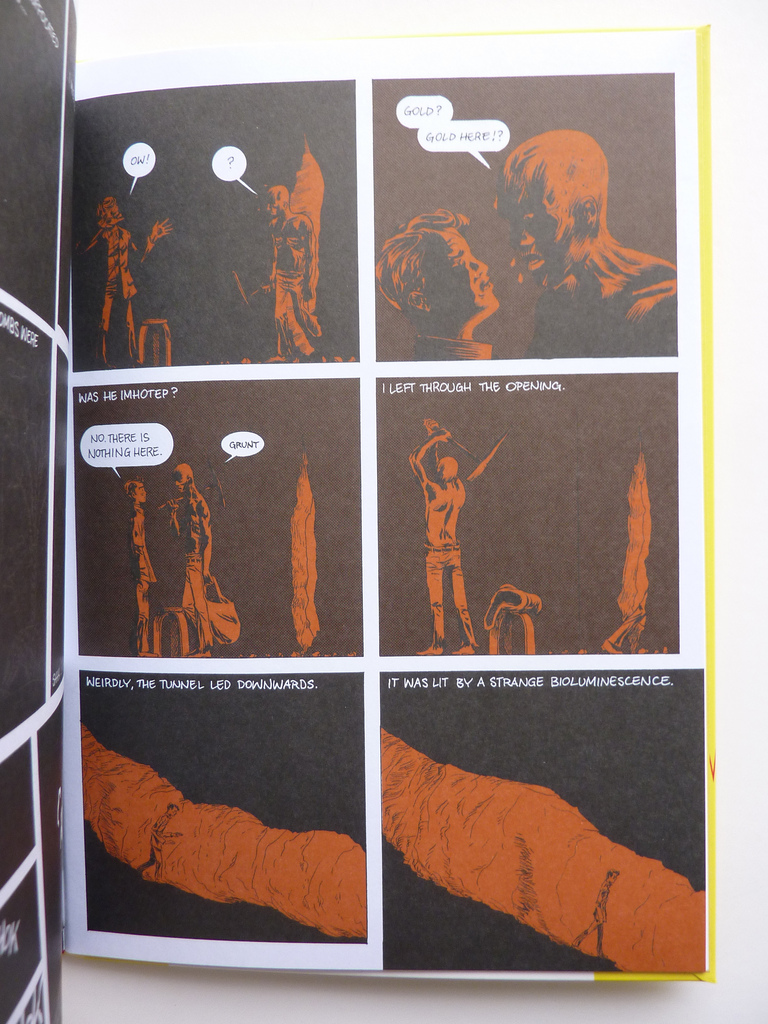
Tom Kaczynski's stories in the anthology Mome always felt like part of a larger cycle of stories. That's certainly borne out in his collection of stories from Mome and elsewhere, Beta Testing The Apocalypse (Fantagraphics). Kaczynski's stories combine elements of cultural & economic critique with the paranoia and rawness of a JG Ballard story. His stories address aspects of modern civilization and the ways in which they break down. These stories are collected with an unusual formal gimmick that grounds each story in terms of space (distance from Minneapolis) and time in the form of a graph. He also unites his stories by creating an index, which is interesting because of the way it documents how Kaczynski's themes and motifs tend to repeat themselves. For example, there are eleven sub-entries under "architecture", a hint at just how much the structures in which we live prove are crucial to Kaczynski's ideas. The same goes for "city", "civilization", "company", "corporation", and "genetics". He also indexes all of the sound effects he uses, which is interesting because they tend to be fairly invisible when reading a story and because they are raw sound, directly tied into experience. Each story uses a single color wash that highlights an aspect of the story; for example, in "The New", the dark orange represents the primal clay of the city of Uruk.

The first story,  "100,000 Miles" employs a sickly green background in its fantasy about the end of the world in the form of a worldwide traffic jam ending society as we know it. He takes that idea further in with "10,000 Years", about a man in therapy who becomes twisted by the idea of creating a utopia on Mars, a dream held as a reaction to extreme alienation. Alienation is a key point in the brilliant "976 Sq Feet", about a couple who are driven insane by a high-rise condo built in their neighborhood. (The line the man utters when he calls 911 for his now-insane girlfriend [babbling about "double paned windows"] is priceless: "Uh, I need an ambulance...or an architect.") Kaczynski implies that the construction was less built than conjured or summoned, as though it were some sort of hideous otherworldly intelligence brought in by the nameless, faceless forces of global capitalism.

"Phase Transition"  involves a man devolving into a sort of reptile-brain state as a way of throwing off the yoke of technology. Kaczynski implies here that primitivism is its own form of false utopia, as the man becomes a megalomaniac at the end. Kaczynski tops himself  with "Million Year Boom", about a brand expert who winds up working for a bizarre "green" company, trying to come up with a corporate logo as it prepares to go public. This is ,an insane stew of paranoia, devolution, corporate messiahs, and global capitalism fused with a tribal, scatological mindset. The final panel, where the protagonist's blood spewing across a door gives him the inspiration for the logo, is a stunning moment.  Kaczynski draws with a certain looseness in his line and modifying it either with simple color or effects like zip-a-tone. These strips are dark, unsettling and thought-provoking critiques layered with multiple meanings. Again and again, his stories are about what it means to be human and how easily we give up our humanity thanks to our relationship with technology and the spaces we inhabit.

Kaczynski really has his finger on the collective neuroses of the new millennium.  A recurring theme in this book is how Kaczynski taps into how various of our senses have been warped through modern living. In "Noise: A History", Kaczynski boils down the history of the world in terms of random events and how many decibels they measured out to, from the big bang to the falling of rustling leaves. He links past to present through the use of that measure of sound, providing an interesting shorthand for understanding the world in its greatest, worst and most indifferent moments. "Hotel Silencio" is about a man who creates a hotel that employs sound-baffling technology, creating a sensation that quickly abates after its inhabitants go crazy from the lack of sound. "100 Decibels" is about how the perception of sound can be quite subjective in its own way.

 "Cozy Apocalpyse" is one of the more directly comedic stories in this collection. Here, that titular doomsday event is not only mostly in the minds of the couple who have just bought a house in the suburbs, it serves almost as a kind of much-needed aphrodisiac for a couple growing bored with each other. When it proves to be a "localized phenomenon", there's an immediate urge to reproduce it.  "Music For Neanderthals" takes things into deeper satirical territory, as a musician and actor in an extreme method-acting project about neanderthals gets his nose broken intentionally by the purview of the lunatic director. That's a prelude to the actual cave built by the director, with the acoustics and sounds developed by the actor/musician resonating to the point where they took on their own kind of power. That said, the punchline of the story still grounds this entire primal experience in the venality of Hollywood. Finally, "The New" is in some respects a recapitulation of the entire book.The protagonist is an architect, brought in to build a new city for the original city, Uruk. The essence of this elegant, elliptical story is that modernity is a falsehood. Archeologically speaking, modernity comes and goes crashing down after catastrophes, with all of civilization built and greased by blood and powered by the compressed bones of the dead. It's a comparison that Kaczynski draws again and again in this book, that the line between civilization and savagery is an exceedingly thin one, and that humans are constantly being subjected to forces and pressures that could collapse civilization along with our sanity. Far from a screed, however, Kaczynski sees both the inevitability and the humor in this in strip after strip.