Philadelphia's Pat Aulisio has been steadily publishing his own work as well as the work of others for quite a while. The beautifully constructed cardboard box that houses the Yeah Dude Comics mini-sampler is quite the attention-getter for a variety of comics. Aulisio essentially constructed a portable mini-library for these comics.
Most of them are very short and raw. Going in order of the table of contents, Josh Bayer leads off with Hot Desert Fever. It's one of his riffs on Sylvester Stallone and Stan Lee, as he imagines Stallone desperately wanting to write comic books like Lee. The resulting Human Torch story is a classic Bayer parody: altered character design (the Torch wears a helmet and carries a gas can), scatological humor, and visceral violence. Bayer's ability to fully inhabit the minds of these hyper-masculine, ridiculous characters and somehow make them come alive on the page is one of his greatest talents. Even in a story as absurd as this one, where Stallone has a butler that he names as Jarvis or Alfred, depending on the panel, and where he grows a tiny version of himself as Rocky to give him advice and encouragement, Bayer's always working within an internal set of logical rules.
Ian Harker's Face Force is a parody of 90s era Image Comics, with Rob Liefeld in particular being a touchstone. Nothing much actually happens in this comic, which makes it a particularly apt satire. McDonald's National Cemetary (sic), by Michael Gerkovich, is a series of strange images and clip art surrounding the idea of McDonald's going back to ancient Egypt, and to imagine what one would find if a site was excavated. Some of them riff off McDonald's iconography, like a Hamburglar looking through a telescope or a pharaoh having Ronald McDonald makeup on. The actual images match the meaningless absurdity of the concept itself, and Gerkovich gleefully runs with it. Josh Burggraf's International Geographic cleverly takes the you-are-there anthropological premise of the source material it's parodying with similar shots of nature, candid shots of "native" life, and the rituals from an alien world that are as baffling to the reader here as indigenous societies are to western societies. Burggraf's skill as an illustrator sells the joke, which is short enough to not outstay its welcome.
Aulisio's Diabolik! is a parody of the Italian anti-hero, and he nails the way the narrative in the comic spells everything out. Getting pushed aside by his girlfriend Eva was also amusing in the way he puts everything in annoyingly modern speech patterns. The use of shadows and effects like zip-a-tone also made it reminiscent of its source material. Tara Booth's Daily Routine reminded me a lot of Jerry Smith's Rattletrap: extremely crudely-drawn comics, printed at tiny size, that hilariously and disgustingly address quotidian issues. Booth holds absolutely nothing back, like an early strip where she's over at a friends' place, falls asleep on her couch and accidentally urinates on it while asleep. When she wakes up, she leaves as fast as possible, as the caption "Run away from pee couch" indicated with a combination of shame and glee. Booth isn't afraid to get absurd or exaggerated, like in her strip where her face resembles two eggs and bacon, another where her dog licked her face off, and a truly disgusting entry where she gives birth to a "food baby". The cheery wave the food baby gives is what puts the strip over the top. There's an essential sweetness to these strips despite the frequently disgusting and scatological subject matter, and that sweetness ties in to her willingness to confront issues that normally are couched in terms of shame. She forgives herself and allows herself to be human, and that shines on every scrawled page.
Issue one of Box Brown's Softcore is something I have reviewed elsewhere, Skuds McKinley's Korgok is straight-up, visceral sword-and-sorcery. After an epic-establishing introduction, the actual comic is all highly-detailed violence. Keenan Marshall Keller's The Goiter #1 is another standout in this collection. Keller's work is not unlike Ben Marra's in that he uses hyperviolent and exaggerated situations for humorous intent, only that humor is bone-dry and at times indistinguishable from the actual genre comics and movies that he is paying homage to. In this case, Keller starts out doing a story about stoners and transforms it into a supernatural/horror story, as a young man who's working for an elderly woman hears a voice coming from the enormous tumor on her head. Keller leaves open the possibility that the young man is insane & hallucinating, which makes the scene where he "frees" the tumor by cutting it off, leaving her body spurting blood, all the more disturbing (and yet hilarious because of its ridiculous nature). Keller goes over the top in his figure work, deliberately overdrawing and cluttering up his page in an effort to keep the reader off-balance.
Finally, Erika Davidson's enigmatic Hadaka is a dreamy, surreal version of the Japanese festival where a minimal amount of clothing is worn. All the figures here are women, as they walk into rooms filled with or filled up by various women's erogenous zones. It's a brief mini whose mission seems to have been getting down those images on paper, of putting something that came from dream logic and fantasy and making it partially tangible. Thomas Toye's Entering A Room Full Of People is another visceral horror story, this time involving a frightening, serpentine home intruder who encounters a voracious plant that has killed the family living in the home. This almost entirely silent comic is typical of the works found in this box: rough, visceral, iconoclastic, visually distinctive, uncompromising and entertaining. The actual quality of each comic varies, as does its ability to sustain interest after a single read, but this was a great sample of a particular kind of comics aesthetic that a number of artists are currently pursuing.
Showing posts with label pat aulisio. Show all posts
Wednesday, November 30, 2016
Friday, July 1, 2016
Catching Up With Hic & Hoc: Tsurumi, Aulisio, Kelley
Hic & Hoc's publication rate has slowed down a bit in the past year or so, but Matt Moses still releases all sorts of interesting comics. Let's take a look at recent work.
Why Would You Do That?, by Andrea Tsurumi. Somewhere between Lisa Hanawalt and Kate Beaton lies the content of this book, though this book is most interesting when Tsurumi focuses on a particular obsession and just runs with it. Early features about how to go to one's local pool and the secret greatness of poodles, feel labored over, pounding an underwritten joke into the ground in the hopes that repetition would make it funny. It's only when Tsurumi abandons more conventional humor and decides to get really word that the book starts to take off. Take "Yup/Nope", for example. It's a hilarious and bizarre satire on the arbitrary nature of sports fandom, or really any kind of competitive activity that creates opposing camps by its very nature. The eccentric and monstrous figures combined with crass consumption and the ways in which fans fostered self-esteem by way of identifying with a group made this story funny, strange and pointed.
A gag where the food photographer for a newspaper is forced to take over as primary news photographer sees Tsurumi at her best, as every single story somehow manages to focus on any food-related images that are nearby. There's a fine line between beating a gag to death and escalating humor through repetition, and Tsurumi here tops herself in image after image. Speaking of food, "Cake Vs Pie" combines the antagonism of "Yup/Nope" with a certain kind of wartime photojournalism, creating visceral and even hilariously disturbing images of various dessert items doing horribly violent things to each other. The scene where a medical surgeon pours out a surgical pan filled with pie fillings is somehow simultaneously heart-breaking and hilarious, due in no small part to Tsurumi's considerable drafting skill. The book gets even better as Tsurumi quotes and illustrates the astoundingly cruel 19th century children's book The Peep Of Day, which reads sort of like a Jack Chick tract, only even meaner. The last big story in the book is the epic "HMTown", which is about growing up as part of a tourist trap town that prides itself on being haunted. It's a funny and sweet meditation on the ways in which the town's "ghosts" provided a memorable upbringing and gave the protagonist a sense of connection that she deeply felt despite her urgent desire to leave as a recent graduate. It was interesting to see Tsurumi pair her wacky imagery and conceptual gags with a more emotional, quiet and thoughtful premise. One gets the sense reading this book that Tsurumi is just getting warmed up as a humorist and storyteller, because it's obvious that she has the chops, delightfully skewed perspective, keen observational eye and clear ambition to continue to evolve as a humorist and storyteller.
Fedor, by Patt Kelley. This is a bit of historical fiction about Fedor Jeftichew, aka Jojo the Dog Faced Boy, who was one of the world's most famous and wealthy circus freaks. In sepia tones that ground the story in the late 19th and early 20th centuries and character design similar to that of Jay Howell (most famous for the character design of Bob's Burgers), Kelley spins a lovely and heartbreaking romance about Fedor and Helena, whom he met when he was a young man in the circus. The daughter of the bearded lady and the scaly man, she immediately fell for the young man who had a condition that caused him to be entirely covered in thick hair. What's clever about this comic is the way that Kelley jumps back and forth in time to create mystery, tension and slowly unravel a long-simmering conflict. Kelley introduces the couple in 1904 as simply a man and a woman meeting up again after a long time; it takes a few pages before it's obvious that the young man is a "Jojo" who had shaved his face. We then go back twenty years to when they met, in a fascinating section that establishes Fedor as a star, a sensitive young man, and a potential target for belligerent townies. It establishes Helena as a young woman with a strong sense of self but an indeterminate sense of purpose who is fiercely protective of those she loves. From there, we continue to flip back and forth in time as we see them splitting apart and meeting up again over the years, with neither willing to do what it took to really be together. Kelley perceptively guts romance without realism or true commitment, as Helena at one point takes him to task for loving the idea of her and not the actual person, and for caring more about his Jojo persona than her. The lengths that Fedor goes to in the end to prove his devotion provide an excellent final twist that takes advantage of real life events and reimagines them. Kelley backs up his time-jumping with panel design that seems to intentionally avoid any kind of consistent grid pattern, which keeps the reader off-balance while whipping them through memory after memory at a dizzying pace. There's a sweetness to the proceedings that takes it for granted that the couple saw past their obvious physical extremes and instead focuses on the ways in which their bodies were exploited for pay and how this kept them apart for so long. Fedor is about learning to be real and understanding & acknowledging the factors that keep people apart.
Infinite Bowman and Xeno Kaiju, by Pat Aulisio. Aulisio uses a variation of the Brian Chippendale/Mat Brinkman style in depicting monsters investigating an environment, often with a layer of deliberately crude humor thrown on top. He also looks to work big, with as many splash pages as possible so he's able to cram as much detail as possible into his page. Xeno Kaiju was published as an oversized, 12 x 17 broadsheet to maximize the impact of his images. The title roughly translates to "alien giant monster", with kaiju being a type of film genre originating in Japan where a monster would attack humanity. Obviously, Godzilla is the most familiar example, and it's no accident that the monster in this story resembles the fire-breathing, giant lizard. The key to reading Aulisio's comics is that for all their scribbly clutter and lack of flow, the artist only has one or two images on each page that the reader needs to focus on. The rest is all noise or decoration, which one can study or ignore, because they have little importance to the overall story. On each of the pages here, the only thing the reader needs to pay attention to is the monster's egg that crashes to earth (seeded by an alien spacecraft) and its eventual transformation into a monster that starts destroying everything around it. The day is saved by a supertank that obliterates it, but in an EC-style twist ending, the final image is that of the alien craft launching six more monster eggs. The big format was essential in getting across the massive scale of the creature and its destruction, as well as enjoying the visceral pleasures that monster movies and comics bring.
Infinite Bowman has Aulisio writing about the further adventures of 2001: A Space Odyssey's Dave Bowman, the astronaut who survived the murderous HAL-9000 computer and was taken by a mysterious monolith and rapidly evolved. In the original story, Bowman becomes a godlike Starchild. Aulisio imagines something quite different, as Bowman is sent to another dimension, meets up with Kirby-like space gods who help him conquer his new world, goes to the earth of the future and winds up in hell, where he stirs up a rebellion. In essence, every panel in the book is designed in the same way that Xeno Kaiju is: despite there being a lot of visual "noise", the reader is always pointed to a single, defining image or pair of images. Aulisio fuses a hyper-violent, relentlessly weird set of images with what is basically dick joke humor. It's the essence of the book's humor: the supposedly advanced space gods seem to have no agenda other than conquest and destruction, and their chosen one is a boorish brute who is making his campaign as their avatar into his personal mission of revenge against anyone or anything that ever slighted him. Aulisio's visual approach changes slightly as the book proceeds, leaning away from the ultra-cluttered look and instead started to strip away scenes to their essentials. Aulisio's aesthetic can be wearying after a while, but he changes things up just enough to make this a consistently amusing read.
Labels:
andrea tsurumi,
matt moses,
pat aulisio,
patt kelley
Wednesday, February 20, 2013
Checking In WIth Hic & Hoc
Let's check in with some of the recent comics published by interesting new micropublisher Hic & Hoc.
Demontears, by Bernie McGovern. The title is a play on another way of representing "DTs", or "delirium tremens", a severe form of alcohol withdrawal. The comic follows the struggles of the artist with alcohol and how to overcome its debilitating effect not only on his life, but on his imagination as a creative person. When he starts getting the shakes and finds himself drinking again, the specter of alcohol is literally a shadow that forcibly pushes his skull into walls and pushes him into blackout states. In those states, McGovern is reduced to being a brain attached to a spinal cord, floating through a devastated environment. As the story proceeds, he understands that this wasteland is what's happened to his imagination and ideas as alcohol wreaked havoc on him, and the rest of the book is an extended metaphor about recovery. It's beautiful, strange and more than a little harrowing, yet has moments of whimsy and humor, especially at the end, which ends with a crude but appropriately funny joke. McGovern's thin and even fragile line is perfect for evoking his sad world of imagination, populated with all sorts of funny-looking and slightly terrifying characters. Despite the darkness of the material, there's an almost visceral joy of drawing that pops off these pages, which is fitting for someone whose very control over his hands was weakened when the DTs came on. Simply being able to get back the sheer pleasure of having total control of making marks on paper is evident on every page of the book. The visceral quality of the imaginative sections of the book are able to get across the desperation of addiction in a more poetic and powerful manner than a naturalistic approach would have been able to, and that's what makes this comic so effective.
Jammers, by Lizz Hickey. Some comics appear to have flowed effortlessly from the pen or pencil of their creator. In the case of Hickey's bizarre, frequently hilarious and sometimes distressing comics, it seems more like her images escaped from her pen, taking refuge on the page. There's actually a genuinely frightening streak of violence and danger to be found amongst the many absurd and downright stupid images and situations portrayed in this comic. The Australian frog with a knife (Tim-Tam), the "very dumb girl" Carol and her obsession with love and the other strange characters go through adventures that remind me a bit of the sort of out-there comics one might have seen in the 80s; there's hints of early, weirder Chester Brown in here along with a general NuWave sensibility. Portions of the comic are deliberately drawn to resemble children's art, a conceit that ties it into its overall sense of being outsider art. That said, one can see the mind behind the weirdness exorcising the darker parts of its id in a very direct and deliberate manner. It's as though Hickey is working out all of her worst impulses as well as the things she hates most about herself on the page.
Looking Out, by Philippa Rice. I was happy to hear that Hic & Hoc Publisher Matt Moses was publishing a comic by Rice, who's one of the exciting young talents on the British comics scene (she's a frequent contributor to Solipsistic Pop). This comic is a mix of simple figures and cluttered backgrounds about a future world where technology is complicated but doesn't always serve to make life better, especially when it breaks down. Indeed, in the same way that texting and social media serve in some ways to isolate people, this future world reduces people to tiny units in their little living pods. It's a failure of technology that pushes two people who happen to live in the same building together in that familiar and slightly clumsy & awkward way, where both parties are clearly interested but neither is exactly sure to what extent. When the main character reveals why she's alone much of the time to her potential suitor, it comes from an angle that's convoluted and science-fiction, yet also speaks of the way that obsession can drive us. The clutter and chaos of this world helps thin the more twee aspects of this romance story (both in terms of the cute figures and the situation), giving the emotions expressed a surprising amount of weight and even a sense of bittersweet delight.
Why Is My Easy Life So Hard?, by Dina Kelberman. I blurbed the back cover of this book, so allow me to share that quote: "Dina Kelberman's comics are all about contradictions, as she tries to balance living in her own head with that desperate, nagging need to interact with others. With her minimalist line, her avoidance of conventional narrative, her counter-intuitive use of color and her focus on the decorative aspects of lettering, Kelberman cuts a unique figure in comics as a guileless provocateur as well as a humorist with surprisingly traditionalist roots." This comic really focuses in on and ruthlessly excoriates her own narcissism that borders on solipsism as her little, hair potato-shaped stand-in theatrically ignores a crying friend ("I mean, is this really all you're bringing to the table."), tries to atone by hanging out with her boyfriend (a sort of smudgy cat), and finally mocks herself by introducing TV as a cure-all for every one of her relationships. It's a funny, weird and at times powerful visual experience, thanks to that bizarre color sense of hers.
Bowman: Earthbound, by Pat Aulisio. Aulisio seems to be trying to serialize the further adventures of 2001: A Space Odyssey's Dave Bowman with as many different micropublishers as possible. The central shtick of the series is that it's as balls-out crazy and profane as the Stanley Kubrick film is austere and cold. Indeed, this comic has more in common with the kinetic craziness of Jack Kirby's 2001 adaptation than the film, other than the use of the Bowman character. Aulisio also packs his pages with crazy amounts of eye-melting detail, drawing in scads of wavy lines and debris that leave the reader off-balance when simply looking at the page. There are times when this technique goes a bit off the rails and makes it difficult to parse his pages, but he usually finds a way to rein things in a bit and return to a more conventionally solid kind of storytelling. This chapter of the Bowman saga finds him getting bored with being an all-powerful space warrior on a planet with creatures that fear and obey his every whim, until the enigmatic Monolith returns. Bowman steps through the Monolith and winds up in a Road Warrior-type earth in the far future, which suits him just fine.I don't know how tightly plotted Aulisio has made the story so far or if he's improvising it along the way, but he makes just enough nods to the original source material to keep things coherent before he runs off on some crazy, visceral and frequently nastily funny tangent.
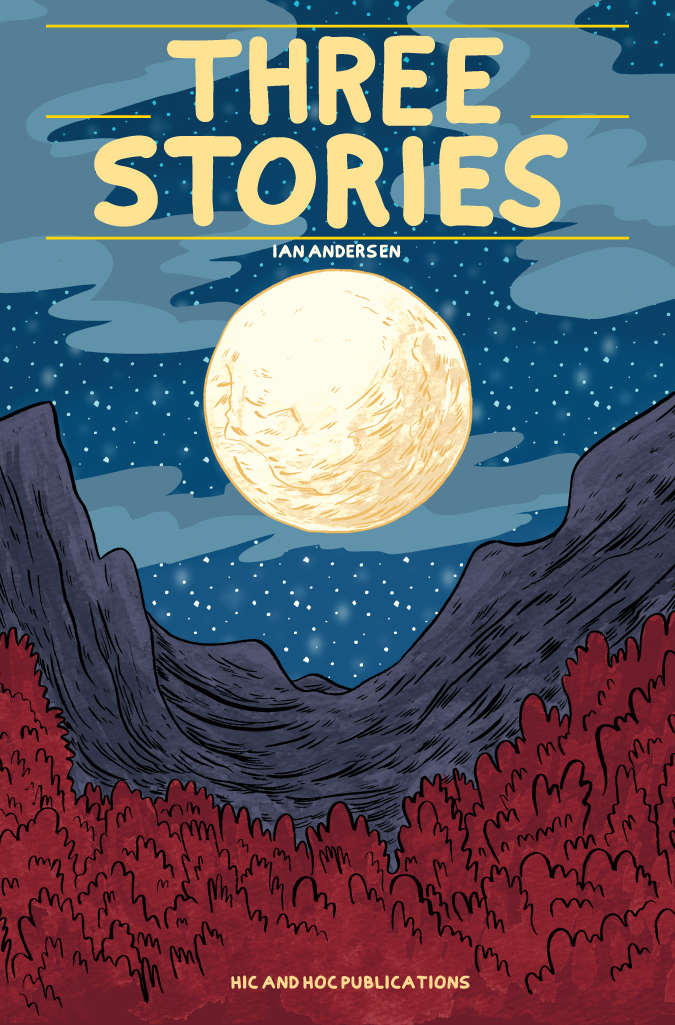
Three Stories, by Ian Andersen. Each of the titular three stories is stripped down and simply told. The first story, "Pack Rat", is a sort of visual exercise as a blank-faced character first finds a face on the ground (two dot eyes and a line for a mouth), and then proceeds to acquire more and more material goods as he walks along, until he collapses under the weight of his possessions and loses everything--including his identity. I't unclear just how much meaning Andersen is choosing to inject into this story beyond the neat visual trick of a simple character adding more and more detail and weight, until it's all gone. The second story, "Pear", concerns what seems to be the gentle eating adventures of a river turtle. He tries to dodge a loud animal that winds up eating his food, until he devises a method to get rid of it--once and for all. Andersen likes to inject a bit of cruelty into his stories at their conclusions, and the turtle's eventual "reward" for his actions is an effective surprise. In the last story, "Howl Hole", a couple of forest tree creatures follow a howling wolf to his hole, making fun of him when they can't understand him. The reveal here is a creature suffering heartbreak, with a lack of understanding denying any possible empathy. This is a comic with modest ambitions and an understated visual approach; it's quite different from the crazier, flashier and less conventional material that Moses usually publishes. That said, there's a surprising amount of emotional depth to this comic that belies its otherwise mundane trappings.
Demontears, by Bernie McGovern. The title is a play on another way of representing "DTs", or "delirium tremens", a severe form of alcohol withdrawal. The comic follows the struggles of the artist with alcohol and how to overcome its debilitating effect not only on his life, but on his imagination as a creative person. When he starts getting the shakes and finds himself drinking again, the specter of alcohol is literally a shadow that forcibly pushes his skull into walls and pushes him into blackout states. In those states, McGovern is reduced to being a brain attached to a spinal cord, floating through a devastated environment. As the story proceeds, he understands that this wasteland is what's happened to his imagination and ideas as alcohol wreaked havoc on him, and the rest of the book is an extended metaphor about recovery. It's beautiful, strange and more than a little harrowing, yet has moments of whimsy and humor, especially at the end, which ends with a crude but appropriately funny joke. McGovern's thin and even fragile line is perfect for evoking his sad world of imagination, populated with all sorts of funny-looking and slightly terrifying characters. Despite the darkness of the material, there's an almost visceral joy of drawing that pops off these pages, which is fitting for someone whose very control over his hands was weakened when the DTs came on. Simply being able to get back the sheer pleasure of having total control of making marks on paper is evident on every page of the book. The visceral quality of the imaginative sections of the book are able to get across the desperation of addiction in a more poetic and powerful manner than a naturalistic approach would have been able to, and that's what makes this comic so effective.
Jammers, by Lizz Hickey. Some comics appear to have flowed effortlessly from the pen or pencil of their creator. In the case of Hickey's bizarre, frequently hilarious and sometimes distressing comics, it seems more like her images escaped from her pen, taking refuge on the page. There's actually a genuinely frightening streak of violence and danger to be found amongst the many absurd and downright stupid images and situations portrayed in this comic. The Australian frog with a knife (Tim-Tam), the "very dumb girl" Carol and her obsession with love and the other strange characters go through adventures that remind me a bit of the sort of out-there comics one might have seen in the 80s; there's hints of early, weirder Chester Brown in here along with a general NuWave sensibility. Portions of the comic are deliberately drawn to resemble children's art, a conceit that ties it into its overall sense of being outsider art. That said, one can see the mind behind the weirdness exorcising the darker parts of its id in a very direct and deliberate manner. It's as though Hickey is working out all of her worst impulses as well as the things she hates most about herself on the page.
Looking Out, by Philippa Rice. I was happy to hear that Hic & Hoc Publisher Matt Moses was publishing a comic by Rice, who's one of the exciting young talents on the British comics scene (she's a frequent contributor to Solipsistic Pop). This comic is a mix of simple figures and cluttered backgrounds about a future world where technology is complicated but doesn't always serve to make life better, especially when it breaks down. Indeed, in the same way that texting and social media serve in some ways to isolate people, this future world reduces people to tiny units in their little living pods. It's a failure of technology that pushes two people who happen to live in the same building together in that familiar and slightly clumsy & awkward way, where both parties are clearly interested but neither is exactly sure to what extent. When the main character reveals why she's alone much of the time to her potential suitor, it comes from an angle that's convoluted and science-fiction, yet also speaks of the way that obsession can drive us. The clutter and chaos of this world helps thin the more twee aspects of this romance story (both in terms of the cute figures and the situation), giving the emotions expressed a surprising amount of weight and even a sense of bittersweet delight.
Why Is My Easy Life So Hard?, by Dina Kelberman. I blurbed the back cover of this book, so allow me to share that quote: "Dina Kelberman's comics are all about contradictions, as she tries to balance living in her own head with that desperate, nagging need to interact with others. With her minimalist line, her avoidance of conventional narrative, her counter-intuitive use of color and her focus on the decorative aspects of lettering, Kelberman cuts a unique figure in comics as a guileless provocateur as well as a humorist with surprisingly traditionalist roots." This comic really focuses in on and ruthlessly excoriates her own narcissism that borders on solipsism as her little, hair potato-shaped stand-in theatrically ignores a crying friend ("I mean, is this really all you're bringing to the table."), tries to atone by hanging out with her boyfriend (a sort of smudgy cat), and finally mocks herself by introducing TV as a cure-all for every one of her relationships. It's a funny, weird and at times powerful visual experience, thanks to that bizarre color sense of hers.
Bowman: Earthbound, by Pat Aulisio. Aulisio seems to be trying to serialize the further adventures of 2001: A Space Odyssey's Dave Bowman with as many different micropublishers as possible. The central shtick of the series is that it's as balls-out crazy and profane as the Stanley Kubrick film is austere and cold. Indeed, this comic has more in common with the kinetic craziness of Jack Kirby's 2001 adaptation than the film, other than the use of the Bowman character. Aulisio also packs his pages with crazy amounts of eye-melting detail, drawing in scads of wavy lines and debris that leave the reader off-balance when simply looking at the page. There are times when this technique goes a bit off the rails and makes it difficult to parse his pages, but he usually finds a way to rein things in a bit and return to a more conventionally solid kind of storytelling. This chapter of the Bowman saga finds him getting bored with being an all-powerful space warrior on a planet with creatures that fear and obey his every whim, until the enigmatic Monolith returns. Bowman steps through the Monolith and winds up in a Road Warrior-type earth in the far future, which suits him just fine.I don't know how tightly plotted Aulisio has made the story so far or if he's improvising it along the way, but he makes just enough nods to the original source material to keep things coherent before he runs off on some crazy, visceral and frequently nastily funny tangent.
Three Stories, by Ian Andersen. Each of the titular three stories is stripped down and simply told. The first story, "Pack Rat", is a sort of visual exercise as a blank-faced character first finds a face on the ground (two dot eyes and a line for a mouth), and then proceeds to acquire more and more material goods as he walks along, until he collapses under the weight of his possessions and loses everything--including his identity. I't unclear just how much meaning Andersen is choosing to inject into this story beyond the neat visual trick of a simple character adding more and more detail and weight, until it's all gone. The second story, "Pear", concerns what seems to be the gentle eating adventures of a river turtle. He tries to dodge a loud animal that winds up eating his food, until he devises a method to get rid of it--once and for all. Andersen likes to inject a bit of cruelty into his stories at their conclusions, and the turtle's eventual "reward" for his actions is an effective surprise. In the last story, "Howl Hole", a couple of forest tree creatures follow a howling wolf to his hole, making fun of him when they can't understand him. The reveal here is a creature suffering heartbreak, with a lack of understanding denying any possible empathy. This is a comic with modest ambitions and an understated visual approach; it's quite different from the crazier, flashier and less conventional material that Moses usually publishes. That said, there's a surprising amount of emotional depth to this comic that belies its otherwise mundane trappings.
Subscribe to:
Posts (Atom)