Showing posts with label bernie mcgovern. Show all posts
Friday, May 24, 2013
Personal Comics: Foss, Shapiro, McGovern
Haiku Revue and Empty Bed, by Rachel Foss. Foss was due to enroll at the Center for Cartoon Studies, but various circumstances never allowed that to happen. She still lived in White River Junction for a year and clearly spent her time wisely, because both of these comics are fine early efforts for a young cartoonist. Haiku Revue is a sort of combination of journal comic and formal experiment, as Foss writes an autobiographical haiku on every page to go with her comic. On each page, Foss deliberately tries to change something about its composition or form: changing up panel sequencing, using greyscaling, using different drawing styles, using silent panels, writing pages without her on them, etc. There's a wonderful frankness and openness about the sort of things that Foss shares; these comics are about taking a risk and learning to cope with loneliness and distance, but there's also a carnal component to them that's presented in a forthright but unsensational manner. Foss's draftsmanship also goes from shaky to confident over the course of that year as she quickly learned to play to her strengths as much as possible while developing her own style.
That certainly plays out in her most recent comic, Empty Bed. In its earliest pages, one can see how much more adept she is at things like cross-hatching and effective page design. However, the real draw is the way she draws faces and depicts body language. Using a simple but distinct line that makes the most out of the negative space around it (especially in the way she spots blacks to make her characters stand out), Foss generates an understated narrative about a lonely woman separated from someone who may be a former lover in a new place. An act of simple good will she performs early in the story winds up having enormously positive benefits (in every sense of the word) later on, as she actively fights against that sense of isolation that surrounds her. Foss still has work to do in terms of perfecting the way she draws characters other than her own stand-in as well as maintaining that polish for the duration of a story, but this is another honest, affecting and well-told story by a young cartoonist who seems eager to rapidly improve. The fact that she's able to get across so much emotion with a minimum of narrative excess points to a bright future, especially because she's adept at writing stories that are at once deeply personal but immediately recognizable.
Crushable: John Doe and 3 Comics, by Janice Shapiro. These are more amusing and self-deprecating autobio comics by Shapiro. Crushable: John Doe is novel because she actually knew the musician and actor at the very start of his career, when they were still working in a bookstore together. This one's especially funny because it takes us into her young adult life and into the present. Her tales of the viciousness of film school were hilarious, especially in the way everyone would react like vipers when someone achieved a measure of success. What I like best about this comic is the way it presents this sort of unrequited attraction as something that dominated her perceptions of him until they were able to find some common ground years later when they were both parents, living on the same block. This story is all about having huge dreams as a creative person, finding oneself falling completely short of achieving them and learning how to move on from this failure and create different kinds of meaning in one's life. Her arc of working as a screenwriter or director paralleled her feelings toward seeing Doe: being around a walking dream, never to be fulfilled, and eventually coming to terms with this.
3 Comics is much more light-hearted, as she explores her relationship with the film Red River, the weather and her fantasy of being on the game show Jeopardy!. There's a subtext of being uncomfortable with aging and doubting one's taste and beliefs as a younger person, a sense of wanting to reevaluate everything. The story also speaks to her wonderful expressiveness as a cartoonist even with a crude line; like her most direct influence, Lynda Barry, Shapiro has a lot of control over how a reader will experience her story through things like lettering and the body language of her characters. Brrrrrr! documents her life-long fear of cold weather, pinned mostly on worrying about being pinned to a single location and being forced to go out with her dog in the snow and ice. The sensation of being a prisoner to elements beyond one's control tie back into that fear of aging. The Jeopardy story is pure wish fulfillment, as Shapiro gets categories like "The Life and Times of Iggy Pop" and steamrolls her competitors.
Demongunz and Demondust #12-17, by Bernie McGovern. This is both prequel and sequel to McGovern's recovery comic DemonTears, which I thought was a generally bold and interesting take on the subject, especially because of McGovern's willingness to employ magical realism. These books are unusual in that they are journals of recovery, both in terms of the physical and psychological toll that addiction takes but also in terms of the artist recovering his creative spark. Indeed, the series involves from DemonGun to DemonDust as his alcoholism starts to become a more distant event in his past and the more violent and direct metaphor of a soul-splicing gun is no longer needed.This is still very much a journal, as McGovern is writing to a small but specific audience regarding news of the creative aspects of his life while slowly revealing aspects of his post-recovery self. The initial images are quite jarring, especially if one hasn't read DemonTears. McGovern fancies himself as literally growing another version of himself, from the brain and spinal cord up to an entire other body by the end of the first ten issues. What is obvious is that his practicing zen meditation has an enormously positive and centering effect, even in the face of tragedy like his grandmother dying and other of life's travails. The difference is that he has a different focus and different ways to cope with pain and sadness. By the very end of the collection, McGovern and his brain avatar are auditioning new characters to play with as stand-ins.
The individual minis (#12-17) are much more lighthearted and playful than the preceding stories, as each issue features one or more of the new avatars exploring new ideas. Some of the stories are philosophical gags (like the moon crushing a recalcitrant tortoise), some are breezy (like an elf and pumpkin-headed character cracking jokes and getting pumpkins to decorate), while others reflect McGovern's fears as a creator (a light-bulb headed character who is quite a potent metaphor), a character who doesn't quite work as a mouthpiece, the Karate Kid as an avatar of spring and renewal and the pumpkin-headed character (Bram Bones) on vacation. The sense I get reading these comics is that even when McGovern is covering a heavy topic, nothing he's going through is as bad as being an alcoholic and then going through withdrawal and rehab. It almost feels like his comics offer him a little release for his darker feelings while in real life he knows he has to stay upbeat, which is reflected in his statement at the end of each issue. This series also gives him the opportunity to goof around and experiment with his art and characters. With no particular plot or direction, McGovern allows his characters to play around on the page in a spontaneous manner while trying new tricks, such as his tribute to Moebius. The result is a rare tour through an artist's mental playground as he tries to find out what works and what doesn't (sometimes stopping a story right in the middle when it's going nowhere) while trying to apply the same lessons to his own life. It's all a bit ratty and unsteady at times, but this is the mark of an artist unafraid to express as much as he can as often as he can, knowing he almost lost that ability for good.
Wednesday, February 20, 2013
Checking In WIth Hic & Hoc
Let's check in with some of the recent comics published by interesting new micropublisher Hic & Hoc.
Demontears, by Bernie McGovern. The title is a play on another way of representing "DTs", or "delirium tremens", a severe form of alcohol withdrawal. The comic follows the struggles of the artist with alcohol and how to overcome its debilitating effect not only on his life, but on his imagination as a creative person. When he starts getting the shakes and finds himself drinking again, the specter of alcohol is literally a shadow that forcibly pushes his skull into walls and pushes him into blackout states. In those states, McGovern is reduced to being a brain attached to a spinal cord, floating through a devastated environment. As the story proceeds, he understands that this wasteland is what's happened to his imagination and ideas as alcohol wreaked havoc on him, and the rest of the book is an extended metaphor about recovery. It's beautiful, strange and more than a little harrowing, yet has moments of whimsy and humor, especially at the end, which ends with a crude but appropriately funny joke. McGovern's thin and even fragile line is perfect for evoking his sad world of imagination, populated with all sorts of funny-looking and slightly terrifying characters. Despite the darkness of the material, there's an almost visceral joy of drawing that pops off these pages, which is fitting for someone whose very control over his hands was weakened when the DTs came on. Simply being able to get back the sheer pleasure of having total control of making marks on paper is evident on every page of the book. The visceral quality of the imaginative sections of the book are able to get across the desperation of addiction in a more poetic and powerful manner than a naturalistic approach would have been able to, and that's what makes this comic so effective.
Jammers, by Lizz Hickey. Some comics appear to have flowed effortlessly from the pen or pencil of their creator. In the case of Hickey's bizarre, frequently hilarious and sometimes distressing comics, it seems more like her images escaped from her pen, taking refuge on the page. There's actually a genuinely frightening streak of violence and danger to be found amongst the many absurd and downright stupid images and situations portrayed in this comic. The Australian frog with a knife (Tim-Tam), the "very dumb girl" Carol and her obsession with love and the other strange characters go through adventures that remind me a bit of the sort of out-there comics one might have seen in the 80s; there's hints of early, weirder Chester Brown in here along with a general NuWave sensibility. Portions of the comic are deliberately drawn to resemble children's art, a conceit that ties it into its overall sense of being outsider art. That said, one can see the mind behind the weirdness exorcising the darker parts of its id in a very direct and deliberate manner. It's as though Hickey is working out all of her worst impulses as well as the things she hates most about herself on the page.
Looking Out, by Philippa Rice. I was happy to hear that Hic & Hoc Publisher Matt Moses was publishing a comic by Rice, who's one of the exciting young talents on the British comics scene (she's a frequent contributor to Solipsistic Pop). This comic is a mix of simple figures and cluttered backgrounds about a future world where technology is complicated but doesn't always serve to make life better, especially when it breaks down. Indeed, in the same way that texting and social media serve in some ways to isolate people, this future world reduces people to tiny units in their little living pods. It's a failure of technology that pushes two people who happen to live in the same building together in that familiar and slightly clumsy & awkward way, where both parties are clearly interested but neither is exactly sure to what extent. When the main character reveals why she's alone much of the time to her potential suitor, it comes from an angle that's convoluted and science-fiction, yet also speaks of the way that obsession can drive us. The clutter and chaos of this world helps thin the more twee aspects of this romance story (both in terms of the cute figures and the situation), giving the emotions expressed a surprising amount of weight and even a sense of bittersweet delight.
Why Is My Easy Life So Hard?, by Dina Kelberman. I blurbed the back cover of this book, so allow me to share that quote: "Dina Kelberman's comics are all about contradictions, as she tries to balance living in her own head with that desperate, nagging need to interact with others. With her minimalist line, her avoidance of conventional narrative, her counter-intuitive use of color and her focus on the decorative aspects of lettering, Kelberman cuts a unique figure in comics as a guileless provocateur as well as a humorist with surprisingly traditionalist roots." This comic really focuses in on and ruthlessly excoriates her own narcissism that borders on solipsism as her little, hair potato-shaped stand-in theatrically ignores a crying friend ("I mean, is this really all you're bringing to the table."), tries to atone by hanging out with her boyfriend (a sort of smudgy cat), and finally mocks herself by introducing TV as a cure-all for every one of her relationships. It's a funny, weird and at times powerful visual experience, thanks to that bizarre color sense of hers.
Bowman: Earthbound, by Pat Aulisio. Aulisio seems to be trying to serialize the further adventures of 2001: A Space Odyssey's Dave Bowman with as many different micropublishers as possible. The central shtick of the series is that it's as balls-out crazy and profane as the Stanley Kubrick film is austere and cold. Indeed, this comic has more in common with the kinetic craziness of Jack Kirby's 2001 adaptation than the film, other than the use of the Bowman character. Aulisio also packs his pages with crazy amounts of eye-melting detail, drawing in scads of wavy lines and debris that leave the reader off-balance when simply looking at the page. There are times when this technique goes a bit off the rails and makes it difficult to parse his pages, but he usually finds a way to rein things in a bit and return to a more conventionally solid kind of storytelling. This chapter of the Bowman saga finds him getting bored with being an all-powerful space warrior on a planet with creatures that fear and obey his every whim, until the enigmatic Monolith returns. Bowman steps through the Monolith and winds up in a Road Warrior-type earth in the far future, which suits him just fine.I don't know how tightly plotted Aulisio has made the story so far or if he's improvising it along the way, but he makes just enough nods to the original source material to keep things coherent before he runs off on some crazy, visceral and frequently nastily funny tangent.
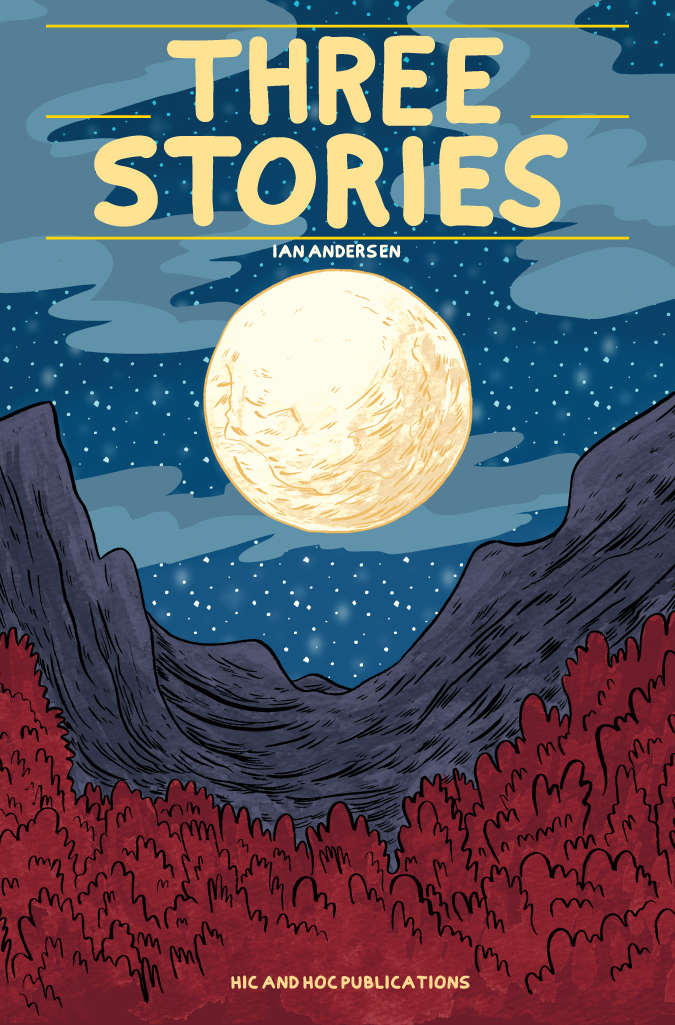
Three Stories, by Ian Andersen. Each of the titular three stories is stripped down and simply told. The first story, "Pack Rat", is a sort of visual exercise as a blank-faced character first finds a face on the ground (two dot eyes and a line for a mouth), and then proceeds to acquire more and more material goods as he walks along, until he collapses under the weight of his possessions and loses everything--including his identity. I't unclear just how much meaning Andersen is choosing to inject into this story beyond the neat visual trick of a simple character adding more and more detail and weight, until it's all gone. The second story, "Pear", concerns what seems to be the gentle eating adventures of a river turtle. He tries to dodge a loud animal that winds up eating his food, until he devises a method to get rid of it--once and for all. Andersen likes to inject a bit of cruelty into his stories at their conclusions, and the turtle's eventual "reward" for his actions is an effective surprise. In the last story, "Howl Hole", a couple of forest tree creatures follow a howling wolf to his hole, making fun of him when they can't understand him. The reveal here is a creature suffering heartbreak, with a lack of understanding denying any possible empathy. This is a comic with modest ambitions and an understated visual approach; it's quite different from the crazier, flashier and less conventional material that Moses usually publishes. That said, there's a surprising amount of emotional depth to this comic that belies its otherwise mundane trappings.
Demontears, by Bernie McGovern. The title is a play on another way of representing "DTs", or "delirium tremens", a severe form of alcohol withdrawal. The comic follows the struggles of the artist with alcohol and how to overcome its debilitating effect not only on his life, but on his imagination as a creative person. When he starts getting the shakes and finds himself drinking again, the specter of alcohol is literally a shadow that forcibly pushes his skull into walls and pushes him into blackout states. In those states, McGovern is reduced to being a brain attached to a spinal cord, floating through a devastated environment. As the story proceeds, he understands that this wasteland is what's happened to his imagination and ideas as alcohol wreaked havoc on him, and the rest of the book is an extended metaphor about recovery. It's beautiful, strange and more than a little harrowing, yet has moments of whimsy and humor, especially at the end, which ends with a crude but appropriately funny joke. McGovern's thin and even fragile line is perfect for evoking his sad world of imagination, populated with all sorts of funny-looking and slightly terrifying characters. Despite the darkness of the material, there's an almost visceral joy of drawing that pops off these pages, which is fitting for someone whose very control over his hands was weakened when the DTs came on. Simply being able to get back the sheer pleasure of having total control of making marks on paper is evident on every page of the book. The visceral quality of the imaginative sections of the book are able to get across the desperation of addiction in a more poetic and powerful manner than a naturalistic approach would have been able to, and that's what makes this comic so effective.
Jammers, by Lizz Hickey. Some comics appear to have flowed effortlessly from the pen or pencil of their creator. In the case of Hickey's bizarre, frequently hilarious and sometimes distressing comics, it seems more like her images escaped from her pen, taking refuge on the page. There's actually a genuinely frightening streak of violence and danger to be found amongst the many absurd and downright stupid images and situations portrayed in this comic. The Australian frog with a knife (Tim-Tam), the "very dumb girl" Carol and her obsession with love and the other strange characters go through adventures that remind me a bit of the sort of out-there comics one might have seen in the 80s; there's hints of early, weirder Chester Brown in here along with a general NuWave sensibility. Portions of the comic are deliberately drawn to resemble children's art, a conceit that ties it into its overall sense of being outsider art. That said, one can see the mind behind the weirdness exorcising the darker parts of its id in a very direct and deliberate manner. It's as though Hickey is working out all of her worst impulses as well as the things she hates most about herself on the page.
Looking Out, by Philippa Rice. I was happy to hear that Hic & Hoc Publisher Matt Moses was publishing a comic by Rice, who's one of the exciting young talents on the British comics scene (she's a frequent contributor to Solipsistic Pop). This comic is a mix of simple figures and cluttered backgrounds about a future world where technology is complicated but doesn't always serve to make life better, especially when it breaks down. Indeed, in the same way that texting and social media serve in some ways to isolate people, this future world reduces people to tiny units in their little living pods. It's a failure of technology that pushes two people who happen to live in the same building together in that familiar and slightly clumsy & awkward way, where both parties are clearly interested but neither is exactly sure to what extent. When the main character reveals why she's alone much of the time to her potential suitor, it comes from an angle that's convoluted and science-fiction, yet also speaks of the way that obsession can drive us. The clutter and chaos of this world helps thin the more twee aspects of this romance story (both in terms of the cute figures and the situation), giving the emotions expressed a surprising amount of weight and even a sense of bittersweet delight.
Why Is My Easy Life So Hard?, by Dina Kelberman. I blurbed the back cover of this book, so allow me to share that quote: "Dina Kelberman's comics are all about contradictions, as she tries to balance living in her own head with that desperate, nagging need to interact with others. With her minimalist line, her avoidance of conventional narrative, her counter-intuitive use of color and her focus on the decorative aspects of lettering, Kelberman cuts a unique figure in comics as a guileless provocateur as well as a humorist with surprisingly traditionalist roots." This comic really focuses in on and ruthlessly excoriates her own narcissism that borders on solipsism as her little, hair potato-shaped stand-in theatrically ignores a crying friend ("I mean, is this really all you're bringing to the table."), tries to atone by hanging out with her boyfriend (a sort of smudgy cat), and finally mocks herself by introducing TV as a cure-all for every one of her relationships. It's a funny, weird and at times powerful visual experience, thanks to that bizarre color sense of hers.
Bowman: Earthbound, by Pat Aulisio. Aulisio seems to be trying to serialize the further adventures of 2001: A Space Odyssey's Dave Bowman with as many different micropublishers as possible. The central shtick of the series is that it's as balls-out crazy and profane as the Stanley Kubrick film is austere and cold. Indeed, this comic has more in common with the kinetic craziness of Jack Kirby's 2001 adaptation than the film, other than the use of the Bowman character. Aulisio also packs his pages with crazy amounts of eye-melting detail, drawing in scads of wavy lines and debris that leave the reader off-balance when simply looking at the page. There are times when this technique goes a bit off the rails and makes it difficult to parse his pages, but he usually finds a way to rein things in a bit and return to a more conventionally solid kind of storytelling. This chapter of the Bowman saga finds him getting bored with being an all-powerful space warrior on a planet with creatures that fear and obey his every whim, until the enigmatic Monolith returns. Bowman steps through the Monolith and winds up in a Road Warrior-type earth in the far future, which suits him just fine.I don't know how tightly plotted Aulisio has made the story so far or if he's improvising it along the way, but he makes just enough nods to the original source material to keep things coherent before he runs off on some crazy, visceral and frequently nastily funny tangent.
Three Stories, by Ian Andersen. Each of the titular three stories is stripped down and simply told. The first story, "Pack Rat", is a sort of visual exercise as a blank-faced character first finds a face on the ground (two dot eyes and a line for a mouth), and then proceeds to acquire more and more material goods as he walks along, until he collapses under the weight of his possessions and loses everything--including his identity. I't unclear just how much meaning Andersen is choosing to inject into this story beyond the neat visual trick of a simple character adding more and more detail and weight, until it's all gone. The second story, "Pear", concerns what seems to be the gentle eating adventures of a river turtle. He tries to dodge a loud animal that winds up eating his food, until he devises a method to get rid of it--once and for all. Andersen likes to inject a bit of cruelty into his stories at their conclusions, and the turtle's eventual "reward" for his actions is an effective surprise. In the last story, "Howl Hole", a couple of forest tree creatures follow a howling wolf to his hole, making fun of him when they can't understand him. The reveal here is a creature suffering heartbreak, with a lack of understanding denying any possible empathy. This is a comic with modest ambitions and an understated visual approach; it's quite different from the crazier, flashier and less conventional material that Moses usually publishes. That said, there's a surprising amount of emotional depth to this comic that belies its otherwise mundane trappings.
Subscribe to:
Posts (Atom)