Let's take a look at the fledgling publisher So What? Press and some recent releases.
7 or 8, by Lara Antal. This autobio comic about a failed job interview was later fictionalized in Antal's Night Watchman comic. It's about turns of bad luck, the feeling of being stuck in a dead-end job and the sheer weirdness that life presents us with sometimes. Antal's line is a mix between naturalism (especially in close-ups on faces) and cartoony exaggeration, like when she starts to get rained on and her shoulders slump dramatically or when she cringes in horror when she first meets a potential new employer. This is a short comic that's less about specific events and more about the feelings the author has about her station in life.
Tales of the Night Watchman #3, by Dave Kelly, Lara Antal and Amanda Scurti. From the very beginning, Kelly has written stories for artists other than co-creator Antal for this supernatural slice-of-life series. It's been a bit of a risky proposition, because not every artist has been a great fit. Take Scurti in "The Dwellers of Big Bogie", for example. The story idea, of a creepy supernatural creature luring children down to the sewers, is solid enough. However, Scurti's character work is badly in need of someone else's inking, because the faces are too sketchy and indistinct. It would have worked fine if this comic was in color, but the greyscaling combined with her often too-light line widths made faces disappear into the page at times. Antal is actually less skilled as an artist than Scurti, but her thick line and slightly clumsy way she stages her characters simply fits this group of weirdo characters much better. Each one of the main three characters is trying to figure out their life. Street kid Serena doesn't understand what an opportunity she's been given, and it's obvious that life will have to inflict a few more lessons before she does. Charlie, the titular Night Watchman, is a dead man trying to regain his memories while protecting New York from various supernatural menaces. Nora, the barista and manager of a coffee shop, is trying to get a job that befits her actual skill set as a journalist, with no success. This installment is mostly just set-up, character building and laying down some future plot points in a rambling, charming manner. This is a genre comic I can get behind.
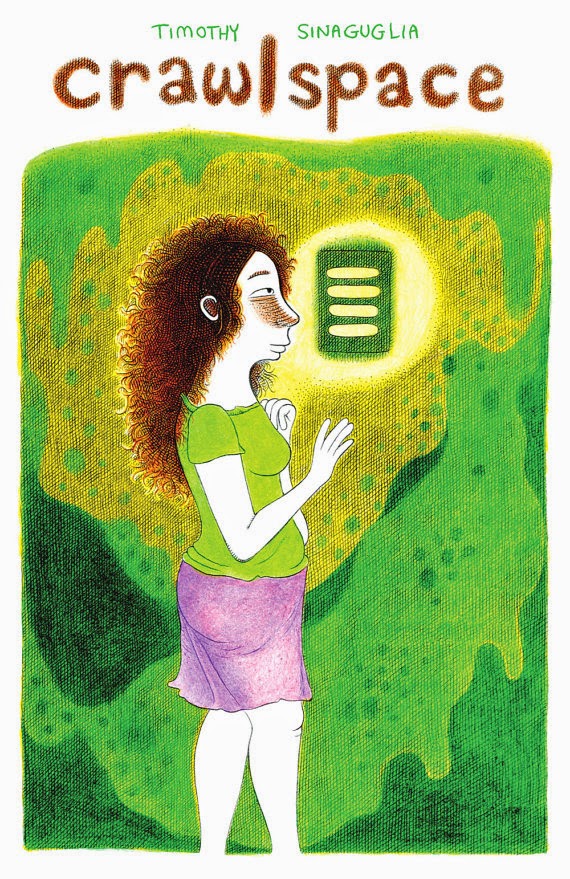
Crawlspace, by Timothy Sinaguglia. So What? has proven to be highly unpredictable as to what sort of comics they publish. Crawlspace almost feels like a Domino book (complete with a blurb from publisher Austin English on the back), as Sinaguglia's eccentric storytelling style is given free reign in these two stories. The first, "She Smiled Back" is a fascinating account of adolescent sexual awakening paired with a new awareness of sexual identity. It follows a teen boy trying to figure out sex getting the idea to try on women's clothing and stare at himself for hours. It's remarkably honest and almost pure in how it distills this dawning self awareness. Visually, Sinaguglia goes heavy on hatching, especially with regard to noses. The hatching indicates the artist's fascination with creating both ugly and worked-over images and contrasting them with beauty. The second story, Trudy, is far more elliptical, as it follows a girl venturing outside for an unusual walk, dealing with elements that are vaguely threatening yet not unsettling to her. It's as though the female persona of the first story went out for a walk on her own, always aware that she was a double of someone else. There's something aching about Sinaguglia's comics; they are not sad, per se, but there's a sense of yearning and incompletion that haunts each beautiful page.
City Chickens, by Jess Ruliffson. One story at a time, Ruliffson is telling the stories that belong to a city and its frequently bruised and traumatized residents. This story is a bit more upbeat than some of her other comics, detailing the specifics of how to raise chickens at a particular community garden in Brooklyn. Born out of the wreckage of old properties, it provides a vital green space for its residents, a space where life grows amidst concrete and steel. Ruliffson's line is lively and expressive while still focusing on the matter at hand: a naturalistic depiction of her subjects for documentarian purposes. By sticking to a narrow question (how, when and why to raise chickens in the city), she helps focus her narrative while allowing herself to veer off a bit here and there to provide context and depth. I like that Ruliffson is honing her chops on these small stories, but I'd say she's ready for a bigger assignment.
Showing posts with label jess ruliffson. Show all posts
Tuesday, May 5, 2015
Friday, May 23, 2014
More Minis: Adrian Pijoan, Graeme McNee, Jess Ruliffson, Matt Huynh
Ma, by Matt Huynh. This is a stripped down and expressionist companion piece to GB Tran's Vietnamerica in that it's an account of a family leaving an Asian country under stressful circumstances in the hopes of creating a new life overseas. In Ma (a word that Huynh informs us means "mother", "interval", "water" or "ghost", depending on the language), Huynh brings us the story of his parents while they were waiting to sail from Malaysia to Australia as boat people. That meanings of the word ma are reflected in different ways in the story. The connection between young Huynh and his mother is a crucial one in the story, especially as she constantly fears others taking him away. The story is all about Huynh's family waiting on the beach, desperate to get medical help and to be called upon as next to depart. Huynh draws the water in grey brushstrokes, giving it a spectral quality. That grey wash pervades and distorts the surroundings, turning a "beach paradise" into a hellish environment where food is scarce and everyone is desperate. There's one page where Huynh's mother just completely breaks down in sobbing, wracking tears after her husband left her to go to the doctor and the enormity and hopelessness of their situation hit them. There are also moments of hope, as their sons learn to speak their first words and provide a kind of light and warmth, even as the difficulty of how they will be provided for in the future is always at hand. In the end, when their names are called, their expression is less one of joy than of total disbelief. That's where the narrative ends for Huynh, because Ma in many ways is a book with a specific purpose: to provide a human face to those seeking asylum. The political climate in Australia now is such that asylum-seekers are now turned away and sent back, an attitude justified by scare tactics and scapegoating immigrants. It's an old story, one that's been told for over a hundred years in the US, and one that's backed up by nothing but fear. Huynh's book is compelling precisely because he turns that fear around and lets the reader experience the fear his own family faced while waiting for a better life. Without getting didactic or preachy in the least, he simply told a human story that other humans should be able to sympathize with, especially thus in countries largely settled by immigrants in the past. The sensitivity and power of his brushstrokes is held in check by a sense of restraint as he lets the images tell the story for him. It's less a lecture than an affirmation of the power of the family bond, a bond that should strike a chord in any reader. It's also a remarkable display of the depiction of body language, gesture and mood using that expressive, bold brush.
Invisible Wounds, by Jess Ruliffson. This is a simple and straightforward first-person account of a war veteran with post-traumatic stress disorder (PTSD), the "invisible wounds" of the title. A comics journalist, Ruliffson boldly and clearly illustrates this account of life back home after the war. The vet in question starts off by talking about he surprisingly gets more compassion from civilians than from other ex-veterans, especially older veterans who have an axe to grind and see him as a convenient target. That's followed by a heartbreaking scene where he shares perhaps a bit too much with a neighbor, concluding with the statement "I'm not dangerous or anything." In the illustration above, Ruliffson captures the subtle and sad changes in expression as both parties found ways to exit the situation. In calm but plain language, he details how his emotions had become frayed since coming back; witnessing "cruelty would send me into a rage". He started to lose time when he would suddenly simply freeze and dissociate. Once again, Ruliffson is up to the task in illustrating this account of him laying down tiles and mortar, craeting a panel made up out of clocks and black & white tiles and showing the passage of time. The comic is full of simple and elegant solutions to storytelling problems. The one page where Ruliffson doesn't quite stick the landing is one where the vet relates this moving anecdote of being with his young daughter and the seriousness of her expression after he voices his thoughts about her growing older. Ruliffson didn't quite capture the girl's expression and in fact makes a rare error in trying to over-render. This isn't especially surprising for a young cartoonist, as children are extremely difficult to draw. Still, this is a short and moving comic that shows Ruliffson's great promise.
Minimal Comics Volume One, by Graeme McNee. With McNee's comics, the whole is greater than the sum of its parts. Each comic in this small volume printed in color features three vertically stacked columns, each depicting the subject in a sequential manner. Some like "Shy", featuring a blank background in the first panel, a simply-drawn head barely peeing into the second panel and then a blank background in the third. Each strip is a sort of meditative problem-solving exercise, as McNee (a Scotsman living in Japan) seems fascinated by depicting simple events through time in a vivid but entirely stripped-down fashion. As a result, some of the strips have what amount to punchlines, while others are simply descriptive. It's almost an exercise in phenomenology, really, as McNee labors to describe one thing over time, removing other, competing subjects or concepts. There's not much more to these strips than that, but McNee finds ways around his constraints to depict a wide variety of emotions and ideas, all rooted in time and space.
Botany Utopia and Thinking Like A Mountain, by Adrian Pijoan. A self-professed "cartoon ecologist", Pijoan's latest comics have wisely dipped much closer to the world of science with considerably less mysticism piled on. Botany Utopia is a perfect balance of Pijoan's life-long fascination with plants and the actual science behind photosynthesis. Using clever spot greens on top of a line that's sometimes clear, sometimes scrawled and sometimes in the form of diagrams, the whole comic is visually striking. Pijoan labors to make it an immersive experience, as even the lettering takes on a decorative quality, one designed to emphasize the more emotional and evocative points he makes. While the first part of the comic is about Pijoan marveling about how alien plants are, the second is about why leaves turn brown in the fall. That description is remarkably lovely and even poetic, and that's backed up by the way he draws falling leaves. Thinking Like A Mountain is about how humanity needs to take a long-form view of how they impact they environment, referring to the title as an example of that sort of thinking that is necessary. He relates an anecdote about cowmen killing wolves preying on some of their herd, without thinking that the wolves kept the population of deer under control. With no predators, the deer reproduce rapidly and strip a region's ability to sustain them and stay fertile. Pijoan essentially adapts an essay by forester Aldo Leopold, endeavoring to make the lettering resemble someone's own script as though they were writing a letter. This leads to an occasional lack of clarity, as does Pijoan's difficulty drawing people and animals in a naturalistic manner. Drawing plants is certainly his strength at this point, but he'll need to find a way to streamline and clean up everything else. That said, the concept behind this mini was compelling, as Pijoan zeroed in on the most interesting, immediate and visceral ideas from the essay.
Labels:
adrian pijoan,
graeme mcnee,
jess ruliffson,
matt huynh
Monday, August 19, 2013
Consumed: Digestate -- A Food And Eating Themed Anthology
JT Yost's anthology Digestate contains an interesting concept that gets lost in its bloated pagecount. The anthology is about different cartoonists' relationship with food and eating. Though on a superficial level there are stories from vegans and carnivores alike, the best parts of the anthology take on different aspects of food and how traumatic events can shape what we eat and our subsequent social identities. Unfortunately, at nearly 300 pages, that personal touch got lost in Yost's attempt at cramming in a number of previously published stories and story excerpts that had something, anything to do with food. There are any number of examples of this: pages from Renee French's new book, an entire minicomic reprinted from Daryl Ayo, an excerpt from a comic by Minty Lewis, assorted gag reprints from Keith Knight, Hawk Krall and Dan Piraro, etc. I found these comics distracting and not just because I had read them before. Aside from the back cover being somewhat misleading in getting the reader to think that people like Berke Breathed had contributed new material in this anthology (his strip is actually a photocopy from a collection; I get that it inspired Yost to rethink his own eating habits, but advertising it on the back was a dubious move), those strips stand out in the anthology because they lack the kind of personal touch that the best stories in the anthology possess.
Take Alex Robinson's "That Peanut Butter Kid", for example. Robinson rarely does autobiography, but not only does he explain that he is only capable of eating the blandest, kid-friendly food, he boldly reveals that he suspects it has something to do with being a survivor of childhood sexual abuse. One can almost sense the relief on the page as he relates how embarrassing and awkward it's been over the years to explain his very limited palate and relates this to his introversion and preference for staying at home. The gratitude he expresses toward his therapist but especially his wife for slowly, patiently getting him to try new things is also remarkable. It's a powerful story that's still funny (because Robinson is naturally funny). Tod Parkhill's "Picky Picky" is along the same lines, only in his case his eating habits were simply solidified at a young age and he lacked the parental attention needed to correct his palate.
A common theme among many of the meat-eater's stories is guilt for eating meat. Pranas Naujokaitis' "The Tell-Tale Burger" plays this for laughs, as his guilt for eating fast food is mostly in his own head, as his girlfriend doesn't care even as she's cooked chickpea burgers for him. Paul Hoppe's "The Flesh Is Weak, The Meat Is Strong" takes a friend saying "Oh, you're eating meat?" and proselytizing for vegetarianism, which he goes along with until he's hungry and a KFC is up ahead. Cartoonists like Sophie Wiedeman touch on meat eating in terms of sacrifice, as a group of children eat a chicken as a way of keeping up their strength in lieu of their mother leaving to bury their grandmother. It's a touching, intense rite of passage story.
The stories from the vegan/vegetarian side of the fence vary in their fervor. Sam Henderson manages to poke fun at both sides in his inimitable manner; his interstitial strips were important in trying to break up the anthology's unwieldy page count. JT Dockery's ruminations on being a vegetarian are lushly illustrated and funny; he's less interested in preaching than describing what works for him. Liz Prince's autobio account of becoming what she describes a "junk food vegetarian" is also quite funny, thanks in part to her sketchy line and solid comedic timing. Hazel Newlevant rightly points out the connection between veganism and the food-related practices of religions, though she doesn't go all the way in connecting the dots between the fervor of some vegans as a kind of evangelical fervor. At the other end of things, the title of K. Thor Jensen's "Living With Murder" alone tells the reader what's in store for them, as an injury to his daughter puts him in a furious state, with no desire to candy-coat his beliefs. Yost's 25-page illustrated text relating to the slaughterhouse industry is even-handed in tone, though I found it a slog in terms of its repetitiveness. Nicole Georges' "Boycotts" tries to poke fun at her own self-righteousness but doesn't quite get there. Cha's extremely amusingly-drawn fairy-tale screeds may have all the subtlety of a sledgehammer, but they're still extremely well-done and effective. She absolutely sells every one of her points with illustrations that are both hilarious and horrifying. The same was true of Danny Hellman's typically superb two-page illustration depicting a history of meat consumption.
I could have done with more of that kind of expression than some of the blander attempts at comedy and/or weirdness in the book. I enjoy William Cardini's wacky monster comics as much as anyone, but a strip about the Mizzarrd eating a snack didn't really add much to the proceedings, nor did Aaron Mew's "Ghost Dog" strip. About the only other bit of weirdness that I enjoyed was Josh Bayer's frantically scrawled strips, but even they had relatively little to do with food. I could have used more strips like L.Nichols' "The Wonderful World of Vegetables", which really gets at one woman's experience with eating that's atypical of many Americans. Jess Ruliffson's "City Chickens" is an excellent bit of reportage in comics form about the history and implications of raising one's own poultry in an urban setting. I got the sense that Yost was trying to appeal to as wide an audience as possible by bringing in genre stories or stories with a tenuous connection to food. I'd love to see him take another crack at this concept with a tighter focus.
Take Alex Robinson's "That Peanut Butter Kid", for example. Robinson rarely does autobiography, but not only does he explain that he is only capable of eating the blandest, kid-friendly food, he boldly reveals that he suspects it has something to do with being a survivor of childhood sexual abuse. One can almost sense the relief on the page as he relates how embarrassing and awkward it's been over the years to explain his very limited palate and relates this to his introversion and preference for staying at home. The gratitude he expresses toward his therapist but especially his wife for slowly, patiently getting him to try new things is also remarkable. It's a powerful story that's still funny (because Robinson is naturally funny). Tod Parkhill's "Picky Picky" is along the same lines, only in his case his eating habits were simply solidified at a young age and he lacked the parental attention needed to correct his palate.
A common theme among many of the meat-eater's stories is guilt for eating meat. Pranas Naujokaitis' "The Tell-Tale Burger" plays this for laughs, as his guilt for eating fast food is mostly in his own head, as his girlfriend doesn't care even as she's cooked chickpea burgers for him. Paul Hoppe's "The Flesh Is Weak, The Meat Is Strong" takes a friend saying "Oh, you're eating meat?" and proselytizing for vegetarianism, which he goes along with until he's hungry and a KFC is up ahead. Cartoonists like Sophie Wiedeman touch on meat eating in terms of sacrifice, as a group of children eat a chicken as a way of keeping up their strength in lieu of their mother leaving to bury their grandmother. It's a touching, intense rite of passage story.
The stories from the vegan/vegetarian side of the fence vary in their fervor. Sam Henderson manages to poke fun at both sides in his inimitable manner; his interstitial strips were important in trying to break up the anthology's unwieldy page count. JT Dockery's ruminations on being a vegetarian are lushly illustrated and funny; he's less interested in preaching than describing what works for him. Liz Prince's autobio account of becoming what she describes a "junk food vegetarian" is also quite funny, thanks in part to her sketchy line and solid comedic timing. Hazel Newlevant rightly points out the connection between veganism and the food-related practices of religions, though she doesn't go all the way in connecting the dots between the fervor of some vegans as a kind of evangelical fervor. At the other end of things, the title of K. Thor Jensen's "Living With Murder" alone tells the reader what's in store for them, as an injury to his daughter puts him in a furious state, with no desire to candy-coat his beliefs. Yost's 25-page illustrated text relating to the slaughterhouse industry is even-handed in tone, though I found it a slog in terms of its repetitiveness. Nicole Georges' "Boycotts" tries to poke fun at her own self-righteousness but doesn't quite get there. Cha's extremely amusingly-drawn fairy-tale screeds may have all the subtlety of a sledgehammer, but they're still extremely well-done and effective. She absolutely sells every one of her points with illustrations that are both hilarious and horrifying. The same was true of Danny Hellman's typically superb two-page illustration depicting a history of meat consumption.
I could have done with more of that kind of expression than some of the blander attempts at comedy and/or weirdness in the book. I enjoy William Cardini's wacky monster comics as much as anyone, but a strip about the Mizzarrd eating a snack didn't really add much to the proceedings, nor did Aaron Mew's "Ghost Dog" strip. About the only other bit of weirdness that I enjoyed was Josh Bayer's frantically scrawled strips, but even they had relatively little to do with food. I could have used more strips like L.Nichols' "The Wonderful World of Vegetables", which really gets at one woman's experience with eating that's atypical of many Americans. Jess Ruliffson's "City Chickens" is an excellent bit of reportage in comics form about the history and implications of raising one's own poultry in an urban setting. I got the sense that Yost was trying to appeal to as wide an audience as possible by bringing in genre stories or stories with a tenuous connection to food. I'd love to see him take another crack at this concept with a tighter focus.
Labels:
alex robinson,
cha,
jess ruliffson,
jt dockery,
jt yost,
l nichols,
liz prince,
sam henderson,
sophie wiedeman
Subscribe to:
Posts (Atom)


