Let's take a look at the fledgling publisher So What? Press and some recent releases.
7 or 8, by Lara Antal. This autobio comic about a failed job interview was later fictionalized in Antal's Night Watchman comic. It's about turns of bad luck, the feeling of being stuck in a dead-end job and the sheer weirdness that life presents us with sometimes. Antal's line is a mix between naturalism (especially in close-ups on faces) and cartoony exaggeration, like when she starts to get rained on and her shoulders slump dramatically or when she cringes in horror when she first meets a potential new employer. This is a short comic that's less about specific events and more about the feelings the author has about her station in life.
Tales of the Night Watchman #3, by Dave Kelly, Lara Antal and Amanda Scurti. From the very beginning, Kelly has written stories for artists other than co-creator Antal for this supernatural slice-of-life series. It's been a bit of a risky proposition, because not every artist has been a great fit. Take Scurti in "The Dwellers of Big Bogie", for example. The story idea, of a creepy supernatural creature luring children down to the sewers, is solid enough. However, Scurti's character work is badly in need of someone else's inking, because the faces are too sketchy and indistinct. It would have worked fine if this comic was in color, but the greyscaling combined with her often too-light line widths made faces disappear into the page at times. Antal is actually less skilled as an artist than Scurti, but her thick line and slightly clumsy way she stages her characters simply fits this group of weirdo characters much better. Each one of the main three characters is trying to figure out their life. Street kid Serena doesn't understand what an opportunity she's been given, and it's obvious that life will have to inflict a few more lessons before she does. Charlie, the titular Night Watchman, is a dead man trying to regain his memories while protecting New York from various supernatural menaces. Nora, the barista and manager of a coffee shop, is trying to get a job that befits her actual skill set as a journalist, with no success. This installment is mostly just set-up, character building and laying down some future plot points in a rambling, charming manner. This is a genre comic I can get behind.
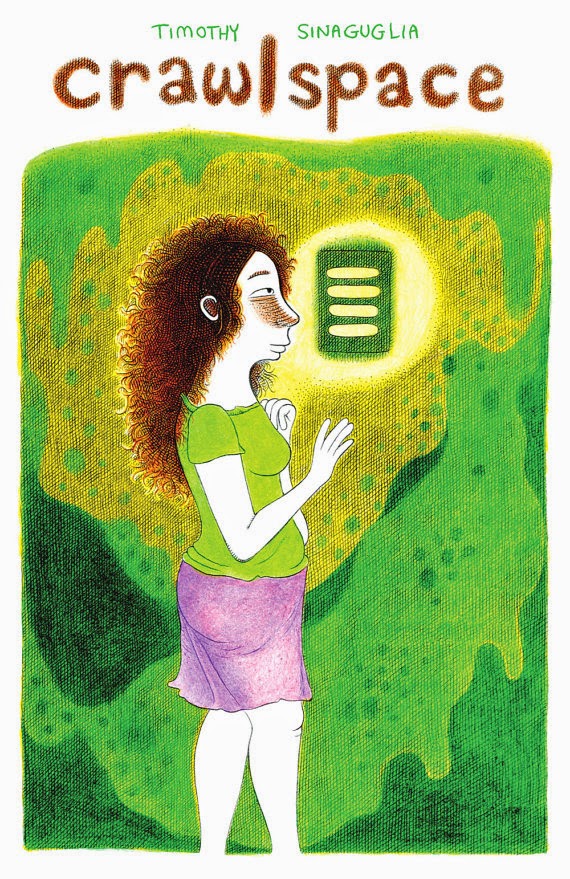
Crawlspace, by Timothy Sinaguglia. So What? has proven to be highly unpredictable as to what sort of comics they publish. Crawlspace almost feels like a Domino book (complete with a blurb from publisher Austin English on the back), as Sinaguglia's eccentric storytelling style is given free reign in these two stories. The first, "She Smiled Back" is a fascinating account of adolescent sexual awakening paired with a new awareness of sexual identity. It follows a teen boy trying to figure out sex getting the idea to try on women's clothing and stare at himself for hours. It's remarkably honest and almost pure in how it distills this dawning self awareness. Visually, Sinaguglia goes heavy on hatching, especially with regard to noses. The hatching indicates the artist's fascination with creating both ugly and worked-over images and contrasting them with beauty. The second story, Trudy, is far more elliptical, as it follows a girl venturing outside for an unusual walk, dealing with elements that are vaguely threatening yet not unsettling to her. It's as though the female persona of the first story went out for a walk on her own, always aware that she was a double of someone else. There's something aching about Sinaguglia's comics; they are not sad, per se, but there's a sense of yearning and incompletion that haunts each beautiful page.
City Chickens, by Jess Ruliffson. One story at a time, Ruliffson is telling the stories that belong to a city and its frequently bruised and traumatized residents. This story is a bit more upbeat than some of her other comics, detailing the specifics of how to raise chickens at a particular community garden in Brooklyn. Born out of the wreckage of old properties, it provides a vital green space for its residents, a space where life grows amidst concrete and steel. Ruliffson's line is lively and expressive while still focusing on the matter at hand: a naturalistic depiction of her subjects for documentarian purposes. By sticking to a narrow question (how, when and why to raise chickens in the city), she helps focus her narrative while allowing herself to veer off a bit here and there to provide context and depth. I like that Ruliffson is honing her chops on these small stories, but I'd say she's ready for a bigger assignment.
Showing posts with label lara antal. Show all posts
Tuesday, May 5, 2015
Wednesday, August 20, 2014
Minicomics Round-Up: Kelly/Antal, Kowalczuk, Callahan, Tripodi
Scrambled Circuits 1-4, by Cameron Callahan. These are interesting comics in that they represent a creative ground zero for a new cartoonist. Callahan simply started making comics one day to express himself, and while the results are understandably raw, there's definitely something compelling about them. These comics are clearly autobiographical, but Callahan features robot, lizard and monster stand-ins for all of his characters. His own stand-in is Primus, a robot who wears a Ninja Turtle-style mask, while his parents are giant lizards. It's a gimmicky choice that works, because Callahan can draw simple and expressive monsters in a way that he's not quite able to do while drawing people. It also adds a layer of fantasy to his real-life strips, allowing him perhaps to say and draw things that would be more uncomfortable if he was actually drawing those close to him. It's more than a gimmick, though, because one also gets the sense that Callahan feels confused and alienated by the world and his circumstances, and the drawings get across this feeling without being too obvious about it.
The results can be seen in the actual stories. The first issue features anecdotes from working in a bookstore and then later moving to the desert to take care of his dying grandfather, a move that put him in maddening isolation. The second issue contains essays about how we develop personalities, how to deal with bullies and the inception of creativity. The third goes back to more quotidian information, as he moves in with his father, starts art school, starts going out with a girl (in a series of very sweet strips) and gives dating advice to his best friend. The fourth issue sees Callahan going to a bigger format and using other artists to draw his stories. While it's a different look to be sure (and I thought Dylan Canfield's story was perhaps the most effective in the book), I didn't find it more effective than Callahan's own line. Callahan's own chops as a writer have certainly improved from issue to issue. Instead of slightly rambling anecdotes, he's begun to add more structure and more obvious story rhythms to give these stories more punch. That's certainly true in the story about going to a video store with his dad as a teen and being denied a chance to watch anime, as well as a hilarious story about two mothers seeing Callahan and his friends play and discuss esoterica regarding a fantasy card game. The final story, where he shows his mom and his step-dad some of his comics and they read them on the spot, had some remarkable emotional resonance. Callahan is clearly a young artist dedicated to the form, getting better in public and grappling with emotional truths from a number of different angles.
Vreckless Vrestlers #1, by Lukasz Kowalczuk. This is a gleeful bit of nonsense from Polish cartoonist Kowalczuk. It combines the cartoonish and melodramatic glee of professional wrestling with the visceral, nihilistic violence of Johnny Ryan's Prison Pit series. They're also a form of cartooning problem-solving, as Kowalczuk tries to make each bout different while finding ways to highlight each of the combatant's abilities in an interesting and clear manner while finishing each one in a satisfying manner. In this issue, The Eye battles the Crimean Crab in a splattering bloodfest that incorporates ringwork, chopped-off hands replaced with sharp implements and a grotesque final-panel reveal. It also features a character named Vegan Cat overcoming the noxious fumes of the Flatwood Monster and shredding it to bit. The reveal here is also pretty nifty, though it comes earlier in the story, robbing it of some of the power the first story possessed. Kowalczuk delights in using a chunky line and over-the-top character dynamics and revels in the sort of American pop culture melange he's created here by combining monsters, pro wrestling and gladiatorial combat.
Black Sheep and Melee, by Diego Tripodi. Tripodi is an Argentinian cartoonist heavily influenced by the likes of Frank Miller and Will Eisner. Mood, shadow and density are the hallmarks of his pages. In Black Sheep, he's also very much influenced by director Akira Kurosawa and actor Toshiro Mifune (even naming the locale after the latter) in this story of a man who sacrificed being a samurai to spare a friend and raise his own family. The story opens as the samurai have finally tracked him down and he and his family have to deal with their fate. It's formulaic if well-executed, with all sorts of zip-a-tone, dense and shadowy hatching, ink smudges, extensive use of silhouettes, cinematic transitions and other tricks adding visual excitement to each page There's also an interesting climax with a couple of clever twists.
Melee is an anthology of his short stories and collaborations. The most intriguing one is "Slower Burning", a collaboration with his publisher Jeremy Baum. It's about two young vampires and a painting that captures their image, with one desperate to break out of her circumstances. The use of color is especially effective. "Toy Box Queen" is a sweeter story dominated by brighter colors but also highly influenced by Miller's character design style. It's about a toy soldier and a female doll and their efforts to be together. "Smoke Signal" is a more surreal tale dominated by red and black about the woman in the moon. Once again, it's heavy on Eisner-style noir atmosphere. "Avalanche", about aliens rescuing a man and a dog in the snow, references a lot of European comics, with a touch of Moebius in there for sure. Tripodi seems to be cycling through his influences rapidly, and he would be an ideal illustrator for a long-form fantasy comic.
Tales of the Night Watchman: Staycation and It Came From the Gowanus Canal, by Dave Kelly, Lara Antal & Molly Ostertag. The Kelly-written and Antal-drawn Night Watchman "franchise" is marked by its superhero and supernatural tropes, but it's really a good old-fashioned slice-of-life comic, the kind that used to be far more common twenty years ago. Staycation eschews all of the supernatural aspects of the series and focuses instead on Nora and a friend going on a beach adventure. This is a slight little tale about personal reflection, friendship, loneliness, escape and betrayal. It acts as a prologue for the larger series, and it's interesting that Kelly and Antal have chosen to write so many interstitial stories surrounding the larger stories. It's clear that they want to flesh out the characters as much as possible as well as get to tell stories outside of what is clearly a tighter story arc in the main comic.
It Came From The Gowanus Canal is more of a "monster of the week" story that contains elements of noir and horror along with developing its characters. It's a clever twist on the old mobster movie trope of "cement overshoes", as those murdered by the mob and dumped in the river come to life as the "Gowanus Golem", killing the children of the vicious mobster and his cronies who killed them. It deepens the relationship between the Night Watchman's alter ego (Charlie) and Serena, the young punk who's working in the coffee shop that Nora manages. It adds a level of complication to the relationship between Nora and Charlie, the former of whom wants to be involved in his adventures and the latter who wants to keep her safe and away from danger. It also adds tantalizing clues as to his past and his missing memory. The art from Molly Ostertag is solid, though the action sequences are stiff. The comic also fairly cried for color, as the use of shading was on the dull side. Overall, this is a nice hybrid of the quotidian and the creepy with modest aims.
Tuesday, March 18, 2014
31 Days of Short Reviews #18: Dave Kelly & Lara Antal
Dave Kelly and Lara Antal's Tales of the Night Watchman is a clever hybrid of super-heroics, horror and slice-of-life storytelling. Its structure allows for an episodic quality to the stories as well as a larger overall storyline, as it follows a man named Charlie who happens to be possessed by a mystical, protective force called the Night Watchman. Essentially, in terms of design and concept, he's kind of a hybrid between The Spirit and The Spectre. Antal's drawing at times is crude, but it's always clear and particularly well-suited to the many quiet and funny character moments. Indeed, this comic is as much about life working as a barista as it is about fighting the forces of the supernatural.
Charlie winds up going to an apartment he had lived in sixty years earlier, only to find it occupied by Nora. In a manner as yet unexplained in the series, she agreed to help him by letting him stay there in exchange for him working at the coffee shop. Nora is a political blogger following the progressive political actions of a particular councilman everyone hoped would run for mayor. Kelly sort of telegraphed from the start that this man wasn't what he seemed but quickly takes that notion way over the top and into the land of the supernatural. The best aspect of the book is the chemistry between Nora and Charlie that is nonetheless platonic. Indeed, that chemistry has more to do with their mutual curiosity about the unknown. The one-shot "The Night Collector" (drawn by Molly Ostertag) is similarly slightly crude in its attempts at naturalism, but crude always beats slick when it comes to horror. This is a clever, unsettling story about romantic betrayals and vampires that takes some interesting twists and turns. The ending is actually quite surprising, as even though the chief vampire is slain, it's not exactly a happy ending. I like the way in which vampires are treated as almost like feral animals, as well as the ways in which this story revolves around sex but isn't the least bit titillating. These are solid and well-told comics, and while there are plenty of rough edges in every aspect of the storytelling, there's also a sincerity and belief in these characters that comes through on every page.
Friday, February 1, 2013
Still More Minis: Antal/Kelly, Mozzocco, Yost, Pritts, Hindle, De Radigues
Immovable Objects, by James Hindle. This comic shows the influence of later Daniel Clowes, right around the Ghost World era. It's a story about an outsider told with a certain sense of distance and a clear, naturalistic line. Though there are repeating visual motifs, every page is designed differently in terms of panel layout and whether or not there's any bleed between panels. There's a fairly extensive use of foam-green as a spot color but never for the characters' skin, which is left white. There's a great deal of care and thought that went into this comic about an aimless young man in college dealing with his only friend drifting away from him as well as his lifelong curiosity about his father, who left when he was too young to remember. Though it has some of that Clowesian iciness, reserve and restraint, there are certainly a lot of emotions bubbling under the surface in this story. It's really a story about depression and the ways in which we find ways to deal with it, and how certain kinds of activity can cause such a depression to lift. Steven finds a measure of happiness not because he finds his father, but rather because he tries, because he finally goes into motion. The breakthrough is subtle, to be sure, but the fact that Steven joins the track team at school is another sign of him becoming aware of his needs as a person. This is a really outstanding comic with a number of different angles to consider from a character perspective, and it's all done by mixing formal qualities designed to keep the reader off guard with narrative qualities that keep the reader on an even keel--until Hindle deliberately wants to upset the apple cart. It's definitely the best work I've seen from Hindle to date.
The Mothman Comics, by J. Caleb Mozzocco. The well-known blogger and critic did a funny comic about the infamous "Mothman" sightings in West Virginia, which is a source of both bizarre local pride as well as genuine terror for those who claim to have seen it. The creature has inspired a wave of books and even a movie that are heavy on the alien/supernatural/monstrous qualities of the creature. Mozzocco goes in a different direction, using a number of cited cases as a sort of humorous set of what ifs. Mozzocco has a crude line but a keen sense of humor, as he imagines the Mothman to be a misunderstood creature that enjoys skateboarding, writes letters to the editor and is generally unfailingly polite. Mozzocco went the extra mile and had these comics printed with spot colors for the creature's glowing red eyes (its most distinctive characteristic aside from its freakish wing span), which help sell the comic's deadpan gags. I'd love to see Mozzocco wax amusing on any other personal obsessions, because his sense of the absurd juxtaposed against something usually treated with deadly seriousness is quite effective.
Walking Into Traffic #3, by Dave Kelly & Lara Antal. This is a little anecdote of a comic about a man reminiscing about a particular sexual encounter that may or may not have happened in the way he recalls. It's a nice little play on the unreliability of memory, as his reverie is triggered by finding a thong that said "Roxy" on it, leading him to remember a crazy night that he ultimately abandoned, for fear of being trapped in a crazy relationship. Of course, if he bagged on her, how did he have the thong? The naturalistic style of Antal is stiff at times, but I admire her dedication to detail, like in a "freaky sex" panel complete with whips, a double-headed dildo and a screwdriver. The ambiguity of this comic is its greatest strength.
Moose #14, by Max de Radigues. This is the last issue of the excellent and influential minicomics series by de Radigues, who is the inspiration behind Oily Comics. The slowly unfolding story of a teenaged boy who is systematically bullied by a sadistic schoolmate, this final issue has a surprising and even ambiguous ending. When we learn the reason why Joe is being beaten and mentally tortured, it's a reason that doesn't make much sense as a real justification beyond the ways in which bigotry can justify persecution. In the last issue, when Joe is being chased by his bully through a snowy field, the bully threatens him even more, given there's no adult supervision there to stop him. Instead, he falls into a deep hole, and Joe is given an interesting choice: go get help (which the bully demands even as he continues to threaten him) or leave him to rot? The choice Joe makes here is surprising and manages to straddle the two extremes, as he seeks relief even if it's just for a brief moment. The comic ends on a sweet note that leaves the question of what happens to the bully unresolved, even if it's implied that Joe will eventually act. de Radigues' drawings are exquisitely simple and assured, with a remarkable command over body language and a surprisingly diverse array of different character types. Any American publisher would be smart to snap up what would wind up being a 180 page or so book.
There Will Be Nothing Left, by Nate Pritts. This is Pritts' first minicomic (he's a published poet) and it shows in terms of his ambition outstripping his drawing ability. I liked how he attacked the page regardless of his limitations without over-rendering too much to compensate. Indeed, Pritts goes out of his way to try to keep each page clear and simple as he goes into his philosophical digression about the nature of choice creating a specific temporal and narrative path, snuffing out others like opening up Schroedinger's box. Pritts imagines being "haunted by ghosts...echoes of the ruptures" as all our choices might occur sometime, somewhere simultaneously with the choice we actually make. He further fantasizes about being able to study our choices as we make them on a page that cleverly uses a leaf with a branching vein structure spreading across his 2 x 3 panel grid. It's an interesting bit of musing on being and time, if a paralyzing one, since he wonders which choice is the "right" one a question that (perilously) presupposes that there is such a thing, because it assumes an objective and clearly understandable greatest good. That problem has been confounding philosophers for a long time. Hopefully, Pritts will continue to work out his questions on the page.
Thinger Dingers and Losers Weepers #3, by JT Yost. Losers Weepers is the continuing story of poor Alvaro, based on scraps of paper or lost mail found by Yost and his friends. In this issue, Alvaro encounters racism at a copy shop (based on a found flyer that read "Learn Spanish! It's to easy and funy."), confronts his girlfriend over a letter she received from an ex-boyfriend in prison ("You know I'm coming to sex that asshole of your's, right?") and sees an enigmatic note after he's arrested when a bottle he throws accidentally winds up in front of a cop ("Constant grinding can turn an iron rod into a needle"). Yost has great chops, and I especially admire his varied and cartoony character design: square-jawed characters, squatly-shaped characters, bushy unibrows sweeping across a face that are furrowed in rage. Even if this comic is based on a gimmick, Yost manages to wrest real emotion out of it.
Thinger Dingers is a catch-all anthology of shorter works that have appeared elsewhere. "Ruemates" is an autobio piece about awful roommates of the past. It's amusing enough and Yost tries to be fair about his own eccentricities, but I found myself sympathizing with the roommate who was annoyed that Yost's cat kept missing the litter box. On the other hand, "Earl Bible" was a funny account of a friend who pretended to be a sort of redneck savant as a kind of performance art. It definitely seemed to be the sort of thing better read about than experienced in real life. The two best strips here are "Oval vs Square" (a series of "battles" where a square shape always trumps any other shapes by virtue of its inherent awfulness) and "Unappreciative Baby", wherein a baby yells at his father for singing a traditional song with racist content. When I read Yost's work, I'm not sure what sort of cartoonist he is. A humorist? A formalist? An autobio cartoonist with a didactic streak? He obviously has a great deal of talent but I've yet to read one of his comics that feels like something close to a definitive statement, as he seems to be trying to figure out the answer to this question himself.
Labels:
dave kelly,
j caleb mozzocco,
james hindle,
jt yost,
lara antal,
nate pritts
Monday, January 28, 2013
Food and Drink: Knisley, Antal, Brideau/Toosi
Let's look at three comics that investigate the visceral and cultural joys of food and drink.
A Comic Guide To Brewing, by Lara Antal. All three of these comics have extensive how-to and history sections, which is not surprising when talking about food. What's a bit different about this comic is that it's told from the point of view of a character from Antal's series, Tales of the Night Watchman. The character, a barrista, speaks with such expertise about the subject that it's clear that Antal herself has spent time brewing coffee for a living. Antal's in-depth discussion on the kinds of coffee and the complexities of making it in its many forms is actually quite fascinating, especially in the way she cleverly designs each page to give it a lively, active feel. Her chops as a draftsman are not quite up to snuff in providing the kind of detail necessary to really highlight the different brewing systems and other technical stuff, though she more-or-less gets her point across. Of course, this was done as a 24-hour comic, so it's understandable that it's a bit rushed. Antal includes fun little gimmicks with this comic, like a cardboard spoon attached to the front cover.
Yock Yok, by Neil Brideau and Fereshteh Toosi. This is an odd little project from an organization called Regional Relationships, which "commissions artists, scholars, writers and activists to create works that investigate the natural, industrial and cultural landscapes of a region." In this case, writer Toosi investigates a curious food local to New Orleans and Virginia called Yock, which is classic poor people food that has a fervent following. It's essentially noodles and a ketchup-based broth that has as many permutations as it does different names and spellings. Brideau is not a top-notch draftsman, but like Antal, his clever design work makes each page a pleasure. The book is lighthearted in tone, freely dipping into tall tales surrounding yock while acknowledging its status as a beloved, crucial and above all else, regional food. It's hangover food that's cheap to make and generally contains whatever happens to be laying around the kitchen. It's not unlike pho or any other peasant food that relies on ingenuity and years of subtle alterations to attain its status as a comfort food icon. The fact that it is still very much a regional phenomenon in an age when industrial and commercial food is so dominant is both interesting and reassuring. The comic comes in a fancy bronze-colored envelope and comes with a CD containing an interview between Toosi and a woman named Joy Smith, who knows quite a lot about the subject.
Relish: My Life In The Kitchen, by Lucy Knisley. Knisley's new book will be published by First Second in April of 2013. This can best be described as a "food memoir", as Knisley mediates a number of key events in her life through the making and consumption of food. Born to foodie parents in a time when that term and way of life was just coming into being, Knisley was nourished by her parents in more ways than one. There's a sense in which this book is lightweight and a fluff piece; negative emotions and aspects of Knisley's life are mentioned only in passing or avoided altogether. At the same time, Knisley clearly hasn't had too traumatic of a life; she has two loving parents, lots of friends and tons of rich experiences as well as a career as an artist. Of course, not every autobio story has to be about the Holocaust, terminal illness, or dead parents in order to be engaging. Vanessa Davis' comics are a good example of this, and while I don't think Knisley is quite in her class as an artist, there's a cheerful, familiar and friendly tone to her work that immediately draws the reader in and makes them comfortable. Indeed, as Knisley's clear line and bright colors flow along and relay funny anecdotes and family recipes, I immediately wanted more. It's not what I would call comics junk food, but rather a simple but expertly rendered piece of pastry.
Knisley is simply a cheerful sort with a sharp eye and a highly-developed sense of wonder. She ends each of the brief chapters with a recipe that's brightly-rendered and amusingly annotated. Knisley is also far from a food snob. Her parents denied her processed food as a youngster, so she naturally gravitated towards it
and often ate it in secret. The chapter on junk food is funny and spot-on: people eat junk food because it tastes good, and eating it on rare occasions is not such a bad thing. She highlights this by discussing a trip to Rome with her father as a bratty teen (she gently chides herself for her behavior more than once in the book), where she got revenge on her dad one morning by going to the McDonald's across from the hotel and then chowing down on burgers and fries in front of him. A child of divorce, Knisley was nonetheless loved by both parents, even if her relationship with her father was fractious at times.
Knisley's eye for and memory of detail is a key reason why this book is a success. For example, in detailing a trip to a Mexican village as a pre-teen, she makes the page come alive when depicting how she and her best friend had total free reign to spend money there, thanks to their sick parents. The anecdote about her friend discovering Mexican pornography was as funny as her description of the cheap, astonishing delights of taqueria food was evocative. Indeed, considering that one can't smell or taste what she experiences throughout the book, she does a remarkable job of bringing to life everything around the experience itself. For example, her description of the circumstances of consuming a number of apricot-filled croissants on a humid Italian morning made my mouth water not so much for the food, but rather for the sheer aesthetic joy that Knisley experienced that morning. Above all else, that connection to simple beauty and her ability to convey it is what draws me to Knisley's work. It's not just a croissant, it's a means of expression and connection, which is how Knisley views food. Relish is a simple book about simple pleasures, providing account after account after why such enjoyment is so important.
A Comic Guide To Brewing, by Lara Antal. All three of these comics have extensive how-to and history sections, which is not surprising when talking about food. What's a bit different about this comic is that it's told from the point of view of a character from Antal's series, Tales of the Night Watchman. The character, a barrista, speaks with such expertise about the subject that it's clear that Antal herself has spent time brewing coffee for a living. Antal's in-depth discussion on the kinds of coffee and the complexities of making it in its many forms is actually quite fascinating, especially in the way she cleverly designs each page to give it a lively, active feel. Her chops as a draftsman are not quite up to snuff in providing the kind of detail necessary to really highlight the different brewing systems and other technical stuff, though she more-or-less gets her point across. Of course, this was done as a 24-hour comic, so it's understandable that it's a bit rushed. Antal includes fun little gimmicks with this comic, like a cardboard spoon attached to the front cover.
Yock Yok, by Neil Brideau and Fereshteh Toosi. This is an odd little project from an organization called Regional Relationships, which "commissions artists, scholars, writers and activists to create works that investigate the natural, industrial and cultural landscapes of a region." In this case, writer Toosi investigates a curious food local to New Orleans and Virginia called Yock, which is classic poor people food that has a fervent following. It's essentially noodles and a ketchup-based broth that has as many permutations as it does different names and spellings. Brideau is not a top-notch draftsman, but like Antal, his clever design work makes each page a pleasure. The book is lighthearted in tone, freely dipping into tall tales surrounding yock while acknowledging its status as a beloved, crucial and above all else, regional food. It's hangover food that's cheap to make and generally contains whatever happens to be laying around the kitchen. It's not unlike pho or any other peasant food that relies on ingenuity and years of subtle alterations to attain its status as a comfort food icon. The fact that it is still very much a regional phenomenon in an age when industrial and commercial food is so dominant is both interesting and reassuring. The comic comes in a fancy bronze-colored envelope and comes with a CD containing an interview between Toosi and a woman named Joy Smith, who knows quite a lot about the subject.
Relish: My Life In The Kitchen, by Lucy Knisley. Knisley's new book will be published by First Second in April of 2013. This can best be described as a "food memoir", as Knisley mediates a number of key events in her life through the making and consumption of food. Born to foodie parents in a time when that term and way of life was just coming into being, Knisley was nourished by her parents in more ways than one. There's a sense in which this book is lightweight and a fluff piece; negative emotions and aspects of Knisley's life are mentioned only in passing or avoided altogether. At the same time, Knisley clearly hasn't had too traumatic of a life; she has two loving parents, lots of friends and tons of rich experiences as well as a career as an artist. Of course, not every autobio story has to be about the Holocaust, terminal illness, or dead parents in order to be engaging. Vanessa Davis' comics are a good example of this, and while I don't think Knisley is quite in her class as an artist, there's a cheerful, familiar and friendly tone to her work that immediately draws the reader in and makes them comfortable. Indeed, as Knisley's clear line and bright colors flow along and relay funny anecdotes and family recipes, I immediately wanted more. It's not what I would call comics junk food, but rather a simple but expertly rendered piece of pastry.
Knisley is simply a cheerful sort with a sharp eye and a highly-developed sense of wonder. She ends each of the brief chapters with a recipe that's brightly-rendered and amusingly annotated. Knisley is also far from a food snob. Her parents denied her processed food as a youngster, so she naturally gravitated towards it
and often ate it in secret. The chapter on junk food is funny and spot-on: people eat junk food because it tastes good, and eating it on rare occasions is not such a bad thing. She highlights this by discussing a trip to Rome with her father as a bratty teen (she gently chides herself for her behavior more than once in the book), where she got revenge on her dad one morning by going to the McDonald's across from the hotel and then chowing down on burgers and fries in front of him. A child of divorce, Knisley was nonetheless loved by both parents, even if her relationship with her father was fractious at times.
Knisley's eye for and memory of detail is a key reason why this book is a success. For example, in detailing a trip to a Mexican village as a pre-teen, she makes the page come alive when depicting how she and her best friend had total free reign to spend money there, thanks to their sick parents. The anecdote about her friend discovering Mexican pornography was as funny as her description of the cheap, astonishing delights of taqueria food was evocative. Indeed, considering that one can't smell or taste what she experiences throughout the book, she does a remarkable job of bringing to life everything around the experience itself. For example, her description of the circumstances of consuming a number of apricot-filled croissants on a humid Italian morning made my mouth water not so much for the food, but rather for the sheer aesthetic joy that Knisley experienced that morning. Above all else, that connection to simple beauty and her ability to convey it is what draws me to Knisley's work. It's not just a croissant, it's a means of expression and connection, which is how Knisley views food. Relish is a simple book about simple pleasures, providing account after account after why such enjoyment is so important.
Labels:
fereshteh toosi,
lara antal,
lucy knisley,
neil brideau
Subscribe to:
Posts (Atom)


