Showing posts with label jenny zervakis. Show all posts

Friday, May 17, 2024

Bubbles Con: Reimagining The Comics Festival

Bubbles Con, billed as "a symposium of interviews and talks on comics and manga," was held at the Richmond Public Library on May 5th, 2024. Organized to celebrate the fifth anniversary of the fanzine of the same name published by Brian Baynes, the event was unusual in that it wasn't designed in the same way as most comics shows. The aim at most shows is to provide a place for artists to display their wares. At more mainstream shows, this doesn't even mean comics much of the time, as you'll find people hawking prints, keychains, t-shirts, mugs, and other images that aren't even original to the artist. Even at print-centric shows like SPX or CXC, the problem is that the artists have to stay at their tables as much as possible and can't participate very actively in programming and workshop tracks. 


Baynes used a symposium model that made the various artist interviews the main attraction of the event. There was still plenty of commerce to be had, as Bubbles had its own table with the works of the special guests, as well as tables from Chris Pitzer (featuring AdHouse stock and things from his own extensive zine collection), Toybox Coffin (run by Noel Friebert and also acting as a limited distro), and Cerebral Vortex, which may have the most astonishing array of underground and alternative comics I've ever seen. Their tables were active between talks, as well as before and after the event. All of this was held in one room in the library's basement, so everyone had a chance to see every panel. It's a variant of a model that Bill Fick, Eric Knisley, and I used when we held DICE in Durham a decade ago, where we had a full day of panels and workshops that the artists could attend while volunteers sold their books. 

The night before the show, there was a reading at the library featuring a number of mostly local artists. It was reasonably well-attended, which bade well for the next day. Indeed, even though Bubbles Con got going at 9:30 am, the room was full for most of the day, and a number of folks traveled to attend the show. A contingent from Philly containing new tcj.com co-editor Sally Madden and artist Ina Parsons was there, for example, as was Drawn & Quarterly co-publisher Tom Devlin. I won't go into too much detail on each panel, because Baynes recorded them and will transcribe them for a future issue of Bubbles, but I thought I'd give a few impressions here and there. 


First up was scholar Mark Shubert on the cartoonist George H. Ben Johnson, a Black cartoonist who did political comics for the Richmond Planet (a local Black newspaper) a century ago. Shubert's presentation was fascinating, including the suggestion that Johnson may have well used the phrase "Black Power" decades before anyone else. Shubert did a number of strips that certainly upset the status quo and was also interested in the revolution in Ethiopia. I asked Shubert if it was known if he had any contact with Ethiopians, and he said that this wasn't known. This was a fascinating slice of local history packed with historical context and plenty of examples of Johnson's excellence. I've always thought that for small comics events, it's important to take advantage of resources and the greater culture that makes your city unique, and Baynes certainly added this flavor to kick off the symposium. 

Second was manga translator Ryan Holmberg. Holmberg has practically been a one-man industry in bringing gekiga and other manga aimed at adults to English-speaking audiences. Rather than talk about any particular manga he translated and wrote about, he instead spent the hour detailing exactly what he did. He discussed his different clients, how he made money, how much he charged, etc, and it was a fascinating look at the work of someone who is comics-adjacent (not a writer or artist) who nonetheless plays a huge role in bringing them to life. There was an amusing moment when Holmberg noted that Devlin (who he's worked with a lot at D&Q) was in the audience and that he hadn't met him before--and that he had to watch what he said! (Devlin replied that Holmberg could say anything he wanted.) Of greatest interest was Holmberg talking about how he was trying to translate and reprint certain kinds of manga that were in the public domain, and there's a lot of this kind of material. He also talked about how fruitful his relationship working with Bubbles was, as they had published two books together and announced a third was on the way. 

Baynes then interviewed Jenny Zervakis, the first cartoonist to be interviewed of the day. Zervakis' work is highly influential and was reintroduced to a wider audience a decade ago when John Porcellino published a collection of her Strange Growths comic. (There's a wide-ranging interview in the back that I conducted with her.) Baynes was trying to connect with Zervakis' background as much as possible, and she's not really one to give expansive answers. Zervakis has always been amusingly straightforward regarding her techniqes and influences, but she gave a lot of insight into the early days of modern zine culture in the late 80s and early 90s. In particular, she connects zine culture with the wider DIY punk culture that mostly took place by way of the US mail--a hidden revolution. 

Dash Shaw opened up the afternoon with Baynes interviewing him about his practice as a cartoonist and animator. Shaw lives in Richmond, adding more local flavor to the show, though he's obviously one of the most accomplished and innovative cartoonists in the world. He discussed his upcoming book Blurry, to be published by New York Review Comics, and noted he liked the idea of how making seemingly inconsequential decisions on a daily basis, or struggling to make those decisons, can have a ripple effect down the line. More than most cartoonists I've known, Shaw has a tendency to not only downplay past work, but to forget many of their details altogether. That was true when someone asked about Bodyworld, and he couldn't quite remember much about its sleazy protagonist, Paulie Panther. He noted that he struggled with his Civil War letter adaptation, Discipline, because he wanted to make sure he didn't put modern thoughts in the heads of his characters. Shaw is among the most thoughtful and deliberate cartoonists with regard to his practice, and he's always thinking ahead. He also talked about the Richmond Animation Festival that he organized at the historic Byrd Theater, another exciting way that locals artists are drawing more attention to comics & animation. The last note to mention is that someone referenced Shaw imagining a manga & animation in Richmond featuring Ryan Holmberg nearly a decade ago in his comic Cosplayers!

The penultimate talk was Dr. Francesca Lyn interviewing the great Gabrielle Bell. Lyn took a funny approach with Bell, and both were self-aware about the format and the sort of things discussed during these sorts of interviews. Bell is actually a great talker, even if she's always slightly squirmy on stage. It's pretty obvious that she's someone who likes to observe more than being the center of attention. Bell talked about being in a somewhat fallow period now in terms of comics, though she continues her surreptitious illustration practice. 

The final talk was a real showstopper. C.F. was introduced by cartoonist (and now retailer/distro guy) Noel Friebert, and he had some real tales to tell. He talked about being a kid in the 90s and starting his own miniseries while still in high school. He was bold in seeking out his heroes and finding the kind of comics he wanted to ignite his imagination, noting that he would travel to Million Year Picnic, drop off some of his minis, and then buy whatever the newest, most exciting comics were--and then immediately head home. He once went to New York as a teen, cold-called Gary Panter, and finagled an invitation to visit him in his studio. Panter took a look at C.F.'s comics ("He was very kind") and then watched what was essentially a private performance of Panter's latest multimedia light show. In later years, he decided he wanted to collaborate with the artists of Fort Thunder. This was in the late 90s, and the legendary art space/living of Brian Ralph, Mat Brinkman, Jim Drain, Leif Goldberg and others did not have the internet. There was a single landline for the whole house, and C.F. didn't even know the real names of many of the artists he wanted to work with!

The best story, and one that tied the whole day together, came when Friebert asked C.F. about his first series, Low Tide. C.F. published it for years before moving into PWR MSTRS. When asked about the title of the series, C.F. noted that he had taken from a letter in an issue of Chester Brown's Yummy Fur when he was asking readers to suggest a title for his next series (which would eventually be Underwater). One letter writer had a number of suggestions that included "Low Tide," which C.F. adopted. The person who wrote the letter? It was Jenny Zervakis. Comics is the smallest of worlds sometimes, especially during that time. C.F. will have a new collection of comics, titled Distant Ruptures, this fall. 

The afterparty for the event was held at a performance space called the Warehouse. It was a noise show that C.F. headlined as Universal Cell Unlock. The mood was giddy at the overall success of the show, and the performance was fascinating and intense. Baynes was noncommital regarding the possibility of another iteration of Bubbles Con, but it was thrilling to see an event that celebrated the aesthetics and connections of comics over decades of time while still allowing for sales. It was a refreshing and invigorating event. 


Saturday, October 22, 2022

Minis: Jenny Zervakis' Love and other Crack-ups, Part 1

There is always a sense of immediacy with Jenny Zervakis' comics and zines. Her latest, Love and other Crack-ups, is about her romantic relationships from college. It's based on some old letters she found in her attic, reminding her of the details of these relationships. The zine is a mix of text and comics, printing some of the letters verbatim, along with some additional comments. It's a window into the mind of a young woman in college and is interesting for that reason, but as always, it's her comics about her memories that are of greatest interest. 


While Zervakis is rarely afraid to share her thoughts and feelings in her comics, it's usually a bit more oblique and less than direct than it is in this comic. What comes through most in the comics is her biting wit and unvarnished sincerity. This is a look at a young person's first real encounters with love, and as such it's embarrassing, tender, and feels intensely dramatic. Zervakis keeps her drawings loose and scribbly, which works out well with regard to her storytelling. Her self-caricature as a college-age teen is expressive, and her short hair allows her a lot of different angles to work from. My favorite of the strips is the one about Aaron, her first true love in college. It's practically a rom-com! She loses her virginity to him but gets a UTI. She goes to a Halloween party dressed as a dinosaur (tail and all) and gets rejected by him. She has to deal with his general ambivalence, breaks it off, and takes no solace when she learns he has his heart broken by someone else. It's a classic Zervakis story as well: funny, vulnerable, a little awkward, and expertly told with linework that emphasizes gesture above all else. 

Zervakis shows off her drawing chops with drawings from a Scotland trip with the third boyfriend mentioned here, a long-term one with a guy named Jack. This also has rom-com vibes, with Jack's best friend asking her out prior to them getting together. Zervakis only sees him as a friend, which causes drama between them. In retrospect, she saw the cracks forming between them, since he had no interest in hanging out with her friends or family, but there's a change in the storytelling that reflects a more serious and settled relationship. Zervakis really gets at the heart of relationship dynamics in an interesting way. 

The text from the letters is interesting on its own, although toward the end, the balance she established earlier in the zine starts to skew heavily toward text over comics. Zervakis also ends the issue rather abruptly, but there is a promise of another issue in the future. This was an interesting experiment to see her focus on such a specific theme, as opposed to the looser and more poetic nature of her Strange Growths comics. 


Monday, March 9, 2020

Minis: Michael Aushenker, Jenny Zervakis

Crows, by Jenny Zervakis. This was a zine that Zervakis produced for 2019's Zine Machine show. It's not a comic; instead, there are illustrations on the front and back cover of the Durham skyline and crows flying over it. This is a painfully difficult read, as it's about the slow dissolution of her marriage, yet her writing is intimate and full of wisdom. Zervakis adds the running element of associating her divorce with seeing crows. Though she's not superstitious, she wonders about this. Much of the zine is also dedicated to talking about the women of her family and their strength, and it's suggested that perhaps the crows are ancestors trying to pass on a message. The final lines, "They are neither villains nor ghosts. They are just birds, living their lives. I should be too." are powerful and worth pondering. Creating meaning in random events is a human thing to do, but obsessing on these details can create paralysis. Zervakis' story is a difficult one that emphasizes finding a way to mourn and move on; making this zine is clearly part of the process.

Professor Mrs. Miniver, by Michael Aushenker. A good rule of thumb for Michael Aushenker's comics: the more ludicrous the premise, the more entertaining the actual comic. And the three premises for Professor Mrs. Miniver are among his zaniest. The first imagines a third volume in the Mrs. Miniver film series (from 1942!), conflating the character's relationships with the actress who played her. Greer Garson, who played the feisty titular character, had an affair with the much younger actor who played her son. In Aushenker's version, she fakes her own death, goes to college, parties naked, and manipulates her "son's" love into committing an extremely minor crime. Then she goes off into the sunset with the Nazi she supposedly killed at the end of the first film. It's all total nonsense that's made even more hilariously lurid with his use of color.

"Lincoln Horse" asks the question: "What is Abraham Lincoln had been transformed into a centaur?" Well, he would have personally ended the civil war, been in threesomes, and gotten a new owner. Aushenker keeps this silliness to a tight five pages. His Unstoppable Rogues also get a story as McDonald's employees, and the expected chaos ensues. Tonally, Aushenker likes his images, colors, and action as loud as possible. This sometimes belies the cleverness of his craft, especially his verbal gags, but it also befits the overall silliness of his ideas. From premise to execution, every aspect of this comic is designed to make the reader asks "WTF?"

Friday, October 26, 2018

Minis: Jenny Zervakis, Whit Taylor

Strange Growths #16 1/2, by Jenny Zervakis. Zervakis threw this one together shortly before the Zine Machine show so as to have something new, so it's a bit shorter than a usual issue at just twelve pages. Zervakis hasn't been able to do many comics in recent years, so getting this issue was a treat. Most of the issue is about a beach trip she took with her daughters and a friend & her daughters. The cover is one of her best: a drawing of her daughters on vacation, the wind near the beach whipping through the  palm trees and their hair. It's the perfect blend of Zervakis' knack for drawing vegetation and capturing the likeness, personality and body language of her girls.

There's always been a reserved quality to Zervakis' work. There's not much in the way of surface flash in her drawing or writing style. However, I'm inexorably drawn to it because of her quirky, meditative observations and her spontaneous, expressive line. Even pondering such quirky Americana like the tourist trap South of the Border, Zervakis manages to imbue it with a poetic quality. Most of what she writes about in this story is fairly quotidian: what she and her daughters did on their vacation in Myrtle Beach. That said, the essence of her daughters' personalities comes through both in terms of how she draws them as well as little quirks regarding the things they wanted to do. Zervakis' zines have always been personal and intimate while usually being deliberately spare regarding specific details, but this issue finds her opening up a little about her divorce and the ways in which certain rituals and public appearances may seem routine to others but trigger sadness in her.

There are also a few sketches of her kids and pets, along with a series of cartoons from her older daughter Penelope that are darkly hilarious. Everything about this issue feels spontaneous and loose, as Zervakis noted to me that she was doing it on a time crunch. To my eye, that freed her up to not fuss over things and instead trust in her instincts as a storyteller. Zervakis played to her strengths here as an artist, and the result was a series of images that were lovely on their own and even more effective in conjunction with the text.

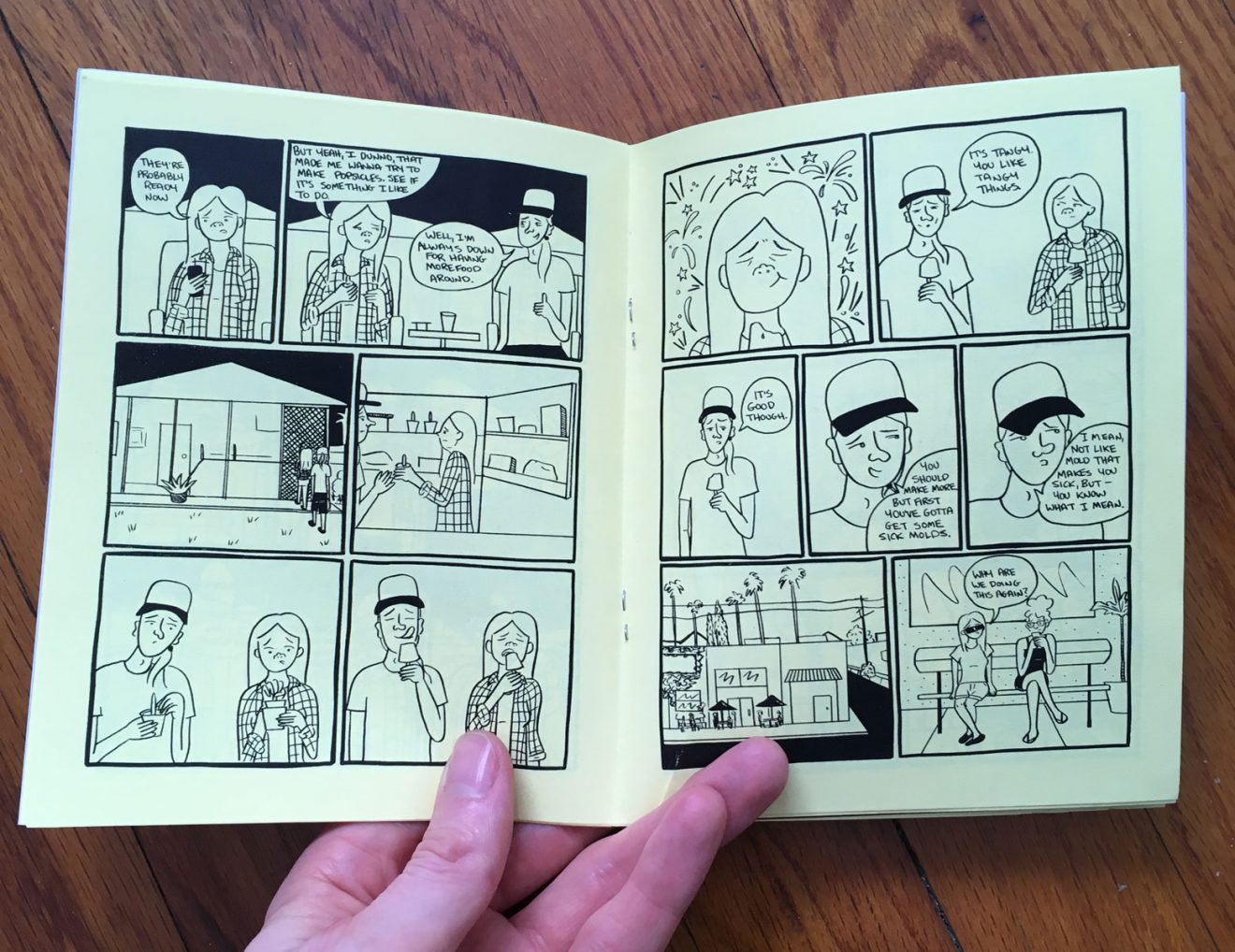
Fizzle #2, by Whit Taylor. The second issue of Taylor's slice-of-life series about a disaffected young woman named Claire. She works in a boutique tea shop, she has a rich stoner boyfriend, and she has no idea what to do with her life. One of the questions that Taylor raises here is if there's a difference between existential malaise and depression. After all, there's nothing "wrong" with her life, but it's made clear that she's desperate to have a "thing" to make her own. A hobby, a belief, a creative outlet--something. Taylor seems to suggest that there is certainly a link between the two concepts of malaise and depression, with the former leading to the latter at times. Indeed, many therapists recognize situational depression as a diagnosis different than major depression. That said, the character of Claire is in more of a holding pattern in this comic, trying to fight the feeling of "meh", with anything, even something as silly as making gourmet popsicles.

There's a panel where Claire made her popsicles out of different kinds of fruit, she tries it and fireworks go off around her head. It's a brief, sublime moment. There's that moment of possibility that's then spoiled by her boyfriend and her awful boss, but it's a memorable moment nonetheless. A Shark Tank-style reality show introduced toward the end makes me think the comic will go in that direction, but even if it doesn't Taylor's wry comedic chops are on display here, as her send-up of popular and youth culture in general is sharp. She's really locked into her style as an artist as well, with expressive faces that center around lips and eyebrows. There's a smooth confidence to her work that can be seen all-around in her page design and backgrounds. In a comic that's mostly talking heads, her ability to make create compelling expressions was the key to the comic's success.

Thursday, August 17, 2017

Comics-As-Poetry #11: Inkbrick #5

After a strong fourth issue, the fifth issue of Inkbrick was mostly forgettable. Most of the pieces weren't out-and-out bad, but some were too short to make much of an impact. Others were just not visually exciting. The highlight of the issue was a specially colored section featuring work from Jenny Zervakis, one of the earliest practitioners of comics-as-poetry. Her section, introduced by John Porcellino (who just published a big collection of Zervakis' work), stands out for its depictions of stillness and beauty, as well as a reserved but beautiful use of language. "Chuparossa" is an emotional reflection on a bird's song, its resilience and its motivations. It's a poem about intentionality, beauty and being present, with a marvelously subdued use of color. Zervakis was also an early practitioner of dream comics; here, there's a softly-colored one about her mother being a highly proficient gardener. There's also a deliberately ugly, bruise-colored strip that takes place at night and depicts a car accident, with the identity of the victim switching at the last moment. It's a dream about uncomfortable, raw emotions.

The recurring bit that held this issue together was that of a series of strips from Samplerman. He's best known for his collages of golden age comics and is especially interesting not just for juxtaposing images in unusual ways, but in experimenting by using clumps of comics as formal and decorative tools. In one story, the images form fractals. In another strip, the gutters take on character shapes, with the images of the strips turning into negative space. Other strips form loops raining down from above, or rooms full of strange objects. There's a sense of delightful experimentation and joy on each of these pages as Samplerman takes on the rich, lurid nature of the original colors and repurposes it in fascinating ways. Samplerman is able to retain enough of the original imagery to let the reader easily understand its original source material while at the same time divorcing the images from their original contexts. And there's no doubt that what he's doing is still comics; indeed, he relies heavily on the grid in order for the reader to understand the nature of the patterns he's playing with.

Other highlights in the issue include Courtney Loberg's mysterious, evocative strip about "sistering" (the use of water magic to recall specific visions) and a bizarre event seen while driving down a road. Her smudged, light sepia tones add an extra air of mystery to the proceedings, especially with her thin line weights with regard to her characters. Kurt Ankeny also uses a thin line weight effectively, albeit his method involved colored pencils. His story is about older people contemplating heights and also their inevitable ends. The way Ankeny juxtaposed the lines of the people's faces with the lines forming fields and buildings below was especially clever, as was a comparison of blades of grass to swords. Winnie T. Frick's red-and-lime "interview" with someone's double touched on all sorts of interesting ideas, including the concept of being a container for ideas for another person as well as the idea of shifting selves and identities. There's a sense of identity fracture here, with some hints that part of it is due to capitalism, and it was interesting to see this explored by way of a direct interview with her but not the "original". Publisher Alexander Rothman continues to impress, as his imagery of spring in the woods and the text regarding closeness and later othering play against each other in interesting ways.

Paul Tunis has made some interesting choices as editor, but his recent contributions have left me cold. The images are little more than decorative and don't have much impact on their own. The paint-spattering and photography of Alexey Sokolin and the textile/text experiment of Deshan Tennekoon & Thilini Perera just left me cold. They're too slick for the eye to grab onto, and that goes double for the actual plastic qualities of the text itself. Most of the rest of the issue either didn't combine text and image in interesting ways, or they were so fleeting that they simply didn't have much impact. This issue speaks to how difficult it can be to put together strong issues on a consistent basis without repeating too many of the same contributors.

Tuesday, June 6, 2017

Ten Artists To Seek Out At CAKE 2017

I will be attending the Chicago Alternative Comics Expo (CAKE) this Saturday and Sunday, June 9th & 10th. I'm excited to meet a number of Chicago-area artists for the first time, and of course will be looking for comics for review. On Sunday at 3pm, I will be moderating a panel titled "Place As Character", featuring the artists Emil Ferris, Laura Knetzger, Sophie Goldstein and Mita Mahato. All panels will take place on the third floor of the Hoover-Leppen Theatre. CAKE has a tremendous amount of talent, perhaps the most per capita of any American art festival. This is a show with special guests like Gary Panter, the explosively popular Emil Ferris, Simon Hanselmann, Kevin Budnik and many more. Here are ten artists you might be less familiar with that you should consider visiting if you attend the show.

1. Haleigh Buck (Table 315). This autobiographical cartoonist from Baltimore is making some of the rawest, densest comics about dealing with mental illness as part of everyday life, including how she dealt with an enormous breakdown. Her naturalistic style has a surreal edge to it and she maintains a wicked sense of humor throughout.


2. Chris Cilla (Table 205). His book The Heavy Hand is one of my favorite comics of all time, fusing a variety of styles together seamlessly to create a psychedelic, hilarious journey that defies all of the genre conventions that the book explores. His minis are also excellent, creating his own brand of underground comics that acknowledge all of their forebears without being beholden to any one in particular.


3. Cathy Hannah (Table 410). Hannah is another autobio cartoonist who writes about the intersection of the personal and political in interesting ways. She spills a lot of ink in delving deep into her own mental illness issues, her feelings about relationships and documenting her own therapeutic breakthroughs in real time. She uses an inviting, cartoony style to tell her stories.


4. Sophie McMahan (Table 403). Ever since one of her comics appeared in my mailbox, I've been astounded by the sophistication of her critiques of beauty, image and the male gaze through the use of body horror and distorted versions of 1950s-style advertising illustrations. Every one of her comics is both aesthetically beautiful and thematically challenging.


5. Carolyn Nowak (Table 505). She's doing some fantastically funny comics about sex, gender identity, culture and intimacy, with her recent Diana's Electric Tongue especially notable. A winner of the Ignatz award last year, her comics have a sense of lived-in warmth that's part of her sharp critiques. Her work is questing, curious, warm, funny and extremely smart.


6. Ben Passmore (Table 307). He just earned an Eisner nomination for his breakthrough short comic Your Black Friend, a pointed meditation on racial alienation. However, his other comics, like his postapocalyptic-autobio series Daygloayhole, are every bit as provocative, dealing with issues like addiction, isolation and connection, told with a weary sense of humor and razor-sharp intellect.


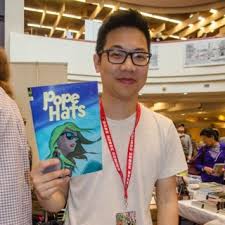
7. Ethan Rilly (Table 405). Rilly's Pope Hats series is one of the best things going in comics. Its serialized storyline about a law clerk named Frances features characterizations that rarely found in comics, gorgeous character design and an unerring ability to use stillness and pauses as a key part of his storytelling. His comics are subtle, beautiful and immensely satisfying.


8. Yumi Sakugawa (Table 220). This is an artist whose sharply-observed observations about art and gender dovetail beautifully with her sense of composition that makes extensive use of negative space. There's also a slightly exaggerated sense of reality to be found in her comics, often mediated through her frequent use of a reserved or deadpan narrative voice. UPDATE: Yumi Sakugawa has cancelled.


9. Eric Kostiuk Williams (Table 510). Williams' gained a lot of notice with his Hungry Bottom Comics series, a comic that mixed autobiographical essays about being young and queer in Toronto with surreal dreamscapes. Williams' potent mix of incredibly fluid draftsmanship and a probing mind helped get an Eisner nomination with his recent Babybel Wax Bodysuit, and his recent Heartbreak Condo Disco from Koyama Press.


10. Jenny Zervakis (Table 105). It's a conflict of interest to suggest that her debut collection of Strange Growths could very well be the book of the show, given the fact that I interviewed her for a section at the end of it. However, I'm not the only one eagerly awaiting this book that collects the first 13 issues of her minicomic, mostly from the 90s when she was a publishing mainstay. That John Porcellino had been planning to do this kind of collection for years speaks to the respect he has for her work. Her thin, penciled line tells stories that are poetic, still, funny and sharply observed.

Monday, April 14, 2014

Three From The Triangle: Adam Meuse, M.R. Trower, Jenny Zervakis

One of the reasons I helped create DICE (Durham Indie Comics Expo) was to spotlight the interesting and diverse range of cartooning talent that's emerged here in what's known as The Triangle portion of North Carolina (Durham, Raleigh, Chapel Hill). Mineshaft of course publishes out of Durham, and there are long-time cartooning veterans like Eric Knisley (a DICE co-organizer), Kevin Dixon, Mark McMurray and many others. Here, I thought I'd spotlight the work of three cartoonists who had these comics available at DICE last November.

Roh and Eik, by M.R. Trower. Trower is a recent graduate of the Rhode Island School of Design, and these comics reveal a young cartoonist with an interesting point of view who is rapidly developing. Roh was student work (done in Paul Karasik's class) and there's a lot here that makes that plain. Trower works too small in this comic, with a number of scenes lessened in terms of emotional impact because Trower tried to cram too much onto one page. This is unfortunate, because their linework is quite excellent, with an expressive quality that matches deft draftsmanship along with a fluid understanding of panel-to-panel transitions. Roh follows a high school girl who was born with frog-like creatures who's treated as a freak by her peers, teachers and parents. Only a P.E. coach (herself an "other" because the students think she's a lesbian) see Roh's potential as a track star on the hurdles. I thought that was a nice touch, adding a clever real-life use of her frog-related abilities. When Roh is told to dissect a frog in class or else, she rebels against the teacher, principal and even her parents, who want her to have "the surgery". All of this is, of course, a pretty clear metaphor for queer issues in general and transgender issues in particular. The latter half of the book gets a bit messy, as Roh runs away from home, meets a soul mate, and then encounters an actual demon in human form that tries to kill them. When Roh saves them both, they are provided a deux ex machina out of their entire existence: the opportunity to live on another world where everyone is "strange". This was clearly a wish-fulfillment scenario, one that came out of nowhere, and it took what was an emotionally wrenching and powerful story and gave it an easy way out.

Eik, finished in early 2013, is a more nuanced and interesting story that touches on similar themes. The story once again opens in a school, with a figure named Eik who's a sort of anthropomorphic set of geometric shapes, running for their life. Chased by a mob of slightly different shapes and patterns, they manage to escape underground. From there, Trower takes us on a tour of Eik's world, where children are allowed to change their shapes only up until a certain age, when that shape must harden into a societally-acceptable form that directly informs their role. Be it labor, enforcement or simply "filler", once you line up and take your form, there's no going back. Eik's dilemma was realizing that they were due to become part of the "martyr" class, whose members could help "beat back enemies of society by participating in a noble suicide mission". Trower's work is all about subverting the idea of binaries, fixed roles and the societal pressure that demands this sort of conformity, and Eik's world proved to be a more flexible way of exploring this metaphor than Rho. When Eik literally goes underground and is given a variety of choices that include isolation, surrender and confrontation, they choose confrontation. That leads to a battle with self that results in a sort of blossoming that transforms the whole of society, but not without personal cost. It's an ending that has a utopian quality, only this time it's one where society is transformed instead of escaped. The cartooning is uniformly excellent, as the vagueness of the characters' forms allows Trower a lot of room to invent their own set of cultural norms that are still closely tied to ours. The clear linework is dazzling, especially in the sequences where Eik is trying to negotiate pipes underwater and the populace is transformed; indeed, there seems to be just a touch of the Fort Thunder aesthetic to be found in those pages, only with far greater use of spotting blacks. In these two comics, Trower's already shown an interesting use of genre tropes for metaphors related to identity and oppression and has demonstrated an impressive set of cartooning skills. They promise to be an ambitious and challenging artist as their work continues to mature from a storytelling perspective.


Strange Growths #16, by Jenny Zervakis. John Porcellino has long listed Zervakis as an inspirational figure for his comics; in fact, he will be publishing a collection of her work for his Spit-and-a-Half distro in the near future. It's easy to see why Zervakis, whose output has been greatly slowed in the past decade because of family and work, was such an important figure for Porcellino and others interested in comics-as-poetry in the 90s. In her most recent issue of her series Strange Growths, Zervakis focuses on drawings of her environment, her children, her pets and the simple implications of everyday life and everyday sensory experience. Take "Winter Wonderland", for instance. This is a simple story about a rare snow day in Durham, one that she and her daughters took advantage of by making a trek to the local college campus. With great precision, Zervakis describes the feeling of the air and environment around her. With her scratchy and grey-scaled imagery, she depicts how alien the landscape became covered in snow and ice, most of all getting at the stillness and sense of magic that all three felt.

Zervakis' comics also have a warmth to them thanks to a creator not afraid to fully express her emotions without worrying about a particular kind of payoff or a potential lapse into sentiment. In "I Am Thankful For Betty The Dog", Zervakis transforms a simple story about a lost dog with health issues into an examination of her family structure, the emotional development of her older daughter, and her own feelings when that dog reappears again as though by magic. "Postcards From Ripley's Aquarium" shows the artist ilustrating the weirdness of aquatic creatures, using a fat line and lots of black in a manner that captured something essential about these animals. There's a crude beauty in Zervakis' line; it's not quite as refined as Porcellino, but there's a sense of immediacy and even urgency in the way that she draws her stories, her dreams and the observations of both her children and herself. This is a must-read for any fan of this kind of thoughtful, reserved sort of storytelling.

White Cards, by Adam Meuse. Meuse was a revelation for many at DICE, because while he's fairly well known locally, this hilarious cartoonist doesn't have much of a national profile. The out-of-towners who saw his witty, absurd and frequently filthy cartoons were impressed. While he generally works with a simple and uncluttered line, there's actually a great deal of studied clarity and simplicity to be found in his work that clearly came after a great deal of thought. In White Cards, comics that Meuse drew at work to stave off boredom for him and his co-workers, the opposite was true. These are totally off-the-cuff, disgusting and hilarious gag strips involving him and his co-workers Heather, Tracy and Curtis. They are frequently violent, scatological, sexual and wholly inappropriate. My favorite part of the book was a series of cartoons involving Tracy having a sexual relationship with a giraffe that gets every bit out of this possibility as one can imagine, including a giraffe's neck/cunnilingus joke that had me rolling. Meuse excised the cartoons that were too in-jokey and provides all the necessary information needed to enjoy each series of jokes. Mostly, he expertly captures that sense of frustration and mind-numbing boredom that can lead to shared moments like this, where there's that one co-worker who does something to make one's day more exciting. Meuse just happened to be that co-worker, who was fueled by their interactions to create something memorable.

Thursday, April 12, 2012

Comics-As-Poetry: Badman, Moreton, Zervakis

Let's look at some recent minicomics examples of comics-as-poetry:
No Way Constant and Untitled (Sternwood), by Derik A. Badman. Badman is a critic whose comics play around with appropriating and repurposing the texts and images of others to create new and frequently elliptical meanings. Untitled is one of his most successful comics to date. The front half of the comic consists of images appropriated from stills taken from a variety of film noir examples, including The Big Sleep. We see close-ups of doors, telephones, revolvers, cameras, statues with hidden compartments, shower stalls with bullet holes, and finally a wisp of cigarette smoke in the dark. Badman is ingenious in the way he strings together unrelated images and completely eschews depicting any people to create a more accessible narrative, yet the atmosphere he creates and the images he chooses make it easy to roughly understand what's happening. The key here is his choice of a midnight-blue wash in every panel, truly creating the "noir" atmosphere found in those sort of movies. The back half of the comic has a dark yellow wash and similarly depicts a place and a set of objects. The difference is that it's modern-day and that the things he depicts are stripped of the cultural meaning imbued in film noir: it's just a normal person going about their day. Yet, many of the objects he portrays could easily have a sinister bent depending on coloring choices and the juxtaposition of images. This comic is a witty depiction of how we read, comprehend and contextualize images.


No Way Constant is just as intriguing in its own way, working as a mash-up between Robinson Crusoe and 1940s/1950s romance comics and jungle girl comics. The way he juxtaposes Crusoe author Daniel DeFoe's prose regarding desire and danger with both the sort of action one would see in a jungle comic and the yearning found in a romance comic is especially clever. The one problem with this attempt is that Badman's attempts at copying masters of motion like Jesse Marsh comes out looking stiff. The sheer lushness of image that made those comics interesting is absent here, and as a reader I found myself being taken out of the page by the crudeness of some of the drawings--especially the figure work. It was an interesting experiment, but it's nowhere near as fluidly successful as Untitled.


Strange Growths #15, by Jenny Zervakis. For a variety of reasons, this 90s and early 2000s minicomics mainstay has had a reduced work output over the past few years. Like her friend and peer John Porcellino, she does autobio comics with a heavily poetic bent, focusing on the meaning to be found in small but significant moments. Her line is scribbly and warm, echoing the way her text invites the reader into her life without necessarily giving them much context. It's a portrait of a life lived, moment by moment, told in a series of short anecdotes. "Iceberg", for example, talks about an iceberg screensaver on her computer that comes to represent the feeling of stasis she herself was experiencing--especially with regard to being creative. This issue marks the melting of that iceberg, as she herself put forth the question. Much of this issue focuses on family, like the sort of things her daughter says or connections back to her relatives in Greece. Zervakis seeing the world through the eyes of her daughter is especially fascinating, as she treats her observations seriously but without overt sentimentality. Zervakis also has an ear for what others say that's reminiscent of Harvey Pekar, like a conversation she overheard on a bus between two people who were putting down someone else. There's a lyricism present in her work that gives each story a satisfying quality on its own, but the accretion of her short stories in this issue adds up to a gestalt that's warm, sincere and honest.


Smoo Comics #4 and The Escapoligist, by Simon Moreton. Moreton continues to refine his voice as a poet and cartoonist. Smoo #4 is an especially lovely meditation on the town he grew up in as a teen-ager called Marlow, which is essentially a suburb of London. Working with a spare, scribbly and occasionally smudged pencil line, Moreton evokes memories through geometric figures, lines and shadows. The way in which he leaves so much open space on each page allows the reader to fill in the gaps while still maintaining the essential sketchiness of both image and memory. Moreton takes the reader on a recapitulation of his perceptual journey of Moreton, going from the awe of childhood to the contempt of his teenage years to the ways in which he and his friends tried to create meaning. The revelations Moreton provides about his sense of growing old externally but not feeling it internally are not especially innovative, but that does not diminish the impact of the revelation as he feels it, nor the beautiful way that he expresses it on the page. I loved the added touch of Moreton attaching an envelope that has a postcard and a hand-drawn map of Marlow.

If Smoo is Moreton's take on John Porcellino, then The Escapologist is his attempt at Warren Craghead's style of comics-as-poetry. Here, Moreton cleverly juxtaposes the solidness of place (brick walls, bushes, lawns of carefully cut grass) with his geometrically spectral figures. Like in Smoo, this is a comic about being from a particular place and knowing particular people, and how the sum total of our personality is constructed in part by our relationships with others. It's a short and sweet depiction of a feeling and a sense of loss, of being connected and feeling apart.