Showing posts with label whit taylor. Show all posts

Monday, July 7, 2025

Whit Taylor's Fizzle #4 & #5

There's only one more issue of Whit Taylor's series Fizzle to go after the fourth and fifth issues, and the fourth issue turns inward while the fifth issue has competing flashbacks and forward movement. The story revolves around Claire, an adrift twentysomething living in Los Angeles who's in an orbit of mutual aimlessness with her rich stoner boyfriend Andy. She works in a yuppie, high-end tea shop whose owner, Poppy, is obsessed with image and hyper-focused on her extremely niche interest. Claire develops an interest in creating gourmet popsicles with unusual fruit flavors, and the only person who really takes it seriously is Andy's grandfather Dick. Dick gives her a citrus taxonomy book to encourage her. 


What the reader doesn't know at this point is exactly how Claire wound up in this position. She had alluded to a shitty family and being estranged from her family, but that doesn't quite explain how she wound up in LA after being raised in New Jersey. It was also unclear what drew her to Andy in the first place. Taylor spends a lot of time answering both of these questions in these issues and fleshes out an unusual character narrative in Claire. What do you do with a character who has no motivations other than trying to figure out exactly what it is she wants? Taylor essentially presents Claire as a character whose motivations are defined by negative space. That is, Claire may not know what she wants, but she quickly realizes what situations she doesn't want.


The fourth issue goes into an extended flashback where her father forgets to pick her up from school, and young Claire has to walk to her mother's place. She takes comfort in television, and the sort of shows with romantic angles in particular. In the present day, she's increasingly frustrated with her slacker "musician" boyfriend, who sneers when Claire tells him that her mother is getting remarried. Claire is so angry that she takes up her work crush Jaime on his offer to hang out.


The fifth issue flashes between her first extended date with Andy and her platonic day out with Jaime. Here, Taylor reveals why she was drawn to Andy: he represented a total sense of freedom from responsibility that she had clearly craved. Living in a family marked by conflict and with a father who barely acknowledged her existence, pushed her to want to be with someone who wanted her exactly as she was. What the series suggests is that she had been drifting in a fantasy world, trapped in a warm cocoon where she wanted for nothing because of her rich boyfriend but was also not encouraged or acknowledged as having any meaningful sense of agency. Meeting Jaime, a witty and ambitious man who clearly valued her passions and found ways to encourage them, was clearly an unprecedented event that led her to start doubting everything about her life. Doubting, but not quite yet acting on these doubts. I'll be curious to see what happens in the final issue. 

Taylor sells everything with outstanding character work. Claire's facial expressions tell the story in ways her dialogue doesn't; the barely suppressed rage expressed as harsh facial angles, the brief moments of eyes-closed bliss, copious amounts of side-eye, and furrowed-brow anxiety. Andy's slovenly character design resembles someone whose own sense of inertia is highly cultivated; he's never known actual poverty or discomfort, and it shows. Poppy's hair and glasses instantly give the reader an instant sense of how self-serious she is, yet also totally contemptuous of anyone outside of her "influencer" sphere. The extra fun stuff is the fantasy segments where Claire imagines someone being on a dating show where the central woman is dating anthropomorphic versions of the planets. Taylor just cuts loose visually during those segments, as she plays to her strengths with regard to keeping things focused on characters but also displays a confident visual ambition that's a new element of her work. 

Tuesday, November 5, 2024

Whit Taylor's Dead Air #1-2

Over on Patreon, Whit Taylor has been serializing her new long-form project, entitled Dead Air. It's the sort of slice-of-life comic that was common in the 90s but has largely fallen out of fashion. It's set at a college in 2002 and follows a frosh named Noe (loosely based on Taylor) who decides to become a DJ at the college radio station. If you're at all familiar with that particular social ecosystem on a college campus, it's a scene that's at once broad-reaching and brimming with potential but also incredibly insular. Taylor mines the particularities of this scene with an incredibly fine sense of detail that creates a rich, albeit wacky, world-building setting. 


One problem with slice-of-life fiction is that it can be meandering and episodic. While the plot is certainly episodic, Taylor smartly establishes key aspects of Noe's character and introduces the key secondary character (a fellow frosh named Nate) within the first three pages of the story. Noe dreams of being a connector, of having something to say and finding a way to say it. Dead Air is a sort of spiritual successor to Taylor's older quasi-autobiographical series Madtown High, another story with a large ensemble cast that celebrates a certain cultural era from the point of view of a protagonist who is an outsider in many ways. 


What Taylor does best here is conjure up a huge cast of outsized personalities with an established pecking order, and slowly reveal details on the nature of their interactions through the eyes of Noe. The first issue goes into a deep dive as to why alternative music is so important to her. It allowed her to express her angst and manage her loneliness and alienation. Taylor once edited an anthology called Sub-Cultures, and she locks into this particular sub-culture in the way that it creates a certain camaraderie even when some of her fellow DJs are insufferable and awful. There is a magic and power to music that Taylor also taps into, as the band she gets free tickets to see creates an experience where Noe says "And just like that, I was transfixed." She wants to be a DJ and become part of the subculture, but she never forgets what music does for her. 


The second issue delves into the specifics of what a DJ does and how they do it, and because the radio station has certain commercial obligations, it is considerably less fun than Noe had hoped. Taylor also established a plot element (each prospective DJ has to make their own ad feature in order to pass their probationary period) and deepened the relationship/friendship between Noe and Nate. The fact that Nate has a girlfriend throws a bit of a roadblock, even if their relationship had been platonic up until that point. That's where the second issue ends, as the narrative starts to build and other key characters are introduced. There is a looseness to the proceedings that's a great deal of fun, as the best slice-of-life stories tend to lend themselves an informal hang-out feel. Taylor focuses on character dynamics and bodies relating in space, which only serves to reinforce this balance of pleasant relationships and witty interactions with the overarching theme of wanting to find a place to belong. 

Friday, July 9, 2021

Whit Taylor's Montana Diary

I've been following Whit Taylor's career for quite a long time. With Montana Diary (Silver Sprocket), she's published her finest work to date. Taylor has always been a thoughtful and intelligent writer, but there's a remarkable sense of confidence not just in the way she wrote about the frequently-horrific background of this memoir about a vacation to Montana with her husband, but in the way she drew it. It's exciting to see a cartoonist put it all together, and that's the case with this comic. 


In terms of format, it's not necessarily anything new. She's done this kind of historical/geographical exploration before. Whit's always been a thoughtful and restrained writer, offering perspective and wisdom with regard to her historical and cultural observations. She's also never been terribly didactic in her conclusions, allowing the reader to make up their own minds. While all of that was true here as well, there's a kind of funny swagger she displays, an almost unhinged and bizarre sense of humor that makes her the clear comedic focus of the comic. It pushes her husband as the straight man. However, even that narrative falls short of what's really going on. As a Black woman, it feels as though her presence in the whitest of states puts her into full-fledged survival mode, deferring to her husband and shrinking behind him in ways she never otherwise do. Taylor giddily engages with tourism even as she denounces the idea of not being American enough. She pointedly nails this narrative when her narrative caption calmly declares "I hate feeling like have to prove my Americanness. I'm descended from slaves, slave owners, and native peoples." The dialog she indignantly spouts off to her husband is "I am American as fuck."


Taylor goes in a lot of directions, but the main theme is how beauty and ugliness co-exist. Big Sky country was beautiful, but global warming is having an irrevocable impact on it, as one glacier will disappear in the next thirty years. A dive into the history of Lewis & Clark's expedition reveals exploitation and the virulently prevalent concept of Manifest Destiny. Even visiting the local native reservation reveals that the tribe was only left their land because the government didn't have any use for it. Taylor plays down her intellect and emphasizes how little she knows about history, which is a way of saying that few people in the country have a real sense of its history. Despite all of this, she acknowledges the hard truth that in America, the poison of its past and its persistence of its toxic structures is in direct opposition to its ideals, its beauty, and most importantly, its people. That said, this book isn't a screed; it's a vacation. It's funny time spent with her husband. It's hikes and meals and boat rides. Taylor balances all of these elements effortlessly.


Part of that is because her own persona here is so carefree and silly at times; in fact, there's almost an insistence on it despite her fear of white nationalists (and bears). There is no question that she was only able to sell this because her line was so expertly rendered. Taylor's line is clear and concise, as she leaned into her greatest skill: drawing expressions. Her tight talking-head focus was also a clever narrative technique, but she rewards the readers with a far greater range of expressions than usual in one of her autobio stories, with her husband a tight-lipped straight man. However, Taylor's clarity and skill in depicting her environment was absolutely essential in selling the rest of the story. Her line is not only clear, it's frequently beautiful in its simplicity in detailing forests, wildlife, and the people she meets. While her pages are full of detail, she avoids cluttering up her pages. In terms of layout, she used an open-page layout built on grid principles, providing both structure and freedom for her storytelling.  This story is in terms funny, personal, vulnerable, instructive, historical, and grim. Like John Porcellino, it's highly sophisticated and emotive storytelling that looks simplistic at first blush. However, there are hidden depths to be found in Montana Diary, rewarding multiple readings. 

Monday, October 12, 2020

Ley Lines Monday: Whit Taylor's Smile

Welcome to a new weekly feature here at High-Low: Ley Lines Monday. I've accumulated quite a few new issues of this joint production between Kevin Czap's Czap Books and L.Nichols' Grindstone Comics, and rather than review them all at once, I've decided to spread them out over a few weeks. Ley Lines is a series where a cartoonist does a comic about a particular work or works of art and the artist(s) who made them. The results have been straight-up narratives, comics-as-poetry, historical examinations, and even abstract ruminations. It's one of the most original ideas for a comics series I've ever seen.

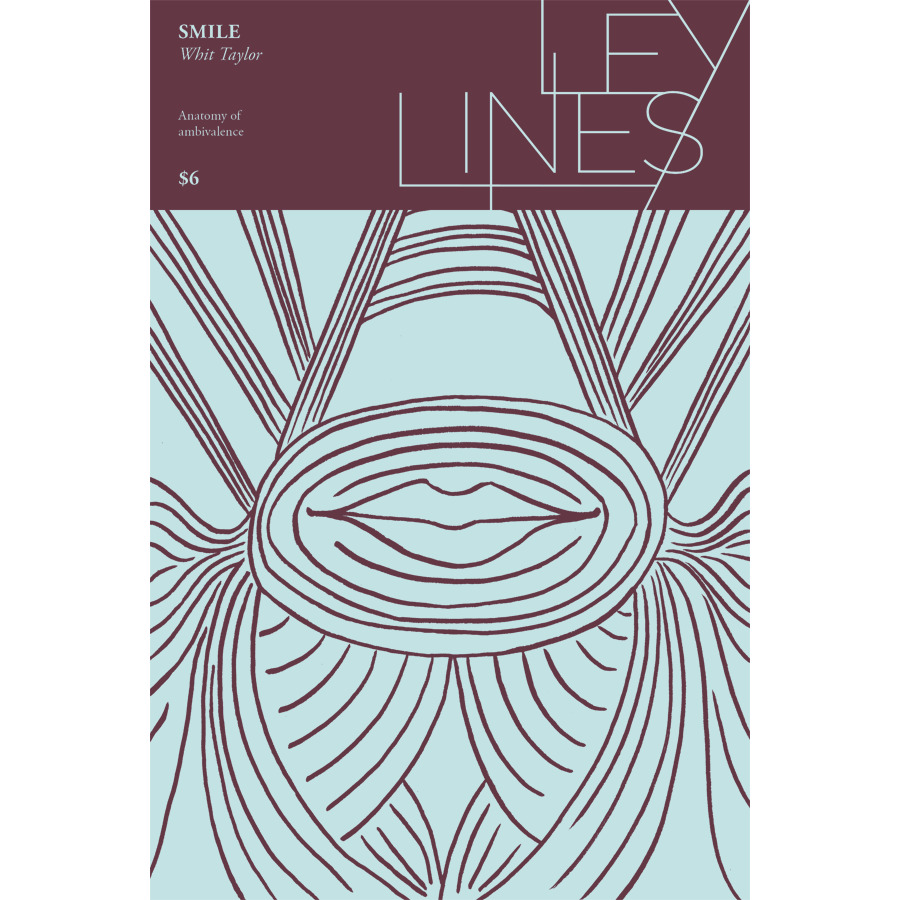
First up is Whit Taylor's Smile, subtitled "Anatomy of ambivalence." It details five-year-old Taylor's first exposure to Leonardo da Vinci's famous Mona Lisa, as she was assigned to be the woman behind the painting for a class play. She rejected this out of hand, thinking it was boring that she just sat there. She wanted to do something, like "make the pasta," as in Tomie de Paola's children's book Strega Nona, the other text that Taylor examines in this comic.


Taylor the adult examines her feelings about this experience but does so through the prism of ambiguity. The mystery of her wry smile gets at the heart of an artist's intentionality. Taylor dances around the idea in providing the reader with biographical data regarding both da Vinci and Lisa Gioncondo, as well as details regarding the sophistication of da Vinci's painting technique and firm understanding of optics. It's not a coincidence that the subject of the painting's eye seem to follow the viewer; da Vinci's painstaking studies of corpses led him to an understanding of human anatomy that few other artists possessed. 


The question Taylor asked was, "What did it all mean?" That's a question with no answer. The circumstances surrounding the actual creation of the painting and Leonardo's intent are lost to time. The Mona Lisa is the soul of ambiguity, and this is one reason why it is so recognizable. Its ambiguity is a feature, allowing viewers to draw their own conclusions and feel justified in doing so. 


The last image of Taylor is stirring a pot of pasta as an adult. It's a funny image, but it reflects the way she not only looks at the world as a scientist, but also as an artist. Taylor's entire project has been about confronting ambiguity and giving it a name. Whether it's confronting political injustice or her own personal mental health, Taylor approaches every topic with bracing honesty and a dash of whimsy. This particular comic sees her going to her strengths as a designer, turning anatomical drawings into elegantly decorative figures. By keeping her figures simple, she allowed herself greater complexity with regard to other details. The result is a charming comic that claims no answers other than the right to perpetually ask questions.


Friday, March 6, 2020

Whit Taylor's Fizzle #3

The third issue of Whit Taylor's story of twenty-something ennui, Fizzle, continues to follow its protagonist Claire as she tries to figure out her life. Fizzle is now being published by Neil Brideau's Radiator Comics, an outfit that's slowly making waves in Miami. Claire works in a tea shop with an overbearing, pompous owner. Her boyfriend is a stoner from a super-rich family. Her boss and her boyfriend represent extremes that Claire is repulsed by. Her boss takes her role as a sort of tea lifestyle expert quite seriously. She is insufferable as she carries her employees in her wake, demanding that they share her enthusiasm. Her boyfriend hates his family's trappings of wealth but has no interests or ambitions of his own. The events of Fizzle chronicle her reactions to these extremes.

In the first two issues, Claire happens upon an idea for her own business: popsicles made from real fruit, with unusual blends. It's all related to her fantasy of being on this entrepreneur reality show not unlike Shark Tank, where investors fund ideas that they like. The third issue takes ideas that were on a slow boil early on and makes them more prominent. In the first part of the comic, her boss holds a tea tasting with the author of a ridiculous self-help book that uses a life jacket as a poundingly obvious metaphor.

The middle of the book details how Claire met her boyfriend Andy in college; not surprisingly, it involved getting high. It's implied that things didn't ever get much deeper than that. There's a well-designed sequence where Claire listens to the self-help book, and it strikes a chord with her. She's not happy with Andy, she fantasizes about her co-worker, and she's desperate to feel passionate about something, anything.
She attends the birthday dinner of Andy's dad and takes a deep breath before interacting with his family. Taylor makes them not so much monstrous as banal, especially Andy's priggish brother Rich. Rich loves his father but also clearly loves being the favored son. Andy plays golf with his dad to appease him but doesn't understand how easily he slips in and out of this life of privilege. The only person who talks to Claire like a person is Andy's grandfather, who takes an interest in her study of fruit. The final scene in the book is her receiving a book on the subject from him.
Andy gets drunk at the party and Claire confronts him on him trying to distance himself from his brother, who is having a fourth child. As dull as Rich is, he knows what he wants: family and material success. When asked point-blank about what he wants, he doesn't know--and then asks her the same question. At this moment, it becomes crystal-clear that a mutual lack of ambition is all that's keeping them together, an orbit of laziness and apathy. It's not his fault that she's chosen to stay in this orbit, but it's clear that she has the capacity to break out of it if she wants to. Receiving the book in the mail not only means important information that she can use, but it also represents an important sense of affirmation. Someone believes in what she's doing and takes it seriously, and this hasn't happened before. We'll see how quickly the plot spins around this one scene. Through it all, Taylor's cartooning is becoming increasingly whimsical and fun to look at, aside from telling the story.

Friday, October 26, 2018

Minis: Jenny Zervakis, Whit Taylor

Strange Growths #16 1/2, by Jenny Zervakis. Zervakis threw this one together shortly before the Zine Machine show so as to have something new, so it's a bit shorter than a usual issue at just twelve pages. Zervakis hasn't been able to do many comics in recent years, so getting this issue was a treat. Most of the issue is about a beach trip she took with her daughters and a friend & her daughters. The cover is one of her best: a drawing of her daughters on vacation, the wind near the beach whipping through the  palm trees and their hair. It's the perfect blend of Zervakis' knack for drawing vegetation and capturing the likeness, personality and body language of her girls.

There's always been a reserved quality to Zervakis' work. There's not much in the way of surface flash in her drawing or writing style. However, I'm inexorably drawn to it because of her quirky, meditative observations and her spontaneous, expressive line. Even pondering such quirky Americana like the tourist trap South of the Border, Zervakis manages to imbue it with a poetic quality. Most of what she writes about in this story is fairly quotidian: what she and her daughters did on their vacation in Myrtle Beach. That said, the essence of her daughters' personalities comes through both in terms of how she draws them as well as little quirks regarding the things they wanted to do. Zervakis' zines have always been personal and intimate while usually being deliberately spare regarding specific details, but this issue finds her opening up a little about her divorce and the ways in which certain rituals and public appearances may seem routine to others but trigger sadness in her.

There are also a few sketches of her kids and pets, along with a series of cartoons from her older daughter Penelope that are darkly hilarious. Everything about this issue feels spontaneous and loose, as Zervakis noted to me that she was doing it on a time crunch. To my eye, that freed her up to not fuss over things and instead trust in her instincts as a storyteller. Zervakis played to her strengths here as an artist, and the result was a series of images that were lovely on their own and even more effective in conjunction with the text.

Fizzle #2, by Whit Taylor. The second issue of Taylor's slice-of-life series about a disaffected young woman named Claire. She works in a boutique tea shop, she has a rich stoner boyfriend, and she has no idea what to do with her life. One of the questions that Taylor raises here is if there's a difference between existential malaise and depression. After all, there's nothing "wrong" with her life, but it's made clear that she's desperate to have a "thing" to make her own. A hobby, a belief, a creative outlet--something. Taylor seems to suggest that there is certainly a link between the two concepts of malaise and depression, with the former leading to the latter at times. Indeed, many therapists recognize situational depression as a diagnosis different than major depression. That said, the character of Claire is in more of a holding pattern in this comic, trying to fight the feeling of "meh", with anything, even something as silly as making gourmet popsicles.

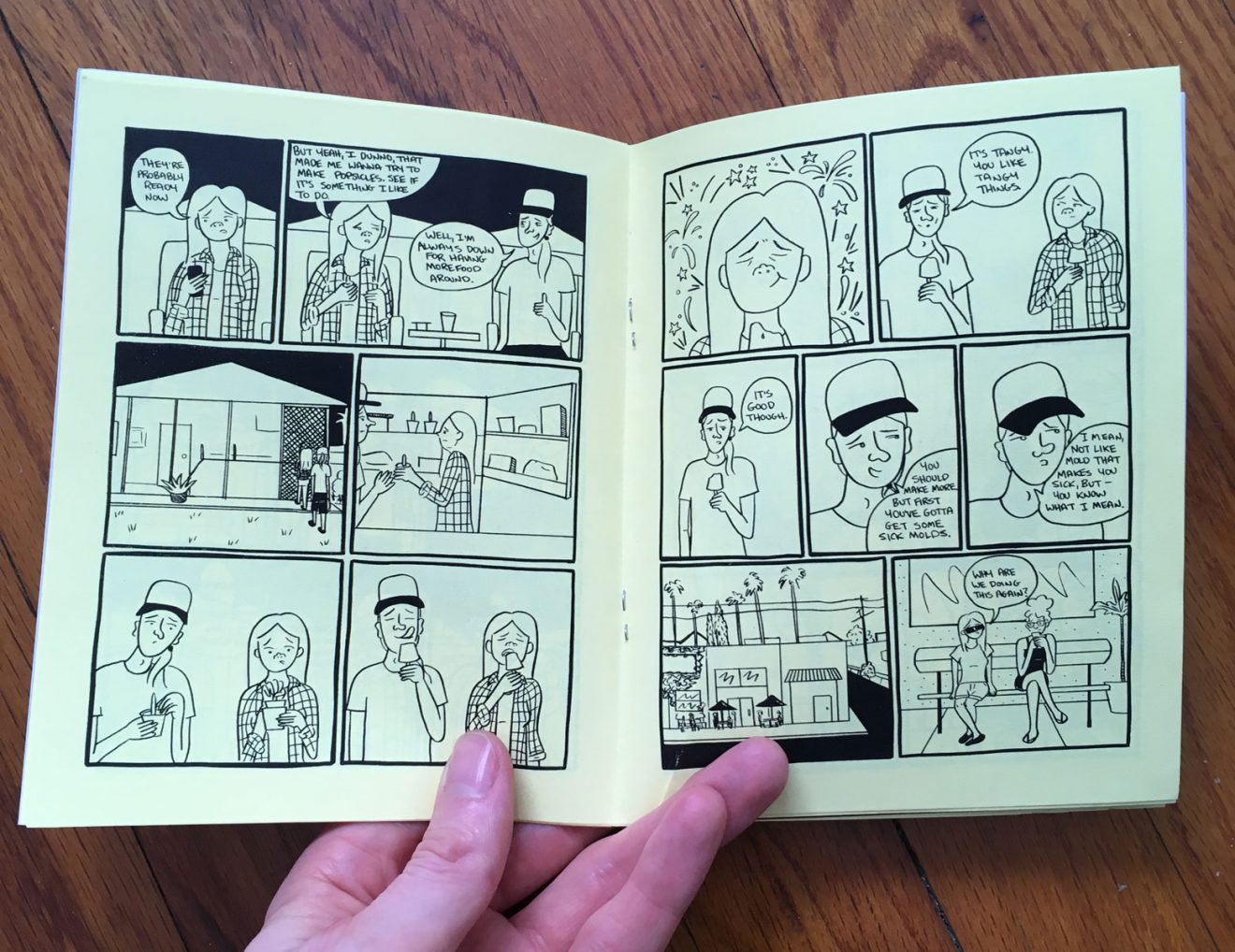
There's a panel where Claire made her popsicles out of different kinds of fruit, she tries it and fireworks go off around her head. It's a brief, sublime moment. There's that moment of possibility that's then spoiled by her boyfriend and her awful boss, but it's a memorable moment nonetheless. A Shark Tank-style reality show introduced toward the end makes me think the comic will go in that direction, but even if it doesn't Taylor's wry comedic chops are on display here, as her send-up of popular and youth culture in general is sharp. She's really locked into her style as an artist as well, with expressive faces that center around lips and eyebrows. There's a smooth confidence to her work that can be seen all-around in her page design and backgrounds. In a comic that's mostly talking heads, her ability to make create compelling expressions was the key to the comic's success.

Tuesday, September 26, 2017

Minis: M.Hoey & P.Hoey, C.Cass, W.Taylor

Time for some more mini talk:

Coin Op: Project Gemini (Musical Twins) and Coin Op: Chuck Berry's Revenge (Afro-Futurist Re-Mix), by Peter & Maria Hoey. The Hoey siblings have always been interesting in exploring music on the comics page, and their "45 RPM comics" are shaped like the old 45 sleeves: an aesthetically pleasing square. Project Gemini is one of their comics that combines historical research and straight-up illustration, juxtaposing interesting anecdotes about famous musical twins with vintage imagery of casinos, countrysides and gas stations that all use a twin theme.

On the other hand, Chuck Berry's Revenge is hilariously deranged, working in themes, quotes and lyrics from a number of artists into this unexpected sequel to Back To The Future. As you may recall, Marty McFly passes off Chuck Berry's work as his own, to the point where Chuck's "cousin" Marvin plays him some of the music. We see the other end of that conversation, as a furious Chuck slams the phone into the wall. However, he seeks out avant garde jazz maestro Sun Ra, who sends rock pioneer Ike Turner with him to alter the course of history. Turner kills Henry Ford, uses his assembly line idea, and becomes America's premier industrialist, only with a diverse workforce. Chuck goes back to 1955 and seduces Marty's mom ("she's too cute to be a minute over seventeen"), causing Marty to disappear. This twelve-page comic features an avalanche of ideas, jokes, references, puns and history, and it's astonishing just how much havoc the Hoeys wreaked in the course of the story. The mix of naturalism and psychedelia (the "Afro-Futurist Remake") were perfectly balanced for a comics story, as both made sense right away, given the story's absurd premise.

The Once Great Auk, by Caitlin Cass. As far as Cass's comics go, this one is pretty grimly straightforward. The Great Auk was a bird that had no natural fear of man, was plentifully found on small islands, and exceedingly easy to kill. It was like they were a litmus test for humanity's capacity for mercy that it wildly failed. With each page a single panel, Cass zeroes in on the escalating hilarious and horrible circumstances surrounding the eventual total extinction of this species. Cass indulges in some detailed cross-hatching in this comic, emphasizing the utterly benign quality of the bird and its utter lack of a survival instinct. From an evolutionary perspective, it's a simple case of a species getting wiped out because it had no way of dealing with its predator. From a human perspective, it's an extreme example of the way we take advantage of nature without fully thinking of the consequences, like an exceedingly long game of killing the goose that laid the golden eggs.

Fizzle #1, by Whit Taylor. Taylor has really come into her own in the past year or two doing autobiography and journalism. This series represents her best slice-of-life work to date, and she really stands out in terms of character design and expression. Always great at drawing side-eye and creating expressions with scrunched-up mouths, Taylor really goes to town with those expressions in this comic in panel after panel. In a story that's mostly a series of talking heads, Taylor creates action and tension in each panel because of the frequently seething and hidden character of emotions that are hinted at by facial expressions. This story follows a young woman named Claire who is questioning her life's choices. She has a stoner boyfriend with a rich family that he's rebelling against, finding him complaining about having to hang out with his dad and brother at a posh steakhouse. She has a job at a boutique tea "lounge" with a hilariously obnoxious boss named Poppy who is obsessively focused with her business. Her glasses and sort of mop-top haircut are a great example of the way Taylor used character design to sum up her characters without saying a word. This is a character who isn't suffering: she has a job, a relatively cushy life and a boyfriend--yet it's clear that she's deeply depressed, her life the titular "fizzle" as she has no creative outlet. The verisimilitude of the dialogue and the story's tiniest details are elements that help it stand out, as well as variations in page design that reflect Claire's disorientation and ennui. The cover image reflects the overall cleverness of the comic. It's exciting to see how Taylor has come into her mature style as an artist and is doing it across the board with all of her various projects.

Friday, July 14, 2017

Introducing High-Low Intersection: #1: Whit Taylor Interviews Miranda Harmon

Welcome to the first edition of High-Low Intersection, an occasional (and hopefully soon to be regular) feature that will highlight reviews, essays and interviews by other writers about comics, specifically for this site. They will be posted on High-Low's regular blank day (Friday) when they appear. There are so many excellent writers about comics and too few of them have a regular outlet for their work. On to our first feature: artist and writer Whit Taylor interviews up-and-coming cartoonist Miranda Harmon.
**
Miranda Harmon first caught my attention a few years ago on Tumblr. Her cute, but fierce character design, paired with her relatable one panel comics and autobio stories about feelings and relating to the world, show a young cartoonist with a fearlessness towards tackling the trickier parts of being a human. I recently spoke with her about how she got into comics, her process, and what she’s been up to lately.


  1. What’s your comics origin story? (aka. When and why did you start making comics?)
The first comics I remember making were heavily inspired by Garfield, my first obsession. I was around age 8 or 9, and my main character was named Marie, and she was a blue cat with Powerpuff Girl eyes. She was in love with a cat who was named after a boy from my school who I had a crush on!
       
I started drawing journal comics when I was in my senior year of high school, and they’re all very embarrassing now. I was introspective in the same way all 17-year-olds are. Then I went to Goucher College and studied fine arts and art history, expecting to go into academia or curatorial studies. While I was there I learned about indie comics.

I went to NYCC in 2011 and met some webcomics people, and it seemed like a good time. Then I went to my first SPX in 2013, and I started to make comics friends through twitter. That sealed the deal for me! I was surprised that I could participate as well as be a fan, and I was so happy to find a community.

Even though I wasn’t published, nobody could stop me from making zines and that was exciting to me. I liked that comics was separate from my academic career, in that way it felt like I had control over this new part of my life. My professors were supportive but didn’t know what to tell me, besides to keep going.


  1. It seems like in the last year or so, your comics have exploded in popularity, especially on Tumblr and Twitter. What do you attribute this to?
In late 2015 I finished a long, sincere journal comic about an experience I had with a podcast. I miscalculated and thought that nobody would care about that comic, but it turns out a lot of people connected to my story. After that I started to get more opportunities and eyes on my work. It feels like I’m oversimplifying but I really do look back on that one comic and the response to it, and I think that was a turning point for me.

I became much more confident about sharing my work after that. I started to believe in myself as an artist. For the first time making a comic made me feel powerful and strong, and I want to keep chasing that feeling forever.  


Whit: Are you referring to Harmontown?

Yep, that’s the one!

  1. Much of your work focuses on your emotional realm, including self-worth, relating the outside world, relationships, and mental health. What has your experience been with sharing this publicly, both for you and others?

When I make quick journal comics in my sketchbook, I try to make every part of the process as easy and fast as possible. Part of that is trying not to worry about any audience reaction. I feel like that way I am able to be more honest.

But when I sit down and spend time making something with more intent, it can be difficult because I don’t want to hurt anyone with my work. In one journal comic, I show myself explaining to a therapist that I feel, “rotten.” After I made this comic and put it online, a friend who almost never reads any comics at all sat me down and, crying, told me I’m not rotten and that she was worried about me. I was surprised because I nearly forgot that when I put a comic online, it can be read by anyone! I still think that when I make something it’s only for me and a handful of my friends to see, but the reality is different.

I haven’t made anything yet about real people in my life hurting each other. That’s something I want to do in the future and something that has the potential to really harm those close to me. I don’t know how to best proceed but I think I’ll have to find a way. Autobio doesn’t need to do the same thing for everyone, and I’ve used it as therapy as well as a way to gain some control over how I am received by the world. Both of those are valid but I think I’m at a point where I’d like to do more.
       
All of my favorite autobio stories are full of conflict, and I know I can’t keep making stories about just my own feelings about myself forever. If I’m being honest about my life and the stories I want to tell, they will be full of messy relationships and embarrassing, horrible moments. Lately I’ve been thinking a lot about work by MariNaomi, where she shares her romantic history. I think those stories are fascinating and have a real impact on people, and I want to work towards sharing my own life like that.  


  1. Your artistic style is really charming! I like how it combines thoughtful character design with simplicity. How did you develop your style?

Thank you! I like to draw quickly and I’ve tried to build a visual shorthand that works for me, and I really think I just copied everything I love to look at.

I fell in love with webcomics in the mid 2000’s! The first webcomic I ever read was called VG Cats by Scott Ramsoomair. It was a comic about video games and the two main characters were anthropomorphic cats. I never play a lot of video games so I didn’t get the jokes, but I remember copying the drawing style when I was 14 and something new clicked. It’s been a long time but I think it’s still there in the way I draw! Is that embarrassing? I can’t tell! Sorry to Scott Ramsoomair if he ever reads this.

Luckily I found a lot of different webcomics and each one felt like a little place I could go, and almost none of them were about video games. I spent a lot of time reading KC Green’s work and I still look at my copy of his book, Anime Club, when I want to draw something important. I was also influenced by the comics of Meredith Gran, Magnolia Porter and Kate Beaton. The Internet was an incredible resource when I was a teenager. There were always new things to learn and I could go look at these artists’ work and study it as long as I wanted to.

The book that most changed the way I draw and think about drawing is Joann Sfar’s The Rabbi’s Cat. I bought it in college and read it over and over. It’s full of all these panels like little chaotic worlds that work perfectly. I’m also in love with Sally Cruikshank’s work. Honestly there are so many great illustrators who I owe a lot to, I could keep listing names for a long time! Especially Tove Jansson.


  1. You recently graduated from SAW (Sequential Artists Workshop). What was your experience like and how has it influenced your comics making?

SAW was really perfect for me! I didn’t go to art school but by the end of my undergrad experience I wished I had. When I graduated from college I knew what I wanted to do and didn’t feel like I had spent any time preparing for it. Luckily I went straight to SAW right after Goucher College. I’m from Florida so it was nice to live close to home.

My classmates who I spent all year with were incredible and from all different ages and experience levels. I learned a lot from them, and we had a good chemistry as a class.

Tom Hart, the main teacher and founder of the school, is a big influence on me. He’s a great cartoonist but also a great person, and it was a big deal for me to watch how working artists actually live. During my year at SAW I was able to think a lot about what kind of person I want to be. I learned that I love being part of a community and I can’t do this alone. I want to be the kind of person who brings people together and helps others. I will never forget that Tom told us once, “The best reason to make comics is to show those fuckers.” I think about that every day and it helps guide my work still.

Gainesville was the last place I lived before I moved to LA, and while I don’t regret moving at all, it’ll always hold a place in my heart. I spent ages 22-24 there and I feel it’s where I finally became a person who I’m proud of.


  1. You recently moved to Los Angeles. How are you liking it?

I love it here more than I thought I could love living anywhere! I’ve never lived in a big city before and I’m excited by how much there is to do and how many people there are. I’m tired all the time because I need to work a lot and I feel like I’m always on, but I can tell that even though I’m not producing as much work as before, I’m thriving.

The other day I was on top of my friend Heather’s roof, the sun was setting and it was cool and windy even though it’s the middle of June. The sunsets here are so unbelievable. I could see Griffith Observatory, and the Hollywood sign, and everything, and I kept asking myself in my head over and over if it was real. I knew I wanted to live here for years, and it was a big jump. I’m lucky to have so many people supporting me.


  1. What are some of your hopes and goals going forward with your comics?

I want to really sit down and work on a longer fictional narrative. I love making autobio work and I don’t want to stop but I want to get better at fiction. I have some ideas and I’m a little afraid to begin, but I know I need to take those steps! I think I’ve gotten away with doing what comes easy for me for a long time. There’s nothing wrong with easy but I want to stretch more and get stronger in other areas.

  1. What comics are you reading right now?

Currently I’m reading Ariol, the Three Donkeys by Emmanuel Guilbert and Marc Boutavant, and Spaniel Rage by Vanessa Davis. I love Vanessa Davis’ work, I am very inspired by the way she draws and records her life. I also just read through all of Octopus Pie by Meredith Gran again because it ended. Octopus Pie is my favorite comic ever made, I can’t stop thinking about it!

  1. Do you have any upcoming projects you can share with us?

Not really! In the past year, I’ve been focused on moving and surviving. Unfortunately, I’ve pushed my personal comics work to the back for a little bit, but I feel like I’m finally stable enough to get back on that horse. I’d like to make a new minicomic before OC zine fest in August. I’m thinking it’ll be about a monster who goes to an important business lunch and messes everything up. I’ve also working on a couple of webcomic ideas that I’d like to get started before too long, and I have a picture book idea that I’m developing. And of course there’s also always journal comics I want to make, I really want to document this time in my life as best as I can because I want to remember it and process it fully.

  1. What advice would you give to fans of your work who are looking to make their own comics?

People should come before work if you can help it. When you’re making friends, find your peers instead of chasing down your heroes. Keep reminding everyone that you exist by making comics and showing up. It can feel lonely at first but in my experience people respond to sincerity and kindness. Really listen and get to know people and draw from your own experiences when you make comics.

I would also say that it’s not the worst thing in the world to make a bad drawing! It can be intimidating because when you put something out on the Internet, there’s the potential for a lot of people to look at it. But don’t let that scare you away from making things. Everyone at some point has looked back on old work and felt embarrassed. The best thing I made a year ago makes me cringe to look at now and I’m prepared for that to always be the case!

Wednesday, September 28, 2016

Minis: H.Newlevant, W.Taylor


Wallpaper, by Whit Taylor. Taylor's writing and conceptual design continue to grow sharper and more sophisticated. While the small size of this mini was a printer's mistake, it wound up being a fortuitous one. Told from a childhood point of view, the left side of each page is text and the right side is a beautiful, decorative and emotionally resonant wallpaper pattern or some other kind of visually significant pattern. The book's smaller size makes it feel more like a child's book. There are a series of events detailed by Taylor that slowly coalesce into a narrative about her grandmother's increasingly failing health. However, the story is really about the ways in which certain details are important to children on an emotional level that adults simply don't perceive. Indeed, the very title "Wallpaper" colloquially refers to the sort of bland, background decoration that's ignored on a day-to-day basis. Taylor highlights these decorations in a way that is both functional in their depiction and genuinely beautiful as they appear on the page. Her use of color is vibrant without being lurid, and it truly gets across why a child would notice certain colors and patterns. Not all of them are of wallpaper; there's a microscope slide, a piece of pizza and other things appreciated for their aesthetic, rather than their practical value. Even the boring patterns--like the beige the mother in the story ultimately picks out for the kitchen--have emotional resonance. The child was upset by that choice because it was boring, but what she was really upset up was the death of her grandmother, who had a bright color sense. Concealing an emotionally complex story in a simple package is what gives this mini its punch.

Tender-Hearted, by Hazel Newlevant. This is a thoughtful collection of short stories about relationships and identity. "Finding Place" is the standout of a strong collection, as Newlevant uses a beautiful watercolor wash in a story that connects her sexual identity with her budding interest in comics. The crux of the story is experiencing the difference between a theoretical and even intellectual understanding of identity with the actual experience of that identity. It's about the missteps that can be involved with that exploration, like putting identity ahead of human empathy. However, it's also about the importance of visibility as a creator, passing on information to younger creators or fans desperate for material that speaks to them, embracing both the responsibility and opportunities such a position provides.

"Apt #105 381 Troutman Street" is about being in a relationship with a self-harming individual, juxtaposed against the simple recitation of the contents of the titular apartment. It's as though the events unfolding before the reader's (and the narrator's, presumably) eyes is simply too much to take in, so there's a default back to simple, context-free description. "Enough" is a story I've reviewed elsewhere, though it obviously fits in seamlessly here. It's about emotional manipulation in a relationship where she was a caretaker, creating dangerous power imbalances and overcorrections. After that black & white interlude, Newlevant returns to color (one of her strengths as a creator) in "Bi-Furious", a story about a conversation she had regarding bisexuality with her mother. It's all about the concept of bi-erasure, and wondering that if she had lived in an earlier era, would she have had the courage to act on that aspect of her sexuality? Newlevant brings up a variety of bi women from recent history as examples, which is all part of Newlevant's larger project of exploring women's sexual identity throughout history, particularly in the arts. What I liked best about this story is Newlevant's willingness to honestly engage with the issue despite its hurtful premise, resulting in a discussion that sheds light (not heat) on the subject. Newlevant's figure drawing is appealingly fuzzy here, though there were times when the way she and mother looked stiff and posed, especially with regard to each other in space. This was surprising, because Newlevant's other figure work looks much more natural and fluid. I'm not sure if this effect was intentional, but it did feel a bit jarring.

Wednesday, August 3, 2016

Minis: K.Berry, R.Hendricks, W.Taylor


Spank, by Kitty Berry. Berry is a talented alum of the Minneapolis College of Art and Design, and this violent sexploitation comic is a love letter to high-voltage women's revenge/ass-kicking movies. The closest comics analog is the kind of material Katie Skelly has been doing of late with her Agent 8 comics, creating a feminist context for highly stylized (and stylish) violence and character design. Berry's character design has a rubbery quality to it, with exaggerated curves, absurdly accented lips and an emphasis over suggestion of form and action rather than a naturalistic filling out of character. Berry also favors dramatically staged shots, like one where the titular Spank is standing over a soon-to-be-ex-boyfriend who had just tried to kill her, pointing a gun at his head. The skewed perspective (essentially a ground-eye view that focuses as much on his smarmy expression as it does her gun. Other than one two-page spread which expresses Spank's humanity and vulnerability in assuring her client that she'd bring back her missing daughter, the book is full of posing, attitude and assured bad-assery. The Quentin Tarantino influence I see in the comic is likely as much an artifact of films that influenced him as it is the influence that the director may have had on the cartoonist. This first issue has some problems (the fight scenes are stiff and there's a general lack of fluidity throughout), but it's otherwise a delightful, over-the-top set-up for something potentially far more explosive.

Passing, by Whit Taylor. While this is just the first chapter of a longer story, Taylor touches on topics rarely explored in comics. The concept of "passing" refers to a person of color whose physical characteristics allow them to pass as Caucasian. It's a reference to the ways in which how dark a person of color is can affect social standing and overall levels of privilege, as well as the complicated nature of multiracial identity and politics. This comic starts with a young woman looking for an older woman who may have been a friend of her mother's, who was a person of color. The frigid response she gets is enigmatic on the one hand (and I assume the specifics get explained later), but it's obviously related to race and shame. Taylor plays to her strengths here, focusing on character design (the details related to clothing are especially important and telling) and facial expressions. This comic isn't bold simply because Taylor addresses race in a way few comics do, but because the vividness and realistic qualities of her characters provide a perfect platform.

The Washington Tragedy and Stranger Two Stranger, by Robert Hendricks. Hendricks uses a dense, naturalistic style to relate historical fiction and and quotidian encounters. The Washington Tragedy is about the assorted questionable activities of Daniel Sickles, a mid-19th century congressman. It speaks to one eternal truth: where there are politicians, there is scandal. Sickles was a known philanderer, yet it was his outrage over his own wife's affair that led him to hypocritically react in a wounded and morally outraged manner. In this first part, Hendricks establishes Sickles as a corrupt member of the Tammany Hall political machine who married a 16-year-old after being involved with a prostitute for many years. With a penchant for dense hatching and cross-hatching, Hendricks does well in creating atmosphere and dread. Stranger Two Stranger is not unlike the Julia Wertz-edited anthology I Saw You, taking Missed Connections ads from Craigslist and turning them into comics. Most of them are on the literal side and not especially interesting, but Hendricks does come up with some interesting compositions, like "Would You Like My Umbrella", which goes the extra mile in creating atmosphere, with the best panel being a picture of a woman wearing glasses, with the lenses entirely covered with drops of water.

Thursday, June 23, 2016

Foxing Reprints #2: Whit Taylor

Continuing my reprints of columns I did for Foxing Quarterly:

The Anthropologists, by Whit Taylor (Sparkplug Comic Books).  Virginia Paine was Dylan Williams' employee at Sparkplug Comic Books and is now the publisher after his death in 2011. After a long period of adjustment where Paine co-published along with Tom Neely and Emily Nilsson, Paine is now in the process of putting her own stamp on one of the more eclectic and unpredictable catalogs in comics. Apropos with regard to cost and her sphere of interests, she's launched a Sparkplug Minis Series as an official complement to some other recent, shorter releases. 

Sparkplug has long been a place where young cartoonists are chosen because of their promise and given the opportunity to become better in the public eye. As such, Whit Taylor's The Anthropologists is a perfect selection for this series. The comic features Taylor's autobio stand-in character Wren during her college days, when she traveled to western Australia as part of a study abroad program. The idea was to study and talk to Aboriginal people as part of their cultural anthropology program. Paired with a hyperenthusiastic fellow American student and filled with ambivalence about the trip, Wren's anxiety is really just an expression of her own cultural, racial and identity issues in microcosm.  

In such an experience, one might expect to become close to a fellow student in such a situation. Instead, Taylor shows Wren and the other student, Miriam, as being opposites in nearly every imaginable way. However, their contrasts become more complicated and interesting than simply overly enthusiastic vs ambivalent. Wren is ambivalent about being shown an Aboriginal sacred space as though it were a vacation destination and is even more uncomfortable with getting a photo taken with a wanjina (an Aboriginal symbol). Miriam was constantly peppering people with inappropriate questions and was clearly bothered that Wren didn't share her enthusiasm. In the parlance of the comic, Miriam was comfortable treating the Other as the other, meaning that as an anthropologist she was distinct and separate from her subjects. On the other hand, Miriam wouldn't commit to doing things that actual Aborigines would do: going crabbing, eating whelks, hunting lizards, etc. This was partly because she was a vegan, but the implication here was that these activities were too immersive for her. 

For Wren, doing these things gave her a chance to talk to people in the context of their daily lives, ask them their feelings about how Aborigines are treated, and generally step outside of the comfort of her daily life. When she meets some young women at a party and they say she looks like "a Broome girl", this means that she looks like she's of mixed race, just like many people in the city of Broome. Taylor suggests that it was easy and natural for Miriam to draw a line between herself and the Other, given that she was white. For Wren, who noted that she was racially mixed, drawing that line was much more difficult, especially given the history of racial oppression both in the US and Australia. At the same time, the struggles she had in the book reflected the difficulty she had identifying with any group in particular. 

Taylor gets at these revelations with a great deal of subtlety and humor. Even though Miriam is kind of a ridiculous character and acts as comic relief for the reader, Taylor still treats her with some degree of sympathy. She's depicted as a person, not the embodiment of every American cliche'. Wren's struggles are similarly presented as neither the correct nor incorrect point of view. Instead, it's all about learning to ask the right questions about oneself and the world. Most of all, the way that their guide, Terry, is depicted is fascinating. He's clearly reserved about revealing details about himself, something that Wren respects but Miriam doesn't. He's as much the Other as the Aborigines they meet. 

Taylor's line is crude but functional. Her character design is solid (the way she draws upturned mouths is especially effective in expressing mood) and she has a decent grasp of body language. There were times when it seemed like she wanted the reader to get a sense of the environment, but her chops weren't quite up to drawing lush background scenes. Instead, Taylor stuck to what she could comfortably draw and focused more on character, concepts and nuance. Taylor continues to be an excellent writer and smart cartoonist who is becoming increasingly proficient in working around her limitations as a draftsman to create sophisticated and contemplative work.