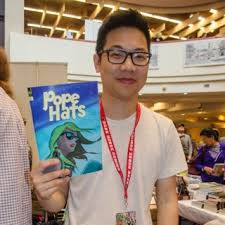
Here are a few more minis from CAKE:
Bug Boys #14, by Laura Knetzger. Knetzger was on my "Place As Character" panel, and I chose her specifically because of the way the forest has taken on an ever-expanding role in this gentle YA series about two bug friends who are slowly finding their way in the world. This issue is a perfect example of the way that Knetzger invites her audience to explore a new space, feeling the rush of excitement and mystery that this new environment has to offer. While the Bug Boys adventures are always fun, the series really is a kind of philosophical diary for Knetzger about identity and growth. This issue starts with the newly-crowned Queen Bee visiting the Bug Boys' village; she was the new queen in part because of the bravery of friends Stag-B and Rhino-B. The issue begins with a simple question of what's in a name, as she's called either the Queen by outsiders or Mother by those in her hive, but had no name for friends.
Apropos of the theme of exploring a new environment, the bee and the bugs take a spill from the top of a raspberry bush and wind up in its root system. Exploring the tunnels together, they happen upon a central chamber that has a giant gem with roots coming out of it. The Queen suggests that maybe it's the soul of the bush, which leads to a discussion about whether plants have souls, and how the queen thinks of herself as the soul of her hive. That's not just in the case of her own individual agency having precedence over everything, but rather imagining her agency as part of the entire hive's needs, wants and dreams. When they emerge from the tunnels (unscathed; there is rarely real danger in this series, and when it happens, it's dramatic because of its typically gentle tone), one of the boys says, "Goodbye, Soul!", and there's a beautiful sequence where the Queen is taken aback in one panel, then realizes the profundity of this statement and is filled with love. This sequence worked in part because Knetzger is not only increasingly confident in her line, but she's also increasingly elegant as well. The Queen is just a lovely figure to look at: graceful, poised and confident. Knetzger's cartoony but naturalistic line, paired with zip-a-tone to give the world depth and texture, allows the reader to easily interact with the characters but also enjoy the majesty of the environment.
Malarkey #2, by November Garcia. Garcia is my favorite new autobio cartoonist, especially given the way she's able to navigate humor and poignant moments with equal aplomb. Malarkey is her catch-all comic where she collects her four-panel gag strips that center around her family, her husband, comics, and life in general in the Philippines. Her mother is perhaps my favorite character, especially in the way Garcia draws her. The glasses she wears obscure her eyes, which I imagine is a deliberate distancing technique for a character that Garcia depicts as odd, abrasive, in-your-face and frequently larger than life. That distance also sets up her storytelling ability, like in a series of strips where her mom describes her childhood. She told the story of "Uncle Doctor", whom her mom hated, because he was a helicopter parent who micromanaged everything they did. Even as an older person, Garcia ably depicts her as a total free spirit, unconcerned with mores and custom in many ways. That wasn't always a good thing, as in the course of their conversation her mom told Garcia about the racial slur she and her family used to refer to her cousin by, as well as her husband on occasion!
Observing these strips carefully, Garcia does something interesting visually to add a bit of context and activity to what is essentially a two-talking heads strip. First, she changes the pose of both of her characters in each panel, carefully adjusting poses them so as to better relate body language. Garcia also adds food and drink in each panel, giving the characters something to react against and giving the reader's eye something else to look at, but it also works on a sequential basis, like when Garcia does a spit-take at the end of one panel. Garcia also loves exaggerating facial expressions in particular, with wide grins, wrinkled-up expressions of fear, and almost sad-clown type frowns. She also captures the fact that her mom is the kind of person who speaks with her hands, so her arms are flying in every other panel.
There are also various strips about drunk adventures (a wine-and-cheese festival was especially amusing) and comics. Being in the Philippines, Garcia naturally feels quite distant from the North American comics scene, so seeing her do strips about listening to podcasts where her comic is mentioned or fantasizing (positively and negatively) about what going to CAKE would be like have that element present in all of Garcia's comics: an element of pure joy & excitement about life balanced with anxiety and in particular regret for things she hasn't actually done yet. That element adds a certain tension to these strips but doesn't dominate it, as her enthusiasm for life is still the dominant element in her work, and it's the engine for her sense of humor.
Dreaming Of Johnny, by Sophie McMahan. This is a collection of reprints from McMahan's outstanding You Were Swell series as well as a few other stories I hadn't seen before, all printed beautifully on a Risograph. The colors make the original strips pop even more, like "Winner"'s beauty-pageant nightmare. McMahan explores 1950s romance comics and advertising art in her work, and the candy-colored quality of the riso's coloring adds to that sense of the grotesque as she subverts that imagery. In "Please Go", she uses ornate, immersive lettering to say "Wondering when this empty feeling will leave/I hope it's not here to stay" in a posed family photo of three girls. Their eyes are blank in both shots, with what looks like tears or vitreous humor being forced from their eyes.
McMahan explores body dysmorphia through body horror, like multiple eyes on a beauty-queen type, teeth falling out and faces & bodies warping through distorted self-perception. It's also a brutal satire on societal norms and expectations creating an unobtainable image and idea of what one's self-worth should be like. "Lothario From The Black Lagoon" is perhaps my all-time favorite comic of hers, as the titular monster is depicted as a sleazy guy using tired pick-up lines like "Come here often?" and concludes by saying "Another day, another girl. You now how it goes." There's almost a sense of resignation in his own sense of emptiness and alienation, even as he takes advantage of women by saying all the right things. McMahan has a powerfully realized aesthetic that she's refined even further in this comic, one that addresses her own internalized feelings of worthlessness as well as the societal forces that shape them. Her comics are an innovative way of externalizing those feelings by subverting the very kinds of images that helped to create them.
Showing posts with label sophie mcmahan. Show all posts
Wednesday, June 28, 2017
Tuesday, June 6, 2017
Ten Artists To Seek Out At CAKE 2017
I will be attending the Chicago Alternative Comics Expo (CAKE) this Saturday and Sunday, June 9th & 10th. I'm excited to meet a number of Chicago-area artists for the first time, and of course will be looking for comics for review. On Sunday at 3pm, I will be moderating a panel titled "Place As Character", featuring the artists Emil Ferris, Laura Knetzger, Sophie Goldstein and Mita Mahato. All panels will take place on the third floor of the Hoover-Leppen Theatre. CAKE has a tremendous amount of talent, perhaps the most per capita of any American art festival. This is a show with special guests like Gary Panter, the explosively popular Emil Ferris, Simon Hanselmann, Kevin Budnik and many more. Here are ten artists you might be less familiar with that you should consider visiting if you attend the show.
1. Haleigh Buck (Table 315). This autobiographical cartoonist from Baltimore is making some of the rawest, densest comics about dealing with mental illness as part of everyday life, including how she dealt with an enormous breakdown. Her naturalistic style has a surreal edge to it and she maintains a wicked sense of humor throughout.
2. Chris Cilla (Table 205). His book The Heavy Hand is one of my favorite comics of all time, fusing a variety of styles together seamlessly to create a psychedelic, hilarious journey that defies all of the genre conventions that the book explores. His minis are also excellent, creating his own brand of underground comics that acknowledge all of their forebears without being beholden to any one in particular.
3. Cathy Hannah (Table 410). Hannah is another autobio cartoonist who writes about the intersection of the personal and political in interesting ways. She spills a lot of ink in delving deep into her own mental illness issues, her feelings about relationships and documenting her own therapeutic breakthroughs in real time. She uses an inviting, cartoony style to tell her stories.
4. Sophie McMahan (Table 403). Ever since one of her comics appeared in my mailbox, I've been astounded by the sophistication of her critiques of beauty, image and the male gaze through the use of body horror and distorted versions of 1950s-style advertising illustrations. Every one of her comics is both aesthetically beautiful and thematically challenging.
5. Carolyn Nowak (Table 505). She's doing some fantastically funny comics about sex, gender identity, culture and intimacy, with her recent Diana's Electric Tongue especially notable. A winner of the Ignatz award last year, her comics have a sense of lived-in warmth that's part of her sharp critiques. Her work is questing, curious, warm, funny and extremely smart.
6. Ben Passmore (Table 307). He just earned an Eisner nomination for his breakthrough short comic Your Black Friend, a pointed meditation on racial alienation. However, his other comics, like his postapocalyptic-autobio series Daygloayhole, are every bit as provocative, dealing with issues like addiction, isolation and connection, told with a weary sense of humor and razor-sharp intellect.
7. Ethan Rilly (Table 405). Rilly's Pope Hats series is one of the best things going in comics. Its serialized storyline about a law clerk named Frances features characterizations that rarely found in comics, gorgeous character design and an unerring ability to use stillness and pauses as a key part of his storytelling. His comics are subtle, beautiful and immensely satisfying.
8. Yumi Sakugawa (Table 220). This is an artist whose sharply-observed observations about art and gender dovetail beautifully with her sense of composition that makes extensive use of negative space. There's also a slightly exaggerated sense of reality to be found in her comics, often mediated through her frequent use of a reserved or deadpan narrative voice. UPDATE: Yumi Sakugawa has cancelled.
9. Eric Kostiuk Williams (Table 510). Williams' gained a lot of notice with his Hungry Bottom Comics series, a comic that mixed autobiographical essays about being young and queer in Toronto with surreal dreamscapes. Williams' potent mix of incredibly fluid draftsmanship and a probing mind helped get an Eisner nomination with his recent Babybel Wax Bodysuit, and his recent Heartbreak Condo Disco from Koyama Press.
10. Jenny Zervakis (Table 105). It's a conflict of interest to suggest that her debut collection of Strange Growths could very well be the book of the show, given the fact that I interviewed her for a section at the end of it. However, I'm not the only one eagerly awaiting this book that collects the first 13 issues of her minicomic, mostly from the 90s when she was a publishing mainstay. That John Porcellino had been planning to do this kind of collection for years speaks to the respect he has for her work. Her thin, penciled line tells stories that are poetic, still, funny and sharply observed.
Thursday, July 14, 2016
Foxing Reprints #8: Sophia McMahan, MariNaomi, Liz Valasco
You Were Swell #2, by Sophia McMahan. This comic reflects McMahan's interest in exploring alternative meanings in 1950s-style advertising art and romance comics. In particular, she's interested in the dichotomy between beauty as a social construction and the feelings of self-loathing that undermine one's own self-image. She also takes dead aim at the ways in which men are more frequently exempt from this self-destructive cycle and help perpetuate it, like in strips such as "Lothario From The Black Lagoon". This is a hilarious bit of satire featuring the sea monster from the titular Black Lagoon schmoozing and seducing woman after woman with cheesy pick-up lines like "Do you believe in love at first sight?" "Escape" talks about McMahan's own attempts to distance herself from her need to compare herself to others, in order to avoid plunging into the inevitable depression that this creates. It's accompanied by trippy images of blank-eyed women with a third eye, a four-armed devil woman, and other externalizations of her negative feelings.
Speaking of which, "Good To See You' is a devastating story that initially consists of blandly pleasant-looking people sharing inane conversational pleasantries. ("Wow you look great! It's been so long", "Thank you, how are you?" accompanied by cheerful if slightly blank faces. The last page of the story consists of one of the characters rearranging her face until it distorts into unrecognizable, inchoate flesh. McMahan specializes in this kind of body horror, the sort that gives an image to the sort of silent scream one can never unleash in such situations when one is expected to act in certain ways.
"Slip Away" and "Please" talk about fears regarding being hurt, being exposed and even fearing the experience of happiness, given that it will inevitably will slip away. It's less a sense of catastrophising one's negative feelings and instead being a realistic barometer of the way things are. Vulnerability is hard, and being rejected is painful. "Please" depicts two boxers sparring with text like "Please don't be mean to me" floating inbetween punches. It's a visceral way of getting at those feelings, both in terms of receiving punishment but also dishing it out because of a fear of being hurt. McMahan then turns around in "Are You Lonesome" and draws cheesecake beauty pin-ups with scales and webbed hands, challenging the male gaze and just what it is we mean when we say that we're lonely. Her subversion of the concept of beauty and what it entails emotionally, her depiction of the difficulty of communicating in a meaningful way, and her own willingness to graphically grapple with her own self-loathing make her comics quite a powerful experience.
The Seeker, by Liz Valasco. This is a delightfully creepy piece about a tween girl who slinks around her neighborhood, looking for a mysterious box and hiding it from a neighborhood boy. It has all the elements of being a cute Halloween story until shit gets real in its climax. What's interesting about this surprising culmination of ritual and belief is that things don't backfire on the protagonist. Indeed, the end of this comic promises more of a quest for truth and meaning than the typical reasons people try rituals, though the girl is not above scaring the boy she encountered earlier. Valasco's think line, cute but naturalistic drawing style and use of a strategically-applied blue wash make this a an intriguing comic to look at as well as read. The page where the contents of the box come out is made all the more effective thanks to the use of dense hatching and cross-hatching, creating a genuinely unsettling atmosphere.
Great Heights, by MariNaomi (2D Cloud). This small mini came as a reward for those who subscribed to 2D Cloud's yearlong book subscription service or who ordered her book Dragon's Breath.. The window for joining that subscription has now passed, but I wanted to note that this little eight-page comic has an eerie charm. It's about a visit to the World Trade Center that MariNaomi made in 1998, where she and a friend went to the top of Tower 2. She notes that pressing up against the glass made it feel like she was falling, which was a secret fantasy of hers. The final image of the mini is that of a tiny airplane. It goes without saying that this fantasy could not encompass the horror of the events of 9/11, which makes that flashback juxtaposition so interesting, especially as rendered in MariNaomi's minimalist style.
Wednesday, September 25, 2013
Minicomics Round-Up: Roberts, Sharpe, R.Smith, Fleener, McMahan
There's no through-line in the minis reviewed in this column this time around, other than I found them all to be quite good.
Powdered Milk #11, by Keiler Roberts. This mini is an especially sharp and subtle bit of storytelling. Roberts has been doing comics about being an artist and a mother for a few years now and hasn't flinched in detailing her struggles with post-partum depression along with the ups and downs of being a parent. This issue is a tightly-drawn series of rapid-fire comments from her toddler daughter, and while many of the comments are hilarious and played for laughs, it's clear that Roberts is drawing these comics as a way of letting off steam as well. Having your child yell at you, hit you, bite you and just do inexplicably destructive things is maddening Children are also quite intuitive and can pick up on emotional signals both subtle and not so subtle, and they are quite willing to confront you on them, like when Roberts' daughter asked why her eyes are crying. Roberts also hints at the difficulties of being a primary caregiver, especially when one is trying to be an artist. There's a page where Roberts tells her daughter "You're supposed to be napping" when she's drawing a strip, only to meet with curiosity from her daughter. When she sees the strip is about her, she says "Thank you for drawing that, Mommy". It's the situation in a nutshell: guilt, joy, frustration, astonishment. In strip after strip, Roberts gets across what it's really like to be a parent.
Viewotron #2, by Sam Sharpe. Employing frequently deadpan anthropomorphic animals as a storytelling device not unlike the artist Jason, this is a devastating story about the disintegration of the relationship between a son and his schizophrenic mother that seems to be at least partly autobiographical. Sharpe opens the comic depicting himself as a child, talking about his mother being missing with a friend, as well as the odd fact that his father let him read the strange, convoluted and paranoid letters she sent to her boy. From there, we see the hopeful reconnection between mother and son as we're privy to Sharpe's nervousness and uncertainty about what, exactly, he wanted from the relationship. Sharpe slowly, painfully details the way his mother's mind starts its descent back into paranoid delusions, as she thinks that her son is part of the "Sharpe crime family" and wants him to disassociate from his father and family completely. He humors her and tries to change the subject as much as possible, helping her when a friend of hers from therapy suddenly commits suicide. The end of the comic is chilling, as Sharpe is forced to confront his mother's mental illness with her when she demands to know if he's seen the horrible things she hallucinated at his house. Even then, the connection he wants to have with her (as opposed to the actual connection) is so strong that he patiently tells her that they just see things differently and that she has a mental illness. At that point, she starts laughing hysterically, writing him off as a duplicate and telling him that her son is dead. Even drawing his characters as anthropomorphic dogs does little to blunt the emotional impact of the scene, and one senses that drawing his characters in this way was as much for Sharpe's benefit as it was for the readers. Sharpe uses a 2x3 panel grid to maintain the same sense of rhythm and pace no matter what the situation, so even the rougher scenes aren't lingered on for very long by either artist or reader. This is a powerful comic that's told with confidence, skill and even flair.
I Am Fire, by Rachael Smith. This is a full-color mini about a couple of wildly dysfunctional teens who develop a crush on each other. British artist Smith has a nicely-honed sense of comic timing and manages to create a pair of protagonists who are near-sociopaths yet strangely likable at the same time. The story follows a girl named Jenny, who creates havoc doing an internship of sorts in a department store, and Chris, a pyromaniac who somehow winds up as an intern for a fire-prevention outfit. While the cover certainly has an apocalyptic feel to it, the actual circumstances of how Chris winds up wearing that sign are quite amusing. Smith is unrelenting in these forty pages when it comes to the obnoxiousness of her characters and the shtick that surrounds them, as the cast includes an obsessed fire safety officer, an alpha male fireman, a dotty saleslady and various other somewhat one-dimensional character types. Smith manages to insert a bit of humanity into the proceedings in a way that doesn't seem ham-fisted, unearned or sentimental, and that rescues the comic from falling into cliche'. Indeed, it provides some rather amusing surprises for a number of characters. Smith's bug-eyed characters remind me a bit of a slicker Kate Beaton or perhaps Raina Telgemeier. That smooth, slick line actually goes nicely with her acerbic sense of humor. Given the way she writes her characters, I thought her use of color was a bit over-the-top, however. Nearly every page had dense, rich colors that at times overpowered the eye, especially on pages where nothing much was actually happening. A more muted palette would have been appropriate for much of the book and might have allowed the reader a better chance to take in the loveliness of her drawing style. There's no question that Smith is funny and talented but a smidgen of restraint could have made this comic even funnier.
You Were Swell, by Sophie McMahan. Getting this comic in the mail is one of those rare occasions when you get a comic that's completely bonkers and fantastic from an artist you've never heard of. This is an amazing series of strips mashing together 50s advertising art and romance comics tropes with modern body horror/body dysmorphia that together give a scathing, hilarious critique of gender norms and roles. "Other Self" illustrates a seemingly happy, white 1950s family with heads that split off, as the narrative caption posits the question "Do you ever feel split between two selves?" It's an arrow aimed right at societal and consensus constructions of "normal" and acts both as a declaration by the artist and a hand extended to the reader. In "What If?", McMahan takes an idyllic scene of three women enjoying ice cream, inserts a traditionally handsome male making a crude remark, and then has the women disintegrate him with a laser eye blast. I found this comic to be hilarious, partly because the wish fulfillment is so obvious but mostly because of the way she juxtaposes bland figures with crazy action. "Winner", which details a beauty queen winning first prize, goes in a similar direction, as she loses all of her teeth upon getting the crown, though no one seems to notice. It's a funny image to begin with, but it also pokes fun at the ways in which beauty is so obviously a socially constructed concept, something the pageant setting makes quite clear.
"Bad Thoughts" is the central piece of the comic, where McMahan explores and admits that the hateful thoughts she has about others are literally ugly and a reflection of her own self-hatred. This comic is a way of acknowledging this tendency and destroying the notion that we are abnormal if we have negative feelings. McMahan subverts and undermines this notion at every turn, like in one strip where a handsome guy tells a beautiful girl with lovely lashes that mascara is made out of bat feces, or another "perfect date" where the couple's faces melt at the end. This remarkable comic covers a lot of ground and hammers home a lot of provocative ideas thanks to McMahan's command over her line and willingness to explore the grotesque. That facade of beauty that she punctures again and again is set up perfectly, as McMahan has an unerring grip both on what makes such art and imagery appealing as well as how it is also innately revolting. That sense of revulsion is almost palpable throughout the comic, whose commentary is less overtly political (though there is a political and satirical element to it) and much more deeply personal. McMahan has an interesting career ahead of her.
The Less You Know, The Better You Feel #2, by Mary Fleener. This early alt-comics era standout continues to draw political comics for The Coast News, focusing in on local government greed and calling them out for getting in bed with big developers trying to extract every dollar possible from her idyllic and arts-oriented beach town in California. Fleener's at her best when she gets into particulars, like in the above strip about the right of every citizen to speak for three minutes at every city council meeting. Another strip gives advice on how to be effective when given that platform. Fleener also veers away from politics to offer amusingly-illustrated recipes, complain about aggressive bikers (those strips are especially hilarious), talk about the local flora and fauna or whatever strikes her fancy. Still learning on the job as a political cartoonist, she's making much better use of simple and striking images and cutting back on fussy over-labeling and complicated drawings. Strips where she compares a local politician named Stocks to MacBeth (complete with the three witches and their cauldron) are a good example of this powerful image-making. Fleener is a naturally funny cartoonist, and it's been interesting to see how she's allowed her whimsical nature to merge with her sharp, focused political instincts to provide cartoons that are memorable and brutal. She's not afraid to repeatedly get out the long knives to carve up hypocrites and greedy politicians who would prefer that the public simply ignore what they're doing.
Labels:
keiler roberts,
mary fleener,
rachael smith,
sam sharpe,
sophie mcmahan
Subscribe to:
Posts (Atom)