Showing posts with label gabrielle bell. Show all posts

Friday, May 17, 2024

Bubbles Con: Reimagining The Comics Festival

Bubbles Con, billed as "a symposium of interviews and talks on comics and manga," was held at the Richmond Public Library on May 5th, 2024. Organized to celebrate the fifth anniversary of the fanzine of the same name published by Brian Baynes, the event was unusual in that it wasn't designed in the same way as most comics shows. The aim at most shows is to provide a place for artists to display their wares. At more mainstream shows, this doesn't even mean comics much of the time, as you'll find people hawking prints, keychains, t-shirts, mugs, and other images that aren't even original to the artist. Even at print-centric shows like SPX or CXC, the problem is that the artists have to stay at their tables as much as possible and can't participate very actively in programming and workshop tracks. 


Baynes used a symposium model that made the various artist interviews the main attraction of the event. There was still plenty of commerce to be had, as Bubbles had its own table with the works of the special guests, as well as tables from Chris Pitzer (featuring AdHouse stock and things from his own extensive zine collection), Toybox Coffin (run by Noel Friebert and also acting as a limited distro), and Cerebral Vortex, which may have the most astonishing array of underground and alternative comics I've ever seen. Their tables were active between talks, as well as before and after the event. All of this was held in one room in the library's basement, so everyone had a chance to see every panel. It's a variant of a model that Bill Fick, Eric Knisley, and I used when we held DICE in Durham a decade ago, where we had a full day of panels and workshops that the artists could attend while volunteers sold their books. 

The night before the show, there was a reading at the library featuring a number of mostly local artists. It was reasonably well-attended, which bade well for the next day. Indeed, even though Bubbles Con got going at 9:30 am, the room was full for most of the day, and a number of folks traveled to attend the show. A contingent from Philly containing new tcj.com co-editor Sally Madden and artist Ina Parsons was there, for example, as was Drawn & Quarterly co-publisher Tom Devlin. I won't go into too much detail on each panel, because Baynes recorded them and will transcribe them for a future issue of Bubbles, but I thought I'd give a few impressions here and there. 


First up was scholar Mark Shubert on the cartoonist George H. Ben Johnson, a Black cartoonist who did political comics for the Richmond Planet (a local Black newspaper) a century ago. Shubert's presentation was fascinating, including the suggestion that Johnson may have well used the phrase "Black Power" decades before anyone else. Shubert did a number of strips that certainly upset the status quo and was also interested in the revolution in Ethiopia. I asked Shubert if it was known if he had any contact with Ethiopians, and he said that this wasn't known. This was a fascinating slice of local history packed with historical context and plenty of examples of Johnson's excellence. I've always thought that for small comics events, it's important to take advantage of resources and the greater culture that makes your city unique, and Baynes certainly added this flavor to kick off the symposium. 

Second was manga translator Ryan Holmberg. Holmberg has practically been a one-man industry in bringing gekiga and other manga aimed at adults to English-speaking audiences. Rather than talk about any particular manga he translated and wrote about, he instead spent the hour detailing exactly what he did. He discussed his different clients, how he made money, how much he charged, etc, and it was a fascinating look at the work of someone who is comics-adjacent (not a writer or artist) who nonetheless plays a huge role in bringing them to life. There was an amusing moment when Holmberg noted that Devlin (who he's worked with a lot at D&Q) was in the audience and that he hadn't met him before--and that he had to watch what he said! (Devlin replied that Holmberg could say anything he wanted.) Of greatest interest was Holmberg talking about how he was trying to translate and reprint certain kinds of manga that were in the public domain, and there's a lot of this kind of material. He also talked about how fruitful his relationship working with Bubbles was, as they had published two books together and announced a third was on the way. 

Baynes then interviewed Jenny Zervakis, the first cartoonist to be interviewed of the day. Zervakis' work is highly influential and was reintroduced to a wider audience a decade ago when John Porcellino published a collection of her Strange Growths comic. (There's a wide-ranging interview in the back that I conducted with her.) Baynes was trying to connect with Zervakis' background as much as possible, and she's not really one to give expansive answers. Zervakis has always been amusingly straightforward regarding her techniqes and influences, but she gave a lot of insight into the early days of modern zine culture in the late 80s and early 90s. In particular, she connects zine culture with the wider DIY punk culture that mostly took place by way of the US mail--a hidden revolution. 

Dash Shaw opened up the afternoon with Baynes interviewing him about his practice as a cartoonist and animator. Shaw lives in Richmond, adding more local flavor to the show, though he's obviously one of the most accomplished and innovative cartoonists in the world. He discussed his upcoming book Blurry, to be published by New York Review Comics, and noted he liked the idea of how making seemingly inconsequential decisions on a daily basis, or struggling to make those decisons, can have a ripple effect down the line. More than most cartoonists I've known, Shaw has a tendency to not only downplay past work, but to forget many of their details altogether. That was true when someone asked about Bodyworld, and he couldn't quite remember much about its sleazy protagonist, Paulie Panther. He noted that he struggled with his Civil War letter adaptation, Discipline, because he wanted to make sure he didn't put modern thoughts in the heads of his characters. Shaw is among the most thoughtful and deliberate cartoonists with regard to his practice, and he's always thinking ahead. He also talked about the Richmond Animation Festival that he organized at the historic Byrd Theater, another exciting way that locals artists are drawing more attention to comics & animation. The last note to mention is that someone referenced Shaw imagining a manga & animation in Richmond featuring Ryan Holmberg nearly a decade ago in his comic Cosplayers!

The penultimate talk was Dr. Francesca Lyn interviewing the great Gabrielle Bell. Lyn took a funny approach with Bell, and both were self-aware about the format and the sort of things discussed during these sorts of interviews. Bell is actually a great talker, even if she's always slightly squirmy on stage. It's pretty obvious that she's someone who likes to observe more than being the center of attention. Bell talked about being in a somewhat fallow period now in terms of comics, though she continues her surreptitious illustration practice. 

The final talk was a real showstopper. C.F. was introduced by cartoonist (and now retailer/distro guy) Noel Friebert, and he had some real tales to tell. He talked about being a kid in the 90s and starting his own miniseries while still in high school. He was bold in seeking out his heroes and finding the kind of comics he wanted to ignite his imagination, noting that he would travel to Million Year Picnic, drop off some of his minis, and then buy whatever the newest, most exciting comics were--and then immediately head home. He once went to New York as a teen, cold-called Gary Panter, and finagled an invitation to visit him in his studio. Panter took a look at C.F.'s comics ("He was very kind") and then watched what was essentially a private performance of Panter's latest multimedia light show. In later years, he decided he wanted to collaborate with the artists of Fort Thunder. This was in the late 90s, and the legendary art space/living of Brian Ralph, Mat Brinkman, Jim Drain, Leif Goldberg and others did not have the internet. There was a single landline for the whole house, and C.F. didn't even know the real names of many of the artists he wanted to work with!

The best story, and one that tied the whole day together, came when Friebert asked C.F. about his first series, Low Tide. C.F. published it for years before moving into PWR MSTRS. When asked about the title of the series, C.F. noted that he had taken from a letter in an issue of Chester Brown's Yummy Fur when he was asking readers to suggest a title for his next series (which would eventually be Underwater). One letter writer had a number of suggestions that included "Low Tide," which C.F. adopted. The person who wrote the letter? It was Jenny Zervakis. Comics is the smallest of worlds sometimes, especially during that time. C.F. will have a new collection of comics, titled Distant Ruptures, this fall. 

The afterparty for the event was held at a performance space called the Warehouse. It was a noise show that C.F. headlined as Universal Cell Unlock. The mood was giddy at the overall success of the show, and the performance was fascinating and intense. Baynes was noncommital regarding the possibility of another iteration of Bubbles Con, but it was thrilling to see an event that celebrated the aesthetics and connections of comics over decades of time while still allowing for sales. It was a refreshing and invigorating event. 


Tuesday, July 31, 2018

Carrying The Bicycle: Gabrielle Bell's Everything Is Flammable

This was originally published at Roar in 2017.

Graphic memoirist Gabrielle Bell’s comics have always been built on her deadpan and uniquely discomfiting sense of humor, subtlety, restraint, simplicity of line and design, and keeping a certain distance between herself and her readers. Because her images operate in such beautiful harmony with her dialogue, she has a way of crafting an absorbing series of narratives out of the minutiae of daily life. In reading about her childhood spent in an isolated area in California, one gets the sense that she’s someone whose socialization was never quite complete, which turned out to be both to her benefit as well as to her readers. That’s because her keen intellect and powers of observation slice through polite and assumed interactions and lead her to ask questions and act in ways that others might not.
On the one hand, Bell often presents herself as a shy and anxious misanthrope who plays up her quasi-feral tendencies. On the other hand, she’s also engaged, witty, and intellectually and emotionally curious. Because she essentially opens all of her books in media res and rarely provides any kind of background or context, she’s able to keep the reader off-balance even as she draws them into her narrative. Though Bell shows a willingness to talk about anything, that doesn’t always mean that she’s actually revealing herself to the reader. She’s able to keep her distance while relating embarrassing anecdotes that she feels compelled to relate, or as she said in her previous book, Truth Is Fragmentary, “It is humiliating to expose myself like this, but it is worse to try to hide it.”
Her latest book, Everything Is Flammable, builds on her past work by maintaining that same reserved style told in short vignettes, but she builds them into a powerful, overarching narrative that winds up being far more revealing than anything she’s ever written. As always, she divides the page into six identical square panels, two by three, in an effort to create an easy rhythm for the reader and to get them to focus less on the composition of each page and more on the content. Her thin line is given definition and depth by the mostly muted use of color, and her drawings have a weight that’s also supported by her own unique style of smudgy spotting blacks. She goes out of her way to vary the way each panel is arranged on a panel-to-panel basis as a way to avoid reader fatigue, since there’s very little in the way of action in her stories. That technique helps keep each page lively, even when it’s just people sitting around talking.
The book begins with the usual sort of Bell strips: stories about her fretting about her vegetable garden, being frustrated with her computer, and dealing with the kind of weirdos who seems to zero in on her. There’s a funny strip where she imagines having to carry “some invisible, unwieldy object, like say, a bicycle, with both hands over my head, while continuing to try to function normally”. It’s an image that resonates and reappears throughout the book, as Bell often likes that sort of poignant but comedic callback.
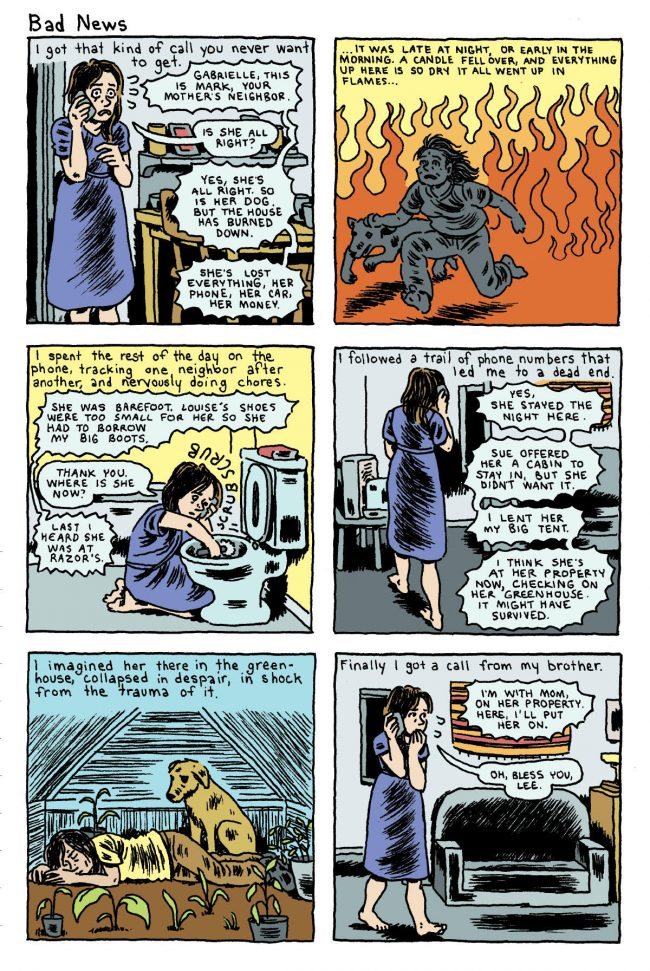
Bell then gets a call that sets the rest of the book in motion: an old neighbor tells her that her mother’s house has burned down and that she’s lost everything. That prompts her to begin one of many trips from New York to rural Northern California, with each one delving deeper into her feelings about her mother. Along the way are a number of digressions that make Bell’s work so funny, but this is a book where her tendency to sometimes slip into magical realism is entirely avoided. There’s a sense that Bell wanted to stay grounded and entirely present in this narrative, though she can’t seem to help but slip in a few of those funny digressions. A fan in Germany bought a lot of her original art, and she had the fantasy that she could bring her mom to that fan’s house and simply live with him.
It’s revealed in the book that Bell’s mother Maggie was abused by her partner Jeff. After he left, she essentially dropped out of society, happy to live on her small property with her dogs and away from others. Sometimes she would let people (like her younger next-door neighbor Gus) help her out, and other times she’d yell at them to leave. She wanted to simplify her life as much as possible, and to that end, she wanted to buy a small, prefab house to replace the one that burned down. Much of the book explores this process, as Bell also comes to terms with the fact that her mom (with good reason) was skeptical regarding Bell’s helpfulness as to this process as well as her ability to thrive in isolation. Honest to a fault, Bell cops to wanting to feel like a hero to her mother as well as hoping to generate material to do comics about.
She depicts her mother with great warmth and complexity. Maggie is a highly intelligent and sensitive person who just decided not to put up with the world’s bullshit anymore one day and who lived on her own terms ever since. It’s hard to describe her relationship with Bell; it is certainly loving and caring, but not maternal in the stereotypical sense. They are more than friends, but the bond that Bell depicts (especially on her own part) is a tremendous sense of empathy for someone who looks at the world in very much the same way she does, and who helped Bell become awake and aware. There’s also a scene with Bell’s 90 year old grandmother where Bell goes off on her for not teaching her mother the skills she needed to cope with the world or even show an interest in her now, and her grandmother tearfully replies that she didn’t know how.
What was remarkable about that scene is that the dialogue between Bell and her grandmother played out in the present tense, but Bell also added some past tense captioning that commented on what she was saying–often adding an amusingly self-deprecating comment. It speaks to her mother’s regrets and feeling that she was a terrible mother, leaving unspoken the role of her father and grandfather. The end result of the berating was both of them in tears, with Bell apologetic, and a talk the next morning that revealed that telling these truths made them closer. The Bell women may have been part of dysfunctional families, but they never had any illusions as to whom they really were.
As Bell and her mother negotiate and navigate the process of purchasing and then having a house assembled and brought to her property, there’s a separate but unspoken sub-narrative of how they both negotiate and navigate having to deal with men. Maggie’s neighbor Gus has a history of violence and time spent in prison, but he also seems genuine and caring in his own broken way. Bell is fascinated by him and “interviews” him (to his bewilderment), partly to suss out his true motivations and partly out of genuine curiosity. Bell depicts him with a certain solidness and clearly empathizes with him as a fellow outcast, even imagining shacking up with him as part of an effort to stay close to her mother as well as fulfilling a fantasy of dropping out. Bell knows that would never work for any number of reasons (hilariously picturing a “future” scene of her with children, chasing them away from their home), with her need to sometimes be in the city being one of them.
In perhaps the most subtle storytelling presentation in the entire book is the character of the salesman who sold them the house. Superficially gracious but also a somewhat unctuous character, he steadily takes opportunities to make inappropriate comments and physical overtones toward Bell. It starts with calling her “sweetie”, an unwanted hug at the close of sale and an unwanted gift of salmon, and continues on with entreaties to go fishing and concludes with a kiss on the cheek, another unwanted embrace and a speech about being glad she came into his life while his fiance’ wasn’t watching. Bell didn’t directly comment on any of this other than simply illustrating it, nor did she have to.
Bell also spends a lot of time discussing the pets (many of them pretty wild) she and her mother had had on the property, barely tamed to the point where neighbors wouldn’t allow their big dogs on their property. Bell didn’t feel an emotional connection to her pets as a child (she notes having to fake it when a cat died), but it’s clear that as she constructed her own identity as a person, a love of animals developed even as she grew to love and connect with others.
The book ends with a bookend sequence of sorts, as the apartment she was illegally subletting to a friend burned down in a fire in New York. Contrasting the empathy of her mom’s friends in California to the apathy and outright hostility in New York was something she didn’t even have to play up. There was an interesting scene where she came upon a woman who was shaking next to the subway when she and a friend were in a hurry, and Bell stopped to help her and eventually call 911. She eventually gets offered an apartment in a building for the displaced, which she immediately is charmed by but her friend is horrified by. It speaks to the way that Bell isn’t really so much of a misanthrope as she is someone who needs a certain amount of solitude. Indeed, her perception of herself as “someone barely passing” to street people makes it all the more easy for her to break the unspoken rules of living in New York and reach out to others and help those in need.
There’s a coda that features a number of silent pages of Bell back at her mom’s place, taking a walk in the woods and taking in the scenery. She encounters a dog and makes friends with but warns him off when she gets near home, because Gus’ dogs are viciously protective of territory, not even recognizing Bell. It’s a mirror image of her reaching out to help that woman amidst the barking dogs of New York and a reflection of the ways in which her growth as a person was affirmed over the course of the book. The last image in the book is a silent one of Bell soaking in a bathtub that Gus had just installed in her mother’s house, quietly portraying her restoring her strength in a place that she did so much to make happen. If Bell’s other books revealed a person whose persona seemed fractured, then this one reveals a woman who has begun to reconcile the twin needs for solitude and connection. It’s no coincidence that such a book would be her first long-form narrative, even if it was made up of vignettes.

Thursday, February 23, 2017

Josh Neufeld & Sari Wilson's Flashed

One thing that a number of Xeric Generation cartoonists (those between about forty and fifty-five years old or so) have in common is an interest in comics formalism, often expressed through the OaBaPo method. This is a series of comics-drawing games that use certain constrictions, like drawing all characters in silhouette, or including the image in every third panel, etc. to challenge cartoonists to use creative solutions for these problems. In many respects, formalism simply implies an awareness of the actual form of comics and how it can be manipulated to produce certain kinds of effects. A lot of comics-as-poetry leans heavily on formalist techniques, for example. In the case of Josh Neufeld, he's done things like comics drawn with his non-dominant hand as well as travelogues told from the point of view of strangers he encountered. Working with his partner Sari Wilson, who is a writer, they put together a collection of "flash" fiction and comics called Flashed. One of the constraints here is a comics story of no more than four pages and a short story of no more than a thousand words. The biggest constraint, and what makes the collection interesting at times, is that three stories or comics would bundle together to form a sort of triplet with a common theme.

Neufeld & Wilson would choose a previously-published comic or short story as a seed. It would be handed over to the next cartoonist or writer (always at least one of each in each triplet), who would respond to the first piece in whatever way they saw fit. Then that second piece would be handed over to a third artist/writer, who would react only to the second piece; they were not allowed to see the first. There are fifteen such triplets in the book and thus forty-five artists, which had to have made for an intense amount of work for the editors, especially since they solicited and printed reactions from each artist about the process after every assignment in a triplet had been completed. That made the entire project unusually meta for an anthology, although I found the author responses to be some of the most interesting parts of the project. As I have written about nearly every anthology I've ever reviewed, this book was highly uneven. I probably would have cut it from fifteen triplets down to ten, because some of them were either difficult slogs to read (which is surprising for flash fiction), lacking substance or outright juvenile.

The "Cheating" triplet started off with some swaggeringly tedious Junot Diaz machismo in short story form, was followed by an absurd Nick Bertozzi strip about a guy who started to think that the tags on his girlfriend's underwear were sending a message, and then finished by Zoe Zolbrod's purple prose. It's one of the rare times I've felt angry after reading something due to the feeling of having my time wasted. Some of the other triplets, like "Shell Shocked" all took somewhat obvious approaches to their subjects; in this case, it was the subject of a soldier returning home to a lover. Some did little to add to a great seed, like in the "Frozen" section where a John Porcellino piece is rendered into something predictable and lacking the poetry of the original piece by Alan Gilbert. In "Venus & Mars", a sentimental piece about emotional pain by Dean Haspiel is turned into an S&M piece by Gina Frangelo and then a parody of S&M and academia by Jason Little. "Winter Walk" went into territory that was too esoteric and abstract at times and didn't hold together.

Sometimes, however, the combinations worked and some interesting connections were made. Kellie Wells drew straight from certain aspects of Lynda Barry's deeply, emotionally rich story "Lost Worlds", and Box Brown went into a completely different direction that nonetheless captured the quality of light that's difficult to quantify in its beauty. "Dystopias" showed that even when an author did not understand an element of the original story (like Anthony Tognazzini misunderstood Jessica Abel's original), they can turn it into something interesting. In this case, it took a story about a tragic highway accident into a bizarre conspiracy piece, and the cartoonist DW managed to double-down on this. A more direct example of teamwork was "Amerika", where Jen Camper started off with a goofy parody of a future fascist America (yikes!) that V.V. Ganeshananthan turned into a full-out dystopian tale with an open end that Tom Kaczynski picked up and completed in his trademark absurd but deadpan manner.

In other stories, the connections made just weren't that interesting or the deviation from original texts wasn't striking enough. That was true of triplets like "Awakenings", "Brothers", and "Leviathan". When the creators started with a weird or whimsical premise and were willing to keep it going, the stories were more interesting. "Bronte", for example, starts with stage directions for a scene about the death of Emily Bronte, continues with a comic by Ken Nash that transposes the setting to an office, and finishes with a story by Rob Walker that transposes it once again and shifts the point of view to a guy in a club. The through-line of barking dogs being transformed into a ringing phone and then finally the person making the call was especially clever, even if one is completely unaware of the history of the literary Bronte sisters. "Mutable Architecture" starts with a premise grounded in the mundane (living in a tiny city apartment) with the horrifying (a mysterious hole in the bathroom that takes on an increasingly disturbing quality) thanks to Gabrielle Bell. Jedidiah Berry's takes that premise and warps it in a positive way, as a landlady showing an apartment to a new tenant becomes younger and younger as the tenant finds more and more secret chambers. Carol Lay's scratchy and tenuous line flip the story around again, as the resident of a sinister house across the street from the apartment goes about his day. "Incommunicado" flips from a disaster-situation to a surreal party to an anatomy of a date and personal ad, with Michael Hinken's deranged final segment strongly capping off the weirdness. Finally, "Curses" finds Anna North and then Andrea Tsurumi doing different takes on disaster and superstition that are both emotionally resonant, and Ben Greeman finishes up with something far more frightening.

All told, this was an interesting experiment that was mostly worthwhile as a read, with a number of slow spots. One thing I noticed is the near-equal split in the number of male and female creators, which probably had something to do with the diversity in subject matter and storytelling styles. I'm not sure a second volume would make much sense, unless it was completely revamped with a new set of rules. Even more preferable would be a volume where every group had a completely different set of rules. The problem with these sorts of exercises is that they usually wind up being more interesting to those who participated in them as opposed to those who might want to read them, which is why a heavy editorial hand is so important. Still, I've never seen an anthology quite like this one, especially in the way it encouraged artists from two different disciplines to collaborate.

Monday, September 14, 2015

Autobiography Is Fiction: Gabrielle Bell

Gabrielle Bell is my favorite autobiographical artist, in part because she eschews so many of the medium's cliches. She draws diary comics that are revealing in some ways, but treats them as an exercise to write and draw (not to mention entertain herself) rather than as an opportunity to overshare or work out her anxieties on paper. Bell remains a bundle of contradictions as a person and an artist, and her new comic reveals this without her having to come right out and say it. Her most recent book, Truth Is Fragmentary (Uncivilized Books), sees Bell deep dip into fictionalizing her life in the most absurd ways. Essentially, when she gets bored, she simply starts making things up, which I find to be refreshingly hilarious. While she "spills" plenty of ink in that she reveals plenty about herself in how she interacts with the world, the book deliberately rejects any kind of conventional confessional approach and instead asks the reader if the wise-cracking Bell is to be taken seriously. All the reader can do is continue to ask questions, some of which she answers and others of which she deliberately leaves vague. At its core, this book is an autobiographical framework for frequent flights of fancy.

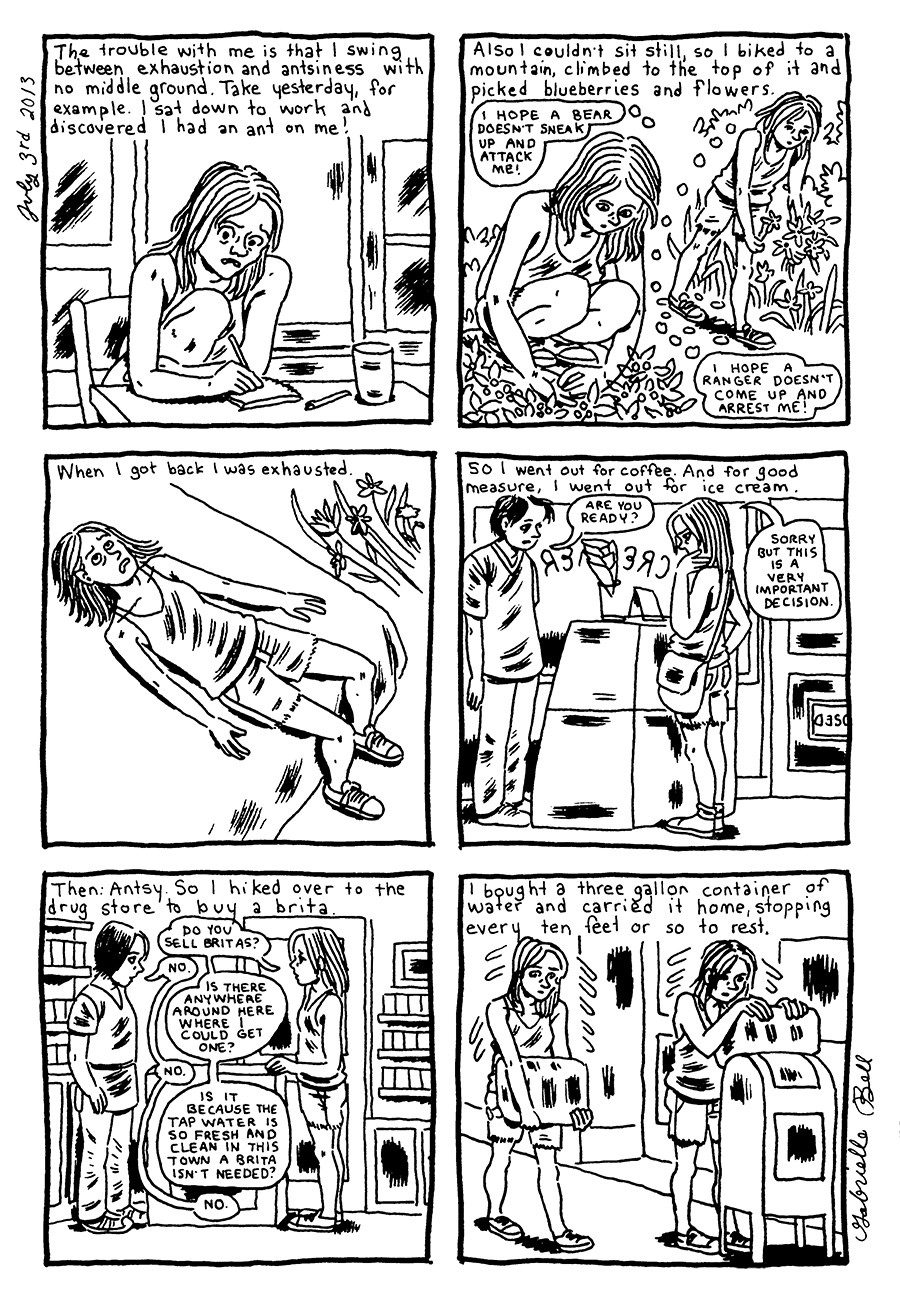
The structure of this collection of short stories, such as it is, centers around Bell's frequent travels thanks to her cartooning career as well as three years' worth of July diaries, where she did a comic per day for the entire month. Most of those diary comics tended to emphasize her frequently self-imposed isolation, providing a ready contrast to the strips where she's traveling overseas. This contrast highlights Bell's central, internal contradictions. On the one hand, she's a shy and anxious misanthrope who plays up her almost feral qualities. On the other hand she's engaged, witty and intellectually & emotionally curious. Going to foreign nations provokes an extreme blend of these states, with her natural awkwardness both exacerbated and excused/alleviated by being an American fish out of water--because she's always a fish out of water no matter the situation.

My favorite device of Bell's is her "unreliable narrator" voice deployed in meta fashion, pulling the reader out of the narrative and reminding them that she can manipulate the reality of her narrative on a whim, adding or subtracting real-life "characters" on a whim. It's a device that reveals the potentially fictive nature of any diary, be it an intentionally fictive left turn to smooth out the narrative or simply a result of one person's point of view always being unreliable as an absolute conveyor of the truth of a situation. In any event, Bell's tendency to do this is always good for a laugh.

Keeping that diaristic tone makes the fictional elements resonate and pop when something absurd happens in an otherwise mundane anecdote. There's a story about her friends abandoning her during the sudden zombie apocalypse that plays on her lack of useful skills. There's a running gag about bears that punctures reality with the same force as a well-landed long-form improv sketch. When she anticipates a friend visiting her with her newborn baby, Bell is surprised to receive the baby in a package mailed to her. Considering how deadpan her comics are, both in terms of narrative tone and the way they're drawn, these absurd little jokes land especially hard. That's especially true because she doesn't over-do them; her restraint as an artist is one of her best qualities.

One reason why this book in particular is so entertaining is that her need to entertain the reader is commensurate with her need to entertain herself. She repeatedly states that she hates drawing things that bore her, so she is perfectly happy to skip ahead and draw something that she likes. This is especially true in her daily July diaries, but it also applies to the meat of her foreign tours, as she frequently omits accounts of the actual events in favor of side anecdotes. That boredom is a manifestation of her restless and fierce intelligence. Bell frequently downplays her own eloquence and intelligence, especially when she's being translated, but at other times she doesn't hide the sharpness of her wit, like during her pointed critiques of literature--especially thinly-veiled autobiography. Bell's feminism is blunt and to the point, as she notes that men tend to get away with a lot more in their memoirs than women.

As to the details of the stories themselves, her trip to a comics festival in Stockholm is marked by her wanting to write about anything but the festival itself, talking about the difficulty of making the diaries themselves. This sort of meta-writing can often be tedious, but Bell is less interested in complaining than she is in making quirky, funny observations. Her trip to France includes meeting mainstream artist Tim Sale. Bell is amazed that he can make so much money selling drawings of Batman, which she briefly considers as a career move until she remembers that this would involve knowing about and drawing Batman. Her first July diary is more-or-less that last time Bell still feels comfortable writing about her quotidian adventures, but even here she subverts her own narrative by deliberately leaving out the exciting parts of her day-to-day life, like the actual party she was organizing for her book release. By contrast, her second diary opens with Bell declaring that she really has no inner life or interests, saying that she sits "quietly in a dark room until I'm needed". This is the diary that introduced the wackier fictive elements of Bell's work, like zombie apocalypses, recurring bear attacks (and ice cream sales) and other nonsense. While writing her third July diary in a rented house in a "writer's residency", she works in gags like a brain booster drink that makes her remember long-forgotten relationships and children. The final diary, at a comics festival in Colombia, makes great use of a fictional secretary writing all of these notes, ala the philosopher Montaigne.

As Bell has  matured as an artist and writer, her prose has become crisper and wittier. There's one sequence where she ponders "I am so lonely... and yet, I can't stand the company of anyone...(That is when the place fills up with ghost cats)", which is precisely what happens in the panel--a number of spectral felines crawling all over her. Regarding her social awkwardness she says, "When I walk down the street, the kooks and the wingnuts glare at me accusingly. They know I am just barely able to pass", with those passerby thinking "Traitor" as she walks by. Bell gets to the heart of why she does autobio when she starts off some strips by saying "It is humiliating to expose myself like this, but it is worse to try to hide it". Regarding meeting a cartoonist, she says "I knew this was my one chance to make a good impression, but I just wouldn't take it". This self-awareness is funny and brutal at the same time. Her line is also looser but also slightly thicker, and the drawings themselves are wilder, funnier and more expressive than some of her older work.


Friday, August 2, 2013

Out With A Bang: Mome #22

The final issue of Mome is understandably all over the place, as Eric Reynolds wanted to encourage as many of its contributors as possible to submit a piece for the finale but also had a gaggle of new cartoonists he wanted to include as well. Given the new roster of cartoonists he published in this issue, I could have easily seen Mome go on for another dozen issues, replenishing its talent pool as older artists bowed out. I hope that Reynolds sees fit to do an occasional "Mome Annual" in the future, especially since Fantagraphics doesn't have a flagship anthology at the moment.

The last issue sees several more episodes of serials, many of which unfortunately did not get a chance to finish up. Kurt Wolfgang hilariously addresses that problem head on with his latest installment of "Nothing Eve." Right in the middle of this episode, Wolfgang (inexplicably depicted as a talking dog) yells "cut" and sends his characters home since Mome is ending. It goes on from there: dog-editor Reynolds informing Wolfgang that Mome was being cancelled because no one likes his comics, dog-publisher Gary Groth demanding zombies and hookers to liven up the series, and (best of all) Jordan Crane being brought in to write exactly the ending that Groth wants. Wolfgang is finishing up the real ending now for a Fantagraphics book, but this ending reminded me a bit of his Low-Jinx days, when he would cleverly savage everyone in comics (especially himself).

I don't have much to say about the other serials in this issue, like the Michael Jada/Derek von Gieson "Devil Doll", Ted Stearn's latest Fuzz 'n Pluck epic "The Moolah Tree", T. Edward Bak's "Wild Man" or Josh Simmons/Shaun Partridge's "The White Rhinoceros". I've discussed each of these at length in prior reviews. Bak completely reworked "Wild Man" into a book that will be out in the fall of 2013, and he notes that "it's a completely different work." I really hope someone picks up the demented Simmons/Partridge story. Speaking of Simmons, he also contributes a lovely one-pager that's essentially a series of happy endings about a group of friends meeting their maker.

At nearly 250 pages, Mome 22 must have been an enormous challenge for Reynolds to whip into something that had any kind of flow. Thanks to its size and variety of material, this issue indeed lurches back and forth, with some of the serials providing particular screeching halts. Reynolds clever gets around this to an extent by using a series of Steven Weissman strips as interstital material, giving the anthology a number of rest stops to cleanse one's aesthetic palate. These strips, featuring the members of Guns N Roses working in a deli, are some of the funniest comics I've ever seen by Weissman. With titles like "Chinese Chicken Salad Democracy" and "Appetite For Delicatessen", Weissman piles on the crazy in strip after strip, especially with his star character, the guitarist Slash. I could read a book's worth of these.

Many of the returning regulars turned in some of their best work for this volume. Eleanor Davis' "Nita Goes Home" stands as one of the best five or ten stories published in Mome. It fits snugly into most of her themes, involving family and the ways in which women relate to each other, transplanted to a futuristic setting. The colors are bright and deliberately stylized, reflecting a future where the air is toxic but family relationships are still a matter of push-and-pull. There's a wistfulness to this story that reflects a woman coming back to where she was raised after having rejected it for a life as an artist and natural farmer, a bittersweet quality that reflects the experience of dealing with her father dying. The scene where the titular Nita and her sister, each wearing a cocoon-like anti-toxicity suit, spread their father's ashes out across the land and then weep wracking sobs into each other's arms. It's both absurd and totally heartfelt, a reflection of the way humanity can trump technology. I'm hoping this and her other excellent Mome contributions will make it into her upcoming Fantagraphics collection.

The other top-notch submissions by returning artists included stories by Joseph Lambert, Laura Park and Tom Kaczynski. I reviewed the Kaczynski story, "Music For Neanderthals", elsewhere. Lambert's "Lists of Lasts" continues his considerable leap as a storyteller, taking the intensely detailed and hyperkinetic stories about kids and once again transplanting that concept into a darker, deeper setting. In this story, two young boys suddenly have total freedom in their house and decide to make lists of things they have, as Lambert slowly reveals the apocalyptic reasons why they have this freedom. Lambert's creative use of lettering takes on an especially crucial role in the story telling. Park's "George" is a delightfully creepy little noir story about an unassuming man who secretly blows up movie theaters as a sociopathic way of lodging his protest against modern civilization. As always, her character design and sheer drawing skill are impeccable.

There were nearly a dozen other stories by past and recent Mome regulars that were also quite good. The always dependable Nate Neal's "Death" was his cheerfully morbid take on the end, focusing on the absurdity and inevitability of it all through the use of randomly named characters. Sara Edward-Corbett's "The Fanciful Companion" was typical of her melding of childhood whimsy and cruelty, drawn with her delicate line. Lilli Carre's "Into The Night" is another of her mysteries; she loves spinning yarns about unexplained and strange compulsions that appear without warning; This time, it was a sound in the middle of the night that had a slightly different effect on everyone, but it was something that could not be entirely ignored. There's a delicacy to her line as well, though it's put to slightly more abstract ends. Tim Hensley's "Sir Alfred" is a series of hilarious strips about the late, great film director Alfred Hitchcock. Hensley really gets after the gossipy side of Hitchcock and his many sexual obsessions, along with his impotence. I could have read a book's worth of these, and I was delighted to see Hensley return after finishing up his amazing "Wally Gropius" serial. When Noah Van Sciver was first published in Mome, he was just starting to build up steam as a cartoonist. Now he's entered into a more mature phase of his career, and it's remarkable to see how assured and funny his "Roommates" is. Van Sciver loves depicting toxic, disgusting and generally reprehensible relationships, and this short & sweet story really gets at that essence. Joe Kimball's story was another bizarre and immaculately drawn bit of visceral weirdness, while Sergio Ponchione provided another of his rubbery and fun Dr Hackensack adventures. Tim Lane's "Belly Gunner" abandoned his usual interest in life on the American road and instead flashed back to the possibility of instant death as a plane gunner in World War II, drawn in his usual naturalistic but fluid style.

Three of the original Mome artists returned for the finale (along with Wolfgang, who never stopped contributing): Gabrielle Bell, Anders Nilsen and Paul Hornschemeier. Hornschemeier's main contribution to Mome was his serial "Life With Mr Dangerous", which was later collected. In #22, he contributes an interview with Amy, the main character from that story, revealing influences and generally finding ways to talk about the story. It's a little gift for long-time readers of his. Nilsen contributes one of his funny and philosophical photo comics, the kind that make up his "Monologue" books. Bell, who was another MVP of this series, contributes a funny fantasy comic called "Unlucky", which sees her unable to get into a club where a party held in her honor was being staged. Things just get worse from there, as her evening and fortunes unravel bit by bit. It's a fitting final story for the anthology, as she was on the cover of the very first issue.

Eight artists made their debuts in this issue of Mome. Chuck Forsman's story "Francis", about a young man dealing with his own insecurities and his inability to cope with the fact that his mother was dying, was typically excellent. It's in turns crude, heartfelt and bubbling over with barely-contained and confusing emotions for its main character, who doesn't quite know how to express them. Forsman nails that feeling of being close to losing a close family member where that relationship is strained. Most of the newer artists worked in a more fantastic fashion, like Jesse Moynihan's excellent "Simon Magus". Moynihan has a knack for staging big, dumb battles between godlike beings who nonetheless have all the emotions and frailties of a human, but does it in a deliberately stiff and color-drenched manner. Malachi Ward's approach is a bit more restrained, but he also likes to use science-fiction settings to depict man's essential savagery, showing that the line between man and savage is a thin one indeed. James Romberger's "Loving Bin Laden" is reality based tale that quickly veers into fantasy, as a woman dreams of having an affair with the notorious terrorist after 9/11. Romberger is an incredible artist who makes great use of color in this bracing, bizarre story. Finally, Victor Kerlow's "Oh Man" is one of his fantastical stories of a man being devoured by invading vines, Nick Drnaso' "Keith or Steve" is a curiously flat story about a nobody who nonetheless takes on great significance for the narrator, while Jim Rugg's one-pager pokes gentle fun at serials by being an "original page" from a comic called "Suburban Love Tales".

Eric Reynolds managed to publish over 2,600 pages of comics in six years, and he did a fine job of recruiting new talent and shaping each issue in order to keep it coming out on time. For any serial publication, even one aimed at bookstores like Mome, keeping a regular schedule is key to it lasting any length of time. I think the key to Mome surviving was the combination of Reynolds' singular taste as an editor and flexibility. I know that the comics by David B and Lewis Trondheim may not have been in his particular wheelhouse as a reader, but he listened to the advice of Kim Thompson and published them in Mome because they would draw in readers and provide a home to material that would not otherwise appear anywhere else in English. He was a tough editor who could demand that young artists step up their game when submitting material, though there were times that some of his veteran artists didn't always submit their best stuff. I found Sophie Crumb's presence in Mome to be especially frustrating when she half-assed a story, or when Jeffrey Brown didn't seem to be saving his good stuff for Mome. On the other hand, he greatly nurtured the careers of Gabrielle Bell, Eleanor Davis, Dash Shaw, Lilli Carre', Tim Hensley and many other cartoonists who made it a point to really do their best for each issue. Mome wasn't necessarily avant-garde in the way that Kramer's Ergot is, but it reflected the rise of the alt-comics scene from its new blossoming around 2000 to the explosion of young talent present today. Reynolds was the steward of much of this talent, as so many cartoonists aspired to be in Mome, and the comics scene now lacks a similar guidepost for young artists. That's why I hope Reynolds will consider going back to producing a new anthology that returns to Mome's roots and rotates in the best of the younger cartoonists on the scene today. Even if he doesn't, he produced a body of work that is lasting and produced some of the best short stories of the past decade.

Tuesday, January 22, 2013

Sequart Reprints: Stuck In The Middle/Escape From "Special"

This article was originally published at sequart.com in 2007.
************
The teen-age years are prime ground for storytelling because of the inherent drama that adolescents create in their own world. The transition from elementary school to junior high is perhaps the most awkward move of all, because the formation of one's personality is as much a reaction to the Other as it is a development of their own self. Staking out one's place in the social hierarchy is a complicated game, where conformity to norms is the rule and the systematic hazing of those who are different is the means by which the system is maintained. Comics are an especially ideal means for talking about this period, because the expressiveness of cartooning can be a perfect match for the outsized feelings teens experience.
Cartoonist Miss Lasko-Gross, in her semi-autobiographical comic Escape From "Special", learns that if you're not any good at playing the game after you've learned it, you may as well stop playing. Starting with her earliest memories as a child, Gross manages to create a narrative out of a bunch of short anecdotes. On an initial reading, the narrative feels like a house of cards, threatening to tip over into an unfocused mess. The further one goes in the story, however, the more one can see it cohere. The story begins with young Melissa realizing early on that she was a bit different from others. The realization that she can never know anything for sure sent her into a tailspin, and her wanting to put Barbie into a murder-mystery freaked out one of her friends.
It didn't help that she had trouble looking others in the eye, and that she was behind her classmates in being able to read despite an active and engaged mind. It also didn't help that she was actively resistant to any kind of authority. That combination got her kicked out of her school and placed in a new age feel-goodery, which had its own absurd rules. Its "no-negativity" rules extended to wearing black and eating mushrooms, since they grew in dark places. Of course, her parents sending all sorts of mixed messages had its own effect--they made her go to religious classes but also brought her along when their band went on tour. Things came to a head when she's placed in a special-ed class. While this was certainly humiliating ("Why don't they just call us retards and get it over with?"), it allowed her to see the game for what it was.
As she went into junior high school, she tried to fit in but realized "I'm outside of some mass cult of social agreement." There was a period of despair when this realization sank in, leading to thoughts of suicide and non-existence. It got to a point where part of her wanted to be "lobotomized" like the rest of her peers, but she knew it wasn't an option. When she was given an ultimatum by the girls she was trying to be friends with not to hang out with "druggies & losers", she saw that her choice was obvious, and that choice brought the freedom to speak her mind and stop pretending. Gross is skillful in how she arranged the anecdotes and gave them an accumulated weight, especially as she grew older in the story. What's most appealing about the book is her warts-n-all portrayal of her stand-in. The slightly grotesque and expressionistic art is a perfect match for the way Melissa looks at the world and herself. She's not an easy person for the reader to like--she's cranky, argumentative and prone to outbursts of rage. But her eccentricities are not affected, and the ways that she comes to terms with how to deal with the world while embracing what made her different made for an inspiring conclusion.
Stuck In The Middle is appealing because it provides a look at a variety of experiences and a variety of artistic styles to match. It's no surprise that Ariel Schrag put this volume together, because she's well-known as someone who started doing comics about her high school life while she was still in high school. She's currently finishing up a book on her senior year of high school after a two-year stint on the TV show The L Word. In this anthology, she got heavy-hitters Joe Matt & Dan Clowes to allow her to reprint some of their work. Clowes' "Like A Weed, Joe", is one of his best short stories, dealing with a boy's boredom spending a summer with his grandparents and his struggle to create a narrative framework for his life.
One of Schrag's stories, "Plan On the Number 7 Bus", is about the other end of the teen hierarchy. She was one of the ones on top who used her position to heap abuse on others, and the story involves a plan hatched by her and a friend to humiliate someone they knew. When they wind up in an unfamiliar part of town and they panic, Ariel vows "I cannot be mean"... though it seems doubtful that she'll be able to hold herself to that vow. Her sister Tania contributes "Snitch", about the fluidity of the hierarchy and how easy it is to slide up or down. After snitching on a boy who was torturing her in class, she becomes a social pariah, looking for a new group. When she finally finds it, she eagerly says "Well, that's what you get when you're a snitch" when she hears about someone else's tattling to a teacher. The harsh reality is that no matter how oppressive & unfair peer pressure can be, most kids can't see a way out of it and want to use it to their own advantage. Along the same lines, Gabrielle Bell has a piece that gives a slightly different perspective on an outsider's relationship with her classmates. In "Hit Me", Bell eschews the use of thought balloons or internal narration, making the story unique in this collection. We never see her inner thoughts as her classmates taunt her for wearing the same clothes several days in a row and smelling odd. When another outsider challenges her to a fight, Gabrielle wins and abandons another outsider friend when popular girls invite her to sit with them at lunch. The narrative distance Bell erects makes this an especially effective and devastating story.
There are sweeter stories as well. Dash Shaw's "Crater Face" involves a boy with acne problems who falls for a girl, and manages to overcome his own insecurities and reach out to her and reassure her about her own issues. "Never Go Home" is a Robyn Chapman story about a girl who is abused by her father who winds up at a school dance and sits under the bleachers. She's found by another girl, and several minutes of awkward silence & conversation ensue until the girl asks her to dance, leading our narrator to think "Maybe I'm OK. Maybe this could last. Maybe I'd never go home." Aaron Renier's "Simple Machines" talks about the author's ADD and tendency to escape into his own world with his drawings. When others reach out to him and he takes a risk by trusting and working with them in school projects, he's able to mix his old world of fantasy with his new friends. It's an enormously touching moment, one of the instances where life-long friendships can grow out of the crucible of adolescence.
Virtually every story is at least worth reading, though Nick Eliopulos' tale about a batboy and a baseball mascot doesn't fit very well with the other stories. Jim Hoover's style is a lot slicker than the other artists', and his entry feels a lot more pat and less nuanced than the other stories in the collection. On a visual level, they at least do offer something different to look at, compared to the less "realistic" styles of most of the artists in the anthology. Schrag obviously took great pains as an editor. She balanced upbeat & downbeat stories, stories by men & women, and gave everyone plenty of room to tell their stories. She added touches like a yearbook-style "autograph" section and photos of the contributors from middle school (the photos of Clowes & Matt are especially amusing). The variety of stories that she gathered was crucial, because it's easy for a reader to grow exhausted by a "theme" anthology if the editor doesn't do a good job getting as many different takes on a subject as possible. Unlike many anthologies where the stories are too short to really make an impression, there's a meatiness to this 200-page volume that makes it an enormously satisfying read.

Wednesday, December 5, 2012

Gazing Inward and Outward: The Voyeurs


While I greatly enjoyed Gabrielle Bell's fiction pieces in Mome and elsewhere, there's no question that her autobio work is uniquely discomfiting and hilarious. Carefully editing a couple of years' worth of autobio strips from her website and other places, The Voyeurs is a rich, dense and baldly honest account of Bell's attempts to connect with others. In his introduction, Aaron Cometbus (who first met Bell when she was eleven years old) notes her extremely antisocial upbringing, hinting at Bell as an almost feral human being in some regards. For her part, Bell revealing that she loved hiding behind bushes as a child and waiting for cars to come by is a touchstone for someone whose socialization was never quite complete. That is certainly to the benefit of her readers, because her keen intellect and powers of observation slice through polite and assumed interactions, as she asks questions that others might not. It's not surprising that most of her friends are cartoonists, artists and outsiders, but even in the company of those outside the societal mainstream, Bell reminds an outsider. Mainstream society is the club that she would never join if they'd have her for a member, to put it in Groucho Marxist terms.

Bell and publisher Tom Kaczynski (this is the first book from his Uncivlized Books publishing concern) organized the book chronologically, which is as good as any method to read the strips. The first chapter mostly concerns Bell's lack of presentness, disinterest in everything around her, and simultaneous hatred of and dependence upon the internet. These are short, punchy strips, setting up the structure of the rest of the book by focusing on the mundane and everyday but giving it a certain vivdness with her use of color. Speaking of which, the use of color and the paper chosen for the book are both top-notch, giving Bell's thin line an extra richness and depth while fueling the more fantasy-focused portions of the book. Chapter two leaps from Bell's mundane existence to detailing her relationship with director Michel Gondry. Whisked away to supervise and effectively co-direct his adaptation of her story "Cecil And Jordan In New York", Bell keeps the reader as off-center as she must have felt throughout the experience by not showing how she met him or the beginning of their relationship. "Michel and Me" starts off with the couple on the set, Bell struggling to come to terms with the absurd fantasy her life has become. Throw in the fact that the film was being filmed in the totally alien environment of Tokyo, and you have a perfect storm of stimuli that eventually drive Bell to hide out in her hotel room and argue with Gondry every day. The two money quotes in this section come from Gondry. The first, by way of translating his aunt: "Suzette says you're like a wild cat and I'll never be able to tame you", reflects Gondry's very real fear that this relationship is a tenuous one at best, even as he puts on a full court press to introduce Bell to his family and spend time with her in quieter locales. The second quote is from Gondry himself, after Bell gave him a drawing "I don't think I could tolerate you if you weren't so talented." In a narrative sense, Bell couldn't have a better foil than the garrulous Gondry, whose model of relationship relies on constant confrontation. Bell ends this section with a separate strip going back to her childhood, imagining herself running away to the woods but reemerging to great acclaim, eating a hamburger. It's a fitting cap to this chapter because it paints herself as having feral tendencies but tempering that with the desire to not just be accepted, but celebrated.


The third and fourth chapters are all about push and pull. As Bell gets into yoga, she starts to understand that the intensity of the physical activity (especially "hot" yoga) is the only thing that acts as a corrective against her mounting neuroses and her inability to stay present--that is, to simply be without being overwhelmed by random thoughts. It also acts as a corrective to her frequent irritability around others coupled with her fear of being alone. The fourth chapter chronicles a year of coastal travel during her long-distance relationship with cartoonist Ron Rege, Jr. A running theme of the book is Gabrielle doing things with an eye toward writing about it for her journal. Going on fish-out-of-water excursions to Los Angeles makes that exceedingly easy to do, and there's plenty of hilarious anecdotes about going to the beach, awkward hugs with Californians, and uneasy parties. The chapter closes with Bell creating her own yoga tent as a way of combating her depression and paranoia, making the connection between mind and body very sharp.

The standout chapter is the fifth, which is the "story" of Bell adapting Valerie Solanos' infamous S.C.U.M Manifesto for a comics anthology. When Bell starts to confabulate autobio stories with outrageous details, she's at her best. That's the case with this ludicrous account of word getting around to the press that she was doing this adaptation, adding all sorts of pressure. So much so, that she had to contact her mother in a hilariously convoluted fashion to get the scoop on Solanos and her past dealings with her. All of those shenanigans wind up with Bell speaking before a crowd and admitting that she chose Solanos in part because she could hide behind the author's outrageousness without having to cop to believing everything she said. Bell then confesses to the reader that it was all obviously made up, but brilliantly wraps up the the strip in a way that ties into some of Solanos' utopian ideals while tenderly paying tribute to her own mother. For a story that starts off as a lark, it's a remarkably moving and even revealing moment. Cometbus notes that despite Bell's willingness to talk about anything, this doesn't always mean that she's actually revealing herself to the reader. This chapter is one of the rare times when Bell reveals the clarity and depth of her self-knowledge and her upbringing and how it shaped her for the better.

The sixth chapter is her epic account of attending the San Diego Comicon as an invited guest. Having a comic turned into a movie will earn one that opportunity. I've read a ton of comicon-related comics, but this was by far the funniest. The tension between Bell's natural aversion to such an experience and her desire to return as a conquering hero leads her to go to crazy parties and lavish dinners in an effort to spend her considerable per diem. As always, it's the tiny details that make this comic so funny, like having to choose a genre for her room at the Hard Rock Cafe, or the uncomfortable party in her hotel room where Gondry and his new girlfriend come by, or the wrestling match Bell gets in with Ariel Schrag.
The last chapter and epilogue are a mix of inventory strips, gags, and reflections. For the first time, Bell starts musing about her age and identity along with how she fits in wither others. In the epilogue, her friend calls her out on her lack of presentness, noting that Bell is never "here", but rather always watching, learning, observing and filing things away for later. Bell is always working because Bell is always thinking, and the epilogue suggests that her inability to disengage in thinking is what leads to periods of solipsism and depression; the former to get away from people and the latter because of her need for interaction. This is a level of self-awareness that's startling to encounter as a reader and makes Bell something more than simply a great memoirist: she's become, in her own-self-deprecating and awkward manner, one of comics' great thinkers. And she gets precisely the kind of presentation that makes her art look best thanks to Kaczynski's loving treatment of her work in hardback form. This may well be my favorite comic of 2012.

Thursday, October 25, 2012

Sequart Reprints: 12 Great Minis From SPX 2006


This article was originally published in 2006.
*****
One of the highlights of any alt-comics events is the opportunity to take a look at a new crop of mini-comics. Some of them are by established artists who have regular, professional publishing outlets. They often make minis just to have something new to show at conventions, or do it as a way of publishing chapters of new, long-form works. Other minis are by young artists looking to establish themselves, and yet others do minis purely as an end unto themselves. Some are elaborate, with die-cut or silk-screened covers; while others are humble Xeroxed efforts. The minis I included in this article were those that were my favorites. There were a number of other minis that I enjoyed as well, but the minis I wanted to include here were a bit more substantive -- both in terms of content and page length. Without further ado...

1. My Affliction, by Gabrielle Bell. Bell was giving out copies of this mini, a return to the weirder, magical realist stories of her earlier work. The title affliction is actually summed up by Gabrielle's stand-in character: "I'm always falling in love with guys who aren't good for me." One would expect a story built around that statement to be a typical melodrama. Instead, Bell starts off the story being picked up by a giant and finding herself stopping in mid-air when he dropped her. Things get stranger from there, as she finds herself in a neurologist's office after getting attacked by a gang of dogs. He tells her that that she must transfer her feelings of love to someone safer, and gives her a wooden token named Charlie. After she drops it into a river, he comes to life and they live together on a houseboat. Gabrielle finds herself unable to fall in love with him, and in fact fell in love with everyone but him. A panel where a UPS delivery man asking for her name for a signature is hilarious, as she suggestively replies "What's your name?"

Things get even weirder from there, as she winds up with a brutish thug who was the original owner of her foul-mouthed parrot. She gets abandoned by her new boyfriend and winds up getting a ride from a suicidal man and careens off a cliff. Winding up in a cage in the home of the original behemoth, she manages an escape attempt with her new cagemate and her rescuing boyfriend, and must worry about her dog winding up in a giant rat trap. As always, Bell plays all of this wackiness with a straight face. Her deadpan narration provides a bit of distance, but its flatness actually draws out the absurdity of the scenarios Gabrielle winds up in. That craziness is given warmth by Bell's loose and lively line. This mini is the latest in a series of triumphs by Bell and an interesting change of pace from her autobiographical work in her new book Lucky, as well as the conventional stories in Mome. While we've seen some fantasy elements creep back into her work recently, it's been awhile since we saw an all-out flight of fancy from Bell. It's a welcome return and makes me wonder if we'll see a long-form work of this nature from her in the future.

2. Becky and Friend, by Lauren R. Weinstein. This mini includes the story "Horse Camp", which was  published in the Viking anthology Stuck in the Middle.. A story much like her work in Girl Stories, this is a hilarious but awful account of Becky and her summer at what is supposed to be a horseback riding camp. Weinstein possesses the uncanny ability to depict the narcissism, self-loathing, giddiness and melodrama of the teenaged years. The funniest bits in the story are the over-the-top letters of woe Becky writes to her parents, despite the fact that she does finally manage to spend a few rapturous hours riding a horse. As always, Weinstein's style is an exaggerated one, to the point where some of the figures are almost grotesque. Her teenaged stand-in is memorably goofy--the scene where she tries to start dancing with her horse (singing Salt 'n Pepa's "Push It") is ridiculous, especially when some other girls catch her, mortified. Despite these exaggerated touches throughout the story, what makes it so effective is how remarkably (and embarrassingly) true she makes the episode seem. The distortions are played straight, which makes them both funny and real. A nice addition for the mini was the presence of grade school poetry about a similar experience, which was as over-the-top as one might expect for a child.

3. Couch Tag #3, by Jesse Reklaw. Reklaw's previous issue was one of the more compelling comics of 2005, and I was happy to see it included in The Best American Comics, 2005. Reklaw's skill as an autobiographical artist is to relay one series of anecdotes that are of interest to a general audience, but doing so in a manner that subtly reveals more profound emotional truths. In Couch Tag #2, Reklaw discussed the cats he had as childhood pets, but he was really telling the story of how his family disintegrated. In #3, the hook is the series of pranks and artistic projects he and his friend collaborated on over the years, but the underlying story is about different kinds of communication and the ways they can break down.

The best comparison I can think of is the relationship between Becky & Enid in Ghost World. Jesse and his friend Brandon went through ups and downs as friends, but when they were close, that friendship was expressed through a series of artistic collaborations and pranks. That culminated in a comic they did together about a man named Fred Robinson. He was someone random they picked to make into sort of their own everyman character--except that they'd leave him weird objects, set up stolen traffic signs repainted to say "Fred Robinson Crossing" across from his house and even send him comics they did about him. This communication through activity and in-jokes is not unusual for many men, especially those who have trouble expressing their feelings otherwise.

A telling scene in the story is when Jesse gets a letter from Brandon, who is living in Norway at the time. All of the things that had never been said between the two of them as friends just spilled out--and were never said again in the same way when they reunited. That letter became especially poignant when we see their friendship splintering apart because they aren't capable of talking about it. That poignancy is prevented from becoming schmaltz by the shenanigans depicted throughout the rest of the issue. My favorite sequence is when they make up a stencil template and use spraypaint to turn street signs that look like this <- -> into the Batman signal. Reklaw is becoming an increasingly skilled and versatile artist, capable of doing straight-up humor pieces, dream interpretation strips, autobio and much more.

4. Krayon's Ego, by various. In the tradition of Low-Jinx and Johnny Ryan's nasty parodies, a variety of artists take on comics in the Kramer's Ergot vein. Parodies of Craig Thompson and James Kochalka, while both funny, don't really have much to do with the Kramer's aesthetic. Still, the hilarious parody of Blankets (involving an extremely inappropriate use of a crucifix) was a hoot, and the mimicking of Thompson's angular style was uncanny. Spoofing Kochalka's cloying sweetness is like shooting fish in a barrel, but the "American Elf 2030" strips here were extremely clever. The thought of Kochalka continuing his strip into old age, while visiting his son in prison and selling his song "It's My Dink" for a Viagra ad were all good gags. However, the Tom Gauld-esque looking strips satirizing Sammy Harkham, Souther Salazar, Kevin Huizenga, Ben Jones and Gabrielle Bell were nasty fun. The fifth strip, involving Harkham finding a discarded strip by Mr T and Harkham declaring him "another naïve master of sequential art!" The other strips poke fun at the creators by portraying them as their opposites: Jones as a wheeler-dealer businessman, Bell as a superhero, Harkham as a junkie who pretends to bow out of activities for religious reasons, etc. My favorite strip was probably "Why Johnny Can't Satirize", a send-up of Johnny Ryan's crude parodies: "It's like he takes a great comic and then puts a dick or fart joke at the end." "Brilliant!" This mini is clearly a series of inside jokes for the alt-comics crowd, but it's still quite amusing. Contributors include Karen Sneider, Marc Campos, Clutch, Josh Frankel, Tom Neely, Jesse Reklaw and Sara Oleksyk.

5. Morbus, by Star St. Germain. St. Germain is primarily an illustrator whose style is somewhat reminiscent of Phoebe Gloeckner. Both have an astonishing facility with anatomical drawings put to new purposes. This short mini is a stylized catalogue of "various diseases, illnesses, and syndromes that my body has collected over the years". Each page's design is beautiful, with an illustration of conditions like scoliosis and carpal tunnel paired with medical descriptions that have been mostly erased. The final image of the mini, where she opens up her dress to reveal an anatomical diagram perfectly captures the evocative nature of her work. The disappearing text evokes the imperfection of how medical lingo captures the effect that pain and sickness can inflict--theimage, combining her normal features and the anatomical dialogues, perfectly conveys these feelings.

6. Various minis by Drew Weing & Eleanor Davis. Both are graduates of the Savannah College of Art & Design and are two of the most promising talents in comics. All four of the minis reviewed here are beautiful art objects on their own, with die-cut covers, innovative cover designs and beautiful uses of color.

Weing is best known for his Journal Comic and Pup, both of which drew a lot of attention when they were originally published on the web. Weing is an amazing draftsman and designer, merging a light cartoony sensibility with lush backgrounds. His solo effort here, Blar, is a straight-ahead tale of a barbarian who kills everything in his path. Feeling a bit like Trondheim & Sfar's Dungeon, Weing plays the action straight but ups the ante with ever-more ridiculous opponents and situations. Each story ends with an unexpected punchline, as Weing paces each strip with great skill. This is a modest but delightful comic.

Davis is a bit more under the radar at the moment, but not for long. Her comics often have fantastic themes but a melancholy tone; she reminds me a bit of Megan Kelso in that regard. The Beast Mother is a masterpiece in the use of negative space as Davis details the life of a female monster with dozens of children. When a hunter starts stalking her, our assumptions and expectations are quickly challenged. Even after the big reveal, there's a sadness to the story that lingers. Mattie and Dodi is a very different sort of strip that evokes the same kind of feelings. It concerns a pair of sisters, the older of whom is taking care of both her dying grandfather and her younger sister, an extremely shy girl. This story is all about roles and responsibilities, as Mattie struggles to deal with her grandfather, her boyfriend (who wants her to sell the house), and Dodi, who is enormously uncomfortable with the outside world. While not as visually striking as The Beast Mother, it's every bit as powerful. The final two panels, as we see the sister in very different places emotionally, gives the reader a number of clues as to where their stories might go next.

Davis and Weing collected several of their short stories in a mini called Bugbear. Life and death are the overriding themes in this mini. Weing does an odd story based on a dream he had after his father died, where his father comes back to life in a "soy-based" body. In the dream, Drew realizes that he can bring Eleanor back to life in the same manner. Davis has a story in which a young girl screams that there's been a mistake and ventures with a creature to the local graveyard, where her dead grandfather is revived. The themes are similar, but there's always an added distance present in Davis' stories.

Both artists are self-publishing, but don't look for that to last much longer. The only question is what kind of stories they'll want to tell given the resources of a publisher. I sense that Weing has several big stories that he wants to tell, but Davis' future might lie in being a short story specialist like Bell or Kelso. 

7. Husky #1 & #2, by Alex Robinson & Tony Consiglio. Two of my favorite "new-mainstream" creators are serializing their new long-form stories. Consiglio (whose  110PerCent was quite enjoyable) contributes "Titanius", a surprisingly hard-boiled, straight-laced noir involving a guy in a metal suit and his quest to get his son back. The humor here is told with a straight face as Consiglio conforms to certain genre conventions. However, the increasingly-convoluted plot (involving cures for herpes, evil pharmaceutical companies, killing enemies with lamps and more) reveals that Consiglio is winking at the whole story with his cartoony art style and over-the-top scenarios.

Meanwhile, Robinson's new story is called "2 Cool 2B 4gotten". The high concept is quite simple: a 40-year old man undergoing hypnosis to cure him of smoking is somehow sent back in time to high school--and in his 16 year old body. While he initially thinks he has an opportunity to ask that girl out he always wanted to and perhaps never start smoking as a youngster, it's clear that there's some deeper problem that he's repressed and has only started to bubble up. As always, Robinson's grasp on relationships and facility with dialogue makes him a pleasure to read. I like his work best when it deals with the most painful of human emotions; he has a way of evoking desperation that's almost visceral. While there's plenty of 80's name-checking here, Robinson keeps the nostalgia to a minimum and in service to the story. Robinson in the past has tended to write huge, sprawling stories; in Box Office Poison, they sometimes lost focus. That was due in part to the periodical nature of that story, but I think he was also perhaps a bit overambitious. The tighter focus in this story bodes well for this new project's development.

8. The Egoists, by Kelli Nelson. Another SCAD grad, Nelson's blocky computer-designed line provides the right amount of emotional distance needed for this story of her trip back to her hometown for her parents' divorce. The story itself has enough lurid and painful moments to be interesting without any further elaboration by Nelson, but she makes a number of clever formal and narrative choices that lead to some unexpected results. First off, the emotional distance created by her line is reflected in other choices. Nelson begins the story by introducing us to her hometown, leading us at last to the courthouse where her parents are divorcing. While the story is told in real time, Nelson tells us the story from a first-person future perspective. This choice again filters out the emotions she felt at the time; even as she tries to describe how she felt, it's all through her present perspective. The obvious absurdity of the moment and the meaninglessness of many of her interactions are emphasized by her choosing to put so much of the dialogue in empty word balloons--including all of her non-narrative, real-time dialogue. The most interesting question that Nelson asks is of herself: why did she attend? To support her mother, or get back at her father? Or worse--was it to get material for another comic? None of these questions are answered, but this isn't a story about answers. It's a story about a process, one that didn't make sense at the time of the events and clearly still didn't make much sense when Nelson wrote it. The irony is that only Nelson herself seems capable of asking questions, self-doubt and seeing perspectives other than her own.

9. Hey, 4-Eyes! #2, edited by Robyn Chapman. A delightful combination of zine and comics, this new paean to eyeglasses is a stylishly quirky read. This is the sort of esoteric zine that's clearly a labor of love and unapologetic about its obsession. What makes it so enjoyable is Chapman's sense of style and the variety of material she presents. From articles on how to purchase vintage glasses, to profiles on fellow zinesters and photo features on the "Miss (and Mister) Specs Appeal", Chapman gets down to the nuts and bolts of why she finds glasses so appealing. The best bit was "Eyeglasses Trading Cards" featuring profiles and D&D-style characteristics of the likes of Harry Potter, Lisa Loeb, Enid Coleslaw and Woody Allen, among others. Of course, there are also a number of top-notch comics in here as well. Chapman herself contributes a strip where she hits on these two guys who look like personal crush Harry Potter but instead gets shot down. The Icecreamlandia duo of Eve Engelos & Josh Moutray have their usual painfully gorgeous linework combined with bizarre one-page monologues, all centering around characters with glasses, goggles, monocles, etc. Also enjoyable is Damien Jay's take on being forced to wear glasses. A worthwhile read for anyone interested in the topic or just frothy fun.

10. Phase 7 #006 & 010, by Alec Longstreth. Longstreth is a hurricane of comics enthusiasm. These two minis tell very different kinds of stories, one the next chapter of his serial "Basewood" and the other an autobiographical account of his obsession with comics. "Basewood" is a story simply told, about a young man who wakes up in the middle of a mysterious, dangerous forest with no memory of how he got there. In this chapter, he becomes friends with Argus, an older man who had lived in a forest treehouse for years. We learn that Argus moved there with his wife, who was killed by a monster. The two become friends, but our amnesiac protagonist is haunted by dreams of monsters devouring him. The issue ends on a cliffhanger.

While the story itself is not especially ground-breaking, it's told simply and beautifully. Longstreth keeps his figures simple and iconic but provides lavishly cross-hatched backgrounds. He almost completely eschews the use of blank space, and the imbues each panel with a sort of nervous energy. Despite the heavy uses of blacks and shading, none of his pages feel claustrophobic or overstuffed. Instead there's a richness to his art that draws the eye in, aided by his fine storytelling skills and page design.

PHASE 007 #010 is something completely different. The story starts by Alec going to a therapist of some kind to tell him that "my comic book is really stressing me out!" That leads into Longstreth discussing how he became so devoted to comics. While Disney comics and Bone were huge early influences (there are touches of both in "Basewood"), it was Scott McCloud's Understanding Comics that blew his mind. Combined with Dave Sim's preachings on self-publishing, Longstreth knew that he wanted to make, teach and think about comics for the rest of his life.

One gets the sense when reading some of his comics that he wishes some of his stories could just come pouring out of him. We don't actually get to the root of his frustration in this issue, but I would suspect that he hates that he can't get his ideas down on paper fast enough. Longstreth's story is notable for his reaction when introduced to new concepts and ideas--he becomes so absorbed by them that he forgoes everything else to fulfill them. After being exposed to art comics, he read everything his libraries had in stock within a couple of weeks. Sim's writing encouraged him to draw some form of comics every day of his life. When he compares this to "a commitment on the same level as marriage", it's clear that this intensity is going to bring a lot of highs and lows as an artist. There's a total lack of cynicism in his approach, a purity and naivete that comes through clearly on the page. Longstreth is not only obsessed with the form, but he's also trying to figure out why he is obsessed. That mania, as Longstreth struggles with his own personal blind spots, is almost as interesting to follow as his actual comics.

11. How To Start Thinking About Learning How to Draw Comics, by Kevin Huizenga. This mini, designed as a guidebook for the Center for Cartoon Studies in Vermont, offers rewards on every page both as promotional material and as a comics-reading experience. I can't think of someone more suited to do this sort of comic than Huizenga, other than perhaps fellow USS Catastrophe stablemate Dan Zettwoch. Huizenga's fascination with structure and patterns meshed perfectly with the flights of fancy that inform his best work in this catalog-as-comic. My favorite bits are the how-to tips and "secrets" of comics, like the absurd series of visual cues for mood that he came up with, like "Fiery Shoulder" for a "feeling of regret", or "Waltzing Duck" as "The ghost of carefree days".

What Huizenga captures best here are the joys and frustrations of a cartoonist's life. In a strip called "Vermont Winter: Cartooning Season", we see the CCS student hole up in his room for four months working on his comic as snow piles up outside his window. Upon emerging, he proudly hands a completed comic to a friend. Twenty minutes later, the friend completely finishes reading it. That's the struggle of the cartoonist in a nutshell: months of tedious labor that is consumed in mere minutes.

The booklet is also just plain funny and knowing about comics. Lesson 113: "The Types of Cartoonists" is an accurate bit of smart-assery, as Huizenga tels us about the "Retro Retentive (Motto: 'Sigh')", the "Mad Comedian (Motto: 'F*** all this boring artsy s***')", and "Autobiographical (Motto: 'That would make a good comic')". There are also plenty of Huizenga's diagrams--some useful (like neck & back exercises for cartoonists) and some whimsical (such as deliberately over-complicated model of approaches to comics, an amusing job at Scott McCloud's attempts to reduce comics down to easily categorizable forms). 

12. Pony Up, by Karen Sneider. Sneider is a stand-up comedian whose comics come all-too-infrequently. This comic appears to be an autobiographical tale from her youth, somewhat in the vein of Lauren Weinstein. Only wanting to ride her friend's horse, our heroine instead talks herself into drinking a beer and smoking a cigarette. Desperate to look cool for her fashionable friend (I love the touch of her friend wearing an off-the-shoulder Flashdance-style shirt), our heroine can only ask "Is this what adults do all the time?" The bonus story, where our heroine learns how to pop a pimple, is a bit more light-hearted. I like the way Sneider deals with the melodrama of her teenage years with a lighthearted illustration style. I'm used to stories from Sneider that are purely comedic, but I enjoyed this change of pace and style.