Showing posts with label robyn chapman. Show all posts

Wednesday, October 14, 2015

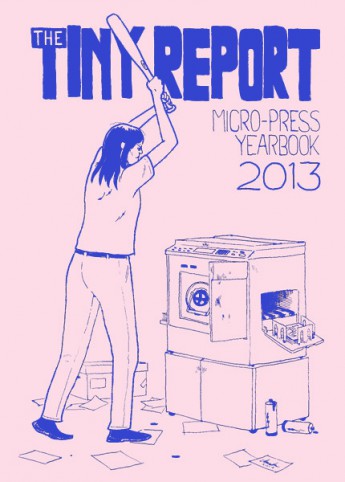
Thirty Days of Short Reviews #14: The Tiny Report 2013

Robyn Chapman has long been a stalwart in the world of minicomics and micropublishing. From her early days self-publishing her own comics to co-editing two volumes of the True Porn anthology to starting her own publishing concern in Paper Rocket Minicomics, Chapman has embodied the journey that many cartoonists undertake. One interesting thing about Chapman is that she's always been interested in making connections among cartoonists. She was part of a collective called Artists With Problems, which sponsored a number of cartoonist get-togethers for drawing. She reprinted Ariel Bordeaux's Deep Girl minis in a paperback because she didn't want the past of comics publishing to get lost. Her most recent project, The Tiny Report, is already on its way to becoming a crucial publication for the future.

Published in 2015, it's a yearbook of micropress activity in 2013. She sought out a huge number of micropress publishers and made a chart of their publishing activity for the year, as well as offering up other details like their website, physical location, titles of publications, etc. Because Chapman is interested in history, she also offered up an essay about the subject by way of introduction, presented some graphs related to a publisher survey she sent to them and listed the three most popular micropresses of the year. (For 2013, it was Chuck Forsman's Oily Press). The questions included their biggest challenge (distribution and funding were the winners), the types of comics they publish, how they print them and if they make a profit. This mini is useful now for young cartoonists looking for potential publishers, it's useful for me as a critic and reader to see what I might have missed, and it will be useful in the future when research is being done on publication in this era.

Thursday, August 22, 2013

Sequart Reprints: True Porn 2

True Porn Volume 2, edited by Robyn Chapman and Kelli Nelson (Alternative, $19.95). This is a 250-page anthology dedicated to one thing: autobiographical stories about sex. The first volume had a lot of good stories, but also a lot of filler. A number of the stories may have been true, but weren't of much interest (even as porn). The editors, two talented artists known mostly for their minicomics work, did a much better job of selecting material and arranging the 46 stories in a manner that flowed quite well. From the peeping-Tom cover drawn by Chester Brown, we as readers are voyeurs into the worlds of these artists, most of whom are also mini-comics stars, anthology contributors or webcomics creators.

Anthologies are tricky, especially ones that have an open submissions policy like this one. It's easy for the work of one bad artist to taint one's experience of the work as a whole. It's difficult to edit and arrange the stories in a manner that makes sense. Any anthology that is themed often falls prey to repetitiveness, especially when artists tend to mine the same clichés regarding a subject (the 2004 SPX War anthology and all of the awful 9/11 anthologies in particular fell prey to this problem). That's why I was amazed by the overall quality of this anthology, even from artists whose work I generally have no interest in.

The stories in the book did fall into some stratification patterns: serious or humorous, childhood experience, first adult experience or recent experience, cartoony or realistically rendered, demure or hardcore, and satisfying/unsatisfying. Pretty much everything broke down along these lines, and not always in expected ways. For example, Jon Siruno did a story where all the characters were anthropomorphized animals drawn in an iconic style. While this story had its light moments and was not explicit, the ending was remarkably grim. This contrast made this one of the most memorable stories in the book.

The most effective stories overall tended to be either the funny stories or childhood reminiscences. Karen Sneider's "Can't Buy Me Loft" is the most laugh-out-loud story, detailing her fling with a guy she hired to build her a loft in college, with a gag in every panel. Rich Tomasso's "Don't Come In My House" and Fredo's "Circus Peanut" were also hilarious. Yet an all-humor sex anthology wouldn't have worked as well as this did, with the earnestness of some of the pieces contrasting the humor. The whimsy of pieces like Eleanor Davis' "I Wish You Were Tiny", about a silly conversation between her and her boyfriend, proved to be palate-cleansing interludes after a heavy meal of hardcore sex. The editors placed that story after an outrageous, hardcore story, and were wise to do so.

The other memorable pieces were the most bizarre of anecdotes. The talented Nick Jeffrey's story "The Hot Tub", a tale told by a friend of the narrator's that involves a threesome in a hot tub and ends with the suicide of the boyfriend of one of the women involved, is somehow hilarious the whole way through. Justin Hall's "Only In San Francisco", involves three men with quite differing sexual tastes (anal ball insertion, a scrotum licking dog, etc), and a hilarious punchline. The best-written piece may be "Aaron", written by Sharon Lintz. She writes about porn for a living and this tale of a friend of hers in the industry is oddly compelling, as the reader comes to share her admiration of its lead.

Not every story is compelling or even interesting, and that has more to do with the creators than the stories, I imagine. Still, they work in the context of the book, which is a page-turner even with its great length. Talking about one's sexual experiences is a great way for an artist to really demonstrate their basic chops; the rawness of the experience is something anyone should be able to channel, but a good artist should be able to tell a truly compelling story. What's remarkable is that there are so many excellent young artists in this book.

Friday, May 10, 2013

Deepening The Field: Drawing Comics and Mastering Comics


One of the biggest changes in comics in the last decade is the increasing commitment to providing a pedagogical foundation for both serious students and enthusiastic amateurs alike. Lynda Barry's texts are more about writing and drawing in general than about the specifics of how to make a comic, but they are still invaluable works for any creative person. Ivan Brunetti's Cartooning is still the most valuable single text out there in terms of really getting to the heart of what it is to make comics. Scott McCloud's texts seem to be fading a bit in importance as more authors who have actual experience teaching comics have entered the publishing picture, but Understanding Comics remains an interesting philosophical entry point for a newcomer.

The gold standard for comics pedagogy, however, is Jessica Abel & Matt Madden's Drawing Words and Writing Pictures, as discussed in my reprint column from yesterday. When writing that text, the authors had to cut out a lot of material. So much so, in fact, that they had another book's worth of material to publish. So their Mastering Comics should be seen less as a sequel than a continuation and fleshing out of DWWP, while recapitulating certain points in a different way. It should be noted upfront that this is a textbook and is written as such: units, homework assignments, diagrams, tons of examples, etc. It's not a book that one reads, it's a book that one uses. One could easily jump right into this textbook without having used the first one, especially if one is looking more for tips and less for the basics.

The first three chapters actually touch on Barry-style writing and drawing exercises to help generate ideas and keep up a love of making marks on paper. The fourth chapter goes into hardcore instruction on how to use perspective on the comics page. The fifth chapter begins to address a major items missing from the first book: how and when to do webcomics. This chapter talks a little behind the possibilities and theory behind webcomics. The sixthis all about style; it's a dazzling chapter that provides example after example of how cartoonists break rules to create their own style. The seventh, eighth and ninth chapters go into inking, lettering and greyscale effects. They talk about digital and hand-crafted effects for both, once again going into painstaking detail. This is the good stuff for those looking for specific craft tips with little formal training. The tenth and eleventh chapters go into detail about another deficit from the first volume: color. Chapter ten mostly talks about color principles and digital coloring, while eleven is mostly about hand-coloring. The last chapters are mostly about publishing and hand-making comics. It's unfortunate that both of the minicomics distros referenced in the book are both defunct, but that's the nature of the game. The authors frequently reference the book's blog,which continues and expands upon what's taught in the text. I imagine there will be comics texts that teach certain aspects of the craft better than Abel and Madden, and there are already better books about the creative process. However, I can't imagine better, more thorough yet approachable texts than DWWP and Mastering Comics.

Robyn Chapman's Drawing Comics Lab is in many ways, a distillation of the Abel/Madden textbooks. Combining the emphasis on exercises from those books as well as the philosophy and inspiration from several other books (including Brunetti's Cartooning and McCloud's Understanding Comics) as well as her extensive experience teaching and workshopping, Chapman synthesized her own approach in this book. It's two pages per exercise, zipping the aspiring artist through character building, creativity exercises, panel and page design, pacing, "camera" placement, storytelling tips and tricks, jam comics and other creative exercises, storytelling choices, materials (including ink, paper, pens, and pencils), minicomics publishing, screenprinting and other related aspects of making a comic.
Chapman's book is heavily illustrated and is designed to get the artist's pen moving right away in order to get them to make a minicomic. Its exercises are absolutely perfect for short comics-making courses (like one or two hour workshops) or drink 'n draw events. The chapters on materials are a perfect crash course for an aspiring artist. She seeks out the advice of dozens of other cartoonists for many of the labs; Tom Hart's character exercise is a great example. Her descriptions of the many different ways one can fold paper to produce a minicomic are more thorough than any text I've ever seen; Chapman is a veteran mini-maker and has seen a lot of people try different methods during her time working at the Center for Cartoon Studies. Overall, Drawing Comics Lab creates a unique balance between theory, practice and readability. There's enough attention to detail to impart real and useful information to aspiring cartoonists, but it keeps moving along quickly enough to encourage its students to keep going no matter what. What I like about all of these texts is that Abel, Madden and Chapman worked very hard to become the artists they are today. None of them are the sort of whiz-kid drawers who dazzled everyone from a very young age. The lessons in these books were hard-earned through trial and error and battle-tested by these veteran cartoonists and perfected through years of teaching their students.

Wednesday, March 13, 2013

Plug Time: Bourdeaux, Aushenker, S.Toth, Standfest, Espey

A few requests for project publicity have come my way, so I thought I'd run a little clearing-house here.

First, cartoonist pal Michael Aushenker is working on the comics end of an overall revival of The Human Fly. Billed as "The Wildest Super-Hero Ever -- Because he's REAL!", the Human Fly was a costumed 70s daredevil who had a short-lived Marvel Comics series. There's going to be a movie based on his life as well as the comic. This is about as obscure a 70s revival I can imagine, but the premise is so agreeably strange (as was the 70s Marvel Comic, written by Bill Mantlo and drawn by Golden Age legend Lee Elias) that I can't wait to see what it looks like.

This isn't strictly comics, but I was enormously excited to have received a bag of cookies from the Golden Age Bakery in Chapel Hill, NC from a friend. It's starting to make the rounds that baker Sylvia Toth is creating cookies containing panels from public domain golden Age comics, including a batch that's nothing but Fletcher Hanks' Stardust the Super-Wizard. Toth recently quit her day job to bake cookies full time, and they are delicious and beautiful.

Ryan Standfest has just opened a Kickstarter fund for his second issue of Black Eye, his intriguing comics/essay publication dealing with satire and black humor. This issue will feature comics from Michael DeForge, S.Gross, Ben Marra, Brecht Evens and many more. The first volume was excellent and ambitious, so I'll be curious to see how Standfest refines his ideas for #2.

I haven't yet had a chance to review it in full, but the puppet show adaptation of Eamon Espey's Songs Of The Abyss looks fascinating. Espey and his wife, Lisa Krause, co-created the show. Check out details and a schedule here.

My old pal Steve Lafler has a video up about his Dog Boy series and its recent revival on the web: 

Finally, I wanted to point readers to the fine job Robyn Chapman did collecting Ariel Bourdeaux's Deep Girl series. Full disclosure: I interviewed Ariel for this book.That said, I recommend her comics unreservedly.

Tuesday, January 22, 2013

Sequart Reprints: Stuck In The Middle/Escape From "Special"

This article was originally published at sequart.com in 2007.
************
The teen-age years are prime ground for storytelling because of the inherent drama that adolescents create in their own world. The transition from elementary school to junior high is perhaps the most awkward move of all, because the formation of one's personality is as much a reaction to the Other as it is a development of their own self. Staking out one's place in the social hierarchy is a complicated game, where conformity to norms is the rule and the systematic hazing of those who are different is the means by which the system is maintained. Comics are an especially ideal means for talking about this period, because the expressiveness of cartooning can be a perfect match for the outsized feelings teens experience.
Cartoonist Miss Lasko-Gross, in her semi-autobiographical comic Escape From "Special", learns that if you're not any good at playing the game after you've learned it, you may as well stop playing. Starting with her earliest memories as a child, Gross manages to create a narrative out of a bunch of short anecdotes. On an initial reading, the narrative feels like a house of cards, threatening to tip over into an unfocused mess. The further one goes in the story, however, the more one can see it cohere. The story begins with young Melissa realizing early on that she was a bit different from others. The realization that she can never know anything for sure sent her into a tailspin, and her wanting to put Barbie into a murder-mystery freaked out one of her friends.
It didn't help that she had trouble looking others in the eye, and that she was behind her classmates in being able to read despite an active and engaged mind. It also didn't help that she was actively resistant to any kind of authority. That combination got her kicked out of her school and placed in a new age feel-goodery, which had its own absurd rules. Its "no-negativity" rules extended to wearing black and eating mushrooms, since they grew in dark places. Of course, her parents sending all sorts of mixed messages had its own effect--they made her go to religious classes but also brought her along when their band went on tour. Things came to a head when she's placed in a special-ed class. While this was certainly humiliating ("Why don't they just call us retards and get it over with?"), it allowed her to see the game for what it was.
As she went into junior high school, she tried to fit in but realized "I'm outside of some mass cult of social agreement." There was a period of despair when this realization sank in, leading to thoughts of suicide and non-existence. It got to a point where part of her wanted to be "lobotomized" like the rest of her peers, but she knew it wasn't an option. When she was given an ultimatum by the girls she was trying to be friends with not to hang out with "druggies & losers", she saw that her choice was obvious, and that choice brought the freedom to speak her mind and stop pretending. Gross is skillful in how she arranged the anecdotes and gave them an accumulated weight, especially as she grew older in the story. What's most appealing about the book is her warts-n-all portrayal of her stand-in. The slightly grotesque and expressionistic art is a perfect match for the way Melissa looks at the world and herself. She's not an easy person for the reader to like--she's cranky, argumentative and prone to outbursts of rage. But her eccentricities are not affected, and the ways that she comes to terms with how to deal with the world while embracing what made her different made for an inspiring conclusion.
Stuck In The Middle is appealing because it provides a look at a variety of experiences and a variety of artistic styles to match. It's no surprise that Ariel Schrag put this volume together, because she's well-known as someone who started doing comics about her high school life while she was still in high school. She's currently finishing up a book on her senior year of high school after a two-year stint on the TV show The L Word. In this anthology, she got heavy-hitters Joe Matt & Dan Clowes to allow her to reprint some of their work. Clowes' "Like A Weed, Joe", is one of his best short stories, dealing with a boy's boredom spending a summer with his grandparents and his struggle to create a narrative framework for his life.
One of Schrag's stories, "Plan On the Number 7 Bus", is about the other end of the teen hierarchy. She was one of the ones on top who used her position to heap abuse on others, and the story involves a plan hatched by her and a friend to humiliate someone they knew. When they wind up in an unfamiliar part of town and they panic, Ariel vows "I cannot be mean"... though it seems doubtful that she'll be able to hold herself to that vow. Her sister Tania contributes "Snitch", about the fluidity of the hierarchy and how easy it is to slide up or down. After snitching on a boy who was torturing her in class, she becomes a social pariah, looking for a new group. When she finally finds it, she eagerly says "Well, that's what you get when you're a snitch" when she hears about someone else's tattling to a teacher. The harsh reality is that no matter how oppressive & unfair peer pressure can be, most kids can't see a way out of it and want to use it to their own advantage. Along the same lines, Gabrielle Bell has a piece that gives a slightly different perspective on an outsider's relationship with her classmates. In "Hit Me", Bell eschews the use of thought balloons or internal narration, making the story unique in this collection. We never see her inner thoughts as her classmates taunt her for wearing the same clothes several days in a row and smelling odd. When another outsider challenges her to a fight, Gabrielle wins and abandons another outsider friend when popular girls invite her to sit with them at lunch. The narrative distance Bell erects makes this an especially effective and devastating story.
There are sweeter stories as well. Dash Shaw's "Crater Face" involves a boy with acne problems who falls for a girl, and manages to overcome his own insecurities and reach out to her and reassure her about her own issues. "Never Go Home" is a Robyn Chapman story about a girl who is abused by her father who winds up at a school dance and sits under the bleachers. She's found by another girl, and several minutes of awkward silence & conversation ensue until the girl asks her to dance, leading our narrator to think "Maybe I'm OK. Maybe this could last. Maybe I'd never go home." Aaron Renier's "Simple Machines" talks about the author's ADD and tendency to escape into his own world with his drawings. When others reach out to him and he takes a risk by trusting and working with them in school projects, he's able to mix his old world of fantasy with his new friends. It's an enormously touching moment, one of the instances where life-long friendships can grow out of the crucible of adolescence.
Virtually every story is at least worth reading, though Nick Eliopulos' tale about a batboy and a baseball mascot doesn't fit very well with the other stories. Jim Hoover's style is a lot slicker than the other artists', and his entry feels a lot more pat and less nuanced than the other stories in the collection. On a visual level, they at least do offer something different to look at, compared to the less "realistic" styles of most of the artists in the anthology. Schrag obviously took great pains as an editor. She balanced upbeat & downbeat stories, stories by men & women, and gave everyone plenty of room to tell their stories. She added touches like a yearbook-style "autograph" section and photos of the contributors from middle school (the photos of Clowes & Matt are especially amusing). The variety of stories that she gathered was crucial, because it's easy for a reader to grow exhausted by a "theme" anthology if the editor doesn't do a good job getting as many different takes on a subject as possible. Unlike many anthologies where the stories are too short to really make an impression, there's a meatiness to this 200-page volume that makes it an enormously satisfying read.

Thursday, January 3, 2013

Sequart Reprints: Yet More MoCCA minis

This article was originally published at sequart.com in 2007.
**************
There's always been a strong relationship between minicomics culture and zine culture. Indeed, one could make the argument that minicomics are one of the most vibrant subtypes of zines these days. Beyond the fact that they're relatively cheap and easy to make, minis also allow cartoonists to turn comics into art objects if they so desire. Another connection is that many personal zines tend to be autobiographical musings of the author, and that tradition is certainly prevalent in the minicomics scene. This article will examine a number of minis that are either autobiographical or deal with slice-of-life narratives. I'm going to try to resist giving detailed plot descriptions and instead focus on character and characterization, along with the specific look of the comic and what kind of impact it makes on characterization.

CROSS-COUNTRY, by MK Reed. MK Reed's newest feels like a screenplay, but she puts in enough comics-only flourishes to give the comic weight and substance. This one's about a cross-country road trip with a young guy who's part of a family of Wal-Mart-like stores, and an employee. Greg, the boss, is a boorish frat boy type whom Ben, the employee, despises. Greg is a vacant sleazeball and Ben is conflicted about being there--it's a summer job and he needs the money. Greg loves to sleep with young girls, and this first issue ends with Ben being forced to drive home a waitress that Greg slept with--to school, because she's only 15 years old.

Greg is actually the more interesting of the two lead characters, because he's so unrepentently awful and banal. Ben clearly hates himself in more ways than one, and is stewing over an old girlfriend. He obviously thinks he's morally superior to Greg, but the fact that he's enabling his boss' bad behavior makes him worse in some ways. I like this ambiguity in Reed's characters here, as well as the unusual page and panel composition she uses. That includes panels at odd angles like diagonals, eschewing a grid on certain pages, using diary-style narration in print outside the panels, and going to unusual close-ups. Reed's figure-work is crude but she continues to play to her strengths, focusing on gesture, body language and facial expressions. Reed's definitely one of my favorite mini-comics artists who specializes in the lives of young people; I'm glad that she's moved on to a slightly older age demographic after mostly writing about teenagers.

MATCHING JACKETS and SOURPUSS 1 by Robyn Chapman. Chapman is a graduate of the Savannah College of Art & Design whose work I've been following for many years. She's one of the co-editors of the fascinating TRUE PORN anthologies as well as the driving force behind the enormously entertaining HEY, FOUR-EYES! zine. This pair of minis are obviously very personal and intimate; one is explicitly autobiographical and the other inspired by autobiographical events.

MATCHING JACKETS is a compilation of stories about old boyfriends. "Something's Wrong" is from TRUE PORN, and is a devastatingly personal account of her problems with sex with one particular boyfriend, and how this turned into an irreparable barrier. What I liked most about this story was the disconnect between "Robyn's" emotions and her physical reactions as a sexual being. When she reveals that it may be related to her evolving sexuality (being attracted to women), it's a painful moment, one where all further communication is impossible. A cheerier story is "Comfortable", a John Porcellino-style story where Chapman merges text and image in a free-flowing manner, abandoning panel gridlines altogether. This one retells a clearly-doomed but still-pleasant relationship from college, and is told in Chapman's sparer, cleaner line from her recent works. The nature of the narrative will feel familiar to anyone who recalls their first love from college, but it's her compositon that makes this the best story in the book. There's one page where she describes the first time she and her boyfriend told each other that they loved each other. The way she makes the eye follow her boyfriend laying in the grass, to the narrative, to an overhead view of a park, to Chapman in the bottom right hand corner, is a perfect example of assured and creative storytelling, neatly solving several visual problems.

SOURPUSS is the first chapter of a high school story, and it takes place in Chapman's native rural Alaska. There's a Chapman stand-in in Doris, an artist who hangs around with some nerd friends and can't relate to anyone else around in her redneck town. This comic is a well done but quite familiar account of teen alienation. In the first chapter, the dynamic between Doris and her friends is fairly predictable, down to her jealousy over one of them getting a girlfriend. Chapman's character design is the main attraction of this mini, along with her understanding of expression. I'll be curious to see where the story winds up going.

JAM IN THE BAND and PARTY @ HORROR BEACH, by Robin Enrico. Enrico's specialty is conjuring up atmospheres of particular youth scenes, and he creates that verisimilitude thanks to witty dialogue. JAM IN THE BAND is a short preview of a much longer work, and it had echoes of Brian Lee O'Malley's SCOTT PILGRIM and Jaime Hernandez' LOVE AND ROCKETS. It's about a music writer in New York who's about to see a well-known, all-female indy rock band--one that he knew quite well in the small college town they came out of. It's got that same indy rock vibe as SCOTT PILGRIM but uses the time-jumping techniques in those Locas stories. Despite those influences, Enrico has his own voice. His cartooning is simple, iconic and stylized, with a number of decorative flourishes. He's careful to keep his panels uncluttered, even when he's trying to get across a lot of information through visual cues. The small taste we get of the characters in this issue wasn't quite enough to get lost in their stories quite yet, but it does lay out the tensions nicely. I look forward to the larger work that's yet to come.

PARTY @ HORROR BEACH has several semi-auto-bio stories, some of which read like inside jokes. "Trapped In The Closet", however, put together a string of ridiculous situations and sustained them nicely as one coherent, funny narrative. It's about a Halloween party that Enrico's stand-in character attends, where he comes as a "Big Stupid Box" on a dare. There's a funny aside where two women note that since it's Halloween, they're required to dress in something Sexy--so one chooses to be Sexy Abe Lincoln and the other comes as Sexy John Wilkes Booth. He winds up fooling around with a woman (with a boyfriend) whom he had slept with before (at a drunken party) in a closet. When he's told that the woman is now engaged, and that her fiance was at this very party, he finds himself stuck in a closet for the night, hiding out. Enrico manages to play a sordid encounter for laughs, mostly at his own expense. What I like about this is the extreme short-sightedness of every character; the woman he sleeps with has no problem cheating on her fiance, until he gets wise and takes away their engagement ring, while Robin knows it isn't a good idea but does it anyway. Enrico's skill at humor is what distinguishes this autobio mini from others of its kind, along with that amusingly cartoony art (which greatly aides in evoking laughs).

DISCO MAXX by Katie Skelly  This brief mini has a mylar cover with a different design on every copy. While this is an autobiographical story, it's not really a narrative or even an anecodote, really. Instead, it's a series of memories as images, flowing together on a night when Skelly and a friend DJ'd a party at Syracuse. Skelly's style is spare and simplistic, emphasizing expression over form. It's a sweet, unambiguous account of a night where everything went magically right. It was the sort of night where one could sense great things happening as they unfolded, and the result is a series of memories that burned themselves into one's mind's eye quite vividly. Skelly's panel composition can be slightly cluttered; if anything, I'd like to see her simplify things even further. Still, I enjoy the way she presents memories and encounters on a page, especially how she constructs dialogue. Though this story was very sweet, she actually has a tart and witty voice, and I'd like to continue to see that fleshed out in longer narratives.

MY BRAIN HURTS #6, by Liz Baillie  Enrico and Skelly distance the reader from the emotional content of the material, either through humor (Enrico), narrative ambiguity (Skelly) or a cartoony drawing style. Liz Baillie, whose work I've reviewed here previously, goes in a different direction. She plunges us head-first into her characters' tumultuous emotional lives, and does so with dense, detail-packed panels. Her actual line is fairly thin, which lessens the punch of each particular panel (different from Robyn Chapman, who uses fairly thick blacks for her lines), but she adds mood to her panels with the heavy use of shadow, cross-hatching, blacks in a panel, etc.

All of this is in service to her story, and this particular issue deals with some unusual difficulties regarding young love for a teenaged lesbian. Baillie perfectly captures the awkwardness of an attempted sexual encounter, especially when her girlfriend paradoxically clings to her Catholic upbringing. Baillie gets this across in a page where the panels sit at odd angles to each other, overlapping and zooming in and out of intimate close-ups. It's a great page, one of several in the book where the page design has a direct influence on the book's emotional content. By the end of the issue, we have a real sense of the main character feeling as though she's hit rock bottom, with nowhere to belong. Baillie's become more adventurous as an artist as the series has proceeded, and the interesting choices she's made have deepened the book's emotional impact.

NO IN-BETWEEN #1-6, by Marion Vitus  I remember buying the first issue of this series at SPX several years ago, and was struck at how ambitious it seemed for a young artist to undertake a sprawling travelogue as their first work. It's obvious that this story, described as "fiction with autobiographical inspiration" (what Dean Haspiel calls "semi-auto-bio"), was a life-changing and enormously meaningful event for Vitus. The plot can be described simply: an aspiring artist is stuck in a dead-end job, awaiting a backpacking trip to Europe with her long-distance boyfriend as the catalyst needed to get her out of a rut. When he unexpectedly dumps her, she decides to go anyway--by herself. I like that Vitus took a sharp turn away from standard 20-something romance drama and went in a very different direction. It's clear that this isn't just a series of observations on travel, but rather an attempt at using travel as a means of finding out what she really wants in life, and how to get it.

The fact that it took Vitus nearly four years to produce six 8-page minis just points to how much of a struggle it can be for a working artist to find the time to concentrate on their personal projects. Among other things, this mini is obviously Vitus' laboratory in attempting to grow as an artist. She changed her rendering style twice before settling on a look that seems to be a good fit. The first issue was a pretty clear-line affair; there weren't many blacks used, and she kept her figures fairly simple. I also noticed that Vitus loves to play with gesture, posture and expression as emotional cues; there's a squirminess to her stand-in character that reflects her own discomfort with the world, and at times, herself.

The second issue, which takes place in Italy, was much more heavily rendered than the first. At times, it was over-rendered. That killed a lot of the spontaneity on the page and made her figures look stiff. By the end of the third issue, she loosened up a bit, especially on a page where she gets goosed on a subway. In the sixth issue, Vitus does a nice job of keeping that spontaneity going while still getting across the beauty of the surrounding countryside. It's fitting that in a story about transformation, growth and becoming comfortable with oneself, Vitus the artist continues to grow and struggle with the lessons she learned as Vitus the character. The difference is that the story crystalized that moment into a series of epiphanies. The struggle to hold onto those feelings of self-discovery and relay it on paper continues to inform the way Vitus is slowly unfolding the story.

THE ROSIE STORIES, by Diana Tamblyn  As a storyteller, Tamblyn is clear, restrained, matter-of-fact and has an assured, bold line. After reading a number of stories involving teens or young adults, it was an interesting change of pace to read stories about becoming a mother. Tamblyn's tone is gushingly emotional and joyful; there's no attempt or thought of an attempt to put any distance between her plain feelings and the reader. She ameliorates that bluntness by using a couple of different techniques in these stories about her daughter. Tamblyn either tenderly narrates her stories in a realistic style, or else simplifies her line for stories told from her daughter's point of view. It's a more cartoony, John Stanley-esque style that's very appealing. Throughout the comic, there's a genuine warmth that comes across on each page. At times, it's a bit overwhelming for a reader.

While I can certainly appreciate how much a new mother loves her child, there's not much going on in the first story other than an expression of that love, along with trying to capture perfect moments. It felt more like something you'd send out to your relatives than work for the general public. The Rosie-as-narrator stories work a bit better, especially when Tamblyn introduces some light elements of conflict. The last story, where Tamblyn relates her paranoia regarding her child's safety and her own desire to become a better person, is the most interesting by far. There's a lot of skill and sincerity in this comic, but one senses that Tamblyn isn't sufficiently distanced from the initial event to write a compelling narrative about her experiences. I'd like to see her take cues from the last story in the mini and add a bit of perspective to what is obviously an amazing, life-changing odyssey.

DUMB JERSEY WHITE BOY #3, by Mark McMurray McMurray is a very strong storyteller, using a variety of approaches to give a powerful sense of time and place. His stories usually mix comic and horrific real-life events, and this issue is no exception. It's a collection of short stories about his father from various points in his life. The most accomplished is a short story he submitted to the SPX anthology some years back, and it's a beautifully-illustrated memory of his childhood. Young Mark is obsessed with the new Fantastic Four cartoon, which his father interrupts by talking about his failing marriage. While he weeps and holds his son, young Mark can only think that Jack Kirby was definitely involved in the cartoon! The stage is set for the other stories in the book, where McMurray displays a combination of ambivalence and bemused affection for his father. The latter stories were originally done as correspondence, and have the vibrancy that a quick sketchbook drawing possesses. McMurray has a very assured line and an excellent eye, and augments these skills with a keen sense of when to exaggerate and when to reel things in. As a writer, McMurray keeps a layer of humorous distance up when discussing his father--he talks about what his father has done or said, but never spells out his own feelings. He prefers to let the anecdotes speak for themselves, a tactic that works to his advantage.

PHASE 7 #11, by Alec Longstreth. This is a follow-up to PHASE 7 #10, wherein Longstreth starts to lay out his entire history of comics involvement. This issue picks up with Longstreth deciding to make creating comic books his life. The last issue was all about how he became immersed in comics and came to start drawing them, but this one focuses on how he developed his working method, the ways in which he started interacting (and drawing strength from) fellow cartoonists, and how he came to terms with his own publishing schedule. Longstreth uses a cute framing device to explain why he published issues out of order, giving a long and very specific autobiographical story some structure. What I find interesting about Longstreth is that while he acknowledges the huge debt he owes to those cartoonists who inspired him over the years, he doesn't seem to be quite aware yet of his own role in inspiring his peers. Simply put, it's rare to see an artist this completely devoted to his art, who thinks about it in terms of the years that are ahead of him, and who provides such a steadfast example of hard work being its own reward. The fact that he has such an enormous appetite for different kinds of storytelling and doesn't seem to favor one over another is also interesting; he's very much an "in-between" sort of artist. He lists BONE as his favorite comic ever, but is also a big fan of Chris Ware and Adrian Tomine. Likewise, his comics go from gags to autobio to adventure, and his art ranges from stick-figure (inspired by Matt Feazell) to intensely cross-hatched and detailed; he refuses to impose limits on what he can do.

Even though he's already published quite a few comics, I get the sense that he's still working through his influences. As solid a craftsman and storyteller as he is, Longstreth is not yet an innovator or visionary as an artist. He's an artist that I think will plow through a series of "steady-states", wherein he will master a storytelling or artistic technique, and then face either a new problem to solve or influence to absorb and then adapt that into his routine. Eventually, these years of internalizing these adaptations through sheer hard work will coalesce into something we've never seen before. Until that time, his audience will have a great many unusual, enjoyable comics to read.

ANTELOPE EATER, by Juliacks. This is an intensely stylized, painful story of a young boy struggling with his mother's illness and her resentment towards him. What's most striking about this is the sophistication of the page design, coupled with raw, primitive art. The way Juliacks combines text and image on a page, such that the text should be seen both as part of the image and as a separate message, makes for an intimate, almost suffocating experience as a reader. The images are not pleasant, because the experience of watching one's mother die as she wishes you had never been born is certainly not pleasant. The boy retreats into fantasy, becoming a superhero who can save her. The images switch from purely grotesque to fanciful, though the tiny text reminds us of the painfulness of the experience. The last page, with a number of small panels that intersperse her vitals with images of a heart (acting as both literal and metaphorical agent), is shattering--especially, once again, with the way she integrates text into the image. Juliacks has a powerful voice, and the multitude of influences on her art (see her website) point to someone who can do some very interesting things in the world of comics.

THE OTHERS, by Matt Madden. Madden is well-known for his formalist experiments, devising whole stories around clever storytelling constructions. He seems endlessly interested in taking the basic format of comics--panel, page, images, letters, panel-to-panel transitions, point of view--and scrambling them so as to force the audience to see what's happening "backstage", so to speak. At the same time, he's able to imbue this interest with enough humanity to make these more than mere technical exercises. THE OTHERS is a brief, circular exercise in switching points-of-view. It reminds me a bit of the Richard Linklater film SLACKER in that we are privy to a character's narrative for a few moments, and then we sail off into another character's narrative when their paths cross. The difference is that as a comics audience, Madden gives us access to their interior, running monologue. Each character happens to be studying the next character, wondering about their histories and motivations. Starting with one young man in a cafe, we zip from character to character until we arrive back at the original character--and an attempt to make contact. "Other" here refers to our essential isolation as human beings, and how difficult (and often startling) it can be to try to genuinely break through that layer of alienation. Madden's line is as loose and sketchy as ever; I sense that he prefers that his work should look a bit fuzzy so as to provide less of a shock to the reader when he starts shuffling his formalist deck. Madden really found his voice doing these sorts of comics, and they're always satisfying to read--though they'll never have the emotional impact of more personal work.

THE OTHER SIDE and DOUBLE-YELLOW LINES, by JP Coovert and Hope Larson. These comics have modest ambitions, but the ambiguity in both made them linger a bit. THE OTHER SIDE is a seemingly simple look at a sleepover with two boys who are best friends. They scamper around their neighborhood at night in a carefree manner, peeking into the windows of various people. Until one of them spies a couple having sex--one of the boys is fixated, and the other gets nervous and wants to leave. This leads to an argument, accusations of being gay, and then an attempt to pretend the whole thing didn't happen. While never apologizing, I liked the way Coovert found ways for the characters to nonetheless reconnect without language--especially through the use of physical contact.

DOUBLE-YELLOW LINES is a beautifully-designed mini (black cover, black-embossed lettering, and 2 yellow lines to represent the highway) where Coovert and Hope Larson collaborated. Both stories reflect on each other, as they're both about the briefness of life and the painful awareness that it can be taken away at any time. Larson's story has her coming upon a rabbit that had been struck by a car . As she tried to comfort it, she noticed that the rabbit's mate saw them near the edge of the highway. The rabbit she held died, but the other was shooed away to safety, despite the obvious urge to search for his mate. Not for long, however--the rabbit returned, only to meet his own death on the highway, joining his mate. "Driving In The Rain" is about Coovert wondering where his better half is and getting a phone call from her that she'd been in a wreck. He raced to get her, worst-case scenarios burning through his thoughts, until he found her OK--and presented him with a touching romantic gesture. The sentiment of the story is a nice balance to the downbeat ending of Larson's half of the mini. It's the nature of mortality, that we're all essentially living on borrowed time, and this mini eloquently gets at that truth in just ten pages. Visually, Larson punctuates her bold black line with all sorts of decorative touches that act as narrative clues, while Coovert keeps things clear and simple. His art is all about economy of line and advancing the emotional narrative of his story with a minimum of fuss.

NEW CONSTRUCTION #1, by Kevin Huizenga Huizenga is a fast-rising star in the world of comics, with an Ignatz book (GANGES) from Fantagraphics and his own series (OR ELSE) and a collection (CURSES) from Drawn & Quarterly. However, he got his start with his minicomics series SUPERMONSTER, and he continues to make minis to work out ideas, provide anecdotes, and show off some interesting work from his sketchbook. There's a sense that this is autobiographical, because it's displaying ephemera and sketches straight from the cartoonists' pen, and a number of the pages are about his working methods.

A number of the strips here were "deleted scenes" from GANGES #1. I have no idea if he actually meant to include these scenes but didn't have room, drew them but decided they didn't fit, or did them after the fact as a lark, but they're all a hoot. That issue depicts the life of a couple at home, focusing on minutiae and moment-to-moment beats & rhythms. Both of the scenes depicted here were a lot more light-hearted than what we saw in the actual comic, and I can see why they weren't included. Still, it was fun to see Wendy Ganges tell Glenn to stop thinking sexualized thoughts about her, or see her fall on the floor laughing because of a trick Glenn was pulling with snacks. I also rather enjoyed the very odd "The Hundred Most People In America", a riff on celebrity and other such lists featuring a number of oddball characters and descriptions. Any fan of Huizenga should track down a copy.

ECLIPSE and THE ANATOMY OF US, by Karla Krupala. Krupala has serious chops as an artist. ANATOMY OF US is less a story than a self-described "work in progress", where she "sketched various relationships in states of disorder". The results are very interesting in this mini, but they've obviously not resulted in a coherent whole as of yet. Krupala likes static images and using them in unexpected ways. On one page, we see the back of a skeleton as a means of conveying a conveying a dialogue, doubling as an anatomical chart. On another page, we see a woman's legs, and her shadow is formed out of the word "take" repeated multiple times. Krupala seems to be emphasizing our essential aloneness and the near-impossibility of communication. In particular, words not only fail in trying to connect people together, they inevitably serve as weapons. ECLIPSE is a story set in outer space, but the themes are similar: loneliness, the possibility of connection, and the nature of that connection. I felt tantalized by these two minis, wanting to see more by the artist. I especially wanted to see her themes fleshed out a bit more in longer stories. Her development as an artist over the span of a year was remarkable, especially in terms of her figures. They became more assured and bolder in ANATOMY, though her composition in both comics was striking.

ALICE IN NEW YORK #4, by Henry Chamberlain. I reviewed the first two issues of this series in entry #10 of this column, and was happy to see this issue pop up in my mailbox. I missed #3, but it was easy to catch up with what happened. This is the conclusion of Chamberlain's love letter to New York and Lewis Carroll, and it's interesting to see how his art has matured. He uses a thick line but is nice and loose with his figures. There's a pleasing, sketchy quality to them that meshes well for the slightly dreamy quality he embues in his story. The theme of the story is allowing oneself to become open to an awakening of imagination and the possibilities therein. The Henry character is guarded and uncertain, but clearly wants to find ways to break out. This issue is essentially one long battle of wits with the object of his affection, a woman who challenges him to break free of his self-imposed, over-intellectualized restraints and assumptions. This issue is very talk-heavy, but Chamberlain counters that with big panels that are well-composed. The central conceit of the series, that characters from ALICE'S ADVENTURES IN WONDERLAND are secretly aiding Henry in opening himself up to a new world, is kept mostly to the edges of the story, allowing the issue's central dialogue to take precedence. It's a smart decision, because there was definitely a danger in those fantasy elements overwhelming the emotional thrust of the story. Instead, Chamberlain was able to present the story of a character who overthinks things a little too much, who was able to find a way to lose himself to the immediacy of experience.

THE HOOKAH GIRL VOLUME 1, by Marguerite Dabaie. The subtitle of this comic is "Growing Up Christian Palestinian In America", and Dabaie wastes little time in addressing some very sticky points about this subject. She cleverly begins this collection of brief stories and anecdotes with "Should/Am", which is a series of paper-doll cutouts. Dabaie goes from stereotype to stereotype, boldly drawing humor out of a cut-out of "Martyr" ("NOT in Israel To Sight-See!"), alongside "Muslim", "Seductress" (a harem girl costume), "Revolutionary" and finally "Hungry Artist". It's a direct shot across the bow to start a collection, and Dabaie makes her bluntness work by using dark humor and the convention of a child's activity.

The rest of the stories in the book range from light-hearted memories as a child to pointed observations on today's political climate. A story about her family stealing grape leaves from wine orchards (prefaced by the technique on how to roll a grape-leaf) was funny, as was a story about the ways in which Palestinian-Americans go to extremes in connecting with their culture. It's clear that Dabaie is conflicted on a number of matters relating to the Palestinian cause. In a story about hijacker Leila Khaled, it's obvious that Dabaie is drawn to her because she was a woman who acted boldly in the Arab world, and not just because she drew media attention to the Palestinian cause. There's another story called "The BestEST Joke" where someone tells her a Palestinian joke (not knowing that she was half-Palestinian), and she doesn't know how to react.
My favorite story in the collection was "NOW", an acidic critique of Americans using the kaffiyeh, a traditional piece of cloth, as a fashion statement. ("Go against 'the man' Now. In style!") I think Dabaie is currently most skilled as a satirist; she has an elegant thin-line in those drawings that really brings out the cutting humor in her concepts. I also admire her simplified, stripped-down style that she used in "The BestEST Joke" and the grape leaf story. The stories using thicker blacks are somewhat less successful visually, feeling slightly over-rendered and drawn with a less confident hand. Still, Dabaie was bold in trying so many different styles for her first collection of work, and she has a strong storytelling voice. Her point of view and experiences are also obviously unusual in the world of comics, but it's not just that point of view that makes her distinctive as an artist. Her brains, sense of humor, and graphic design sense are the engine that manages to link her memories and opinions in such a bold presentation. I'm eager to see how she grows as an artist.

STABBED! and BERNIE, by Cheryl Gladstone. These autobiographical comics score major points for being really funny. Gladstone uses her background to generate laughs out of family drama, thanks mostly to the outsized personality that is her mom, Bernie. She's a "Jewlipino", a rare person who is both Jewish and Filipino. In BERNIE, Gladstone does a series of one-page gag strips with Bernie's point of view on all sorts of things. My favorite is Bernie telling young Cheryl that she was adopted, even though she wasn't. Another strip, "Motherly Advice" has Bernie offering dating advice to Cheryl's sister: "No blowjobs!" STABBED! relates another crazy anecodte: Cheryl's brother and mother both threaten to kill themselves as a means of trying to one-up each other. Her brother finally tops her by impulsively stabbing himself in the leg, which is a cold dose of reality for everyone. That bit of insanity leads everyone to cope the best they can: Bernie starts organizing her shoe closet, Cheryl starts writing in her livejournal, and her sister goes shopping. BERNIE is the later mini, and it shows. Gladstone's line is both bolder and simpler. It's much more assured, with better panel composition. STABBED! loses some of its comedic impact simply because the figures are shakier, and Gladstone tries to compensate by overrendering the backgrounds. BERNIE is more successful on a visual level simply because Gladstone makes sure to emphasize her characters above all else. She has a strong comedic voice and manages to evoke humor from a situation without relying on distancing herself from the reader. Reading these two comics made me want to see more from her.

KING-CAT #66, by John Porcellino. To say that John Porcellino is a revered figure in minicomics circles is an understatement. He long ago mastered an economy of line that strips away everything but what is essential, especially in terms of emotional content. His stories range from standard narratives to wisps of memory to story poems, all grasping at getting across the sublime on paper. "Football Weather" is a lighthearted story about playing football with the neighborhood kids, with more funny moments than the usual Porcellino story. I especially liked the revulsion he felt at the possibility of having to play on a team called "The Packers", given his status as a life-long Bears fan. I love the way this story looks--the stripped-down lines still depicting action and motion so well, various emotions shown with just a line or squiggle, and the way he creates a rainy fall atmosphere. It's beautiful and evocative. This issue is like a Porcellino primer, because he goes from a straight-ahead story like "Football Weather" to an illustrated poem in "Blue Light" to an almost wordless meditation on scenery in "Freeman Kame". Porcellino writes many of his stories on a small scale--a memory here, an anecdote or observation there. It's that very scale that creates an intimacy and warmth for a reader, that slowly lets us understand Porcellino's point of view instead of him jamming it into our faces. The urge to create autobiographical work is often a narcissistic one, wherein the creator is the most important "character" in their story. Porcellino manages to side-step that tendency by neither overselling nor underselling himself, but rather by revealing himself to be a small but not insignificant part of the world--just like everyone and everything else.
Thursday, October 25, 2012

Sequart Reprints: 12 Great Minis From SPX 2006


This article was originally published in 2006.
*****
One of the highlights of any alt-comics events is the opportunity to take a look at a new crop of mini-comics. Some of them are by established artists who have regular, professional publishing outlets. They often make minis just to have something new to show at conventions, or do it as a way of publishing chapters of new, long-form works. Other minis are by young artists looking to establish themselves, and yet others do minis purely as an end unto themselves. Some are elaborate, with die-cut or silk-screened covers; while others are humble Xeroxed efforts. The minis I included in this article were those that were my favorites. There were a number of other minis that I enjoyed as well, but the minis I wanted to include here were a bit more substantive -- both in terms of content and page length. Without further ado...

1. My Affliction, by Gabrielle Bell. Bell was giving out copies of this mini, a return to the weirder, magical realist stories of her earlier work. The title affliction is actually summed up by Gabrielle's stand-in character: "I'm always falling in love with guys who aren't good for me." One would expect a story built around that statement to be a typical melodrama. Instead, Bell starts off the story being picked up by a giant and finding herself stopping in mid-air when he dropped her. Things get stranger from there, as she finds herself in a neurologist's office after getting attacked by a gang of dogs. He tells her that that she must transfer her feelings of love to someone safer, and gives her a wooden token named Charlie. After she drops it into a river, he comes to life and they live together on a houseboat. Gabrielle finds herself unable to fall in love with him, and in fact fell in love with everyone but him. A panel where a UPS delivery man asking for her name for a signature is hilarious, as she suggestively replies "What's your name?"

Things get even weirder from there, as she winds up with a brutish thug who was the original owner of her foul-mouthed parrot. She gets abandoned by her new boyfriend and winds up getting a ride from a suicidal man and careens off a cliff. Winding up in a cage in the home of the original behemoth, she manages an escape attempt with her new cagemate and her rescuing boyfriend, and must worry about her dog winding up in a giant rat trap. As always, Bell plays all of this wackiness with a straight face. Her deadpan narration provides a bit of distance, but its flatness actually draws out the absurdity of the scenarios Gabrielle winds up in. That craziness is given warmth by Bell's loose and lively line. This mini is the latest in a series of triumphs by Bell and an interesting change of pace from her autobiographical work in her new book Lucky, as well as the conventional stories in Mome. While we've seen some fantasy elements creep back into her work recently, it's been awhile since we saw an all-out flight of fancy from Bell. It's a welcome return and makes me wonder if we'll see a long-form work of this nature from her in the future.

2. Becky and Friend, by Lauren R. Weinstein. This mini includes the story "Horse Camp", which was  published in the Viking anthology Stuck in the Middle.. A story much like her work in Girl Stories, this is a hilarious but awful account of Becky and her summer at what is supposed to be a horseback riding camp. Weinstein possesses the uncanny ability to depict the narcissism, self-loathing, giddiness and melodrama of the teenaged years. The funniest bits in the story are the over-the-top letters of woe Becky writes to her parents, despite the fact that she does finally manage to spend a few rapturous hours riding a horse. As always, Weinstein's style is an exaggerated one, to the point where some of the figures are almost grotesque. Her teenaged stand-in is memorably goofy--the scene where she tries to start dancing with her horse (singing Salt 'n Pepa's "Push It") is ridiculous, especially when some other girls catch her, mortified. Despite these exaggerated touches throughout the story, what makes it so effective is how remarkably (and embarrassingly) true she makes the episode seem. The distortions are played straight, which makes them both funny and real. A nice addition for the mini was the presence of grade school poetry about a similar experience, which was as over-the-top as one might expect for a child.

3. Couch Tag #3, by Jesse Reklaw. Reklaw's previous issue was one of the more compelling comics of 2005, and I was happy to see it included in The Best American Comics, 2005. Reklaw's skill as an autobiographical artist is to relay one series of anecdotes that are of interest to a general audience, but doing so in a manner that subtly reveals more profound emotional truths. In Couch Tag #2, Reklaw discussed the cats he had as childhood pets, but he was really telling the story of how his family disintegrated. In #3, the hook is the series of pranks and artistic projects he and his friend collaborated on over the years, but the underlying story is about different kinds of communication and the ways they can break down.

The best comparison I can think of is the relationship between Becky & Enid in Ghost World. Jesse and his friend Brandon went through ups and downs as friends, but when they were close, that friendship was expressed through a series of artistic collaborations and pranks. That culminated in a comic they did together about a man named Fred Robinson. He was someone random they picked to make into sort of their own everyman character--except that they'd leave him weird objects, set up stolen traffic signs repainted to say "Fred Robinson Crossing" across from his house and even send him comics they did about him. This communication through activity and in-jokes is not unusual for many men, especially those who have trouble expressing their feelings otherwise.

A telling scene in the story is when Jesse gets a letter from Brandon, who is living in Norway at the time. All of the things that had never been said between the two of them as friends just spilled out--and were never said again in the same way when they reunited. That letter became especially poignant when we see their friendship splintering apart because they aren't capable of talking about it. That poignancy is prevented from becoming schmaltz by the shenanigans depicted throughout the rest of the issue. My favorite sequence is when they make up a stencil template and use spraypaint to turn street signs that look like this <- -> into the Batman signal. Reklaw is becoming an increasingly skilled and versatile artist, capable of doing straight-up humor pieces, dream interpretation strips, autobio and much more.

4. Krayon's Ego, by various. In the tradition of Low-Jinx and Johnny Ryan's nasty parodies, a variety of artists take on comics in the Kramer's Ergot vein. Parodies of Craig Thompson and James Kochalka, while both funny, don't really have much to do with the Kramer's aesthetic. Still, the hilarious parody of Blankets (involving an extremely inappropriate use of a crucifix) was a hoot, and the mimicking of Thompson's angular style was uncanny. Spoofing Kochalka's cloying sweetness is like shooting fish in a barrel, but the "American Elf 2030" strips here were extremely clever. The thought of Kochalka continuing his strip into old age, while visiting his son in prison and selling his song "It's My Dink" for a Viagra ad were all good gags. However, the Tom Gauld-esque looking strips satirizing Sammy Harkham, Souther Salazar, Kevin Huizenga, Ben Jones and Gabrielle Bell were nasty fun. The fifth strip, involving Harkham finding a discarded strip by Mr T and Harkham declaring him "another naïve master of sequential art!" The other strips poke fun at the creators by portraying them as their opposites: Jones as a wheeler-dealer businessman, Bell as a superhero, Harkham as a junkie who pretends to bow out of activities for religious reasons, etc. My favorite strip was probably "Why Johnny Can't Satirize", a send-up of Johnny Ryan's crude parodies: "It's like he takes a great comic and then puts a dick or fart joke at the end." "Brilliant!" This mini is clearly a series of inside jokes for the alt-comics crowd, but it's still quite amusing. Contributors include Karen Sneider, Marc Campos, Clutch, Josh Frankel, Tom Neely, Jesse Reklaw and Sara Oleksyk.

5. Morbus, by Star St. Germain. St. Germain is primarily an illustrator whose style is somewhat reminiscent of Phoebe Gloeckner. Both have an astonishing facility with anatomical drawings put to new purposes. This short mini is a stylized catalogue of "various diseases, illnesses, and syndromes that my body has collected over the years". Each page's design is beautiful, with an illustration of conditions like scoliosis and carpal tunnel paired with medical descriptions that have been mostly erased. The final image of the mini, where she opens up her dress to reveal an anatomical diagram perfectly captures the evocative nature of her work. The disappearing text evokes the imperfection of how medical lingo captures the effect that pain and sickness can inflict--theimage, combining her normal features and the anatomical dialogues, perfectly conveys these feelings.

6. Various minis by Drew Weing & Eleanor Davis. Both are graduates of the Savannah College of Art & Design and are two of the most promising talents in comics. All four of the minis reviewed here are beautiful art objects on their own, with die-cut covers, innovative cover designs and beautiful uses of color.

Weing is best known for his Journal Comic and Pup, both of which drew a lot of attention when they were originally published on the web. Weing is an amazing draftsman and designer, merging a light cartoony sensibility with lush backgrounds. His solo effort here, Blar, is a straight-ahead tale of a barbarian who kills everything in his path. Feeling a bit like Trondheim & Sfar's Dungeon, Weing plays the action straight but ups the ante with ever-more ridiculous opponents and situations. Each story ends with an unexpected punchline, as Weing paces each strip with great skill. This is a modest but delightful comic.

Davis is a bit more under the radar at the moment, but not for long. Her comics often have fantastic themes but a melancholy tone; she reminds me a bit of Megan Kelso in that regard. The Beast Mother is a masterpiece in the use of negative space as Davis details the life of a female monster with dozens of children. When a hunter starts stalking her, our assumptions and expectations are quickly challenged. Even after the big reveal, there's a sadness to the story that lingers. Mattie and Dodi is a very different sort of strip that evokes the same kind of feelings. It concerns a pair of sisters, the older of whom is taking care of both her dying grandfather and her younger sister, an extremely shy girl. This story is all about roles and responsibilities, as Mattie struggles to deal with her grandfather, her boyfriend (who wants her to sell the house), and Dodi, who is enormously uncomfortable with the outside world. While not as visually striking as The Beast Mother, it's every bit as powerful. The final two panels, as we see the sister in very different places emotionally, gives the reader a number of clues as to where their stories might go next.

Davis and Weing collected several of their short stories in a mini called Bugbear. Life and death are the overriding themes in this mini. Weing does an odd story based on a dream he had after his father died, where his father comes back to life in a "soy-based" body. In the dream, Drew realizes that he can bring Eleanor back to life in the same manner. Davis has a story in which a young girl screams that there's been a mistake and ventures with a creature to the local graveyard, where her dead grandfather is revived. The themes are similar, but there's always an added distance present in Davis' stories.

Both artists are self-publishing, but don't look for that to last much longer. The only question is what kind of stories they'll want to tell given the resources of a publisher. I sense that Weing has several big stories that he wants to tell, but Davis' future might lie in being a short story specialist like Bell or Kelso. 

7. Husky #1 & #2, by Alex Robinson & Tony Consiglio. Two of my favorite "new-mainstream" creators are serializing their new long-form stories. Consiglio (whose  110PerCent was quite enjoyable) contributes "Titanius", a surprisingly hard-boiled, straight-laced noir involving a guy in a metal suit and his quest to get his son back. The humor here is told with a straight face as Consiglio conforms to certain genre conventions. However, the increasingly-convoluted plot (involving cures for herpes, evil pharmaceutical companies, killing enemies with lamps and more) reveals that Consiglio is winking at the whole story with his cartoony art style and over-the-top scenarios.

Meanwhile, Robinson's new story is called "2 Cool 2B 4gotten". The high concept is quite simple: a 40-year old man undergoing hypnosis to cure him of smoking is somehow sent back in time to high school--and in his 16 year old body. While he initially thinks he has an opportunity to ask that girl out he always wanted to and perhaps never start smoking as a youngster, it's clear that there's some deeper problem that he's repressed and has only started to bubble up. As always, Robinson's grasp on relationships and facility with dialogue makes him a pleasure to read. I like his work best when it deals with the most painful of human emotions; he has a way of evoking desperation that's almost visceral. While there's plenty of 80's name-checking here, Robinson keeps the nostalgia to a minimum and in service to the story. Robinson in the past has tended to write huge, sprawling stories; in Box Office Poison, they sometimes lost focus. That was due in part to the periodical nature of that story, but I think he was also perhaps a bit overambitious. The tighter focus in this story bodes well for this new project's development.

8. The Egoists, by Kelli Nelson. Another SCAD grad, Nelson's blocky computer-designed line provides the right amount of emotional distance needed for this story of her trip back to her hometown for her parents' divorce. The story itself has enough lurid and painful moments to be interesting without any further elaboration by Nelson, but she makes a number of clever formal and narrative choices that lead to some unexpected results. First off, the emotional distance created by her line is reflected in other choices. Nelson begins the story by introducing us to her hometown, leading us at last to the courthouse where her parents are divorcing. While the story is told in real time, Nelson tells us the story from a first-person future perspective. This choice again filters out the emotions she felt at the time; even as she tries to describe how she felt, it's all through her present perspective. The obvious absurdity of the moment and the meaninglessness of many of her interactions are emphasized by her choosing to put so much of the dialogue in empty word balloons--including all of her non-narrative, real-time dialogue. The most interesting question that Nelson asks is of herself: why did she attend? To support her mother, or get back at her father? Or worse--was it to get material for another comic? None of these questions are answered, but this isn't a story about answers. It's a story about a process, one that didn't make sense at the time of the events and clearly still didn't make much sense when Nelson wrote it. The irony is that only Nelson herself seems capable of asking questions, self-doubt and seeing perspectives other than her own.

9. Hey, 4-Eyes! #2, edited by Robyn Chapman. A delightful combination of zine and comics, this new paean to eyeglasses is a stylishly quirky read. This is the sort of esoteric zine that's clearly a labor of love and unapologetic about its obsession. What makes it so enjoyable is Chapman's sense of style and the variety of material she presents. From articles on how to purchase vintage glasses, to profiles on fellow zinesters and photo features on the "Miss (and Mister) Specs Appeal", Chapman gets down to the nuts and bolts of why she finds glasses so appealing. The best bit was "Eyeglasses Trading Cards" featuring profiles and D&D-style characteristics of the likes of Harry Potter, Lisa Loeb, Enid Coleslaw and Woody Allen, among others. Of course, there are also a number of top-notch comics in here as well. Chapman herself contributes a strip where she hits on these two guys who look like personal crush Harry Potter but instead gets shot down. The Icecreamlandia duo of Eve Engelos & Josh Moutray have their usual painfully gorgeous linework combined with bizarre one-page monologues, all centering around characters with glasses, goggles, monocles, etc. Also enjoyable is Damien Jay's take on being forced to wear glasses. A worthwhile read for anyone interested in the topic or just frothy fun.

10. Phase 7 #006 & 010, by Alec Longstreth. Longstreth is a hurricane of comics enthusiasm. These two minis tell very different kinds of stories, one the next chapter of his serial "Basewood" and the other an autobiographical account of his obsession with comics. "Basewood" is a story simply told, about a young man who wakes up in the middle of a mysterious, dangerous forest with no memory of how he got there. In this chapter, he becomes friends with Argus, an older man who had lived in a forest treehouse for years. We learn that Argus moved there with his wife, who was killed by a monster. The two become friends, but our amnesiac protagonist is haunted by dreams of monsters devouring him. The issue ends on a cliffhanger.

While the story itself is not especially ground-breaking, it's told simply and beautifully. Longstreth keeps his figures simple and iconic but provides lavishly cross-hatched backgrounds. He almost completely eschews the use of blank space, and the imbues each panel with a sort of nervous energy. Despite the heavy uses of blacks and shading, none of his pages feel claustrophobic or overstuffed. Instead there's a richness to his art that draws the eye in, aided by his fine storytelling skills and page design.

PHASE 007 #010 is something completely different. The story starts by Alec going to a therapist of some kind to tell him that "my comic book is really stressing me out!" That leads into Longstreth discussing how he became so devoted to comics. While Disney comics and Bone were huge early influences (there are touches of both in "Basewood"), it was Scott McCloud's Understanding Comics that blew his mind. Combined with Dave Sim's preachings on self-publishing, Longstreth knew that he wanted to make, teach and think about comics for the rest of his life.

One gets the sense when reading some of his comics that he wishes some of his stories could just come pouring out of him. We don't actually get to the root of his frustration in this issue, but I would suspect that he hates that he can't get his ideas down on paper fast enough. Longstreth's story is notable for his reaction when introduced to new concepts and ideas--he becomes so absorbed by them that he forgoes everything else to fulfill them. After being exposed to art comics, he read everything his libraries had in stock within a couple of weeks. Sim's writing encouraged him to draw some form of comics every day of his life. When he compares this to "a commitment on the same level as marriage", it's clear that this intensity is going to bring a lot of highs and lows as an artist. There's a total lack of cynicism in his approach, a purity and naivete that comes through clearly on the page. Longstreth is not only obsessed with the form, but he's also trying to figure out why he is obsessed. That mania, as Longstreth struggles with his own personal blind spots, is almost as interesting to follow as his actual comics.

11. How To Start Thinking About Learning How to Draw Comics, by Kevin Huizenga. This mini, designed as a guidebook for the Center for Cartoon Studies in Vermont, offers rewards on every page both as promotional material and as a comics-reading experience. I can't think of someone more suited to do this sort of comic than Huizenga, other than perhaps fellow USS Catastrophe stablemate Dan Zettwoch. Huizenga's fascination with structure and patterns meshed perfectly with the flights of fancy that inform his best work in this catalog-as-comic. My favorite bits are the how-to tips and "secrets" of comics, like the absurd series of visual cues for mood that he came up with, like "Fiery Shoulder" for a "feeling of regret", or "Waltzing Duck" as "The ghost of carefree days".

What Huizenga captures best here are the joys and frustrations of a cartoonist's life. In a strip called "Vermont Winter: Cartooning Season", we see the CCS student hole up in his room for four months working on his comic as snow piles up outside his window. Upon emerging, he proudly hands a completed comic to a friend. Twenty minutes later, the friend completely finishes reading it. That's the struggle of the cartoonist in a nutshell: months of tedious labor that is consumed in mere minutes.

The booklet is also just plain funny and knowing about comics. Lesson 113: "The Types of Cartoonists" is an accurate bit of smart-assery, as Huizenga tels us about the "Retro Retentive (Motto: 'Sigh')", the "Mad Comedian (Motto: 'F*** all this boring artsy s***')", and "Autobiographical (Motto: 'That would make a good comic')". There are also plenty of Huizenga's diagrams--some useful (like neck & back exercises for cartoonists) and some whimsical (such as deliberately over-complicated model of approaches to comics, an amusing job at Scott McCloud's attempts to reduce comics down to easily categorizable forms). 

12. Pony Up, by Karen Sneider. Sneider is a stand-up comedian whose comics come all-too-infrequently. This comic appears to be an autobiographical tale from her youth, somewhat in the vein of Lauren Weinstein. Only wanting to ride her friend's horse, our heroine instead talks herself into drinking a beer and smoking a cigarette. Desperate to look cool for her fashionable friend (I love the touch of her friend wearing an off-the-shoulder Flashdance-style shirt), our heroine can only ask "Is this what adults do all the time?" The bonus story, where our heroine learns how to pop a pimple, is a bit more light-hearted. I like the way Sneider deals with the melodrama of her teenage years with a lighthearted illustration style. I'm used to stories from Sneider that are purely comedic, but I enjoyed this change of pace and style.