Showing posts with label jessica abel. Show all posts

Friday, May 10, 2013

Deepening The Field: Drawing Comics and Mastering Comics


One of the biggest changes in comics in the last decade is the increasing commitment to providing a pedagogical foundation for both serious students and enthusiastic amateurs alike. Lynda Barry's texts are more about writing and drawing in general than about the specifics of how to make a comic, but they are still invaluable works for any creative person. Ivan Brunetti's Cartooning is still the most valuable single text out there in terms of really getting to the heart of what it is to make comics. Scott McCloud's texts seem to be fading a bit in importance as more authors who have actual experience teaching comics have entered the publishing picture, but Understanding Comics remains an interesting philosophical entry point for a newcomer.

The gold standard for comics pedagogy, however, is Jessica Abel & Matt Madden's Drawing Words and Writing Pictures, as discussed in my reprint column from yesterday. When writing that text, the authors had to cut out a lot of material. So much so, in fact, that they had another book's worth of material to publish. So their Mastering Comics should be seen less as a sequel than a continuation and fleshing out of DWWP, while recapitulating certain points in a different way. It should be noted upfront that this is a textbook and is written as such: units, homework assignments, diagrams, tons of examples, etc. It's not a book that one reads, it's a book that one uses. One could easily jump right into this textbook without having used the first one, especially if one is looking more for tips and less for the basics.

The first three chapters actually touch on Barry-style writing and drawing exercises to help generate ideas and keep up a love of making marks on paper. The fourth chapter goes into hardcore instruction on how to use perspective on the comics page. The fifth chapter begins to address a major items missing from the first book: how and when to do webcomics. This chapter talks a little behind the possibilities and theory behind webcomics. The sixthis all about style; it's a dazzling chapter that provides example after example of how cartoonists break rules to create their own style. The seventh, eighth and ninth chapters go into inking, lettering and greyscale effects. They talk about digital and hand-crafted effects for both, once again going into painstaking detail. This is the good stuff for those looking for specific craft tips with little formal training. The tenth and eleventh chapters go into detail about another deficit from the first volume: color. Chapter ten mostly talks about color principles and digital coloring, while eleven is mostly about hand-coloring. The last chapters are mostly about publishing and hand-making comics. It's unfortunate that both of the minicomics distros referenced in the book are both defunct, but that's the nature of the game. The authors frequently reference the book's blog,which continues and expands upon what's taught in the text. I imagine there will be comics texts that teach certain aspects of the craft better than Abel and Madden, and there are already better books about the creative process. However, I can't imagine better, more thorough yet approachable texts than DWWP and Mastering Comics.

Robyn Chapman's Drawing Comics Lab is in many ways, a distillation of the Abel/Madden textbooks. Combining the emphasis on exercises from those books as well as the philosophy and inspiration from several other books (including Brunetti's Cartooning and McCloud's Understanding Comics) as well as her extensive experience teaching and workshopping, Chapman synthesized her own approach in this book. It's two pages per exercise, zipping the aspiring artist through character building, creativity exercises, panel and page design, pacing, "camera" placement, storytelling tips and tricks, jam comics and other creative exercises, storytelling choices, materials (including ink, paper, pens, and pencils), minicomics publishing, screenprinting and other related aspects of making a comic.
Chapman's book is heavily illustrated and is designed to get the artist's pen moving right away in order to get them to make a minicomic. Its exercises are absolutely perfect for short comics-making courses (like one or two hour workshops) or drink 'n draw events. The chapters on materials are a perfect crash course for an aspiring artist. She seeks out the advice of dozens of other cartoonists for many of the labs; Tom Hart's character exercise is a great example. Her descriptions of the many different ways one can fold paper to produce a minicomic are more thorough than any text I've ever seen; Chapman is a veteran mini-maker and has seen a lot of people try different methods during her time working at the Center for Cartoon Studies. Overall, Drawing Comics Lab creates a unique balance between theory, practice and readability. There's enough attention to detail to impart real and useful information to aspiring cartoonists, but it keeps moving along quickly enough to encourage its students to keep going no matter what. What I like about all of these texts is that Abel, Madden and Chapman worked very hard to become the artists they are today. None of them are the sort of whiz-kid drawers who dazzled everyone from a very young age. The lessons in these books were hard-earned through trial and error and battle-tested by these veteran cartoonists and perfected through years of teaching their students.

Thursday, May 9, 2013

Sequart Reprints: Cartooning, Drawing Words & Writing Pictures

For years, there was a dearth of educational resources available for those who wanted to learn how to create comics. Sure, there were piecemeal options available: textbooks on drawing anatomy, life-drawing courses, creative writing workshops, etc. But when one of the few books that actually addressed comics creation for many years was "How To Draw Comics the Marvel Way", it was obvious that this badly needed to be addressed. In the past few years, there's been a greater demand for comics-related pedagogy and the result has been the creation of schools like the Center for Cartoon Studies and expanded programs at the Savannah College of Art & Design, the School for Visual Arts (SVA), etc.
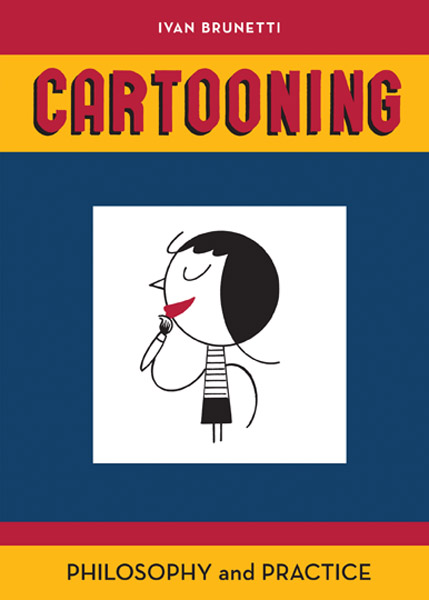
Many professional cartoonists find themselves winding up as teachers either at places like SVA or at other colleges trying to teach the medium. For Ivan Brunetti, he created a comics course from trial and error, but the result was that he developed a syllabus and curriculum that worked for him. He codified these results in a brisk 80-page booklet titled Cartooning: Philosophy And Practice, and it was included along with Comic Art #8. Brunetti is one of the great thinking cartoonists, and it's obvious that the teaching methods he employed were as much about his own ways of getting around his own writer's block and fear of the page as they were to teach others how to do so. In that respect, it's very much a worthy companion to Linda Barry's astonishing What It Is. The emphasis is on the pure pleasure of cartooning, with no other specific end in mind.

Brunetti's Cartooning is less a detailed textbook and more an annotated, detailed course syllabus or guide. It's sparsely illustrated and has an informal, conversational style in its instruction. It reminds me a bit of Aristotle's writings, which were designed as notes for lectures, conversational in tone. The genius of this book is the way Brunetti builds from week to week. In a fifteen-week course, Brunetti moves from the sort of spontaneous drawing (doodling) that anyone can understand and works his way up to single-panel cartoons, four-panel strips, using different grid styles, learning to use different tools and onward to creating a four-page story. Brunetti is a demanding teacher and accepts no shortcuts, but he also has remarkable patience for beginners. The assignments and exercises he hands out are incredibly clever and cut through potential writer's block in ingenious ways.

While I would have preferred more figures and examples, the illustrations he does employ add a high degree of clarity to this book. It should be noted that Brunetti makes a careful distinction that this book is not designed to instruct one on how to draw, but rather on how to cartoon. He teaches principles based on intuitive ideas about how to look at an image and doesn't spend much time indexing a lot of formal terminology regarding panel-to-panel transitions, for example. This is a manual for a lab-only course, in a sense; he's teaching principles but immediately instructs the student to work out these principles on a page. He also spends a little time discussing some of the tools and equipment needed for comics but doesn't dwell on it. His driving point is cartooning fundamentals, and he emphasizes that this can be taught using a standard sketchbook and a pencil. That said, he later does give some practical advice and exercises related to the use of tools, becoming comfortable with them and mastering them. Brunetti's voice speaks loudly in this book, and he doesn't hide his many strongly-held opinions and theories on cartooning. That idiosyncratic approach is one of Cartooning's greatest strengths.

Jessica Abel and Matt Madden, in their text Drawing Words & Writing Pictures, seemed to pick and choose from a number of different sources in their approach. Both instructors at SVA (and of course, veteran cartoonists in their own right), they set out to create a definitive, step-by-step, heavily-illustrated book that covered virtually every aspect of comics creation. There's a lot of Scott McCloud in this book in terms of the way they used categories and labels to explain concepts like representation and transitions, but they were careful to avoid McCloud's more dogmatic, essentialist positions on how to define comics. The structure of this book is much like Brunetti's, down to the 15-week, college-semester length of the course to building up from crude images to more complex structures. The book very much has a "big-tent" approach, encouraging its use for artists interested in a variety of styles, from super-heroes to manga to art comics. That's certainly a matter of practicality as much as anything, given the nature of the student body at SVA.

There's a lot to like about this book. Like Brunetti, they quickly cut to the chase and have their students drawing. They also find ways to make distinctions between students in the classroom, independent drawing clubs, and individual artists, letting them know how they should approach the assignments. Given the scope of their nearly 300-page textbook, Abel & Madden spend a lot of time defining and illustrating a number of concepts, terms and tools used in creating comics, going into a lot of detail. They spend two different chapters on inking techniques, talk about lettering for a chapter (including how to use an Ames guide), and discuss reproduction techniques in another.

For any assignments that involve new techniques, it's laid out in a step-by-step, illustrated series of diagrams. Abel and Madden spend time on approaches to panel composition, tricky bits of anatomy like heads and hands, story structure, 24-hour comics and how to make a mini-comic. The chapter on story structure felt like something right out of a screenwriter's manual, given its emphasis on conflict, protagonists, story sparks, etc. As noted earlier, Abel & Madden pick and choose from a number of sources to throw as much information as possible at the aspiring cartoonist, within reason. They actually don't get into fine-art concepts like perspective as much as one would think, for example.

The book is at its best when Abel and Madden use panels, strips and pages from other cartoonists. The way they break down structure, design and composition of classic strips or illustrate the way artists use certain tools are used is positively illuminating. That was especially true in their chapters on inking and the effects one can achieve with it. One thing I was very surprised not to see in this book was a chapter on color and coloring. I was also a bit surprised that they didn't devote at least an appendix to webcomics and what one needs to vary when putting one's work online. That said, I did appreciate that like Brunetti, they found it important to emphasize the handcrafted origins of cartooning. Before one fools around with a computer, they need to understand the fundamentals.
While both books share a lot in common philosophically, the main difference between the two lies in focus. Brunetti's book is about teaching cartooning for its own sake, while Abel & Madden aim their work at artists aspiring to publish. It's an important distinction. Brunetti tries to encourage non-cartoonists to relax on the page and enjoy the physical, visceral experience of drawing, all while teaching them discipline and fundamentals. Abel and Madden aim to slow down aspiring cartoonists from plotting out their epics or graphic novels and get them to focus that enthusiasm on the fundamentals. If their approach is a bit more prosaic and process-oriented, it's because the book is aimed at artists who want tips and helpful hints as much or more than theory. If I was designing a comics class, I'd assign both books, using Brunetti's as a template but referring constantly to Abel & Madden's for specific examples and solutions to problems.

Tuesday, April 9, 2013

Sequart Reprints: Life Sucks

I've been reading Jessica Abel's comics since the Xeric grant-funded Artbabe #5. Her greatest skill is her character work, especially in terms of the verisimilitude of her dialogue. In portraying little snippets of the lives of her 20-something characters, she managed to get at the core of their concerns and lives. There is a vividness in her character portrayals that made her stories linger long after reading them. With La Perdida, she once again created a vibrant set of characters, this time in a much more extensive narrative. Her running theme of characters feeling lost and trying to find their place in the world was put to dramatic effect, adding a frenetic element of action to her story. She made the bold choice of presenting us with a cast of characters who were mostly unsympathetic, especially the main character. By telling the story from her point of view but making it eminently clear that this character was deeply flawed, Abel made some telling points about identity and authenticity.

With Life Sucks, Abel is aiming a book at a different audience. The problem with this book is that its intent, flow and execution all seem to be at odds with each other at various points, which led to a comic that feels disjointed and overly labored. I'm not sure if this came about because she worked with another writer (Babe Soria) and another artist (Warren Pleece) to illustrate it, but the end result was largely unsatisfying. The book's high concept is very clever: a 20-something man is a vampire and is the servant of another vampire (the one who "made" him). As his servant, he's expected to work--in this case, the night shift of a convenience store. We meet his friends, the human goth girl he has a crush on, and his antagonist as the story unfolds. The effect we get is Vertigo comics meets Kevin Smith's Clerks.

The problem is that this comic is neither fish nor fowl. The rather predictable plot gets in the way of the kind of languid character set pieces that Abel excels at. We don't meet characters, we meet character types, and the main character is the flattest of them all. Dave is the familiar kind of sniveling, put-upon passive protagonist whose story arc is trying to screw up his courage to woo Latina goth girl Rosa. Dave is a "vegetarian" vampire, meaning he doesn't want to suck blood from humans and instead gets his nourishment from plasma. He's spurred into action by his irritant vampire friend Jerome (the bloodsucking Randal to Dave's Dante, to compare it to Clerks), his human roommate Carl but most especially by his rival Wes. Wes is a rich, spoiled vampire who has multiple slaves and furthers the whole "slobs vs snobs" plotline. He is determined to win Rosa, mostly as a way of annoying Dave.

After 90+ pages of this story, there's a shocking act of violence committed by Wes that reminds us that vampires are powerful and amoral. The violence is jarring and certainly changes the tone of the story momentarily, but we then return to the regular story with Dave. He then gets the girl when she realizes that Wes has several lovers, loses the girl when she realizes that Dave concealed his vampiric nature from her and refuses to turn her into one, and then has a big confrontation with Wes after she begs him to "make" her. This leads to a surprisingly downbeat ending where Dave makes a sort of sacrifice to win her her freedom from Wes.

There were aspects of this book that I found were done well. A leaner book with a tighter narrative built around its high concept could have been fun, especially if there had been a few more twists and turns in the plot. Alternately, a book that forgot about the plot and stayed with the high concept but concentrated solely on fleshing out the characters beyond the one or two notes that we saw in this book could have been a winner. Instead, we got to see way too much of Dave's vampiric sidekick Jerome, too much of the "old school" owner of the store Radu, and too much of the too-easy goth caricature Alistair.

The biggest problems, however, are the romantic leads. Dave is so put-upon and self-pitying that it's impossible to root for him. While this can be a bold decision (as noted above with La Perdida), it backfires in a familiar narrative like this that demands that the main character be at least somewhat sympathetic. Rosa is an even more frustrating character, with her falling for the trappings of the goth world as a means of rejecting her family; her eventual shallowness in choosing to become a vampire speaks to how underdeveloped she was. If those characters had had more than one dimension, or had been part of a tighter narrative, then Life Sucks would have been a much more engaging read. Warren Pleece's art walks a pleasant edge between realistic and cartoony, but does little to liven up the narrative. It's functional but unremarkable. I think it's quite possible that I'm not the target audience for this book, and that it may well be aimed at a teen demographic. That may be the case, but the rather graphic violence would seem to be at least slightly at odds with that goal in terms of marketing (though perhaps not appeal). I think if some of the more dramatic twists that were crammed into the end of the story had been employed throughout the story, or if the whole story was a more amiable (if oddball) slice-of-life story, I would have enjoyed either story more wholeheartedly. Life Sucks tries to be too many things at once, and while I admire the ambition of its creators, the execution of that vision simply didn't coalesce.

Thursday, January 1, 2009

Start Anywhere: Best American Comics 2008

Rob reviews the latest volume in the Best American Comics series, edited by Lynda Barry, Matt Madden and Jessica Abel (Houghton Mifflin). (This review originally appeared at sequart.com)


As I've noted in my reviews of prior volumes of the Best American Comics series, the choices selected for inclusion reflect not only the tastes but the editorial missions of its guest editor. For Harvey Pekar in 2006, many of his choices leaned towards naturalistic stories and representations. For Chris Ware in 2007, he was interested in stories that showed its characters expressing the truth of their desires. He cleverly and painstakingly edited it such that each story in some way connected to or commented on the stories around it. The experience started with the ways children looked at the world and went from teens to adults, then switched from the ways we communicate to the ways in which we try to obtain our desires. In each (unlabeled) subsection of the anthology, he would be careful to juxtapose stories with similar themes that had wildly different graphic approaches. It was a formalist editing experiment from comics' supreme formalist that was very much a love letter to comics and its capacity to express emotion, a capacity that obviously means everything to Ware as both cartoonist and editor.


The series' permanent editorship has passed from Anne Elizabeth Moore to the cartoonists Jessica Abel & Matt Madden. It's an interesting and inspired choice, given their roots as DIY minicomics artists to their current station as having published several books. It also fits their side career as educators, with every one of these volumes a potential text. Still, the most important component of this series is the guest editor, and it was thrilling to hear that Lynda Barry was this year's editor. A longtime fixture in the alt-weekly world, she's made a huge career comeback of sorts in 2008. After being unable to land a book deal, she found a perfect home with Drawn & Quarterly and published WHAT IT IS, my current pick for book of the year. She'll also have a new collection of her ERNIE POOK strips published by D&Q.


It's interesting to compare Barry's role as editor to her role as an educator. WHAT IT IS is an extension of her creativity workshops, where she helps people avoid the Two Questions: "Is this good?" and "Does this suck?" As editor, she gets to spend time picking out nothing but what seems "good" to her. In her introduction, presented in a comic strip/collage format not unlike WHAT IT IS, she talks about the phenomenology of looking at comics. She discusses looking at a "dirty" strip as a child and not understanding the "real" punchline, but instead taking a different meaning from it. Barry also talks about how much Bil Keane's THE FAMILY CIRCUS meant to her as a child, as a gateway into this ordered world she wished she could live in. Sometimes we don't understand why we make certain connections to certain kinds of art; we only know that it is important to us. Barry chose the selections in much the same way: she thought they were Good, and encouraged each reader to create their own experience reading the book. She encouraged them to start reading anywhere.

Obviously, this was a vastly different tact than Ware's, and yet this volume is not entirely dissimilar in terms of the way works are arranged and the ways in which they comment on each other. There are some more jarring transition points, to be sure, but one can see Barry reacting to certain aspects of excerpted work and reprinting those key pages. She'd then follow that up with a completely different kind of story that shared some aspect of the same theme. Of course, these connections are entirely accidental, given that the stories are printed in alphabetical order by author. As Barry suggested, the reader makes connections that aren't necessarily really there, but the mere act of putting one comic next to another and the parts of them that are excerpted creates new connections that must be sorted out.

As one might expect, the choices here are rather eclectic, and are taken from a number of different sources. As befits an artist with such a long history in independent/alternative weeklies, there are strips here from Derf, Kaz, Matt Groening, and Alison Bechdel. A number of stories are reprinted straight from minicomics. Barry also had a way of rooting out interesting stories that weren't widely seen by many comics fans. Chris Ware's Thanksgiving covers for the New Yorker is one example, David Axe & Steve Olexa's WAR FIX excerpt is another, and Kevin Pyle's BLINDSPOT excerpt is a third.


Barry avoided a lot of obvious names and included a lot of cartoonists who have not been widely printed to date. Barry did operate under the constraint that the stories must have been printed from August 31, 2006 to September 1st, 2007. They also had to be North American (USA, Canada or Mexico). Of course, the last constraint involved the willingness of the artist and/or publisher to have their work reprinted. DC forbade the anthology from using a Paul Pope Batman story, which sort of douses complaints from some sectors of comics fandom that superhero stories were being deliberately ignored.

The first few stories center around forms of obsession and inspiration. Graham Annable's "Burden" sees a man who commits a horrible act as a way of making up for the horrible acts of his brother. The excerpt from WAR FIX is about one man's obsession with Iraq and the ways in which the reality of the situation is a shattering experience. That dance between abstract desire and reality is examined from a different angle in T. Edward Bak's "Trouble", about two teenaged girls, the possibility of their sexuality, and feelings of abandonment. A series of DYKES TO WATCH OUT FOR strips by Alison Bechdel focuses on the ways in which personal and political obsessions cross over, while an excerpt from Nick Bertozzi's THE SALON details obsession and inspiration, as Braque and Picasso struggle to find the right way to express their vision. Visually, we move from Annable's cartoony line to Olexa's dense, heavy naturalism to Bak, Bechdel and Bertozzi's focus on character design.


The next several strips, in their own way, are different kinds of fables. Lilli Carre's "The Thing About Madeleine" is about a woman coming home to find herself asleep in bed, and how this one fantastic element leads to a total loss of identity. Martin Cendreda's "Hopscotch" imagines little orphan children coming out at night to play games and then disappearing when morning comes. Both "The Monkey and the Crab" (by Shawn Cheng & Sara Edward-Corbett) and "The Seven Sacks" have a classic fairy tale set-up, with talking animals and monsters being used to construct ethical dilemmas and the ways in which revenge is pointless.

Seeing the grotesques in Derf's syndicated strip THE CITY next to a Rick Geary strip about a family of murderers was an appropriate transition. Going from a family of murderers to Matt Groening's LIFE IN HELL strips starring his young sons was an unintentionally funny segue. Groening is sort of forgotten in art-comics circles these days, but he's still very much a part of that community. From kids talking about monsters we move to Eric Haven's strip about the war between reptilian monsters and mammals, "Mammalogy". From there, the reader is given a left turn as we see a Jaime Hernandez Love & Rockets strip featuring Maggie as a young girl, establishing connections of her own with the outside world.

Kaz and Michael Kupperman are next with their own brands of absurdist humor. Joseph Lambert and Evan Larson, going back to the fabulist theme, give updated versions of The Tortoise and the Hare and Cupid's Arrows, respectively. Lambert sees the race as a battle of drummers, while the world goes haywire when Cupid takes a day off. A running theme in the pieces Barry selected is obsession vs. inspiration. We see the latter running rampant in the excerpt from Jason Lutes' BERLIN and Cathy Malkasian's PERCY GLOOM, while John Mejias' "Teacher's Edition" seeks to tease out the latter in the form of an art teacher's diary comics. Sarah Oleksyk's "Graveyard" and the excerpt from BLINDSPOT both deal with significant encounters that change our protagonist's lives. The pieces from Seth, Ware and Gene Yang all discuss identity and how we measure ourselves as humans.

As a reader, I was delighted to see so many stories I hadn't read but had heard about. There are a lot of surprises in here and a lot of delights that I'm glad are being seen by a wider audience. The book is handsomely designed, with a wrap-around Eleanor Davis cover and endpapers designed by Joseph Lambert. Barry really is right that it doesn't really matter where one started in this book. That said, it's interesting to see how many of the stories had some kind of fantastic element, some sense of conveying the reader elsewhere (something obviously important to Barry). There's very little in the way of autobiographical stories in this volume (just Axe, and even that's mediated by having an illustrator). Every strip is very much a story, with an emphasis on narrative. That makes sense, given Barry's style as someone who in her creativity workshops emphasizes creating connections between objects and memories to create stories.


The kind of stories she selected are unusual, varied and challenging, but they are stories or jokes nonetheless; there's no interest in formalist experimentation. In a sense, the vagueness of her own directive ("good") made her selection process all the more clear. No matter where we start, we are getting a peak into Barry's point of view both as artist and reader. And so, we have a third volume in this series that is quite dissimilar from the first two, illuminating what is important to Barry. In the case of each volume, it's up to the reader to make their own interpretation of what was selected for them. Like Chris Ware's volume, this is Linda Barry's own love letter to comics and its readers.