Showing posts with label ivan brunetti. Show all posts

Monday, June 18, 2018

Two From Toon: Ivan Brunetti and Jordan Crane

Toon Books has a fairly uninterrupted run of quality, especially with regard to their younger readers' books. Some of the longer-form comics aimed at teens haven't quite hit the mark, but artists who have a strong design sense tend to excel in their slim hardcover format, even if they hadn't done stuff for kids prior to this. Two recent books are from two of the best designers and illustrators in comics: Ivan Brunetti and Jordan Crane. Twenty years ago, it was hard to picture Ivan Brunetti doing children's books and Jordan Crane working for a major publisher, but there you go.

Brunetti's 3x4 is aimed at Toon Books Level One, meaning emerging readers. He had previously done a book called Wordplay for Toon, which used a similar device of conceptualizing the topic from a purely visual standpoint and then explaining it using words as well. Right on the cover, Brunetti explains the basics of multiplication with the book's star, Annemarie, headlining three different rows but also being part of four different columns of images. The book hammers home the conceptual quality of multiplication, as a number that adds up items in rows and columns. The book itself is about a classroom assignment regarding multiplication, as Brunetti doubles down again and again to keep the focus on the fundamentals established at the start. He carefully breaks down various kinds of sets in a running gag, making it easy to remember. Brunetti keeps the background colors muted so as not to interfere with the objects on each page. They're crucial because Brunetti has to highlight those in order get the concept across to young readers. Brunetti also has a slow build-up of kids trying to one-up each other with the assignment, with Annemarie emerging with the most ambitious drawing of all. A nice side note regarding the book is how many of the characters in the book are people of color. It's simply a matter-of-fact detail that goes unspoken, yet it speaks volumes.

Design king Crane's We Are All Me is deceptively simple. Another Level One book, there's just a few words of text on each page. However, the book is conceptually complex, as Jordan asks the reader to shift their perspective multiple times. He starts out exploring our relationship with the environment as the pages bleed into each other in terms of color. Air, water and earth flow into one another as smoothly as Crane's crisp color patterns. There's just a joyous rhythm to this comic, both in terms of visuals and words, like the lines "and bone and meat/and beat beat beat". Flipping over to the heart with the last line, there's an explosion of pink, orange, and blue on the page as Crane went in the opposite direction, going smaller and smaller until he reaches the subatomic level. Crane goes beyond that to make some interesting claims regarding sentience arising at that level and that all of it (and us) are connected. Heady stuff, but Crane clearly respects his audience enough to think them capable of understanding it conceptual. Thanks to his bold and dynamic use of color, he's right to think so. 

Wednesday, August 27, 2014

Chicago Week: Linework

11/11/2017: Please note that references to Andy Burkholder have been redacted due to multiple reports of him being connected to sexual assault.

Linework is a student & alumni anthology from Columbia College in Chicago. As befits a student anthology from one of the cartooning capitals of the world and with a great cartoonist like Ivan Brunetti as a faculty advisor, Linework is unusually strong and coherent for student work, and each issue has grown bigger and more ambitious. The magazine boasts strong contributions from its alumni, including the likes of Onsmith and Lilli Carre', along with recent grads like Nick Drnaso, Kevin Budnik and [redacted]. Let's go issue by issue and highlight the most interesting work in each one.

Linework #1, edited by Onsmith, Madalyn Merkey and [redacted].

[Redacted], Onsmith and Budnik are three of the anthology's cornerstones, though Drnaso would contribute remarkable work in the next three anthologies. He hadn't yet developed his mature style in his submission here, and it shows in the way it's a bit of a muddle. Budnik's self-flagellating strip is more in-your-face than his later, gentler style, echoing the work of David Heatley. Onsmith's strip about two kids finding a dead cat is brutal and then turns a magnifying glass on that brutality. He has a way of getting at the white trash living experience and its shocking and casual embrace of violence but is also empathetic enough to delve into the minds of these characters.

There are a number of fine stories by artists with whom I was not already familiar. Kyle Harter's "After These Messages" features a man who can only relate to others in so far as they remind him of television; the cartoony line and the use of TV sets as panels is clever. Rachel Duggan's reminiscence about her father telling her about his rough childhood was fascinating; her rough line and use of colored pencil gives the drawings a child-like quality, even as the stories she was told were entirely inappropriate for children. Kiyomi Negi-Tran's piece comparing the way she relates to her mother to the way she relates to her boyfriend is bracingly honest and heart-rending. She makes great use of color in splitting up her story and uses the cute super-deformed style of character design to powerful effect.

Marc Filerman's "Sasha" is strongly derived from Chris Ware's design style but does have a funny punchline. Jonathan Wilcox's narrative about a man buying increasingly fancy clothes and accoutrements and then getting mugged works because of the small panels, the rhythm of the grid and the simplicity of his character design. Regina Rotondo's "Family Gossip" strip, on the other hand, works because of the idiosyncratic way she draws characters and settings, though this was a story whose impact was blunted a bit by its use of color. Joyce Rice's strip about the hell of working in a convenience store and the desperate need to get out is aided by its mostly steel-blue monochrome approach, which helped to sell monotony. Finally, David Alvarado's strip about a brain on a desert island is whimsical and well-drawn.

Linework #2, edited by Kevin Budnik, Nick Drnaso and Max Morris.
Alvarado switched styles and this time around went for larger panels and figures and brighter colors, though his characters maintained a primitive quality that dovetailed nicely with the weird, gross-out gag about hallucinagenic chicken nuggets. His other strip, about a man who dies on a camping trip, is even better, as it screws around with time and narrative using a beautifully clean line. Budnik eschews dialogue entirely in a detailed strip about exploring an abandoned, wrecked house that nonetheless carries emotional weight and strong connections between its two characters. Joyce Rice contributes a strip where the main character's brother has just died, and she uses a surprisingly bright color palette to get at the weird and conflicting emotions surrounding the event. Drnaso's strip about a depressed clown is staggering; the first page is depressing because of the clown's attempting to buy into corporate while discouraging his son (after it's too late); and the second is just a total meltdown in front of kids. Drnaso has mastered his clear-line style and uses a cheerful palette that belies the darkness of his work. Betty Heredia's strip about her compulsive needs to get and peel away scabs is not only compelling and disturbing in equal measure, it's even philosophical, as she asks what she's doing is self-mutilation if it gives her pleasure. The stark and simple black and white and the small panels move the reader from image to image quickly, as she's less interesting in dwelling on specific images of torn flesh than she is in exploring how she gets there.

Filerman's strip about eating cat food as a child and vomiting is funny and weird, especially as he ties it into the anxiety of being punished by his father. Rachel Duggan's sketchbook drawings are excellent, reminiscent of Eleanor Davis' work. Claire McCarthy's "Robert" is a cleverly-design series of small anecdotes about a local homeless man that's surprising in some parts and sadly predictable in others. Angela Caggiano's "House on Lombard" is designed to look like a photo album in her tribute to her grandfather; the character design and overall presentation reminds me a bit of Carol Tyler. Michelle West's "The Receiving End" is crudely drawn but sharply conceived, as she relates an amazing roommate horror story that's also hilarious. Liz Gollner's smoothly-rendered story about a pilot crash-landing and losing his memory makes skillful use of greys and a restrained, fragile line in its tiny panels. It's in many ways a more traditional comics story than most in this anthology, but it's artfully done.

Linework #3, edited by Kevin Budnik & Nick Drnaso.

This is probably the best all-around issue of Linework, thanks in part to contributions by Brunetti and Carre'. Still, the students and other alum acquit themselves quite well here. Both of Drnaso's features are strong. The cover features four cheerleaders, and the flaps tell their life stories, with selected images from their lives charted to a graph that measures "happy" or "sad" over time. It's an ingenious idea that's well-executed. "Chatter" is a far more low-key effort, as Drnaso transcribed an interview with someone who placed a "Missed Connections" ad and drawing it as though the two of them were sitting across from each other. The level of awkwardness he achieves with body language belying speech is remarkable. Alvarado hit on his preferred style in this issue: flat color with Ben Day dot effects. That style allowed him to get really weird, as one strip features a kid making an impromptu sex doll whose face he accidentally tears before completion, and the other strip features two weird kidnappers and their obsessions while navigating the fate of their captive. Both strips offer strange and brief glimpses into their characters with a unique and powerful visual presentation.

Matt Novak's hilariously awkward story about mangling sex-related language as a youngster is another highlight, especially thanks to the crudeness of his line. Brunetti's autobiographical story about coming to terms with diabetes is typically excellent, as he manages a remarkable level of detail in a strip that's supposed to be stripped down. Equally good is his profile of designer/artist Alvin Lustig, a restless fellow who succumbed to diabetes. Budnik's story about crushes is more in line with his current, confessional style, and the use of black & white and a more restrained line allows him to inject more emotional power into his drawings. Carre's panel-less story about forgetting someone's face is fascinating, as she shows a drawing slowly mutating into something recognizable after twenty iterations. It ends by talking about how only the present moment is at all recognizable. Onsmith similarly contributes a strip about the mutation of form in the face of comfortable tedium, employing those sharp and askew angles that disorient the reader.

There are many different visual styles at work in this issue. Michelle West keeps it simple with another horrifying encounter with a neighbor in "G String Man"; she really has a way of working up disgust and contempt in her strips. Max Morris' "Tsar Bomba" is a color-soaked account of the microseconds that go by in a nuclear blast and what happens to skin, buildings and bones in the process. Heredia's dream about a freeway that becomes a rollercoaster is sharply angular and claustrophobic, and it winds up being about finding out how to let go. Filerman's gender-bending space opera is over the top from the word go, using his simple character design, bright colors and a rhythm that doesn't let the reader ask too many questions to push it along.

Linework #4, edited by Marieke McClendon, Erik Lundquist and Pete Clodfelter.

The fourth issue switched to an entirely new editorial team and got even bigger. Alvarado's strip about a couple running over a man in a furry suit is hilarious and unsettling. He has a way of starting strips and throwing a monkey wrench into a very particular and defined set of social interactions and expectations. Budnik's strip about the "Mayan apocalypse" is typically thoughtful and smart, as it addresses his obsessive need for ritual. Ryan Duggan's gag about tattoos, "Permanent Solutions For Temporary Problems" is well-drawn and hilarious. Joyce Rice's "Hoosier Valley" finds the artist in peak form in this slice-of-life teen comic that cuts close to the bone with regard to the way relationships and friendships can suddenly shift and implode. Her use of color enriches the reading experience, especially at the end when one of the characters takes a long look at the night sky in awe and wonder.

Brunetti's strip about fearing he might have oral cancer is neurotic, self-obsessed Brunetti at his best; the panel where his head swells to dwarf his body is especially funny. Sam McMorris' strip, "The Adventures of the Oblivious Sexual Conqueror" is hilarious in its depiction of awkwardness around the opposite sex; the verisimilitude of the dialogue is especially painful, while the cartoony style allows him to warp faces and still keep the strip recognizable. Onsmith's bizarre strip about a man made out of paper who has a phone inside of him that is used to call a help desk is both funny and unsettling, primarily because of his angular drawings and the slightly sickening color palette he used. Matt Novak's tremulous line gives his strip about being dumped, finding a slightly unstable person for a rebound relationship and learning that he had a brain aneurysm both a humorous and emotional sense of resonance.

Drnaso is once again the biggest stand-out. His "Play Pen" is a masterfully created, subtle and unsettling story about a police officer who deciphered a seemingly innocent toy catalog and realized that it was peddling children for sex. There's a level of detail that's almost mundane, reflecting the nature of the investigation, but there's also a level of nausea in this strip that's palpable. Other strong strips in the issue include Betty (credited here as Beatriz) Heredia's strip about encountering an old man, a crow and a chair that caught her foot when she went inside. Her brush really went wild in this strip even as she continued to use small, cramped panels to maximize that sense of being trapped, even when outside.  Chris Dazzo's strip about an awful roommate is cleverly constructed ala Chris Ware, where the drawing is meant to be looked at panel-by-panel as well as a single gestalt. Pete Clodfelter's manic, detailed drawings and sense of the grotesque are enabled by the sickly orange-yellow color scheme he employs. Max Morris' Gary Panter-stylings and musing on punk get at the heart of the "now" nature of the music and scene and how quickly disposable it is. Sanya Glisic wavers between sharp angles and grotesquely melting flesh in a story about escape, confrontation and change.

Every detail is considered carefully in the anthology. Even details like endpapers (a clever visual call and response between Drnaso and Budnik) are given maximum effort. Not every entry is of interest, but it's been interesting to observe the evolution and improvement from issue to issue, because every artist is obviously trying to pitch their "A" material as much as possible. I think by this time the tradition of the anthology has created a culture of excellence and pride surrounding it, with every new editorial team trying to outdo the next.

Thursday, June 20, 2013

Sequart Reprints: Comic Art #8, #9

The forces that have made possible a new golden age in comics publishing have also led to similar riches in publications about comics. The Comics Journal is still the model for such publications, but it's been forced to adapt to a new generation of comics-related magazines. Windy Corner is my favorite of these publications for its eccentricity and focus on artists writing about artists. Comics Comics stands out for its tabloid format and distinct editorial point of view far outside of any orthodoxy. In many respects, the most ambitious magazine of this kind has been Comic Art, edited by Todd Hignite. In its older, periodical form, Comic Art distinguished itself with its production values, the depth of its analysis, and the worldwide search for interesting and sometimes forgotten cartoonists to profile.

With the last two issues, Comic Art became even more ambitious. It switched to an annual, bound format; issues #8 and #9 are around 200 pages each. Additionally, each issue has a bonus publication by a prominent cartoonist attached to it. The result is a sumptuous feast for the eyes for comics fans and for comics historians in particular. Those who aren't students of the genre may find some of the articles a slog to read, but the illustrations themselves (as arranged by designer and cartoonist Jonathan Bennett) are top-notch. What follows are some observations about the two issues.

* Perhaps unintentionally, these two issues feel like a RAW reunion, with extensive profiles on Richard McGuire, Jerry Moriarty, Kaz and Drew Friedman. The interview with McGuire was probably the single most stunning article in these two issues, due in no small part to McGuire's peerless and instantly affecting sense of graphic design. The interview with McGuire leads off with a reprint of his classic strip "Here", a work that was a direct influence on Chris Ware's diagramatic comics. The Moriarty piece led off issue #9, and the artist essentially narrated his own progress as an artist, commenting on his own work. It felt like it could have been a chapter in a sequel to In The Studio, Hignite's coffee table book that had artists talking about their own work.

* The best-written pieces in the issues were by Ben Schwartz, who wrote about Kaz and Friedman. Apart from being remarkably thorough histories of those two artists (both of whom were students at the School of Visual Arts at the same time), Schwartz crucially contextualizes the work of both men. While the interests and styles of the artists couldn't be any more different, both created comics that were intrinsically connected to a time and a place: New York City in the late 70s and early 80s. Schwartz is careful to analyze the actual content of the images, how it was influenced by the artist's surroundings, and how those images commented on larger cultural issues. Friedman used an hyperrealistic style to both expose and celebrate ugliness, while Kaz went the abstract route. Schwartz then took great pains to interview a number of figures crucial to their stories, adding further context.

* There are plenty of comics in these issues as well. There are new pieces by Dan Zettwoch, Aline Kominsky-Crumb, Tim Hensley (who drew the demented cover for #9) and a comics essay by Zak Sally. That latter piece, "The Man Who Killed Wally Wood", is another triumph. It absorbs the tropes of the detective genre into an autobiographical account of meeting a man who published the great former EC artist late in his career--but wouldn't let Wood collect those strips. It's a story of inspiration and desperation, one familiar to many cartoonists, and Sally's straight-ahead, clipped prose and washed-out pencils are an ideal match.

* There's a lot of attention paid in these volumes to classic strip and magazine cartooning. Tom DeHaven's essay on Chester Gould was gripping because it presented and defended a strong & personal point of view on the best eras of Dick Tracy. He articulated precisely why he preferred those eras and backed it up with page after page of illustrations and examples. The production values of Comic Art make this sort of essay possible.

* Most of the other articles on classic cartoonists are written from a more academic perspective, like Theirry Smolderen's exhaustively researched history of the word balloon and essay on Lyonel Feininger. The former article is really for the most hardcore of academics on the subject, but the latter is a revealing profile on the fine artist who began his career as an illustrator and cartoonist. In both articles, Smolderen's research unearthed all sorts of rare images and correspondence.

* There really is a sort of murderer's row of great writers about comics in these pages. The great Donald Phelps (author of Reading The Funnies and one of the first serious comics critics) contributes essays on Edd Cartier and George Clark. Phelps in particular makes a convincing case for the importance of the latter artist, analyzing both the era and the creator and contextualizing the kind of family satire he was pushing through in his strips. He was less convincing in his painstaking profile on pulp artist Cartier, whose work had more to do with illustration than comics.

* Another member of that "murderer's row" is Jeet Heer. Yet another essay seeking to provide context for the inspirations of cartoonists was his article on Navajo Country and its influence on George Herriman, Frank King and other artists who made the trek out to the American southwest in the 1920s. This was before trains made it easier to see things like the Grand Canyon and Monument Park. Heer also wrote an article about the famed New Yorker cartoonist Gluyas Williams and his friendship with writer E.B. White. Williams' work was subtle and refined to an extreme degree, revealing a lot about the personality of the cartoonist as a result.

* There's really something for any kind of fan of comics in these issues. Douglas Wolk broke down why he found Jim Starlin's Adam Warlock to be so strangely alluring. There's a long feature on German avant-garde cartoonist Anke Feuchtenberger that's another triumph. Ken Parille wrote a feature on Abner Dean that delved deep into analyses of particular drawings (including their psychological impact). There are features on the prank art familiar to any long-time comic book reader, the long-buried teenage comics of S. Clay Wilson, the Mystery Men strips of Richard Taylor, German publication Simplicissimus, French humor magazine La Rire and more. I especially enjoyed Adrian Tomine interviewing Gilbert Hernandez about why he liked former Tarzan artist Jesse Marsh's work so much.

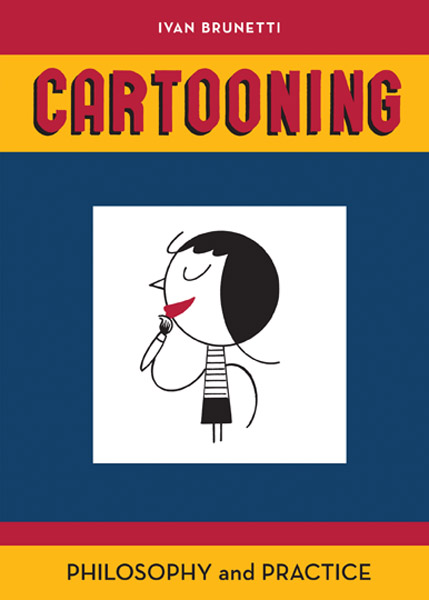
* Lastly, the small booklets by Seth ("Forty Cartoon Books of Interest") and Ivan Brunetti ("Cartooning") are both fantastic. I've reviewed the latter book elsewhere, but Seth's book is a testament to a lifetime of collecting. He begins the book with a strip on his obsession and how he misses the "thrill of the hunt" in dusty old bookstores (obviated by the internet). The book itself shows us an illustration from a cartoon book and his thoughts on it. None of them are all that obscure, yet he also avoided making obvious selections as well.

Seth's essay reminded me why I enjoy reading cartoonists talking about other cartoonists, and it's perhaps the one thing I'd like to see more of in Comic Art. The main critique that's been made in other corners about Comic Art is that it eschews negative critiques. I don't really see that as a pertinent critique, because that's simply not the magazine's mission. All I ask for from a comics essay is an author who is willing to truly engage the material he's analyzing and do the hard work of unpacking it. When you combine this willingness from its writers with its production values, it's no wonder why the release of a new issue is always so eagerly anticipated

Thursday, May 9, 2013

Sequart Reprints: Cartooning, Drawing Words & Writing Pictures

For years, there was a dearth of educational resources available for those who wanted to learn how to create comics. Sure, there were piecemeal options available: textbooks on drawing anatomy, life-drawing courses, creative writing workshops, etc. But when one of the few books that actually addressed comics creation for many years was "How To Draw Comics the Marvel Way", it was obvious that this badly needed to be addressed. In the past few years, there's been a greater demand for comics-related pedagogy and the result has been the creation of schools like the Center for Cartoon Studies and expanded programs at the Savannah College of Art & Design, the School for Visual Arts (SVA), etc.
Many professional cartoonists find themselves winding up as teachers either at places like SVA or at other colleges trying to teach the medium. For Ivan Brunetti, he created a comics course from trial and error, but the result was that he developed a syllabus and curriculum that worked for him. He codified these results in a brisk 80-page booklet titled Cartooning: Philosophy And Practice, and it was included along with Comic Art #8. Brunetti is one of the great thinking cartoonists, and it's obvious that the teaching methods he employed were as much about his own ways of getting around his own writer's block and fear of the page as they were to teach others how to do so. In that respect, it's very much a worthy companion to Linda Barry's astonishing What It Is. The emphasis is on the pure pleasure of cartooning, with no other specific end in mind.

Brunetti's Cartooning is less a detailed textbook and more an annotated, detailed course syllabus or guide. It's sparsely illustrated and has an informal, conversational style in its instruction. It reminds me a bit of Aristotle's writings, which were designed as notes for lectures, conversational in tone. The genius of this book is the way Brunetti builds from week to week. In a fifteen-week course, Brunetti moves from the sort of spontaneous drawing (doodling) that anyone can understand and works his way up to single-panel cartoons, four-panel strips, using different grid styles, learning to use different tools and onward to creating a four-page story. Brunetti is a demanding teacher and accepts no shortcuts, but he also has remarkable patience for beginners. The assignments and exercises he hands out are incredibly clever and cut through potential writer's block in ingenious ways.

While I would have preferred more figures and examples, the illustrations he does employ add a high degree of clarity to this book. It should be noted that Brunetti makes a careful distinction that this book is not designed to instruct one on how to draw, but rather on how to cartoon. He teaches principles based on intuitive ideas about how to look at an image and doesn't spend much time indexing a lot of formal terminology regarding panel-to-panel transitions, for example. This is a manual for a lab-only course, in a sense; he's teaching principles but immediately instructs the student to work out these principles on a page. He also spends a little time discussing some of the tools and equipment needed for comics but doesn't dwell on it. His driving point is cartooning fundamentals, and he emphasizes that this can be taught using a standard sketchbook and a pencil. That said, he later does give some practical advice and exercises related to the use of tools, becoming comfortable with them and mastering them. Brunetti's voice speaks loudly in this book, and he doesn't hide his many strongly-held opinions and theories on cartooning. That idiosyncratic approach is one of Cartooning's greatest strengths.

Jessica Abel and Matt Madden, in their text Drawing Words & Writing Pictures, seemed to pick and choose from a number of different sources in their approach. Both instructors at SVA (and of course, veteran cartoonists in their own right), they set out to create a definitive, step-by-step, heavily-illustrated book that covered virtually every aspect of comics creation. There's a lot of Scott McCloud in this book in terms of the way they used categories and labels to explain concepts like representation and transitions, but they were careful to avoid McCloud's more dogmatic, essentialist positions on how to define comics. The structure of this book is much like Brunetti's, down to the 15-week, college-semester length of the course to building up from crude images to more complex structures. The book very much has a "big-tent" approach, encouraging its use for artists interested in a variety of styles, from super-heroes to manga to art comics. That's certainly a matter of practicality as much as anything, given the nature of the student body at SVA.

There's a lot to like about this book. Like Brunetti, they quickly cut to the chase and have their students drawing. They also find ways to make distinctions between students in the classroom, independent drawing clubs, and individual artists, letting them know how they should approach the assignments. Given the scope of their nearly 300-page textbook, Abel & Madden spend a lot of time defining and illustrating a number of concepts, terms and tools used in creating comics, going into a lot of detail. They spend two different chapters on inking techniques, talk about lettering for a chapter (including how to use an Ames guide), and discuss reproduction techniques in another.

For any assignments that involve new techniques, it's laid out in a step-by-step, illustrated series of diagrams. Abel and Madden spend time on approaches to panel composition, tricky bits of anatomy like heads and hands, story structure, 24-hour comics and how to make a mini-comic. The chapter on story structure felt like something right out of a screenwriter's manual, given its emphasis on conflict, protagonists, story sparks, etc. As noted earlier, Abel & Madden pick and choose from a number of sources to throw as much information as possible at the aspiring cartoonist, within reason. They actually don't get into fine-art concepts like perspective as much as one would think, for example.

The book is at its best when Abel and Madden use panels, strips and pages from other cartoonists. The way they break down structure, design and composition of classic strips or illustrate the way artists use certain tools are used is positively illuminating. That was especially true in their chapters on inking and the effects one can achieve with it. One thing I was very surprised not to see in this book was a chapter on color and coloring. I was also a bit surprised that they didn't devote at least an appendix to webcomics and what one needs to vary when putting one's work online. That said, I did appreciate that like Brunetti, they found it important to emphasize the handcrafted origins of cartooning. Before one fools around with a computer, they need to understand the fundamentals.
While both books share a lot in common philosophically, the main difference between the two lies in focus. Brunetti's book is about teaching cartooning for its own sake, while Abel & Madden aim their work at artists aspiring to publish. It's an important distinction. Brunetti tries to encourage non-cartoonists to relax on the page and enjoy the physical, visceral experience of drawing, all while teaching them discipline and fundamentals. Abel and Madden aim to slow down aspiring cartoonists from plotting out their epics or graphic novels and get them to focus that enthusiasm on the fundamentals. If their approach is a bit more prosaic and process-oriented, it's because the book is aimed at artists who want tips and helpful hints as much or more than theory. If I was designing a comics class, I'd assign both books, using Brunetti's as a template but referring constantly to Abel & Madden's for specific examples and solutions to problems.

Friday, November 30, 2012

Sequart Reprints: Hotwire 2

This article was originally written for sequart.com in 2007.
******************
There's a lot to like in the new Hotwire, both by contributors new and old. The package is pretty similar to the last volume: lots of lurid, over-the-top and funny comics along with many pages of similarly-grotesque illustrations. Hotwire is editor Glenn Head's reaction to "literary comics" that he feels are pretentious an dull. While there's no editorial in this version announcing his manifesto of sorts, it's clear that Head both is continuing his own personal aesthetic vision while breaking his own rules when he sees fit. For example, there are even more non-story illustrations in this volume than the last, which contradicts Head's desire to present "comics with cool style and great stories". There's a lot here that isn't comics, but it does somehow fit into the anthology's underground, anything-goes, unruly sensibility.

I like the unapologetic, take-it-or-leave-it aesthetic that Hotwire carries. This isn't an anthology designed to win new converts to the world of comics, but rather it's a celebration of a style rooted in the tradition of the 60s underground artists and the 80s anthology Weirdo. As such, it's hard to imagine a reader being drawn to every artist in here, given such an extreme series of artistic choices. For example, Glenn Head's "Tongue Trouble" and Doug Allen's "Hillbillys 'R' Dumb" are the sort of over-the-top, stylized and id-soaked comics that are personally difficult to read. Johnny Ryan's "Sin Shitty" quasi-parody felt like a Ryan Mad Lib (insert your own scatological reference into line A, a taboo sexual act into line B, a vague comics reference into line C), especially since Frank Miller comics are the proverbial low-hanging fruit. Matti Hagelberg's "Zombie Justice" feels more like a Kramer's Ergot or Bete Noire piece than something for Hotwire, given the extreme stylization and scratchboard technique. Illustrations by David Paleo and Stephane Blanquet are the sort of page-jamming, highly-detailed orgies of visceral unpleasantness that my eye tends to gloss over.

On the other hand, the fact that this anthology provides such a fine spotlight for humorists, which is such a rarity in this era of graphic novels and prestige anthologies. It's exciting to see new work by Ivan Brunetti (in his stripped-down but still-vulgar style), Mark Newgarden (with his usual combination of old-style gag format with nihilistic punchlines), and R.Sikoryak (another literary smash-up, this time of Little Nemo in Slumberland with The Picture of Dorian Gray, done with his usual astonishing style mimicry), and Sam Henderson ("Lonely Robot Fuckling"--nuff said). Christian Northeast's "In The Trenches" was a hilarious, deadpan account of a self-serious but unaware small businessman's past. Onsmith contributes an autobiographical story detailing the odd behavior of a creepy neighbor. There's a lot to laugh at in Hotwire, and that alone makes me hope that we get a new edition every year.

Beyond pure humor strips, there's an amazing range of interesting material. The most welcome new presence in this volume is that of Mary Fleener, who contributes a new 10-page story and several of her distinctive illustrations. The latter are in her "Our Lady" series, using her fractal "cubismo" style, with subjects like "Our Lady of Apocalyptic Fixation" and "Uninterrupted Munitions". Her story, entitled "Niacin" will thrill any readers of her old Slutburger series in its depiction of sex, drugs and rock 'n roll. This was a hilarious account of Mary winding up in a car with a creep who gave her pot laced with PCP, and her attempts at crawling out of that particular trip. Her thick, rubbery line is a perfect delivery system for the warped, drug-induced imagery that she saw in the story. Hotwire is a perfect home for Fleener's work, and I hope she continues to contribute to future volumes.

My favorite Hotwire discovery has been Tim Lane. His unfussy, naturalistic line is used to tell straight-up pulp stories. "Outing" plops us straight into a bizarre encounter in a bar that ends with a shooting and a car crash. My favorite conceit of the story is that it's narrated by a character who gives us all sorts of intimate information without revealing who he is or most of his backstory. "The Aries Cow" features a character named Muncie and weird stories told at a bar. "In My Dream" has Lane detailing the wacky details of a flying dream and his downfall in it. This sort of anthology is a great showcase for Lane, because his stories act as a sort of anchor for the work in here that are weirder, while still creating an unusual and unsettling tone.

Another remarkable achievement is Jonathan Rosen's "A Massive Stroke of Bad Luck", which is about an aunt who suffered a stroke and was kept alive but in a great deal of distress and pain for quite some time. The top half of each page is a single image that illustrates a few lines of text. The bottom half is a series of images from a sketchbook that "diagram" his aunt's sad state. The grey wash acts as a sort of numbing agent for the reader to the intensity of each page's drawings. The story's best quality is its lack of sentimentality while still getting across the affection Rosen had for his aunt and his concern for her condition.

Not every story here is in-your-face. Carol Swain's "Communicable Disease", is a quiet story about a man in an institution of some kind, where the very words of books fly off the page and his companion starts burying the books when they're empty. Colored pencil seems to be at work here in setting up the air of melancholy and despair. "Last Testament" is a clever, time-jumping story by Chris Estes and David Lasky about Clash guitarist Mick Jones.

Still, Hotwire's main punch comes from its stylization and concentration on the "all that is good is nasty" school of storytelling. Lorna Miller (another welcome presence) retells the story of Little Red Riding Hood that portrays her as a little skank who ends up being eaten--eaten out, that is, by the Big Bad Wolf. Glenn Head's "Oozing Dread" is a hilarious account of Wilhelm Reich's wackier theories regarding orgone energy, orgasms and how they're rooted in alien involvement, all centered around a particular neurotic patient. David Sandlin's "Slumburbia" is a typically sex-and-shame centered story, a sort of echo of Reich's prediction that sexual behavior and activity was doomed to take on a fetished, guilt-ridden quality. Mack White's "Trouble In Tacosa" takes on a western legend, splitting its depiction into the grimy truth on one side of the page and then how it would be portrayed in Hollywood. Craig Yoe's ode to Tijuana Bibles is a sort of day-glo meditation on the surreptitious, anonymous nature of these bits of pornography and the writers who created them. What I get out of it is that these artists weren't all that different in nature to other cartoonists in terms of pandering to an audience and doing it in a sweatshop setting. All told, while not every story in this anthology will appeal to every reader, there should be at least a story in here that will draw in the eye of any reader.

Thursday, November 29, 2012

Sequart Reprints: Hotwire

This article was originally published in 2006 for sequart.com
*****************

With Mome, Fantagraphics tried to put together an anthology that would appeal to sophisticated readers who were open to reading comics but didn't necessarily know what to buy. A book for those who read Ghost World or American Splendor and wanted to know where to go next. Understandably, the focus of that anthology had to be on somewhat straightforward narratives. One doesn't find a lot of funny comics in there, even if some strips have a somewhat humorous bent (Tim Hensley is a notable exception). There also weren't a lot of comics in the id-fueled underground tradition, and what comics there were in that style were somewhat restrained. This is not a criticism, but rather a simple observation: Mome has its own aims and certainly can't be all things to all people. Hotwire steps in and picks up the threads missing from Mome, all in a delightfully lurid package.

Editor Glenn Head is quite clear about his goals for the anthology in his introduction. While acknowledging that it was all well and good that comics were now respectable, he missed comics that "felt unsafe, undomesticated, unhinged, even!" Hotwire is his expression of the feeling that "comics with great style and cool stories are already art, and no critic, museum or journal can change that..." Of course, Head breaks his own rules throughout the book. There are plenty of pages that aren't comics, like David Paleo's revolting pin-ups, Sam Henderson's sketches, Craig Yoe's centerfold or Judith McNicol's scribbles. While not stories per se, they contribute to the carny freakshow nature of the book. A book filled with nothing but this sort of thing would have been unreadable, but interspersed throughout they're a nice sideshow of sorts. Hotwire isn't a book likely to win new converts. Most of the artists within are take-it-or-leave-it in terms of their stories, and they don't apologize for it. It's a book meant for people who already love comics without reservation, in all of their cheap and occasionally debased glory.

As a result, there are a number of stories in Hotwire that aren't personally appealing. As a reader, I've never been drawn to a lot of the traditional underground artists. I can admire their nerve and the trails they blazed, but my eyes fall off the page of stories in the S.Clay Wilson tradition. The unleashed id and broken taboos are simply no longer as shocking or interesting in their own right. Thus, the stories by Head and Doug Allen didn't do much for me. My eye tends to fall off the page when reading these sorts of stories, and that was true here. The true highlights of this anthology are stories by the formidable array of humorists. Not all of them are personal favorites, but that just fits in with the rest of the book: there's something for every true fan of comics to either love or despise.

There are four comics in particular that stood out. Michael Kupperman's "The Scaredy Kids", Lauren Weinstein's "The Call", R.Sikoryak's "Mephistofield" and Mack White's "My Gun Is Long". The first is a tour-de-force of absurdity, as the title characters encounter The Bittern, Jungle Princess and other characters who introduce themselves by crashing through windows. Lines like "Nearby, an ant makes love to a paperclip" are thrown into the narrative as part of Kupperman's all-out assault on conventional storytelling. Every panel is packed with visual humor, wordplay, dada asides and/or over-the-top colors. Kupperman's sheer relentlessness is what makes his work stand out, and is perfect in this venue.
Weinstein's story would have fit nicely in her Inside Vineyland collection. It's a nightmarish tale of a young girl listening to a record of her favorite story, but the needle skips on an evil queen screaming. The scream takes on its own reality and draws the girl in, as she meets a sort of angelic figure who shows her the universe. She eventually returns back to her own world, but a later encounter with that same note leaves a permanent impression. Weinstein's loose, almost vibratory line adds to the story's hallucinatory quality.
Sikoryak is known as an astonishingly skilled style mimic, and his particular shtick is retelling works of classic literature by merging them with well-known comics characters. This time around, he combines Dr Faustus with Garfield to get "Mephistofield". He tells the story just like Jim Davis does a daily strip: three panels, with the third containing a punchline. The colors are appropriately flat and Sikoryak's perfect use of every Davis tic and style choice is a hilarious pairing with the grim cautionary tale of Dr Faustus. And of course, Garfield as the personification of evil is more than appropriate...

Mack White's "My Gun Is Long" is the amusing marriage of hard-boiled noir and conspiracy theory. It stars the real Lee Harvey Oswald, his double Alex Hidell, strippers, Jack Ruby, and a desperate attempt to dodge killers. The stark black & white imagery and unadorned figure work match the paranoia and claustrophobia in this story, but it's White's skill in channeling Phillip Marlowe that propels the story along.
There are plenty of other delights in here: a David Lasky-drawn biography of the Clash; a creepy Carol Swain story about a circus; a stripped-down Ivan Brunetti story; and Onsmith's demented tales of rural Oklahoma. This anthology didn't get a lot of notice when it was released, which is unfortunate because there's so much strong work in here. In particular, having a regular anthology that features humorists so prominently is something that the comics world has needed for quite some time. It'll be interesting to see if Head can produce future volumes that are as fresh and compelling as this.

Tuesday, August 14, 2012

Sequart Reprints:An Anthology of Graphic Fiction, Cartoons & True Stories


An Anthology of Graphic Fiction, Cartoons and True Stories (hereafter just AGF) is the third significant general-audience comics anthology to be published in as many years, and in many ways it's the most important. The missions of each anthology, though complementary, are all slightly different. McSweeney's  #13 and Best American Comics  2006 were both results of the personal tastes of editors Chris Ware and Harvey Pekar, respectively. Ware was looking to bring comics to the reader of literary anthology McSweeney's: a broadly-read person who is always looking to expand the boundaries of their reading experiences. Thus the emphasis on essays about comics by literary figures as well as the comics themselves. Pekar's book reflects his tastes, that of an author of naturalist stories who is looking to introduce a general audience to more of this kind of work--with the added chronological restriction.

Ivan Brunetti, one of my five favorite cartoonists working today, had a different mission with AGF. With Yale as his publisher, his mission was to create a sort of Norton's Anthology for comics. That is, a book for a literate general audience, but one that eschewed the more radical visuals one can see in some comics now (eg, anything from Picturebox). This book was meant to be read more than looked at, and this was an imperative from the publisher. The difficulty of what to call the comics themselves was an issue with the title--after initially calling the book simply "An Anthology of Graphic Fiction", some of the contributors noted that they didn't write fiction--hence the extra "Cartoons & True Stories" tagline. While Brunetti noted that his only prerequisite was to include intensely personal work, the way AGF flows reflects another aspect of Brunetti: his role as a teacher.

As such, the book doubles as a general reader for a literate audience and the best kind of textbook for those looking to go further and lay bare the bones of comics. The difficulty I've had with other attempts at comics-as-textbooks is that they quickly fall into restrictive traps that do little to really demonstrate the possibilities that comics offer. The best-known example is Scott McCloud's Understanding Comics. In many ways a noble attempt to create the terminology on how to study & think about comics, McCloud's prescriptive, rigid & reductive attempts at description, while well-meaning, ultimately have too many holes in them to hold together. In particular, McCloud seeks to nail down an exact definition of comics, and in attempting to do so, includes things that intuitively don't make sense (like the Bayeaux Tapestry) and excludes works that do make sense (like single-panel comics). While I don't particularly have a problem with a more inclusive definition, since outlier examples like cave paintings tend to fall away quickly when really getting down to analyzing comics, I do have a problem with arbitrarily attempting to remove works that are recognizably comics from the lexicon.

McCloud insists that because some comics have panels that are reflective of a sequential (and temporal) order, he declares that any work of art that doesn't strictly fit this description simply isn't comics. In order to make the rest of his theories work, he had to awkwardly apply this temporally-based definition to the entire artform and declare it to be objectively true. I liken it to Kant trying to unify ethics & epistemology in one well-ordered system; that is, trying to create a system that provides an objective system of morals based entirely on reason. Kant proceded from one general principle and built an entire philosophical system based on it. The holes in Kant's system bring it down upon close inspection, but it's convincing enough to do actual damage in the real world. Likewise, while it's heartening that so many young creators have felt the call to start drawing comics as a result of reading Understanding Comics, I find it alarming that many artists in an entire generation look at the book's theories as unassailably true.

Beyond my aesthetic & philosophical differences with McCloud, Understanding Comics violates the oldest of saws regarding comics: show, don't tell. This is what AGF does so wonderfully well. Brunetti could have split the book up into bite-size chapters that cordoned off different ways of telling stories into discrete packages. Instead, his guidance is much more subtle. The way he chose the ordering of the strips he included is very deliberate, starting from simpler single-panel work and then showing single-panel work that totally subverts audience expectations. While there are noticeable subthemes and stories that can be grouped together, this classification is an organic one. One kind of storytelling technique in one story may be subtly different in the next, and then subtly different in the one following. An astute reader can see the change in storytelling choices when each strip is read one after the other, but it doesn't rob them of the pleasure of an actual reading experience.

In a sense, this is a stealth textbook. There are lessons here for those looking for them, but this education doesn't interfere with the book's original purpose: to be read. Still, understanding AGF as a textbook sheds light on some of Brunetti's choices as an editor. First of all, his own imperative to include only personal work easily explains why he chose not to include any genre comics. Some have dismissed the book as being just an "art-comics primer" on that basis alone, but this decision was the best way to show general audiences what comics are capable of, what they are, how they compare to other arts--from the simplistic to the most complex. Including assembly-line/corporate comics here simply wouldn't make sense from this perspective, even if many of them are quite good in their own right (Alan Moore springs to mind).

Furthermore, in light of the decision to only include personal comics, the section on outsider artist Henry Darger and various classic cartoonists makes more sense. They're meant to be a point of reference to newer material, a means of comparing new and old eras of comics. If the book has a sequel I hope we get a more expanded version of this section. Reprinting the classics serves to make the public understand that comics have been an ambitious art form in spite of commercial concerns for many years. Not only that, but from a pedagogical perspective, these strips are a way of describing the origins of the language and iconography of comics. This is not just in the sense that these strips influenced those later artists to come, but that they created a language out of whole cloth. Comics are so endlessly fascinating to me because of their ability to express the mysterious, the sublime. The form borrows from virtually every other art in one way or other at some point, yet in combining different techniques, influences and motifs allows itself to create an endless number of variations.

These variations on a form are what AGF captures so well. I'm not going to review every piece in here, a task that would practically take another 300 columns to complete. Instead, I'll discuss the ebbs and flows of how the book goes from one form to another, look at major subthemes and hit on some of the key artists in the book.

One of the oldest bits of advice on public speaking is: start with a joke and get your audience laughing. Brunetti does this, and then turns gag strip humor on its head. Actually, Brunetti begins the book by starting from his first lesson in drawing comics. Our first understanding of comics comes from childhood, when we get a simple pleasure from making marks on paper. That's why he leads with three detail-packed pages of Marc Bell's doodle narratives, and then moves on to Sam Henderson's simply-drawn gag work. After that, Brunetti stuns his audience with 3 consecutive Mark Newgarden cartoons. Newgarden is one of the most subversive of all cartoonists and a clear influence on Brunetti himself, creating bigfoot images and pairing them with the most nihilistic of punchlines. But his "Love's Savage Fury", a distortion of Nancy & Bazooka Joe iconography, takes our understanding of what comics are and shoves it into a blender. By reminding the reader that these are all just marks on paper (even as the eye recognizes them as a familiar iconic figure) and then repurposing the images for a completely new narrative with inserted text, Newgarden shows the reader that comics aren't what you think they are. He's a sort of comics version of Marcel Duchamp, giving old images new ideas.

We segue from there into typical alt-newspaper comics insolence from Kaz, Tony Millionaire and Bill Griffith. All of them have a bluntness and edge to their work that stops just short of trying to shock, but all still work within a gag strip paradigm. The link between these master gagsmiths and the next section is provided by David Mazzucchelli, who contributes a strip about a cartoonist who falls in love with his own creations and finds himself both trapped and liberated.

That next section is dedicated to several artists paying tribute to one of the most successful artists of the 20th century, Charles Schulz. Art Spiegelman, Chris Ware and Seth rhapsodize (all in a style paying tribute to the master) about Schulz's influence on comics and them in particular. Schulz is one of those touchstone artists whose ability to depict humor and suffering simultaneously makes him a role model. From there, we are treated to an essay by Schulz himself on how to create a comic strip, but before things get too stuffy and reverential, the section is capped off by R.Sikoryak's pitch-perfect interpolation of Peanuts with Kafka's The Metamorphosis.

From there, we go from a page of Crockett Johnson's low-key Barnaby to James Kochalka's diary strips. Kochalka's strips generally grate on my nerves (I consider him to be the Zach Braff of the comics world), but there's no denying that he's had a huge influence on the journal comic that's become popular with the rise of the web. From Kochalka, we turn to Lynda Barry's fictional and autobiographical confessional comics. The subject matter remains the same as we read an excerpt from the Joan Reidy-Ron Rege collection Boys, even as the art becomes more stylized.

The themes of style, design, page composition and color are quickly explored with single Sunday color pages from classic strips Krazy Kat, Polly & Her Pals, Gasoline Alley, The Ambassador and the Kinder-Kids. Brunetti had to heavily cut down the number of pages from the first draft of this book, and it's clear that the classic comics section got the unkindest cuts. Still, if you look at it from the point of view of a textbook, these single pages are a nice series of examples on how the language of comics was created and expanded. What follows immediately after that is an obviously comics-influenced painting by outsider artist Henry Darger. His images were part of a huge epic he wrote that was only discovered after his death, and Brunetti makes the connection between his palette choices and the Sunday comics.

Darger also serves as the perfect segue to a fantastic flow of comics. It starts with comics outsider Rory Hayes, who combined teddy bear imagery and horror. Then it shifts to Aline Kominsky-Crumb, whose crude images & warts-and-all confessional approach paint her as a different kind of outsider. We then shift to Mark Beyer's Amy & Jordan strips, perhaps the ultimate alienated pair of characters. Along with that alienation and slightly crude draftsmanship comes a sort of dream-like quality, one that's picked up by Mat Brinkman in his "Oaf". All of these strips have a pureness to them, a revelling in the language of comics, and Brinkman in particular immerses us in the world of a monster exploring his environment. The jarring but familiar strangeness continues in a Jim Woodring Frank strip. Like Brinkman, we are completely drawn into the world of the odd, funny title creature. Unlike Brinkman, Woodring uses bright colors and a cartoony style to both emphasize the fantastic in his work and contrast it with the darker thematic undertones.

The more cartoony, stylized aspects of Woodring are picked up next in strips by Peter Bagge and Walt Holcombe. The artists simplify their figures while imbuing the strips with manic energy and do it all without words. Indeed, that's another subtheme that started with Brinkman in this section: wordless imagery that forces the reader to use their eyes to process the visuals of a page without the aid of text. That continues in two strips by Brunetti himself, the latter of which has a number of formal tricks that warp time and space.

That formal experimentation present in his strip makes it a perfect transition to Richard McGuire's classic "Here", a strip about the history of small corner of a room. The trick here is that with techniques like panels popping up within panels, all labeled as different years, McGuire shows that all of the events in this room are happening simultaneously, that time is another construction. Brunetti then takes a look at other comics that try to express this sort of simultaneity by first fracturing images and then seeing them come together on a page, as with pages from Gene Deitch and Harvey Kurtzman.

After that comes another thematic shift, as we look at increasingly complicated and intense comics exploring increasingly strange & hellish scenarios, all with a powerfully visceral feel. This is capped off by an excerpt from Gary Panter's Jimbo In Purgatory, a masterpiece of design that demands total immersion from its readers in order to follow it successfully. The shift to the slicker but equally strange world of Charles Burns is a smooth transition, as is the next switch to Kim Deitch's cartoony but nightmarish images.

One of comics' great strengths is its ability to depict time and place. Ben Katchor's strips make his not-quite-real world of New York come alive despite their deadpan absurdity. Excerpts from Art Spiegelman's classic Maus, Jason Lutes' Berlin and James Sturm's The Golem's Mighty Swing similarly create worlds that instantly transform the reader to eras filled with monstrous oppression & violence--and all do it with completely different graphic approaches.

Another strength of comics is its ability to depict interior struggles. Strips by Sammy Harkham, Adrian Tomine and Gilbert Hernandez all address guilt, alienation, obsession and loneliness. What makes them great is the distance each of the artists creates between character and reader and the narrative choices that creates this distance. Jaime Hernandez runs with this notion in his classic "Flies On The Ceiling", a tale of one woman's struggle with self-loathing, guilt and trying to break out of self-destructive patterns. With his gorgeous line, powerful use of blacks and magical-realist motifs (the heroine may or may not be in conflict with a demonic creature that spurs along her guilt), it's staggering how much power is built up by its use of restraint.

The experiences of children and how they deal with trauma marks the next transition, beginning with an excerpt from Justin Green's Binky Brown Meets The Holy Virgin Mary. This is widely considered to be the first autobiographical comic, and it's certainly the first to be so openly confessional with regard to one's most persistent inner demons. This is extremely thinly-veiled autobiography, with the author not holding back any painful details from his childhood. It's no surprise that the next two entries, Phoebe Gloeckner's "Fun Things To Do With Little Girls" and Debbie Drechsler's "Visitors In The Night", are two jaw-droppingly stark and painful retellings of childhood sexual abuse. The manner in which both artists approach the stories is completely different, with Gloeckner's distorted realism adding a touch of detachment to the proceedings, while Dreschler's intense woodcut-style art fully immerses us in the horror of her surroundings.

Brunetti stays on the theme of autobiography and sexuality as we get an excerpt from Chester Brown's I Never Liked You and Joe Matt's The Poor Bastard. The pretense of even thinly-veiled identities is dropped here as Brown recounts a story from his childhood that clearly evokes wisftul feelings, especially in regard to early feelings of romance. Matt's story is typical Joe Matt, wherein the face he shows is a completely unsympathetic, blunt lout. The third member of the D&Q Canadian cabal, Seth, checks in with an excerpt from It's a Good Life If You Don't Weaken, a meditation on time, place and romance (in all senses of the word) that turns out not to be strictly autobiographical.

Continuing in the confessional vein are excerpts from Julie Doucet's My New York Diary and Jeffrey Brown's Clumsy. Both take journal-style approaches to autobiography, with Doucet's crowded & chaotic style reflecting the overwhelming experience of moving to a rundown New York apartment. Brown's anecdotal strips look like they've been shot straight from his sketchbook, a design choice that heightens the sense of immediacy found in his work. Progressing from Doucet's panel-filling design to Brown's sketchiness, the reader is led to John Porcellino's minimalist musings. John Hankiewicz takes things in a different direction with an autobiographical narrative that comments on images that are tangentially related to it.

With a complete Jonathan Bennett minicomic as a transition point (complete with front and back cover), things take a shift for the slightly strange and deadpan. David Heatley checks in with dream comics, Gabrielle Bell contributes "Cecil & Jordan In New York" (about a young woman who decides to turn herself into a chair), Kevin Huizenga presents an iconic & phenomenological exploration of one man's experience of a sunset and Lauren Weinstein's grotesquely renders a reminiscience of adolescence. Carol Tyler finishes this section of beautifully stylized and (mostly) color comics with "Gone", a story of memories and opportunities lost.

The complexity, depth and subtlety of Tyler's comics mark a segue for the rest of the book. Thoughout the anthology, Brunetti had shown us a variety of approaches to comics in terms of content, style, design and mood. In the final section, Brunetti shows us comics of increasing complexity, those that are blazing new trails. He naturally starts off with Robert Crumb and the various phases the underground master has undergone. He starts with "A Short History of America", a commentary on commercialization that's a companion piece of sorts to "Here". "Uncle Bob's Mid-Life Crisis" is autobiographical Crumb at his neurotic best, while two strips about music put his passions (and wild imagination) on display. There's a natural shift from solo Crumb to Crumb collaborating with Harvey Pekar's quotidian autobiographical stories.

Joe Sacco follows Crumb, a progression that makes sense given the influence Crumb had on his visual style. But in this excerpt from "Soba" (my favorite of all his stories), Sacco demonstrates his facility in comics-as-journalism, combining the personal observations pioneered with gonzo journalism but managing to provide a level of objectivity and subtlety not found in such reports. We get more of the same in a David Collier article about a Canadian athlete before we move on to the reigning king of design in comics, Chris Ware. He starts with "Scott Joplin" and an excerpt from his landmark Jimmy Corrigan, both staggeringly beautiful tales of despair. But his "Thrilling Adventure Stories" is perhaps his most remarkable short story. Framed like a golden age superhero comic (down to the flat four color palette), it tells of a young comics-obsessed boy trying to come to terms with his mother's new boyfriends. After the formal pyrotechnics of an excerpt from Ware's new Building Stories, we come to the final major story of the collection: Dan Clowes' "Gynecology". In many ways, it's a recapitulation of many other stories from AGF. It draws its aesthetic from the past, depicts a lurid series of adventures of despicable characters, and it is bitingly hilarious. Really, this story (and most of the other entries in this book) deserve columns of their own, but I wanted to get across the sense of why Brunetti chose to include this story last.

Well--almost. After an essay from Daniel Raeburn about "Gynecology", we get a one-pager from Seth that feels like a perfect, quiet epilogue. Even the dust jacket provides clever commentary, with Seth riffing on classic comics and illustrating commentary from Schulz and Crumb. After finishing this book, a new reader of comics will have gotten a thorough sampling of what comics can do. A long-time reader will still likely encounter something they haven't read before, and perhaps gain a new appreciation of familiar pieces placed in a new context. An aspiring artist will have gotten a quick education in the kind of choices available for solving narrative problems and a wide range of approaches.

This kind of book always tends to reflect the idiosyncracies of its editor. As such, while the vast majority of Brunetti's choices were dead-on, I probably would have made some different selections. David Collier's piece seemed redundant after Sacco's more powerful story, for example. Michael Kupperman's brand of insanity would have been my choice over Kaz, and I also would have tried to find a way to include Mary Fleener's unique design in the autobiographical section. Of course, the fact that this collection is restricted to North American creators only gives it some limitations. If a sequel is done, it's simply begging to have translations of the best European and Asian masters. Another volume could contain more classic comics matched with modern analogues. The bottom line is that Brunetti took on an extremely difficult mission and succeeded in creating a book whose true influence will not be fully understood until a generation has gone by.

Thursday, July 19, 2012

Sequart Reprints: Buddy Loves Jersey and Misery Loves Comedy

Here's another reprint of a column originally written for sequart.com.  This article was written in 2007.
****

It's a bit odd for me to review the new Peter Bagge and Ivan Brunetti collections that Fantagraphics recently released, because I've read the original issues that they collect more times than I can possibly recall. Both artists have been on my top-five list for well over a decade, even with their output being somewhat sporadic during this period. Both have become hugely influential in very different respects, while their new material continues to be as strong as ever. Anyone who loves comics, and humor in particular, owes it to themselves to take a look at this work. Most humorous comics might elicit a smile or a chuckle or two from me, but Brunetti & Bagge are the rare artists whose work kills me, again and again.


Like all great humorists, both artists reveal something of the truth of human existence with their works. Both artists produce work that is sometimes excruciatingly uncomfortable to read because of its brutal honesty. Both create comics that cross the lines of decency and erase taboos, but are never crude for crudity's sake. There are no cheap laughs in these comics. Their artistic styles are quite different: Bagge favors an expressionistic, over-the-top style that reflects the frantic nature of his characters. Brunetti, at this stage of his career, demonstrated his astounding virtuosity in switching from style to style depending on what the story or gag required. Bagge's Buddy Bradley character, as he describes it, is a version of himself about ten years younger. The character is just different enough to put him through some truly absurd paces. Brunetti's comics either feature rants starring himself, or are over-the-top screamingly funny & horrible gags done in the style of newspaper strips. The worldviews and philosophies of the two artists are completely different, but both tell the truth as they see it.

That truth is bleak. Brunetti's Schizo era can best be described as an existential howl, nothing less than an attack on all of humanity's worthlessness. The target he saves most of his vitriol for is himself. Brunetti's recent material has gone away from this sort of relentless assault, and it's quite understandable. As exhausting as it can be to read his extended treatises, it must have been even more draining to write & draw them. Some of the pages have a manic quality to them, as text overwhelms image and dominates the page. In some respects, his nihilistic gag strips are a more succinct way of expressing his rage, hatred and despair. His creating the most awful and despicable scenarios imaginable for gags and punchlines is an expression of his understanding of humanity as almost entirely worthless, debased and banal--and the artist himself is no exception. I often find myself laughing in spite of myself, thinking "This is so awful!" but still being slain by the darkness of Brunetti's humor and his incredible skill both as an artist and humorist.

The bulk of the first three issues of Schizo is taken up by his "Self-Caricature", which details his musings after waking up (late) for work and what happens upon his arrival. The first issue sets the scene with his general disgust towards the world and himself; there's one memorable page where he pictures "The world as it is today", wherein he's surrounded by murderers, pedophiles, rapists, the hopeless and the victims, begging "Please lobotomize me!" He lies in bed musing upon his fantasy where "I'm Jim Jones, and planet Earth is my Jonestown" and then realizes that he's late for work. Brunetti then moves into a more stripped-down, cartoony style for his gag work, with strips like "Drink My Piss, Motherfucker", "Pontiff In My Pants", "Pardon My Sodomy, Son" and the unforgettable "The Nun With Two Dicks". This is Brunetti's deepest exploration of his id, unfiltered, and attached to a gag structure that makes each strip detonate on the page. These strips are Brunetti at his best: brutal and brilliant.
As adept as Brunetti is at lashing out at the world, he's even better at self-immolation. The story "I Like Girls", drawn in the most realistic style I've seen from Brunetti (before or since), details his obsession with various types of women as he's waiting for his wife at an art fair--including his crush on a mutual friend of theirs. That self-flagellation continues in the second issue of Schizo, which focuses on suicide. "Turn Your Eyes Inside and Dig The Vacuum" continues the self "Self-Caricature" serial and veers into an almost manic direction. As he debates suicide as a defensible position with himself, he then has an extended debate with Jesus Christ. One page of the debate is one panel, filled almost entirely with one huge word balloon. By way of contrast, there's also a page where we see dozens of Ivans in hell, killing, torturing and/or sodomizing each other. The French artist Killoffer did an entire graphic novel years later revolving around this sort of image, but it's still a stunner. He gives a page over to his then-wife to describe what it's like living with Ivan, and then does an amazing page of strips mimicking the style of classic strips starring him and his wife. My favorite is one where he's Sluggo and his wife is Nancy, who chides him by asking "Doesn't anything make you happy?" only to recoil when he's cheered by a nearby nuclear explosion.

Another amazing feature from the second issue was the fantastic letter column. Virtually every important cartoonist of the day wrote in, including R.Crumb ("Lighten up, dude"), Chris Ware ("Maybe I wasn't such a bad guy after all"), Mary Fleener ("I enjoy the fact that there is a decapitation or stab wound on almost every page--now that's Big Entertainment for your Comics Dollar"), and David Mazzucchelli ("I suspect that anyone who lists his favorite toy as 'Hello Kitty' can't be totally bitter"). It goes on from there, but it was obvious that his initial impact was huge within the art-comics world.
The third issue has the last-released part of "Self-Caricature", titled "Work Equals Degradation". Told in a 4 by 4 panel grid on every page, the regimentation and claustrophobia on the page reflects those feelings evinced by arriving at work and having to deal with the rest of the world. This strip represents his late-90's peak in his old, highly-detailed but still cartoony style. While not sacrificing an ounce of the bile and bite of his earlier stories, he's able to structure his rants into a more coherent, and ultimately more effective, storytelling style. As he negotiates his day and talks to his coworkers, his inner voice is still as devastating as ever--even moreso, given his mild-mannered demeanor. He concludes the issue with perhaps the peak of his gag work during this era: 4 strips featuring the characters Diaper Dyke and Captain Boyfuck, with the jokes exactly what you think they might be, only much funnier. Brunetti's knack for subverting traditional gag-strip situations with the darkest premises and characters he can imagine is a key to what makes his jokes work.
Those that already own Schizo 1-3 will still find a wealth of other material, culled from the many other places Brunetti's appeared over the years. I consider myself to be something of a Brunetti completist, but even I found a few strips here and there that I'd never seen before. Most of them are the sort of "horrible, horrible cartoons" that we later saw in his books HEE! and HAW!, but drawn in his older style. A section devoted to his work in color was especially enjoyable, with strips like "Who's Your e-bay Nemesis?", a surprisingly hopeful bit called "The Dancing Queen" and three pages about James Thurber as highlights.

About the only negative thing I can say regarding Brunetti's career is that he spawned a wave of imitators, few of whom understand the intelligence and despair behind the gross-out cartoons. All they saw in Brunetti's work was the over-the-top transgressiveness of its humor, and they seized on this shock value to produce work that ranged from mean-spirited to utterly worthless. This, of course, was not Brunetti's fault, but it's not a surprise to see how different his new material is from his old comics, especially in Schizo1-2. Brunetti has written and spoken about how a lot of work that he did in the past was tied directly into depression, to the point where he became paralyzed and unable to draw for a long time. As a reader, it made me uncomfortable to see others treat the "Ivan" of these comics like any other character, relishing his pain. But the pain expressed in these comics isn't shtick, it's real. The last thing Brunetti the artist wanted from these comics was for the reader to feel sorry for him (since he deflates himself constantly), but it's impossible for me to read these stories and not feel the artist's humanity. While his new material explores a lot of the same territory, it's filtered through a very different kind of artistic lens, one that gives both author and reader a bit of room to breathe. Brunetti himself is understandably ambivalent about his comics from this era, but it's a great day for comics that this material has been collected at last and made available for a wider audience.

Peter Bagge's Hate was one of the most popular and best selling alt-comics series, and I consider it the comic that best defined its decade. The first Hate collection, Buddy Does Seattle, features Buddy Bradley living in Seattle in the early 90's, at precisely the same time it became the cultural capital of the United States and a symbol of the "slacker" generation. Hate was both the embodiment of this era and a critique, but there were many readers who saw themselves in the cynical, loud-mouthed and brutally honest Buddy. When Buddy decides to go back to his parents' place in New Jersey with his crazy girlfriend Lisa, a lot of readers were horrified. Replacing the hipness of Seattle with the mundane quality of suburban New Jersey was not what a lot of people wanted to see in this series. The fact that Hate was now in color and had someone else inking it led to cries of "sell-out", but it's not like Bagge toned down the content in any way. If anything, the series became even crazier and darker, but in a way that was perhaps much more uncomfortable for some of its readership. Instead of keeping Buddy eternally young and squaring off against hipsters (sort of like a Bizarro Archie), Bagge made Buddy deal with the perils of suburbia: babysitting his sister's brats, dealing with his insane alcoholic brother, tolerating sleazy neighbors and trying to find a way to make money without actually working too hard. In other words, dealing with actually becoming a real adult, a topic that's pleasant for no one.

Buddy starts a collectibles business with his old friend Jay, who promptly spends much of their profits on drugs and strippers. "Uncle Buddy" is a grueling story featuring Buddy having to babysit his niece and nephew--monsters both. It concludes with Buddy wondering how much a vasectomy costs. "I've Got Three Moms!" shows Buddy dealing with his girlfriend, his mother and his sister--and that despite his protests, he actually comes around to enjoy domestication. Things start to deteriorate with the ever-unstable Lisa, to the point where Buddy declares his love to a married friend of his in the middle of a toy convention (and is naturally shot down). When he snaps at Jay afterwards and he's asked what his problem is, he replies "Nothin', 'cept for the fact that my life's a total joke, is all..." Jay replies, "That, and the fact that you're a total asshole." Buddy puts his head on the table and mutters, "...yeah ...that too..."

Bagge keeps upping the ante in story after story. Lisa going to see a shrink is perhaps the highlight of the whole collection, culminating in a joint session where Buddy eviscerates the therapist for blatantly manipulating Lisa into buying into her agenda. As dysfunctional as that relationship was, when Lisa walked out on Buddy he started to spiral downward in a truly impressive fashion. He set about alienating all of his friends and family, including his business partner, to retreat into almost total isolation. The return of Leonard "Stinky" Brown was just the harbinger of the insanity that was to follow in the second half of the book. And unlike Seattle, where Stinky's shenanigans were merely ridiculous, New Jersey took him down a much darker path. His exit from the series, depicted in a very straightforward fashion, remains one of the more stunning moments I've seen depicted in a comic. It was so senseless and (seemingly) random, yet fit perfectly into the trajectory of Stinky's life.

Stinky's ultimate fate was fitting for one of the few characters in the book who, in his own way, was a hopeless romantic. The inveterate cynic Buddy was always his opposite, but Bagge depicts Buddy as being just as pathetic when he starts hanging around AOL chat rooms, going on blind dates and hanging around other losers. When Buddy has a chance to get back together with Lisa, he not only jumps at it but decides to marry her on the spot when she reveals that she's pregnant with his child. The way he talked Lisa into keeping the baby and marrying him was classic Buddy. When she said that any kid they'd have would be fucked-up, Buddy simply replied, "So there'll be one more fucked-up person in the world! Who's gonna even notice?" It's a happy ending of sorts for Buddy, as he abandons his cynicism to pursue "the American dream". The truth is that Buddy never quite figures out what he wanted in life; his misanthropy is cancelled out by his fear of loneliness. There was always a part of him that wanted to be able to buy into middle-American culture, but he knew that he could never really stomach it. At the same time, his hatred of pretension in all its forms (and utter lack of creative expression on his own part) meant that he could never really live as a hipster. Either way, Buddy knew he was going to live a lie; he simply chose the lie that disgusted him less, and pursued it wholeheartedly.

Bagge's rubbery, manic art is a perfect match for the outsized personalities of his characters. His slightly expressionistic style allows him to do things like have a page where Buddy's head swells to ten times its normal size with anger. And no one depicts the ridiculousness of sex like Bagge--he combines a graphic depiction with flailing limbs, exaggerated poses and bulging eyeballs. It's a pleasure just looking at a Bagge page, because the often grim events depicted in his story always take an absurd turn with the way he draws them.

Any comics fan who is a fan of humorists needs to snap up both of these volumes, as well as the first volume of Hate and Schizo #4. Anyone interested in cartooning, humor, storytelling and total investment in one's art owes it to themselves to read them. Even if neither artist's work speaks to the reader personally (and there is a huge serving of cynicism & nihilism dished up), their sheer devotion to the craft of making comics is inspiring. It's inspiring to me as a critic, and it's certainly influenced a generation of artists. These are comics that work on so many levels: as craft, as humor, as commentary, and as the most personal of expressions.