Showing posts with label tim lane. Show all posts

Thursday, April 25, 2013

Sequart Reprints: Solace of the Road: Abandoned Cars

Tim Lane is one of those 20-year overnight successes in comics. He's been doing comics and illustration work for quite some time, but it's only recently that his work has become widely published. In places like Typhon and Hotwire, Lane's spare, stark pulpy stories have stood out. It's to his credit that they work even better as a collection, and Abandoned Cars feels spun from whole cloth rather than carefully stitched together from a number of disparate sources. It's an unusual work because the stories seem so familiar, which is not surprising given the broad array of influences that Lane freely admits to. At the same time, they don't seem to be particularly derivative of a single source, but are rather a fusion of inspirations from comics, film, literature and a hard-lived life. While Lane's goal was to highlight some aspects of what he refers to as "the Great American Mythological Drama" as a broad experience, the way he does it is intensely personal.

In terms of subject matter, his biggest influence is Jack Kerouac. He's drawn to the author's attempt at creating that American myth, especially in terms of wandering about the vast spaces of America. Every one of his characters is restless and unsettled. Some openly take to the road as a kind of temporary relief, while others run from their misery in more metaphorical terms. Unlike Kerouac, Lane isn't interested in building up that myth around himself; even in the autobiographical story about train-hopping titled "Spirit", he openly admits to being in the shadow of his heroes. Lane takes a big cue from Joe Sacco in this regard; not only does his art have a lot of the unfussy, naturalistic characteristics of Sacco's line, but his own self-presentation is decidedly self-deprecatory. Lane becomes one of his own characters: lonely, a little desperate, searching for something and hoping to find it on the road.

There aren't any morals or even real beginnings or endings for most of his characters' stories. There's a touch of the grotesque and the absurd in his stories that lightens and even deflates his narrative style. It's a bit reminiscent of Daniel Clowes in that respect, and I think both artists drew from a lot of the same 1950s illustration influences. Lane goes in a slightly different direction than Clowes in his use of noir stylings. The use of shadow, stark black & white imagery and close-ups recalls the work of Charles Burns, along with his character design. That said, Lane's stories aren't really like Burns' or Clowes'. The more eccentric influence of Clowes is mitigated by the spare, unadorned frankness of Ernest Hemingway.

Many of the stories center around bars and the way that they can act as refuge, crucible, storytelling center or deathtrap. In "Outing", a couple of friends narrowly dodge death in a bar filled with crazy characters, only to meet a grim end on the road. In the book's biggest standout story, "The Aries Cow", the barkeep tries to imagine the life of an old man who comes to her bar to escape his demons, only to give him a tantalizing bit of information that winds up leading him to his end. "Sanctuary" is a classic tale of a man who's done something horribly wrong and knows that he'll be punished for it, having a drink with one of the men who will be meting out that punishment, defiantly delaying his fate just a bit longer. Even Lane's version of "The Story of Stagger Lee" takes place in one of the most disreputable bars in St. Louis. Lane is clearly drawn to the bar as a place whose purpose is not just inebriation, but the possibility of human contact and communication.
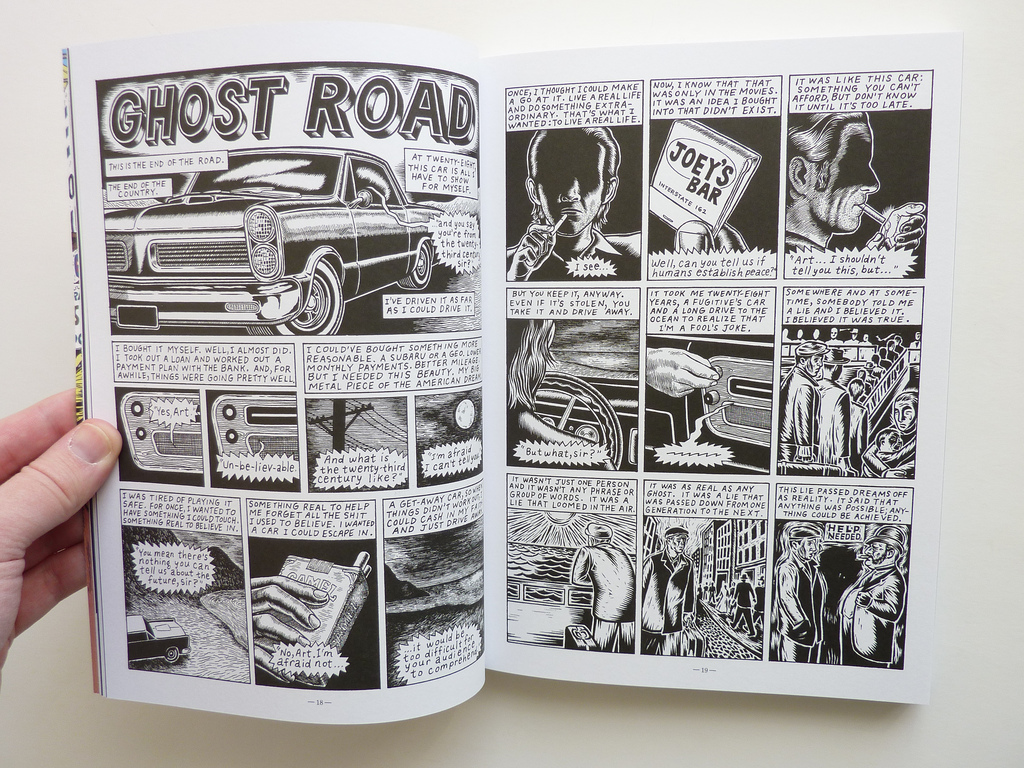
If the bar represents community for Lane, the car represents not just the possibility of escape, but the illusion of solipsism. Cars are tied closely to notions of identity and triumph over one's situation. In "Cleveland", a man at the end of his rope drives to Cleveland to be present at the birth of his best friend's first child, and manages to find a spark of inspiration. "Ghost Road" is about that urge to hit the road only to find that even talking to like-minded individuals doesn't dull pain. "Doo-Wop and Planet Earth" concerns the desperate urge to connect with another as one is ready to leave town, and how that attempt is both an act of cowardice and a leap of faith.

The stationary characters in Lane's world have generally descended into madness. In the book's interstitial pieces, a shut-in is consumed by delusions of grandeur and begins having demented daydreams. In the "The Manic Depressive From Another Planet", another shut-in dares to confront the world despite his near-crippling fear. "Spirit" addresses all of the book's themes: restlessness, the attempt to create meaning out of the randomness of our lives, the way that stories and legends accrue to create our understanding of America, and the need we have to connect our own personal narratives with those overlying American legends. Lane goes a step further in building his notion of American myth with other interstitial features like paper doll cut-outs of American originals like grifters, rockabilly dancers, Chuck Berry, good cops/bad cops, etc. He opens the book with a drawing of young Marlon Brando and ends with a drawing of an older Brando, bookending two views of an actor whose own symbology declined as he aged. Abandoned Cars will appeal to anyone who's ever sought out the comfort of the road, the urge to jump a train, or who looked for answers in the company of fellow patrons at a bar.

Friday, November 30, 2012

Sequart Reprints: Hotwire 2

This article was originally written for sequart.com in 2007.
******************
There's a lot to like in the new Hotwire, both by contributors new and old. The package is pretty similar to the last volume: lots of lurid, over-the-top and funny comics along with many pages of similarly-grotesque illustrations. Hotwire is editor Glenn Head's reaction to "literary comics" that he feels are pretentious an dull. While there's no editorial in this version announcing his manifesto of sorts, it's clear that Head both is continuing his own personal aesthetic vision while breaking his own rules when he sees fit. For example, there are even more non-story illustrations in this volume than the last, which contradicts Head's desire to present "comics with cool style and great stories". There's a lot here that isn't comics, but it does somehow fit into the anthology's underground, anything-goes, unruly sensibility.

I like the unapologetic, take-it-or-leave-it aesthetic that Hotwire carries. This isn't an anthology designed to win new converts to the world of comics, but rather it's a celebration of a style rooted in the tradition of the 60s underground artists and the 80s anthology Weirdo. As such, it's hard to imagine a reader being drawn to every artist in here, given such an extreme series of artistic choices. For example, Glenn Head's "Tongue Trouble" and Doug Allen's "Hillbillys 'R' Dumb" are the sort of over-the-top, stylized and id-soaked comics that are personally difficult to read. Johnny Ryan's "Sin Shitty" quasi-parody felt like a Ryan Mad Lib (insert your own scatological reference into line A, a taboo sexual act into line B, a vague comics reference into line C), especially since Frank Miller comics are the proverbial low-hanging fruit. Matti Hagelberg's "Zombie Justice" feels more like a Kramer's Ergot or Bete Noire piece than something for Hotwire, given the extreme stylization and scratchboard technique. Illustrations by David Paleo and Stephane Blanquet are the sort of page-jamming, highly-detailed orgies of visceral unpleasantness that my eye tends to gloss over.

On the other hand, the fact that this anthology provides such a fine spotlight for humorists, which is such a rarity in this era of graphic novels and prestige anthologies. It's exciting to see new work by Ivan Brunetti (in his stripped-down but still-vulgar style), Mark Newgarden (with his usual combination of old-style gag format with nihilistic punchlines), and R.Sikoryak (another literary smash-up, this time of Little Nemo in Slumberland with The Picture of Dorian Gray, done with his usual astonishing style mimicry), and Sam Henderson ("Lonely Robot Fuckling"--nuff said). Christian Northeast's "In The Trenches" was a hilarious, deadpan account of a self-serious but unaware small businessman's past. Onsmith contributes an autobiographical story detailing the odd behavior of a creepy neighbor. There's a lot to laugh at in Hotwire, and that alone makes me hope that we get a new edition every year.

Beyond pure humor strips, there's an amazing range of interesting material. The most welcome new presence in this volume is that of Mary Fleener, who contributes a new 10-page story and several of her distinctive illustrations. The latter are in her "Our Lady" series, using her fractal "cubismo" style, with subjects like "Our Lady of Apocalyptic Fixation" and "Uninterrupted Munitions". Her story, entitled "Niacin" will thrill any readers of her old Slutburger series in its depiction of sex, drugs and rock 'n roll. This was a hilarious account of Mary winding up in a car with a creep who gave her pot laced with PCP, and her attempts at crawling out of that particular trip. Her thick, rubbery line is a perfect delivery system for the warped, drug-induced imagery that she saw in the story. Hotwire is a perfect home for Fleener's work, and I hope she continues to contribute to future volumes.

My favorite Hotwire discovery has been Tim Lane. His unfussy, naturalistic line is used to tell straight-up pulp stories. "Outing" plops us straight into a bizarre encounter in a bar that ends with a shooting and a car crash. My favorite conceit of the story is that it's narrated by a character who gives us all sorts of intimate information without revealing who he is or most of his backstory. "The Aries Cow" features a character named Muncie and weird stories told at a bar. "In My Dream" has Lane detailing the wacky details of a flying dream and his downfall in it. This sort of anthology is a great showcase for Lane, because his stories act as a sort of anchor for the work in here that are weirder, while still creating an unusual and unsettling tone.

Another remarkable achievement is Jonathan Rosen's "A Massive Stroke of Bad Luck", which is about an aunt who suffered a stroke and was kept alive but in a great deal of distress and pain for quite some time. The top half of each page is a single image that illustrates a few lines of text. The bottom half is a series of images from a sketchbook that "diagram" his aunt's sad state. The grey wash acts as a sort of numbing agent for the reader to the intensity of each page's drawings. The story's best quality is its lack of sentimentality while still getting across the affection Rosen had for his aunt and his concern for her condition.

Not every story here is in-your-face. Carol Swain's "Communicable Disease", is a quiet story about a man in an institution of some kind, where the very words of books fly off the page and his companion starts burying the books when they're empty. Colored pencil seems to be at work here in setting up the air of melancholy and despair. "Last Testament" is a clever, time-jumping story by Chris Estes and David Lasky about Clash guitarist Mick Jones.

Still, Hotwire's main punch comes from its stylization and concentration on the "all that is good is nasty" school of storytelling. Lorna Miller (another welcome presence) retells the story of Little Red Riding Hood that portrays her as a little skank who ends up being eaten--eaten out, that is, by the Big Bad Wolf. Glenn Head's "Oozing Dread" is a hilarious account of Wilhelm Reich's wackier theories regarding orgone energy, orgasms and how they're rooted in alien involvement, all centered around a particular neurotic patient. David Sandlin's "Slumburbia" is a typically sex-and-shame centered story, a sort of echo of Reich's prediction that sexual behavior and activity was doomed to take on a fetished, guilt-ridden quality. Mack White's "Trouble In Tacosa" takes on a western legend, splitting its depiction into the grimy truth on one side of the page and then how it would be portrayed in Hollywood. Craig Yoe's ode to Tijuana Bibles is a sort of day-glo meditation on the surreptitious, anonymous nature of these bits of pornography and the writers who created them. What I get out of it is that these artists weren't all that different in nature to other cartoonists in terms of pandering to an audience and doing it in a sweatshop setting. All told, while not every story in this anthology will appeal to every reader, there should be at least a story in here that will draw in the eye of any reader.