

The top two pages were cut up and combined into the bottom page for "Spring 1982".
Hernandez is known as one of the greatest comics draftsmen in the world, so getting to see original art was fascinating. In the early days, he actually used quite a bit of whiteout. In the pages I saw from the recent story "The Love Bunglers", there was almost none. The real discovery of this exhibit is that Hernandez had a few out-take pages from several stories, including the only extant original art from "Flies On The Ceiling" (the originals were "lost" after being displayed in a gallery). Another outtake from "Jerusalem Crickets" was thrown out because it depicts Hopey writing a letter to Maggie while she's touring; Jaime realized that Hopey simply wasn't the kind of person who writes letters and scrapped the idea. Other pages were simply abandoned after a panel or two. It was also interesting to see him draw a couple of pages and later cannibalize them, combining them into a single page as he switched around or threw away panels. Also on display were a few pages from his scripts, which he continues to write on yellow legal pads. He used to throw them away until someone urged him to keep them. He told me he now has a huge stack of them and doesn't know what to do with them. I suggested he donate them to one of the many universities now collecting comics-related work. He said he's thought about that, but that he's also thought about selling them (he's selling some of his art now).

Outtake from "Jerusalem Crickets".
Stories highlighted in the exhibition include the aforementioned, "Spring 1982", "Home School"; and "The Death of Speedy"; Sally hit the highlights hard. At the end of the exhibition, there were two couches and a bookshelf with various volumes of L&R for readers to peruse. The crowd then streamed into the building's big auditorium on the campus of MCAD. It was standing room only in the hall, with a video feed being piped into the overflow room next door. Sally interviewed Hernandez in his heartfelt, passionate style, and it was clear that the artists had established a clear connection in working together on this project. As Sally enthused later, Hernandez indeed told stories he hadn't heard before. A big focus was on the role of his family in becoming a cartoonist. Jaime talked at length about his mother, who used to collect comics in the 40s and 50s but had to hide them from her own mother. He talked about drawing with his brothers one day, and his mom brought out a stack of drawings she had made of various comic book and comic strip characters. He and his brothers were awed by the fact that she had done this and it became something very cool to them.

The author in the reading section of the exhibition.
He noted that he and his brothers had simply always drawn comics. "It was just what we did. Get up, eat breakfast, draw comics". It was a cheap way to get a bunch of little kids to quiet down for a while. His older brothers did it, so he had to do it too. Sally made a joke about wanting to have introduced the Crumb brothers to the Hernandez brothers. I ran with that idea and asked Jaime about the hierarchy in the family, noting that Charles Crumb was the comics boss of the family and the other two brothers followed along. I wondered if he was ever told to draw a certain way, or if he was told he was doing something wrong. Jaime replied that it was never like that. Instead, it was just a constant sense of excitement from his brothers, but especially Gilbert:. "Hey, let's draw!" There were suggestions about fun things they could draw together but never orders.

An outtake from "Flies on the Ceiling".
Jaime said that during the academic year, comics were frequently forbidden until they got their grades up. When summer rolled around, his mom would take out a huge bag of Archies, Dells, Gold Keys, etc. (Mario's Marvel collection was considered to be "the good stuff" and off-limits for rough re-readings.) Those frequent re-readings refined Jaime's eye and made him realize what excited him. He remembered an issue of Dennis The Menace (most likely drawn by Al Wiseman) where Dennis and Joey walk down a street, having a conversation. This excited young Jaime for reasons he didn't understand, but he started to love the scenes in super-hero comics were they were in civilian clothes instead of the fight scenes. That launched him on his way.

Zak Sally and Jaime Hernandez. Photo by June Julien Morrisey.
There were any number of other interesting anecdotes as Sally and Hernandez got to the heart of how comics and music were meaningful to them. One common theme to Hernandez talking about his own comics is authenticity; he wants to depict things accurately and honestly. That extends to growing up Mexican-American in Texas and California, to the punk scene in early 80s Los Angeles, to how women think and act, to writing gay and lesbian characters. When I mentioned to him that a mutual cartoonist friend was working as an apartment manager in LA like Maggie, he said that he had run into her and she had told him that story. His main concern: "Did I get it right?" The other interesting theme that emerged about him over the weekend is how important it is to him to be part of the current comics scene. There was a long period where "the phones stopped ringing" and he and Gilbert stopped being hot cartoonists. The show and the reception he got the entire weekend spoke to just how important he is to young fans and cartoonists alike.
2. PFC Exhibition. Coinciding with the Jaime Hernandez show and the Autoptic festival was Pierre Feuille Ciseaux #4, or "Rock Paper Scissors". Organized by the ebullient June Julien Misserey and brought to the US by way of Zak Sally's suggestion, this was a weeklong experimental comics camp that brought together artists from North America and Europe. PFC is all about constraint comics, wherein artists are asked to draw stories given time limits and particular limitations. In one "game", an artist would draw a panel. The next artist would continue the story by drawing a panel above that panel, to the right of the panel and under that panel. The next artist would have to draw five panels, and so on, all the while keeping up the narrative. Another game saw the artists have to draw themselves captured by Wonder Woman's lasso and forced to tell the truth about something. Another game, called "Fuck This Thing" (printed as a free mini) forced each artist to draw the the thing they hated drawing the most until they got sick of it; they got to write "Fuck drawing thing x" as a sort of reward.

The roster of artists included Kevin Huizenga, John Porcellino, Eleanor Davis, Lisa Hanawalt, Genevieve Castree, Jim Rugg, Anders Nilsen, Lilli Carre', Marc Bell, and Tom Kaczynski from the US and Canada. Representing France and Belgium were J.C. Menu, Misserey, David Libens, Max de Radigues, Benoit Pretesille, Domitille Collardey, Eugene Riousse, Sandrine Martin, and Pierre Ferrero. All of these cartoonists have reached their mature style, but all of them are still in their primes. There was a careful balance of styles, from naturalistic to cartoony to minimalist. The artists also collaborated with a group of MCAD students on a number of projects, and the students came up with their own games as well. Something remarkable about this assemblage is that even by Saturday, the last day of PFC, the artists still couldn't stop drawing. A number of professional cartoonists sat in with those stopping by for a public zine/mini making workshop. Lisa Hanawalt and Eleanor Davis made a last-second mini for Autoptic. When I stopped by the main studio on Saturday, the artists were hanging around, helping each spot blacks and make beautiful, accordion-style minicomics.

The Saturday Comics Workshop at MCAD. The author's wife is in the lower left-hand corner. Photo taken from PFC website (presumably by June Misserey).
In speaking to the participating artists, most of them were apprehensive to begin the week. The joke of the situation was that every artist felt like they weren't as good as their neighbor--they couldn't draw as well or as seemingly effortlessly as everyone else. That was true from John Porcellino to Jim Rugg, representing a beautiful and minimalist style to a highly elaborate, detailed line, respectively. Critic Xavier Guilbert discussed how being forced to work with another cartoonist, especially a stranger, was a way of breaking the ice for you. You each had a project to do and had to find solutions together, which naturally led to talking about everything else. Menu noted that artists from both Europe and North America not only have drawing in common, but the common language of storytelling. Even someone like Marc Bell, who works in a kind of dream logic, is working in that common language of narrative. Being forced to engage in these games forced the artists to work in their most spontaneous and natural styles, putting down their purest line before doubt and the need to clean up lines or the urge to choke a drawing to death took over.

The assignment board for "Break Something".
The ostensible goal of the week was to create a screenprinted comic. Each artist was asked to pick a character from a list. A North American artist was randomly paired up with a European artist (in most cases), combining their two characters with the theme "Break Something". The screenprinting studio Aesthetic Apparatus printed them and they were cut on site as the artists pitched in with folding and cutting. There are a lot of great collaborations, but the Kevin Huizenga ("The Devil") and Sandrine Martin ("God") was the best, as God was a cartoonist and the Devil kept burning up his work. I also quite enjoyed Eleanor Davis & Max de Radigues doing a Soldier and a Corpse. All of the cartoonists used the sort of rich color screen that popped when screenprinted on thick paper stock.
Another highlight of the day was getting a guided tour to the students' exhibition of their PFC challenges by Barb Schulz, a professor in the comics program at MCAD (I should note that Sally is also a professor there). She talked a bit about particular students and the curriculum for undergraduates. MCAD has offered cartooning as a major since 1997 and they're now up to fifty or so cartooning majors in a school that has about 700 undergraduates. A number of the cartoonists wound up tabling at Autoptic. Mandie Brasington was one interesting artist who runs the Dead Cartoonist's Society, which published an anthology. Dawson Walker is a senior who has serious cartooning chops. Frosh Rosemary Vallero-O'Connell's cartoons for PFC really stood out; despite her lack of publishing experience, it's clear that she has real talent and ambition. I'll have a more detailed MCAD artist report for my High-Low column over at tcj.com soon, once I plow through the pile of minis I got from the cartoonists who tabled at Autoptic.

L to R: Genevieve Castree, Zak Sally, John Porcellino, Jaime Hernandez, Max de Radigues. Photo by June Julien Misserey.
There was an interesting lightness I observed in the PFC artists as I saw them working. Combining the social aspects of a convention with an environment that demanded actual productivity led to work that was mostly light-hearted and even crude in nature, but there was also a lot of cleverness and truth-telling to be found in the PFC exhibition. The sheer amount of comics they produced was staggering. Even Jaime Hernandez got into the act on Friday night, drawing a couple of images for a Nancy animation and getting in on a couple of games. Lisa Hanawalt naturally started a comic involving a woman's ass, knowing that Jaime was taking part and knowing that he'd "knock it out of the park" when he got to it. (Needless to say, he did.) Porcellino and Misserey both described the week as one of the best of their lives. I imagine a number of the other artists concurred. The lingering memory I'll carry of the day is Porcellino flitting from table to table and room to room, cracking jokes, spotting blacks and whistling Led Zeppelin's "Houses of the Holy".
I'll be curious to see what the future of PFC might be. The last event in France had all sorts of logistical problems, and there was talk that that might have been the last one. Bringing it to the US was a logical move that obviously bore great fruit. I could see the event moving to England for a year, given the now-high concentration of interesting cartoonists there. I could also see it coming back to the US. The Center for Cartoon Studies would be a logical home. SCAD in Savannah might work as well, or perhaps Columbia College in Chicago (Ivan Brunetti would be a total natural in this scenario!). Those institutions might have the money to make this possible. A longshot but interesting possibility might be SAW in Gainesville, which would be fitting because Tom Hart is a longtime OuBaPo participant. This is a worthwhile experiment that foments enthusiasm and productivity, and I hope to see it continue on an annual basis.

The funkiness of the Aria Building.
3. Autoptic. The show itself was a one-day affair held at the Aria Building, a renovated former warehouse and theater that's now an all-purpose event space. Others have raved about the space for the purposes of this show and I have to agree. The exposed brick, the quirky accents and the airy feel of the place reminded me a bit of the Puck Building in the MOCCA festival's early days. The fact that the show was free combined with a sunny day meant a number of curious passers-by came to take a look, given that the building is in a walkable part of downtown near the Mississippi River. The organizers of the show smartly had a hot dog stand and a food truck set up outside the show, and there were raves about both. There was clearly a great deal of thought that went into any number of decisions related to the show, even as they ran into some last-minute snafus.For example, the programming for the show was supposed to be at Alliance Francaise next door, but there was a mix-up in scheduling on their part that froze out Autoptic after 4pm. So the organizers quickly made a room in the back of Aria into a makeshift programming area. This had mixed results, as the microphones were all hand-held and the ambient noise out in the hall muffled a number of panel members. Luckily, the room was small enough that most information got across.

The show itself was just the right size for a one-day event, with just over a hundred exhibitors. Some of them were printmakers, local radio stations and local independent music labels. A few artists noted that prints seemed to be the biggest sellers in the room. For the most part, the room was still dominated by cartoonists. What I found interesting about the character of this show was that it drew a number of west coast cartoonists who I'd never met who were able to afford a ticket to Minneapolis (and in the case of some, drive there). This show was also a chance for the thriving Minneapolis comics scene to make itself known, especially students and graduates of MCAD. Of course, the American and French PFC artists also tabled at this show and made a big splash. West coast artists on hand included Elijah Brubaker, Rusty Jordan, David King, Greg Means, Tom Neely, and Virginia Paine. There were a number of Chicago artists who made the short trip up, including Sam Sharpe, Laura Park, Keiler Roberts and Marnie Galloway. The locals filled out many of the other spots, including Anna Bongiovanni, Kevin Cannon, Zander Cannon, JP Coovert, Max Mose, Will Dinski, 2D Cloud, Tom Kaczynski, and MCAD students and alumni like Dawson Walker, Leigh Luna, Mandie Brasington, Danielle Chenette, Alexis Cooke, Amara Leipzig, Jay Ragorshek and many others. There were any number of other familiar faces and micropublishers, but seeing that local color in a juried show gave the show an unusually high level of overall quality.

The Dead Cartoonist Society table from MCAD. L to R: Jen Silverman, Joel McKeen, Kitty Berry
Sales ranged from low to solid. John Porcellino said he did quite well and sold a lot of comics to non-comics readers who were curious, including plenty of his own King Cat series. Annie Koyama also reported good sales despite having nothing new for the show. Having Jaime Hernandez on hand certainly helped Fantagraphics (repped by the tireless Jen Vaughn) move a decent number of books. The total attendance for the day neared 1500, which is about what the defunct Minneapolis Indie Expo (MIX) did in its second year. The low sales were perhaps not surprising give the fact that the show drew in lots of local fans who weren't necessarily sophisticated comics readers. However, even a publisher like Secret Acres, which pretty much took a bath at the show, said that they want to come back if possible when the show is held again in two years because of the show's many other attractive aspects.
I had a strong hand in programming the show's panels after volunteering in the early going. Bill Kartalopoulos suggested doing a Q&A with Menu. I didn't get a chance to see it, but Bill said that the Alliance Francaise had a bottle of white wine on the table and the two of them drained it over the course of an hour, leading to a very relaxed panel. I put together the "Impact and Future of Micropublishing" panel and handed it over to the very capable hands of local writer Greg Hunter, who was also a big help in the A/V department during one of my panels. That panel included Justin Skarhus (2D Cloud), Virginia Paine (Sparkplug), Kartalopoulos (Rebus Books), and Barry Matthews (Secret Acres). Zak Sally moderated a panel on "Independent Culture" that included Koyama, a printmaker and a indy record label producer, while Isaac Cates' "Animals as People" panel had Lisa Hanawalt, Anders Nilsen and Sally.

L to R: Max Mose, Anna Bongiovanni, Eamon Espey, Eleanor Davis.
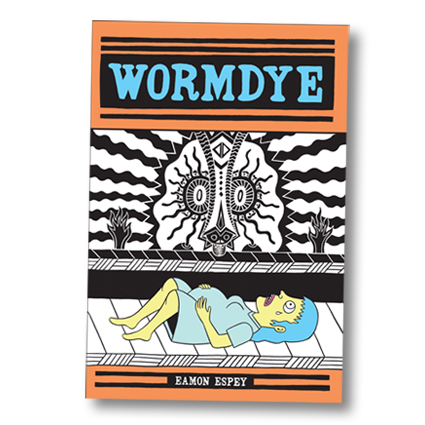
I moderated two panels. The first, "The Dark Roots of Myth" took an unexpected and personal turn in the early going. Featuring Eleanor Davis, Caitlin Skaalrud, Eamon Espey, Max Mose and Anna Bongiovanni, each artist noted that their frequently dark and fictional comics are rooted in autobiographical concerns. For example, Davis said that she is every one of the characters in her stories, and so conflicts presented are really internal conflicts. Espey said that some of his violent, meat-grinding imagery reflects an unpleasant job he was working at the time. Skaalrud and Bongiovanni both said that comics are a way of working through their own personal issues without having to talk about it at a conscious level. Bongiovanni said that she depicts motherhood and babies in the unusual way that she does as a way of working through her own childhood trauma. Mose works through political issues that burn at him (like the Louisiana oil spill) using monsters and horror so as not to be didactic. All of them mentioned using primal imagery as something direct and easy to understand by a reader and easy to translate as a creator.

L to R: Eleanor Davis, Caitlin Skaalrud, the author.
The second panel was a conversation with Jaime Hernandez and Lisa Hanawalt. I was well-prepared for my first panel, but I was mostly winging it here, counting on Lisa to make Jaime laugh for an hour. This is more or less what happened, to my great delight. I had a few questions prepped for them, mostly along the lines of when they first encountered the other's work, what you saw in their work that you wish you could do, etc. Right before the panel, Lisa brought Domitille Collardey up to the panel to participate, to my great delight. Jaime recalled meeting Lisa in a van at Comicon in San Diego, getting a ride with Matt Groening and Lisa to some location. He remembered being thrilled to actually hang out with some of the younger cartoonists. Then he said that he signed up as "an old man" on twitter, stalking his favorite young cartoonists. Domitille said that one of her crowning achievements in life was getting Jaime to favorite a fart joke that she made, but he replied that he favorites all fart jokes on twitter.
L to R: Domitille Collardey, Lisa Hanawalt, Jaime Hernandez, the author.
The artists also talked about process, with both Lisa and Domitille both being relieved to hear that Jaime encounters problems he sometimes can't fix when trying to tell a story. Jaime mentioned putting some stories in a drawer and coming back a few months later to see if the problems magically worked themselves out. If not, back in the drawer they go. Lisa described her version of this process as putting her pages in a drawer in order to "let them think about what they did." Lisa and Domitille also talked a bit about Pizza Island, their old studio were all the artists were women, which received some funny publicity as a result. I noted that Pizza Island is the sort of concept that Jaime would have done twenty years ago.
At one point, Jaime suggested that Lisa aim some of the questions meant for him over to Domitille. On cue, Lisa said, "So Domitille, what was it like to grow up as a Mexican-American?" Jaime ended the panel by saying that he was happy to do it to tell the artists how much of a crush he had on their work and to let them know it. Lisa elaborated on a point I made toward the end, in that Jaime is drawing packed rooms and has a lot of younger fans: "Deal with it!"

The Autoptic organizers spelling out "Thanks!!" at the end of the show.
Regarding Autoptic as a whole: as others have noted, the lighting was too low in some parts of the room, there was no easy access to an ATM, and while the crowd was decent, many of them weren't interested in buying comics. Still, there was a tremendous amount of goodwill in the crowd and affection toward the organizers and volunteers (mostly MCAD students) who tried to solve problems and offer help as quickly as they could. Like the city of Minneapolis itself, the home team wanted the out-of-towners to have a great time and love their city and scene as much as they did. The show and the city certainly made a believer out of me.

Critic Xavier Guilbert and the author, both in black, at the kick-off party on Friday night. Photo by June Julien Misserey.
4. The Social Scene. I generally tend not to focus on this sort of thing very much in my convention reports, because it's not generally relevant to the show, and no one really cares unless you were there. That said, the kick-off party, held at the CO Exhibitions building that was housing an Anders Nilsen-curated exhibit of the PFC artists, featured cheap PBR and a number of interesting musical/performance art pieces. This is when guests of the show started showing up en masse, and the place was packed and full of nervous energy. After Autoptic, there was an afterparty at a restaurant/bar called the Red Stag Supper Club. While the ambiance and weather were both absolutely perfect, the restaurant was a bit overwhelmed by the crowds of cartoonists and service was spotty as a result. When the hour grew later, the place emptied out of non-cartoonists patrons and a great time was had by all. The evening benefited from the general good vibes of the show, as crowds ebbed and flowed together and artists of multiple generations entertained each other. Goodbyes were long and lingering, and the conversations ranged from serious discussions of art to fall-down laughing anecdotes. I know of at least one editor who got a cartoonist to quickly sign on to his anthology as a result of their conversation. Even though some cartoonists and publishers didn't make a lot of money, the low-key vibe and relatively small size of the show (the juried guest list was top notch) made for an intimate and pleasant weekend for all and struck a powerful claim for the Minneapolis comics scene as one of the most exciting in North America.

Special thanks to the ever-amazing Laura Jent-Clough for taking photographs (all photos taken by her unless otherwise credited). and to Annie Koyama for being Annie Koyama.



 Posts
Posts


