Saturday, February 3, 2024

DOP Anthology

DOP: Comics As Craft is an interesting mini-anthology published by the students of Paul Karasik at a CCS workshop. It's a fitting comic to review after my long CCS feature, although Karasik's methods are his own and he's been teaching for a long time. Karasik has been one of the very best background guys in comics for well over 40 years. He had a huge impact in production and editorial on the seminal anthology RAW, collaborated with David Mazzucchelli on his adaptation of City of Glass, and co-wrote a book about his autistic brother. With regard to DOP, he had a bunch of students who were so fired up about comics that they got down and did the work of putting together an anthology of their work, which is a truly grueling and oft thankless task. 


DOP doesn't list an editor, but Lila Cruz designed and assembled it. She also added the interstitial drawings, where were a nice touch that helped reset the reader's palate between stories, which was important given the wide variety of styles. Brianna Collins' one-pager "Water Glass" is a simple but effective use of a visual metaphor to talk about illness. King Ray (the class TA) contributed an excerpt from their continuing "Insomnia Mansion" story; while this is a funny and effective story, excerpts without any context tend to derail the flow of anthologies. Howell Murray's "Where Am I?" is the first longer entry at 6 pages, with a classic trope of someone waking up in an alien environment with no memory of how they got there. This one ended on a cliffhanger, which once again is annoying to read without any assurance of this being a continuing series, but it at least had a semblance of a complete thought. The art is stiff at points in terms of gesture and body language, but it also effectively uses spot blacks and has an undeniable energy throughout. 

August Bomer-Lawson's "Veridis Quo" is one of the best stories in DOP. The story is affecting without being mawkish, as the narrator recalls his boyhood best friend who started drifting away from him as an adult, coming to a tragic end. Bomer-Lawson effectively establishes the restless protagonist as an older man, returning to his hometown, recalling the past. In short order, he makes his friendship with his friend Pen come alive, drawing the reader into the joy of their navigating the ups and downs of adolescence together. The title is a Latin phrase that roughly means "Where are you going?" but the connotation is more "Why are you going in that direction?" In other words, "Why are you doing this?" Bomer-Lawson effectively establishes character with a series of smart cartooning choices. He keeps the reader off-balance with odd compositional choices, like grids that don't line up, splash pages with circular inset panels, and other tricks that establish that things aren't what they immediately seem.

Malachy Hopkins goes in a completely different direction in a story about anthropomorphic animals getting high and talking shit to the cops. It's a nicely-cartooned ode to punk and underground comics. Bohn Whitaker's one-page about a child watching her mother packs a lot in there, with a left-hand column setting up the rest of the page's grid. It's not just an effective visual trick; it also establishes the child's feelings about her mom as she watches her mom act with a total sense of authenticity. This is a great example of a comic where the drawing is simple but effective, but the actual cartooning is sophisticated. 


Amy Neswald's "Hearts" is another example of how great cartooning (in the form of clever composition) trumps actual drawing. The story is about a group of loved ones literally touching the heart of a dead loved one and connecting to the people he had connected to and the places he had seen. Every page is carefully laid out to provide a vivid, powerful effect. Neswald's actual line and character design are both crude, but it didn't hinder the power of this piece one bit. Dawn Nye's "Frankie" is also about saying goodbye, this time to a beloved cat. Neswald clearly worked from photo reference to clearly and powerfully articulate her cat's expressions--especially his eyes. Once again, an unusual layout (part open-page, part grid, mixed with splash pages) added to the story's visual and emotional impact. 


Durbin's "Comics As Craft" is a sort of recapitulation of the entire anthology. Using a tight four-panel grid but making the panel-to-panel transitions ambiguous at first was a clever tactic, because Durbin created a rhythm that made more sense as the story flowed. It's a beautiful testament to the joy of not just creating, but sharing one's work. Emet Aron's "Bug Theory" is a masterful meditation on one's own gender identity. Aron's drawing chops are undeniable, and they also used unusual layouts (like mismatched grids) and visually exciting diversions (like entire pages devoted to the taxonomy of spiders) that all related to the concept of being genderfluid. The only flaw was relying a bit too much on grayscale shading. Finally, Lila Cruz's exaggerated cartooning provides both a laugh and a poignant moment in talking about her dad's unwillingness to bend to conventionality. 

Like any anthology, some of the pieces in here are better than others, but it really picks up after the couple of cliffhanger pieces to give the reader a variety of heartfelt, thoughtfully conceived and drawn comics. Those interested in ordering a copy can contact Shannon Durbin. 


Sunday, January 14, 2024

45 Days Of CCS, #45: Aaron Cockle

Let's jump back into the world of Aaron Cockle and Andalusian Dog. Cockle's been hard at work pumping out issues of his enigmatic pastiche of and ode to the work of sci-fi author Philip K. Dick, producing six issues in the last couple of years and a related zine, Solar Lottery. The essence of these heavily text-driven zines with sparse and frequently oblique illustrations has revolved around the concept of a VR game called Andalusian Dog. It essentially transforms your own reality into a Grand Theft Auto overlay, with various instructions and missions to perform in real life. 


Cockle took this idea and meshed it with the concepts behind several Dick novels (including VALIS, The Three Stigmata Of Palmer Eldritch, Clans Of The Alphane Moon, The Penultimate Truth, Ubik, and others) and fuses it with modern technology to spin an oblique narrative and metanarrative. It revolves around alien intelligences, sex cults, drugs, office drudgery, and the total destabilization of society. Frequently quoting from Dick directly, Cockle focuses on the fear, paranoia, and inherently destructive and isolating qualities of late capitalism and how technology can be used as another tool of dehumanization that is an essential element of this nihilistic death cult. 


Like Dick, Cockle sees the future, and it is grim. From self-replicating androids designed to replace humans to horrifying drugs that permanently alter one's sense of reality, there's no escape once you've been caught up in this conspiratorial web. At the same time, there's a sense that it's the only game in town. It's the only way to remain relevant. We are willing consumers of our own annihilation. Cockle implies that there is resistance here and there, but even this resistance has its own agenda. The individual has no chance because they have been reduced to mere individuality. Once again, much of this work stretches the very definition of comics or sequential art; it's closer to comics-as-poetry than anything else in terms of how there is something important about the illustrations and collages he uses with regard to how they interact with the text, but that relationship isn't necessarily easy to understand or parse. It's as though Cockle is working on a deeply subconscious level, hoping to trigger connections and even memories (ala VALIS) in an effort to wake us up. 

Saturday, January 13, 2024

45 Days Of CCS, #44: Natalie Norris

Natalie Norris has been producing memoir about trauma since before she started at CCS. Even in her earliest assignments at the school, she turned standard first-year assignments like adapting a fable from Aesop or doing a comic in the style of Ed Emberley into frank, bold, and highly vulnerable narratives about her traumatic experiences. It's no surprise that her first long-form memoir, Dear Mini, should not only expand on her struggles, but it's also the one where she reveals, in an achingly intimate manner, her most formative traumatic experience. 


Norris uses a very clever narrative technique in making this an epistolary memoir for a number of reasons. The most obvious one is that it allows her to comment on events from the past from the perspective of the future, which is what differentiates it from the most obvious comparable book, Ulli Lust's This Is The Last Day Of The Rest Of Your Life. That's another memoir about a teenage girl out of her depth in Europe who is raped, but Lust chooses to convey that experience in the present tense for a different kind of impact. Norris not only adds commentary from the future in the form of huge, floating decorative lettering, but her dreamy open-page layout style gives the entire memoir a magical storybook feel until things start to go very wrong. 


Secondly, by addressing it to her Austrian friend Mini, whom she feels inadvertently betrayed her, she puts the narrative power in her own hands rather than grant it to her nameless rapist. This is an unflinching account of being sexually assaulted and its aftermath and reverberations across the years, but more importantly, it's an attempt to connect and truly reach out to someone who meant a lot to her. This narrative is Norris's own, and she's sharing it with Mini.


Norris noted in the afterword of this first volume that she had reams of diaries and photos that documented her time in Europe, but for the most part, she chose to rely on her memory. This made for a much more emotionally rich narrative, as it followed the path of memories that she allowed herself to unlock by drawing them rather than compelling her to commit to a more "true" account of those events. Of course, even a diary or journal from that time, while more immediate, isn't necessarily more accurate. Indeed, as Norris points out, she deliberately downplayed most of the key moments of trauma in those journals.


The plot summary for part one of Dear Mini goes like this: Natalie is 17 years old and suffers from chronic pain and depression, among other issues. Natalie was quite used to the attention given to her by older men, which was a form of flattery she sometimes chased but was also frequently repulsed by it. Her mother suggested that she try a language immersion summer program in France as a way of trying to push her away from getting drunk and high with local older guys. Upon arriving, she met an Austrian girl named Mini, and they became thick as thieves, constantly pushing against the rules in order to go out dancing and drinking as well as meeting guys. Norris was young enough to conflate desire with love in an environment where sex, generally speaking, was treated as far more casual than in American culture. 

This invoked the key line of the book: as she found herself treated with contempt by the boys who used her sexually, she convinced herself that "this was just what happened to girls like me." That her desire made her worthless and unworthy of expressing her own agency. That lesser forms of horrible treatment by men were somehow OK because they were "nicer" to her than out-and-out assailants. The flip side of constantly wanting to be drunk or high as a way of numbing these feelings had the double whammy of not only being ultimately ineffective, it also made her far more vulnerable. Eventually, after the program, Natalie spent time in Italy and then made a side trip to see Mini in Vienna.

That's where the bulk of the narrative really picks up and slows down, as Norris goes day by day in great detail with regard to this fateful visit. She alludes to the event, the birthday party of one of Mini's friends, multiple times (even referring to it as an execution), yet her depiction of the rape itself is far more harrowing, direct, and graphic than I could have imagined, even given how frank she was about everything else. It reads as though Norris was disgorging a malignant tumor in the most painful way possible; an excruciating experience in every way as a reader and one would imagine, as an artist, yet one where at least the malignancy was out in the open. As awful as this depiction of this all was, the events afterward (where she internalizes everything and hides it from Mini and then winds up fooling around with another guy just to not be alone with her thoughts) are terrible in their own way. All of this is made even more devastating in Norris' bright, colorful, and dreamy style. 

Norris alludes to having discussed this with Mini over the years, with Mini not understanding Norris' anger to not only being abandoned at this party but virtually being pushed into the clutches of her rapist. The nature of this disconnect is something that I imagine will be discussed in part two. While I can understand the split, it feels like doing this in a single volume would have done more justice to the narrative as a whole. There are some other problems with the book that reveal Norris as a relatively inexperienced cartoonist, but this is stuff that should have been corrected by an editor. Basic design issues like word balloon flow, word balloon blocking, large lettering being split by a figure and making it hard to read, and even a typo are all distractions. Norris' character design for figures other than herself seems a bit undercooked at times, which is not unusual for young artists having to introduce multiple characters in a longer narrative. 

Those are mostly nitpicks. What Norris does here is unlock a tremendously powerful narrative about the ways in which memory can be warped and poisoned as it is obliterated by shame, trauma, and misogyny. Her use of color, her understanding of how using decorative drawings can influence the narrative, and her strong & distinctive authorial voice all drive this memoir to an unflinching place that eventually grants herself and women who have similar stories a sense of grace and absolution that no one else has given them.


Friday, January 12, 2024

45 Days Of CCS, #43: Rust Belt Review, Beth Hetland

The latest issue of Sean Knickerbocker's Rust Belt Review (#5) is light on CCS content but heavy on other interesting stories. Knickerbocker runs a blend of one-shot stories as well as serials, with his own "Best of 3" being the most prominent serial. It's probably my favorite story by Knickerbocker to date, as he incorporates the usual small-town losers, sleazebags, and lowlifes into a story that escalates into a genuinely thrilling murder mystery. His drawing has leveled up to match his ambition, as the yacht and other background details are drawn with a level of intense accuracy that enhances the action. This particular episode featured a yacht on fire thanks to a Molotov cocktail, a daring escape by the villains, and the start of a stressful quest. 

Audra Stang's excellent "Tunnel Vision" serial concludes in this issue, focusing on the character of Bernie, the young documentarian who followed around more familiar characters in the abandoned theme park tunnels that are an essential part of her Star Valley lore. There's an incredible page where Bernie is in the car with her hostile stepmother and then going in the other direction every other panel, talking to her mom. Stang's comics tend to fundamentally be about huge lacks in not just communication, but a willingness to listen and try to understand others. This is personified in power struggles through relationships, as those who are least willing to listen are those that hold tightest to the reins of power. This story would have benefited from (at a minimum) spot color, as the shading here crosses over into being muddy at times, but it's otherwise another great story from a cartoonist who works intentionally in a way that I really enjoy. 

Andrew Greenstone unveils some more wrinkles in his crazy story about cultists, a trivia expert who escaped a nightmarish experience, federal hearings, an attempt at normalcy, and a lot of other stuff. Balancing the craziness with an attempt at normalcy is what gives this serial some serious stakes and balances out his frequently grotesque and absurd character designs (and references to Image artists). The conclusion of Sam Grinberg's "Pancake Jake" gets funnier and more absurd with each passing page. The first part focused on the silliness of urban legends, until two friends who tried to scare their friend Sid with the legend of a breakfast monster called "Pancake Jake" discover its somehow real. This swerves into a witch who owns a diner, an abandoned tower, gentrification, magical constructs, and the healing power of IHOP. Grinberg's art is sharp and the spot blacks really pop on the page, while the character design is rubbery and playful. 

Other stories include Sienna Cittadino's story about a trans teen play soccer and the pointless, hurtful controversy this creates; it's done in a scratchy style with lots of blotchy greyscale shading that reflects the expressiveness of the characters. Alex Nall has his usual story of small-town, awful people drawn in a wacky style that seems to work at cross-purposes with the story. Pat Rooks has a full-color mini that's inset featuring a hilarious, over-the-top bit of slapstick where the futuristic workers inevitably get fucked over. Jordan Speicher-Willis has an interesting story about kids working in the library and trying to complete a quest; the character interactions are very well-observed here. Andy Wieland's story is a Rust Belt special, meaning miserable people oppressed by capitalism being miserable and then dying. John Sammis' line reminds me a bit of Tim Hensley, as he tries to think about differentiating two old Hollywood actors. Finally, Matt MacFarland contributes the first part of a serial devoted to the unfortunate genre of "dudes talking about getting laid." At least his cryptid-inspired art looks good.


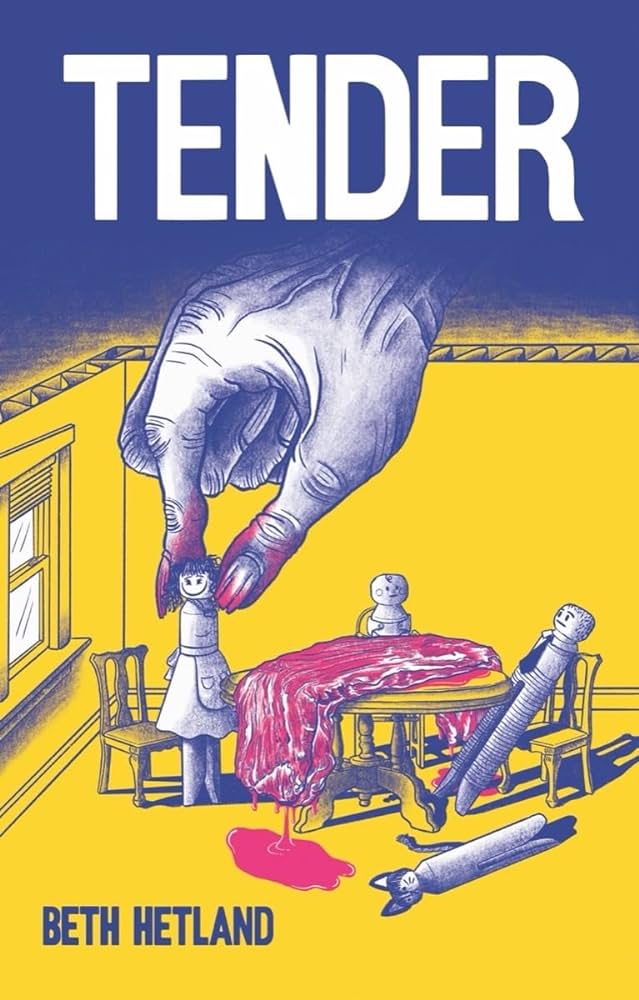
Beth Hetland's solo debut graphic novel Tender isn't what it seems at first, but the horror that's touched upon in the story's build-up informs the totally fucked-up events in the back half. The book opens with a creepy shot of the protagonist, Carolanne, softly singing to what appears to be a bundled-up baby. Hetland takes us back and forth in time and reveals that, while Carolanne is clearly a psychopath, the societal and cultural forces that shaped her and her horrific choices are also clearly to blame. 

Tender is a brutal critique of gender roles, social media, cultural pressures & expectations, and the isolation fomented by capitalism. I tend to be bored by horror that seeks to elicit shock value based on breaking taboos that were shocking fifty years ago. I'm talking about random gore, violence rooted in racism or misogyny, and other surface-level shock value tricks that embrace and reinforce cultural mores rather than challenge them. Tender is very much the opposite of this. Even as Carolanne's actions become more extreme and horrifying in her obsession with having a baby, her psychosis has a terrifying logic to it in how it reinforces not just what she has always wanted, but what she thinks is essential to being a woman. 


The narrative follows Carolanne as she seeks to get pregnant with her husband, Lee. It's all very cute and wholesome, as it then quickly cuts to her quitting her job so she can be a full-time mom. Slowly, using a dark blue wash with dense hatching and shading gradients, Hetland starts to reveal that Carolanne's approach to relationships is one where fantasy is more important than reality. She sets out to marry Lee, a co-worker, because it will help her accomplish her goal of the perfect wedding and lead her to the perfect life--all captured by Instagram posts. Hetland doesn't even have to try very hard to critique social media; indeed, social media isn't the issue so much as conflating it for reality is. In the first unsettling sequence of the book, she goes to his Facebook page, prints out a photo, cuts out his head and creates a collage where she and Lee are on their wedding day. All for a person she hadn't yet even spoken to. 

Every time she goes to a friend's engagement party, Carolanne has to practice smiling and rehearse what she's going to say. It's a mechanical response meant to mimic appropriate social behavior, which she's good at enough to garner a real group of friends. About a third of the way through, Hetland introduces a particular coping method she uses--biting off little bits of skin and eating them as a response to anxiety. Hetland periodically modulates the color scheme with purples, reds (especially for chewing on flesh or pulling skin), and yellows to indicate conflict or anxiety. Hetland also uses this creepy upward angle where we see Carolanne looming over something, usually with a blank or grim expression. 

Despite Hetland slowly unveiling not just increasingly unhinged behavior, but a genuine sense from Carolanne that she knows her behavior would frighten others, she and Lee marry, she is pregnant, and then in a devastating and terrifying scene, their baby is stillborn. This sets the events of the last third of the book into motion, as Carolanne increasingly loses touch with reality, drives away Lee, and then starts to become truly unhinged in her destructive and self-destructive behavior. She deludes herself into thinking she's pregnant, denies the death of her first child, and by the end, is in a psychotic world of her own. The visceral, awful, and genuinely unsettling scenes of her carving up her own flesh are all established and amplified by the rhythms Hetland established early in the book. 

Tender is ultimately a tragedy, where a person who simply has no conception of how to actually connect with others finds herself creating a conception of self entirely dependent on cues that are ultimately limiting, shallow, and fleeting at best. The images of self-consumption and total alienation are fitting, given that she never had a real chance of meaningfully interacting with others. Her total lack of empathy manifested in rage mostly aimed at herself, but also at the one creature she had thought of as being connected to her in her cat. It made sense in terms of the plot, but it was also the point where Hetland very deliberately wanted the reader to both cease having sympathy for Carolanne and simultaneously think about the ways in which society's guideposts brought her to that point. Having followed Hetland's career for years, Tender is a massive leveling-up visually, as she brought to bear the increasingly dense storytelling she used in Half-Asleep as well as a sophisticated and affecting color palette. This is the first major project she's written since her CCS days, and there's no question that it's a triumph. 

Thursday, January 11, 2024

45 Days Of CCS, #42: Issy Manley, Anna Sellheim

Issy Manley's No One Wants To Work Anymore is a series of comics essays addressing labor and one's role in global capitalism from a personal perspective. Their tone widely varies, given the venues these stories originally appeared. Manley is at her best when she's able to truly craft a narrative that focuses on character over information. For example, "To All The Bosses I've Begged For A Job" and "Not Working" cover a lot of the same territory, but the former is funny and biting while the latter feels didactic and is way too text-heavy. 


The opening story, "How Things Are Done," smoothly highlights Manley's skill as a cartoonist and smartly employs her experience of losing her job as a server at the start of COVID. Starting with the personal and then applying it to a wider swath of society is a clever way of helping a reader understand a complex issue, especially if it's one where they might have preconceived notions. Like many who work or worked in the service industry, the exploitative nature of the business, especially in the US, was something that was understood as just the way things functioned as a natural part of the system. The willingness to put such workers at high risk with no additional reward during the pandemic was a splash of cold water that massively put the lie not only to exploitation by big chain restaurants but also (and often especially) locally-owned businesses. Manley's clear line and thoughtful use of spot color help lead the eye around the page and emphasize important details.


"To All The Bosses..." is the real standout of the collection, in large part due to its structure and sardonic sense of humor. Manley confronts head-on the demeaning quality of looking for a job that's looking for you to want to do it for any other reason than making money. The more dehumanizing the actual job or business (like anything in baking, consulting, or investment), the more they play up their "values" and demand that employees play along. Manley uses an array of clever visual tricks to keep the reader engaged with both her own narrative (badly needing a job) and the critique of what jobs are. The only slightly dissonant tone was the digression into imagining a job that's just and fulfilling in a corporate structure. I understand the yearning and even admire her hoping this is possible, but critiques that introduce fantasy utopian scenarios without a bridge to how they might be possible tend to fall flat. 

Much better in that regard is the titular essay, "No One Wants To Work Anymore." It's another COVID-era essay that this time turns the narratives of others she interviewed into anecdotes, where each person is drawn as an anthropomorphic flower. The story addresses the heart of the labor conflict in the US: the clash between the so-called "Protestant Work Ethic" with the concept of a life devoted to something other than just labor. This was brought into sharp relief during the pandemic when the government provided small amounts of money to every citizen, suspended student loan repayments, and forestalled rent. For low-income workers, this offered up a level of freedom that was unprecedented for them, and the narratives showed how much happiness this brought. While some stayed inside and read for pleasure, others took the time to volunteer or otherwise stay active. Moreover, when the quarantines ended and businesses started to open up, it led to many not wanting the same old shitty jobs anymore. Manley hits on this collective wake-up call for one part of the population and a gross sense of entitlement for those who expected the others to simply fall back in line. Here, Manley's digression into anti-work fantasies and a different world makes a lot more sense. Manley definitely has that Dan Nott style of using a gentle visual style to approach difficult problems, and I'd be curious to see her really sink her teeth into something long-form.


Anna Sellheim didn't have a traditional comics entry this year. Instead, she presented a couple of zines she made for the Refugee Youth Project After School & Summer School Programming from Baltimore City Community College. Sellheim's Promo Zine is exactly what it sounds like: a comic describing her experience as an art/comics teacher for young refugees from a variety of countries. Sellheim's anecdotes are funny, blunt, and optimistic without overstating things. Her own past dealing with not just trauma, but somatic trauma responses deeply informs how she interacts with the students, even if their trauma experiences are completely different. Sellheim also gets into how the cultural shock for refugees coming to the US is much deeper than it might seem at first while also providing the basics of how the program works. It's an ideal promotional tool for the RYP as it's from an insider who genuinely believes in the beneficial qualities of the program. RYP Zine consists mostly of art from Sellheim's students, as well as poetry and other writing. Sellheim lets the contributors' work speak for itself while adding some highly supportive notes in the bio section. This is applied cartooning at its best, as it encourages each student to develop and express their own voice as they work to adjust to American culture. 

Wednesday, January 10, 2024

45 Days Of CCS, #41: Meandering Realms

Filipa Estrela has long been a leading proponent of constructed comics made from unconventional materials. Meandering Realms is an anthology that she edited full of such comics. Be it woodcuts, clay figures, cut paper, pyrography on wood, or mixed media, this anthology is a fascinating read for fans of extreme formal experimentation in comics. The anthology has a mix of CCS artists and others; some are well-established in terms of cartooning while others primarily ply their trade in other media. 


Starting with the CCS artists, Issy Manley's pandemic story about taking walks for pleasure was done in cut paper and embroidery. It is a perfect union of form and content, with countless clever formal touches that are all in service to the narrative. Manley's page composition, done mostly in an open-page layout, is beautiful and contains surprising elements. The use of embroidery to depict center lines on roads was an inspired element, especially when they loop around. It all gives context to this meditation on walking when others would prefer to drive. 


Bread Tarleton's facepaint comic literally uses their face for a comic in panel after panel, with paint creating images and lettering. The story is totally absurd, yet Tarleton makes it work so effectively. The story is engaging enough that the gimmick never grows old. 


Allison Bannister's retelling of a Greek myth with a feminist edge was done in layered woodcuts, and this was an incredibly effective way of portraying this kind of story. Stacking and layering the images gave them weight and depth, as though one was looking at a fresco. The sepia tones feel like the reader is looking at something ancient. Bannister's drawing and decorative touches only further this effect, especially the detail on the tree that is so central to the end of this myth about unasked for romantic attention that drives the protagonist to transform into a tree out of defiance. 


Sage Clemmons does a highly expressive story using clay figures and mixed media. It's a story about how a beloved childhood family game was phased out because of the protagonist's brother's sensitivity regarding his teeth, and it evolves into how not understanding others can lead to fractures. 


Estrela contributed two comics. The first was about an elder seed who chose to stay underground, despite being cajoled by the roots around it. It was pyrography on wood, and the burnt tones mimicked sepia hues. The shading gradations being made by altering the intensity of the flame was absolutely ingenious. Once again, while the form was important, it was entirely in the service of content. Her other story was done with needlefelt and wool, and it was about an explorer giving a mushroom sentience and what the mushroom chooses to do afterward. The muted, fuzzy colors create an atmosphere completely different from her first story. 


Of the non-CCS cartoonists, Bryn Ziegler's re-telling of the story of Orpheus (done with paint markers on acetate) is the most successful. The sharpness of the colors go hand-in-hand with the dramatic content, creating an achingly beautiful set of images. Kriota Willberg's story, done with embroidery on painted fabric, is right in her wheelhouse. It's about an account of a medical procedure after an attempted murder in the 16th century. Willberg nails the medieval tapestry look. Roshan Ganu's "Chappal Diary" combines a leather sandal and photography; this one is more a novelty than a coherent narrative. D.T. Burns also uses cut paper, and while it's less sophisticated than some of the other stories, there's a solid gag at the end. Keren Katz's use of cut paper and wire sculpture to depict a scene at an art museum is not only beautifully constructed, it's also a compelling character study. The other pieces tended to be either too wordy or lacking in substance beyond formal play. Overall, the misses were just as important as the hits. This is one of the rare anthologies where the formal constraints are just as important as the narrative content, and the pieces that nailed both made for boldly distinctive and innovative comics.