Showing posts with label violet kitchen. Show all posts

Tuesday, December 24, 2024

45 Days Of CCS, #24: Violet Kitchen

Violet Kitchen came out of the gates at CCS doing interesting work, and they've only built on that potential since graduating. They co-founded GoPress Girl with Rachel Bivens, and they are already publishing excellent work on top of their own comics. The comic they published with the ShortBox Comics Festival this year, Allodynia, is probably their strongest work to date. It is fundamentally a comic about the limits of empathy. 

The title refers to a condition that is a type of nerve pain triggered by a stimulus that doesn't normally cause pain. The classic example is when sunburned skin feels unusually sensitive to touch. In the comic, the term has multiple meanings. The narrative follows a young trans couple named Tess and Jules. Tess is a jock who loves running, while Jules is a homebody who struggles with the pain and fatigue of fibromyalgia. Tess volunteers at a clinic for an experiment studying pain and responses to pain. They receive a drug that gives them a sort of total body burning sensation while they are in an MRI, and then they see images of human faces and click on the ones that seem to be in pain. It's a clever set-up for what follows next, especially as Kitchen is careful to establish the loving relationship between Tess and Jules, albeit one where Jules clearly feels the need to do certain things on their own, sometimes to Tess' chagrin. 


After a couple of sessions in the clinic, an unusual thing happens to Tess: they begin to perceive pain in others and feel their own pain in electric jolts. Working at a cafe, they start to look at their customers like the images in their experiments, observing their expressions to see if they are pained or not. Kitchen brilliantly uses color in an otherwise black & white comic to express this. When their nervous system is activated (something they never share with anyone), Kitchen uses a bright red to emphasize this pain. The images of people in pain are in blue. Kitchen repeats these patterns later when Tess starts perceiving all of this information outside of the clinical setting. 

As I said, this is a comic not only about the limits of empathy, but also how we interact with others based on that level of empathy that we feel. When Tess can sense how much pain Jules is in all the time, their empathy doesn't just come from a place of caring, it comes from them not wanting to perceive that pain in someone else anymore. It is allodynia--something that was a part of normal life has now become painful for them, and their reaction is to recoil from this feeling someone else's pain while ignoring their actual feelings. Jules tells them they need to do things for themselves, even if it hurts, and begs them to back off. Tess replies "I'm just supposed to let you watch you do that?", refer to Jules' pain, depression, etc. Jules goes to a logical place: if their pain bothers them so much, be with someone who's healthy.


The irony is that Tess can no longer escape from pain--including their own. The end sequence, with Tess listening to their motivational recording spout platitudes like "I know change is not comfortable" brilliantly encapsulates their sense of being trapped in this new sense of awareness, and it dawns on them that this is how Jules lives all the time. All of this is heightened by them both being trans, especially in a sequence where Tess seethes in frustration about having to educate someone at work about trans issues. Tess is furious, but it's also clear they relish having the moral high ground and are offended by the lack of empathy they receive from cis people. Their empathy only extends to themselves, something they learn the hard way. Kitchen is a fabulously nuanced storyteller who understands how to use color and tell a story primarily through the use of visuals. Some of the color registers were a tad off and there were a few lettering corrections that weren't quite fixed, but these are minor quibbles for one of the best comics of 2024.

45 Days Of CCS, #23: Riffraff

The Gutter is a substack anthology that mostly publishes very short stories or serials. Of late, they've gotten more serious about things, going to a paid subscription model for comics in 2025 and releasing their first print anthology, Riffraff, in 2024. The anthology also had a digital component, but I'm going to focus on the print edition here. 


It's edited by two CCS alums, Cathy Mayer and King Ray, and there are several CCSers who contributed stories. Emil Wilson opens with "Recycling Husbands," which is fitting since this issue's theme is "Trash." Wilson leans into the concept from the beginning, as a wife puts her "husband on the curb with the recycling. I decided I didn't need a husband anymore." It follows the logic of this statement in an even-handed and slightly dispassionate way, as she finds the husbands are "crushed into compressed blocks." Eventually, some of her friends get recycled husbands. Wilson's art is partly scribbly and partly looks to be inspired by advertising art designed to invoke a 1950s America feel, but the power reversal here is amusing and understated. 


Sofia Lesage's "Digital Wasteland" cleverly uses the short format with a repetitive gag that lands because it's only six pages. The protagonist is beset by a buxom bot begging for her attention while she scours the internet for something else, only the digital wasteland is a real one. This is a rare example where a digital font (for the bot) is an effective storytelling tool. The ending doubles down on all of this, as the protagonist's desperation leads her to make a critical mistake. 


Ana Two once again proves their capacity for innovation with "Throw Your Past Away." Once again, it's a smart use of a limited number of pages, as Two uses the Riso format to create a ghostly, foggy background. The protagonist talks about leaving messages behind on napkins revealing the sensation of wanting to be thrown away, to be drained, to be hollowed out of their depression and turned into something new. It's a striking combination of spectral images and beautifully concrete text. 


Violet Kitchen's "Birdhouse" reveals yet another strong story for the young artist, who has been on an incredible roll. Kitchen's line is scribbly and expressive; it reminds me of a certain kind of cartoony naturalism from artists like Michel Rabagliatti. However, their understanding of composition is incredibly advanced. Here, the open-page layout of hipster friends attending a garage sale transforms into one of them feeling the sincerity of an old woman's joy in the simplicity of her understanding of beauty. Kitchen's ability to subtly evoke emotion through visual cues is extraordinary.


In the other stories, Faye Harnest's "Books" makes interesting use of shapes in discussing how she felt when the books she was forced to dispose of weren't taken by anyone. Stephanie Guralnick's story about dumping out one's heart is less a story than a tone poem. Betsy Hudson's story of an unhoused man building his own tarp castle in the alley next to some friends' apartment was touching, especially with the tender, scribbly line. Abi Inman's story of a robot and a bird feels a little familiar, but it's well-executed. Quinn Stephens' ridiculous "Rick Garbage" short is just the injection of ridiculousness that this otherwise fairly sincere and serious anthology needed. Overall, this is a very well-edited anthology that makes good use of its theme while providing enough variance to prevent things from getting tedious. 

Wednesday, December 6, 2023

45 Days Of CCS, #6: Go Press Girl!

Today's entry is the initial output of an exciting new publisher, Go Press Girl! Spearheaded by Violet Kitchen (editor) and Rachel Bivens (designer), they already have a lot of publishing experience in resurrecting The Ladybroad Ledger, the broadsheet anthology featuring women and non-binary folks from Vermont. Both of them lean toward poetic comics with strong emotional narratives, and their initial entries here are no exception. 


Ugly Bread is from Bivens and done on a Risograph. It's a beautiful comic about the creative process and te goals that matter most: how it connects to others. What's especially clever is the narrative style: it starts as a kind of narrative recipe before easing into more general commentary on baking as a highly personal craft. The emphasis is on the connections made: the smell of the bread, sharing it, nourishing yourself and others, and above all else--repeating it. It is the repetition that hones craft. It is the intent that creates meaning, even if it is not "perfect." The process is physical and deliberate, and the results of getting better in public as a baker are more important than what the bread looks like. It's a wonderful metaphor for cartooning or any kind of creative process, but Bivens' background as a baker is uniquely suited to executing it. There's a beautiful sequence where flour billowing up is represented by line erasure, an ingenious solution that shows how minimalism can be used so effectively in cartooning. Her cartooning throughout is nuanced and sensitive, with an emphasis on gesture and facial expressions. 


How To Fall In Love. is by Kitchen, and it sees her truly leveling up in terms of the dynamism of her line. Printed in landscape, Kitchen takes advantage of all that left-to-right space using second-person narration, even as she's writing about her own stand-in character. This is a story about how the desperate need to connect can lead to losing one's own self. Writing "you are a space to be occupied," there's a brilliant sequence where the figure turns herself into a welcome mat, desperately seeking the attention of the people who come into her space, even as their presence also revolts her. Later, there's another sequence about being touch-starved, and how they must resist the urge to fall in love with their hairdresser. That segues into another brilliant sequence of an intimate encounter where the stand-in is drawn in red and the other figure is in black, and she can't quite touch him or be touched. The ending is a howl, as the figure ignores the narrator in search of their own solutions, walking into a crimson sea of hands. Kitchen is so clever as a cartoonist, constantly finding new visual solutions to solving the emotional narrative of this story that deeply resonate with the reader. Kitchen's talent has been obvious for a long time, but she's upping her degree of difficulty in a way that doesn't feel ostentatious; instead, she's expanding her visual toolbox in exciting and innovative ways. 


Finally, fellow CCS grad Cathy Mayer's The Last Time I Saw Deborah is also emotionally complex and visually compelling, but she does it in the confines of a more conventional narrative. This one is a slow-burning mystery, and the fact that it's a mystery isn't even apparent until the end. It's about a camping trip to a lake undertaken by two women who are childhood friends. The nameless narrator is clearly worried about her longtime friend Deborah, whom she calls Dee. There are some lighthearted shenanigans surrounding a B&B, swimming, and camping, but there's a lurking darkness underneath. It starts when the narrator asks Dee about her old car, and it's revealed that Dee's malignant husband Ted wrecked it while drunk. Other questions about her life are deflected, even as Dee reflects back on "Bernadette," the playground boat they used to play on that offered infinite possibilities. For Dee, all of those possibilities were clearly whittled down. The central mystery of the story is one that Dee can't confess to her friend, but she finds a number of different ways to clue her in, the final one being giving her the keys to the car to look for something and the narrator opening up the trunk. Mayer's green wash and beautifully sketchy line are wonderfully expressive, and her character design was perfectly evocative of the narrator who was emotionally open and Dee, who was closed off. It's Mayer's use of restraint--the lines she doesn't draw, the character details she doesn't reveal--that make every emotional clue feel so much more potent. 

Monday, December 5, 2022

31 Days Of CCS, #5: The Ladybroad Ledger #5

The Ladybroad Ledger is a broadsheet anthology by women, femmes, and nonbinary cartoonists in Vermont. So says its back page. The original version of this folded a few years ago after four issues, but three CCS students revived it with a bunch of their fellow students and alumni, along with other local cartoonists. The editors are Violet Kitchen, Annabel Driussi, and Sofia Lesage, and it looks like Kitchen handled the editing and Driussi the design. Kitchen took the cover chores and she came up with a powerful, vivid strip filled with violent reds and oranges that exemplified her anger regarding the Supreme Court overturning Roe v. Wade and endangering a woman's right to her own body. It's an eye-catching, righteous bit of fury that demonstrates her considerable skill as a cartoonist. She's got every tool needed to become great. 


One of the fun things about a broadsheet is that cartoonists get to work big. Coco Fox's strip about her struggles with gardening is a 16-panel grid that still has plenty of room to breathe because there's so much room on the page. Her loose, scribbly style and extensive use of decorative flourishes along her panel borders aid in depicting the slightly out-of-control nature of gardening and how difficult it is to control. Kristen Shull's autobio comic addresses the problem of worrying about her readers and audience reactions in general. It also has a lot of interesting visual flourishes that reflect her other cartooning interest of fantasy, and the panel design is chaotic in ways that aid its overall aims. 

A lot of Daryl Seitchik's work involves wide-open spaces, and so working big in her story "How To Become A Mermaid" does a great job of using negative space and black/white contrasts. Masha Zhdanova's comic about summer and falling in love has a nice visual gestalt effect that encapsulates a brief, fleeting feeling. Sofia Lesage's comic about summer goes in a radically different direction: it's a depression journal that's an absolute howl. It's a comic about being trapped in one's own worthless, horrifying mind and body, where the possibility of communication that doesn't poison everyone around you seems impossible. Where one's creative impulses are self-muted and whatever distractions that can be generated are fleeting and foolish. She captures all of these feelings and more in a loose grid that emphasizes body language above all else. 

Leda Zawacki's "29 Miles" suffers from murky grayscale reproduction, marring an otherwise spare, emotionally resonant story about a desperate young woman making a hail Mary play to get a ride. Sarah Woodard's "Open Heart" is a slightly heavy-handed but certainly pointed story about the ways in which the absurdity of racism is highlighted in a medical care facility, with people of all backgrounds providing care and treatment. Driussi's own piece spreads across two pages, depicting the raw, visceral, and erotic experience of experiencing live music. The clashing and clanging images and density of the lettering all play into creating this experience for the reader. 

Sarah Oak's strip about her "Daisy Duke" character grossing out a guy who's hitting on her at work is funny, although her cartooning style is cloyingly stylized. Jen Jolls' piece about someone whining regarding a class has a funny punchline, although the cartooning is all over the place. Keilani Lime and Amy Burns' graphic medicine comic about giving blood (I think; it might be just getting a shot) is funny, reflecting how chronic illness can disrupt any experience. Franky Frances Cannon's full page strip about favorite Vermont bars is cluttered and disorganized, but the drawings are so charming and the actual reviews are so funny that it won me over. Finally, Gabrielle Tinnirello's piece on dresses beautifully uses up the space provided with a host of delicate, decorative elements in a fluid, open page layout. 

There are also essays on why making bad comics is a good thing, how to become a cartoonist, an interview with Kitchen, and a long interview with musician and comics fan Neko Case. Overall, the level of cartooning is superior to the original publication, and more of the cartoonists take advantage of the format to produce work that's outside of their normal comfort zones. 

Friday, December 17, 2021

31 Days Of CCS #17: Violet Kitchen

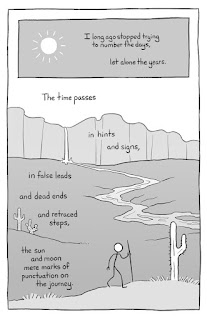
Violet Kitchen, another first-year CCS student, definitely has the goods. She submitted five comics for review, and they're all quite good. You Are These Streets And These Streets Are You is comics-as-poetry with a memorable palette consisting of violet, blue, and yellow. The water metaphor is used in an interesting way; rather than the constant rain being depressing, Kitchen instead talks about mirroring the malleability of water and literally going with the flow, "ready to pour myself out to the nearest passerby, to prove that water has a memory." Matching the text with images of rain pouring from the sky, umbrellas in the street, and water running down drains as a sort of visual metonomy is clever and heartfelt. 

Immortals is the Ed Emberley assignment, about an immortal being trying to track down another immortal being on an otherwise inhabitated planet. Kitchen goes beyond aspects of the assignment in that everything in the comic is fairly naturalistic with the exception of the protagonist, who is strictly a stick figure. An expressive stick figure, to be sure, but a stick figure nonetheless. Once again, Kitchen's prose is assured, terse, and powerful. 

Do You Believe In Life After Love? is a classic experimental comic, taking pages from many other comics and doing a "mixtape" style cut-up with an entirely new narrative superpositioned over the original images. In this case, it's literally about a mixtape that someone made and is listening to now in an effort to not kill themselves. Kitchen has an interesting and varied bookshelf, especially in terms of color, and it made for a lively experiment. 

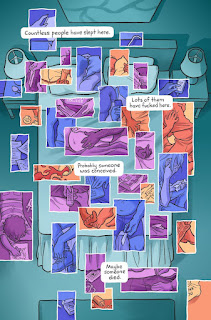
Baggage is from an anthology about in-between spaces that Kitchen was part of, and it's yet another polished, smart, and visually striking but restrained narrative. This story is about hotel rooms, clearly inspired by Richard McGuire's classic story "Here." That's a story about a space over a long period of time, as opposed to a set of characters, and there's a particular page where Kitchen depicts snippets of the lives of dozens of people who stayed in that room, echoing the experience of her unseen protagonist, who muses on living out of a suitcase, trying to imprint a little of one's home on a room, and then leaving it all behind. She also muses that we leave something of ourselves in these spaces; dreams, if nothing else. 

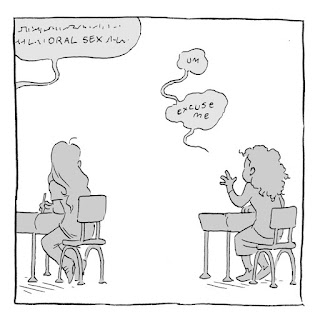
Lack. is a personal zine about Kitchen coming to terms with the idea that she is asexual. This was my favorite of Kitchen's work, partly because it was the most personal and partly because the art was more raw. One possible concern for her as an artist is a tendency to be almost too polished at times; I wanted to see something where she spilled a little ink, metaphorically speaking, and had a little more urgency in her line. The is a memoir that discusses a lifetime of feeling like she was missing something because she didn't feel sexual attraction and horror at the prospect of delivering something she didn't want to do with she was older. Combine that with a perpetually youthful appearance, and Kitchen described a sense of being "unfinished." When she finally came to terms with asexuality, she noted that while it was freeing, she's still having trouble fully coming to terms with being romantic but asexeal. Helping others has helped her accept it herself a little, but I appreciated the idea that she hadn't made some hero's journey, where everything was great on the other side. Things are still confusing, uncertain, and fraught. Kitchen's use of black and white and a slightly tremulous line made the story all the more effective, getting across her vulnerability in a way that her confident prose didn't always directly convey. Kitchen can do anything she wants and is on her way to big things; I'll be curious to see her direction.