Showing posts with label leda zawacki. Show all posts

Monday, December 5, 2022

31 Days Of CCS, #5: The Ladybroad Ledger #5

The Ladybroad Ledger is a broadsheet anthology by women, femmes, and nonbinary cartoonists in Vermont. So says its back page. The original version of this folded a few years ago after four issues, but three CCS students revived it with a bunch of their fellow students and alumni, along with other local cartoonists. The editors are Violet Kitchen, Annabel Driussi, and Sofia Lesage, and it looks like Kitchen handled the editing and Driussi the design. Kitchen took the cover chores and she came up with a powerful, vivid strip filled with violent reds and oranges that exemplified her anger regarding the Supreme Court overturning Roe v. Wade and endangering a woman's right to her own body. It's an eye-catching, righteous bit of fury that demonstrates her considerable skill as a cartoonist. She's got every tool needed to become great. 


One of the fun things about a broadsheet is that cartoonists get to work big. Coco Fox's strip about her struggles with gardening is a 16-panel grid that still has plenty of room to breathe because there's so much room on the page. Her loose, scribbly style and extensive use of decorative flourishes along her panel borders aid in depicting the slightly out-of-control nature of gardening and how difficult it is to control. Kristen Shull's autobio comic addresses the problem of worrying about her readers and audience reactions in general. It also has a lot of interesting visual flourishes that reflect her other cartooning interest of fantasy, and the panel design is chaotic in ways that aid its overall aims. 

A lot of Daryl Seitchik's work involves wide-open spaces, and so working big in her story "How To Become A Mermaid" does a great job of using negative space and black/white contrasts. Masha Zhdanova's comic about summer and falling in love has a nice visual gestalt effect that encapsulates a brief, fleeting feeling. Sofia Lesage's comic about summer goes in a radically different direction: it's a depression journal that's an absolute howl. It's a comic about being trapped in one's own worthless, horrifying mind and body, where the possibility of communication that doesn't poison everyone around you seems impossible. Where one's creative impulses are self-muted and whatever distractions that can be generated are fleeting and foolish. She captures all of these feelings and more in a loose grid that emphasizes body language above all else. 

Leda Zawacki's "29 Miles" suffers from murky grayscale reproduction, marring an otherwise spare, emotionally resonant story about a desperate young woman making a hail Mary play to get a ride. Sarah Woodard's "Open Heart" is a slightly heavy-handed but certainly pointed story about the ways in which the absurdity of racism is highlighted in a medical care facility, with people of all backgrounds providing care and treatment. Driussi's own piece spreads across two pages, depicting the raw, visceral, and erotic experience of experiencing live music. The clashing and clanging images and density of the lettering all play into creating this experience for the reader. 

Sarah Oak's strip about her "Daisy Duke" character grossing out a guy who's hitting on her at work is funny, although her cartooning style is cloyingly stylized. Jen Jolls' piece about someone whining regarding a class has a funny punchline, although the cartooning is all over the place. Keilani Lime and Amy Burns' graphic medicine comic about giving blood (I think; it might be just getting a shot) is funny, reflecting how chronic illness can disrupt any experience. Franky Frances Cannon's full page strip about favorite Vermont bars is cluttered and disorganized, but the drawings are so charming and the actual reviews are so funny that it won me over. Finally, Gabrielle Tinnirello's piece on dresses beautifully uses up the space provided with a host of delicate, decorative elements in a fluid, open page layout. 

There are also essays on why making bad comics is a good thing, how to become a cartoonist, an interview with Kitchen, and a long interview with musician and comics fan Neko Case. Overall, the level of cartooning is superior to the original publication, and more of the cartoonists take advantage of the format to produce work that's outside of their normal comfort zones. 

Sunday, December 5, 2021

31 Days Of CCS, #5: Leda Zawacki

Even before she entered CCS, Leda Zawacki was making interesting comics. She's only greatly advanced since then, making enigmatic but deeply personal and human comics. They touch on trauma, problematic relationships, and yearning. The deliberate narrative vagueness combined with her light touch as a cartoonist remind me a bit of Gipi and Lilli' Carre. As a draftsman, her style seems fully formed at this point, with a lot of beautiful gestural cartooning that's enhanced by her use of color. Her background in design is fully evident, given the obviously careful consideration to how she prints her comics. For example, she works at around 8.5x11" in publishing her comics, giving them a chance to really breathe on the page. What makes her fully-formed as a cartoonist is her ability to merge form and content; her expressive figure drawing and tasteful use of color directly amplify the emotional narrative of the story, allowing Zawacki to show restraint and amp up tension and ambiguity. 


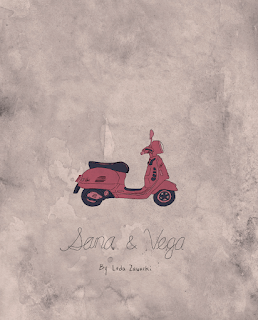
In Sana & Vega, for example, the narrative hook is simple: a young woman hires a delivery service (another young woman on a motor scooter). While the driver, Vega, initially balks at this (wondering why the other woman didn't just call a rideshare), she agrees to do it when the other woman (named Sana) begs her. The result is a journey filled with both comfort and a degree of romantic tension, but it's also about trauma and loss. There's also some danger on the way, as Sana's mere presence seems to anger random men in a gas station. After Vega drops her off, she waits for her outside of the house--and has to wait a while. The implication is that Sana, carrying a box with some toys for a young child, was seeing her child for a brief period of time, but couldn't stay longer--especially since she emerged from the house crying. The character design is top-notch, as both women have completely different looks and yet fit into a single aesthetic. Zawacki's use of close-ups of their face and the occasional splash page are effective, but where she really excels is the way the characters relate to each other in space. It brings up those feelings of yearning, despair, and comfort, especially when Sana is holding on to Vega on the bike.


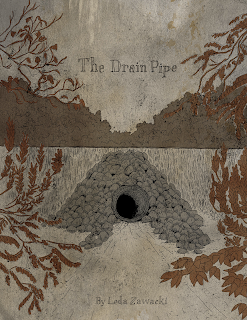
The Drain Pipe is a little more conventional, as it's about a young woman going to her father's house in North Carolina during winter break. Zawacki quietly clues the reader in on a number of things: she has a clingy girlfriend that she's obviously thinking about breaking up with; this isn't the house she grew up in, leaving her a bit betwixt and between; and her attraction to one of her friends who invites her out. Despite the fact that this friend (Helen) had a boyfriend, she still found her attractive and thrilled to little gestures like a touch on the shoulder and the attention she paid to her. There's a scene where Helen shows her a nearby drain pipe near her house where she and her friends liked smoking pot. Zawacki transformed this into the feminine unknown as the main (and unnamed) character had an intense sex dream about Helen in said drain pipe. A miscommunication led to her not coming out to smoke the next day, leading to intense pining and yearning for this potential fantasy scenario. In the end, she started reading her girlfriend's (many) texts again.

This is a comic that truly is about being in a transitional phase: dissatisfied with everything in one's life, wishing for some kind of magic or a person to sweep you off your feet. There's an intense sense of verisimilitude in the scenes in the local musical venue (I actually wondered if this was meant to represent Chapel Hill, given that The Cave is an actual venue and everyone in this story felt VERY Chapel Hill/Carrboro to me) and Zawacki expertly evoked that sense of being young and a little lost. Interestingly, both comics, which were both about intense character relationships, did not feature people on their covers. It's a sort of visual metanym: the bike stands in for the women, and the drain pipe stands in for this sense of vague desire. Once again, Zawacki's character design, her tasteful and restrained use of color, and her overall sense of restraint revealed that she is ready for big things. 

Monday, December 14, 2020

31 Days Of CCS, #14: Leda Zawacki

I was well aware of Leda Zawacki's work before she went to CCS, and the comics she submitted all have a level of sophistication and polish that's indicative of an artist with a style that's close to fully-formed. That's not an accident, considering that she's been making comics for a while. Zawacki has a delicate but highly stylized line that reminds me a little of how Lilli Carre' approaches the page. There's a flat, cartoony quality to her characters that aggressively emphasizes their two-dimensional nature such that every narrative has a dreamy, magical feel. Each of these three comics provides variations on that approach.

For example, The Swinging Bridge, a story adapted for comics from Mari Navarro, emphasized its two-tone colors as the primary driver of the narrative. The dark blue-green not only represented the story's nighttime setting, it also served as the color of clothing. The brief shocks of bright yellow were narrative interjections, representing key emotional turning points. Zawacki's line is a thin one, relying on color to do most of the heavy lifting and fill up negative space. The story, following a teen and a friend who is obviously acting out against a lack of parental engagement, sees Mari go to her friend Rosana's house for her birthday. Rosana demanded that they play with a Ouija board, which freaked Mari out, but also seemed to be a strange, chaotic outlet for Rosana. The story culminated in a dangerous bike ride across a bridge and a shocking encounter that could have been much worse, especially for two Latinx girls. Zawacki mixed dread, anxiety, and confused personal identities into a visually dense but narratively clear story. 

Pomegranate Heart was Zawacki's CCS application comic, which of course meant that it had to include a snowman, a robot, fruit, and the artist in the story. Zawacki wove a sad, sweet story about using a red, fleshy pomegranate as the heart for for a robot and then for a snowman, and then had to find a way where they could be inside together without the snowman melting. This was an experiment in leaning entirely on her line art, and while it looks wobbly in some places, Zawacki's commitment to that clear line backed up by selective uses of hatching, spotting blacks, cross-hatching, and even some stippling gave the story the weight it needed to counterbalance that essential lightness of the narrative.

The Visitor was Zawacki's very loose take on the traditional Aesop's fable assignment. Based on Aesop's fable "The Astrologer," it's ostensibly about someone being so fixated on reading signs that they ignore what's around them. Zawacki, employing grayscale shading to add weight to her thin line, hit on a strong visual formula in this comic. The story was about a lonely seer doing online tarot readings when a demon came through a paid political advertisement. Being a seer, she rejected its attempts to fill her with dark thoughts, but she invited it to dinner as she noted that while she was looking at the cards for fun, she knew she had to engage the outside world eventually. It's an elegant metaphor for quarantining against the pandemic and being wary of intrusive thoughts and isolation. 

Zawacki still works best using color and obviously leans toward philosophical and thoughtful fantasy and mythology as her go-to genres for expression. She's done longer work before, and I'm curious as to how her CCS experience will alter her eventual career trajectory.