Showing posts with label rachel bivens. Show all posts

Wednesday, December 13, 2023

45 Days Of CCS, #13: Rachel Bivens

Rachel Bivens is a clever cartoonist who expresses a great deal of emotional vulnerability in her comics. She's leveled up considerably in the last year or so, with all three of her more recent releases looking sharper in terms of both drawing and cartooning than her earlier work. She still also pursues a lot of different kinds of cartooning, from memoir to absurdist humor to surreal slice-of-life comedy about anthropomorphic fruit.


Fruitlings! features said anthropomorphic characters, and Bivens has really hit on something here. These are 4-panel comic strips, and Bivens printed it as a landscape side-scrolling minicomic. It's an attractive and effective format for these full-color comics, which start off cute and then veer into some different directions. The fruit shyly have crushes, appeal to other fruit for relationship advice, and talk about their feelings. They are also eaten by birds, have worms burst out of them, and deal with breaking away from bunches. That combination of very cute horror and quotidian interactions makes for an unpredictable reading experience, as it whiplashes from one extreme to another, but that's what makes it fun. Bivens' line is simple and inviting, but it's her bright use of color that heightens these extremes. 

DLG is a black-and-white strip about how one's relationship with one's parents can become strained and even invasive during the transition between childhood and young adulthood. The title acronym, of course, stands for "Daddy's little girl," and it refers to the protagonist's father needing her to acknowledge him via text when he asks "SNS?" That stands for "safe and sound," and while a parent's need to know their child is safe is understandable, the context of this comic reveals that it's an invasive form of control. Bivens tells the story with a lot of fairly still images as the protagonist is at the drawing table, receiving the dreaded "SNS" message. There are a series of flashbacks with the protagonist at camp, with a reasonable expectation of earing from a kid, but it persists through college and beyond. In the end, the protagonist ponders options (automatic replies?) and eventually leaves him hanging, creating a necessary boundary. Here, the otherwise silent comic is economically drawn, going deliberately sketchy and expressive as a way of expressing a series of sense memories. The gaps and negative space do a lot of narrative work as the protagonist balances just how to solve this problem. 


Finally, there's Milk. This is a triumph of formal play, as the mini is shaped like a mini milk cartoon and the purple ink and thick cardstock simply make it pleasing to hold and look at. The story is an absurdist account of a Bivens stand-in queueing up at a giant carton of milk for a drink. Along the way, a soccer game bursts into the middle of the line, spills milk out of the enormous carton, and causes mayhem. The end is tense, as things don't go the protagonist's way. This is a silly but well-constructed and cartooned comic with a line reminiscent of Charles Schulz in terms of both its simplicity and expressiveness. 


Wednesday, December 6, 2023

45 Days Of CCS, #6: Go Press Girl!

Today's entry is the initial output of an exciting new publisher, Go Press Girl! Spearheaded by Violet Kitchen (editor) and Rachel Bivens (designer), they already have a lot of publishing experience in resurrecting The Ladybroad Ledger, the broadsheet anthology featuring women and non-binary folks from Vermont. Both of them lean toward poetic comics with strong emotional narratives, and their initial entries here are no exception. 


Ugly Bread is from Bivens and done on a Risograph. It's a beautiful comic about the creative process and te goals that matter most: how it connects to others. What's especially clever is the narrative style: it starts as a kind of narrative recipe before easing into more general commentary on baking as a highly personal craft. The emphasis is on the connections made: the smell of the bread, sharing it, nourishing yourself and others, and above all else--repeating it. It is the repetition that hones craft. It is the intent that creates meaning, even if it is not "perfect." The process is physical and deliberate, and the results of getting better in public as a baker are more important than what the bread looks like. It's a wonderful metaphor for cartooning or any kind of creative process, but Bivens' background as a baker is uniquely suited to executing it. There's a beautiful sequence where flour billowing up is represented by line erasure, an ingenious solution that shows how minimalism can be used so effectively in cartooning. Her cartooning throughout is nuanced and sensitive, with an emphasis on gesture and facial expressions. 


How To Fall In Love. is by Kitchen, and it sees her truly leveling up in terms of the dynamism of her line. Printed in landscape, Kitchen takes advantage of all that left-to-right space using second-person narration, even as she's writing about her own stand-in character. This is a story about how the desperate need to connect can lead to losing one's own self. Writing "you are a space to be occupied," there's a brilliant sequence where the figure turns herself into a welcome mat, desperately seeking the attention of the people who come into her space, even as their presence also revolts her. Later, there's another sequence about being touch-starved, and how they must resist the urge to fall in love with their hairdresser. That segues into another brilliant sequence of an intimate encounter where the stand-in is drawn in red and the other figure is in black, and she can't quite touch him or be touched. The ending is a howl, as the figure ignores the narrator in search of their own solutions, walking into a crimson sea of hands. Kitchen is so clever as a cartoonist, constantly finding new visual solutions to solving the emotional narrative of this story that deeply resonate with the reader. Kitchen's talent has been obvious for a long time, but she's upping her degree of difficulty in a way that doesn't feel ostentatious; instead, she's expanding her visual toolbox in exciting and innovative ways. 


Finally, fellow CCS grad Cathy Mayer's The Last Time I Saw Deborah is also emotionally complex and visually compelling, but she does it in the confines of a more conventional narrative. This one is a slow-burning mystery, and the fact that it's a mystery isn't even apparent until the end. It's about a camping trip to a lake undertaken by two women who are childhood friends. The nameless narrator is clearly worried about her longtime friend Deborah, whom she calls Dee. There are some lighthearted shenanigans surrounding a B&B, swimming, and camping, but there's a lurking darkness underneath. It starts when the narrator asks Dee about her old car, and it's revealed that Dee's malignant husband Ted wrecked it while drunk. Other questions about her life are deflected, even as Dee reflects back on "Bernadette," the playground boat they used to play on that offered infinite possibilities. For Dee, all of those possibilities were clearly whittled down. The central mystery of the story is one that Dee can't confess to her friend, but she finds a number of different ways to clue her in, the final one being giving her the keys to the car to look for something and the narrator opening up the trunk. Mayer's green wash and beautifully sketchy line are wonderfully expressive, and her character design was perfectly evocative of the narrator who was emotionally open and Dee, who was closed off. It's Mayer's use of restraint--the lines she doesn't draw, the character details she doesn't reveal--that make every emotional clue feel so much more potent. 

Thursday, December 8, 2022

31 Days Of CCS, #8: Rachel Bivens and Emil O'Melia

Emil O'Melia's I Think Someone's In There is a poetic exploration of identity and existence, told in a scrawled, scribbly line with the iconography of Catholicism. The narrator struggles with the very concept of the soul, but it also seems to be a metaphor for other kinds of identity and transformation as well. The scribbly denseness of the comic is especially effective as O Melia dives into intense cross-hatching and spotting blacks to immerse the reader in their own uncertainty. When the cracks start to form in the iconography of identity and O'Melia suddenly alternates it with a totally blank page, save some dialogue, it's a shocking and effective technique that forces the reader to confront the narrator's existential crisis. 


There's also a different crisis: not just the worry about oblivion after death, but about not being recognized or seen while they are alive--especially by family. This is heart-rendingly illustrated by the narrator's figure disappearing in the second panel of a four-panel grid, then the entirety of their environment unraveling. The story ends with a defiant assertion of identity and existence, even if the possibility of acknowledgment and connection is unclear.  The vulnerability of this exploration is well-matched by the quavering quality of the line.

Patches, by Rachel Bivens. This is a romance comic in the truest and best sense of the word. Structurally speaking, there are usually two kinds of romance comics: one where the protagonist is lonely and seeks out a partner, or one where the protagonist is partnered but encounters some kind of problem. That second type can be a bit more complex, because their motivations can vary a lot more. Bivens' Patches falls into that second category, as Kristy has a beautiful girlfriend named Jordan but is perpetually obsessed with her own acne. Jordan is loving and accepting of her girlfriend, so that's not the conflict. Rather, the conflict is Kristy's own sense of self, measured up against someone she sees as perfect. 

The conflict is mediated by Brandi, Kristy's best friend, who tries to support her but is tired of Kristy's self-obsession making them late for class and essentially sucking all of the oxygen out of the room. That kind of body dysmorphia can't be reasoned or reassured away, but it's also something that destroys boundaries and ruins friendships if left unchecked. Bivens doesn't need to introduce an artificial misunderstanding or other conflict; this one, and Kristy's obsession with applying decorative "patches" to her acne, is plenty. There's a gentleness to Bivens' work here, as the conflict is resolved in a humane and believable manner, even as no easy solutions are proffered. The cute line that is heavy on facial expressions soaks up the bright but not overly vivid color palette. 

Thursday, December 30, 2021

31 Days of CCS, #30: Rachel Bivens

Rachel Bivens is very much a CCS student hunting for her style, playing around with the student assignments in some clever ways. For example, Texture! is a silly story about needing to use three different kinds of textures in a story; Bivens turned it into a meta-assignment. The cartoonists gets a sweater with fuzzy texture and a haircut with feathery texture bur cries when they can't afford a third texture--and the puddle from tears winds up being the third texture for the real assignment. Bivens' lettering is rough, but that fit into the spontaneous nature of the story's energy. 

Sinking is a very clever use of the Ed Emberley assignment with simplified, geometric figures. It's a mostly silent story about a deep-sea diver who has her oxygen line cut, inducing hallucinations until she manages to make it back to the surface. The simplicity of form contributes both to the comic's sense of wonder and terror. 

The most interesting of Bivens' comics was Granite. This sketchy, expressive comic is about a trio of teen girls who go to a beach. The narrator is shy, unathletic, and clearly not into doing things like cliff diving or log rolling. She goes along with most of it because of her clear crush on one of her friends. It's more than that, however; there's an element of feeling you were exactly like one of your friends, but then you encounter them in a different environment and everything changes. There's a beautiful sense of tension and ambiguity in this comic.


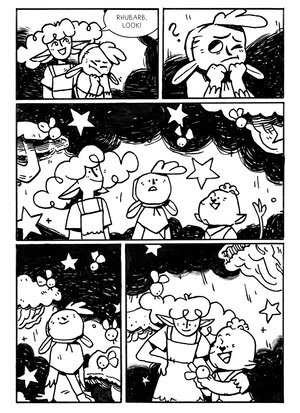
The opposite is true in the fantasy/friendship comic Rhubarb's Cold Open. Rhubarb is a messenger going through a scary forest and is accosted by Smallflower and Frog Fruit. They start their friendship by scaring him and spend the entire comic ignoring his boundaries, either by refusing him a moment's respite or actively putting him in dangerous situations. The intent in this comic for kids is to encourage opening oneself up to adventure, but Smallflower and Frog Fruit are so over-the-top and obnoxious that one can hardly blame Rhubarb for wanting to be alone. This is only part one of a larger story, so perhaps this gets resolved, Rhubarb's "friends" don't display much real friendship here.