Showing posts with label julie delporte. Show all posts

Thursday, May 18, 2017

Comics As Poetry #3: Comics As Poetry anthology

The origins of comics-as-poetry go way back to the 1960s, at least in terms of poets incorporating illustrations. The origins of what I call comics-as-poetry go back to the 1990s, with Warren Craghead being one of the earliest exemplars of the genre. I first used the phrase in 2009 to describe John Hankiewicz' Asthma and Tom Neely's The Blot. In 2012, New Modern Press published an anthology by the title of Comics as Poetry, edited by Franklin Einspruch. It's a short but solid introduction to the genre, featuring some of its greatest exemplars.

William Corbett's introduction regrettably references superhero comic books and generally lacks a real point, other than "who knows what the future will bring". Fortunately, the first piece is by Paul K. Tunis, who opens and closes the book with a style that brings a decorative quality to text that is well-integrated with its corresponding imagery. His first poem addresses the plastic quality of words, in the sense where all words sound like nonsense or onomatopoeia if said enough. Contrasting that with cartooning representations of said words adds to the fun, playful exercise that this piece is. His final piece is just as playful, using vivid imagery in his description of a relationship between a man and a woman--a relationship that's somewhere between work, romance and mutual aggravation.

Derik A. Badman's piece is his usual stuff: repurposing the work of old cartoonists (usually from romance or western comics) and adding either his own text or text from a completely different source. It's a kind of shtick, but it's a surprisingly effective shtick in that this juxtaposition really does create a new meaning for both image and text. The melodramatic quality of the figures is "cooled" by text that's frequently oblique, but not random. Einspurch's own piece is what I would call more of an illustrated poem rather than comics-as-poetry in that the text could hang entirely on its own without the use of the watercolors of different kinds of flowers he employs in the poem. It's an amusing poem but just doesn't hang together like the other work in the book, and I think part of that may be that he was a poet before he tried cartooning.

Absolutely no one puts together a page like Warren Craghead does. His nautical piece uses carefully drawn images, scrawled lines, odd uses of spot color, a six-panel grid with no outside edges, images that bleed into each other and text that is attached to images and tumbles across the page. Despite the spareness of the drawings and the extensive use of negative space, Craghead's comics have a thickness to them that takes several readings to truly absorb. Jason Overby's comics are like that as well, only he's not afraid to go much more abstract than Craghead. He also makes extensive use of collage, found images, scribbles and repurposed text as he goes meta in a piece titled "Process Is Poetry", referring to process in creating anything, not just a poem.

Kimball Anderson uses a first-person point of view in her piece about riding in a car through the countryside and losing one's sense of self. Not just ego loss, but that sense of being unable to understand the difference between sleep and consciousness. The art here is mostly naturalistic, but the color scheme gives the piece a strange quality, like a sense of being hyper-real as though one is in a psychedelic state. Julie Delporte's story about OCD/pure obsession and tracing it back to her childhood and a fear of being hated by her parents over something she did related to sex is actually one of the more conventional pieces in the book. The accompanying images are quite straightforward, but it's her extensive use of colored pencil and open-page layout that makes it unlike other comics. Finally, Oliver East's feature employs some of that Craghead minimalism and negative space, but then goes in a different direction by providing small cutaways of walks around gardens, tiny slices of quietude that I found to be remarkably moving.

Monday, August 22, 2016

D&Q: Chris Oliveros and Julie Delporte


Everywhere Antennas, by Julie Delporte. This is Delporte's first major work of fiction after publishing the visually-similar book Journal with Koyama Press. Delporte's open-page layouts, use of colored pencils and cursive script create an almost uncomfortably intimate atmosphere as a young woman documents her increasing inability to cope with the world. In the course of the story, we learn that she apparently has a heightened sensitivity to the sort of highly concentrated electromagnetic energy that one might see in modern, urban life. As the book goes on, the young woman (named Lily) desperately finds herself withdrawing more and more from society in a series of stopgap attempts to create a life separated from technology. The more she stays in someone's cabin for a couple of months or hops from couch to couch, the more she feels a variety of conflicting emotions. The headaches, exhaustion, confusion and burning sensation she felt at the height of her sensitivity all ebbed (though didn't completely disappear) as she avoided technology, but that was offset by the feeling of being an outcast.

There's another level of narrative at work here beyond what Lily describes. This book is about the narratives, experiences and observations of women and the ways in which those experiences are ignored and discounted by men in authority. In particular, her anxiety is at first barely tolerated and later dismissed by her then-boyfriend and the doctors she sees, whose response each time is to prescribe a different antidepressant. Her father doesn't question her on her problems only because he doesn't want his daughter to comment on his alcoholism. Her desperate need for connection and for people to believe her reduced her to desperate codependence at first, something that she leaves behind as she starts to leave behind the other constrictions of society. While the end has no real solutions in sight for her affliction, she at least is in control of her own fate and own decisions. Delporte's use of colors is disorienting in a way that's meant to reflect her own increasing sense of alienation in her own environment. That alienation is something she has to cope with, understanding that the very forces she tried to cling to early in the book were literally killing her and driving her insane.

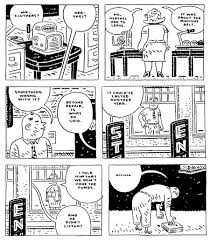
The Envelope Manufacturer, by Chris Oliveros. In the early days of his former publishing concern, Oliveros contributed to the D&Q anthology and also published two issues of this story, The Envelope Manufacturer. The realities of running a publishing company on a shoestring prevented him from finishing that story until he started it again from scratch in 2011. Turning the day-to-day operations of the company over to his trusted lieutenants (and new co-publishers) Tom Devlin and Peggy Burns meant that he had time to finish the book, which he is self-publishing but is having distributed by D&Q. Reading the book made me realize how much I had missed his cartooning, which has elements of Seth and Chester Brown in the sense that they had a number of common influences. Oliveros line is gloriously scratchy and cartoony at the same time, with the book's themes of obsolescence and loss resonating with the profoundly old-fashioned character design. The patchy hair of the company's owner, the suit-bursting girth of his main employee and the bespectacled dowdiness of his other employee are all striking, iconic images that feel strange and almost out of place in a modern book.

That sense of alienating the reader with the evocation of a past time and place is one of the central points of the book, which on the surface resembles Seth's Clyde Fans in that it depicts a failing company that fell prey to obsolescence and its now-useless employees. Where it differs is that Seth's story is at once fixated on surface details but also a deeply interior story that follows the twisting memories of two bitter brothers. The Envelope Manufacturer, on the other hand, has a sense of humor that's both absurd and black as pitch, creating what amounts to scene after scene of dark slapstick. The book's plot, such as it is, involves the last days of a tiny office supply producer. When a key machine breaks down, it signals the end of the company, even as the owner is in complete denial regarding this and has been for some time.

The owner, Mr. Cluthers, is constantly muttering to himself about ways to save the company. His employee, Hershel, is sunk because he's owed a lot of back pay, but it emboldens him to mouth off constantly. So much so that Cluthers thinks he sees Hershel bloviating on a bus and hallucinates choking him. Hershel takes to yelling at failing businessmen to jump from their tall buildings. There's a hilarious sequence where a business owner who's in the process of jumping off the building comes into Cluthers' office, uses his bathroom, offers him some advice and then jumps. When all of the broken-down equipment is repossessed, Cluthers is still obsessed with the idea of making the envelopes by hand, as just one order can help them get out of the red.

The book works as a metaphor for any kind of personal endeavor that's endangered by the whims of the market, and it's not too much of a leap to transfer the sheer absurdity of a three-person envelope manufacturing concern to an equally small art-comics publishing company. Yet one can see Oliveros in D&Q's darkest days, betting on the next book to keep the company going. That said, what marks the characters in this book are their unrelentingly obsessive personalities, an obsession that borders on narcissism and self-delusion. The tiny, scratchy lines on the page give them a nervous, twitchy energy that is especially effective juxtaposed against the classic character and building design. Oliveros proves to be highly proficient in both character and caricature, and the blending of those two worlds gives the book an uneasy sense of both charm and desperation.

Friday, May 3, 2013

Diary Comics: Azzopardi, Budnik, Delporte


Our Ever-Improving Living Room, by Kevin Budnik. Budnik was a student of Ivan Brunetti's at Columbia College in Chicago, and there's a clear link in sensibilities between the two cartoonists. Budnik turned a one-week diary comic assignment into a thirteen-month odyssey that helped him refine his style and slowly unlock the parts of himself he really wanted to start talking about. The format is the classic James Kochalka four-panel structure--four beats, every day. Budnik's style couldn't be more different from Kochalka's, however. In terms of his character design and tone, Budnik is a cross between Jeffrey Brown and Charles Schulz, and I don't mean that lightly. There's an incredible sturdiness in each and every strip, as Budnik carefully thinks through certain events but creates the rhythm of a four-panel strip with a punchline. What's interesting is that he arrives to the project almost totally fully-formed as an artist. Sure, he refines his line and his storytelling over the course of thirteen months, but it's subtle things like using a slightly thinner line and perhaps different tools. He also chooses his background details more carefully, and the result is a more consistent-looking strip that leads the eye exactly where Budnik wants it.

His figures are slightly ragged like Brown's but immediately recognizable and even iconic, like Schulz's. More to the point, Budnik immediately creates his "There goes good ol' Charlie Brown/Oh, how I hate him" moment with his first strip. It starts almost as a parody of the tedium of diary comics, as he checks off the things he does when he has the apartment to himself: take out the trash, do the dishes, vacuum the rug...and "cope with horrible loneliness". It's a great joke, one that's reprised near the end of the book, and it's made even funnier by the way he draws himself in the "loneliness" panel-laying naked in his own filth on the bathroom floor. That's very much a Brunetti sort of moment, but Budnik is actually more reluctant to completely spill his feelings at all times. Having a daily diary comic, however, has a way of getting at information that's otherwise hard to express, and so it comes to pass that he lets slip that he really is seriously OCD. That occurs in a strip where he tries to downplay being called OCD, saying it's an overused and misused term...but that he really does think something bad will happen to his family if he doesn't do certain things.

Overall, this is an incredibly strong first work. Budnik gives voice to his loneliness, his wanting to connect but often feeling uncomfortable with others, nostalgia for a comforting childhood and difficulty accepting adulthood. Somehow, amazingly, he comes up with a punchline every day and a strip that's just a solidly-constructed read. His work ethic and how seriously he takes this project shows on every single page; there's never a sense that he's blown off a day or gotten lazy, even on days when he's not inspired or nothing of interest is happening in his life. He's self-deprecating without being pathetic, open without giving away too much of himself right away, and most of all possesses a sense of self-awareness that is both a blessing and a curse. This book was published by RJ Casey's Yeti Press, yet another small publishing concern that's releasing excellent work. I hope they will publish future volumes from Budnik, who continues to do autobio comics.

Journal, by Julie Delporte. This is a very different sort of diary comic, in that it starts right after a serious break-up. The mother of a friend of mine, when talking about break-ups, once said, "Don't ooze out, get out!"  Delporte is very much in "ooze" mode throughout this comic, seeing her ex-boyfriend regularly even as she no longer lives with him. She also tries something different with this comic; instead of using her usual black & white style, Journal is done entirely in colored pencil. One can even see the tape on the pages where they were originally shot, giving the whole book a sense that it was constructed as much as it was drawn. Unsurprisingly, Delporte does a lot of soul-searching throughout this volume, as she moves from Canada to take up a residency at the Center for Cartoon Studies in Vermont. If Budnik's book was about him grappling with loneliness but wanting to connect, Delporte's book is about her struggle with her desire for connection when she knows that relationship would never work, no matter how much she still loved her ex-boyfriend. She also struggles with the concept of adulthood and living a life without a particular structure or sense of rhythms.

The result is a series of incredibly beautiful pages, as her color sense with the colored pencils is bold and dynamic--almost like what a child might draw, only with a firmer grasp of structure and harmony on the page. Her looping cursive script is as beautiful to look at as her images, and it's done in the same colored pencil as her drawings. Journal is an account of a journey where she moves two steps back for every step forward emotionally, where a bad week follows a good day, often with an almost embarrassing amount of intimacy. It's also her attempt to understand the difference between sadness and depression and whether or not she needs therapy, an attempt that is ultimately left unresolved. She tries to work through her feelings and insecurities quite literally through work--drawing the journal. Unlike Budnik, her journal eventually starts to have diminishing returns and she returns to a more "hidden" life, to use her term. It's clear that in the epilogue, writing the journal had a powerful and positive effect on her, but it was time to let the actual contents into the world and then forget about them. As one would expect, a book published by Koyama Press looks great, as the key to its success is the brightness of the color contrasting with the sadness she feels while evoking childhood delight in drawing.

100 Days of Winter, Nine Months of Beige, and Eight Tablet Dream by Sean Azzopardi. Azzopardi is a bit older than the other two cartoonists discussed here, but he's still grappling with many of the same issues. In particular, the thorny notion of "growing up" haunts him in these accounts of stress, moving, diseased pets, medical issues and time spent with friends. Azzopardi discusses his battle with the skin disease psoriasis at length, detailing his mixed feelings about submitting to a drug regimen that cuts alcohol out of his life. At the same time, he notes how much worse his life could be in terms of health. Azzopardi is in his forties and is single with no children, which brings about those sorts of self-recriminations, the sort of thing that Tim Kreider refers to as "The Referendum". That's where we measure ourselves against the typical and expected societal goals like owning a house, being married, having children, etc vs the current reality. It's a question many artists have to ask themselves repeatedly throughout their lives, especially when they doubt their own abilities.

Nine Months of Beige is a more loosely-drawn journal that's less about specific dates than it is about places and spaces, and trying to come to terms with both as one's age advances and it's harder to be part of a scene. Azzopardi's drawing really takes center stage here and includes some funny drawings about having one's hands in the air at a party, having one's hands in the air on the tube, and improbably doing a "rave" at work. I love Azzopardi's square-headed, bespectacled self-caricature, complete with receding hairline. Eight Tablet Dream is about self-recriminations and the feeling that he is bad at everything: bad at being a friend, a worker, a brother. It ends with Azzopardi having grappled with all of these feelings (as well as loneliness) and coming out the other side intact with an artist's sense of wonder. His drawing is also quite excellent here, especially with regard to depicting exaggerated emotional states and outdoors scenes.Azzopardi's comics have a certain poetic quality on many of the pages as he's given to direct musing about his life in a manner that's different Budnik and Delporte.