Showing posts with label dylan williams. Show all posts

Tuesday, April 30, 2013

Sequart Reprints: Windy Corner 2

The following article was originally published at sequart.com in 2007. Austin is now the publisher of Domino Books. Please consider buying one of the many excellent works he's released, especially since he's losing his base of operations (the legendary Cartoon House). Get the first five Domino books for just 26 bucks, with free shipping. All of them are quite good and unlike most comics you've ever seen.
*************************

My favorite kinds of publications about comics, as I have noted in this series, are those that reflect the idiosyncrasies and passions of its editors. Windy Corner Magazine (WCM) is an exemplar of such a publication. I am particularly drawn to WCM because I share some of editor Austin English's more eccentric tastes, and he does little to buffer or prepare the average reader for them. It's a tact that can be a little demanding on a reader not familiar with English's approach to comics and criticism. The focus of WCM is artists writing about and talking to other artists, an approach that makes sense given English's status as an artist and critic.

I like the give-and-take collaborative feel of WCM. Lis Timpone designed a clever table of contents. Molly Goldstrom opened up the magazine with an odd two-page strip where a man prattling on about his love of bricks fails to notice his companion turn into a tree. Juliacks contributed the back cover, a typically dense collage of image, tone and text with a certain wistful quality.

English continues his autobiographical series of comics with a couple of evocative entries. The emphasis of these stories is on his earliest childhood memories, and I love the way he homes in on tactile sensations from memory, like the feel of the chair he sat in, the distress he felt upon hearing the sound and flash of a star "explode", and the soothing sound of the planetarium show's narrator. In "Movie", his memory is as much about the way he interacted with his parents before and after a movie he saw as the movie itself. The former story looks like it was done in colored pencil, and the decorative quality of the colors he uses to balance out his panels is striking. It balances the panels and actually draws the eye in, something lacking in the second story. That sort of pleasantly ramshackle design quality of his works nicely in his second "Life of Francis" episode, which is almost expressionistic in the way it depicts feeling and emotion. Fiona Logusch's "Entangled Relationships" reminds me a bit of Jules Feiffer's work, both in terms of the way she moves her characters around and the rawness of the emotions she portrays.
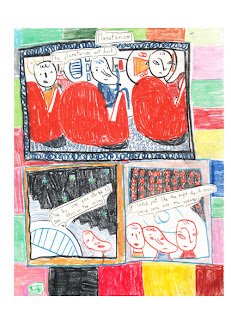
The feature article on children's book illustrator Lois Lenski was positively inspiring. English is unusual for a critic in that he seems to have an intuitive sense in how to discuss the formal qualities of a work in such a way as to bring it alive for the reader. I knew nothing about Lenski's work going into this article, and English probably would have been well-served to have at least some sort of introduction to her work. That said, I appreciate his enthusiasm about the subject and the way he quickly immerses the reader in the formal and aesthetic qualities of Lenski's art.

The interview in this issue was one of the most enlightening I've ever read with a cartoonist. John Hankiewicz, creator of enigmatic & beautiful comics in minicomics and the collection Asthma, was interviewed by cartoonist Onsmith. Hankiewicz reveals much about his working process, the way he approaches doing comics, why he loves printmaking, the specifics of certain stories and his general aesthetic outlook. Onsmith uses his deep knowledge and appreciation of Hankiewicz's work to take the conversation to some interesting places, but he always allows Hankiewicz room to expand on his thoughts.

The standout feature in an issue filled with great features is Dylan Williams's strip about Alex Toth. It's a series of stand-alone images done in what looks like colored chalk, each accompanied by a caption loosely associated with (almost interpreting) the text. It's a wistful piece dedicated to Toth and the intermittent correspondence that Williams had with him over the years. It's also about relationships and friendships and the way Williams approached them and how his feelings about them changed. It ends with a statement of purpose that connects his feelings about being an artist, about Toth, about comics and about long-distance friendships. I can only imagine this piece running in a magazine like Windy Corner , and that's why Austin English's indulgence in his aesthetic passions winds up as a gift to readers.

Tuesday, September 13, 2011

Some Thoughts On Dylan Williams

(photo by Neil Brideau, by way of Raighne Hogan)

Sunday at SPX 2011 was part convention, part therapy session for many of its participants as most everyone woke up having heard that Dylan Williams, the publisher of Sparkplug Comic Books, had died. There's a pretty remarkable outpouring of grief and moving remembrances of Williams happening on the web right now; both Tom Spurgeon and Brian Heater are attempting to capture all of these links. What I hope to do here is not discuss his influence as a publisher or work out his importance as a historical figure in comics. I will be spending ample time in the future on this topic and those results will appear elsewhere, but it's important to at least note that one of the keys to his legacy is indeed the few dozen excellent, idiosyncratic and poetic works of comics published under Sparkplug's blanket. Instead, I want to work out some personal thoughts and ideas about Dylan.

I first met him at SPX 2002. That show had been long-awaited, as the 2001 iteration was canceled thanks to 9/11. As a result, that show was absolutely stacked with talent: the Hernandez Brothers, James Sturm, Ivan Brunetti, Jason (in one of his first US appearances), Charles Burns, Phoebe Gloeckner and many more. Jeff Mason's Alternative Comics was at its height, with the first collection of Gabrielle Bell's work and the Rosetta anthology. Still, I noted at the time that the fledgling Sparkplug Comic Books "may have had the most exciting books at the show", which included Jason Shiga's Fleep and Hello, World, and the excellent Orchid anthology (which I later tabbed as one of the best of the decade). T. Edward Bak and Ben Catmull were also at his table, with Catmull selling his Xeric-winning Paper Theater.

That's back when I occasionally wrote for Savant, attempting to inject some alt-comics flavor into what was mostly a Vertigo-inspired publication. Dylan quickly took notice when I started writing for sequart.com and started sending me everything he was publishing. That's when I learned that he, like me, had remarkably catholic tastes. He loved a lot of different things that can be called comics and was unambiguous and effusive in his affection for everything from golden age comics to select silver age to undergrounds to humor to autobio to burgeoning forms like comics-as-poetry and immersive comics, two styles that he championed far more than any other publisher.

We always shared a warm and cordial relationship, and I felt we understood each other well. He was one of the first publishers to take me seriously as a critic, and saw how seriously I take this endeavor. I only got to see him at shows, and I have great memories of collaborating on how to shape a publishers' panel at SPX 2008. We would write each other notes about things the other had written, which was all too rarely in Dylan's case. In some respects, Dylan was a modern-day Bill Blackbeard. He genuinely loved comics, not as an obsessive/collecting/fetishizing hobby, but as beautiful objects with meaning that are unjustly discarded by the wider culture. More to the point, Dylan subsumed both his career as a cartoonist (where he had been quite active for more than a decade) and a historian (he should have been in a position to have written several books) in order to publish, encourage and nurture the works of other cartoonists. This was not perhaps the most glamorous of choices, but it not only wound up having the greatest benefit for comics (much like Blackbeard's editing so many anthologies changed the lives of readers forever), it was the right use of his skill set.

Dylan was a good cartoonist but not yet a great one; he may well have reached that level, but it was clear that it was something that didn't come easily to him. I think the same may have been true as a writer; I got the sense that he didn't trust his own voice sometimes. Simply put, he didn't enjoy self-aggrandizement or much personal attention in general. On the other hand, he was a phenomenal publisher. His instincts were unerring. He nurtured talent like no one else. He would see things in artists, very early in their career, that they themselves could not yet perceive. This is not to say that he was disingenuously kind; he only accepted work that met his demanding standard, yet always encouraged those he rejected in very specific ways on how to get better.

I think the key to understanding Dylan Williams is that he always thought as a cartoonist, first and foremost. And as a cartoonist, he was an outsider. Publishers rarely touched his work. As a publisher, he was an outsider. While no alt-comics publisher is really out to make money, Dylan brought a scrupulously fair and ethical approach to publishing inspired by punk icon Ian MacKaye. That business model was a small, self-sustaining approach driven not by maximum profits but by a realistic publication schedule, reasonable prices and fair practices for artists, all in the support of work he believed in completely. Dylan felt uncomfortable when artists and editors talked more about book deals and money grabs than they did about the actual comics themselves. I'm not sure he felt comfortable thinking of himself in the same company as Gary Groth or Chris Oliveros, publishers who obviously put out books they believe in, but are also businessmen who have a bottom line and who can only afford to finance a few big losers. Those two are also beholden in some respects to Diamond, which wound up putting the kibosh on a number of their low-selling series. Dylan steadfastly avoided dealing with Diamond and found a way to make it work on a small scale, no doubt at the cost of possibly thousands of dollars.

Dylan may have been an outsider, but he was not an iconoclast. From the start of the career with the Puppy Toss minicomics cooperative, he was a networker. He networked not to move up in the world of comics, but to bring people together. In much the same way disparate artists found themselves part of a community in the 60s with the underground movement and in the 80s with the Newave movement, Dylan helped foster that same sense of purpose and encouragement to another generation in the 90s. Sparkplug was the reification of that ideal, one made at around the same time he was originally diagnosed with cancer. I don't think this was a coincidence.

Dylan thought himself an outsider, and the biggest tragedy of this viewpoint is that he did not understand until it was almost too late just where he stood in the eyes (and hearts) of others in the comics world. As a close friend of his told me, he didn't think of himself as a beloved or inspiring figure to twenty years' worth of cartoonists. He thought of himself as someone getting the job done, as doing the best he possibly he could by the art form & the artists that he loved so much and that had given him so much inspiration (or as he once told me, "Just do your best, always."). In the last few weeks, when there was such a bountiful outpouring of support, love and money after his plight became publicly known, he finally understood, in no uncertain terms, just how everyone felt about him. Fans and friends fell over themselves to buy books. Critics rushed to recommend books. Peers started up an art auction for him, one that is still ongoing and whose need has not passed, given that more bills will need to be paid. Dylan felt that love, which makes it all the more shattering that he died in such a sudden manner.

His death certainly leaves a void in the lives of his family and friends. Clearly, the uncertain status of Sparkplug will be something to consider at a later time, after the mourning is over. There aren't many like him in comics today. That said, the narratives springing up about him and his impact reveal him to be a huge, nurturing tree whose branches spread far and resulted in sprouting blossoms across the world. He provided a model for how to think about comics, how to act with integrity as a businessman and how to treat others as a publisher, and this is his ultimate legacy: he upheld fairness in the arts field with the history of the most inhumane, unfair practices. It's now up to those he inspired to carry forward his example.

Thursday, August 25, 2011

Another Way To Help Dylan Williams

This is a release from retailer and friend of Dylan Williams, Jason Leivian, owner of Floating World Comics in Portland, OR:

"Dylan Williams would never ask any of his friends to do a benefit like this. Not his style.

Sorry Dylan, I know you said no gifts, but your friends love you too much and you're just going to have to accept this present.

A few days ago Tom Spurgeon and others sent out a call for people to support Dylan by buying Sparkplug Comic Books. When I heard how serious the situation was I felt shock and sadness. Felt a little helpless, then I think yesterday we all got the same idea at the same time. Gotta do something to help our friend. Jim Rugg emailed me last night about putting together an art fundraiser show which I'll start organizing this weekend and I'll have more info on Monday.

In the meantime we're going to have a benefit sale at Floating World next Monday and Tuesday, August 29th - 30th.

We're going to donate 100% of our proceeds from those two days to Dylan's medical care (Dylan has no health insurance). We'll have a special section of Sparkplug books for you to check out but the sale includes everything you buy on Monday and Tuesday. "

Tuesday, August 23, 2011

Dylan Williams Needs Your Help

As anyone who is Facebook friends with him knows, Dylan Williams is very seriously ill and could use the help and support of the comics industry. The cartoonist and publisher of Sparkplug Comic Books indicated that beyond getting good vibes of support from his many, many friends, he could use financial support in the form of people ordering books.

It's no secret that Sparkplug has been one of my favorite publishers over the past decade, as Dylan has really put his money where his mouth is in publishing work that he truly loves. Please consider stopping by their shop and ordering some books, comics or minis. Williams has been distributing books from like-minded souls for quite some time, so chances are there's something you've missed. Please consider buying something from my suggested shopping list below, or anything that strikes your fancy from their extensive catalog.

Here's a quick baker's dozen or so of Sparkplug's greatest hits:

1. Asthma, by John Hankiewicz. One of the greatest books of the past fifteen years and the best example of comics-as-poetry.

2. Bookhunter, by Jason Shiga. A hilarious and exciting homage to both 70s police procedurals and library practices.

3. Gay Genius, edited by Annie Murphy. A top-notch assemblage of talent mostly unknown in wider comics circles.

4. Orchid, edited by Dylan Williams & Ben Catmull. Sparkplug's first release contains work by a number of cartoonists who would have a big impact, like Kevin Huizgena and Gabrielle Bell.

5. The Heavy Hand, by Chris Cilla. A dizzyingly inventive book, one of the best of 2011.

6. Inkweed, by Chris Wright. A collection of short stories united by Wright's scratchy line and monstrous character design, along with his bleak but humanistic outlook.

7. Department of Art and Habitat, by Dunja Jankovic. Inventive and oppressive "immersive" comics about a woman facing the terrors and ennui of work and then home.

8. Rock That Never Sleeps, by Juliacks & Olga Volozova. A delightful and strange series of interpretations of a town related to memory.

9. Whirlwind Wonderland, by Rina Ayuyang. A lovely collection of autobiographical short stories.

10. The Hot Breath of War and Mine Tonight, by Trevor Alixopulos. Fascinating and cleverly cartooned stories dealing with politics, sex, war and living in the modern age.

11. The Airy Tales, by Olga Volozova. A series of lovely, immersive fairy tales of a sort.

12. Reich #1-8, by Elijah Brubaker. This is a biography of controversial psychologist and researcher Willhelm Reich, told as objectively as I've ever seen.

13. Christina and Charles, by Austin English. English's first long-form comic is still my favorite in the way he depicts music and familial relationships.

Saturday, September 12, 2009

Single Issues From Sparkplug

Rob reviews a number of periodicals from Sparkplug Comic Books. Included are THE SHORTEST INTERVAL, by David King; ROCK THAT NEVER SLEEPS, by Olga Volozova & Juliacks; DEPARTMENT OF ART #1, by Dunja Jankovic; the free anthology BIRD HURDLER; and REICH #6, by Elijah Brubaker.

Once again flying in the face of established comics business trends, Dylan Williams trusts his intuition and moreover, trusts his artists, as Sparkplug Comic Books has published a slew of comic books in the past few months. While most of them will never be listed by Diamond, Williams knows that the audience for these books is not necessarily one affected by Diamond's more stringent minimum orders policy. For some books, Williams has also pooled resources with other like-minded small press publishers like Greg Means' Tugboat Press and Tim Goodyear's Teenage Dinosaur. As always, there's a singular vision to be found in each of these comics that reflects more a unity of purpose than a house aesthetic.

THE SHORTEST INTERVAL, by David King. This is a short comic about the Planck Epoch (the first microseconds after the Big Bang) and gravity that's part science comic, part fanciful daydream about the universe's origins. With colorful and amusing schematic diagrams and disarming cartoons, King homes in on an interesting philosophical question. During the briefer-than-brief Planck Epoch, gravity was by far the most dominant force in the universe. As the universe expanded, it became less and less significant a force, since gravity is the attraction between two bodies. When two bodies are no longer in close proximity, gravity becomes less important than electromagnetism or (especially) the subatomic forces. King posits this question as though gravity was sentient, was forced to abdicate its crown and has since tried to find a new purpose. This is an aperitif of a comic, pared down to its most essential parts and no more.

REICH #6, by Elijah Brubaker. Brubaker checks in with an issue that's mostly set-up and what feels like a last look at past events of the 1930s. Here, iconoclastic psychotherapist Wilhelm Reich moves his family around in the face of National Socialist rule, ruminates about his encounters with prostitutes and considers what he thought those encounters meant. I've noted elsewhere how much I like Brubaker's blocky & angular character design--all sharp angles and harsh shadows; in this issue, I liked the way he used gradients of light to imply the fading away of an era. Reich was never afraid to challenge authority, and this issue has a very deliberate dissolve between one of his books attacking fascism being burned by Nazis and his first discovery of a weird energy emanating from a sample on a microscope slide. The latter half of the issue further cements one of Reich's chief faults as interpreted by Brubaker: he's a man who loves humanity but who has trouble expressing his emotions for people. Having his feelings broken by a prostitute and being beaten by his father clouded his ability to feel empathy; while not cruel, it was obvious that his affection for his own children was tempered by an almost clinical distance. That distance was instantly adopted by one of his daughters, mimicking his own dispassionate discussion of sex. I'm eager to see Brubaker start to explore the weirder aspects of Reich's ideas, which I imagine won't be for another couple of issues.

BIRD HURDLER, edited by Dylan Williams, Tim Goodyear and Greg Means. This was this year's Free Comic Book Day entry after last year's NERD BURGLAR, and it's once again a collaboration with Tugboat Press and Teenage Dinosaur. It's a strong lineup, including an excerpt from a Julia Grforer story I reviewed here, a two-page observational piece by Andrice Arp, a typically dense dream-related story by Theo Ellsworth, a funny story about cats by Lisa Eisenberg, and welcome short stories by Zack Soto and Farel Dalrymple (two artists whose own work I haven't seen enough of in recent years).

I don't often see Arp tackle autobiographical incidents, but her strip about the kind of weirdos one can observe on public transportation was appropriately bizarre for her style of art. The creepy guy trying to hit on two random women was hilarious because of just how oblivious he was to the open hostility being thrown in his face by everyone around him. Soto's strip was atypical; it was a relationship strip connecting the tangled skeins of the horrible things we can say to loved ones and how it can batter them. The way the threads wound up leading to two other people was a clever and telling shorthand method for depicting what was left unsaid. Eisenberg's clear line story about cats inheriting both the pluses and minuses of a couple's relationship problems was also quite clever, as a cat given a turkey's gizzard wistfully wishes it could taste that mysterious food again, even as a vegan girlfriend was angry at her boyfriend for doing so. This is still a pretty lightweight and amusing story, but the hidden yet jagged edges Eisenberg implies give it a little bite. Ellsworth's work looks great as the anchor of an anthology, given the density of his work and the fairly straightforward gag found in a cat barely deflecting a sleep-related disaster of its master. Dalrymple contributes a second part of a continuing story, which--while cute--was a bit hard to follow. Still, the way he draws children's hair and facial expressions with so much rubbery detail always draws my eye in. This was a truly impressive free comic with a wide variety of styles and superior production values that nonetheless did not seek to water down its stories so as to true a wider audience. The publishes have achieved a measure of success by publishing artists they believe in and finding ways to expose it to audiences who will be drawn to it.


DEPARTMENT OF ART, by Dunja Jankovic. Describing Jankovic's work is difficult. Perhaps "Kafka-esque" comes closest: a sort of suffocating Mobius strip of frustration, yearning, pain and aimlessness. The opacity of her comics comes in part from the moody, scribbly style she employs. Everything is in shadows, but not the sort of ominous noir shadows that imply danger or excitement, but almost a sense that the light has simply faded away. DEPARTMENT OF ART is a workplace comic that intersects with creating art for a living, a process that Jankovic depicts as literally sucking one's light out of one's body. In this issue, the lumpy, ill-seen protagonist finds herself unable to stay in her cubicle, but learns that things get much worse when she tries to go elsewhere. Indeed, Jankovic draws the workplace as an infinite labyrinth with no beginning or end, just more walls and more cubicles. The question that remains at the end of the issue is just what her inability to find her old cubicle (and job) means as far as her purpose in life. Jankovic, whom I believe has a fine arts background, magnificently illustrates what is otherwise a not unusual set of feelings. Depicting coworkers as chattering snakes, portraying a narrow vent first as a potential avenue of escape and then as a claustrophobic hellhole, and the ill-differentiated blobs that are her other co-workers in a break room are the very structure from which the comic's sense of desperation emanates. This has the potential to be a fascinating long-form work, depending on how she chooses to pick up and continue the story's threads.

ROCK THAT NEVER SLEEPS, by Olga Volozova & Juliacks. I've written in great detail about these artists and the immersive style of comics they champion. It was fascinating to see them collaborate on a story about memory; in particular, a story about a town where lost memories can be recovered. The two each wrote two separate stories that intertwined in interesting ways, with Volozova contributing one of her usual modern fairy tales and Juliacks writing a science fiction story. What both stories share in common are the hallmarks of that immersive style: a minimal use of negative space, reading the page as parts and whole simultaneously, and an integration of text and image as almost interchangeable parts. Words not only have a decorative quality at times, they also occasionally act as visual structures. It's an approach that demands a reader's full investment but also promises an enormously rewarding experience.
The key to reading these comics is by considering the concept of memory as something both always disappearing yet still lingering as a trace. Erasure is a big part of these narratives: words and images (often combined) that are tiny, smashed into corners, written in faded ink or half-erased. You can follow the story without paying attention to them, but they can always be espied in one's peripheral vision, or when one takes in the gestalt of the page. Volozova is all about that gestalt, constructing her pages as units to be apprehended all at once and then slowly broken down into panels. Like most of her stories, this one is about a set of alienated characters in a town whose population started to lose their memory. It focused on a family whose father was a puppeteer, whose mother came from a long line of puppet makers and whose daughter wished to learn the family secret. They lost their most important memories and traveled to a town called Rock That Never Sleeps, a place in the desert where one could regain memories for a price. That price was losing something precious. The genius of this story is the way that Volozova painfully had each character remember the horrible things they did to each other that forced their loss of memory, and the price paid was one of separation. I read it in part as a way of approaching trauma; that is, remembering traumatic events both unblocks certain possibilities but creates scars. It's a difficult choice to make, but it's obvious as to where Volozova's sympathies lie.
Juliacks equates the loss of memory with the end of the world in her story, a point of view that makes sense from a personal standpoint. In her future world, most of the world's population lost their memory, an event that essentially wiped out free will as technology stepped in to make up for this lack of identity. The protagonists of the story were part of a small community that not only retained their memory, they could read memories off of objects. The trio travels to Rock That Never Sleeps, and Juliacks portrays the continuum of cognition as an interconnected if jumbled mess. Nothing is ever erased so much as it's out of order in a set of files. As such, Juliacks' story is heavy on thick, black lines; tons of hatching and images blurring into and merging with each other. In the story's climax , the trio causes the whole structure of the town to collapse in on itself as they burrowed for their memories, with the story's main protagonist eschews the whole practice of memory, content to live in her own head. Ultimately, this is a story about solipsism and how an obsession with one's own identity can obscure the ways in which we relate to others.

Thursday, March 12, 2009

Idiosyncratic Expressions: Two New Comics From Sparkplug

Rob reviews two new comics from Sparkplug: JIN AND JAM #1, by Hellen Jo; and DANNY DUTCH, by David King.


In small press comics, the output from a publisher tends to reflect their own personal aesthetic, even when they exert no editorial control over them. That shows through in things like design and format, creating a sort of house style, especially when a publisher puts out a limited number of comics in a given year. For Dylan Williams' Sparkplug Comic Books, this couldn't be any less true. Williams' own work is frequently quirky and personal, so it's no surprise that he encourages the artists whose work he publishes to feel unfettered in the way they express themselves. The result is a catalog that contains very little overlap in style or subject matter, yet is all compelling. There's a sense of obsession that follows each artist's work from Sparkplug, as though they simply must get their ideas down on the page or else. For a comics reader who is a true omnivore, it makes reading Sparkplug's output especially appealing.

Williams is also unusual in that he prints a lot of pamphlet comics. Two fairly recent such comics, JIN AND JAM #1 and the first collection of DANNY DUTCH, couldn't be any more different in terms of visual style, narrative qualities or content. David King's DANNY DUTCH is somewhere between Steve Weissman's stuff and John Hankiewicz's (by way of Charles Schulz) in terms of the character design and set-ups of the former and the narrative abstraction of the latter. I remember seeing some of these posted online and not really being engaged by them. Reading a collection of the strips, what King was doing finally clicked for me. The strip has a sort of dizzying quality as King finds ways to simultaneously distance and engage his readers. He introduces these cutely-drawn, grown-up kid characters who are sometimes grappling with existential concerns and sometimes grappling with scatological humor (and often both at once). King loves grounding the absurd in a staid package, and occasionally taking the reader out of their comfort zone by going from a cute, iconic style to a more visceral, naturalistic style--usually to depict something horrible or stunning.


King's chops as an artist are remarkable. He's in total control of his line, presenting the reader with at least three different styles of visual representation: cartoony, stick-figure and naturalistic. Some of his strips have punch lines, but he's not afraid to simply relate an anecdote or emotional yearning instead of a gag. King's work is also surprisingly raunchy at times, but that raunch is restrained and made more powerful as a result of him chanelling it into resolving either an anecdote or feeling in each story. Some of the most pervasive emotions depicted include regret, loneliness, curiosity and camaraderie. One can't help but get swept along in this quirky collection of strips that speaks loudly through its quietude.


On the other hand, there's little that's quiet about Hellen Jo's JIN AND JAM. Like King (and in the tradition of Schulz), she's clearly exploring different aspects of her self through her various characters. King's characters seem to exist in their own world, while Jo's characters are very much grounded in a familiar sort of suburban malaise that they're reacting against. "Reacting" is a good word to describe what her young teens are doing in this story and how she depicts it visually. They're literally pushing, grabbing, punching and reaching for a life that has some kind of spark beyond the status quo. While King's strip has a deliberately flattened quality to the art (making us aware that it's very much a comic strip, and then subverting that awareness), Jo comes at the reader with all kinds of crazy angles and perspectives. There's also a certain propulsiveness to what she's doing, pushing the reader along the page.


The story is a simple and familiar one. Jam is clearly an outsider, thumbing her nose at authority (depicted as both brutish and buffoonish) whenever possible. Sitting outside a church with a friend, she meets Jin, who would seem to be a "good girl" until she swipes a cigarette as she's leaving. That sets up a time-honored scenario in alt-comics: a bunch of teens trying to get into see their favorite band play but getting denied. While that's straight out of the Jaime Hernandez playbook, it's really more of an opportunity to get these seeming opposites (but actual complements) together in an effort to figure each other out. The triggering event and highlight of the issue was a harrowing but hilarious fistfight between Jin and Ting & Terng, conjoined twins. One can sense the glee that Jo took in drawing the two of them fighting as dirty as imaginable; those scenes pop off the page. It's the visceral quality of this comic that separates it from other stories in this genre; Jo really has a way of positioning figures that makes the reader almost feel their sweat, breath and blood. It's an uncomfortable and in-your-face sensation, but one that makes for compelling reading.