Tuesday, January 2, 2024

45 Days Of CCS, #33: Laura Meilman

Laura Meilman is a talented cartoonist with a particular knack for color and a delightfully scribbly line. Her proficiency with colored pencils and playful sense of humor make reading her frequently silly comics a pleasure. However, Meilman's actual narrative storytelling style shown in these comics leans less toward strong character-based content and more on anecdotal storytelling. That limits her ability to put together coherent stories and sometimes leaves the reader with a meandering series of sequences that too often overly rely on text. 

Starting with the shorter comics, Laura's Writing A Graphic Memoir is a micro-mini that's essentially an extended advertisement for her Patreon. Even the brief clips from this do little to establish an actual story; instead, there are references to anecdotes within a story. Aquar-aoke is a cute anecdote about working in an aquarium and singing to the electric eel. With just six pages of story, it's a perfect length for this brief, funny story that has a solid punchline. 


Salvage is a dream comic. Dream comics are tricky under the best of circumstances, as they require post-dream interpretation to make them into something resembling a narrative. Meilman here strings together a number of images flowing into each other with a few key words, and the boldness of her color brings to mind how vivid some dreams can be. The comic didn't really need any further explanation, but Meilman included a long text page decoding dream symbols. This didn't work at all with what preceded it; instead of the flow of a story, the reader was asked to go back and do homework in a way that didn't flow at all. 


The longest story here is titled The Pot Brownie Story: The Comic. This is a story about telling a story, which unfortunately transforms an amusing narrative into an anecdote about telling a story. What's worse is that the superfluous introduction to the actual anecdote tells the reader how funny and popular this story is--it is literally telling, not showing. The story itself, wherein a drunken Meilman consumed a pot brownie that made her uncomfortably high, leading to a trip to the ER, is funny enough on its own without the extra asides about particular parts of the story being especially funny to people in the medical industry. It's a shame, because there is an actual funny story in her that's well-drawn, but Meilman just added on too many unnecessary details. That said, her self-caricature is killer, her page composition is frequently innovative and makes story elements pop, and her bold lettering adds a great deal to the story's impact. Meilman's talent is undeniable; she just needs to rein it in a little. 

Monday, January 1, 2024

45 Days Of CCS, #32: Edea Giang, F.G. Meanie

It's difficult to get a handle on what kind of cartoonist first-year CCS cartoonist F.G. Meanie is at this point from the two comics they submitted for review. What is clear is that Meanie is a talented writer and thinker about the comics page. In Wobbegong, which seems to be the Ed Emberley assignment, this comic printed on purple paper is about a figure (drawn in stick-figure silhouette) about to be executed for treason/heresy who escapes and goes on a long rampage in their escape. The ending reveals that their heresy may not yield the result they had hoped and makes great use of vast amounts of negative space. Meanie definitely knows what they're doing on the page in terms of composition. 


Turtles South Of Vegas was drawn digitally, and it takes place in a car. There are four stacked horizontal panels on each page, and the figures are just barely sketched out in green and red, respectively. The two men here are Mafia hitmen, and one named Carlo gets in the car and is greeted warmly by his old friend Cazzo. Their job is to bury the body of someone who pissed off their boss. Meanie lays the dialogue on a bit thick, although it's understandable since the story depends on it more than the art, which is more of a visual placeholder and rhythm-setter. Once again, there's a nice twist in the story that feels satisfying. This comic is an interesting visual experiment, but this level of abstraction isn't sustainable for a cartoonist largely writing genre stories. I'm interested in what Meanie's actual drawing and cartooning style turns out to be. 


Edea Giang's three minis are all short, but she gets across a lot about what she's about in a brief number of pages. Giang's relationship with science, nature, and biology seem to be the backbone of her comics about transformation and alienation. The unfolding micro-mini Lanternfly, Lanternfly reminds me a lot of John Porcellino's Mosquito Abatement Man stories, as it starts out with the narrator talking about killing these insects that are dangerous to crops and unfolds into a visceral sense of genuine empathy. The mixture of drawing and diagrams is especially clever. 

Decompression Sickness is a narrative that begins with an underwater creature and the extreme & specific depth it thrives in on top of the page and the near-embryonic form of the narrator at the bottom of the page. As the story proceeds, we move further up from the bottom of the ocean and the narrator takes on an ever-more humanoid form until they move past the ocean, above sea level, and even into orbit. It's a fiendishly clever convergence of science and personal narrative with an eye-catching use of color. Finally, Enigma Taxa is about Barnacle seeking aid from bivalves and crustaceans, both of which reject her, because she's being hunted by Finch and is beset by a parasite. Every crazy thing Finch says about Barnacle, including the legend that they spawn geese, is not only historically accurate but also occurs in the story. Giang's ability to turn science into visceral, jaw-dropping action is a gift. There's a lot of cleanup regarding lettering and other compositional issues, of course, but Giang is ready for much more ambitious narratives. 

Sunday, December 31, 2023

45 Days Of CCS, #31: Taylor Hunt, Sofia Martin, Sydney Austin

It's always interesting to evaluate the work of first-year students at CCS. When I get to review them, their first semester has not quite yet wrapped up. For students relatively new to cartooning, their minicomics output can be quite limited. For some, this is the first time they've ever published anything, thanks to the resources of the CCS lab. Sometimes, it can be obvious that even working through familiar assignments like the Aesop adaptation or the Ed Emberley comic, an artist has a lot to say. (Natalie Norris comes to mind.) There are other times when it's less obvious what kind of leap an artist is capable of making, so long as they are careful to run their own race. Some of the earlier classes at CCS were highly competitive in terms of output, but that seems to be less prevalent these days. 


Sofia Martin's Off The Path is the one comic every CCS student starts with: the application comic. It's a story that must have the following elements in a story: the cartoonist, a robot, a snowman, and a piece of fruit. Here, using a delicate line that also makes great use of black-and-white contrasts, Martin spins a funny story about walking through a snowy forest and encountering a delivery robot that is distressed at the "frown" of a snowman. You can see how Martin's understanding of pacing, transitions, and gesture all contribute to the very gentle gag that is central to this story. Martin's storytelling is understated and subtle, and it will be ideal for sensitive character work. Their lettering is rough; I liked their using different font styles for their character and the robot, but the lettering is too small and cramped. The good news is that the word balloon placement is sensible, so the other issues are simply technique-related and easily correctable. 


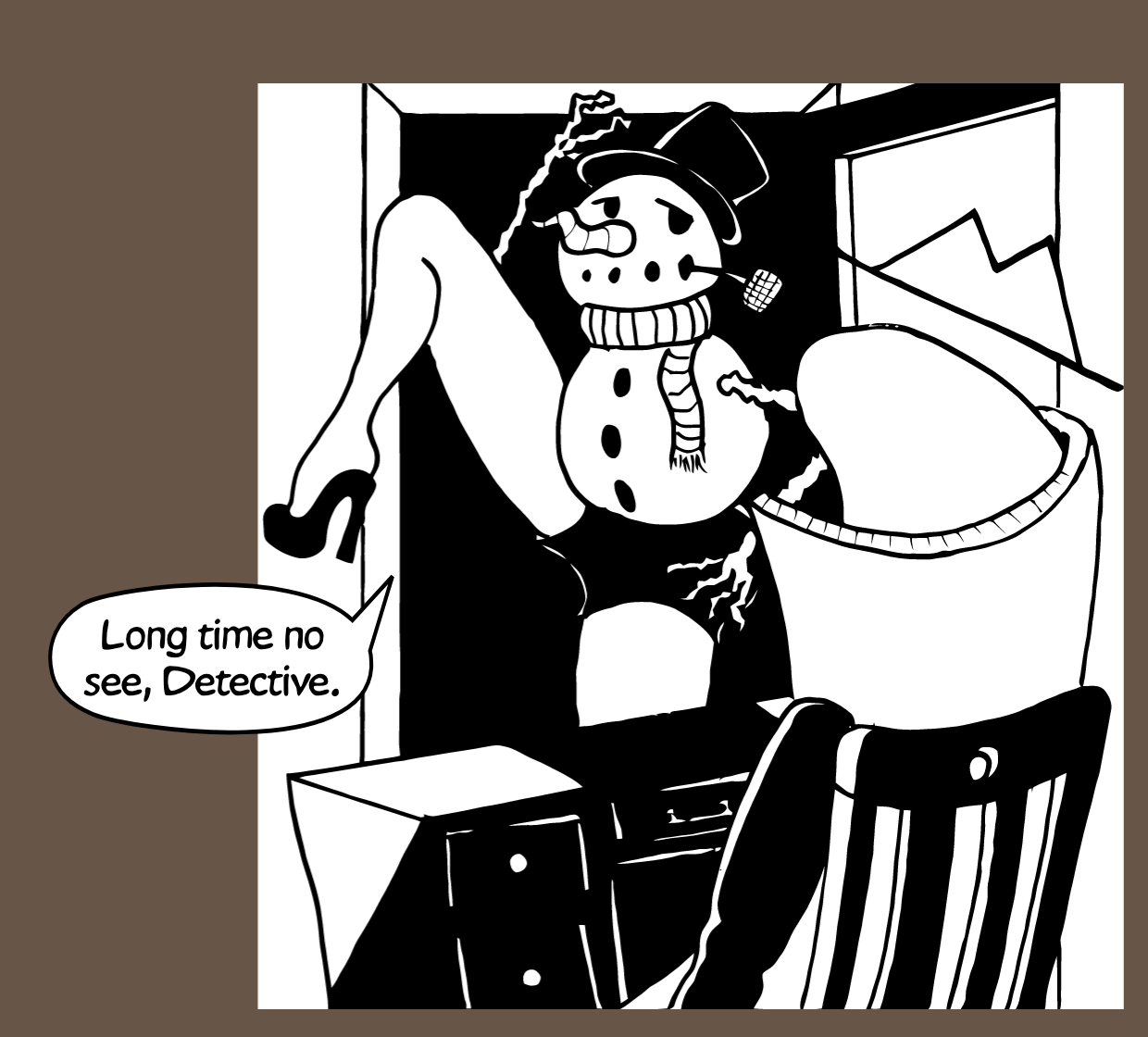
Taylor Hunt's attempt at the same assignment is as big and loud as Martin's was quiet and sensitive. The Big JS is a ridiculous noir detective story where the detective is a rotting banana, the femme fatale is a snow-woman (the initial reveal is hilarious), and the victim is a robot. Printed on a series of unfolding & connected cards, the reader keeps flipping down to reveal more story. It's a clever formal trick that adds to the general sense of ridiculousness surrounding the story. Hunt plays up the black-and-white contrast beautifully to create atmosphere, and there are a lot of bold drawings that push out of the panel that add some drama and excitement. Hunt is definitely funny, and I hope he continues to explore humor in his work. The envelope provided with the comic, acting as a case file holder, was another nice formal, decorative touch. 


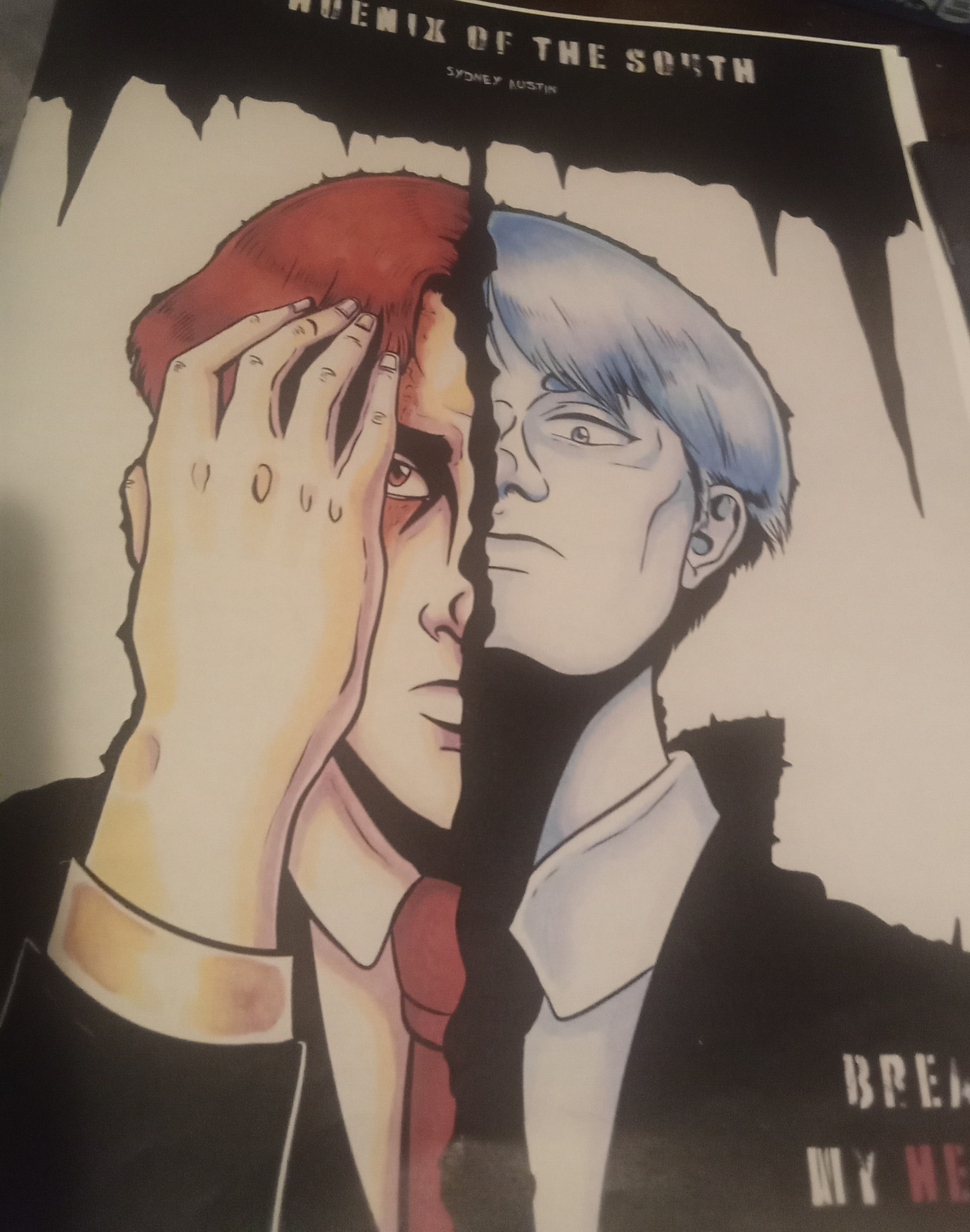
Finally, Sydney Austin tackles the Aesop assignment with a bigger-sized mini featuring characters from her own Phoenix Of The South graphic novels, titled Break Your Heart. Based on "The Man And The Woods," the story is about a man named Jeremy secretly in love with another man named Will. That love leaves him vulnerable to Will's ill intentions that deliberately play on the attraction he knows that Jeremy feels. Austin smartly plays up the seemingly innocent but very intimate physical contact they share to lead the reader in one direction but also make Will seem unbelievably creepy. The problem with this comic is that it rests too much of its information on previously-written characters; as a result, we have no clue why Will acts as he does, or what Jeremy wants until nearly the end of the comic. The reference to Aesop is shoehorned in and isn't exactly a one-to-one correspondence. In the fable, the trees in the wood give a man with an axe handle a branch each, and then he makes an axe handle with the branches and chops them down. Some of the individual character poses are also a bit stiff and feel overly posed. That said, Austin has a clearly-defined style and themes she's working with, and this is simply a matter of drawing more. 

Saturday, December 30, 2023

45 Days Of CCS, #30: E.B. Sciales and Michael Albrecht

E.B. Sciales draws in a pleasing style, both for gags and a comics cookbook in these entries. Working with Sophie Castner, she drew a number of entries in their The Illustrated Kastner-Mednick Family Cookbook. This is certainly one of the more eclectic approaches to a cookbook I've seen, but Sciales was up to the task of bringing the ingredients and how to use them to vivid life. Kastner added watercolors to further deliver that homespun feel for dishes like latkes, gumbo, and lamb chops. More pertinent to this review is Speed Trap Ahead, where Sciales displays her comedic chops. Done in the style of a Dell or Harvey comic from the 1950s, Sciales sets the stage by informing the reader about her grandfather, Dr. William Sciales, an eccentric practical joker and tale-spinner. 


Sciales' attention to detail adds so much to the story. The slightly faded four-color scheme, the exaggerated use of expressions, over-the-top lettering, and airtight plot are worthy of John Stanley or Warren Kremer. Effects like zip-a-tone shading add to the period feel of this comic, and I could have read another dozen stories about Doc Sciales with great pleasure. The only note I'd add is that some of the more conventional lettering is uneven, especially in terms of the size of the font. At this point, I don't know enough about Sciales as a cartoonist to figure out what their major projects might be, but their wide interesting bode well for some interesting future choices. 


Michael Albrecht is a first-year CCS student (class of 2025) who shows a great deal of promise as a horror and science-fiction cartoonist. Above all else, he's just a sharp writer who has an ear for dialogue who brings grit and authenticity to genre comics. He reminds me a bit of Ivy Allie in terms of the tone of their stories and art as well as the cerebral quality of their storytelling. It's a shame that Albrecht came to CCS after Steve Bissette retired, because Bissette would have appreciated Albrecht's work in You Are Alone, a throwback horror comic. It's in the "I'm camping in the woods, lost my friend, and I am totally fucked" genre of stories ala Blair Witch Project, but it's in the execution of these tropes where Albrecht truly shines. The use of a sickly spot yellow, the attention to detail regarding eyes, and the ominous angles help the truly horrifying ending to land with a great deal of impact. 

Lancelot From Memory is a hilarious recounting of Lancelot: Knight Of The Cart done for the Ed Emberley assignment. That's the one where the cartoonists must draw a story in the hyper-simplified style of Emberley, using just shapes like circles, squares, and triangles. It's such a great exercise for any cartoonist, because it strips away the concept of "drawing ability" and forces them to focus on the true principles of cartooning and storytelling. Even in a story like this Albrecht creates tension and mood with his use of blacks and leaves the reader with an ambiguous but ominous ending after playing much of the comic for laughs. 

These comics were fun exercises for Albrecht. The main event was Deus, an exceptionally well-written and told story about a post-apocalyptic setting wherein a former killer robot has been reprogrammed to act as a childcare aid and friend for a young girl named Beanie. The drawing is so sharp and expressive, especially the way that Albrecht draws the child. Albrecht adds an air of menace when the robot, whose name is Bobby, is revealed to have full awareness of their past, but no connection to it. Albrecht swerves the reader by making this less of a horror sci-fi story and more of an existential inquiry into being. 

Friday, December 29, 2023

45 Days Of CCS, #29: Comox and Ionosphere

Comox is an odd little video game-themed anthology with an interesting gimmick: it's a flip book were two artists do the "flip-side" of the other story. Filipa Estrela and Kevin Fitzpatrick are both in it, and both of their stories are very amusing. Each chapter is two pages and focuses on a type of game: horror, RPG, fighter, etc. Estrela gets "simulation," and she approaches an Animal Crossing type of game with the concept of, "what if the farmer was actually kind of a lunatic?" The frenzy of activity following the farmer (including underground rock-breaking) is perfect for Estrela's cute character design, and the fluidity of motion (even on pages crammed with panels) allows the reader to fly right through. Their partner, Emily Wigglesworth, tells the story from the point of view of everyone else in the village who is slightly alarmed by the farmer. 

Fitzpatrick's story is a fantasy RPG, something he's quite adept at in his usual comics. While maintaining some trappings of the game environment (like a health meter), Fitzpatrick wisely steers away from the clutter of a typical video game screen (something that hurt several other stories) and sticks to the layout of a typical adventure. The story follows a hero looking for their young companion in a cave, fighting a monster, and being saved by their friend at the last second. Fitzpatrick is so clever in composing his pages, seamlessly fitting together 14 panels on one page at odd angles in a way that felt both fluid and exciting. The flip story, by Mica Liesenfeld, is told from the point of view of the younger companion. The non-CCS highlight of the anthology was Shoona Browning's first-person shooter story where the bored protagonist, after saving humanity from the zombie horde, restarts the game--much to the chagrin of their companion. 

Speaking of anthologies, Masha Zhdanova edited a very good science-fiction anthology called Ionosphere. It's not a surprise that the best pieces were by her and standout CCS alum Ivy Lynn Allie, but there were a couple of other good pieces as well. Zhdanova's story "This World Still Locked Within A Dream" is a variant take on time loop stories such as Groundhog Day. The story follows a young woman named Perilla who one day realizes she is in a time loop, but her life is so boring and routine that she only realizes it when she notices that the event banner on a phone game hasn't changed. A glamorous character from the game named Gigi Galore tells her she was selected as a time loop beta tester, and for a fee, she would be sent back to her normal life. When Perilla refuses, that creates a long series of loops with some surprising emotional connections, a long meditation on depression and loneliness, and just how hard it is to break out of routines. Zhdanova effectively combines the sparkly video game character with an extremely mundane environment. The story is also available as a stand-alone minicomic. 

Allie's story, "Playthings," is a fascinating account of how adult concerns and the concerns of children are often at such odds that there is a vast disconnection of how reality is perceived. The story takes place on another world, as a girl named Rissy tramps around while her parents feverishly work on a project that will flood a local create in order to grow oxygen-creating algae. Unbeknownst to them, Rissy has discovered a race of tiny aliens that she refers to as fairies, and her parents don't realize that in trying to reassure her about what they think are imaginary friends, they have missed out entirely on the ramifications of what they're about to do. Allie adds greater complexity when she completely misinterprets the actions of the aliens, thinking they've destroyed her robot chicken friend, and she lashes out at them in violence and anger. Allie's pages are so smooth and orderly, built around lurking misery and the creeping feeling that something bad is always about to happen. 

The other notable entries in the anthology are from Akira B. and Zab R., who spin a beautiful-looking story about a space explorer letting in a highly unwelcome visitor to his ship by accident; and Torc, whose story about the ramifications of asking a freed creature for help is emotionally resonant and highly disturbing because of the emotional connection between the characters.  

Thursday, December 28, 2023

45 Days Of CCS, #28: Juniper Kim

Juniper Kim has shown that they are a serious talent in their time at CCS. Their work here reflects smaller works ideal for zine festivals as they gear up for writing their first true longform comic. Their latest batch of comics includes a dream comic, a collection of sketchbook/diary comics, an illustrated collaboration, and a collection of bizarre humor strips from The Gutter. Individually, none of them are especially exceptional, but taken as a whole, it's an interesting snapshot in time as we see Kim experimenting with different genres, techniques, and ideas. Guisers At The Door! is an illustrated zine they did with writer Grant Cook. The prose is more than a little florid, but Kim's attention to decorative detail is what makes the zine worth looking at. Teeth is a better example of what Kim is capable of. It's a dream comic that makes use of all sorts of interesting materials and techniques. It's printed on a thick, vellum-style paper that allows Kim to use a great deal of erasure and "ghost images" on the page, as the details of a classic teeth-falling-out dream go to some unusual places. It's a fascinating showcase for Kim's mastery of color and pure drawing as well as imaginative cartooning. 


My Room Keeps Talking To Me is a fascinating mixed bag from Kim's sketchbook. Here, Kim struggles with their upbringing, medication, what it means to be an artist, and their place in the world. It's a highlight reel once again for their drawing, their use of color, their willingness to confront difficult thoughts, and so much more. Kim can work in any style, from cartoony to colorful to gritty. There are some interesting narrative threads here that I'd love to see Kim pick up down the road. 


Finally, Kim also has a silly side, as their collection of Funken strips from The Gutter proves. Kim clearly doodles these out fairly quickly, because the line is immediate, warm, and slightly rough. These strips about these strange rabbit-like creatures are an exercise in bending lines and shapes in funny, strange, and frequently horny ways. They give Kim an excuse to draw any weird thing that they want, come up with non sequiturs, and make strips that are either bare-bones or else crammed with decorative detail. Its purpose is not unlike that of a diary strip, only these are much more entertaining and unpredictable. All told, these all feel like warm-up exercises for Kim, keeping their pen moving in between larger projects or their exquisite journal-binding hobby.


Wednesday, December 27, 2023

45 Days Of CCS, #27: King Ray and Michael Sweater


King Ray is a cartoonist interested in horror. At the moment this seems to be as much conceptual as anything, which I think is one reason why they chose to write about the horror writer Shirley Jackson in the comic the house was vile. Combining text, newspaper clippings, and their own haunting & sketchy art with grayscale shading, Ray combines their analysis of Jackson with an actual trip to the house that inspired the classic The Haunting Of Hill House. That this occurred after a snowstorm and with a set of footprints ahead of them indicating that they were the only ones making the pilgrimage only adds to the atmosphere. I can't get enough of Ray's ramshackle line, deadpan narrative voice, and incisive social commentary, as they freely speculate as to why Jackson didn't leave more of an impression on the community. 


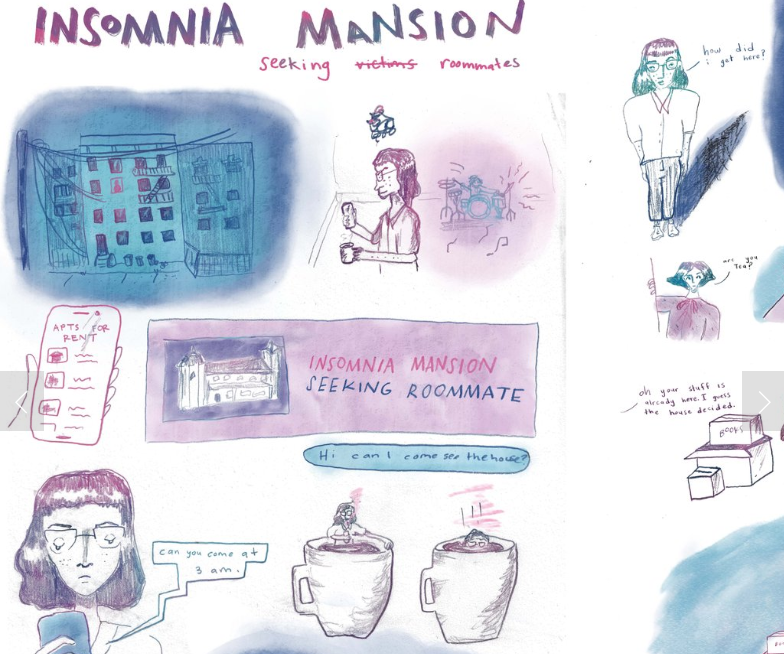
Insomnia Mansion is as much Ray's take on the concept of the haunted mansion as it is a narrative featuring characters dealing with living together in a haunted house. Ray is running this as a serial on the Gutter substack, and it looks terrible online but fantastic in print. The open page layout, sketchy drawings, and extensive use of negative space just don't translate properly online, but the flow of loosely-connected vignettes makes me wish that this mini was a full-length book. Ray's character design is sharp and fully-formed, while the bizarre goings-on in the group house have as much to do with the weirdos living in it as they do the desires of the house itself. Ray's use of what appears to be crayon adds to the slightly crazed, scrawled quality of the art, as though the narrative was a sort of found object. Ray's mix of humor, horror, slice-of-life narratives, and visual surprises make this the project early in their career that really has legs. 


Michael Sweater continues to encapsulate the intersection of cute drawings and crustpunk misadventures. His latest issues of Everything Sucks are both actually tightly-plotted and benefit greatly from the structure that allows him to go deep into some hilarious character narratives. In the third issue, subtitled "Real Gamer Hours," the anti-hero protagonist Noah gets sucked into playing an ancient online video game called Runequest. It's a game with primitive graphics and dull gameplay that is somehow all-consumingly addictive. When his friend Calla checks on him because he's been playing for three straight days, she gets sucked into playing the game as well. Sweater does something clever here, where instead of seeing the primitive gameplay, he draws the action in his typical style, which makes it even funnier when Calla's Runequest character has killed dozens of rats that stack up. Their friend Brad checks in on them and also gets sucked in, leading to a funny conclusion about how one should never make assumptions about who one encounters online. As always, Sweater has nailed that cute/punk aesthetic in his character design, with his drawings of trash and detritus adding a lot to the comic's aesthetic. 


The most recent issue, subtitled "Friends Forever," is what they would call a "bottle episode" in a sitcom. That is, one where the cast is trapped in a single room for most of the duration of the episode, and much of the show revolves around their interpersonal dynamics. Many of Sweater's stories tend to be in such settings (the previous issue is no exception), but "Friends Forever" provides structure when Noah, Calla, and Brad are all trapped in a filthy bar bathroom just when a woman wants to take Noah home. Sweater doesn't skimp on the literal toilet humor, but he does so in a way that pushes things to their limit, like Calla busting into the bathroom when Noah was washing his hands, immediately sitting on the toilet, and when asked why, replies "I don't know why I do the stuff I do...My inner world is a mystery to me." Things escalate from there as the trio nearly drowns when the sink is broken. A back-up feature has Sweater pushing scatological humor even more with a different set of characters; it's brightened by Sweater's typically ultra-cute character design and over-the-top characterization. Little about Sweater's work is ever subtle, but he leans into this and batters the reader with his punk-cute aesthetic, ear for dialogue, and eye for detail.