Showing posts with label king ray. Show all posts

Tuesday, December 24, 2024

45 Days Of CCS, #23: Riffraff

The Gutter is a substack anthology that mostly publishes very short stories or serials. Of late, they've gotten more serious about things, going to a paid subscription model for comics in 2025 and releasing their first print anthology, Riffraff, in 2024. The anthology also had a digital component, but I'm going to focus on the print edition here. 


It's edited by two CCS alums, Cathy Mayer and King Ray, and there are several CCSers who contributed stories. Emil Wilson opens with "Recycling Husbands," which is fitting since this issue's theme is "Trash." Wilson leans into the concept from the beginning, as a wife puts her "husband on the curb with the recycling. I decided I didn't need a husband anymore." It follows the logic of this statement in an even-handed and slightly dispassionate way, as she finds the husbands are "crushed into compressed blocks." Eventually, some of her friends get recycled husbands. Wilson's art is partly scribbly and partly looks to be inspired by advertising art designed to invoke a 1950s America feel, but the power reversal here is amusing and understated. 


Sofia Lesage's "Digital Wasteland" cleverly uses the short format with a repetitive gag that lands because it's only six pages. The protagonist is beset by a buxom bot begging for her attention while she scours the internet for something else, only the digital wasteland is a real one. This is a rare example where a digital font (for the bot) is an effective storytelling tool. The ending doubles down on all of this, as the protagonist's desperation leads her to make a critical mistake. 


Ana Two once again proves their capacity for innovation with "Throw Your Past Away." Once again, it's a smart use of a limited number of pages, as Two uses the Riso format to create a ghostly, foggy background. The protagonist talks about leaving messages behind on napkins revealing the sensation of wanting to be thrown away, to be drained, to be hollowed out of their depression and turned into something new. It's a striking combination of spectral images and beautifully concrete text. 


Violet Kitchen's "Birdhouse" reveals yet another strong story for the young artist, who has been on an incredible roll. Kitchen's line is scribbly and expressive; it reminds me of a certain kind of cartoony naturalism from artists like Michel Rabagliatti. However, their understanding of composition is incredibly advanced. Here, the open-page layout of hipster friends attending a garage sale transforms into one of them feeling the sincerity of an old woman's joy in the simplicity of her understanding of beauty. Kitchen's ability to subtly evoke emotion through visual cues is extraordinary.


In the other stories, Faye Harnest's "Books" makes interesting use of shapes in discussing how she felt when the books she was forced to dispose of weren't taken by anyone. Stephanie Guralnick's story about dumping out one's heart is less a story than a tone poem. Betsy Hudson's story of an unhoused man building his own tarp castle in the alley next to some friends' apartment was touching, especially with the tender, scribbly line. Abi Inman's story of a robot and a bird feels a little familiar, but it's well-executed. Quinn Stephens' ridiculous "Rick Garbage" short is just the injection of ridiculousness that this otherwise fairly sincere and serious anthology needed. Overall, this is a very well-edited anthology that makes good use of its theme while providing enough variance to prevent things from getting tedious. 

Thursday, December 12, 2024

45 Days Of CCS, #12: Wayne Carter and King Ray

Wayne Carter is a humorist. The comics I've seen from him have been absurd and well-designed, with sly surprises. His comic The Saddest Angriest Black Boy Anywhere initially seems like a joking tribute to Robyn Smith's classic The Saddest Angriest Black Girl In Town, down to the use of a vellum cover with an image that overlays an image underneath it. However, it is most certainly its own thing apart from what Smith did, even as it describes a similar experience: being a Black person in the extremely white White River Junction, VT. Smith talked about how othering this experience was, and did it in her own poetic, sensitive style. Carter addressed similar issues in his own style, which is satirical and blunt. He uses a fluid open-page layout and begins with a slavery "joke" that someone made at a bonfire he held. 


Carter then lists a bunch of microaggressions, just plain aggressions (like a cashier who refused to acknowledge him), and the essential point of just how exhausting it is to live in an environment like this. This comic is a seething, unapologetic expression of how angry he is at this exhaustion, but it is also a love letter to Smith, who was his professor at CCS. As he said, "She made it feel less lonely." That said, the comic focuses less on outright, in-your-face racism from that cashier and more on his white peers who see him as someone to foist all of their insecurities about race upon. Part of that anger is that their feelings are not his problem. The comic is also a statement on his own identity, mixing sequential anecdotes with full-page text stops for emphasis. He ends by noting "Here is a place where my anger is good. My anger leads me through the bad." He makes no claims for anyone else, which is one of the most important points of the comic: Carter doesn't presume to speak for others, so why do others presume to speak for him and project their fears on him? Carter makes a statement here, and he does it in style.


King Ray's comic Birds vs Planes is typical of Ray's quirky storytelling and the way they integrate word and image on the page. It manages to include the crazy tale of pilot "Sully" Sullenberg, who famously managed to land a plane after geese flew into his engines, as a sort of patron saint figure who brings peace to the warring factions of birds and (sentient) planes. As it turns out, the conflict between birds and planes was heightened when a bird named Claudia and a plane named Steve fell in love and later broke up. This triggered all-out war before Sully stepped in to promote peace and announce that Claudia was pregnant with Steve's child. Ray cleverly transfers soap-opera tropes to a ridiculous scenario that nonetheless has its own internal logic.

Wednesday, December 27, 2023

45 Days Of CCS, #27: King Ray and Michael Sweater


King Ray is a cartoonist interested in horror. At the moment this seems to be as much conceptual as anything, which I think is one reason why they chose to write about the horror writer Shirley Jackson in the comic the house was vile. Combining text, newspaper clippings, and their own haunting & sketchy art with grayscale shading, Ray combines their analysis of Jackson with an actual trip to the house that inspired the classic The Haunting Of Hill House. That this occurred after a snowstorm and with a set of footprints ahead of them indicating that they were the only ones making the pilgrimage only adds to the atmosphere. I can't get enough of Ray's ramshackle line, deadpan narrative voice, and incisive social commentary, as they freely speculate as to why Jackson didn't leave more of an impression on the community. 


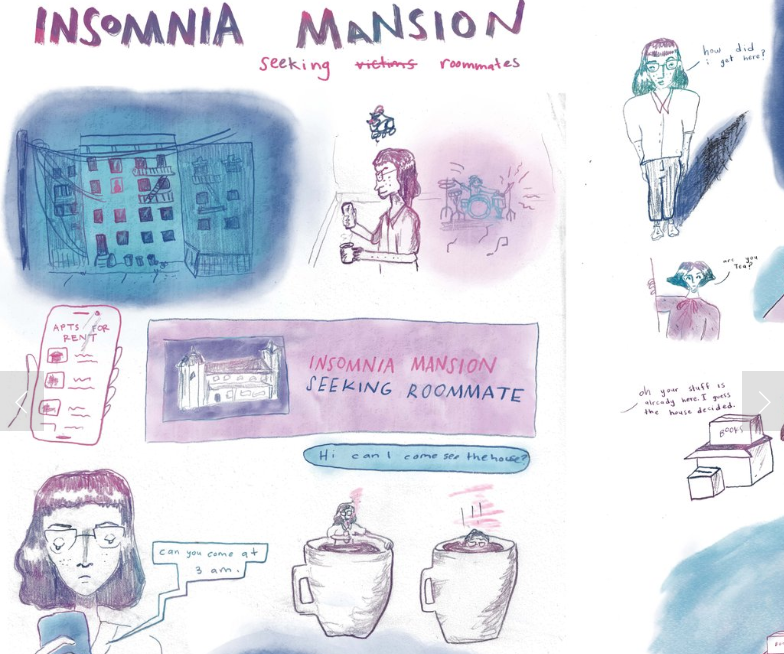
Insomnia Mansion is as much Ray's take on the concept of the haunted mansion as it is a narrative featuring characters dealing with living together in a haunted house. Ray is running this as a serial on the Gutter substack, and it looks terrible online but fantastic in print. The open page layout, sketchy drawings, and extensive use of negative space just don't translate properly online, but the flow of loosely-connected vignettes makes me wish that this mini was a full-length book. Ray's character design is sharp and fully-formed, while the bizarre goings-on in the group house have as much to do with the weirdos living in it as they do the desires of the house itself. Ray's use of what appears to be crayon adds to the slightly crazed, scrawled quality of the art, as though the narrative was a sort of found object. Ray's mix of humor, horror, slice-of-life narratives, and visual surprises make this the project early in their career that really has legs. 


Michael Sweater continues to encapsulate the intersection of cute drawings and crustpunk misadventures. His latest issues of Everything Sucks are both actually tightly-plotted and benefit greatly from the structure that allows him to go deep into some hilarious character narratives. In the third issue, subtitled "Real Gamer Hours," the anti-hero protagonist Noah gets sucked into playing an ancient online video game called Runequest. It's a game with primitive graphics and dull gameplay that is somehow all-consumingly addictive. When his friend Calla checks on him because he's been playing for three straight days, she gets sucked into playing the game as well. Sweater does something clever here, where instead of seeing the primitive gameplay, he draws the action in his typical style, which makes it even funnier when Calla's Runequest character has killed dozens of rats that stack up. Their friend Brad checks in on them and also gets sucked in, leading to a funny conclusion about how one should never make assumptions about who one encounters online. As always, Sweater has nailed that cute/punk aesthetic in his character design, with his drawings of trash and detritus adding a lot to the comic's aesthetic. 


The most recent issue, subtitled "Friends Forever," is what they would call a "bottle episode" in a sitcom. That is, one where the cast is trapped in a single room for most of the duration of the episode, and much of the show revolves around their interpersonal dynamics. Many of Sweater's stories tend to be in such settings (the previous issue is no exception), but "Friends Forever" provides structure when Noah, Calla, and Brad are all trapped in a filthy bar bathroom just when a woman wants to take Noah home. Sweater doesn't skimp on the literal toilet humor, but he does so in a way that pushes things to their limit, like Calla busting into the bathroom when Noah was washing his hands, immediately sitting on the toilet, and when asked why, replies "I don't know why I do the stuff I do...My inner world is a mystery to me." Things escalate from there as the trio nearly drowns when the sink is broken. A back-up feature has Sweater pushing scatological humor even more with a different set of characters; it's brightened by Sweater's typically ultra-cute character design and over-the-top characterization. Little about Sweater's work is ever subtle, but he leans into this and batters the reader with his punk-cute aesthetic, ear for dialogue, and eye for detail. 

Tuesday, December 6, 2022

31 Days Of CCS, #6: King Ray

King Ray's Phone Stoned got an Ignatz nomination, and it was well-deserved. It's a clever, innovative, and disturbing comic about a life lived through one's phone. A search for something called a "Mirthstone" leads the unseen narrator on a quest through the city. Along the way, she is frequently mistaken for a look-alike who is famous, and photos come into her phone that seem to be of her out on the town. This starts to affect her in other ways, as she's charged for things that she can't afford, with the assumption that she's rich and famous. 


Things escalate more and more, as her own identity is seemingly erased in favor of the "Lik-Loc" star; she gets food delivered to her, people talk about investing with her, and she gets stopped in the street. She gets hit by a car and pulls herself out of an ambulance in order to track down the stone, with a cracked phone and cracked bones. 

This is a clever comic because the reality dictated by social media and other phone apps takes on a reality of it own, one that can even supersede actual reality. Consensus reality is changed by this addition of not just technology, but technology packaged with a narrative, much like a video game. The plot of this story is driven by the protagonist's desire for a Mirthstone, something she is drawn to because of an app called Glo-Star. Like a video game, she accepts this new mission and has to negotiate distractions, including a relentless series of distractions related to her identity. By the end of the comic, the reader is made to feel unsure of her identity one way or another, with the exception of the most important status bar on her phone: money. Even then, internet fame is frequently an assumption of wealth that can lead to real wealth, but it also be part of a grifter's profile. 


Ray's cartooning and layout are both extremely clever, especially when the story "pauses" as the phone updates. Their line is not quite up to the job in terms of some of the drawings, a few of which feel over-drawn and blurry in a way that does not seem intended. There's a slickness implied in the narrative which just isn't there in the drawing, but it doesn't detract much from the final result. The concept of the mini is so compelling and unusual that Ray could have gone more minimalistic if need be, though it's understandable why they wanted to create as much of the atmosphere of apprehending the world in such a technologically mediated manner as possible. 


Sunday, December 26, 2021

31 Days Of CCS, #26: King Ray

King Ray's comics are oblique and a little terrifying. In Parched, which looks like the Ed Emberley assignment, there's a minimalist figure in the desert--not an uncommon image for this assignment, really. It begins with the figure being desperately thirsty--for water, certainly, but for other things as well. When another person comes along and points them to an oasis, they both hop into a deep source of water, passing jellyfish and whales. The heartbreaking element was the first person emerging on the other side, with no sign of the person who had saved them. An appeal to darker forces was made, which resulted in creating a loop of eternal thirst. Here, Ray's pencils are delightfully spare and a tad smudged, giving the comic an especially desolate feeling. 


my beast, my friend is similarly propulsive in its narrative, only it's rendered in a more naturalistic style. This can only be described as a horror story, detailing the highest highs of deep friendship and love and the lowest lows of abuse, depression, and suicidal ideations. Midway through the comic, the narrator describes being chained to a dark, great beast after "being turned away from the gates of Dionysus after waiting for 200 years." This was a fascinating sequence, as this is a metaphor for indulgence and sobriety, yet the ensuing state was one of melodramatic, self-spawning darkness. The narrator chose the darkness, in fact, but the betrayal came when a chorus of voices told her to disappear--and one of them was the voice of her friend, "pouring poison into the ears of our friends." The finale of the book, with the narrator cuddling up with the beast, utterly alone, is as desolate as it gets. Ray's language is poetic and the images are rendered in that smudgy, minimalist pencil, warping into grotesque figures unexpectedly. Ray has a lot to say, and I'm curious to see them continue to push themselves on the page.