Dash Shaw made a huge splash with Bottomless Belly Button, an ambling 720-page epic depicting a weekend in the life of a family where the parents just announced a divorce. While this was the first book of Shaw's to gain widespread attention, the 25-year-old artist is really a comics lifer, having started to publish comics as a teenager. While still at the School of Visual Arts, he published Gardenhead through his friends at the Meat Haus collective. Love Eats Brains followed from Odd God Press, the short story collection Goddess Head from Teenaged Dinosaur and The Mother's Mouth from Alternative. Shaw's work also appeared in any number of anthologies and magazines, including Meat Haus, Blurred Vision, Garish Zow, The Drama, Other, Stuck In The Middle, Big Dumb Fun and more. He gave Gary Groth a copy of his work-to-date on Bottomless Belly Button, and Groth quickly agreed to publish it. Shaw's work can currently be seen in the pages of Fantagraphics' flagship anthology Mome as well as on his own website (www.dashshaw.com), where BodyWorld updates every Tuesday. The latter will eventually be published by Pantheon.Shaw's work is notable for his interest in the way opposites interact and blur: gender, the mind and body, beauty and ugliness, abstract and concrete. The progression of his career has seen him burn through and absorb a dizzying number of influences from comics of all kinds, the art world, film and philosophy. His own particular artistic vision is so distinct that those influences are always filtered through his own point of view, rather than the opposite. That vision focuses on spaces in-between, the "gray areas" as Shaw describes it. Shaw has been able to achieve so much in such a short span of time thanks to his dogged work ethic and willingness to evolve as an artist. Considering his astounding learning curve in the past five years, I am eager to see where he will be as an artist when he turns thirty.

Photo by James Yeh, Greenpoint Gazette
Background
CLOUGH: You've noted that your father is a big comics fan. What do your parents do for a living? Did you ever see art made by your parents?
SHAW: My Mom is a child psychologist and my Dad is a direct mail copywriter. My mom's office has a large sandbox and the wall is lined with toys. The children, her clients, play in the sandbox and she analyzes their play.It's called "play therapy." And my dad writes mail packages that you'd get in the mail asking you for money for a (usually non-profit) organization. He has a blog about effective writing for getting donations.My Dad has a sketchbook from his college years. I only saw it once,briefly. Also he took a watercolor class a few years ago.
CLOUGH: How much did your mom's background come into play in creating The Mother's Mouth?
SHAW: Obviously, she doesn't tell me anything about her clients. That would break her client's privacy. I just remember being at her office and looking at her books. It left a lasting impression on me.
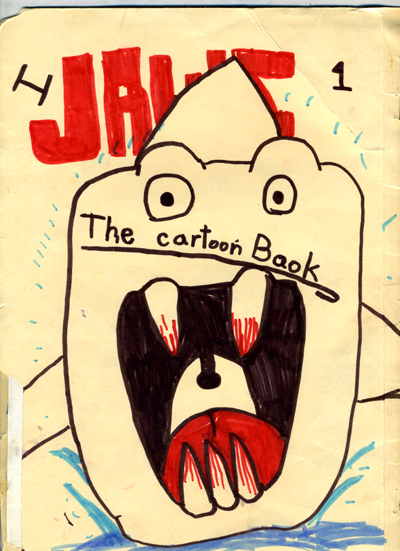
CLOUGH: Do you have any siblings? If so, did they draw with you? Did you have any drawing/artistic partners growing up?
SHAW: I have a younger brother, Nick. He's eight years younger than me, and we never drew together. The age difference was too far apart. The first drawing partner I can remember is Will Jones. We met in high school and we'd do comics together. We'd trade copies of "Sandman" and Humberto Ramos' "Crimson" and talk about comics a lot. He still draws and he did a short story in the back of the Odd God Press "Love Eats Brains" book. He's really fantastic. He's one of those people who has a complete visual catalog in his mind, like an encyclopedia. He can draw any animal or object on the spot and it works. If I have to draw a hedgehog or something I usually need reference, but if Will's around I'll just ask him.

CLOUGH: What was the first comic you remember reading? How did it affect you?
SHAW: I don't have a distinct first comic memory. My Dad had copies of "The Spirit" lying around. The large Kitchen Sink Press magazines. And he had a stack of underground comics in a box in a storage space that I'd sneak in and look at. I was also really into "The Teenage Mutant [Ninja] Turtles" and I did a comic called "Teenage Mutant Ninja Skeletons" that ran for a few issues.
CLOUGH: Your tastes, then and now, seem to be pretty broad. Did you read a lot of superhero comics? What about stuff like MAD? What did you think when you first read those underground comics?
SHAW: My Dad had those small-format Mad collections. The one with Alfred E. Neuman as Tarzan on the cover. I remember taking them to school and reading them under the desk. I read the Image-wave people at Marvel and then followed them to Image.I saw those underground comics too early. I don't remember the exact age, but definitely in Elementary School. I didn't get it. They grossed me out. But I kept looking at them. "Is this porn?", I thought. But it wasn't sexually exciting. It was just weird. I liked the fantasy-stylebooks a lot, like "Fever Dreams."

CLOUGH: Why were you in Japan for six months during high school? What impact did that experience have on your development as an artist?
SHAW: I was there for my Junior Year. I was in a small town south of Nagoya called Tatsumigaoka, helping students and my host-brother learn English. I didn't make any Japanese friends. It was an extremely traditional Japanese family that I stayed with. Of course, I gorged myself on manga and anime, but I was already totally obsessed with that stuff. But Japanese culture/art is very different than Japan itself, at least the limited experience I had. It's a very different culture that's very group-focused, and, obviously, I being American meant that I could never be a part of that group. It's different in the larger cities. I was probably the only foreigner in Tatsumigaoka. I'd get on the train, and everyone would stare at me.

CLOUGH: What kind of comics did you do in high school? What sort of things did you draw for the local papers? How encouraging was it to see some early success at a young age?
SHAW: In early high school, my comics were extremely manga-influenced. I'd go to Otakon and the few early, start-up anime conventions all of the time. That's where I first met Becky Cloonan, I think. This was just as anime/manga was starting to blow up. I did a comic called Demon Carnival and would submit short stories to Heavy Metal (a form rejection letter) and Radio Comix (a nice, personally written rejection letter.) I got the gig for The Richmond Times Dispatch somewhere around the end of Sophomore Year, I think. I'm not sure [of] the exact time. It was for a teenage supplement called "In Sync" (this was before the band.) I got to go [to] the offices and meet Kerry Talbott, one of their staff illustrators who was into comics, work with a couple of editors and writers, learn photoshop, see the work published and get paid! It was a crash course in illustration and by the end of it I had a professional, big portfolio for S.V.A., but it also made me realize I wanted to do my own comics instead of illustrating other people's articles. I'm glad I had that experience early on, rather than getting it after college and wasting my post-graduation years in the illustration world. Near the end of high school, around the same time I was doing the "InSync" illustrations, I'd started doing mini-comics. They were each drawn a different way, something I'd also try to do for the "In Sync" articles. I'd do one mini from a girl character's perspective drawn one way and another one of the same story from the boy character's perspective drawn a different way. I also did a short horror comic and a bunch of random minis. My Senior Year was spent working on a 32 page comic called "Shippori" that was more of an experimental thing. It had a lot of different drawings and weird diagrams and was pretty text-heavy. I submitted it for a Xeric Grant and it was rejected. Thank god.

CLOUGH: I've read Shippori plus those perspective minis. You're obviously ambivalent at best about your earlier work; what is it about it that makes you cringe? Is it perceived mistakes in writing or art, or was the entire conceptual approach something that turns you off now?
SHAW: Everyone doesn't like their early work. It's just a gut reaction, feeling sick. I can't look at them or think about them.
Aesthetics and Work Habits
CLOUGH: You've noted in interviews that one reason why you've been so prolific is that you've arranged your life around drawing (which is why you finished Bottomless Belly Button so quickly). Do you still draw at the same pace? Do you ever feel burned out on drawing?
SHAW: I always admired prolific artists. I'd pick up THB when I was eleven years old and read about his work ethic. Paul Pope wasn't shy about it. And I'd think "I want to be like that." And so I started doing it early on and I'd try to keep upping the ante. This month, August 2008, I did 49 " BodyWorld" pages, start-to-finish full color, plus illustrations for IFC Films, Health Central Network, and The Fader Magazine and a bunch of animation frames. When I'm not drawing I don't know what to do with myself. I just stare at the ceiling. I don't have any other hobbies and I'm enjoying everything that I'm doing immensely. The IFC and Fader illustrations were both "do whatever you want" assignments, and I write "BodyWorld" myself, so I control what I draw and I don't draw anything I don't want to draw. That's important. It's understandable why illustrators get burned out or unhappy, because they're not in control of what they're drawing. People, like me, who do everything don't have any excuse.

CLOUGH: What is it about being prolific that's so appealing to you? Having a body of work to show the world? Constantly being in motion and advancing as an artist?
SHAW: I was in a "Stuck In The Middle" anthology and there was a signing for it at the New York Comic-Con. Since it was published by Viking, they promoted it by just giving away a ton of copies to kids. When I sign/doodle books, I don't like to draw the same head over and over. Some people do that, and it feels cheap to me. I like to do something different in each one, even if it's crappy. So I had to do like a hundred or so little drawings. It blows you out. You have to just go deeper and deeper and follow every thought or direction you have. I like doing that. I want to see all the different directions I can go and where they take me.
CLOUGH: It seems like, through your own ambition, luck and trial & error,you've put yourself in a position where you've had complete control over your time and projects. Do you feel like your life was leading up to this moment through the choices you've made, or do you feel like you've had some luck to be in your position?
SHAW: It's a combination of luck and working my ass off. I just did a lot of work at exactly the right time. Ten years ago the climate was different. Now Fantagraphics is taking submissions and the mainstream/non-comic industry press is interested in doing comic-related articles.
CLOUGH: Despite that fervent work ethic, you've also dabbled in music and film. How does working in these other arts inform and influence your viewpoint as a cartoonist?
SHAW: The music thing was just something social I'd do with my friend, James. I was looking for a reason to get away from the drawing board, but I ended up not liking it. I'm definitely not going to do that again. I'm a terrible musician and performing live in front of people is a nightmare. Also the short film I acted in, "At The River", was something where my friend Todd Raviotta needed someone to act. Someone who had free time and would show up and do whatever he said. Again, that was something I did for a friend and I didn't have any creative input in the short and I'm definitely not an actor. I just have creative friends who I like to help with their random projects.
CLOUGH: Does the physical act of drawing still give you pleasure or satisfaction, or does that only come when you see a finished project?
SHAW: Drawing has always been enjoyable for me. The only thing that's become less enjoyable is computer work. I have to do a lot of computer work on "BodyWorld"- compiling the different layers, huge scanning, etc. When I started, it was a blast. I felt like George Lucas. Everything was like a special effect. I'd think: "Oh, I'll draw the shower curtains for this scene on separate sheets and then I can change the opacity and it'll be like a semi-transparent curtain! It'll be fucking amazing!" But two hundred pages later I'm thinking "Why did I decide to do the curtain that way? Shit!" I hate spending all day sitting in front of the computer compiling things. It feels like work. But after I finish "BodyWorld" I'm going to take a year break from computer work.
CLOUGH: Does reading other people's comics still give you pleasure?
SHAW: It's been hard since "Bottomless" came out because I've been working on my own stuff so much. But I have a "to read" stack of comics piling up.
CLOUGH: Regarding side projects: if Bottomless Belly Button or BodyWorld get optioned for Hollywood (as the rumors have been saying), how much of a hand would you want on such a project? Would you want to write a screenplay, direct, etc?
SHAW: What I've been telling people is this: I don't want to do anything, myself, involving "Bottomless" unless it's animated. I don't understand how it could make a good movie. Everything that's unique about the book is because of the comic/cartooning properties. It's not a unique story. It'd just be like every other indie family movie. But if it's animated, it's possible that it could be good. "BodyWorld" I would be open to co-writing or writing because it has unique story elements. Things like "Dieball" and the telepathy would be entertaining on screen. I wouldn't want to direct either of them. If I was to direct a movie it'd be animated and I'd want to hand-draw each frame. It'd have to be a different story, something developed that would take advantage of the animation medium. I've been doing more animation recently. Animation makes sense to me. It's a series of drawings, like comics. I don't have any training in animation, and so it's an exciting discovery process. I've had random meetings about it, and I think that there are some offers on the table. I have an agent now who deals with that. I don't actively try to make a movie happen. I just have an agent who takes the calls and stuff like that. Go get a free lunch with someone in the city.
Influences & Education
CLOUGH: The influences you've listed on your comics is staggeringly varied, with film being as important as any cartoonist. How does the work of non-cartoonists influence you, especially filmmakers?
SHAW: Freshman Year at S.V.A. I made a filmmaker friend named Andrew Lucido and he introduced me to a lot of great filmmakers. Tarkovsky, Kiarostami, Bruce Conner, Michael Snow, Bella Tarr, etc., and I worked at the SVA film library for three of my four school years, so I got a strong education there too, and started going to the Anthology Film Archives and stuff like that. I'm interested in beautiful sequences, different people's ideas of what a beautiful sequence is. Andrei Tarkovsky: hate the dialogue. Best to just not read the subtitles, or turn them off, if you ask me. But I love the elemental things in his movies. Water! Smoke! Fire! Just these flowing, beautiful things of nature. "BodyWorld" and "Bottomless" and all of mycomics have these things. They're already abstract, right? Water is just wavy lines. Sand is just dots. It can be drawn a million different ways. Also the "flowing" style of the sequences, like water. Someone asked Tarkovsky why there's so much water in his movies and he said "because water is the most beautiful thing in the world." I like that answer. "The Mirror" is his best. And I like that he did Science Fiction genre stories. Abbas Kiarostami: tied with Chris Ware as greatest living artist. Kiaostami's camera is like a sketchbook. He captures sequences of reality that are so beautiful, and it appears so effortless. It's as if his camera "just happened" to be there, and it "just happened" to be this beautiful unfolding of a sequence. Like Henri Cartier Bresson, only instead of catching a moment of dynamic symmetry, Kiarostami catches moments of sequential beauty. Like Chris Ware, he's obsessed with the beauty of the world. A real humanist, too.
CLOUGH: You've mentioned Chris Ware as a particular inspiration. What aspects of his work have been the biggest influence for you? Do you have a particular comic of his that's your favorite?
SHAW: His latest, Acme #18, is his best. He's getting better and better. Like I said before, his work is about the beauty of the natural world. When I read his comics, I feel like I'm traveling to another place, especially in his post-Corrigan work. His post-Corrigan works have more characters and more humor. They're small, beautiful universes of characters.
CLOUGH: Who is the most significant current influence on you as a cartoonist? What were some of the biggest comics influences on you at other stages of your career?
SHAW: After doing the Cold Heat Special with Frank Santoro and talking to him, I've been interested more in painters or other single-image makers. Also I just moved up to New York City, right after doing that Cold Heat Special, and there are so many more opportunities to go to galleries here, obviously. I like the mystery of a single image. I wanted a recent MOME story of mine, "Train," to be like that- to try to do a multi-image story that has a single-image feeling. I did that in February, the first thing I did in New York. The electricity wasn't on yet in the apartment so I could only work on it during the day. Middle school and early high school was hard-core Masamune Shirow. Also Miyazaki. I found out about Moebius from an interview with Miyazaki about "Nausicaa" when it was called "Wind Warriors" or something. Late high school and early college was mostly the brushy, more artsy cartoonists. Like Bill Sienkiewicz, Paul Pope, and a couple of the MeatHaus guys (like Farel {Dalrymple] and Tomer [Hanuka], who I was just meeting). That's during the Love Eats Brains series and the Gardenhead comic. And then Sophomore Year I swung the other way to a more clear-line. People like (Meat Haus cartoonist) Tom Herpich, Chester Brown, Herge. Also Keith Mayerson's book "Horror Hospital Unplugged" and Gary Panter hit me hard. Mayerson and Panter are all over the "Love Eats Brains!" Odd GodPress book and some of the short stories reprinted in "Goddess Head." And then it started to get more jumbled together. I run through influences pretty fast. Soak them up.
CLOUGH: Could you expand on that Mome story a bit? It seemed like in that story you had discrete sequences and several oppositional concepts, but it all boiled down to a series of powerful moments, with the destruction of the train being deliberately misleading in its nature but no less powerful an initial image.
SHAW: In the "facing pages" style of comics I did ("GoddessHead" and "The Mother's Mouth"), it was about putting two different drawings next to each other and that would create a new, exciting third space. In "Train" I did the same thing, only with whole scenes instead of two drawings. The opening and the closing create a third space, a mysterious zone. And the running sequence bridges the two together. There are, to me, two things going on in "Train": The first thing is this feeling that's captured by the sequences. I can't tell you why I like it, but I do. It's a pleasing, emotional sequence of events. And the second thing about that story is the main character, the woman. I tried to draw her in a conventionally attractive way. And she's a therapist, so (I imagine) she's smart and caring. I think that everyone wants something from her. The man tries to get her to stay at the house. She's jogging and everyone's looking at her. When the train crashes, I imagine that she thinks all of these people are going to claw at her, and try to get her to help them. But in the last panel they move on.
CLOUGH: You've listed Jules Feiffer as an influence. In what ways is this so?
SHAW: I'm influenced by his drawings and his relationship-focused stories. I'm not interested in his political work. He does stories about relationships that don't take a "side" of a character. They're more about the humor or absurdity of the situation. They're sort of like comic versions of Laing's "Knots." That's influenced my stories a lot. Also, many of them have an extremely mean-spirited, dark sense of humor (like "Carnal Knowledge" and "Sick, Sick,Sick.")His drawings are beautiful. Expression and movement. In Gary Panter's class at SVA Gary pointed to a frame of "The Mother's Mouth", where older Dick is kneeling next to Virginia in the woods, and Gary said "that looks like a Jules Feiffer drawing." I also like the pace and story of "Tantrum." Very quick-reading and conceptually tight. That book's underrated.

CLOUGH: What was SVA like as a learning environment? Do you feel like it made you a better cartoonist? Did you feel a sense of community there?
SHAW: Mostly I was there for the figure drawing. I was a hard-core JamesMcMullan student. He's a famous illustrator who sort of developed a cult at the school. A couple of the Meat Haus guys told me to take his class, so I read his book "High Focus Drawing" before Sophomore Year and took both of the classes he taught from Sophomore to Senior Year. And then I took other figure-drawing classes, one by a former student of McMullan's, every year and went to all of the "open" figure drawing sessions at the George Washington dorms, where I lived. When I got out of school I worked as a figure drawing model at VCU (in Richmond) for a year and a half while working on "Bottomless." All because of McMullan and his teachings. He's had a similar effect on other students.
CLOUGH: Can you briefly describe exactly what his teachings were, and why they drew such a following?
SHAW: You should just read "High Focus Drawing" by James McMullan. It's sort of a spiritual approach to figure drawing. It's about capturing the life of a person, rather than just copying what you see. It turns figure drawing into a full-sensory, heightened experience. As for a community, it's hard for me to say. made a couple of close friends there, like Andrew. But I never became very close to the other cartooning students in my class. I'm not sure why. I was distracted and alternating between illustration and cartooning classes all of the time.
CLOUGH: Why did you wind up transferring from cartooning to illustration?
SHAW: That's a good question. It seemed like a good decision at the time.I wanted to take more painting and drawing classes, and I had a strong illustration portfolio from "In Sync," so I thought it would be good for me. It was a mistake. I should have just been in cartooning the whole time. I also took some fine art history classes and a bunch of psychology classes, thinking I could go back and get an MFA in Art Therapy. You need a certain amount of psychology credits to apply for that.
CLOUGH: Was this inspired by the career of your mother? Have you done any kind of work with kids like this?
SHAW: I've always been interested in therapy, probably because of my Mom. The only kids-related work I did was I taught a summer course to Middle-School aged kids. I taught cartooning, drawing and animation. It was at an all-girls Middle School. Boys were allowed to take summer classes there, but it was mostly girls. Middle School girls are a nightmare. I'm glad I was never a Middle School-aged girl. They're so mean to each-other and some of them look like they're ten and others look like they're twenty ,but they're emotionally in the same place. It was a weird environment to be a part of briefly. And some of the people who work at all-girl schools are weird too.
CLOUGH: What was Gary Panter like as a mentor? What other professors were especially inspiring?
SHAW: Gary's a very casual, open speaker. He tells stories about his career and love life, brings in weird manga and art books to show students. I don't recall him being very critical. I learned more from him by looking at his work and reading interviews with him. I took David Mazzucchelli Sophomore Year, auditing his Junior Year class. Sophomore Year I was an asshole. I was frustrated with my output and general situation and consequently was acting inappropriately all of the time. I apologized to Mazzucchelli later but he said I wasn't a prick. But I remember asking him once why he didn't point out crappy lettering on one of my comics and he said "because you wouldn't have listened." So Mazzucchelli was just being nice when he said I wasn't a prick, or didn't remember.
CLOUGH: In what ways were you acting inappropriately? Were you unresponsive or hostile during class?
SHAW: I wasn't really mean or anything. I was just thick-headed. It was around that time that I was arrested in New Jersey for "criminal mischief." I was driving around smashing things. But that was happening outside of class. I wasn't violent in his class.
CLOUGH: Some of your earlier works seemed to be heavily influenced by philosophy and linguistics. What influence did Kierkegaard and Wittgenstein in particular have on your aesthetic?
SHAW: I think I was just reading a lot, and putting whatever I was reading into my comics. It felt like a natural thing to do, because I was extremely interested in philosophy and linguistics, and taking a lot of different classes. The influence was pretty blunt. Unfortunately, those comics were printed, albeit on a small scale. Fortunately, the period worked itself over quickly enough.
CLOUGH: What influence does/did the Meat Haus group have on you, both aesthetically and as a group of like-minded artists to have as a community?
SHAW: I get put in with the Meat Haus group because I was in a few of the later books, plus Gardenhead, and I am friends with some of them, but they wer eall graduating as I was entering SVA. They then soon spread out, many leaving New York. I really only hung out with the majority of them my Freshman Year. They were like-minded artists, to each-other, and I was apart, learning from them and trying to make friends, because I'd just graduated High School in Virginia and moved to New York, where I didn't know anyone. I'd walk around the city with Brandon Graham. This was when he was doing the porno comics for NBM. That guy's a living comics education, and the most underrated cartoonist today. He really rubs off on people. He's had a similar effect on a few other cartoonists I know. I idolize him. Same with Tom Herpich, who I've seen more often since then and still hang out with now sometimes.

CLOUGH: How much do you enjoy collaborating with others in your various artistic pursuits? What do you think is your most successful/satisfying collaboration to date?
SHAW: I normally don't like collaborating. I do it rarely. I've just got a lot I want to do on my own. It worked out for the "Cold Heat Special" with Frank Santoro. I'm a huge fan of his work and he asked me to do #3, so I had to do it. He did the layouts for the first half and I matched his layouts in the second half and did all of the finishes. All of his layouts were drawn over some weird grid pattern thing. What is this? He started telling me aboutdynamic symmetry and recommended all of these books. I quickly got the books and read them and now I'm like a weird convert. I draw different design shapes in my sketchbook and e-mail my filmmaker friends links to dynamic-symmetry related articles or images. He's a real genius and inspiration. I hope we can do another comic together. That "Cold Heat Special #3" is hard to find. I don't think there were many copies made. I don't even have a copy of it. But it's my best mini, mostly because of Frank.
Themes
CLOUGH: What would you say are the themes that you are currently most interested in exploring?
SHAW: "Bottomless" and "BodyWorld" are both very character-driven. About relationships between characters. As I'm nearing completion on "BodyWorld" and doing some other things, I'm starting to move into less character-driven territory again.
CLOUGH: The formal qualities of language seem important to you--both in the physical qualities of the letters and sounds themselves, as well as the way it fails as a means of understanding. What inspired you to pursue formal and linguistic experiments with comics? How satisfied are you with these experiments? Do you feel the language of comics is any more successful as a means of understanding than standard language?
SHAW: I'm not a good writer of words. I would never write an all-text book. I don't have a large vocabulary. I find talking to people and the brief writing I do, like in e-mails or this interview, frustrating. Comics are about graphic sequences, presenting information in a graphic way. If words are used, it's about how the words relate to the drawings or the sequence. If characters are talking in "Bottomless," the scenes are never about just what they're saying. It's often the opposite of what they're saying.I understand why "experimental" is a word used a lot with my comics. I'm shooting for a grey area, a mysterious zone. I'm not interested in direct communication, saying something to someone. I like emotional areas, which are harder to talk about. I couldn't tell you why I think something is beautiful or works in a comic. It wouldn't lend itself to words, at least spoken by me. Other people, authors, could probably do it. So I'm not saying that the language of comics is more successful, just that it's more successful and natural for me personally.
CLOUGH: Your comics are almost always concerned with physical, visceral experiences: Breathing, sweating, scars, deformities, etc. Is this concern for material/phenomenological experience a direct balancing response to the more abstract concerns of your art?
SHAW: I wouldn't say that. I often have physical responses to abstract things. Maybe I'm more sensitive to formal properties of things than other people. I don't think of abstractions as more brainy or non-physical. Partly because of my many years of figure drawing, I think that the body is beautiful and important. When I'm reading a book or looking at a painting or watching a movie, I want to feel something in my body. Obviously, the body is beautiful (everyone can tell you that), but it also has an ugliness. Shits and farts. It's a package deal. That dichotomy is important to me. I think ugliness is necessary for a comic to be beautiful. Maybe the character designs are ugly, or the drawings have ugliness, or the story has people doing ugly things. There should be a war between ugliness and beauty on the page.
CLOUGH: Many standard comics narratives have an immersive quality to them, allowing the reader to be swept along with the story. Your comics seem to be deliberately anti-immersive, reminding the reader that they're reading a comic, jarring the reader with different perspectives/points of view,and employing unusual symbology. Is this a deliberate strategy on your part?
SHAW: I understand what you're saying. The way most narrative things work is that there's a main character, usually a man, who the reader is supposed to like or relate to. Then the main character goes through experiences that the reader, in turn, experiences. Like a vessel. None of my comics follow this. It's more like you're standing away, looking down on a diagram of relationships or things interacting with each-other. So the only thing you're reacting to is the comic itself, not what a character is reacting to. But I hope that they are immersive. Just in a different way.
CLOUGH: Is there a reason why you've chosen this tactic (deliberately not wanting the reader to experience things as the character), or has it just naturally flowed out of how you see the comics page?
SHAW: Wholly sympathetic characters aren't interesting to me. They're boring. When I'm drawing, I want to be surrounded by different people, characters and spend time with them, like a friend. I have a friend who's had an off-and-on again relationship with a girl over years and years and all he does is complain about her to me. I wish I could just force him to breakup with her. What is he doing? It's frustrating. But I can't force him to. He's a different person than me. That's what my characters [are] like. I have to let them make their own mistakes. I'm sure other people let me make my own mistakes too. "Bottomless" has a lot of scenes where characters try to give advice to other characters, but their advice doesn't make any sense, or it doesn't apply to the situation. You try to move inside other people, but you can't. Unless you have telepathic abilities, which is why I did "BodyWorld."
CLOUGH: Identity seems to be another big theme of yours. From the very beginning, sexual and cultural identities in particular have seemed to really been particular interests. Why is gender identity such an interest of yours?
SHAW: It's difficult for me to say. I don't have any concrete thoughts on gender identity. I think those come from my experiences in life and they seep into the comics. I've had readers meet me and say that they thought I was a woman from reading my comics. I guess I don't think that there's a strict separation between man and woman or gay and straight. The line is fuzzy to me. I've had strong relationships with both men and women. People use society's thoughts on gender identity for personal reasons. It's on a person-by-person or character-by-character basis.
CLOUGH: What exactly do you mean by that last statement?
SHAW: What I mean is that people are different from each-other. I'm not comfortable making a blanket statement about any group of people. And these individual people will use other people's blanket statements/thoughts for their individual reasons.
CLOUGH: Why are you fascinated by the concept of celebrity and celebrities in your comics?
SHAW: Movies are impossible to ignore. It's the most popular art form, and the vast majority of them are so absurd or awful.
CLOUGH: One other big theme in your comics is the relationship of the individual to society. Do you think the individual and society are both mutually-sustaining illusions? How important do you think it is for a person to seek out relationships?
SHAW: I read something in a self help book that stuck with me: "Interdependency is a choice that only independent people can make." I think that's true. There are very few truly independent people, so most of the time people are just trying to use other people for selfish reasons. I picture people crawling all over each other, scrambling around.
CLOUGH: What is it about reading self-help books that appeals to you?
SHAW: There are a lot of different kinds of self-help books. In a way, it's like the comics community. All of the gurus go to each-other's talks and reference each-other in their books. It's a small world. I like the time-management books. I've probably read a dozen of them. I try to read them all, but if one looks like it's just rehashing another one I've read I put it down. s I said earlier, I like to work a lot on comics and my projects, so time management is important to me. Most people's time management skills are mind-boggling. I don't talk about it to them, because I'd come off as preachy and irritating. After you get into time management seriously, it's incredible what a difference it makes. Everyone else looks like they're lazing around, blowing through their day without doing anything at all. I also like the general self-improvement or effectiveness books and audiocassettes. I took Tony Robbin's "Personal Power" course first, Sophomore Year of college. It sounds silly, but they actually are motivational. These books get a bad rep, mostly because people think of them as money-grubbing. But, as Tony Robbins says early in the course, he uses money as an example because you can tell someone "I was depressed a month ago and now I'm happy" and they don't care, but if you say "I was broke a month ago and now I'm a millionaire" you have their attention. Obviously, I'm not a millionaire. I'm more interested in the motivational speaking, talking about personal happiness and goals. And many of these self help courses and books have helped me a lot. Laugh all you want.
CLOUGH: What in particular about their message spoke to you, in other words, how did they help you reach your personal happiness and goals (other than the time management courses)? Was it a set of useful tools that you took to heart, a way of changing one's attitude, etc? I'm genuinely curious, especially because it's obviously worked well for you.
SHAW: If you're curious you should just start reading them. It's a lot of different information. One example would be Tony Robbins talking about how emotions are physical. It's difficult to be sad if you're standing straight, smiling. It's easy to be sad if you're curled up, frowning. He said emotions are "70% physical." Things like that have influenced my behavior and how I think about the body, and I put this body-mind approach into "Bottomless" and "BodyWorld." But that's just one, small example. You should really start reading them if you're interested.
CLOUGH: Your work transcends and embraces a number of different genres, though it's impossible to pigeonhole your comics in any particular way. Is this a deliberate strategy on your part?
SHAW: Either everything is a genre or nothing is a genre. A lot of so-called serious literature and stories follow predictable patterns and storytelling tropes. I don't think about a separation between high art and pop art. High art sometimes is as predictable as pop art. It's just different rules for different things. It's best to just clear your mind and do whatever you feel like doing. "BodyWorld" has some Science Fiction elements. It felt necessary for what I wanted to do. But it's hardly a classic Science Fiction story. I wanted "Bottomless" to follow a family story, like family fiction or television shows, as genre rules.
CLOUGH: What did you perceive as the "rules" for family fiction, and how did you either follow them or subvert them in BBB?
SHAW: Family stories are about spending time with a group of characters and observing their relationships. It's an ideal structure for character-driven stories, because there's immediately an excuse, or reason, for all of these different people to be forced to deal witheach-other. And then there are family-story tropes: the middle child, the outsider, the oldest son, the distant/dumb father, the smart mother, etc. But BBB is as much about auto-bio as a genre. I wanted it to be as if all of these characters are starring in their own auto-bio comic and the auto-bio comics are overlapping to create a larger tapestry. In part one there's a scene where Peter masturbates and grabs a random cloth, what his mom is knitting, to clean his cum. I see that as shock-confessional auto-bio. That's my reaction to a scene like that. But then, something like 100 pages later, his Mom talks about seeing her sweater thrown outside and taking that as a clue that she shouldn't work on the sweater to distract her thoughts. She uses that to give advice to Peter about the girl he just met. Obviously, Peter can't tell her the real reason the sweater was outside. So I took an auto-bio trope and extended it into a larger universe of characters. The book is filled with things like that, about perception. Claire wakes up from a dream about a dripping coat to see the floor wet from Jill who just took a shower. She doesn't realize that's where the water is actually from and freaks out. Characters go to see a movie and instead undergo a series of events that, we later find out, are the same series of events that were in the movie they were going to see.
CLOUGH: What fascinates you most about "pop", be it pop music, pop comics, pop culture in general?
SHAW: There's something to be said for a well-executed pop piece. Something that's smooth and goes down easy. It's hard to do. "Titanic" did it. "Titanic" is one of the greatest movies ever made. The rare time a billion people were right. Like Gary Panter says, the hippies took over. A lot of "mainstream" media is actually "alternative." I had a meeting with Kevin McCormick, the producer at Warner Brothers who does "The Dark Knight," "Watchmen" and all these huge movies. His first gig was producing Jodorowsky's "El Topo." He thinks of the Warner Brothers movies as big-budget alternative cinema. George Lucas did "THX." He's still an independent filmmaker. Pop music is different too. Christina Aguilera and Beyonce do weird songs. My upcoming Duke gallery show is curated by Diego Cortez, who "discovered" Basquiat and Keith Haring. He said that it used to be that graffiti art wasn't fine art. It was some strange, new thing. Now it's totally accepted and you go into a modern-day gallery and it's all over the place.
Early Works

CLOUGH: Your earliest comics are talkier than much of your subsequent work, and more densely philosophical--did you abandon this style deliberately?
SHAW: I talked about this a little before. I'm interested in philosophy, but I think it should inform your decision-making, rather than sitting on the surface. I soaked that stuff in and it's over. I don't even read "smart" books anymore, really.

CLOUGH: Gardenhead was extremely ambitious, folding in a number of different themes: symbology, the conflict between mind and body, the conflict between emotion and rationality, the struggle of children vs society & authority, the possibility of connection, and artistic self-expression vs orthodoxy. What lessons did you learn from attempting such an ambitious comic? What would you have done differently? What inspired you to use so much collage and mixed media?
SHAW: I would have done everything differently. It was necessary for me to do Gardenhead. I had ideas about how I'd like to do comics, comics with ideas and sequences and different things going on. As for collage and mixed media, I still think of my comics as having these things. Even in "Bottomless", which has visual restraint, or rules, there's actually a lot of range inside of those rules. There are a lot of different kinds of drawings interacting. Comics are about juxtapositions, drawings and words next to other drawings and words. The comics I've always liked have used this, artists like Keith Mayerson and Gary Panter. Even when I was in Middle School, I liked how manga would alternate between different representations of a character, the "super deformed" style, or have a dense, realistic panel among cartoony panels. And then in High School I liked how Sam Kieth would interject paintings and different drawings, and David Mack and Bill Sienkiewicz. It's just something I've always been interested in.

CLOUGH: When you say Gardenhead was "necessary", do you mean that in retrospect that this was the kind of project you had to do to develop as an artist?
SHAW: Yes. Every book is a stepping stone to another book.
CLOUGH: Schematic drawings and diagrams have constantly popped up through your work? Do you employ them as a way of grounding your characters in a sense of physical time and place?
SHAW: All throughout middle school and early high school I was a Dungeon Master ,the person who would write quests for Dungeons and Dragons games. I spent the majority of my time working on these quests, which involved a lot of schematic drawings and diagrams of different places. Shortly after I got a girlfriend and quit D&D, a friend's older sister lent me a copy of a Chris Ware book and it made total sense to me. Something just "clicked."I don't recall Ware ever using maps as much as I do now. I use it mostly to create an environment, a world, where the characters, like P.C.s, wander around in. But his drawings had a schematic quality interested in clear, effective communication. Like Edward Tufte's books ("The Visual Display of Quantitative Information," "Visual Explanations") illustrate, truthful communication of data is beautiful.
CLOUGH: You often write about the struggles of children and teens, attempting to find their place in the world. Why has this struggle become a running theme for you?
SHAW: Children and teens are important to art. A good piece of art should have this perspective. When you're a child everything is new. I remember just staring at glue in a jar, or dust illuminated from a window. It's a constant struggle to keep your mind in that place. It's the goal of my comics, I think, to feel as though I am in the sandbox playing. Lots of creative people have felt similarly.
CLOUGH: You've had librarians as characters in several stories. What about this profession has made this a running device? Do they represent something particular to you or act as a sort of shorthand to a certain kind of point of view?
SHAW: That comes from me being a book lover. Most cartoonists I've met are. I love sitting in libraries, looking at covers or reading parts of books. I guess librarians are romantic figures to me. I've never met a mean one.
CLOUGH: Your earliest comics were very character-oriented, especially the Love Eats Brains series. You seemed to drift away from this in your early long-form works, but have returned to it in earnest with your last two books. What's your current take on how you balance plot, character and symbology?
SHAW: I don't think of them as separate elements that need to be balanced. It's just that recently I've been interested in more character-driven stories. But I think doing completely not character-driven work is fine too. I don't think that you have to do everything to "serve a story." That'ssomething people say a lot, like "well, he did this weird thing to serve the story." Or: "It's got this weird stuff, but -don't worry- it's all in support of strong characters!" But I don't think everything has to serve a story. I do comics because I like sequences. Sometimes those sequences are character-driven and sometimes they aren't. Balance (of plot, character, symbology) isn't important to me.
Love Eats Brains

CLOUGH: This was your first fully-realized long-form work. How frustrating was it to have to scrap your original ideas after the original art was stolen? Do you ever wish you could have revisited those characters and ideas?
SHAW: It's best that I was forced to abandon it. It's just as much my fault. The reason I lent someone the drawings was because I was having trouble with finishing it. He not returning it was probably a blessing in disguise.
CLOUGH: The LEB long-form comic is much more abstract than the short-form series and seems entirely consumed by the tension of opposites. Looking back, how successful do you think you were in getting these ideas across?
SHAW: I don't think I was trying to get across any ideas. I was interested in juxtapositions, like I am now. But those comics are terrible, man. I haven't looked at it in years.
CLOUGH: You've mentioned that you were unhappy with the ending; what about it was dissatisfying?
SHAW: I'm unhappy with the whole thing. But I had to do those comics. I like some of the drawings, some of the sequences and ideas. And it's clear how they developed over the course of different comics, but it's a record of a period of growth. "Goddess Head" is like that too. "Echo and Narcissus" I'm still happy with, and the shorter version of "The Mother's Mouth" for the Spanish Edition. But a lot of those things are false starts, ideas of different directions or sequences, etc.
Goddess Head

CLOUGH: Some of these stories were the densest of your career in terms of their symbology. Do you consider this to be the culmination of a certain period of your career? What led you to later make your narratives more straightforward and less abstract?
SHAW: That collection covers a few years, and only the square-sized stories during that time. I had other stories, some more narrative, that I didn't put in because everything had to be square format. The square format started with the Meat Haus 7 issue, that I did a 3-page story for. And then I'd do short stories for the SVA magazine "Visual Opinion" that happened to be square-sized as well. The short story "Goddess Head" was a real milestone for me, in my thinking. It was the first time I realized I could do comics for myself, like play therapy. That it could feel like free expression. Maybe the story isn't good, but it doesn't matter. It was a significant step forward. I remember working on it vividly. It was Sophomore Year at SVA and I was frustrated with things, the comics I was making. I had these ideas of how I wanted my comics to be, but nothing was working. I just decided to abandon everything I was doing (the Love Eats Brain pamphlet series and these more illustrative drawings) and just start over. I wanted to remove myself from the "professional illustration"-type field of working, the idea that comics were stories that were then "illustrated." I wanted to do comics where the comic was the comic, rather than an illustrated story, for everything to be presented in graphic sequences. It's hard to explain the difference.
CLOUGH: Who did you perceive as your audience before you felt like you had the freedom to make comics for yourself? Do you find creating comics now to be a form of work or a form of play?
SHAW: Comics have always been a form of play, but "Goddess Head" allowed it to be a form of play therapy. Before "Goddess Head", I was more interested in producing something that I wanted to read. But now I'm interested in producing something I want to produce. The process, the struggle, is what I want to be focused on. Even though the comics I did before the "Goddess Head" short story were all drawn by me solo, it was as if I had divided my mind into a writer-penciler-inker team. I would write a story and then pass the story over to my "penciler" self, rather than the story, sequences, everything, coming from a single "cartoonist" self. That's a huge step. Most comics I see, you can tell that the cartoonist was divided. Even i fthe "Goddess Head" short story sucks, it was eye-opening and life-changing. That sounds cheesy, but it's true.
CLOUGH: In "Always Seek The Truth", how did the game Clue inspire you to think about the relationships between the characters in the game, as well as the relationship between the characters and "you", the players/detective?
SHAW: I like board games a lot. I like board game art. There's a website called "Board Game Geek" that I go onto all of the time, just to look at pieces and drawings. I used to play and design board games fervently when I was little, and still do now. Comics are similar to board games in that they're a world of characters and they're very hand-done, humble-feeling, unpretentious. There's a dorky, hand-crafted element to them.
CLOUGH: "Heart-Shaped Holding Cell" is as much about a sense of place as it is about character. How important is creating a sense of place to you now asa storyteller?
SHAW: When I'm reading a book or watching a play or looking at a painting, I'm transported to a place. Comics are worlds when you read them and even more so when you're drawing them. When I'm at a drawing table, it's like a vacation into my imagination. That's why all of my longer comics begin with someone traveling; the plane in "Bottomless", the truck in "Mouth", the monorail in "BodyWorld." The place is the story itself.
CLOUGH: "Operation Smile" is about family dynamics as much as anything, with the father being portrayed as a sort of distant, imperious king. This is a motif repeated in Love Eats Brains and Bottomless Belly Button, to a certain degree. What is it about this image of fatherhood that compels you to depict it in your stories?
SHAW: "Operation: Smile" is the name of an expedition my Dad went on in South America. He wrote packages for the "Operation: Smile" foundation, who would go to poor areas and perform operations healing children with cleft lip. My Dad's job was to sit and cheer up the children who were waiting for their operations. When he came back, he showed me all of these before-and-after photos of the kids and the waiting room and everything there. Those photos had a strong impression on me for some reason. Most of the kids in the photos were around my age. It's an early memory cemented into my brain. Also, the process of making comics has a connection to my Dad because he used to work on them with me. Before I could read and write, he'd tell me the story and write in the words while I did the illustrations.
CLOUGH: Perhaps your best-realized story in the collection was "Echo and Narcissus". Did you see it as sort of a capper to your stories about the difficulty of true communication and the way that narcissism leads to solipsism?
SHAW: I'm proud of that story. That's actually a very faithful adaptation of the Ovid version. I just tried to "illustrate" the story in a comic form, using graphic sequences rather than narration. So I tried drawing whatever the story dictated in a lot of different ways. I'd choose whatever I felt made the best sequence. It's also the best story that used my facing-pages style, a period that started with the "Goddess Head" short story, into "The Mother's Mouth" and culminated in "Echo and Narcissus." Rather than have a sequence that would be "read" across, like a Chris Ware comic or rhythmical sequences of action, "Mouth" and "Echo" used flat deliberately non-rhythmical juxtaposing drawings, usually across page spreads. So the opening of "Echo" is a title page: Echo on the left-hand page and Narcissus on the right, with Echo being a dense, rough charcoal image of a cavern (vertical lines) and Narcissus being a light, smooth pencil image of water (horizontal lines.) And so on. I'd work oneverything in page spreads, something that I continued to do into "Bottomless" and chose to abandon in "BodyWorld."
The Mother's Mouth

CLOUGH: This was your senior thesis project. How did your preparation for it differ from past work?
SHAW: The preparation for that book was strange. I did it from the middle, working out, in chapters. All of the chapters were self-contained. Many of them I self-published as stand-alone mini-comics. Like the last section, with the children's drawings to the end, was a mini-comic that was in a large 8.5 X 11" folder. And then I connected the chapters with drawings or connector scenes throughout. It was very intuitive. I drew a lot of sections that I had to cut out, and then after Alternative published it in America, Apa Apa comics asked for a Spanish Edition and I cut even more out of it for that. So now it's whittled down to something like 80 pages. It feels like a long short story, a weird length. Most of the pages are empty and don't have words, so it takes just a few minutes to read the whole thing and nothing happens in the story.
CLOUGH: What sort of stuff did you cut out?
SHAW: Just a lot of different directions or sequences. More collage-like pages. More humorous scenes. I put some of the humorous scenes into the inside back cover strips.
CLOUGH: When did it become obvious that your original concept, matching a comic with a soundtrack, wouldn't work? Is this something you want to try again in the future?
SHAW: I don't remember the exact time. Somewhere in the middle of it. I'm not going to try it again in the future. I like it that comics don't have sounds. It's one of comics' greatest strengths.
CLOUGH: How so?
SHAW: Comics can have a pleasing stillness and quietness. It irritates me when comics try to attach themselves to a music scene, like "punk" or "noise" or "rock n' roll" comics. Those things are about sounds, and comics are about still, silent sequences of images.

CLOUGH: That was your longest-sustained narrative to date. How did you balance the needs of characterization, plot and symbology?
SHAW: That book was a turning point because it started off completely not character-driven. I drew the characters because I liked the way they looked next to each-other. The woman was round, all circles, and the man was angular, like a triangle. I thought it was moving, like Laurel and Hardy. As I worked on it more and more, I wanted to do character-centric scenes and have comedy and things like that. I put those scenes in the beginning, right before the story starts, and into short strips that I grouped together on the inside back cover. But after working on "The Mother's Mouth" I knew I wanted to do a character-driven story. The "Mouth" characters I liked, but I didn't do them justice. I didn't give them anything. I wanted to draw them more and spend time with them, but I blew it. That experience with "Mouth" and a short story I did for "The Drama" magazine, about a world where everyone draws their own overlapping autobio comics, led to me doing "Bottomless Belly Button."
Bottomless Belly Button

CLOUGH: You've discussed this book quite a bit in interviews. Do you feel like the themes of the book were well understood?
SHAW: Once I'm finished drawing a comic, it's done for me. It's over. Everything that happens outside of that, with it being published and people reading it or writing about it is out of my control. That's just the way it is. I've read things that people have said about it and it seems like they didn't even read it. I've actually done interviews with people to find out half-way through that they didn't read the book. Or that they've read it and whatever they got out of it is completely foreign from me, like they read a completely different book. Like the characters in the book, everyone is coming from different places and project their experiences. I showed it to my friend, who is somewhat similar to the Peter character in the book, and he thought Peter was a sympathetic character. He was rooting for Peter to get together with Kat, like a romantic movie or something. Obviously, this wasn't my intention at all. It's almost the opposite of my intentions, or where I was coming from. Many more people have read "Bottomless" than any of my other comics, and so most people approach it differently than the few people who've read "BodyWorld" or other things I've done. It's all out of my hands. And that's how it should be, I guess. I think that the book, and where I was coming from, becomes clearer if you read it more than once. But who's going to read a 700+ page book more than once? Most of these critics come from a literary-fiction background. They're used to reading all-word books. The way education works, you start off reading children's books and then you "graduate" to all-text books. The only people who "graduate" to visual thinking are people who take the Art elective courses in high school or go to art school in college. The people who write literary reviews for magazines probably didn't go to art school. They majored in English. They're on a literary, all-text mode. This seems to be the direction for comics as they move into the book market. They're being modeled after literary fiction, which is unfortunate. If I had to choose another medium that I would like comics to use as a mold, I would choose children's books. You wouldn't review a children's book without discussing the images, or thinking about them in a visual way. When you go into a book store, the children's book section is the most exciting place. All of the books have different, unusual formats. There's a wide range of different aesthetics. All of the literary fiction books look the same, the same size and format, boring.
CLOUGH: Do you feel this is your most successful work to date? If so, why do you think it was so well-realized?
SHAW: No, I prefer "BodyWorld."
CLOUGH: Why?
SHAW: It could be just that I always prefer whatever it is I'm working on at the moment, but I genuinely believe that "BodyWorld" is better. It's a more unique aesthetic. It's funnier. It's more beautiful to me.
CLOUGH: Was it a conscious decision to make your longest-form work your most accessible as well?
SHAW: I wanted to do a character-focused story. It just happened that the difference between a character-driven story and a non character-driven story is also the difference between people liking a comic and people not liking one. The length of the comic came about because of the style of the sequences, which is a combination of my prior "facing pages" style and manga. I didn't want to think about single pages. I wanted it to be like a long,flowing sequence. That's why I didn't put page numbers in it. It's just this flowing thing in three sections. "BodyWorld" is a long flowing thing too, only instead of it being spread-spread-spread, it's a vertical scroll.
BodyWorld

CLOUGH: How has working in certain genre structures, especially science-fiction, given you a greater freedom as a storyteller?
SHAW: I wandered into Science Fiction because of the stories I wanted to do. Specifically, telepathy in "BodyWorld." I also like Science Fiction imagery. It allows for abstractions and unusual sequences. It's like what I said before about water and smoke already being abstract. Science Fiction is the genre of imagination. But I don't think of "BodyWorld" as a Science Fiction story, I think of it as a Telepathy story. It's about being inside another person. There just haven't been enough Telepathy stories for it to qualify as a genre. I wish there were.
CLOUGH: You've started to work in color; how has this changed not only your storytelling approach, but in terms of crafting the narrative and providing decorative qualities?
SHAW: I've been working in color all throughout this- it's just that they were published in grays. The Odd God Press "Love Eats Brains" was half in color, the printed gray scale half. And "The Mother's Mouth" had color chapters. "Echo and Narcissus" was full color, and was published in color in a magazine in Richmond called "RVA Magazine." So that was leading up to a full color book. Color is extremely freeing for me. It's been the second big step for me, since the "Goddess Head" story. With raw drawing, I carry a lot of baggage- all of these years of figure drawing and looking at other people's drawings. I feel like whenever I draw, it's some weird combination of Mazzucchelli and Gould and Panter and the other billion drawers that I like. There are so many. But with color, I don't have any hard-core heroes and I didn't obsess over it for so many years. I feel like a child. All of the decision-making in the colors is intuitive. There are a hand-full of colorists I like, but it didn't have such a strong impact on me as drawings.

CLOUGH: BodyWorld is by far your funniest work to date; what is it about this story that led you to put your characters in humorous situations?
SHAW: It's that the characters are humorous, so the situations are humorous. Paulie Panther comes from my sense of humor. He's enjoyable for me to draw. He makes me laugh.
CLOUGH: BodyWorld has an unusual, downward scrolling presentation on the web. How will you change its design when it's published as a book for Pantheon?
SHAW: I'm co-designing it with Chip Kidd. It will be a vertical format book, so every spread has a "top" and "bottom" page, rather than a "left" and "right" page. The maps will open on French flaps from the inside covers, so that they sit to the right of the top-bottom pages. It's hard to explain.
Publishing History
CLOUGH: You went from Oddgod to Teenaged Dinosaur to Alternative and now to Fantagraphics. How did you deal with the frustration of never knowing who your next publisher was going to be? How does it feel to suddenly be a big star in Fantagraphics' stable?
SHAW: I didn't have to deal with any huge frustration. It's okay if my books don't get published. Being a big star in the comics world is nothing. It doesn't affect anything in the real world. I'm happy that, for the time being, I don't need a regular job. But I had sections of time when I was working on "Bottomless" where I managed to avoid getting a regular job. It's come about in different ways. It seems like cartoonists and any freelance craftsperson or artist has to constantly be skirting around the outside of society, trying to find random ways of making money without getting a job. You never know how long the money you have is going to have to last.
CLOUGH: How much editing have you received in your career? We've talked about your story in Stuck In The Middle getting sent back for story revisions several times; have you had this experience anywhere else?
SHAW: Generally, I've received very little editing. Obviously, illustration work comes with some editorial feedback. But my most regular illustration work is from the Health Central Network and they hardly ever give me criticism. I've been doing it for a long time and I know what they want.
CLOUGH: Has all of the attention and requests for interviews been strange for you? What did you think of your profile in New York Magazine?
SHAW: Like I said before, I don't have any control over these outside things. I just control the book. Eric Reynolds arranges the press, and I'm happy to do them to help Fanta sell some books. Publicity is a huge part of the process. I've told Eric that I'm usually frustrated with how they turn out, and he said every cartoonist feels that way. That's why people like Mazzucchelli or Crumb stop doing them. Crumb and Mazzucchelli sell books without publicity. I don't. The New York Magazine was the first interview I did for "Bottomless." I'dn ever read the magazine so I wasn't sure if they did a lot of cartoonist interviews. What's strange is that you never know where the interviewer is coming from. I've had interviews start with "Would Art Spiegelman be mad if you called "Maus" a comic book?" or "Where were you born?" or something in-depth relating to the book. Also, I don't read any of these publications. I don't know if I'm supposed to be talking to a specific group. Right now after doing a bunch of them I've just settled in and speak as if I was speaking normally. But I blew the first few. Also, I prefer articles that are straight question-and-answer pieces. Of course they are boring and nobody wants to write or read them, but they're closer to having an actual dialog. Whenever someone writes about the interviewee's personality it's completely bogus. You're meeting them for an hour in a noisy restaurant and you read the article and they made it sound like they lived with you for a month. They don't know you at all. Why would they write this about you? Ultimately, it doesn't matter. It's just press to help the book. Nobody remembers these things anyway.
CLOUGH: Why do you feel like you blew your first interviews?
SHAW: I wasn't used to talking about my comics. When I was in Richmond, I didn't talk about them to anyone, really. And now I have to talk about them all the time. It's hard to put into words what you're doing.

CLOUGH: How did you get the gig to do breast cancer comics? What other illustration jobs have you taken? Do you enjoy this sort of work, or is it just a paycheck?
SHAW: I got the breast cancer comics gig from Sarah Park at Health Central Network. She'd seen some of my comics and is a friend of Yoni Brook, a photographer friend of mine. She called me up and offered it to me. At first, I thought she was calling to ask if I knew a cartoonist who had breast cancer, or how to find someone good for the job. I couldn't believe that she wanted me to do them. But I've been doing them for over a year now and I've done all kinds: lung cancer, asthma, skin care, etc. for the Health Central sites. It's incredible. I've learned so much doing them. I illustrate all of these different people's blog posts they write for the site. They send me photos of themselves and their family and I translate it into comics. I do them weekly, or sometimes twice a week, so the turn-over is very fast. It allows me to constantly be trying different color combinations. I've then used a lot of the different coloring techniques/styles in "BodyWorld" and my personal work. I get them regularly enough that I never had to advertise myself as an illustrator. Now, I could afford to stop doing them but I still do [it]because I enjoy it so much. Other illustration jobs are pretty random. Usually it's someone who's into comics who happens to work at a place where they can hire me for a quick drawing. The time spent on "Bottomless" was largely funded by doing a series of huge advertisements for a new apartment complex near Central Park. They said my old people looked too old and they'd send me photos of what all of the characters should be wearing. Ultimately, they paid me a lot of money and hired someone else to redraw parts of my concepts. That's better as far as I'm concerned.
CLOUGH: Is that Dr. Strange story you did for Marvel ever going to see the light of day? Has anyone else at Marvel approached you to do any work for them?
SHAW: What happened was the original editor of the book, Aubrey Sitterson, left Marvel and so the project was handed to someone else. I got to flip through a rough section of the book. A nice long Paul Pope story was done for it. But I don't know what's happening with it now. Nobody else at Marvel has approached me for anything. I was working on a pitch for a Ghost Rider story with a writer but that faded out. I just started working on "BodyWorld" and other things. I'd love to have a twelve issue run on Swamp Thing for DC, just on the art side penciling or inking. But I don't have the time to go to the office and pitch myself with a new inker or penciler portfolio and they probably wouldn't say "yes."
CLOUGH: Is Swamp Thing a favorite character of yours? Are you a fan of the Alan Moore/Rick Veitch runs on the book?
SHAW: Yes. I was already a fan before I read the Alan Moore run though, because I'd watch the cartoons as a kid. There was a short-lived Swamp Thing cartoon that I had a VHS of that I'd watch over-and-over. I had all of the toys. I like the imagery of the swamp and the design of the character. f the Marvel/DC characters, I prefer the more off-beat monster-ish characters, as opposed to the people in tights.
CLOUGH: Do you see comics as a life-long avocation?
SHAW: Yes.
CLOUGH: When did you realize that this would be possible for you?
SHAW: Do you mean financially possible? Only recently, like in the last couple of weeks.
CLOUGH: You have an art show coming up at Duke University. What sort of work will be on display there?
SHAW: Random drawings from different comics, including some color separations,and the "Bottomless Belly Button" animated video and some of the frames from it. It's all culled from things I had since I moved to New York. Everything I didn't bring with me is sitting in a box in my parent's attic in Richmond, Virginia. I haven't had a chance to go back and get any of that stuff, which includes all of the "Bottomless" originals and a bunch of acetate paintings.


.jpg)


 Posts
Posts


