Tuesday, February 19, 2013

Sequart Reprints: Rabbi's Cat 2

This review was originally published at sequart.com in 2007.
*********************
The first English translation of Joann Sfar's that I read was The Rabbi's Cat. I was immediately struck by the pleasantly ambling plot, the expressive & loose art, and the lively way in which Sfar grappled with questions of faith, ethnicity and identity. Grounding the book in its titular narrator, a cat that gains (and later loses) the ability to speak, he displays an enormous amount of affection for his Jewish roots in North Africa while still engaging and gently chiding rhetoric for its own sake. With the cat, the Rabbi Abraham Sfar, his daughter and the truly inspired character of Malka of the Lions (the Rabbi's cousin), Sfar manipulates the plot to simply fall in place around the lives of these characters. The way Sfar can jump between lighthearted farce and adventure to weighty matters of philosophy (frequently on the same page) is aided by the vividness of his characters, with the cat acting as the ultimate cynic.

The new volume, featuring the stories "Heaven On Earth" and "Africa's Jerusalem", has a slightly more didactic feel to its stories. Sfar more explicitly grapples with issues relating to both anti-semitism and racism. In an author's note, it's clear that he was somewhat reluctant to go in this direction but eventually notes "Chances are everything's already been said, but since no one is paying attention you have to start all over again." Sfar makes both stories work because he successfully disguises his moral medicine in the form of funny but often rip-roaring adventure stories.

"Heaven On Earth" sees Malka, the con man/living legend, growing old with his trained lion. Malka is regarded more as a curiosity than an imposing figure who saves entire towns from his (on-demand) bloodthirsty lion, and he can't bear to live like that. So he ingeniously finds a way to create a mythology around his own death as yet another way of drumming up business. In the end, an act of political courage against an anti-semitic politician, done with no other motivation than anger and outrage, winds up really ensuring his legend. That neatly ties into the nature of political struggle and political identity, an issue that is still obviously quite a valuable one. The nature of Jewish identity, belief and behavior is at once strictly codified in ancient writings and subject to thousands of years of honest debate and shifty rhetoric. Still, the idea of a religion and an ethnicity that is constantly shifting and evolving based on the nature of this unfolding communal argument obviously fascinates Sfar. It's certainly led him to sympathize with any number of viewpoints, especially as Abraham is constantly battling with his own faith.

"Africa's Jerusalem" is the most complex "Rabbi's Cat" story to date. The whole story is one long debate of sorts about the ways different religions go about their practices, the nature of fanaticism, the possibility of ecumenical communication, the way race plays into all of these factors and much more. While Sfar hammers down on his overall message pretty hard, he creates a compelling narrative by growing the story organically from the way his characters interact and then crafting an adventure story that's a sly parody in many ways. The story begins with the rabbi's daughter having trouble with her new husband, himself a rabbi more obsessed with books than her own happiness. We then meet a Russian refugee escaping from a brutal pogrom shortly after the 1917 revolution who winds up by accident in Algeria, where the story is set. There's plenty of comedy mined out of his inability to communicate, including Rabbi Sfar's old teacher thinking the Russian is a golem.

The Rabbi finally looks up a priest who helps him find a local Russian, who is now an atheist. He helps translate for the young Russian immigrant, who happens to be a painter. It turns out he's looking for a legendary "black Jerusalem" in Ethiopia, with a lost tribe of "black Jews" where he hopes to be part of a new Israel. Abraham says that there's no such as a black Jew (saying it would be too much to bear for a single people to have had to endure pogroms and slavery), but the story appears to be true. So the Russians, Abraham, and the cat set out across Africa to try and find this city. They meet up with Abraham's cousin, a Muslim cleric, who joins their party.

What follows is a series of adventures that's both in homage to and a parody of Tintin. The puckish explorer even makes a cameo as the ignorant and condescending explorer of "Tintin and the Congo", a scathing send-up of Herge. The party winds up in a Muslim prince's camp, where there's more than a little fanaticism and a clash of religious wills, along with a surprising death. The Russian artist meets a woman and Abraham marries them (after slightly bending the rules). During the arduous trip, most of the members of the party have to halt except for the happy couple. When they reach the city, the realize that not all is as its seems and everyone's perspective can get skewed if it's too closed off. The cat here is less cynical and nasty and more respectful and helpful, even getting his ability to speak back.

What saves the book from becoming a lecture is Sfar's essential light-heartedness. Even in the most harrowing of scenes, Sfar's faith in the possibilities that humanity possesses informs his worldview. Even the jaded cat can't help but be moved by the painter and many others he meets, while not afraid of meting out punishment to those that deserve it. He was the id to the Rabbi's super-ego when the series began, but it's obvious that both characters started to meet more in the middle with this story. Both have made to see that there was more to the world than could be accounted for in their point of view, and both started to understand the folly of dogmatism--either as a dogmatic holy man or dogmatic cynic. One can't help but love both of them, because they're the most complex characters in the book. Sfar is perhaps guilty of constructing a few too many one-dimensional straw men to rail against, which makes the points he's trying to emphasize a bit too obvious. However, by making the Rabbi and his cat so delightfully ambiguous and shifting in their points of view, having their worldviews threatened at every turn, he's able to mitigate the simplicity of the antagonists with the complexity of his protagonists.

That complexity and the affection he has for his characters is what draws me as a reader to them, again and again, and it's what makes Sfar such a fabulous storyteller. Sfar's figures are loose, expressive and at times rubbery. He uses a sketchy style that he will occasionally abandon to make a dramatic point of some kind, especially with the striking figure of Malka. He uses color to carry a lot of the storytelling load, giving the book a sumptuous feel. The iconic nature of most of his characters adds a touch of lightness to the visuals, never allowing it to bog down in eye-distracting ornamentation. While there are plenty of clever decorative touches, they all serve to draw the eye into his characterizations. There's a fluidity, grace and even whimsy to this book, adding to its breezy nature as a read but never quite allowing the reader to relinquish the responsibility of digesting Sfar's message.

Monday, February 18, 2013

Just Apes: Beta Testing The Apocalypse

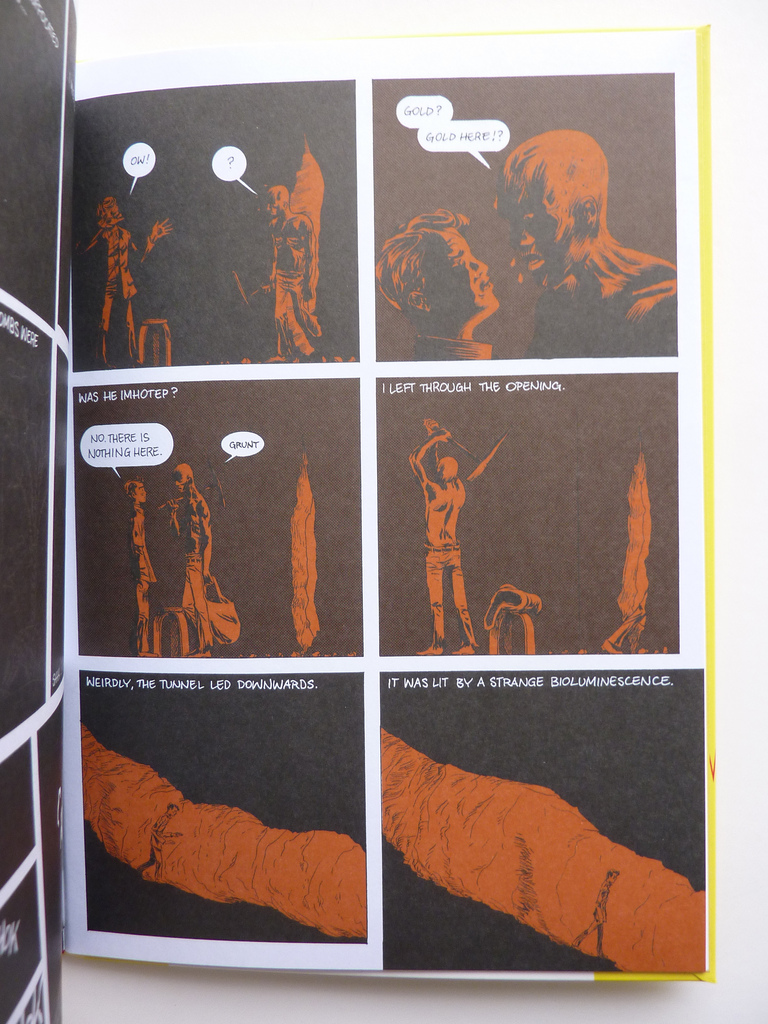
Tom Kaczynski's stories in the anthology Mome always felt like part of a larger cycle of stories. That's certainly borne out in his collection of stories from Mome and elsewhere, Beta Testing The Apocalypse (Fantagraphics). Kaczynski's stories combine elements of cultural & economic critique with the paranoia and rawness of a JG Ballard story. His stories address aspects of modern civilization and the ways in which they break down. These stories are collected with an unusual formal gimmick that grounds each story in terms of space (distance from Minneapolis) and time in the form of a graph. He also unites his stories by creating an index, which is interesting because of the way it documents how Kaczynski's themes and motifs tend to repeat themselves. For example, there are eleven sub-entries under "architecture", a hint at just how much the structures in which we live prove are crucial to Kaczynski's ideas. The same goes for "city", "civilization", "company", "corporation", and "genetics". He also indexes all of the sound effects he uses, which is interesting because they tend to be fairly invisible when reading a story and because they are raw sound, directly tied into experience. Each story uses a single color wash that highlights an aspect of the story; for example, in "The New", the dark orange represents the primal clay of the city of Uruk.

The first story,  "100,000 Miles" employs a sickly green background in its fantasy about the end of the world in the form of a worldwide traffic jam ending society as we know it. He takes that idea further in with "10,000 Years", about a man in therapy who becomes twisted by the idea of creating a utopia on Mars, a dream held as a reaction to extreme alienation. Alienation is a key point in the brilliant "976 Sq Feet", about a couple who are driven insane by a high-rise condo built in their neighborhood. (The line the man utters when he calls 911 for his now-insane girlfriend [babbling about "double paned windows"] is priceless: "Uh, I need an ambulance...or an architect.") Kaczynski implies that the construction was less built than conjured or summoned, as though it were some sort of hideous otherworldly intelligence brought in by the nameless, faceless forces of global capitalism.

"Phase Transition"  involves a man devolving into a sort of reptile-brain state as a way of throwing off the yoke of technology. Kaczynski implies here that primitivism is its own form of false utopia, as the man becomes a megalomaniac at the end. Kaczynski tops himself  with "Million Year Boom", about a brand expert who winds up working for a bizarre "green" company, trying to come up with a corporate logo as it prepares to go public. This is ,an insane stew of paranoia, devolution, corporate messiahs, and global capitalism fused with a tribal, scatological mindset. The final panel, where the protagonist's blood spewing across a door gives him the inspiration for the logo, is a stunning moment.  Kaczynski draws with a certain looseness in his line and modifying it either with simple color or effects like zip-a-tone. These strips are dark, unsettling and thought-provoking critiques layered with multiple meanings. Again and again, his stories are about what it means to be human and how easily we give up our humanity thanks to our relationship with technology and the spaces we inhabit.

Kaczynski really has his finger on the collective neuroses of the new millennium.  A recurring theme in this book is how Kaczynski taps into how various of our senses have been warped through modern living. In "Noise: A History", Kaczynski boils down the history of the world in terms of random events and how many decibels they measured out to, from the big bang to the falling of rustling leaves. He links past to present through the use of that measure of sound, providing an interesting shorthand for understanding the world in its greatest, worst and most indifferent moments. "Hotel Silencio" is about a man who creates a hotel that employs sound-baffling technology, creating a sensation that quickly abates after its inhabitants go crazy from the lack of sound. "100 Decibels" is about how the perception of sound can be quite subjective in its own way.

 "Cozy Apocalpyse" is one of the more directly comedic stories in this collection. Here, that titular doomsday event is not only mostly in the minds of the couple who have just bought a house in the suburbs, it serves almost as a kind of much-needed aphrodisiac for a couple growing bored with each other. When it proves to be a "localized phenomenon", there's an immediate urge to reproduce it.  "Music For Neanderthals" takes things into deeper satirical territory, as a musician and actor in an extreme method-acting project about neanderthals gets his nose broken intentionally by the purview of the lunatic director. That's a prelude to the actual cave built by the director, with the acoustics and sounds developed by the actor/musician resonating to the point where they took on their own kind of power. That said, the punchline of the story still grounds this entire primal experience in the venality of Hollywood. Finally, "The New" is in some respects a recapitulation of the entire book.The protagonist is an architect, brought in to build a new city for the original city, Uruk. The essence of this elegant, elliptical story is that modernity is a falsehood. Archeologically speaking, modernity comes and goes crashing down after catastrophes, with all of civilization built and greased by blood and powered by the compressed bones of the dead. It's a comparison that Kaczynski draws again and again in this book, that the line between civilization and savagery is an exceedingly thin one, and that humans are constantly being subjected to forces and pressures that could collapse civilization along with our sanity. Far from a screed, however, Kaczynski sees both the inevitability and the humor in this in strip after strip.

Friday, February 15, 2013

Sequart Reprints: Girls Missguided

This article was originally published at sequart.com in 2006.
**************
I first discovered the comics of the Canadian comics collective Girls Missguided at last year's MOCCA festival and I'm glad that I finally have a chance to delve into it. The interesting thing about this collective is that the comics of each artist (Stef Lenk, Shannon Gerard, and Willow Dawson) have little in common with each other, other than being primarily about women. Dawson illustrates a comic about girls becoming pirates in fairly straightforward fashion, Gerard creates autobiographical musings in the form of illustrated text, and Lenk almost completely eschews the use of text in her enigmatic tales of the journey of a young girl.

Dawson illustrates a series called Violet Miranda: Girl Pirate, written by Emily Pohl-Weary. It takes as its inspiration the story of real pirates Anne Bonny and Mary Read, and it's an entirely conventional but pleasantly breezy read. The first issue introduces our protagonists Violet and Elsa, daughters of retired pirates living on a small island. When the son of the pirate captain they betrayed finds the pirate families, he kills the men and takes the women. In the second issue, the girls get used to life at sea and learn some backstory about the mammoth treasure trove the young captain is seeking. The third issue sees the girls separated but quickly turning the tables on their circumstances.

Given that this is obviously a woman-centric adventure story, the way the plot unfolds is entirely predictable, if pleasantly told. The comic is well-paced and exciting, making each issue fly by. Dawson's art is highly stylized, leaning heavily on stark black/white contrasts, a thick line and a lot of extreme close-ups. She also employs a lot of distinctive faces and odd little visual tics to tell a story (the way she drew bodily hair made it look like vines, for example, and her close-ups revealed some interesting details surrounding eyes). She brings a strong sense of composition and style to each page, but her major flaw is a difficulty in portraying action and motion. Her figures look stiff and awkward when they're in motion, which is an unfortunate contrast to how natural they look in other situations. I do think these books would be ideally suited for a teen interested in a pirate story with no holds barred in terms of violence with a different set of protagonists than one would normally expect.

Gerard uses the most realistic art style in her stories, clearly drawing straight from life in many of them. That naturalism is set off by her more lyrical use of text in these little slice-of-life observations. Hung #1 is a winter recollection of a sensual summer memory. Gerard-the-narrator recalls the scent of certain trees that smell like semen and segues into a viscerally powerful sexual memory. Hung #2 continues on the theme of reminiscence, this time focusing on how particular details of people she sees on the street remind her of a particular absent person, noting "this is the basic unit of human intimacy:--recognition". Issue #3 is the most personal and most direct, as she describes her feelings when her partner realized that he had a suspicious lump on his body.

Gerard's prose is fairly spare and while her stories are introspective, they are not without wit. There's a short story where she and a friend play "hipster bingo" at a book fair, noting a number of recurring personality archetypes--with the most annoying being "similar interest girl". For the most part, these are not quite standard comics. While the figures are not stiff, the succession of images is not fluid. There's a definite sense of narrative here and the images clearly augment the text. And the fact that they are drawings instead of photos is an important but ineffable detail--being one level away from reality gives these comics a slightly dreamy, detached quality. The design is attractive, from cover to her odd lettering style.

The two minis from Lenk, "Carnival" and "The Alteration", are the first two chapters of a longer work called The Details, which seeks to explore "patterns in human experience that are synchronous with the anatomical systems of the human body". This is an intriguing premise, though the results on the comics page are rather oblique in pursuit of this goal. The enigmatic nature of these mostly-silent comics is certainly not a detriment; indeed, these are beautiful, mysterious narrative art objects.

"The Alteration" sees a young woman entering a tailor's shop, looking for a pattern to alter her dress. The proprietress is a blank-featured humanoid, and while the young woman snatches a pattern and literally spreads it out and attaches it to her dress (with the text on the pattern morphing and changing as she does), there's an air of menace to the shop's owner. When the young woman comes out of hiding, she sees that the customers in the shop (also blank figures) have been turned into paper dolls that she was cutting up after she took their clothes. She makes a break for it, but her dress dissolves, with words spilling off her unraveling dress that say "no mention was made that the words wouldn't stick". The same character in "Carnival" attends a local fair with her anthropomorphic heart-doll. After riding a ferris wheel together, she uses the doll as a hammer on a "test-your-strength" scale, pounding it to bits in order to win a heart-shaped balloon. She then stiches the doll up with a needle and thread.

There are some interesting visual clues in this comic. We don't see the girl's face until she hammers her heart into pieces--and she has that same blank expression of the shopkeeper in "The Alteration". It's not until she sadly realizes what she's done that she has the features of a human being. The anatomical system here is obviously cardiac, and possibly cardiac arrest. The system in "The Alteration" is less clear to me--neurological, perhaps? In each of the comics, however, dehumanization seems to be a clear theme. Finding ways to escape that dehumanization--both in terms of what happens to the girl and what she does to others--is a key to both of these stories. These full-color comics are triumphs of design, combining a certain lushness with an economy of storytelling. They combine elements of narrative and poetry for an unusual experience as a reader, one that leaves me eager to see future chapters.

Thursday, February 14, 2013

Catching Up With Conundrum

Let's look at a few more recent publications from the fine Canadian publisher Conundrum.

The Blaring House, by Claire Seringhaus.This is a book of densely-detailed (think early Drew Friedman), naturalistic and completely absurd gags and borderline dada drawings. As back-cover blurber Joe Ollmann notes, there's bits of Edward Gorey and Terry Gilliam to be found in these drawings, though unlike those artists there's no attempt at a sequential narrative. Ollmann's more on target in comparing Seringhaus to Glen Baxter, both in terms of the drawing style (that stiff, old-fashioned illustration approach that Michael Kupperman also employs so well) and the single-panel design of her gags. Unlike Baxter, Seringhaus frequently goes much farther into absurdity, with images that lack a coherent punchline and are simply, profoundly odd. One can sense that these are the sort of drawings that the artist felt compelled to draw strictly for her own amusement--ideas that more-or-less escaped from her brain and out through her pen. Her naturalistic style makes these images sort of the mirror image of Sam Henderson, an artist who frequently uses similiar sorts of genuinely strange anti-humor, only with deliberately crude (but clear drawings). The antiquated feel of Seringhaus' drawing style combined with captions that sometimes comment on the image nonsensically and sometimes directly sell the gag (just like Henderson) creates a reading experience that makes each subsequent image funnier. There's an additive effect where one eventually begins to enter Seringhaus' headspace, and that is an odd feeling indeed.

Britt Wilson's Greatest Book On Earth, by Britt Wilson. This is a collection of funny and frequently delightfully filthy vignettes. Wilson is a talented draftsman who makes an easy transition between naturalistic and iconic styles of art with great ease, often mixing the two. Her cartoonier work reminds me a bit of Kyle Baker. While she draws funny pictures with great ease, her actual gag construction is a little shaky at times. Some of her comics feel like inside jokes while others sometimes have jumbled storytelling. Her Viking comics in particular sometimes felt like the reader needed to be familiar with the original source material to really understand what was going on. Still, the strip where she and a friend had to negotiate a peril-filled park on the way to celebrating Canada Day (one of my strips in this book involving scat and/or fart humor) and the story where her boyfriend falls into a hole and has to fight dinosaurs have an incredibly manic energy that's highlighted by her rubbery, expressive line. Wilson's sheer enthusiasm for drawing is such that she's sometimes a little too all over the place; a little tightening-up of the gags here and there would serve to give her work a more lasting impact.


Unspent Love, by Shannon Gerard. This is a lovely comics-as-poetry collection that's a series of vignettes that are related in an emotional sense though not a narrative one. The book's subtitle is "Things I Wish I Told You", and that's the unifying theme in this series of ruminations accompanied by pen-and-ink drawings. Gerard employs a clear, crisp and distinct line in depicting her figures moving across the page. These are not comics per se, in that they don't depict time moving forward in a conventional sense. Rather, they are more like small bursts of visual memories, like flipping through a set of snapshots from a memorable day. Gerard is a spare, evocative poet, hitting heavily on details that ground her emotions in what feel like real events. Whether or not the events in the book are autobiographical is less important than how real the sentiments feel, and so very many of them are heartbreaking. They tend to break down into drawings of men, drawings of women or drawings of both. The text sometimes directly comments on the images, and at other times is juxtaposed in opposition to it. One such strip involves happy scenes from a young couple's wedding, set against text that talks about how and why the marriage dissolved. Mostly, Unspent Love is a catalog of 20/20 hindsight and regrets ameliorated by way of confession and retrospective praise. It's a testament to both the power and fragility of love.


Tuesday, February 12, 2013

Sequart Reprints: Jam In The Band

I reviewed a mini-comics preview of Robin Enrico's Jam In The Band last fall, and I noted that I looked forward to the larger work to come. The resulting first volume of what looks to be at least a three-volume set had all of the charms of that mini and added a great deal of depth as well.

There are two competing narratives at work here, though that doesn't become clear until the end of the first volume. This is the chronicle of the rise of an all-female rock band, escaping from a tiny Pennsylvania town to some small measure of national recognition. The story centers around Bianca, the obsessive and ambitious lead singer who by force of will bosses around her bandmates with the singular goal of success. This volume explores the nature of her obsession in the form of an ongoing dialogue she has with this idealized Rock Star version of herself, a clever conceit that reveals much about her character. Jam In The Band's competing narratives are that of the unrequited love between the book's lead male protagonist, Nathan, and Bianca; and then the eventual relationship that arises between him and the band's drummer, Tiara. The clash between those two narratives doesn't come to a head in this volume, but it's strongly hinted that it will be a major part of the next.

I discussed some of Enrico's influences and similarities in my first review, which included the rock scene comics of Jaime Hernandez and the video-game influenced comics of Brian Lee O'Malley. Enrico discusses a specific video game which inspired his highly-stylized design sense (Jet Set Radio) and Seth's Wimbledon Green, which helped him organize the book. The influence of the latter allowed him to strike a number of humorous oounterparts that riffed off the main narrative, using a third-person documentary-style cutaway. This gives the book a very fluid, unpredictable quality that makes it exciting to read. We're led to believe initially that this is Nathan's story and that he would dominate the narrative, even if he was just giving us details in flashback. Instead, Enrico flits from character to character, sometimes to move along the narrative, sometimes for laughs, sometimes as a commentary on what the main characters were doing, and sometimes for pure stylistic effect. I especially liked the scrapbook pages that gave us bits and pieces about what life was like on the road.

One influence that Enrico mentioned that I thought was interesting was Pagan Kennedy's novel The Exes, about the rise and fall of an indy rock band and the interrelationships of its members. Enrico shares Kennedy's keen ear for dialogue, ability to depict the uniqueness of a certain time and place for youth culture and the bittersweet realization that youth is fleeting. What makes the story so strong is the way he's able to clearly sketch out character arcs and motivations without telegraphing his attempt in too heavy-handed a fashion. Band member Corbin hides her essential aimlessness and loneliness through drinking and hooking up. Tiara has a sense of wonder and adventure that is balanced by her love for Nathan.

Bianca is obsessed with becoming this kind of Rock Star ideal (whose eyes are always obscured--hiding what she knows?), and we see her appear in this form at the very beginning of the book. Enrico takes an interesting risk in making Bianca the focus of this book, because she's an interesting bundle of contradictions. She's the sort of vibrant personality who draws people into her orbit but doesn't always either understand or care about the effect she has on others. Her casual interest in the art of a local girl named Janette gave her the confidence boost she needed to become a successful graphic artist, for example. On the other hand, Bianca seems incapable of forging any deep, meaningful relationships with anyone around her.

If there's a single weakness in this volume, it's that the character of Nathan seems underwritten. We never get a real sense of who he is and what he cares about other than his feelings for Bianca and later feelings for Tiara. We know he's now a successful writer, but we don't get the same understanding of his life that we do even for a minor character like Janette. Hopefully in the second volume we'll get to see more of his story, since in many respects he's every bit as pivotal to the overall narrative as Bianca.

Enrico's visual sense gives the reader something exciting to look at on every page. His character design is simple but distinctive, and it's clear that he especially loves drawing interesting-looking women. There's a clarity to his aesthetic style that is enhanced by his video game influence. It's a different kind of energy than the sort of motion that is depicted in most comics; there's that sort of vaguely two-dimensional video game quality to his characters, but that allows them to move and interact with their environment in unusual ways without breaking the reader's sense of continuity on the page. The sort of excitement that Enrico manages to depict on the page will be familiar to anyone who's ever been part of a scene--either as participant or observer. The sense of the possibility of youth, the crackling energy of potential, the feeling that something special is happening (or about to happen)...Enrico captures that ascendant moment in this volume. It will be interesting to see how the conflicts he sets up in this volume play out and how well he can capture how it feels when youth is misspent and potential isn't met.

Monday, February 11, 2013

Back to Black: Jam In The Band 3


There's a sense in which Robin Enrico wrote himself into a corner at the conclusion of Jam In The Band V2.The first volume depicted an all-woman indy rock band in mid-rise, flashing back to their roots and forward to their decline. It's an upbeat, visually exciting comic that combines stripped-down cartooning and a certain video game aesthetic. The second volume depicts the depressing crash of the band, a break-up that occurs in a tour of Germany in front of hostile fans and in unpleasant working & living conditions. Bianca, the despotic leader of the band whose drive put the band together and pointed them to success, was no longer delivering on her promises. That prompted Tiara, the sweet-seeming drummer, to stand up for herself and punch her out. Corbin, the alcoholic skirt-chasing bass player, also walked out. Enrico wrote in the notes to these comics that he had trouble returning to the story, doing an entire second miniseries (the fun Life of Vice) but then nearly quit comics altogether. It's understandable; he wrote a story that ended; and coming up with what occurs after that ending is tricky from a conceptual and narrative standpoint.

Bianca being his stand-in, it's no wonder the story progresses as it does in the first two minicomic issues of the third volume of Jam In The Band. Enrico goes to some pretty dark places in this volume, including a repeating motif of Bianca tying her belt to her door and suffocating herself with it--not enough to kill herself, but enough to alter herself. It's telling that Enrico draws her as her Rock Star alter ego that she has dialogues with earlier in the series; she has now become a Rock Star, only now she's in the washed-up stage of rock stardom. Bianca dominates the first two issues of this volume mostly be her absence; she barely says a word as she constantly tinkers with her music, draining the patience of the few people who will still talk to her. The comic is also interesting because it examines the life of artists who have to figure out what to do with their lives after their first big project ends. Do you get married? Get a job? Drop out altogether? How do you balance the immense satisfaction of playing live shows with the reality of turning thirty and trying to figure out how you can do art and live a relatively comfortable life? Of course, all of these questions pertain to making comics as well and all of them undoubtedly had a place in  Enrico's thinking during his time away from making art.

These issues catch up with Tiara (now close to thinking about marriage), Corbin (now in an "Electro Booty Jamz" band called Rayd Tittiez) and assorted side characters like the ebullient Becky Vice and outsider artist Jennet. The relationship between Jennet and Corbin is fascinating; Corbin's in love with her and Jennet is willing to allow an emotional relationship between the two of them, but nothing more. There's a level of complexity in that relationship that Enrico pulls off nicely, adding a layer of depth to Corbin that she badly needed. Indeed, Enrico does a nice job of fleshing out his characters the more time he spends with them, turning potentially one-note (but fun) characters like Becky Vice into vivid, believable (if slightly crazy) people. Enrico has also progressed as a draftsman, adding a level of precision to his simply-drawn characters that makes them pop off the page. He still has his trademark party-clutter pages, but even these are easier to follow as his page design sense has sharpened. The flashbacks and flashforwards and "interview" pages continue to be go-to narrative devices for Enrico as a way to break up the story into vignettes, though they are in less evidence in this volume out of necessity. Enrico definitely answers one of the big questions of this project: can you balance ambition in one's art with having a personal life? That's a pretty definitive yes as far as most of the character go. The larger question is, can an artist obsessed with success ever be satisfied? That's a question that I imagine we'll see answered in the remaining issues of this excellent series that captures a particular time and place with a great deal of verisimilitude.

Saturday, February 9, 2013

Call For Entries: Dadsvile Anthology

I'll run this as is; I think it's an intriguing anthology concept:

DADSVILLE COMICS ANTHOLOGY 
Call for Entries

WHAT IS DADSVILLE?
Dadsville is a comic anthology organized around the common thread of fatherhood as interpreted by a collaboration of artists and writers united in a commitment to create original comics that don’t suck.

Welcome to Dadsville, where you’ll delve deep into the paternal past and meet the quirky fathers of the artist-contributors. Whether they’re dishing out the wisdom of the ages or scratching themselves in front of the TV, each will give you a unique insight into what it means to be called “Dear Old Dad.” In the 
tradition of Meathaus, Mome, and Kramers Ergot, Dadsville will hold appeal for readers who enjoy whimsy, deep thought, empathy, and nonsense.

DEADLINE, ELIGIBILITY and SPECS.
All entries for consideration must be recieved by July 1, 2013. All submissions must be black & white, conforming to size of 6.625 x 10.25 inches trim, scanned at 600 dpi. Each artist may submit 1 to 4 pages max. Submissions should be based on the theme of fatherhood but need not be autobiographical in nature. Authors and artists of original works may collaborate if desired. Title panels should be included within first page. Submissions from any country are wecome, English language only. Please submit work in pdf form to dane@danelachiusa.com. Subject heading: Dadsville. Please include your name, email address, and a brief bio within the email. Final art in jpeg form will be requested if work makes final list.

HOW DOES IT WORK?
Dadsville editors are responsible for collecting, reviewing, and selecting semi-finalists from all comics received by July 1, 2013. An established comics 
author will act as guest editor, to be announced in July. He or she is responsible for choosing among the semi-finalists the works for inclusion in the book. 
If your work is on the final list, you will be contacted by us in August for permission.


Dadsville Editors: Dane LaChiusa, Tom Christmann, Carol Holsinger. Cover Art © Fabio Lyra, Brazil • http://lyra.50webs.com


For questions contact: dane@danelachiusa.com. View recent submissions at: behance.net/dadsville