Beverly, by Nick Drnaso. Reading a Nick Drnaso story is the comics equivalent of watching a Todd Solondz film. There's an almost crude flatness of design and affect that belie the heart-rending, soul-destroying events. Drnaso's art takes some of its cues from the same influences that Dan Clowes drew from, only he takes that bland aesthetic a step further, making his figures like not unlike the sort of stiff characters one might see in a promotional pamphlet. This is not to say that Drnaso doesn't smartly include a number of clever and pointed storytelling cues; indeed, his skill in that regard is a key in getting across subtle plot points without beating the reader over the head with supporting narrative text. It's just that Drnaso has a way of lulling the reader with a series of repetitive, visually bland images and then suddenly inserting a surprising, disturbing and altogether game-changing image that snaps the reader out of that expected rhythm.
The book is a loosely-connected series of stories that take place over the course of about twenty-five years. For the most part, it focuses on the secret and inner lives of children and teenagers and the disconnect between children and their parents. It's also about social awkwardness, as the first story (originally published as a mini by Oily Comics), "The Grassy Knoll", illustrates. A quite and polite teen named Tim is paired up with Sal on a park-cleaning job, mostly because no one else can deal with Sal's social weirdness. The way Drnaso portrays him as someone missing an understanding of social cues makes him a clear Asperger's case, right down to detailing the minutiae of his interests. For his part, Tim just wants to work, not cause a fuss and hang out with the cute girls he meets on the job. A guileless request to transfer over to be with them is inferred as yet another complaint about Sal, who is then fired. The inscrutably sad and strange expression on his face after he's fired is remarkably subtle, revealing confusion as much as anything. Drnaso early on nails the banal language of teens with regard to surface interactions, especially with regard to peer pressure activities like drinking and partying.
"The Saddest Story Ever Told" is a remarkably masterful and understated story about the mother of one of the girls from the first story (a blond named Cara) who silently sits and watches a screener of a new sitcom's pilot for evaluation purposes. The show is a scathing satire of typical broadcast pabulum, but Cara's mom is excited by it and critiques it, taking notes, because it gives her a sense of purpose. When it becomes obvious by the questions they have to answer afterward that the network is only interested in their reaction to the commercials that were part of the show, Cara's mom, a perfectly-designed character (all blocky and big) sits silently and dejectedly on the coach. Cara doesn't say a word throughout but weeps into her pillow afterwards: is she crying in empathy for her mom or crying because she doesn't want to become her mother?
"The Lil' King" is an excruciating account of a family vacation that centers around Cara's family; her parents are taking the kids to the same place they went for their honeymoon. Once again, the chunky character design is stunningly ideal, and the cheerfulness of the parents contrasted against their sullen and quiet children creates non-stop awkwardness. Drnaso is not content with simply awkwardness, however; when the children are alone, the older Cara asks her ten year old brother Tyler why he's so quiet (ironic, since neither said a word to their parents the whole time) as she goes off with a boy she met at the pool. Drnaso then reveals a moment of sexual obsession in Tyler who is discovered by his sister, pushing the awkwardness level to new levels. One clever thing that Drnaso does in the story is have the reader not hear Tyler's thoughts but instead see things through his eyes: he imagines killing and torturing virtually everyone he sees. A scene at the end where his father is lovingly trying to get through to him is incredibly creepy as Tyler's still in his wish-fulfillment mode, seeing himself as a grown man with an S&M hood over his head.
"Pudding" is about broken friendships and the ways in which abuse and trauma lead people to great lengths in order to seek comfort and fulfillment. After growing up with a girl that she once fooled around with as a child, Tina is invited to her friend's birthday party. The story features the conflicts that arise between three desperate people. Tina brings a friend/sort of romantic interest to the party and then promptly ditches him. Charlotte clearly has no friends and is ashamed of her past with Tina. The guy is sullen and angry, and one questions why he's even around someone as clearly as flaky as Tina. Things get awkward, weird and angry in a hurry in this story, but all of that self-generated angst is quickly chilled when Tina and her friend see a fatal accident on the side of the road. (It's Cara, which is never explicitly stated but it's obvious and a plot point for later in the book.)
"Virgin Mary" ups the creep and sleaze factor in the story, as a young woman is kidnapped from her job at a pizza joint, sexually assaulted and then is found to be pregnant. When she tells the story and says that her attacker was of Arab descent, that only politicizes an already-tense situation in the small town and turns things even uglier. Drnaso keeps the reader off-balance by constantly shifting the point of view in the story, diverting and deflecting attention before throwing in a huge twist. The twist, which revolves around the real identity and motive of the attacker, is revealed over the course of several pages of a chat transcript juxtaposed against the blandly pretty features of their Anywhere, USA suburb. Once again, Drnaso wrings horror from the banal, as the dumb chat transcripts turn chilling and the girl's desperation is palpable.
The final story, "King Me", sees Tyler as an adult, creepily going to an apparently legitimate massage parlor once a week because of his obsession with the woman who works there. It's a story set during winter, so it's chilling to see him wear a mask not unlike the one he imagined himself wearing earlier in the story. As the story unfolds, we learn that virtually everything he says is a lie, concocted either to make himself look good or at least get him out of talking about something awkward like the death of his sister. The twist here is that he meets a woman at a subway stop who turns to him for help because she's dealing with her own stalker. There's genuine anxiety in the story as they try to lose him, and when Tyler finally finishes his good deed and walks her home per her request, he turns to look at her when she goes back in. The next page has a single, tiny panel in the upper left hand corner as he continues to stare at the house; the implication is that this possibly sociopathic person has now found a new target, even if that obsession is entirely one-sided and theoretical.
Tyler represents something fundamentally broken, someone who wants to connect and create meaning but has no idea how. In that sense, he's representative of so many characters in the book who are looking for something resembling authentic experience but instead find themselves mired in prefabricated lives with predictable outcomes. It's no wonder someone like Sal, an aneurotypical outlier, should cause so much distress; his theories may be delusional but they at at least recognize that life has patterns that he doesn't understand or one to relate to. It's no wonder why Tina reached out to Charlotte, in hopes that they could recreate the one relationship in her life that felt pure and right, even if they had both long moved on from the frame of mind that allowed them to share that moment. Beverly is all about the dyspepsia that can result after a lifetime of being force-fed lies and promises about the rewards that hewing to the social order can bring.
Tuesday, August 23, 2016
Foxing Reprints #19: Max de Radigues
Rough Age, by Max de Radigues. Belgian cartoonist Max de Radigues is one of the more secretly influential cartoonists of the last half decade. As a resident cartoonist at the Center for Cartoon Studies, he often collaborated with Chuck Forsman, the future publisher of Oily Comics. They did a broadsheet anthology called Caboose that set the standard for a now frequently-used format for comics publishing. De Radigues' thin, fragile and expressive line was also a clear influence on Forsman's own nascent cartooning style. Both cartoonists seemed most at home drawing stories about teenagers and their daily struggles that seem so epic in scope. De Radigues also self-published a bunch of eight page minicomics calledL'Age Dur, which translates out to "Rough Age". He repeated that format with another series called Moose (soon to be collected by Conundrum Press), and both of these series had a direct influence on Forsman publishing in much the same way with Oily.
Rough Age's transition from a series of brief but related minis to a single collection is seamless. Stripping away the titles of the original stories, de Radigues nonetheless creates a beautiful storytelling rhythm by varying a six-panel grid with a gridless two-panel stinger that concludes each story. In the original minis, these served as the back cover. De Radigues has an uncanny understanding of teenage romantic politics. A kid declares that if a ball goes in the basket, he'll get a date with his crush. Instead, someone picks a fight with him and he winds up elbowing her in the eye. Another story featuring a detention has what seems to be a magical, shared moment between a nerdy boy and a beautiful girl, until he discovers that it's not his shared moment. A boy gets in hot water when he pretends he has a "Canadian girlfriend", and he's treated with some care by one of his friends to help him out with his lie. Later, lies he made up about two other girls come back to haunt him. In the funniest sequence of the book, two boys seem to be talking about which girl is more likely to put out, until we learn that they're talking about trying to copy physics homework.
Band politics, break-ups, shifting friendships and intrigue between and among the sexes are all fodder for de Radigues' gentle but unsparing sense of humor. There's a great deal of empathy on display for all of these characters, but he certainly doesn't let them get away with anything. The dot eyes on his boys and the big, almond-shaped eyes on his girls perhaps betray a bit of his own lingering sense of mystique about women, but they are certainly drawn and presented as entirely three-dimensional characters.
Bastard #1, by Max de Radigues. This mini, printed on canary-yellow paper, starts with familiar de Radigues details (a young woman getting take-out, a young man recognizing her and inducing an awkward scene) that would seem to be more of the usual kind of story from him, and quickly turns all of that on its head. We quickly learn that the woman has a son, and that since she was recognized, she has to move. Once again, the genre of the story is vague. When he takes out a bag full of money, we finally get the reveal: they're on the run and have done something criminal. From there, de Radigues has a great time balancing road trip tensions with the sweetness of the relationship between mother and son, all while slowly revealing crazy detail after crazy detail. By the end of the issue, when they both bleach their hair blonde, the reader is left with a thousand delicious questions. That said, the real charm of this comic is the way de Radigues introduces levity to break the tension by way of the remarkably nuanced and detailed relationship between mother and son. The fact that the likes of Sacha Goerg and Lewis Trondheim each draw a guest page in the story only adds to the appeal of the comic, and its sense of bigness. Indeed, if de Radigues was a big influence on Forsman, Bastard shows that Forsman had an influence on de Radigues as well, given the road trip and sense of danger.
Monday, August 22, 2016
D&Q: Chris Oliveros and Julie Delporte
Everywhere Antennas, by Julie Delporte. This is Delporte's first major work of fiction after publishing the visually-similar book Journal with Koyama Press. Delporte's open-page layouts, use of colored pencils and cursive script create an almost uncomfortably intimate atmosphere as a young woman documents her increasing inability to cope with the world. In the course of the story, we learn that she apparently has a heightened sensitivity to the sort of highly concentrated electromagnetic energy that one might see in modern, urban life. As the book goes on, the young woman (named Lily) desperately finds herself withdrawing more and more from society in a series of stopgap attempts to create a life separated from technology. The more she stays in someone's cabin for a couple of months or hops from couch to couch, the more she feels a variety of conflicting emotions. The headaches, exhaustion, confusion and burning sensation she felt at the height of her sensitivity all ebbed (though didn't completely disappear) as she avoided technology, but that was offset by the feeling of being an outcast.
There's another level of narrative at work here beyond what Lily describes. This book is about the narratives, experiences and observations of women and the ways in which those experiences are ignored and discounted by men in authority. In particular, her anxiety is at first barely tolerated and later dismissed by her then-boyfriend and the doctors she sees, whose response each time is to prescribe a different antidepressant. Her father doesn't question her on her problems only because he doesn't want his daughter to comment on his alcoholism. Her desperate need for connection and for people to believe her reduced her to desperate codependence at first, something that she leaves behind as she starts to leave behind the other constrictions of society. While the end has no real solutions in sight for her affliction, she at least is in control of her own fate and own decisions. Delporte's use of colors is disorienting in a way that's meant to reflect her own increasing sense of alienation in her own environment. That alienation is something she has to cope with, understanding that the very forces she tried to cling to early in the book were literally killing her and driving her insane.
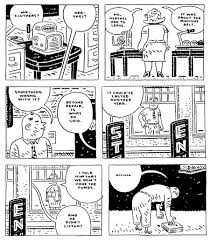
The Envelope Manufacturer, by Chris Oliveros. In the early days of his former publishing concern, Oliveros contributed to the D&Q anthology and also published two issues of this story, The Envelope Manufacturer. The realities of running a publishing company on a shoestring prevented him from finishing that story until he started it again from scratch in 2011. Turning the day-to-day operations of the company over to his trusted lieutenants (and new co-publishers) Tom Devlin and Peggy Burns meant that he had time to finish the book, which he is self-publishing but is having distributed by D&Q. Reading the book made me realize how much I had missed his cartooning, which has elements of Seth and Chester Brown in the sense that they had a number of common influences. Oliveros line is gloriously scratchy and cartoony at the same time, with the book's themes of obsolescence and loss resonating with the profoundly old-fashioned character design. The patchy hair of the company's owner, the suit-bursting girth of his main employee and the bespectacled dowdiness of his other employee are all striking, iconic images that feel strange and almost out of place in a modern book.
That sense of alienating the reader with the evocation of a past time and place is one of the central points of the book, which on the surface resembles Seth's Clyde Fans in that it depicts a failing company that fell prey to obsolescence and its now-useless employees. Where it differs is that Seth's story is at once fixated on surface details but also a deeply interior story that follows the twisting memories of two bitter brothers. The Envelope Manufacturer, on the other hand, has a sense of humor that's both absurd and black as pitch, creating what amounts to scene after scene of dark slapstick. The book's plot, such as it is, involves the last days of a tiny office supply producer. When a key machine breaks down, it signals the end of the company, even as the owner is in complete denial regarding this and has been for some time.
The owner, Mr. Cluthers, is constantly muttering to himself about ways to save the company. His employee, Hershel, is sunk because he's owed a lot of back pay, but it emboldens him to mouth off constantly. So much so that Cluthers thinks he sees Hershel bloviating on a bus and hallucinates choking him. Hershel takes to yelling at failing businessmen to jump from their tall buildings. There's a hilarious sequence where a business owner who's in the process of jumping off the building comes into Cluthers' office, uses his bathroom, offers him some advice and then jumps. When all of the broken-down equipment is repossessed, Cluthers is still obsessed with the idea of making the envelopes by hand, as just one order can help them get out of the red.
The book works as a metaphor for any kind of personal endeavor that's endangered by the whims of the market, and it's not too much of a leap to transfer the sheer absurdity of a three-person envelope manufacturing concern to an equally small art-comics publishing company. Yet one can see Oliveros in D&Q's darkest days, betting on the next book to keep the company going. That said, what marks the characters in this book are their unrelentingly obsessive personalities, an obsession that borders on narcissism and self-delusion. The tiny, scratchy lines on the page give them a nervous, twitchy energy that is especially effective juxtaposed against the classic character and building design. Oliveros proves to be highly proficient in both character and caricature, and the blending of those two worlds gives the book an uneasy sense of both charm and desperation.
Friday, August 19, 2016
D&Q: Tom Gauld's Mooncop and Lisa Hanawalt's Hot Dog Taste Test
Mooncop, by Tom Gauld. Gauld's long-form comics tend to be variations on an individual being manipulated by forces beyond his control, often resulting in a kind of tragic obsolescence. That's the case in the silent The Gigantic Robot (the robot eventually just erodes away) and Goliath (a nice guy who's manipulated by bureaucracy and circumstance into becoming the victim of legend), and it's true in a less dramatic way in Mooncop as well. In many ways, Mooncop is even sadder than the other two books, because they're both about wars and conquest, where history is written by the winner and then later forgotten. In this book, we're presented with a glimpse of what was once a noble attempt at something glorious that's fallen into disrepair and disinterest. The titular character patrols the moon, earning perfect marks on his quarterly crime-solving reports because there's no crime to report. In the beautiful domed buildings on the starkly gorgeous surface of the moon (which Gauld emphasizes with heavy hatching and cross-hatching and a light blue-grey wash), the cop starts off the story by reluctantly dealing with the fact that he barely serves any purpose and starts to sink deeper into despair when he realizes that everyone is starting to leave.
Gauld mixes the melancholy quality of the cop's life on the moon with some hilarious technology-related gags that ultimately only serve to make him feel even worse. This is a future where technology rules over everything, only it's constantly breaking down or is lacking the right adapter. There's a bit where the cop is denied a transfer back to earth but is assigned a therapy robot. The robot promptly falls on its face when it tries to move, since it wasn't designed for rough terrain. When it finally manages to charge itself, it explodes. The moon bureaucracy takes away his frequently-malfunctioning coffee and donuts machine and inexplicably puts in a cafe, a funny reflection of how out of touch leadership and technology is with reality in the book. The cop and the young woman hired for the cafe trade quips and then share some poignant moments when they realize they're the last two people on the moon. The cop and the other characters are drawn in Gauld's typical simplified style, which aids in him maintaining the deadpan atmosphere of the book. That deadpan style blends perfectly with the sense of not just frustration, but resignation, that the characters share. Not only did the cop (who confesses that all he wanted to do as a kid was be a cop and live on the moon) come to understand that he joined this moon utopia too late and that the party was over, he came to understand that it was never that great to begin with. The moon was dotted with convenience stores and drive-throughs, just like any dull suburb on earth. He had to be reminded from time to time that the moon and its views were beautiful, but even those moments of aesthetic bliss were simply not enough to counter the banality and bureaucracy of everyday life.
Hot Dog Taste Test, by Lisa Hanawalt. Hanawalt's minicomics series, I Want You, was a thunderbolt of over-the-top grossness and absurdity. In a strange way, it also felt deeply personal precisely because of the specificity of its eccentricities. Her first book, a collection of assorted short stories and other ephemera titled My Dirty Dumb Eyes, was not quite the Full Hanawalt experience that I had hoped for. It was still really out there and funny, to be sure, but it felt a little safer and a little more measured & restrained. That's understandable, given that many of those pieces were assignments, rather than directly personal work. I was worried that her new book, Hot Dog Taste Test, might be similarly muted in content. Instead, despite the fact that most of it is a collection of work published in a food magazine, I found much of it to be not only Hanawalt's sensibilities fully unleashed, but also to be remarkably personal and even poignant at times.
The fact that the book centers around food is precisely what makes it so personal. Hanawalt loves food, loves talking about it and isn't afraid to remind the reader that we are absurd animals. Hanawalt has a knack for using mundane images to make fun of pretentious ones, like substituting hot dogs for actual dogs at a dog show-style event. She also constantly subverts the kind of food-related advice people seek from the internet or magazines with absurd add-ons. In a hand-written list of baking tips, it starts off with "whisk drys" and "parchment paper will save you" (two sensible things) and ends with "yogurt makes promises it can't keep." She reduces shopping to furniture ("stuff to fart on") and clothing ("stuff to fart in"). This, and wine advice like an arrow pointing to a shiraz that says "makes your tits itchy") establishes the baseline for her humor in this book: coarse, silly, vaguely familiar and very brightly colored.
That use of color is in prominent display in her "Holiday Food Diary", which abandons anything resembling reality to delve into eating "a box of meat", fresh egg nog with eggs squeezed straight from the bird, and an apocalyptic and orgiastic two page spread of "The Holiday Feast". Hanawalt alternates a fairly straight-ahead profile of celebrity chef Wylie Dufresne with a long series of cartoons about toilets and toileting issues. Yes, she literally indulges in potty humor in a series of hilarious strips that work because she treats them with an eager sense of curiosity about our toileting habits as humans. That's followed by her drawings of human-type breasts and genitalia on birds, including a statue of one in an art museum. By the time she finishes up her strip on "menstrual huts" (including the "menstrual barcycle"--one of those pedi-cab bars), Hanawalt has undoubtedly cleared the room of those who simply wanted to read some funny comics about being a foodie--and more power to her.
Most of the rest of the book is dedicated to longer pieces, like one talking about leaving New York City for good and indulging in all the "Sugar, Spice, and Fat" she can get her hands on. There's an interlude featuring one of her anthropomorphic characters that were a staple of her earlier work and are now mostly seen on her TV show that she designs, BoJack Horseman. Tuca the Toucan is hilarious, reminding me a little of the old R.Crumb character Mode O'Day as she has an intensely awkward encounter with a guy at the deli counter. The strip where she's desperately trying to get a Cathy ("Aack!") swimsuit on is a bit of hilarious metahumor. "Planting" features an anthropomorphic bird couple moving into a new house in another brightly-colored story (watercolors, I believe) that introduces plants as a fun hobby and then reveals that the wife starts becoming obsessed with them to the point of starting to sleep curled up in pots.
"Otters!" works as both a guide to something interesting (a sanctuary where you get to swim around with baby otters) and something that could not have been more in Hanawalt's wheelhouse. "I can't get over how good it feels to have otters all over me", she says, in a paragraph next to a self-portrait of her with a shirt that reads "Every Day I'm Not Covered In Otters Is A Piece Of Shit." It's a perfect Hanawalt piece, as its illustrations range from cute to absurd to gross, and there's a kind of sweet inquisitiveness that marks the way she looks at the world. The same is true, in a far different environment, in "Lisaaa Las Vegas", in which she is asked to eat at some opulent Vegas buffets. Hanawalt jumps into the experience wholeheartedly while acknowledging the ways in which Vegas is a sort of bacchanalian con. It's not unlike if a magazine had managed to send her back in time to some Roman feast; it's something that's kind of ugly and conspicuous in its consumption, yet the actual experience of eating that food is one so visceral that that aspect of it is interesting to consider. Hanawalt nails that visceral quality with her absurd, almost hallucinatory ideas about food as well as the effects it has on her body.
The true stand-out piece in the book is her "Argentina Travel Diary". I had no idea that her mother was from Argentina, and the story features Hanawalt traveling there with her parents, her brother and her boyfriend. It's among the very best travel diaries I've ever read, as it's bracingly honest and funny about the experience of travel and the confusing & conflicting emotions that often come with it. Her observations about South American food are dead on: it's not spicy, it's European. (My own Chilean relatives acted like they were eating five-alarm chili when they had a stew with a dash of paprika in it. "Calor!"). Her blunt assessments ("Truche Roqueforte" as "Cheese Fish") and Noquis (Gnocchi) as "Bliss pillows" made me laugh out loud. Hanawalt talks about the feelings she gets when she rides a horse, how riding around with her brother made her think about how his girlfriend had died just a year ago, and the sensation after riding of eating some stew that her mother had made ("Nothing has ever tasted better.") Hanawalt's work, in its purest essence, is embracing what it is like to be embodied. To feel the adrenaline of being on top of a horse, with all the risk that entails. To eat nothing but comfort with family and to feel safe and loved. To accept one's body and bodily functions, acknowledging the fears of what other people might perceive if they saw her on the toilet (the image accompanying that made me howl). To savor those moments of beauty that come through meaningful interaction in an existence that is "mostly meaningless", as she put it. This wasn't just wisdom on top of toilet humor, but rather, an acknowledgment that the toilet humor is part of the wisdom.
Thursday, August 18, 2016
Foxing Reprints #18: Oily Comics: Nick Drnaso, Sacha Goerg, Benjamin Urkowitz, Scott Longo
The Grassy Knoll, by Nick Drnaso. This one's in full color and 7 x 8.5". It makes sense, because Drnaso's work looks best in the slightly bland color palette that he selects to create the slightly deadened, inert feeling he goes for on each page. That inertness matches and is in tension with the deadened or heightened emotions of each character he introduces and the sense of social awkwardness he explores in his work. Drnaso excels at writing about outcasts, weirdos and the socially inadept, not so much to laugh at them but instead to investigate the rules that put them on the outside in the first place.
In this story, we meet Bill, a new employee of a company that cleans up a park. He's assigned to work with Sal and immediately warned not to talk about Sal's father if it comes up. Sal is hyperarticulate in a sort of Asperger's way but clearly lacks an awareness of certain social cues. Bill is just a guy who has a new job and notices that some of his co-workers are attractive young women his own age, and wonders how he met get assigned to hang around them. While Sal does go on about some video game he's just mastered and is mildly annoying, he's mostly harmless. Meanwhile, when Bill gets to hang out with the girls and another male friend of theirs, talk mostly centers around how drunk they were last night: banal, puerile chatter at its shallowest. Of course, Bill's boss misconstrues his interest in hanging out with pretty girls to being yet another person who can't deal with Sal, leading him to fire him. There's a wonderful moment at the end when Sal and Bill lock eyes for a moment, with a slightly sad look of betrayal on Sal's face and a blank but glum look on Bill's, after all of this occurs. Drnaso's suggestion that just because certain social cues are acceptable doesn't make them hard and fast laws is done with restraint, especially since he doesn't show Sal as an entirely sympathetic character. He's annoying, but certainly no better nor worse than the other employees. He's simply not as "normal" as they are, which Drnaso shows isn't the same thing as "admirable".
Nu #1, by Sacha Goerg. This is another Oily comic that's longer and printed at a larger size than the norm. Goerg is a Swiss-Belgian cartoonist with the kind of slightly ratty and expressive line that's similar to Forsman and Max De Radigues. Goerg treads on some familiar ground here in a story about an art school student who develops a huge crush on a model, to the point where he follows her home and surreptitiously draws her. When her dog finds him and grabs his sketchbook, she's able to turn the tables on him. Goerg excels at drawing loose and sloppy lines that zip the story along and perfectly capture emotion. There's one panel where Ielena, the object of the protagonist's obsession, is sneering at the mere concept of her voyeur. Goerg throws a funny twist at the reader at the end of the story, as the protagonist manages to get off scot-free while one of his friends accidentally gets caught. This is a funny and slightly demented take on obsessions, secrets and desires that is perfectly suited for this format.
"Duh Studge" In Real Rap #1-3, by Benjamin Urkowitz. Urkowitz is an artist I discovered through Oily and has proven to be a delightful revelation. These comics are what I would call "stupid-smart", as the initial trappings of the slightly idiotic Caucasian rapper Stu "Da Studge" slowly reveal a series of complex and funny character interactions, especially with his friend Nicky. She's an amazing character: an androgynous singer who's clearly smitten with Stu on some level, but uses a hyper-aggro approach with everyone else. Stu is trying to bring the "real" back to rap with absolutely no sense of fakeness or irony whatsoever, which is what makes him such a great character. He's a Candide in New York City, as one strip where a woman takes him home in hopes of a three-way with her husband reveals; pure Stu is absolutely mystified at all of this. At the same time, he is the least judgmental person around, as his friendship with Nikki reveals. Urkowitz's weird, curvy line reminds me a little of Skip Williamson at some points, and his page design is remarkably eye-catching. This is one of my favorite continuing series in all of comics at the moment.
The Virgin, by Scott Longo. This is a stream of consciousness project done in a variety of fonts to differentiate the deepest, darkest and weirdest thoughts of the unnamed character who is traveling on an airplane. The thoughts cut between the basest of desires to the hopes of selling books at a show. The figures veer from cartoony to naturalistic to simple doodles, all reflecting various states of consciousness, experience and perception.
Labels:
benjamin urkowitz,
nick drnaso,
sacha goerg,
scott longo
Wednesday, August 17, 2016
D&Q: Lynda Barry's Syllabus and The! Greatest! Of! Marlys!
One of the best things that's happened in comics the past decade or so is the generalized acceptance of Lynda Barry as one of the undisputed greats of the cartooning canon. A big part of that, I would posit, is an increasingly sophisticated understanding on the part of the alt-comics reading public regarding the differences between illustration and cartooning. Barry's spontaneous and dense line is not in the style of popular, representational draftsmanship. However, it is expressive cartooning at its finest, conveying gesture, movement, emotion and character interaction at the highest of levels. Simply put, her pages are alive. They are immersive, demanding that the reader patiently allow the images to reveal themselves.
One of the reasons for Barry's recent success has been in this reevaluation of her life's work from her alt-daily days and the acknowledgment that it's been an enormous influence on several generations of cartoonists. Another reason has been the emergence of Barry's second career: as an interdisciplinary professor of creativity. Her first book for Drawn & Quarterly, What It Is, was a masterpiece that somehow included autobiographical material, page after page of collages, drawings, doodles and a rock-solid method of teaching how to write and bust through writer's block. From a series of workshops came being named a professor at the University of Wisconsin-Madison, creating a Syllabus for an interdisciplinary course that reached out to writers, artists, actors and scientists in an effort to get them to use the simplest of methods to create an atmosphere that fostered creativity and asked each of them to tap into previously dormant parts of their brain.
The result of this is documented in Syllabus, a collection of her syllabi and methods used over the years in her classroom, focusing mostly on her "The Unthinkable Mind" creativity class that addressed writing and drawing. Printed in what resembles a standard composition book, the same tool that she had her students use throughout the class, Syllabus has a wonderfully intimate and unassuming appearance for what is in reality pretty close to a formal textbook. Ivan Brunetti's Cartooning text was a clear inspiration for Barry and is in fact an essential part of the course. Like Brunetti, Barry's course is all about the doing rather than going on about theory, but it's not a mechanical guide on how to draw. To be sure, Barry is careful to introduce a variety of drawing implements during the course of the semester, but Barry's concerns are more phenomenological than anything else. The class is an explanation of the questions she raised in What It Is: What is art for? Where do ideas come from? Why do people stop drawing after childhood? What is play and what is its purpose?
In other words, Barry's interests go beyond Brunetti's (who is interested in teaching cartooning) and into the realm of aesthetics itself. The philosopher Immanuel Kant described the experience of beauty as being a manifestation of "the sublime", something belonging to a higher realm. What Barry makes clear is that both the experience and creation of the sublime is tied to time, place and effort. Syllabus notes that one can't simply summon ideas or even characters from the ether without it feeling forced or laborious; instead, it's the simple movement of the hand that acts as a kind of summoning force that paradoxically is tied to time and place yet is not perceived that way in the moment of the sublime experience of either creating or observing art. She notes that "muscle memory" is key for artists in the same way it is for athletes, orienting the hand to the page as well as engraving neural pathways that make accessing creativity easier as one keeps practicing. So long as one doesn't start off a session worrying about "good" drawings or asking what a drawing is for (appraisal and critique of art has nothing to do with creating it), then one can continue to create. In the course of the book, she asks, "what is art good for?" The answer is that it's part of being human.
For both student and potential professor, Syllabus is a gold mine of theory and practice. Barry's own methods are laid bare in her inimitable fashion, but she also provides page after page of examples from her students to go with each hand-drawn syllabus page. It also provides a glimpse of Barry's relationship with pedagogy, as she comes to understand that one of her teaching decisions regarding the use of crayons and her advice on how to use them was a mistake. She also notes how surprised and delighted she was to see the work of her students, especially those who had stopped drawing years ago, and how much it had affected her own work.
Speaking of which, The! Greatest! Of! Marlys! is the first "big" collection of Barry's classic Ernie Pook strip for D&Q, reprinted in a big hardcover that lets her drawings breathe. The genius of Barry's work is not just her eye for detail, but her ability to express that in a poetic manner. There's an earthy, almost grotesque quality to her drawings that is complemented by the concrete nature of her words. To some degree, her class is a kind of reverse-engineering of her comics, as Barry's ability to visualize a time, place and a particular activity and simply follow it where it goes is obvious on the page when one thinks about the strips, and encouraging others to do the same with their own observations is the key to her teaching methods.
To be clear, Marlys, Freddie, Arna, etc. live in a world that bears some resemblance to Barry's, but the details of their childhoods are quite different. As Barry would note, she and the characters sort of stumbled across each other as she was drawing, and stories kept coming. Barry has expressed admiration for the comic strip Family Circus, as it gave her a little world of a perfectly loving and gently mischievous family at a time when she really needed it. In many respects, Barry's work is a funhouse reflection of that strip in terms of the aesthetics and naturalism of her characters, but there's a lovely, almost poetic quality to the way she has the kids in her strip interact. Like Charles Schulz' Peanuts, one gets the sense that they are all different aspects of her personality writ large. Freddie is the gentle weirdo obsessed with nature who is constantly picked on; teen Maybonne is all about love, her burgeoning sense of identity and style; Arnold is an antisocial type who nonetheless wants to connect; Arna is the quiet observer; and Marlys is the flamboyant, over-the-top iconoclast who can't help but share ideas, trivia and nonsense in a relentlessly cheery manner.
A different character narrates each strip, frequently giving the reader little context outside of what's happening at that very moment--the most important moment ever, in essence. Seemingly disparate events start to take shape and coalesce around the characters, who are cousins from two different families. Barry's true gift is an uncanny ability to relate the way children and teens see the world in different, but still magical, terms. The language, logic and especially the play of children is something only truly understood by other children. And if those rules are sometimes cruel and Darwinistic, Barry always injects empathy and humanity into her comics. What's interesting about the book is that while Barry tried a few different page design and format choices for her comic, the quality of her line was almost completely unchanged over nearly a decade's worth of work. If Marlys or Freddie was narrating the strip (which was usually an excuse for Barry to share some awesomely gross bit of information about nature), then the line matched their young, crude hands. If it was being narrated by someone else, then the art was Barry's classic grotesque, beautifully hatched and expressive style.
There's a tendency to think of Barry as a writer who draws (as opposed to an artist who writes), especially given how much text she uses and the ways in which her illustrations seem almost minimalist at times. I think the truth is that they're both a kind of handwriting for her, inextricably bound together. The hand-lettering is expressive and strangely decorative, while her drawings are so iconic that they almost become their own alphabet of sorts. That combination allows Barry to go beyond mere anecdote and deliver strips that are comics-as-poetry. In "Jump Shot", for example, the fourth panel sees Arna adoringly looking out at a boy she likes. The caption for the final panel reads "Him jumping up on the corner, him jumping high and turning in the air under a streetlight with a thousand million bugs flying around it going wild, wild, wild." The image is a wistful Arna surrounded by densely hatched and crosshatched twilight surrounding her, instantly and expressively combining with the text to relate that perfect moment in time, that pure expression of pining. Barry delivers dozens of such moments in the book.
Each character gets time to shine in extended vignettes that usually focus on loneliness, longing and attempts at connection. Arnold the troublemaker gets mixed up with a pyromaniac who wants to kill a hispanic man for daring to date his sister. Arna gets sent to live with her cousin Marlys and deals with the mixed emotions of being with a relative who loves and understands her but also must cope with the fact that her mother abandoned her for a while (which manifested in her wetting the bed). The indefatigable Marlys must acknowledge that the parents of her friend next door actively hate her, and that she stuffs her feelings into a box of items that she steals from those who hate her. Marlys enters into a relationship with a boy whose behavior toward her is exploitative in many ways. There are still jokes thrown in there, but these are painful and awkward stories that expose a deep vein of feelings in these characters and turn them into something far greater than a set of child character-tropes. That pain and awkwardness is also key to allowing Barry to explore issues like homophobia, prejudice against immigrants, and class differences.
I think in part to keep herself interested, Barry shifts the strip from the neighborhood to a trailer park and then has both families move into a huge but dilapidated house together. She shifts the strip from four panels to as many as twelve panels with a decorative framing device and then goes back to four panels. A lot of the strips in here are Marlys offering advice, recipes, news and other silliness in the form of things Barry is bursting to talk about (there are a lot of strips about undersea life, for example). This slowed the book down a bit, as one or two Marlys strips acted as a nice palate cleanser but five or six in a row began to feel like a slog. Still, she is the star of the book and rightfully so: she's a glorious weirdo who wants to be liked but won't compromise her beliefs and feelings under any circumstances. She simultaneously antagonizes and makes connections with those around her. She loves fiercely and has a keen, searching intellect. She is self-aggrandizing and insecure, loud but uncertain, empathetic but sometimes selfish. Barry's weird kids in this strip are real, not just because some of the things they liked and saw and experienced were things that she went through, but rather because the emotions--both dizzying highs and moments of sublimity vs nauseating lows--feel so familiar and so true to life. Her ability to render all of this in her distinct "handwriting" allows the reader intimate access to these people, as though the reader is being let in on secrets that adults don't know. It set the standard for slice-of-life fiction.
One of the reasons for Barry's recent success has been in this reevaluation of her life's work from her alt-daily days and the acknowledgment that it's been an enormous influence on several generations of cartoonists. Another reason has been the emergence of Barry's second career: as an interdisciplinary professor of creativity. Her first book for Drawn & Quarterly, What It Is, was a masterpiece that somehow included autobiographical material, page after page of collages, drawings, doodles and a rock-solid method of teaching how to write and bust through writer's block. From a series of workshops came being named a professor at the University of Wisconsin-Madison, creating a Syllabus for an interdisciplinary course that reached out to writers, artists, actors and scientists in an effort to get them to use the simplest of methods to create an atmosphere that fostered creativity and asked each of them to tap into previously dormant parts of their brain.
The result of this is documented in Syllabus, a collection of her syllabi and methods used over the years in her classroom, focusing mostly on her "The Unthinkable Mind" creativity class that addressed writing and drawing. Printed in what resembles a standard composition book, the same tool that she had her students use throughout the class, Syllabus has a wonderfully intimate and unassuming appearance for what is in reality pretty close to a formal textbook. Ivan Brunetti's Cartooning text was a clear inspiration for Barry and is in fact an essential part of the course. Like Brunetti, Barry's course is all about the doing rather than going on about theory, but it's not a mechanical guide on how to draw. To be sure, Barry is careful to introduce a variety of drawing implements during the course of the semester, but Barry's concerns are more phenomenological than anything else. The class is an explanation of the questions she raised in What It Is: What is art for? Where do ideas come from? Why do people stop drawing after childhood? What is play and what is its purpose?
In other words, Barry's interests go beyond Brunetti's (who is interested in teaching cartooning) and into the realm of aesthetics itself. The philosopher Immanuel Kant described the experience of beauty as being a manifestation of "the sublime", something belonging to a higher realm. What Barry makes clear is that both the experience and creation of the sublime is tied to time, place and effort. Syllabus notes that one can't simply summon ideas or even characters from the ether without it feeling forced or laborious; instead, it's the simple movement of the hand that acts as a kind of summoning force that paradoxically is tied to time and place yet is not perceived that way in the moment of the sublime experience of either creating or observing art. She notes that "muscle memory" is key for artists in the same way it is for athletes, orienting the hand to the page as well as engraving neural pathways that make accessing creativity easier as one keeps practicing. So long as one doesn't start off a session worrying about "good" drawings or asking what a drawing is for (appraisal and critique of art has nothing to do with creating it), then one can continue to create. In the course of the book, she asks, "what is art good for?" The answer is that it's part of being human.
For both student and potential professor, Syllabus is a gold mine of theory and practice. Barry's own methods are laid bare in her inimitable fashion, but she also provides page after page of examples from her students to go with each hand-drawn syllabus page. It also provides a glimpse of Barry's relationship with pedagogy, as she comes to understand that one of her teaching decisions regarding the use of crayons and her advice on how to use them was a mistake. She also notes how surprised and delighted she was to see the work of her students, especially those who had stopped drawing years ago, and how much it had affected her own work.
Speaking of which, The! Greatest! Of! Marlys! is the first "big" collection of Barry's classic Ernie Pook strip for D&Q, reprinted in a big hardcover that lets her drawings breathe. The genius of Barry's work is not just her eye for detail, but her ability to express that in a poetic manner. There's an earthy, almost grotesque quality to her drawings that is complemented by the concrete nature of her words. To some degree, her class is a kind of reverse-engineering of her comics, as Barry's ability to visualize a time, place and a particular activity and simply follow it where it goes is obvious on the page when one thinks about the strips, and encouraging others to do the same with their own observations is the key to her teaching methods.
To be clear, Marlys, Freddie, Arna, etc. live in a world that bears some resemblance to Barry's, but the details of their childhoods are quite different. As Barry would note, she and the characters sort of stumbled across each other as she was drawing, and stories kept coming. Barry has expressed admiration for the comic strip Family Circus, as it gave her a little world of a perfectly loving and gently mischievous family at a time when she really needed it. In many respects, Barry's work is a funhouse reflection of that strip in terms of the aesthetics and naturalism of her characters, but there's a lovely, almost poetic quality to the way she has the kids in her strip interact. Like Charles Schulz' Peanuts, one gets the sense that they are all different aspects of her personality writ large. Freddie is the gentle weirdo obsessed with nature who is constantly picked on; teen Maybonne is all about love, her burgeoning sense of identity and style; Arnold is an antisocial type who nonetheless wants to connect; Arna is the quiet observer; and Marlys is the flamboyant, over-the-top iconoclast who can't help but share ideas, trivia and nonsense in a relentlessly cheery manner.
A different character narrates each strip, frequently giving the reader little context outside of what's happening at that very moment--the most important moment ever, in essence. Seemingly disparate events start to take shape and coalesce around the characters, who are cousins from two different families. Barry's true gift is an uncanny ability to relate the way children and teens see the world in different, but still magical, terms. The language, logic and especially the play of children is something only truly understood by other children. And if those rules are sometimes cruel and Darwinistic, Barry always injects empathy and humanity into her comics. What's interesting about the book is that while Barry tried a few different page design and format choices for her comic, the quality of her line was almost completely unchanged over nearly a decade's worth of work. If Marlys or Freddie was narrating the strip (which was usually an excuse for Barry to share some awesomely gross bit of information about nature), then the line matched their young, crude hands. If it was being narrated by someone else, then the art was Barry's classic grotesque, beautifully hatched and expressive style.
There's a tendency to think of Barry as a writer who draws (as opposed to an artist who writes), especially given how much text she uses and the ways in which her illustrations seem almost minimalist at times. I think the truth is that they're both a kind of handwriting for her, inextricably bound together. The hand-lettering is expressive and strangely decorative, while her drawings are so iconic that they almost become their own alphabet of sorts. That combination allows Barry to go beyond mere anecdote and deliver strips that are comics-as-poetry. In "Jump Shot", for example, the fourth panel sees Arna adoringly looking out at a boy she likes. The caption for the final panel reads "Him jumping up on the corner, him jumping high and turning in the air under a streetlight with a thousand million bugs flying around it going wild, wild, wild." The image is a wistful Arna surrounded by densely hatched and crosshatched twilight surrounding her, instantly and expressively combining with the text to relate that perfect moment in time, that pure expression of pining. Barry delivers dozens of such moments in the book.
Each character gets time to shine in extended vignettes that usually focus on loneliness, longing and attempts at connection. Arnold the troublemaker gets mixed up with a pyromaniac who wants to kill a hispanic man for daring to date his sister. Arna gets sent to live with her cousin Marlys and deals with the mixed emotions of being with a relative who loves and understands her but also must cope with the fact that her mother abandoned her for a while (which manifested in her wetting the bed). The indefatigable Marlys must acknowledge that the parents of her friend next door actively hate her, and that she stuffs her feelings into a box of items that she steals from those who hate her. Marlys enters into a relationship with a boy whose behavior toward her is exploitative in many ways. There are still jokes thrown in there, but these are painful and awkward stories that expose a deep vein of feelings in these characters and turn them into something far greater than a set of child character-tropes. That pain and awkwardness is also key to allowing Barry to explore issues like homophobia, prejudice against immigrants, and class differences.
I think in part to keep herself interested, Barry shifts the strip from the neighborhood to a trailer park and then has both families move into a huge but dilapidated house together. She shifts the strip from four panels to as many as twelve panels with a decorative framing device and then goes back to four panels. A lot of the strips in here are Marlys offering advice, recipes, news and other silliness in the form of things Barry is bursting to talk about (there are a lot of strips about undersea life, for example). This slowed the book down a bit, as one or two Marlys strips acted as a nice palate cleanser but five or six in a row began to feel like a slog. Still, she is the star of the book and rightfully so: she's a glorious weirdo who wants to be liked but won't compromise her beliefs and feelings under any circumstances. She simultaneously antagonizes and makes connections with those around her. She loves fiercely and has a keen, searching intellect. She is self-aggrandizing and insecure, loud but uncertain, empathetic but sometimes selfish. Barry's weird kids in this strip are real, not just because some of the things they liked and saw and experienced were things that she went through, but rather because the emotions--both dizzying highs and moments of sublimity vs nauseating lows--feel so familiar and so true to life. Her ability to render all of this in her distinct "handwriting" allows the reader intimate access to these people, as though the reader is being let in on secrets that adults don't know. It set the standard for slice-of-life fiction.
Tuesday, August 16, 2016
Foxing Reprints #17:Oily Comics: Josh Simmons, James Hindle
Flayed Corpse, by Josh Simmons. One thing I've enjoyed about Chuck Forsman's tastes as a publisher is how wide-ranging they are. From coming-of-age stories to humor to all-out body horror, his aesthetic is less about genre and more about a certain gritty feel with regard to the work of each artist. In the case of Josh Simmons, Forsman attracted him to Oily thanks once again for the opportunity to do very short pieces that nonetheless are highly and supported with great enthusiasm.
Simmons' comics have become increasingly brutal and nihilistic, even as he's become increasingly restrained with the more extreme trappings of his comics. At the same time, his absolutely pitch-black sense of humor is at his sharpest. This mini is a good example, as a group of doctors gathering around a mutilated corpse in order to determine the cause of death. The doctors are hilariously cold and clinical in the increasingly absurd number of ways the corpse died, leading to a first climax of everyone being right about how the person died. That leads to a discussion of theology, wherein Simmons doesn't let atheists off the hook either, as the final argument is that while there is no god, the man's agony "echoed out and was absorbed into a universe already sick with pain". There may be no meaning to life, but the phenomenon of suffering is not merely clinical, either.
Training, by Josh Simmons. Speaking of suffering, this mini is effective because it's so concise. Simmons is totally uninterested in backstory or why a character has arrived at a particular moment of excruciating pain and hopelessness. The "training" here being forced upon a young man seeking a kind of unstated help is to inflict unrelenting pain in order to eventually make them not only "strong", but essentially closed off and desensitized to pain and any other emotions. It reads as a person undeservedly being punished in attempting to seek help, but I also see it as a brutal satire of how corporal punishment and institutionalized brainwashing of any kind can destroy an individual's spirit. Simmons' line is once again spare and even cartoony; the main antagonist vaguely resembles Gary Panter's character Jimbo.
Close Your Eyes When You Let Go #3, by James Hindle. This is one of the more conventional series published by Oily, and yet it fits in with Simmons in the way the main character is obsessed with fear and the things that could happen to his young son. Unlike Simmons, Hindle gives his protagonist an out when he refrains from almost accidentally killing his son when he hears a strange noise at night and goes to investigate. It's an ending that fits, given the tone and emotional sensitivity of the strip. A tragic ending would have felt maudlin. Much better to see the father slowly try to get better, as he takes his son to the "dangerous" playground and just asks his boy to go slowly. There's something beautifully understated about Hindle's drawing that sells the emotion as well. His line is spare and doesn't vary in terms of line weight; the spareness and space he provides in each panel allow his fears to fester and then breathe.
Subscribe to:
Posts (Atom)