Showing posts with label chris oliveros. Show all posts

Monday, August 22, 2016

D&Q: Chris Oliveros and Julie Delporte


Everywhere Antennas, by Julie Delporte. This is Delporte's first major work of fiction after publishing the visually-similar book Journal with Koyama Press. Delporte's open-page layouts, use of colored pencils and cursive script create an almost uncomfortably intimate atmosphere as a young woman documents her increasing inability to cope with the world. In the course of the story, we learn that she apparently has a heightened sensitivity to the sort of highly concentrated electromagnetic energy that one might see in modern, urban life. As the book goes on, the young woman (named Lily) desperately finds herself withdrawing more and more from society in a series of stopgap attempts to create a life separated from technology. The more she stays in someone's cabin for a couple of months or hops from couch to couch, the more she feels a variety of conflicting emotions. The headaches, exhaustion, confusion and burning sensation she felt at the height of her sensitivity all ebbed (though didn't completely disappear) as she avoided technology, but that was offset by the feeling of being an outcast.

There's another level of narrative at work here beyond what Lily describes. This book is about the narratives, experiences and observations of women and the ways in which those experiences are ignored and discounted by men in authority. In particular, her anxiety is at first barely tolerated and later dismissed by her then-boyfriend and the doctors she sees, whose response each time is to prescribe a different antidepressant. Her father doesn't question her on her problems only because he doesn't want his daughter to comment on his alcoholism. Her desperate need for connection and for people to believe her reduced her to desperate codependence at first, something that she leaves behind as she starts to leave behind the other constrictions of society. While the end has no real solutions in sight for her affliction, she at least is in control of her own fate and own decisions. Delporte's use of colors is disorienting in a way that's meant to reflect her own increasing sense of alienation in her own environment. That alienation is something she has to cope with, understanding that the very forces she tried to cling to early in the book were literally killing her and driving her insane.

The Envelope Manufacturer, by Chris Oliveros. In the early days of his former publishing concern, Oliveros contributed to the D&Q anthology and also published two issues of this story, The Envelope Manufacturer. The realities of running a publishing company on a shoestring prevented him from finishing that story until he started it again from scratch in 2011. Turning the day-to-day operations of the company over to his trusted lieutenants (and new co-publishers) Tom Devlin and Peggy Burns meant that he had time to finish the book, which he is self-publishing but is having distributed by D&Q. Reading the book made me realize how much I had missed his cartooning, which has elements of Seth and Chester Brown in the sense that they had a number of common influences. Oliveros line is gloriously scratchy and cartoony at the same time, with the book's themes of obsolescence and loss resonating with the profoundly old-fashioned character design. The patchy hair of the company's owner, the suit-bursting girth of his main employee and the bespectacled dowdiness of his other employee are all striking, iconic images that feel strange and almost out of place in a modern book.

That sense of alienating the reader with the evocation of a past time and place is one of the central points of the book, which on the surface resembles Seth's Clyde Fans in that it depicts a failing company that fell prey to obsolescence and its now-useless employees. Where it differs is that Seth's story is at once fixated on surface details but also a deeply interior story that follows the twisting memories of two bitter brothers. The Envelope Manufacturer, on the other hand, has a sense of humor that's both absurd and black as pitch, creating what amounts to scene after scene of dark slapstick. The book's plot, such as it is, involves the last days of a tiny office supply producer. When a key machine breaks down, it signals the end of the company, even as the owner is in complete denial regarding this and has been for some time.
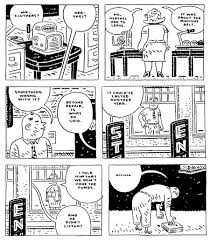
The owner, Mr. Cluthers, is constantly muttering to himself about ways to save the company. His employee, Hershel, is sunk because he's owed a lot of back pay, but it emboldens him to mouth off constantly. So much so that Cluthers thinks he sees Hershel bloviating on a bus and hallucinates choking him. Hershel takes to yelling at failing businessmen to jump from their tall buildings. There's a hilarious sequence where a business owner who's in the process of jumping off the building comes into Cluthers' office, uses his bathroom, offers him some advice and then jumps. When all of the broken-down equipment is repossessed, Cluthers is still obsessed with the idea of making the envelopes by hand, as just one order can help them get out of the red.

The book works as a metaphor for any kind of personal endeavor that's endangered by the whims of the market, and it's not too much of a leap to transfer the sheer absurdity of a three-person envelope manufacturing concern to an equally small art-comics publishing company. Yet one can see Oliveros in D&Q's darkest days, betting on the next book to keep the company going. That said, what marks the characters in this book are their unrelentingly obsessive personalities, an obsession that borders on narcissism and self-delusion. The tiny, scratchy lines on the page give them a nervous, twitchy energy that is especially effective juxtaposed against the classic character and building design. Oliveros proves to be highly proficient in both character and caricature, and the blending of those two worlds gives the book an uneasy sense of both charm and desperation.

Saturday, October 31, 2015

Thirty Days of Short Reviews, Bonus: Drawn And Quarterly: Twenty Five Years of Contemporary Cartooning, Comics and Graphic Novels

The Drawn and Quarterly 25th anniversary anthology (henceforth (D&Q25) is a massive book that's scattered, lacks a cohesive focus but bears examination from a number of angles. As such, here are a number of scattered thoughts about this fascinating monster of a publication.

* This book is a sprawling, joyful exercise in both back-patting and celebration of its departing publisher, Chris Oliveros. As such, the many critical essays in the book aren't exactly hard-hitting, and I thought the way some of the essays rewrote history a bit so as to minimize the efforts of other alt-comics publishers during this period (especially Fantagraphics) bordered on being disingenuous. In defense of this unwieldy cudgel of a book, there is really no attempt at coherency to be found in its production. It's more a victory lap than an anthology, highlighting the many aesthetic (and even a few commercial) victories in Oliveros' reign as publisher. There is the germ of a great anthology to be found here. There were also the beginnings of an authentic history of the publisher, but that history tended to smooth over or ignore the bumps in D&Qs road, except when to mention them would valorize Oliveros and his crew. It's a testament to the quality of D&Q's contributors over the years that this glorified vanity project is so often such a compelling thing to read. For that matter, there are a number of excellent comics in among the more standard-issue tributes.

* The design of the book is typical in that it is beautiful; this is not surprising, given that D&Q brought a beautiful design sense to comics for the first time. Opening up with Tom Gauld's droll minimalism and Dan Zettwoch's elaborate chart-making tendencies gave the book a certain sense of self-effacement and restraint.

* The Sean Rogers-penned History of D&Q hits all the major highlights, especially in terms of zeroing in on D&Q's early reputation as a publisher mostly interested in autobio comics. While the problem of comics as a boy's club is addressed, Rogers overlooks the frequently problematic comics of Joe Matt as a symptom of that club.

* The book is jammed full of testimonials, most of which are at least well-written, if not especially revelatory. The exceptions are those of former employees like Rebecca Rosen, since they really convey precisely what it was like to work at D&Q and what the world of comics was like in general.

* I like that the book connects D&Q's publishing history with that of alternative comics in general, especially in terms of aggressively courting the bookstore market.

* The book goes out of its way to not play favorites in terms of its praise of its roster of artists, which I found understandable if evasive. Every one of their artists is simply awesome, though the book makes no mention of artists leaving D&Q for other publishers or D&Q ceasing to publish authors that had been on their roster for years, like Michel Rabagliati or David Collier. I don't know the whys and wherefores of their departure, but these were two key artists that stopped publishing with D&Q and started publishing with Conundrum Press instead. An honest word or two about how and why the modern roster was constructed and the ways in which business may have interfered with art would have been appreciated.

* I found most of the interviews to be revealing and was surprised at how little overlap there was. Interviewing retiring publisher Chris Oliveros of course made sense, as did new publishers Peggy Burns & Tom Devlin. However, I thought the interview with translator Helga Dascher was a bit much in an already oversized book.

* There were four kinds of comics in this book. There were strips about or in honor of D&Q's 25th anniversary, strips about other subjects, reprints of little seen work and reprints of widely-seen D&Q material.

* The Jillian Tamaki strip about a young women turning her internship at D&Q into a lucrative blogging and then film career is hilariously over the top. Kate Beaton's strip about her "formula" is a gag that's right on the nose, while James Sturm's full story about a "sponsor" for cartoonists kvetching about the success of others is almost a shaggy dog tale, given its punchline. Kevin Huizenga's strip highlights his mordant sense of humor, as he gives a "future history" of his involvement with comics.


* Some of the essays on the artists themselves were quite good, with Joe "Jog" McCullough's essay on Huizenga being particularly instructive. It was a nice touch to have an artist profiled, then to have that artist profile a classic cartoonist whose work was being reprinted, like Chris Ware with the Walt & Skeezix books or Adriane Tomine with Yoshihiro Tatsumi.

* There were a number of interesting "other" strips, including a classic bit by R.Sikoryak, mashing up Walt Whitman with Jack Kirby. Zettwoch's strip typically covers an aspect of Americana without sentiment and with cut-away drawings. Genevieve Castree's story about blankets is probably the most standout in the whole book, as she uses clever design and heart-rending reveals to discuss the roles different blankets have played in her emotional life.

* One of the more interesting features of the book is how it presents little-seen material from its big stars. Chester Brown has two such strips (along with three separate appreciations!), while there's material from a forthcoming book from Tatsumi, new stuff from Ware, etc. There's also brand-new work from Joe Matt that is probably a few years old at this point in terms of when he drew it. The appreciations of Seth by Lemony Snicket and Leslie Stein (respectively) were among the best in the whole book. There's also some interesting archival material from Lynda Barry regarding her novel Cruddy.

* The other reprints mostly mined old issues of the Drawn & Quarterly series, as well as several other books. I found this material to be the most disposable, though I can see why for the sake of completeness it was kept in the book. That inclusion made this an interesting historical document, but not a better anthology.

* Indeed, this may as well have been called the Encyclopedia D&Q, given the number of essays and historical pieces.

* This book is a victory lap and a bit of well-earned log rolling for a company that defied the odds in both surviving and thriving.

* The book is far too unwieldy to read in a single sitting like a typical anthology; it's best digested in fifty page chunks.

* I did appreciate the genuine effort made to give the reader material that, if not new, at least was obscure.

* I thought the balance between D&Q's "big five" cartoonists (Julie Doucet, Joe Matt, Seth, Chester Brown and Adrian Tomine) and the more recent successes like Beaton and Barry was reasonable, although I thought the long section on Art Spiegelman (who has published exactly one book with the publisher) was perhaps a bit overblown.

* I found myself wishing for a more warts 'n all treatment of D&Q, its mistakes (remember the flop of Crumb's napkin sketch book?) as well as its triumphs. This is an interesting oral history, but a highly filtered one.

* In some ways, this book should be thought of as an artifact, something to be referred to in the future as a wonderful bonus. It's an 800 page lagniappe.

* I was baffled that there was no mention of publishing Tani Gevinson's highly successful Rookie books.

* The final irony of this anthology is that the way in which its many editorial voices contributed to its incoherency is amusing, considering that that the publisher was known for 25 years of having a single, distinct editorial and aesthetic voice. To be fair, Burns and Devlin have done much to expand and change that aesthetic since their arrival, creating the beautiful mutant Highwater/D&Q/webcomics creation that marks the publisher today.