Showing posts with label sparkplug. Show all posts

Tuesday, April 30, 2013

Sequart Reprints: Windy Corner 2

The following article was originally published at sequart.com in 2007. Austin is now the publisher of Domino Books. Please consider buying one of the many excellent works he's released, especially since he's losing his base of operations (the legendary Cartoon House). Get the first five Domino books for just 26 bucks, with free shipping. All of them are quite good and unlike most comics you've ever seen.
*************************

My favorite kinds of publications about comics, as I have noted in this series, are those that reflect the idiosyncrasies and passions of its editors. Windy Corner Magazine (WCM) is an exemplar of such a publication. I am particularly drawn to WCM because I share some of editor Austin English's more eccentric tastes, and he does little to buffer or prepare the average reader for them. It's a tact that can be a little demanding on a reader not familiar with English's approach to comics and criticism. The focus of WCM is artists writing about and talking to other artists, an approach that makes sense given English's status as an artist and critic.

I like the give-and-take collaborative feel of WCM. Lis Timpone designed a clever table of contents. Molly Goldstrom opened up the magazine with an odd two-page strip where a man prattling on about his love of bricks fails to notice his companion turn into a tree. Juliacks contributed the back cover, a typically dense collage of image, tone and text with a certain wistful quality.

English continues his autobiographical series of comics with a couple of evocative entries. The emphasis of these stories is on his earliest childhood memories, and I love the way he homes in on tactile sensations from memory, like the feel of the chair he sat in, the distress he felt upon hearing the sound and flash of a star "explode", and the soothing sound of the planetarium show's narrator. In "Movie", his memory is as much about the way he interacted with his parents before and after a movie he saw as the movie itself. The former story looks like it was done in colored pencil, and the decorative quality of the colors he uses to balance out his panels is striking. It balances the panels and actually draws the eye in, something lacking in the second story. That sort of pleasantly ramshackle design quality of his works nicely in his second "Life of Francis" episode, which is almost expressionistic in the way it depicts feeling and emotion. Fiona Logusch's "Entangled Relationships" reminds me a bit of Jules Feiffer's work, both in terms of the way she moves her characters around and the rawness of the emotions she portrays.
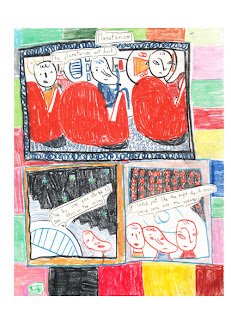
The feature article on children's book illustrator Lois Lenski was positively inspiring. English is unusual for a critic in that he seems to have an intuitive sense in how to discuss the formal qualities of a work in such a way as to bring it alive for the reader. I knew nothing about Lenski's work going into this article, and English probably would have been well-served to have at least some sort of introduction to her work. That said, I appreciate his enthusiasm about the subject and the way he quickly immerses the reader in the formal and aesthetic qualities of Lenski's art.

The interview in this issue was one of the most enlightening I've ever read with a cartoonist. John Hankiewicz, creator of enigmatic & beautiful comics in minicomics and the collection Asthma, was interviewed by cartoonist Onsmith. Hankiewicz reveals much about his working process, the way he approaches doing comics, why he loves printmaking, the specifics of certain stories and his general aesthetic outlook. Onsmith uses his deep knowledge and appreciation of Hankiewicz's work to take the conversation to some interesting places, but he always allows Hankiewicz room to expand on his thoughts.

The standout feature in an issue filled with great features is Dylan Williams's strip about Alex Toth. It's a series of stand-alone images done in what looks like colored chalk, each accompanied by a caption loosely associated with (almost interpreting) the text. It's a wistful piece dedicated to Toth and the intermittent correspondence that Williams had with him over the years. It's also about relationships and friendships and the way Williams approached them and how his feelings about them changed. It ends with a statement of purpose that connects his feelings about being an artist, about Toth, about comics and about long-distance friendships. I can only imagine this piece running in a magazine like Windy Corner , and that's why Austin English's indulgence in his aesthetic passions winds up as a gift to readers.

Tuesday, February 5, 2013

Sequart Reprints: Windy Corner 1

This review was originally published in 2007 for sequart.com
*********************

Reading Windy Corner Magazine #1 was a special pleasure, because I've always found Austin English's taste to be impeccable as a critic and now as an editor. It was a bonus to see so much of his new work as an artist as well. What makes this publication distinctive is its focus on artists and their experiences as artists--how they feel about drawing as much as technical or biographical information. To that end, English has an interview with Andrice Arp, Steve Lafler writes about an anecdote from his art school days, Paula Salemme contributes a few pages from her sketchbook and Richard Hahn has a comic about his thoughts on Saul Steinberg.

I often speak of artists who discuss the pleasurable sensation of drawing, and English is a prime example of this. His draftsmanship has always been primitive, even childlike, but he makes this style work for him with sophisticated composition and a huge bag of storytelling tricks. He has two different storylines in this issue: "Life of Francis", about a girl growing up in the midwest, and "My Earliest Memory Comics", which are self-explanatory. The two different stories feel connected thematically, as Francis grows up poor but becomes an artist. Along the way, she discovers her father's infidelity to her mother, an event fraught with profound significance. We later see him out of the picture as we delve into another memory, and that's what this multipart story is: a series of memories, presented as vignettes. There's one telling page where Francis is drawing and telling her infant brother about the experience. "It's so hard to draw but also so much fun. I can't draw the way I want...but I like the way it feels, the way my arm feels". Drawing as a sensual experience is exactly what English is all about, and when someone asks to buy one of Francis' drawings, we see a twinkle in her eye that suggests a lifetime of balancing the pleasure of drawing with its mercenary and popular aspects.

This story directly segues into English's memory stories, where we see him tagging along with his mother (an artist) at a gallery opening. It's not made explicit, but it's strongly implied that Francis was in fact his mother (or at least the inspiration for same), and Austin is seeing the world of art through her eyes now. English is especially dynamic in telling his story here, with breathless stream-of-consciousness narration applied to each individual panel, forcing the reader through his memories as fast as one can speed through the word balloon. The narration is not exactly done the way a child would describe it; instead, English is clearly trying to reach back to that memory and describe it as an adult, but filtered through the emotions he remembers of that event.

His second memory story, "North Beach", sees him spending time with his father. It's clear that their relationship is very different than with Austin and his mother. There's obviously still a great deal of affection but perhaps not the same kind of closeness, and his memory of going to Chinese New Year with his father ("he knew what a little kid would like he knew this was something I would like") was simultaneously delightful and tinged with danger.

The last story, "Red Balloon", was the sort of small event that can stick in a child's memory for a long time--just a little anecdote about seeing a film in a library with his mother that for some reason lingered on. It's not surprising to see English plunder his memory for materials in these stories, because he always seems obsessed with connecting the emotions one feels as a child with how one engages the world as an adult. It's a theme that rang true in Christina and Charles and certainly is at play here. This is not to say that his comics are simplistic or juvenile--quite the contrary, there's an enormous complexity to his work, as English understands that actually capturing these emotions and experiences is extremely difficult. There's a disconnect between experiencing an event, having a memory of that event, and creating a narrative related to that event--they are all discrete activities that are often conflated as one and the same thing. English seems to understand this and uses a strategy that makes each of these three components as transparent as possible for both himself and the reader. This can be somewhat disconcerting for those who aren't used to seeing the mechanics of autobiographical storytelling laid bare, but the result is a story that is rich with depth and meaning.

The sketchbook paintings of New York's Lower East Side fit smoothly with English's comics. The vivid, almost garish colors of the buildings are almost characters unto themselves. English is generous in the full-color images he reproduces for the Arp interview. As noted earlier, the questions are very much of the sort an artist might wonder about another artist: does she see writing and drawing as the same thing? Is drawing pleasurable? Can you recall your first memory of drawing? How do you modify your drawings to make it understandable for an audience? What's your drawing set-up like, and how much do you draw in a day? What is the benefit of spending time with other artists? English drew out Arp nicely, and the interview was clearly interesting to him because her approach was very different from his. This is where English's status as artist/critic comes into play: though he has a specific approach to his art, he's fascinated by how and why others work. The combination of his understanding the artistic process with a genuine intellectual curiousity is why I've always been interested in both his art and critiques.

Anyone who's ever read any of Steve Lafler's prose knows that he's hilarious. His story of his Advanced Drawing professor in art school torturing the students with seemingly-impossible assignments was a nice counterpoint to the more sober entries in the book. At the same time, Lafler was trying to prove a point about learning not just how to draw but how to see the world in a different way. It was as critically relevant as anything else in this issue, just done from Lafler's off-beat perspective. I hope that Lafler will continue to contribute to Windy Corner, especially now that he's moved to Mexico.

Finally, Richard Hahn (an enormously underrated artist) contributed a startling comics essay of sorts. It's much looser than his normally tight, angular work, giving the sometimes=mysterious images room to breathe and play with each other. The comic seemed to be both a further continuation of the empty city-scapes Hahn is known for exploring along with a commentary on Saul Steinberg's New Yorker cartoons.
Sparkplug Comic Books fills an interesting niche in the world of comics. The work that Dylan Williams publishes is hard to reduce down to a particular type or genre, yet at the same time as a whole is very different from any other publishing concern. It makes sense that he's publishing a comics magazine that's dedicated to featuring artists who get overlooked and discussing ideas not explored in other publications. Each new book by Sparkplug reveals a comic that you didn't know that you needed to read until someone handed it to you. Williams has an ambitious 2007 publishing schedule, which is only great news for the world of comics.

Monday, September 10, 2012

Eight Publishers To Seek Out At SPX 2012

First, I wanted to note that I will be attending the Small Press Expo (SPX) in Bethesda, MD, this upcoming weekend (Saturday 8/15 and Sunday 8/16).  I will be moderating a panel on 8/15 at 11:30am called "British Comics: Does It Translate" featuring a number of UK creators and publishers, including Glyn Dillon (Shade The Changing Man, The Nao of Brown), Luke Pearson (Hildafolk, Everything We Miss), Sam Arthur (co-founder of NoBrow), Ellen Lindner (The Strumpet), and Nick Abadzis (Laika, Hugo Tate). Regular readers of my column will know that several of these artists have been long-time favorites of mine (I've been reading Lindner's comics for over a decade now) and others are new favorites.

There are any number of reasons to be excited by this year's iteration of SPX. Chris Ware, Dan Clowes and Adrian Tomine will make their first-ever appearances here. Mark Newgarden will be here screening some obscure animation. Francoise Mouly and the Hernandez Brothers will be making much-anticipated returns visits. There will be the usual exciting debuts from stalwarts like Fantagraphics, Drawn & Quarterly, NBM, Top Shelf and PictureBox (debuts from Sammy Harkham and Johnny Negron, among others) AdHouse (new books from Ethan Rilly AND Tom Herpich, among others). However, I wanted to shine a little light on several publishers who will be making their SPX debuts, as well as a couple of other important smaller publishers who continue to have a strong presence at the show. Their tables will be loaded with interesting books you may not have even heard of and will be jammed with representative artists.

1. Hic and Hoc. (Table H10) New Jersey's Matt Moses  (at right, above, with Pat Aulisio) is the publisher of this relatively new outfit focusing on collecting minicomics and webcomics, as well as new material. I'll have a big piece on them and a number of other smaller publishers at tcj.com soon, but I've enjoyed Moses' focus on gag and humor work, an area often ignored in the world of small press publishing. Lauren Barnett (Me Likes You Very Much) will be at this table, and she's up for Promising New Talent at the Ignatz Awards. My favorite book of Hic and Hoc's to date is The Complete Talamaroo, by Alabaster. This has just gone into a second edition, so there should be plenty of copies available at the show.

2. Koyama Press. (Tables J7-J10) Toronto-based Anne Koyama finally comes to SPX after several years of publishing extremely well received and highly eclectic comics in a variety of formats. Her table will be jam-packed with her artists and new debuts. Comics wunderkind Michael DeForge will make his SPX debut with the anticipated fourth issue of his comedy-horror series Lose. Julia Wertz joins Koyama Press with the debut of her book on her experience with illness, moving, bad jobs, libraries and other issues, The Infinite Wait (full disclosure: I wrote a blurb for this book). Fellow Old North Stater Dustin Harbin will debut the fourth issue of his Diary series. The Team Society League collective (Aaron Costain, John Martz, Steve Wolfhard, and Zach Worton) will be their with their Book of Answers. Koyama has an eye for developing talent while giving her artists total freedom, not unlike the way Dylan Williams used to run Sparkplug. She also has the well-earned reputation as being one of the nicest people in comics.

3. Retrofit Comics. (Table H14) Philadelphia's Brian "Box" Brown took a well-funded Kickstarter campaign to resurrect the alternative comic book in the form of a subscription service and has turned it into a publishing concern with some impressive books under its belt. Josh Bayer's Raw Power may well be the best of the bunch (a profile I did of Bayer's comics will be featured in the upcoming Studygroup Magazine #2), and he will be at SPX with four new minicomics. Brown will be debuting Flocks #1 by the increasingly prolific and confident L.Nichols and New Sludge City by up-and-comer Brendan Leach, as well as a new comic by himself called The Mark. Tom Hart will also have a couple of heartfelt and personal comics at the Retrofit table but will be repping his own Sequential Artists Workshop (SAW) table with his wife and fellow teacher Leela Corman, who will no doubt have copies of her excellent book Unterzakhn.

4. NoBrow. (Tables A1-A2) This is one of the top British publishers, making their US debut. They're bringing one of their best artists in Luke Pearson, author of Hildafolk, Hilda and the Midnight Giant and Everything We Miss. Known for their illustration books as well as their comics, each of the publications is an art object unto itself, each with impeccable design. In addition to several beautiful anthologies, they also have a number of shorter, affordable books in their 17x23 series (I strongly recommend books by Jon McNaught) and also publish Jesse Moynihan's excellent Forming. Co-publisher Sam Arthur and Pearson will both be part of my British comics panel while fellow co-publisher Alex Spiro tends to the table. Any fan of beautiful-looking comics owes it to themselves to give their table a look; their house anthology NoBrow #6 is up for an Ignatz award.

5. Oily Comics. (Table I12) Chuck Forsman (left, above, with Alex Kim) has ambitiously started to recruit fellow artists to publish serialized minicomics for his new publishing concern, and the results have been beautiful thus far. In addition to his excellent The End Of The Fucking World, he's publishing Melissa Mendes' poignantly sweet Lou, Max De Radigues' Moose, and new comics by Aaron Cockle, Dane Martin, James Hindle, Jessica Campbell and more. He'll be sharing a table with fellow Sundays editors/contributors Kim, Joseph Lambert and several others. Fans of quality minicomics should essentially buy the whole lot, because there's not a loser in the bunch he's chosen to publish.

6. 2D Cloud. (Table W61) This small outfit from Minneapolis begun by Raighne Hogan (above, with his wife Meghan) has been quietly publishing beautiful art objects and introducing new and exciting talent for a few years now. They will be out in force at SPX with new releases from co-publisher Justin Skarhus (RDCD Fist #1.5) and newcomer Christopher Adams' Period. Their table will also feature Nicholas Breutzman (Yearbooks, Motherlover), Sharon Lintz (Pornhounds, which includes personal, riveting stories drawn by the likes of Breutzman, Lindner and others), Meghan Hogan (debuting her new comic) Vincent Stall (with Things You Carry) and Will Dinski, whose 2D Cloud debut is a comic called Ablatio Penis. They also published Noah Van Sciver's excellent Igntaz-nominated comic The Death of Elijah Lovejoy. I would also strongly recommend picking up a copy of Good Minnesotan #4, which was one of the better anthologies of the last couple of years.

6. Secret Acres. (Table J11-J12) The Brooklyn-based publisher consisting of Leon Avelino and Barry Matthews (left to right above, with Gabby Schulz in the middle) have been showing at SPX for many years and have racked up a number of Igntatz awards, and for good reason. This year, they'll have Mike Dawson in contention for an Ignatz with his excellent Troop 142 and also have the debut of Theo Ellsworth's new hardcover, The Understanding Monster. Sean Ford will be at the show as well with his recent completed Only Skin. Eamon Espey will also be there, and I would urge you to check out some of his disturbing, intense minicomics that will soon be collected. This publisher has always combined a sterling design sense with cartoonists who have singular aesthetic senses.

7. Sparkplug Comic Books. (Table W59) Publisher Tom Neely (above) will be repping Sparkplug for SPX, the first after Dylan Williams' death last year. Katie Skelly will also be at their table with her recent complete Nurse Nurse, the first book Sparkplug has published since Dylan died. As always, Sparkplug always has a table full of marvelous minicomics discoveries thanks to their status as a major distributor of minis, and this year will be no exception. Be sure to check out Neely's own unique works, like The Blot, The Wolf, his anthology Bound & Gagged and his part in the amazing Henry and Glenn Forever. Tessa Brunton's Passage was nominated for an Ignatz, and she's also up for Promising New Talent.

8. Hidden Fortress Press. (Table C8) This is the name of Paul Lyons' (above, with Cheryl Kaminsky) publishing concern, and this former member of Fort Thunder will be debuting the new issue of Monster. This is one of the best of all alt-comics anthologies, pushing the line between fine arts and comics in a horror genre context. This will be one of the potential "book of the show" choices. Kaminsky, Roby Newton and possibly Brian Ralph will also be at this table.

Sunday, April 15, 2012

A Couple of Worthy Fundraisers

Just wanted to bring a couple of worthy fundraisers to your attention.


First, Sparkplug is still about $5,000 away from meeting their goal of fully funding their next three projects. This is their first publishing effort since the death of Dylan Williams and meeting their goal would go a long way in allowing them to continue to publish new work. The perks included in this fundraiser are pretty great, so please consider donating.

Second, interesting new cartoonist Grant Thomas is trying to fund the second issue of his series My Life In Records. I reviewed his work here, including the first issue of his series. Check it out.

Monday, March 19, 2012

A Worthy Fundraising Effort: Sparkplug Comic Books

Sparkplug Comic Books is trying to fund their next three books, which are Katie Skelly's Nurse Nurse, Elijah Brubaker's Reich #9 and Olga Volazova's Golem of Gabirol. Please consider donating to keep Sparkplug going and to fund these very worthy projects.

Tuesday, September 13, 2011

Some Thoughts On Dylan Williams

(photo by Neil Brideau, by way of Raighne Hogan)

Sunday at SPX 2011 was part convention, part therapy session for many of its participants as most everyone woke up having heard that Dylan Williams, the publisher of Sparkplug Comic Books, had died. There's a pretty remarkable outpouring of grief and moving remembrances of Williams happening on the web right now; both Tom Spurgeon and Brian Heater are attempting to capture all of these links. What I hope to do here is not discuss his influence as a publisher or work out his importance as a historical figure in comics. I will be spending ample time in the future on this topic and those results will appear elsewhere, but it's important to at least note that one of the keys to his legacy is indeed the few dozen excellent, idiosyncratic and poetic works of comics published under Sparkplug's blanket. Instead, I want to work out some personal thoughts and ideas about Dylan.

I first met him at SPX 2002. That show had been long-awaited, as the 2001 iteration was canceled thanks to 9/11. As a result, that show was absolutely stacked with talent: the Hernandez Brothers, James Sturm, Ivan Brunetti, Jason (in one of his first US appearances), Charles Burns, Phoebe Gloeckner and many more. Jeff Mason's Alternative Comics was at its height, with the first collection of Gabrielle Bell's work and the Rosetta anthology. Still, I noted at the time that the fledgling Sparkplug Comic Books "may have had the most exciting books at the show", which included Jason Shiga's Fleep and Hello, World, and the excellent Orchid anthology (which I later tabbed as one of the best of the decade). T. Edward Bak and Ben Catmull were also at his table, with Catmull selling his Xeric-winning Paper Theater.

That's back when I occasionally wrote for Savant, attempting to inject some alt-comics flavor into what was mostly a Vertigo-inspired publication. Dylan quickly took notice when I started writing for sequart.com and started sending me everything he was publishing. That's when I learned that he, like me, had remarkably catholic tastes. He loved a lot of different things that can be called comics and was unambiguous and effusive in his affection for everything from golden age comics to select silver age to undergrounds to humor to autobio to burgeoning forms like comics-as-poetry and immersive comics, two styles that he championed far more than any other publisher.

We always shared a warm and cordial relationship, and I felt we understood each other well. He was one of the first publishers to take me seriously as a critic, and saw how seriously I take this endeavor. I only got to see him at shows, and I have great memories of collaborating on how to shape a publishers' panel at SPX 2008. We would write each other notes about things the other had written, which was all too rarely in Dylan's case. In some respects, Dylan was a modern-day Bill Blackbeard. He genuinely loved comics, not as an obsessive/collecting/fetishizing hobby, but as beautiful objects with meaning that are unjustly discarded by the wider culture. More to the point, Dylan subsumed both his career as a cartoonist (where he had been quite active for more than a decade) and a historian (he should have been in a position to have written several books) in order to publish, encourage and nurture the works of other cartoonists. This was not perhaps the most glamorous of choices, but it not only wound up having the greatest benefit for comics (much like Blackbeard's editing so many anthologies changed the lives of readers forever), it was the right use of his skill set.

Dylan was a good cartoonist but not yet a great one; he may well have reached that level, but it was clear that it was something that didn't come easily to him. I think the same may have been true as a writer; I got the sense that he didn't trust his own voice sometimes. Simply put, he didn't enjoy self-aggrandizement or much personal attention in general. On the other hand, he was a phenomenal publisher. His instincts were unerring. He nurtured talent like no one else. He would see things in artists, very early in their career, that they themselves could not yet perceive. This is not to say that he was disingenuously kind; he only accepted work that met his demanding standard, yet always encouraged those he rejected in very specific ways on how to get better.

I think the key to understanding Dylan Williams is that he always thought as a cartoonist, first and foremost. And as a cartoonist, he was an outsider. Publishers rarely touched his work. As a publisher, he was an outsider. While no alt-comics publisher is really out to make money, Dylan brought a scrupulously fair and ethical approach to publishing inspired by punk icon Ian MacKaye. That business model was a small, self-sustaining approach driven not by maximum profits but by a realistic publication schedule, reasonable prices and fair practices for artists, all in the support of work he believed in completely. Dylan felt uncomfortable when artists and editors talked more about book deals and money grabs than they did about the actual comics themselves. I'm not sure he felt comfortable thinking of himself in the same company as Gary Groth or Chris Oliveros, publishers who obviously put out books they believe in, but are also businessmen who have a bottom line and who can only afford to finance a few big losers. Those two are also beholden in some respects to Diamond, which wound up putting the kibosh on a number of their low-selling series. Dylan steadfastly avoided dealing with Diamond and found a way to make it work on a small scale, no doubt at the cost of possibly thousands of dollars.

Dylan may have been an outsider, but he was not an iconoclast. From the start of the career with the Puppy Toss minicomics cooperative, he was a networker. He networked not to move up in the world of comics, but to bring people together. In much the same way disparate artists found themselves part of a community in the 60s with the underground movement and in the 80s with the Newave movement, Dylan helped foster that same sense of purpose and encouragement to another generation in the 90s. Sparkplug was the reification of that ideal, one made at around the same time he was originally diagnosed with cancer. I don't think this was a coincidence.

Dylan thought himself an outsider, and the biggest tragedy of this viewpoint is that he did not understand until it was almost too late just where he stood in the eyes (and hearts) of others in the comics world. As a close friend of his told me, he didn't think of himself as a beloved or inspiring figure to twenty years' worth of cartoonists. He thought of himself as someone getting the job done, as doing the best he possibly he could by the art form & the artists that he loved so much and that had given him so much inspiration (or as he once told me, "Just do your best, always."). In the last few weeks, when there was such a bountiful outpouring of support, love and money after his plight became publicly known, he finally understood, in no uncertain terms, just how everyone felt about him. Fans and friends fell over themselves to buy books. Critics rushed to recommend books. Peers started up an art auction for him, one that is still ongoing and whose need has not passed, given that more bills will need to be paid. Dylan felt that love, which makes it all the more shattering that he died in such a sudden manner.

His death certainly leaves a void in the lives of his family and friends. Clearly, the uncertain status of Sparkplug will be something to consider at a later time, after the mourning is over. There aren't many like him in comics today. That said, the narratives springing up about him and his impact reveal him to be a huge, nurturing tree whose branches spread far and resulted in sprouting blossoms across the world. He provided a model for how to think about comics, how to act with integrity as a businessman and how to treat others as a publisher, and this is his ultimate legacy: he upheld fairness in the arts field with the history of the most inhumane, unfair practices. It's now up to those he inspired to carry forward his example.

Sunday, August 28, 2011

Sequart #174: Inkweed

Here's a review of one of Sparkplug's best-ever releases, Chris Wright's Inkweed. This was originally published at sequart.com
**

The last book I'm reviewing in the latest wave of releases from top-notch boutique publisher Sparkplug Comic Books is Inkweed, by Chris Wright. Publisher Dylan Williams once again provides a platform for an artist with a distinctive voice and style, collecting stories from a number of different places into one thematic whole. The gestalt of Wright's work may be as fully-formed as I've ever seen from a relatively young artist, with the stylistic choices he makes fitting in perfectly with his themes. The result is a comic that is unnerving, uncomfortable and relentlessly compelling. His work is one of contradiction: his figures are grotesque but majestic, scratchy yet imaginatively designed, and monstrous but recognizably human. Wright employs a scratchy, dense line jammed with cross-hatching and shadow. His figures are often distorted but expressive, and he never sacrifices clarity for effect. His use of gesture and body language makes his characters recognizably human even if they don't quite appear to be. The oddness of his figures is especially given context with the way he uses the eyes of his characters to guide the reader.


Wright's themes overlap, and he cleverly arranged the stories in the book such that one theme led to another. The first story, "The Unmerciful Gift", is about an artist who can no longer paint works that others can see--they simply look like blind canvases. The story is about sacrifice, obsession and the ultimate futility of that pursuit. Here, Wright's cross-hatching creates an emotional weight, a density where there is no relief for the reader. Wright observes obsession from a different point of view in "Tapestry", about an aging astronomer who desperately reaches out to his young female assistant. The desperation is not born simply out of loneliness, but out of the terror of his increasing realization of his insignificance in the face of the infinite. In the end, she leaves and he has no choice but to continue to try to chart the abyss that he studies every night. The way Wright contrasts the astronomer's bravado by day (asserting how much more scientists now understand) with his terror at night was the story's master stroke.

"Snake" and "Truth" both look at love from different points of view. The first as a form of temptation that no one can avoid, and the second as an actively pernicious force that we nonetheless are endlessly drawn to. In both tales, Wright creates a vaguely mythical, fairy-tale type background for the stories. Those two shorter stories prepare for the true gut-punch of the collection, "Urn". It's Wright's most devastating and masterful short story, with an introduction that piques interest and warns us that tragedy is ahead, but the reader could not possibly be prepared for what was to come. The story is about "love", but it's really about the many things we call love that are really something else. It's about guilt, lies, self-hatred, self-deception and the way all of these things come home to roost in the end. The most devastating part of the story is that the most despicable character is also the only fully truthful one.


Inkweed is also about creation and destruction, slipping between the stories of gods and artists. "The Sea Demon" essentially presents a set of dilemmas not unlike faced by the other artists in the book. "Rags and Turpentine" is interesting because it features one of the few characters in the book that is at the height of his creative powers, only he doesn't know it. An artist in love (or probably lust), he's conflicted by his desire for a woman who is also an artist and the possibility that he doesn't even like her work. Like many of the characters in Inkweed, the artist character gets drunk as a response to his surroundings. The loopy panel design reflects his wobbly orientation. Wright balances the philosophical, probing nature of his stories with visceral, earthy concerns that often put the lie to many of the characters' beliefs.


That tension between mind and body is at the heart of Wright's stories. In particular, Wright gets at the disconnect between the two, as his characters don't always understand their own motivations or don't figure it out until it's far too late. Wright modulates pleasure and pain here, as there are many ridiculous, laugh-out-loud moments to go with the melancholy or horrific ones. The intersection between obsession and desire is painfully evoked by Wright's art, and his unusual character design sucks the reader into this world where "he who learns must suffer", where journeys of discovery come at a terrible price.

Sequart #72: Bookhunter

Here's another old Sequart.com review of a Sparkplug comic that I greatly enjoyed, in support of Dylan Williams.
**


One reason why I love comics is that one occasionally runs into a creator producing art that would only work as comics. I prefer not to use reductive terms like "pure cartooning", but I have a great appreciation for many artists who rethink this idea of making marks on paper for a narrative intent and come up with different angles. One such artist is Jason Shiga, an artist who simultaneously manages to have a cult following in the world of comics and a broad following in the larger culture. He's been contributing his odd choose-your-own-adventure comics for Nickelodeon magazine for some time, and his twisted sense of humor has been perfect for that venue. He's also crafted a series of minis, collections and odd art objects that elicit nothing less than sheer delight.

Shiga has a degree in math and works as a librarian in his day job. Coming from that point of view, he views comics and storytelling quite differently than most artists. At the same time, that point of view is in tune with what all great gagsmiths and storytellers must do in creating a narrative: state a premise or problem and then go through the process of solving it. If Shiga reminds me of anyone, it's Lewis Trondheim, whose intuitive approach in boiling down conflicts in pursuit of a gag always leads to satisfying and sometimes unexpected conclusions. Shiga's approach appears to be more studied, but the mechanics of his process drop out on the page thanks to his absurd (and often surprisingly dark) sense of humor.

Shiga's created comics that are visual palindromes, complicated (and violent) choose-your-own-adventure comics, and comics that are problems that have to be solved. In his longer-form work, Shiga displays his facility for writing taut, tense stories that use genre trappings for unexpected results. Double Happiness was about an Asian man who grew up in a mostly caucasian community who goes to live in an Asian community where he feels equally out of place. This comic isn't about teaching some kind of lesson in identity or acceptance--it takes several sharp and shockingly violent turns to an ending that is unsettling. Fleep begins with an incredible premise--a man awakes with no memory, finding himself trapped in a phonebooth that's been covered in cement--and works as a sort of logic problem, as the man uses his possessions to try and find a way out. His ultimate identity is the kind of twist that was there all along but was cleverly hidden from the reader.

Shiga's art is simultaneously utilitarian and idiosyncratic. He uses crude, blob-like figures that somehow manage to capture emotion and expression with great sensitivity. They way these cute figures provide a counterpoint to the sometimes savage violence seen in his stories makes reading his comics all the more jarring. The cuteness of his figures is always played straight, however, and they usually fade into the background of one's mind as the reader gets involved with the story.


His latest comic, Bookhunter, is perhaps his most ambitious integration of image, figure and story. The plot of the book is simple: it's a police procedural about a stolen book and the team that tries to track down both book and thief. It's the details of the story and the variables that Shiga alters that make this one of the best comics of 2007.

First, the book is set in 1973 Oakland. Shiga is clearly inspired by the look and feel of 70's cop pictures, and the sepia tones he uses throughout the book are meant to invoke that era. With the look and feel of the book established for the audience, Shiga changes just one variable that turns out to be a major curveball: the existence of the Library Police. That is, an entire branch of the police force dedicated to tracking down rare book thieves and the tomes they plundered. This team at times must use SWAT-team tactics but also employs high-tech (for 1973) forensic science and the latest in technology. Despite the ridiculousness of this premise, Shiga plays it straight as the library police goes through its detailed and painstaking process of trying to figure out who committed the crime.

Shiga ups the ante by making the theft "three concentric locked-room mysteries", tackled by Agent Bay and his team. Shiga takes obvious delight in constructing the mystery, having a team attack it and cracking it through equal parts hard work and luck, and do it with technological limitations that would be unthinkable today. As a librarian, it would seem that Shiga would be quite well-versed in the history of library science and security, and so when thinking about how this crime could be committed, ran through all of the possibilities in his head. Whether or not he was an expert in early-70's library security protocols, his authorial voice is so confident that it's not important.

The tropes found in 70's cop movies are touched on here, mostly as a way to add tension and dynamism to the story. The book begins with a sort of mini-feature of another case that Agent Bay and his team were solving, and ends with a spectacular and hilarious act of violence that immediately sucks the reader in. From there, we move on to the main story, starting with Bay and his team speeding to the scene of the crime. The team investigates the crime scene, analyzes evidence, finds clues, and begins to understand that this may have been the perfect crime. The relentless Bay pushes his team, follows hunches and long-shots, and uses every resource available to him (including a primitive internet). The search for the thief resolves in spectacular fashion once again, and Shiga's art once again adds a touch of the absurd to the proceedings even if the events are played straight. Shiga then adds an additional twist and climax that make this an enormously satisfying read.

The simplicity of Shiga's style doesn't obscure the spectacular quality of his composition. Cinema is once again both an inspiration and an object of parody, like in the mute scene near the beginning of the story where Bay observes a day in the life of this library. He's asking questions but Shiga leaves out the dialogue, almost like a camera wanting the viewer to concentrate on the visuals of a scene. It culminates in a 2-page panorama shot of Bay standing at a rail
overlooking the rest of the library at a dizzying height, reminiscent of the famous shot of the Library of Congress from All The President's Men. Shiga borrows from film in this comic, but one could never imagine this comic as a film.

There's no one else quite like Jason Shiga. The way he looks at comics as problems to be solved gives them a kind of narrative tightness that draws the reader in immediately and holds them. Combining that sort of precision with a delightfully loose line, warped sense of humor and fiendish sense of timing makes him one of my favorite creators.

Saturday, August 27, 2011

Sequart #37: Mine Tonight

In support of Sparkplug, here's another old review of one of their releases from Trevor Alixopulos. This is from 2006 and sequart.com.

***********

Those that follow the minicomics scene will observe that geography plays a large part in forming artist support groups. These groups provide encouragement and critique for young artists and play a part in their development. The recent development of a sustained book publishing beachhead in the world of comics has suddenly made being an art comics practitioner potentially lucrative--or at least something that could pay the bills. Look at Raina Telgemeier. She went from self-publishing minis to getting a story in an anthology, which led her to get a contract to do graphic novel versions of the Babysitter's Club novels for Scholastic. Then there's the FLIGHT crew, who took a chance with a full-color anthology that has become so successful that the third volume was picked up by Ballantine.

In recent years, those loose associations have yielded some interesting results. In St. Louis, the USS Catastrophe crew of Kevin Huizenga, Dan Zettwoch and Ted May have not only served as a focal point for minicomics distribution, they?ve gone on to much wider regard. Huizenga and Zettwoch in particular are rising stars for Drawn & Quarterly and the cutting-edge Kramer's Ergot anthology. Huizenga also has a series for the prestigious Ignatz line at Fantagraphics. In Chicago, the Holy Consumption group of Paul Hornschemeier, Jeffrey Brown, Anders Nilsen and John Hankiewicz have also taken the art-comics world by storm. Three of the artists have regular gigs in Fantagraphics' wide-reaching Mome anthology, and between the four of them, have comics published by Fantagraphics, Drawn & Quarterly, Dark Horse, Sparkplug Comic Books, Top Shelf and Buenaventura. Just a few years ago, they were honing their craft in minicomics. Thanks to their talent and a broadening market, they're now significant figures in the comics world.

As a writer, critic, editor and general observer of the comics world, I make it my business to track the most promising minicomics artists. Not only to determine who might produce great work in the future, but because the minicomics themselves are such an engaging and immediate form of the comics experience. Emerging from a West Coast group of artists that includes Jesse Reklaw, Andrice Arp, Lark Pien, Thien Pham, Jason Shiga and others, Trevor Alixopulos has shown an astonishing learning curve in recent years. He's gone from making crude but promising minicomics where he was clearly working out his influences to developing his own voice.

That voice is hard to characterize. There's an edginess, a certain paranoia, that surrounds his best work. In particular, a long minicomic called Dread was a big step forward for him. Mine Tonight manages to combine all of his interests in one cleverly-designed format. It's part paranoid political thriller (albeit with a 21st century twist), part love story, part dream journal, part history lesson, part autobio comic. It's got the feel of noir fiction and slacker/punk stories. The art is loose and expressive, with a moodiness belied by his exaggerated figure drawing. The nervousness and anxiety that his characters feel is expressed nicely through sweaty faces and a sense of claustrophobia. The whole package works, and the result was a story that was a genuine joy to read.

The story follows Lukas Blum, the sort of lost soul not unfamiliar to noir stories. Except Blum followed a run of dissolution by hooking up with an unusual political machine, headed by mysterious Hungarian financier George Miklos. Miklos is a thinly-veiled version of George Soros, the billionaire who donated money to groups like Moveon.org in support of John Kerry. Blum had met him at the last great moment of American protest: the 1999 WTO protest in Seattle. That event looms large in the book, as Blum flies to New York to put a plan of Miklos' into effect. That plan is for Blum to find 5 million dollars that Miklos has hidden in a shell organization and get it to Kerry's campaign in order to help him win the 2004 election. Despondent, adrift and confused, Blum contacts the one person he knows in New York: cartoonist Trevor Alixopulos.

The book takes plenty of side trips and diversions, as Blum reads a weird strip by Alixopulos in a weekly newspaper, we get detailed accounts of dreams that are haunting Blum, and we see a story by Alixopulos about his own involvement at the WTO protest. It's clear that the experience was a significant one for him, but that he also went through a long period of disillusionment and confusion. He also is clearly self-deprecatory towards his own career up to that point; one senses that he regretted wasting time on trivialities but that he's past that point now. Through his own character and that of Blum (a sort of alter ego), this book feels like the author taking stock of his career. There's a certain wistfulness here, but also hope for the future.

While the book has a noir feel and plot, Alixopulos subverts the reader's expectations at every turn. The culmination of his mission is deliberately anti-climactic, partly because of the electronic age we live in. Blum has every opportunity to act the tough guy, but can't bring himself to do it, and falls in love with a woman who's the key to completing his mission. In the end, the book was really about the possibility of reinvention and ends on a hopeful note.

Sequart #167: Hot Breath of War

This weekend, I'll be republishing some old reviews of various Sparkplug comics. Today, it's a pair from Trevor Alixopulos. This review originally ran on sequart.com.
**

Trevor Alixopulos struck a nerve with his paranoid capitalist spy thriller Mine Tonight, and he follows that up with war parables in The Hot Breath of War. His style is more eccentric and playful than usual, channeling Jules Feiffer and Elzie Segar into his work. He's always had a loose and expressive style, especially with regard to his character design, and he unleashes that here on pages that are mostly have just one or two panels each. Alixopulos' opening salvo is his invocation of a Thomas Paine quote noting that "He who is the author of war lets loose the whole contagion of hell and opens a vein that bleeds a nation to death". This book is as much about the collective consciousness of a society as it is about war itself, and what happens to its citizens when times become warped beyond comprehension.


There are six separate stories in the book and they are loosely connected in terms of theme. Roughly speaking, the stories break down into stories about soldiers, stories about victims and stories about life during wartime. The two stories about a pair of soldiers, "We Are Defeated" and "Vallodolid 1936", couldn't be more different in terms of tone. The former is political satire as slapstick, as Alixopulos is at his most playful, culminating in a punchline and a plop-take. Body language is one of Alixopulos' greatest strengths: his characters are always slumping, leaning, slouching or falling forward. The exception is "Vallodolid 1936" where a communist soldier fighting during the Spanish Civil War is captured and sent to die before a firing squad. As the chapter nears its inevitable conclusion, the art becomes more realistic and the prisoner stands ramrod straight, defiant in the face of death and meaninglessness.


The two stories about victims, "There's A Monkey On My Back..." & "...and His Breath Is Hot" read more like fairy tales or parables, albeit without a moral. The former story takes a child who resembles Huck Finn (or perhaps Dennis the Menace) and forces him into a mythic journey. The narrator guides the reader through the story and simultaneously deconstructs it. The boy comes to what appears to be a happy end, at least in his own mind, but the doomed expression on the faces of those who save him tell a different story. "...and His Breath Is Hot" mimics the action of a stage drama, as a soldier returning from war meets a girl dragging her dead mother away in a wagon. The formal nature of their dialogue and the give-and-take between the two characters is deliberately stiff and awkward. The reality is that there's really nothing left to say for the girl and the soldier.

The life during wartime stories, "A Journey Into Time" and "Data Recovery" find Alixopulos on his most familiar and firmest ground. These are variations on the sort of urban romances he's been writing for quite some time, only far bleaker. "Data Recovery" finds our protagonist skipping out of his night shift job in a desperate attempt at seeking connection in a world that's become increasingly unreal and meaningless. In an echo of Hurricane Katrina, he finds that the party and subsequent hook-up he gets into are really the last revel before the apocalypse, as the ocean sweeps away his city. As much as the protagonist is looking for connection, he's also looking for something to do, trying to forestall boredom (and hence oblivion) in the face of the chaos he encounters.

"A Journey Into Time" interweaves the stories of three characters, including a carefree anthropomorphic cat. The cat lacks the desperation of the other characters, flowing freely along life's tide to create a balanced existence. The girl in the story is seeking human connection even as she must cut herself off from a relationship that was in danger of wrecking her own sense of narrative. The man in the story is an agent of crass materialism, seeking to possess what is not his and threatening to destroy what he can't have. He possesses an enormous sense of entitlement, wanting what he hasn't earned because he figures it's owed to him somehow. The specter of war looms in this story from two servicemen who run a bar (one horribly injured) to the sense that this feeling of entitlement is what keeps wars running.

The overall effect of this book was somewhat scattershot. It took a few readings to really grab on to it, to not only absorb each story but try to contextualize them in relation to the others. That effort is more than worth it, especially when one understands the way Alixopulous not only is paying tribute to classic cartoonists but also recontextualizing familiar war iconography. Sex is a key undercurrent of the book. In Freudian terms, this book is very much about the eros and thanatos drives, and the way the latter affects and pathologizes the former. Alixopulos' greatest feat was creating a work that is very much a political statement that avoids didacticism, one that examines issues from a variety of viewpoints but that allows the reader some flexibility in playing with these ideas. While it's not quite as crisp a read as Mine Tonight, I think Alixopulos was deliberately trying for a much different effect. His passion for dissecting issues related to global politics has become perfectly integrated with his understanding of how best to depict them in comics form.

Tuesday, August 23, 2011

Dylan Williams Needs Your Help

As anyone who is Facebook friends with him knows, Dylan Williams is very seriously ill and could use the help and support of the comics industry. The cartoonist and publisher of Sparkplug Comic Books indicated that beyond getting good vibes of support from his many, many friends, he could use financial support in the form of people ordering books.

It's no secret that Sparkplug has been one of my favorite publishers over the past decade, as Dylan has really put his money where his mouth is in publishing work that he truly loves. Please consider stopping by their shop and ordering some books, comics or minis. Williams has been distributing books from like-minded souls for quite some time, so chances are there's something you've missed. Please consider buying something from my suggested shopping list below, or anything that strikes your fancy from their extensive catalog.

Here's a quick baker's dozen or so of Sparkplug's greatest hits:

1. Asthma, by John Hankiewicz. One of the greatest books of the past fifteen years and the best example of comics-as-poetry.

2. Bookhunter, by Jason Shiga. A hilarious and exciting homage to both 70s police procedurals and library practices.

3. Gay Genius, edited by Annie Murphy. A top-notch assemblage of talent mostly unknown in wider comics circles.

4. Orchid, edited by Dylan Williams & Ben Catmull. Sparkplug's first release contains work by a number of cartoonists who would have a big impact, like Kevin Huizgena and Gabrielle Bell.

5. The Heavy Hand, by Chris Cilla. A dizzyingly inventive book, one of the best of 2011.

6. Inkweed, by Chris Wright. A collection of short stories united by Wright's scratchy line and monstrous character design, along with his bleak but humanistic outlook.

7. Department of Art and Habitat, by Dunja Jankovic. Inventive and oppressive "immersive" comics about a woman facing the terrors and ennui of work and then home.

8. Rock That Never Sleeps, by Juliacks & Olga Volozova. A delightful and strange series of interpretations of a town related to memory.

9. Whirlwind Wonderland, by Rina Ayuyang. A lovely collection of autobiographical short stories.

10. The Hot Breath of War and Mine Tonight, by Trevor Alixopulos. Fascinating and cleverly cartooned stories dealing with politics, sex, war and living in the modern age.

11. The Airy Tales, by Olga Volozova. A series of lovely, immersive fairy tales of a sort.

12. Reich #1-8, by Elijah Brubaker. This is a biography of controversial psychologist and researcher Willhelm Reich, told as objectively as I've ever seen.

13. Christina and Charles, by Austin English. English's first long-form comic is still my favorite in the way he depicts music and familial relationships.

Friday, July 15, 2011

Sequart #162: Reich 3-4

This review originally appeared at sequart.com in 2007.
*********


The first two issues of Reich focused on the basics of notorious psychoanalyst Wilhelm Reich's early adult life, creating a narrative that tried to navigate between the extremes of opinions regarding his life and work. Issues three and four mostly flash back to his childhood and the roots of his obsession with sexuality and difficulty with intimacy. After the flashbacks end, we begin to see how Reich's work intersected with the culture of Germany between the world wars, and the way it essentially broke down to freedom vs. control.


Artist Elijah Brubaker takes a risk by basing most of these two issues on a short autobiography by Reich about his childhood. Brubaker acknowledges this in his essential endnotes, noting that there's no way to prove certain of Reich's claims, like losing his virginity at age eleven with a family cook. What was obvious was that Reich's obsession with sex and sexuality bloomed from a very early age (which, as he notes, is not unusual for a child who grows up on a farm). The reasons for his obsession with exposing sexuality as an open topic of discussion also became clear, given his mother's affair and the brutal nature of his father's jealousy. Of course, that insight came at a steep price: the development and nurturing of his own emotional intimacy.


By focusing on orgasm and sexual health as an essentialist issue, he blinded himself to the emotional complexity of human relationships. His dogged belief in the liberating power of orgasm took an interesting turn with the rise of fascism in Austria, as communists clashed with Mussolini-funded thugs. Reich saw a clear line between the oppression of patriarchy that plays out both on a state level and within marriages with sexual repression; the latter became an instrument by which the former was able to use fear, terror and violence to snuff out human freedom.

This issue felt like the end of the prelude, and that the action in the story's narrative will soon ramp up. Brubaker is taking his time continuing to establish Reich's complexity as a human being and putting his ideas and experiences into historical context. One thing I like about this series is that it takes advantage of its nature as a periodical. Brubaker ends each issue on a cliffhanger of sorts, and each issue feels like a complete story even as it's part of a larger narrative. That's because Brubaker is able to skillfully end each issue at the end of an emotional story beat. For example, at the end of issue #3, the story ends with Reich's father discovering his mother's infidelity and demanding that young Willhelm tell him everything he knows. Brubaker's highly stylized, expressionistic art wouldn't look out of place with the art in Vienna at the time. His use of sharp angles and shading on faces adds a frequently painful depth to the largely sober and restrained narrative voice. It's exciting to see Sparkplug's willingness to publish periodicals in an age when more publishers eschew the traditional comic book format, and one can sense that Sparkplug's Dylan Williams will let Reich take as long as he needs to finish his story.

Blue Cheer: Reich #8


The eighth issue of Elijah Brubaker's series about the life of Wilhelm Reich, Reich, starts to get at the heart of the concepts that Reich was best known for. After throwing out hints about his more unusual methods, theories and devices by way of exploring his childhood and early clinical career in earlier issues, Brubaker fast-forwards to 1946 and introduces us to Reich's orgone box. If the past two issues established Reich in America as a man with a persecution complex who spread that paranoia to his children and assistants, then this issue reveals that sometimes paranoids have real enemies. Once again, Reich is presented as a tragic hero. He's a visionary with any number of enlightened views about sex, gender and repression. At the same time, the lack of affection he received as a child made him cold, reserved and defensive within his own relationships.


Issue eight sets the beginning of the end into motion for Reich, as a hatchet job interview leads the Food & Drug Administration into action to investigate the potential quackery of Reich's orgone box. Essentially, Reich believed he had discovered a visible form of life energy called orgone. He inadvertently built a box that "accumulated and amplified" this energy, which he believed had "healing effects". In conjunction with "the proper psychological outlook", Reich asserted that orgone therapy could heal anything. As always, Brubaker is sympathetic to Reich's position in some respects while still retaining healthy skepticism. A key scene in the book features Albert Einstein, to whom Reich appealed for support. Einstein flatly rejected the science of the orgone box, and anyone with a scientific background can see that while Reich's methodology was sound in terms of the scientific method, his foundational premise was greatly flawed. Reich's stubbornness didn't allow him to reconsider his premises and simply repeatedly ran him into the same set of flawed results.


Brubaker skillfully plays that scientific rigidity of thinking into Reich's emotional rigidity, as one of his daughters scolds him for rebuffing the visit of another daughter on a day he had a toothache. Reich's view of human relationships is so reductionist that he fails to see just how irrational he can be even as he decries others for being neurotic. As the rain begins to fall at the end of the issue, FDA agents show up at Reich's door. They are clearly looking for someone to rake over the coals, and Reich's lack of flexibility as a researcher and human being make him a perfect target. His hubris and arrogance will wind up being his undoing, and this issue is the calm before the storm. As always, Brubaker's moody and angular drawings throw the character's emotions into sharp relief; his use of shadow in particular evokes despondency and uncertainty, while a careful use of cross-hatching and naturalistic drawing in places and objects anchors his pages and gives them weight. Chester Brown continues to be an inspiration for Brubaker in terms of the slightly detached storytelling style, the heavy research into a controversial historical figure, and the extensive use of end notes. Brubaker is more expressive than Brown's tighter style inspired by classic cartoonists, but makes his idiosyncrasies as an artist into his signature as a storyteller.

Wednesday, June 8, 2011

New Review @TCJ: The Heavy Hand

Over at The Comics Journal, my review of Chris Cilla's The Heavy Hand has been published.

Sunday, December 13, 2009

Rhythm & Rhyme: Asthma, The Blot & Comics-as-Poetry

Over at the Comics Journal, I've published an essay I'm particularly proud of. It's on what I'm calling Comics-As-Poetry, and I explore this idea in the work of two artists whose work I admire greatly: John Hankiewicz's ASTHMA and Tom Neely's THE BLOT.

Here's a link to part one, part two and part three

Saturday, September 12, 2009

Single Issues From Sparkplug

Rob reviews a number of periodicals from Sparkplug Comic Books. Included are THE SHORTEST INTERVAL, by David King; ROCK THAT NEVER SLEEPS, by Olga Volozova & Juliacks; DEPARTMENT OF ART #1, by Dunja Jankovic; the free anthology BIRD HURDLER; and REICH #6, by Elijah Brubaker.

Once again flying in the face of established comics business trends, Dylan Williams trusts his intuition and moreover, trusts his artists, as Sparkplug Comic Books has published a slew of comic books in the past few months. While most of them will never be listed by Diamond, Williams knows that the audience for these books is not necessarily one affected by Diamond's more stringent minimum orders policy. For some books, Williams has also pooled resources with other like-minded small press publishers like Greg Means' Tugboat Press and Tim Goodyear's Teenage Dinosaur. As always, there's a singular vision to be found in each of these comics that reflects more a unity of purpose than a house aesthetic.

THE SHORTEST INTERVAL, by David King. This is a short comic about the Planck Epoch (the first microseconds after the Big Bang) and gravity that's part science comic, part fanciful daydream about the universe's origins. With colorful and amusing schematic diagrams and disarming cartoons, King homes in on an interesting philosophical question. During the briefer-than-brief Planck Epoch, gravity was by far the most dominant force in the universe. As the universe expanded, it became less and less significant a force, since gravity is the attraction between two bodies. When two bodies are no longer in close proximity, gravity becomes less important than electromagnetism or (especially) the subatomic forces. King posits this question as though gravity was sentient, was forced to abdicate its crown and has since tried to find a new purpose. This is an aperitif of a comic, pared down to its most essential parts and no more.

REICH #6, by Elijah Brubaker. Brubaker checks in with an issue that's mostly set-up and what feels like a last look at past events of the 1930s. Here, iconoclastic psychotherapist Wilhelm Reich moves his family around in the face of National Socialist rule, ruminates about his encounters with prostitutes and considers what he thought those encounters meant. I've noted elsewhere how much I like Brubaker's blocky & angular character design--all sharp angles and harsh shadows; in this issue, I liked the way he used gradients of light to imply the fading away of an era. Reich was never afraid to challenge authority, and this issue has a very deliberate dissolve between one of his books attacking fascism being burned by Nazis and his first discovery of a weird energy emanating from a sample on a microscope slide. The latter half of the issue further cements one of Reich's chief faults as interpreted by Brubaker: he's a man who loves humanity but who has trouble expressing his emotions for people. Having his feelings broken by a prostitute and being beaten by his father clouded his ability to feel empathy; while not cruel, it was obvious that his affection for his own children was tempered by an almost clinical distance. That distance was instantly adopted by one of his daughters, mimicking his own dispassionate discussion of sex. I'm eager to see Brubaker start to explore the weirder aspects of Reich's ideas, which I imagine won't be for another couple of issues.

BIRD HURDLER, edited by Dylan Williams, Tim Goodyear and Greg Means. This was this year's Free Comic Book Day entry after last year's NERD BURGLAR, and it's once again a collaboration with Tugboat Press and Teenage Dinosaur. It's a strong lineup, including an excerpt from a Julia Grforer story I reviewed here, a two-page observational piece by Andrice Arp, a typically dense dream-related story by Theo Ellsworth, a funny story about cats by Lisa Eisenberg, and welcome short stories by Zack Soto and Farel Dalrymple (two artists whose own work I haven't seen enough of in recent years).

I don't often see Arp tackle autobiographical incidents, but her strip about the kind of weirdos one can observe on public transportation was appropriately bizarre for her style of art. The creepy guy trying to hit on two random women was hilarious because of just how oblivious he was to the open hostility being thrown in his face by everyone around him. Soto's strip was atypical; it was a relationship strip connecting the tangled skeins of the horrible things we can say to loved ones and how it can batter them. The way the threads wound up leading to two other people was a clever and telling shorthand method for depicting what was left unsaid. Eisenberg's clear line story about cats inheriting both the pluses and minuses of a couple's relationship problems was also quite clever, as a cat given a turkey's gizzard wistfully wishes it could taste that mysterious food again, even as a vegan girlfriend was angry at her boyfriend for doing so. This is still a pretty lightweight and amusing story, but the hidden yet jagged edges Eisenberg implies give it a little bite. Ellsworth's work looks great as the anchor of an anthology, given the density of his work and the fairly straightforward gag found in a cat barely deflecting a sleep-related disaster of its master. Dalrymple contributes a second part of a continuing story, which--while cute--was a bit hard to follow. Still, the way he draws children's hair and facial expressions with so much rubbery detail always draws my eye in. This was a truly impressive free comic with a wide variety of styles and superior production values that nonetheless did not seek to water down its stories so as to true a wider audience. The publishes have achieved a measure of success by publishing artists they believe in and finding ways to expose it to audiences who will be drawn to it.


DEPARTMENT OF ART, by Dunja Jankovic. Describing Jankovic's work is difficult. Perhaps "Kafka-esque" comes closest: a sort of suffocating Mobius strip of frustration, yearning, pain and aimlessness. The opacity of her comics comes in part from the moody, scribbly style she employs. Everything is in shadows, but not the sort of ominous noir shadows that imply danger or excitement, but almost a sense that the light has simply faded away. DEPARTMENT OF ART is a workplace comic that intersects with creating art for a living, a process that Jankovic depicts as literally sucking one's light out of one's body. In this issue, the lumpy, ill-seen protagonist finds herself unable to stay in her cubicle, but learns that things get much worse when she tries to go elsewhere. Indeed, Jankovic draws the workplace as an infinite labyrinth with no beginning or end, just more walls and more cubicles. The question that remains at the end of the issue is just what her inability to find her old cubicle (and job) means as far as her purpose in life. Jankovic, whom I believe has a fine arts background, magnificently illustrates what is otherwise a not unusual set of feelings. Depicting coworkers as chattering snakes, portraying a narrow vent first as a potential avenue of escape and then as a claustrophobic hellhole, and the ill-differentiated blobs that are her other co-workers in a break room are the very structure from which the comic's sense of desperation emanates. This has the potential to be a fascinating long-form work, depending on how she chooses to pick up and continue the story's threads.

ROCK THAT NEVER SLEEPS, by Olga Volozova & Juliacks. I've written in great detail about these artists and the immersive style of comics they champion. It was fascinating to see them collaborate on a story about memory; in particular, a story about a town where lost memories can be recovered. The two each wrote two separate stories that intertwined in interesting ways, with Volozova contributing one of her usual modern fairy tales and Juliacks writing a science fiction story. What both stories share in common are the hallmarks of that immersive style: a minimal use of negative space, reading the page as parts and whole simultaneously, and an integration of text and image as almost interchangeable parts. Words not only have a decorative quality at times, they also occasionally act as visual structures. It's an approach that demands a reader's full investment but also promises an enormously rewarding experience.
The key to reading these comics is by considering the concept of memory as something both always disappearing yet still lingering as a trace. Erasure is a big part of these narratives: words and images (often combined) that are tiny, smashed into corners, written in faded ink or half-erased. You can follow the story without paying attention to them, but they can always be espied in one's peripheral vision, or when one takes in the gestalt of the page. Volozova is all about that gestalt, constructing her pages as units to be apprehended all at once and then slowly broken down into panels. Like most of her stories, this one is about a set of alienated characters in a town whose population started to lose their memory. It focused on a family whose father was a puppeteer, whose mother came from a long line of puppet makers and whose daughter wished to learn the family secret. They lost their most important memories and traveled to a town called Rock That Never Sleeps, a place in the desert where one could regain memories for a price. That price was losing something precious. The genius of this story is the way that Volozova painfully had each character remember the horrible things they did to each other that forced their loss of memory, and the price paid was one of separation. I read it in part as a way of approaching trauma; that is, remembering traumatic events both unblocks certain possibilities but creates scars. It's a difficult choice to make, but it's obvious as to where Volozova's sympathies lie.
Juliacks equates the loss of memory with the end of the world in her story, a point of view that makes sense from a personal standpoint. In her future world, most of the world's population lost their memory, an event that essentially wiped out free will as technology stepped in to make up for this lack of identity. The protagonists of the story were part of a small community that not only retained their memory, they could read memories off of objects. The trio travels to Rock That Never Sleeps, and Juliacks portrays the continuum of cognition as an interconnected if jumbled mess. Nothing is ever erased so much as it's out of order in a set of files. As such, Juliacks' story is heavy on thick, black lines; tons of hatching and images blurring into and merging with each other. In the story's climax , the trio causes the whole structure of the town to collapse in on itself as they burrowed for their memories, with the story's main protagonist eschews the whole practice of memory, content to live in her own head. Ultimately, this is a story about solipsism and how an obsession with one's own identity can obscure the ways in which we relate to others.