
The Homesick Truant's Cumbrian Yarn, by Oliver East. Somehow, this is the first comic by East that I've read despite his solid reputation over the past few years. The short description of this autobio comic is that it describes East's walk from Arnside to Grange Over Sands in Northwest England's county of Cumbria. He makes the walk for no other reason than as a thing to do, walking as near the railroad tracks as possible but taking nearly seven hours to make it to his destination because of the mud, sand, wild animals, and odd strangers. There's a strong John Porcellino influence at work here, which isn't surprising, but East's voice is quite different. He has a wonderfully dry and sarcastic wit that accompanies his spare, blotchy line that goes from depicting moments of great stillness to accelerating into frenzied moments of pursuit.

His narrative captions veer between simple and descriptive to saying things like, in discussing the distance he must walk "Somewhere between 200 K and fuck loads" or a brightening day as "The overcast sky like a Tupperware lid. And the tub has just been removed is all. Bright but still locked in." His page layout instructs the reader as to what to pay attention to without actually saying it. When he sticks to a 2 x 3 grid on the page, this signals a steady walking rhythm. When he expands to a 2 x 2 grid on page seven, he wants the reader to slow down and observe the damage done by recent storms, which is marvelously depicted by a blotchy, splattered ink technique. Later on, when he's chased by a dog, he adds more panels to get the reader into the action and fear of the event, reducing both his body and the dog to rudimentary sketches flashing across the page. The comic is full of little delights and surprises such as this, as East drops hints and clues about his own personality without ever discussing why he's making this particular trek. It is simply something that he needs to do, and the degree of difficulty as well as its eventual conclusion are both implicitly tied to a certain emotional feeling of earned triumph, a task completed. East helps the reader see the beauty in the mud, the downed branches, the locks and levees and the simple struggle of putting one foot in front of another--all without calling attention to that beauty in his narrative. It's all in the drawings, whose beautiful immediacy and sketchiness draws the reader in.

Same Day Return and Rain On Glass, by Sean Azzopardi. Azzopardi's comics tend to reflect on his life, career and friends in particular. The former comic is a bit on the diffuse side, as Azzopardi sees a potential dopplelganger on the street, one whom might have been him if he hadn't changed his habits; he reunites with old friends in a mall and feels both the weight and awkwardness of years as well as the eventual easy and familiar rhythms of conversation; and returns to his small home town to see his sister. That latter strip is excellent, as one can see Azzopardi stripping out more and more extraneous detail from his art while adding a touch of grey here and there to give its visuals more weight. That story is ambitious in other ways, as Azzopardi flips back and forth in time as a way of recording his initial ambivalence to coming home, to what he was like growing up and what actually happened on the trip. The final major story, where he's attending a going-away party for a friend but his heart isn't much into it. When a friend texts him about the death of his mother, being able to console his friend is almost a form of relief.

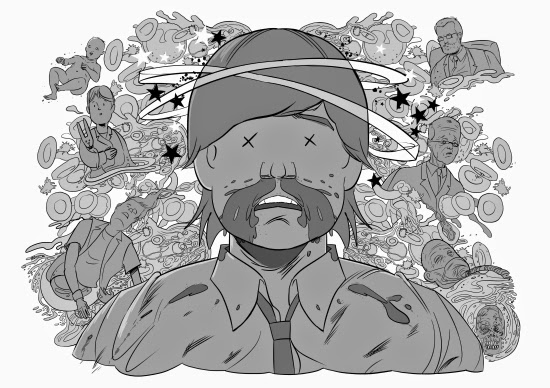
Rain On Glass is a major step forward for Azzopardi. Something about his cartooning just clicks in this connection, though in terms of format it's very much like his other comics. He really spills some ink as he goes back and forth in time in talking about his teenage years living with his father in a miserable setting while turning to his friend Matt via mail in order to keep sane. It's a beautifully illustrated comic that gives the reader just enough information about the narrator to have the story make sense, while delivering odd and jarring anecdotes, like his father sitting him down with his stepbrother to watch a porno. There's a harrowing story about being brutally assaulted as a teen by a thug who thought Azzopardi had messed with her and the scars the incident left; there's little in terms of wrapping the incident up neatly--it is simply recalled in visceral, dizzying fashion (there's a remarkable two-page spread of Azzopardi's dizzying response to a vicious headbutt). The final story is a funny, sentimental account of following around The Jesus and Mary Chain around England as a teenager and even getting invited to stay in their hotel and get free passes to their next, inevitably riot-inciting show. Wading through a non-stop rainstorm, the memory cheers him, even as the waters absurdly rise above the heads of the crowd.
The comic is Azzopardi's best primarily because of his increasing sophistication with regard to story structure. It's not just the flashbacks that I'm talking about here, but rather how his strategic use of them strengthens the overall theme of each story. There are perils to dwelling in the past, Azzopardi's comics seem to be saying. Good memories are sometimes the product of horrific abuse and can easily connect to them. Thinking about the past can be instructive for the present, but one must be aware of rising tides. Above all else, Azzopardi has mastered restraint in his storytelling. Certainly, he's still a cartoonist who very much wears his heart on his sleeve and that earnestness is central to the way he tells his stories. However, the way he gets across that earnestness is slightly less direct, redirected through formal tricks that allow the reader to experience a number of difference narrative perspectives. That's aided by a much lighter rendering touch that reveals an increased confidence in what he's drawing and how he's drawing it. Hopefully, he'll continue to refine and perfect his storytelling, now that he seems to have truly moved into his mature style.
Same Day Return and Rain On Glass, by Sean Azzopardi. Azzopardi's comics tend to reflect on his life, career and friends in particular. The former comic is a bit on the diffuse side, as Azzopardi sees a potential dopplelganger on the street, one whom might have been him if he hadn't changed his habits; he reunites with old friends in a mall and feels both the weight and awkwardness of years as well as the eventual easy and familiar rhythms of conversation; and returns to his small home town to see his sister. That latter strip is excellent, as one can see Azzopardi stripping out more and more extraneous detail from his art while adding a touch of grey here and there to give its visuals more weight. That story is ambitious in other ways, as Azzopardi flips back and forth in time as a way of recording his initial ambivalence to coming home, to what he was like growing up and what actually happened on the trip. The final major story, where he's attending a going-away party for a friend but his heart isn't much into it. When a friend texts him about the death of his mother, being able to console his friend is almost a form of relief.
Rain On Glass is a major step forward for Azzopardi. Something about his cartooning just clicks in this connection, though in terms of format it's very much like his other comics. He really spills some ink as he goes back and forth in time in talking about his teenage years living with his father in a miserable setting while turning to his friend Matt via mail in order to keep sane. It's a beautifully illustrated comic that gives the reader just enough information about the narrator to have the story make sense, while delivering odd and jarring anecdotes, like his father sitting him down with his stepbrother to watch a porno. There's a harrowing story about being brutally assaulted as a teen by a thug who thought Azzopardi had messed with her and the scars the incident left; there's little in terms of wrapping the incident up neatly--it is simply recalled in visceral, dizzying fashion (there's a remarkable two-page spread of Azzopardi's dizzying response to a vicious headbutt). The final story is a funny, sentimental account of following around The Jesus and Mary Chain around England as a teenager and even getting invited to stay in their hotel and get free passes to their next, inevitably riot-inciting show. Wading through a non-stop rainstorm, the memory cheers him, even as the waters absurdly rise above the heads of the crowd.
The comic is Azzopardi's best primarily because of his increasing sophistication with regard to story structure. It's not just the flashbacks that I'm talking about here, but rather how his strategic use of them strengthens the overall theme of each story. There are perils to dwelling in the past, Azzopardi's comics seem to be saying. Good memories are sometimes the product of horrific abuse and can easily connect to them. Thinking about the past can be instructive for the present, but one must be aware of rising tides. Above all else, Azzopardi has mastered restraint in his storytelling. Certainly, he's still a cartoonist who very much wears his heart on his sleeve and that earnestness is central to the way he tells his stories. However, the way he gets across that earnestness is slightly less direct, redirected through formal tricks that allow the reader to experience a number of difference narrative perspectives. That's aided by a much lighter rendering touch that reveals an increased confidence in what he's drawing and how he's drawing it. Hopefully, he'll continue to refine and perfect his storytelling, now that he seems to have truly moved into his mature style.


 Posts
Posts


