Showing posts with label mike fisher. Show all posts
Wednesday, May 15, 2013
Minicomics Round-Up: Aucoin, B.Brown, Meloro, Bird, Fisher
Doublethink #11, by Matt Aucoin. This CCS grad has decided to do a subscription service for his twenty page, two-man anthology featuring fellow CCS grad Kevin Kilgore.Aucoin's video-game influenced line usually doesn't do much for me, but I like the scribbly, tossed-off line he uses for the classic four-panel diary comics in this comic. Kilgore's comics are about his adventures in South Korea teaching English. His line is cartoony but confident and bold, and he lands a number of solid punchlines in these strips that remind me a great deal of Keith Knight's work. The upcoming subscription will serialize a monster story by Kilgore, who hasn't published much in terms of paper publications but is nonetheless talented. I like the way that Aucoin is adapting the Chuck Forsman/Oily Comics model on a much smaller scale, forcing himself to produce work on a regular basis while giving the spotlight to a deserving friend.
Operation Pizza, by Box Brown. This is a rare all-ages comic by Brown, printed on a risograph at the Sequential Artists Workshop in Gainesville, FL. It's a silly story about the captain of a vessel and his first mate who are trying to explore a bizarre island that stands out for its use of red and blue. They saturate the page when the reader is taken underwater and are otherwise used as spot colors. The story itself is a bit of silliness that involves a pizza tattoo, ancient underwater cave paintings of pizza being worshiped, various underwater sea vessels and funny character design. It's more wacky and nonsensical than funny, but I always love the way Brown uses simple and basic shapes to construct his characters and his settings. Combining that with the way he uses bright, primary colors makes the entire package an eye-catching one, even if there's not much "there" there.
Himzal #1, by Anthony Meloro. This is another Fort Thunder-inspired, genre-style comic.Ben Marra is another obvious influence in this story of a man trying to rescue his stripper girlfriend from a slave-trading ring, only to be savagely beaten as a way of getting the attention of the girlfriend's stripper. She happens to be the titular character and a witch to boot. This was quite an enjoyable comic, as Meloro's scratchy line and character design is boxed into a six-panel grid, which in itself is squashed between narrative panels at the top of the page and decorative designs at the bottom. Just when the reader knows what to expect, Meloro busts out splash pages with spot color introducing Himzal, including Michael DeForge-inspired stylized fonts indicating all of the pages she will have to visit. There's a crude enthusiasm about this comic that makes every page worth looking at, lending an added air of strangeness to a story that is otherwise boilerplate in terms of its plot (act of violence, vow of revenge). Meloro has done a lot of fine arts work and it shows in the way he created this comic as an art object, but he still values narrative and the experience of the reader above all else. I'm eager to see more from him.
Bird Brain #2, by Bird. This wordless (save for some pictographs and text on the inside covers) comic is simple in the way it's drawn (likely with a computer), yet it's surprisingly complex in the way it depicts loneliness turning into contentment. It's about one of three roommates bringing home alcohol, only to be rebuffed by the other two, who head out. With a split panel style that simultaneously depicts space and time passing, Bird shows us the man relaxing in his outdoor swimming pool, diving into it from the roof of his house. It's a slightly crazy and reckless series of moments that nonetheless unfold perfectly, as he floats in the water and starts to have dreams of weightlessness. The comic ends with an interruption, pointing to the frustration of wanting to connect but ultimately being alone while knowing that we always have to deal with the problem of other people. This is an artist whose line may be unremarkable, even dull, but his understanding of how to put together a page makes all the difference.
3-D Pete's Star Babe Invasion Comics #4, by Mike Fisher. This is another loving tribute to female actresses from cheesy sci-fi and fantasy films from a couple of generations ago. Fisher is a skilled cartoonist and designer whose drawings are both tasteful and attractive. The best parts of this zine are always his amusing rundowns of his favorite old-school sci-fi films and the attractive actresses therein. This issue focuses on the actress Caroline Munro, with a story dedicated to the awful Italian Star Wars rip-off titled Starcrash. With a sharp but relatively gentle wit, he makes fun of the film while praising the loonier aspects of its design and dishing out bits of trivia. Fisher also has a special knack for drawing in a naturalistic style that doesn't deaden the vitality of his characters on the page. Even his pin-up pages are full of life, thanks to the slightly cartoony quality he brings to each figure. This comic is extremely silly fun aimed at fellow fans of the genre, executed with great panache and enthusiasm.
Labels:
anthony meloro,
bird,
box brown,
kevin kilgore,
matt aucoin,
mike fisher
Wednesday, August 22, 2012
Minicomics Round-Up: Fisher, Young, Gullett, Viola
Time for a look at a variety of domestic minicomics that have come my way...
3-D Pete's Star Babe Invasion Comics #3, by Mike Fisher. This fanzine devoted to b-movies and the women who starred in them doesn't overstate the value of it subject matter nor is its devotion ironic. Fisher simply likes the sheer entertainment value of vintage b-movies and the beautiful women who starred in them, and writes clever and crisply drawn comics that celebrate this fact. "Queen of Outer Space is King of the B-Movies" is a tremendous appreciation of the awful titular film, as Fisher shares weird factoids about the movie (including Zsa Zsa Gabor's role in the film as a rebel). He correctly calls out the male roles in the film as being painfully stereotypical, but it's his sharp use of a boldly-defined line and evocative figures that make reading his comics a real pleasure. Fisher's own thoughts on fandom are equally cheerful, as the actor Marc Singer made him feel warm and welcome at a convention, even if Fisher's encounter with him was a bit weird. Anyone interested in the subject matter will delight in Fisher's observations and drawings.
Blacked Out #1, by Max Young. Young is the king of high-concept minicomics ideas. His last comic, Jetpack Shark, has an appeal that is self-explanatory. This comic is about a slightly douchey college kid prone to blackout drinking binges who learns that drinking alcohol gives him superpowers. Recruited by a grizzled man at a bar whose alcohol-based powers give him the ability to control smoke, the issue ends with the kid ready to be trained in how to use his powers in order to fight some unnamed menace. Young's art is fairly naturalistic with the odd tic of elongating his heads into "long faces", but it's clean and packed with details. The idea of a society of super-powered drunks is a very funny one, and Young milks the concept for all its worth. The comic is funny despite the fact that virtually every character is fratty and obnoxious, but then that's exactly the sort of culture that's going to produce young, super-powered drunks. I'll be curious to see how far he's going to take this story.
Air Ghost Illustrated #1 by Jim Gullett. This is a continuation of the Gary Panter-influenced story that appeared in a recent issue of the anthology Candy or Medicine.Gullett's lightning-bolt headed, big-toothed character post-apocalpytic bounty hunter Ziff feels like a more stylized version of Panter's Jimbo character, though Gullett's overall visual approach is much cleaner and more straightforward than Panter's. In other words, Gullett may have taken inspiration from a certain kind of comics storytelling, but he fuses it with more conventional kind of genre narrative. Still, this book is interesting because of the intensity and detail of Gullett's drawings, which overpower the reader without sacrificing readability or flow. The story, such as it is, emphasizes action and conflict: the bounty hunter gets captured by a vengeance-seeking lizard man and gets back at him using a vital piece of technology. There's no question that this is a great-looking minicomic that, like the other comics examined in this column, are not ground-breaking or innovative but rather represent successful and skilled iterations of older formulas.
3-D Pete's Star Babe Invasion Comics #3, by Mike Fisher. This fanzine devoted to b-movies and the women who starred in them doesn't overstate the value of it subject matter nor is its devotion ironic. Fisher simply likes the sheer entertainment value of vintage b-movies and the beautiful women who starred in them, and writes clever and crisply drawn comics that celebrate this fact. "Queen of Outer Space is King of the B-Movies" is a tremendous appreciation of the awful titular film, as Fisher shares weird factoids about the movie (including Zsa Zsa Gabor's role in the film as a rebel). He correctly calls out the male roles in the film as being painfully stereotypical, but it's his sharp use of a boldly-defined line and evocative figures that make reading his comics a real pleasure. Fisher's own thoughts on fandom are equally cheerful, as the actor Marc Singer made him feel warm and welcome at a convention, even if Fisher's encounter with him was a bit weird. Anyone interested in the subject matter will delight in Fisher's observations and drawings.
Blacked Out #1, by Max Young. Young is the king of high-concept minicomics ideas. His last comic, Jetpack Shark, has an appeal that is self-explanatory. This comic is about a slightly douchey college kid prone to blackout drinking binges who learns that drinking alcohol gives him superpowers. Recruited by a grizzled man at a bar whose alcohol-based powers give him the ability to control smoke, the issue ends with the kid ready to be trained in how to use his powers in order to fight some unnamed menace. Young's art is fairly naturalistic with the odd tic of elongating his heads into "long faces", but it's clean and packed with details. The idea of a society of super-powered drunks is a very funny one, and Young milks the concept for all its worth. The comic is funny despite the fact that virtually every character is fratty and obnoxious, but then that's exactly the sort of culture that's going to produce young, super-powered drunks. I'll be curious to see how far he's going to take this story.
Air Ghost Illustrated #1 by Jim Gullett. This is a continuation of the Gary Panter-influenced story that appeared in a recent issue of the anthology Candy or Medicine.Gullett's lightning-bolt headed, big-toothed character post-apocalpytic bounty hunter Ziff feels like a more stylized version of Panter's Jimbo character, though Gullett's overall visual approach is much cleaner and more straightforward than Panter's. In other words, Gullett may have taken inspiration from a certain kind of comics storytelling, but he fuses it with more conventional kind of genre narrative. Still, this book is interesting because of the intensity and detail of Gullett's drawings, which overpower the reader without sacrificing readability or flow. The story, such as it is, emphasizes action and conflict: the bounty hunter gets captured by a vengeance-seeking lizard man and gets back at him using a vital piece of technology. There's no question that this is a great-looking minicomic that, like the other comics examined in this column, are not ground-breaking or innovative but rather represent successful and skilled iterations of older formulas.
Herman the Manatee Has Had Enough (Volume 5), by Jason Viola. As Viola prepares to wind up this strip that's gone to some unexpected places considering that its premise involves the title character getting hit in the head repeatedly by boats, this latest volume features some of his sharpest cartooning and best gags. There's an extended riff about robbing baby seahorses from a seahorse "gated community" that has lines like "You know, reef today is ten times stronger than when we were kids". Rather than bogging down in extended continuity strips, Viola balances basic gags with shorter, punchier stories that land a lot of hits, mixing goofy gags with existential angst. While many of Viola's strips in this series haven't landed
successful jokes, it's been a strong proving ground for him in producing clear,
strong art that ably supports his premise and an opportunity to gain a certain
rhythm as a cartoonist. There's no question that he's a much better cartoonist
now than he was when he started the strip.
Labels:
jason viola,
jim gullett,
max young,
mike fisher
Tuesday, December 20, 2011
Minicomics and Genre: Doug Michel, Jason Viola, Tim Rocks, Mike Fisher
A number of minis I receive fall into the category of gag work or humorous genre. Let's take a look at a few of them:

Monkey Force One #7 & #8, by Doug Michel. This comic is part epic adventure and part spoof, as Michel blends the X-Men, James Bond, sci-fi, scatological kids' humor, Scott Pilgrim and coming-of-age stories into one dizzying package. It helps that Michel keeps his line simple, varying his line weights to make his characters pop off the page but keeping everything else fairly clear. That's helpful for the reader, because Michel is a "kitchen sink plus" kind of artist, cramming his panels with details, figures, weapons, posters and other chicken fat. There are occasions when Michel indulges in a more detailed extreme close-up of a particular piece of action the way a video game might cut away to that sort of animation. The weird tension in these issues is between the shared indy rock band past of several characters and how their lives are intersecting in the middle of a zombie invasion of St. Louis. I found those conflicts more interesting than the zombie fights, which are all pretty standard issue. Indeed, Michel's main weakness as an artist is depicting action; the stiffness of his line that's appropriate for scenes depicting conversation makes his fight scenes less interesting to look at. That's especially true for fistfights, where Michel seems to have a shaky grasp on how bodies relate to each other in space and how to hook the reader into immediately turning their attention to the next panel. Michel is at his best when he's poking fun at the genre conventions he genuinely enjoys, like when a rapper comes across Zombie Tupac and Zombie Biggie Smalls and demands to get a picture with them for his next album. It's that breeziness that gives these comics their energy and appeal.

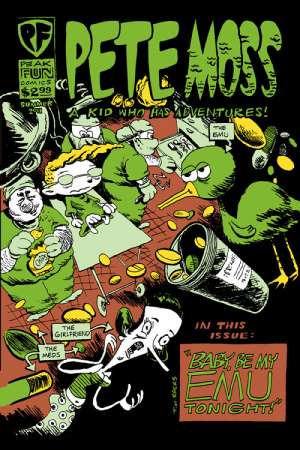
Pete Moss: A Kid Who Has Adventures, by Tim Rocks. This is a hyperexaggerated screwball comic somewhat in the vein of Peter Bagge, in terms of the frenetic quality of its storytelling. It's about a kid who mistakenly receives news that he's a terminal case, who then proceeds to try to get laid before he dies while tricking a variation on the Make-A-Wish foundation. Rocks gets across most of his humor with funny and/or grotesque drawings and over-the-top satire. The drawing is much more interesting than the writing, which aims for shocking and falls well short of shock or even pointed commentary. On the other hand, Rocks is unrelenting in the avalanche of gross and funny images he throws at the reader, making this comic interesting to flip through if not especially memorable otherwise.

Jay's Brain, by Jason Viola. Viola is best known for his webcomic gag strip Herman The Manatee, but I've often enjoyed his side projects more. This is a series of gags about Viola and his anthropomorphic brain, and what's most interesting about it is the obvious discomfort the artist feels from drawing these strips. For an artist who does pretty silly gags (even the ones that touch on despair still feel like shtick), Viola is surprisingly personal and even confessional in these strips that touch on panic attacks, saying horrible things to those he loves, a lack of inspiration and other issues not unfamiliar to readers of autobio comics. The difference is that his brain character turns every strip into a punchline, no matter how awful or uncomfortable the premise. Viola turns his social anxiety into some pretty fertile ground for humor (the page of tweets from his brain is especially amusing--it tells Viola things like "You shouldn't have said that" while wondering "Why don't they put flavor crystals in EVERYTHING?"), making this his single strongest work to date.

3-D Pete's Star Babe Invasion Comics, by Mike Fisher. This comic/zine is exactly what it claims to be--a celebration and examination of sexy women in science fiction films. What makes it enjoyable is the light tone Fisher employs throughout, deemphasizing prurience and playing up humor. It helps that he has rock-solid fundamentals as a cartoonist, capturing the naturalistic essence of a figure without losing the cartoony quality of his compositions. Speaking through his mouthpiece character 3-D Pete, Fisher discusses Jane Fonda in Barbarella and which Star Trek guest actress was most appealing, as well as silly strips where Pete encounters less-than-sharp aliens and tries to get on a space ark. The interview with a model from a sci-fi themed beer commercial is entirely gratuitous; it doesn't really add much to the comic other than letting us know that he managed to interview a model. While the comic is entirely disposable, Fisher's line is wonderfully fluid and expressive. A full length genre story from Fisher would be quite pleasant to read.

Monkey Force One #7 & #8, by Doug Michel. This comic is part epic adventure and part spoof, as Michel blends the X-Men, James Bond, sci-fi, scatological kids' humor, Scott Pilgrim and coming-of-age stories into one dizzying package. It helps that Michel keeps his line simple, varying his line weights to make his characters pop off the page but keeping everything else fairly clear. That's helpful for the reader, because Michel is a "kitchen sink plus" kind of artist, cramming his panels with details, figures, weapons, posters and other chicken fat. There are occasions when Michel indulges in a more detailed extreme close-up of a particular piece of action the way a video game might cut away to that sort of animation. The weird tension in these issues is between the shared indy rock band past of several characters and how their lives are intersecting in the middle of a zombie invasion of St. Louis. I found those conflicts more interesting than the zombie fights, which are all pretty standard issue. Indeed, Michel's main weakness as an artist is depicting action; the stiffness of his line that's appropriate for scenes depicting conversation makes his fight scenes less interesting to look at. That's especially true for fistfights, where Michel seems to have a shaky grasp on how bodies relate to each other in space and how to hook the reader into immediately turning their attention to the next panel. Michel is at his best when he's poking fun at the genre conventions he genuinely enjoys, like when a rapper comes across Zombie Tupac and Zombie Biggie Smalls and demands to get a picture with them for his next album. It's that breeziness that gives these comics their energy and appeal.

Pete Moss: A Kid Who Has Adventures, by Tim Rocks. This is a hyperexaggerated screwball comic somewhat in the vein of Peter Bagge, in terms of the frenetic quality of its storytelling. It's about a kid who mistakenly receives news that he's a terminal case, who then proceeds to try to get laid before he dies while tricking a variation on the Make-A-Wish foundation. Rocks gets across most of his humor with funny and/or grotesque drawings and over-the-top satire. The drawing is much more interesting than the writing, which aims for shocking and falls well short of shock or even pointed commentary. On the other hand, Rocks is unrelenting in the avalanche of gross and funny images he throws at the reader, making this comic interesting to flip through if not especially memorable otherwise.

Jay's Brain, by Jason Viola. Viola is best known for his webcomic gag strip Herman The Manatee, but I've often enjoyed his side projects more. This is a series of gags about Viola and his anthropomorphic brain, and what's most interesting about it is the obvious discomfort the artist feels from drawing these strips. For an artist who does pretty silly gags (even the ones that touch on despair still feel like shtick), Viola is surprisingly personal and even confessional in these strips that touch on panic attacks, saying horrible things to those he loves, a lack of inspiration and other issues not unfamiliar to readers of autobio comics. The difference is that his brain character turns every strip into a punchline, no matter how awful or uncomfortable the premise. Viola turns his social anxiety into some pretty fertile ground for humor (the page of tweets from his brain is especially amusing--it tells Viola things like "You shouldn't have said that" while wondering "Why don't they put flavor crystals in EVERYTHING?"), making this his single strongest work to date.

3-D Pete's Star Babe Invasion Comics, by Mike Fisher. This comic/zine is exactly what it claims to be--a celebration and examination of sexy women in science fiction films. What makes it enjoyable is the light tone Fisher employs throughout, deemphasizing prurience and playing up humor. It helps that he has rock-solid fundamentals as a cartoonist, capturing the naturalistic essence of a figure without losing the cartoony quality of his compositions. Speaking through his mouthpiece character 3-D Pete, Fisher discusses Jane Fonda in Barbarella and which Star Trek guest actress was most appealing, as well as silly strips where Pete encounters less-than-sharp aliens and tries to get on a space ark. The interview with a model from a sci-fi themed beer commercial is entirely gratuitous; it doesn't really add much to the comic other than letting us know that he managed to interview a model. While the comic is entirely disposable, Fisher's line is wonderfully fluid and expressive. A full length genre story from Fisher would be quite pleasant to read.
Saturday, August 8, 2009
Sequart #18: Other Media
A few years back, the Comics Journal published a list of the top 100 english-language comics of the 20th century. That list produced a lot of controversy because a number of the works included didn't exactly conform to what the average person thought of as comics. That meant material like editorial cartoons, sketchbooks, caricatures, woodcut books, and single-panel magazine cartoons. Attempts at analyzing and narrowing comics' scope like in Scott McCloud's UNDERSTANDING COMICS often have the side effect of unnecessarily restricting what the art form can be. For example, McCloud insists that comics must have more than one panel because by his definition, comics show the passage of time. Comics writer RC Harvey insists that its core lies in the the combination of words and images; if it doesn't have both, it's not comics. One of my favorite cartoonists, Kurt Wolfgang, wrote a send-up of this notion in a story called "What The Fuck Is A Mini-Comic?" Playing a McCloud-type character, he tries to narrow down exactly what makes up a mini, only to be shouted down by his audience, poking holes in his theory. He winds up with this definition: "You know 'em when you see 'em!"
I think this point can be made about comics in general. One can tell the difference between a comic of some kind, versus say, an illustrated book or a painting that mixes words and pictures. One can just understand it intuitively, even when it's not clearly a narrative (like Al Hirschfeld's caricatures). There are certainly works that blur the line between comics and painting, or comics and illustration, or comics and books. But why not make the tent broad? That more open approach allows for idiosyncratic works to be considered as comics, which only enriches our understanding of the art. Furthermore, the tradition of comics being a part of other media is a long one, and it's intriguing to see how this tradition has evolved.
I've recently received three completely different publications. One is an aggressively eclectic magazine called MSTRMND which both contains comics and is clearly influenced by a comics aesthetic. Another is a free magazine by a new publisher called COMICS COMICS, which celebrates and critiques comics both past and present. The last is an issue of BIG ORBIT COMICS, focusing on the author's career as an animator. The strips and jokes therein are unapologetically specific to his trade, which gives them an odd charm for an outsider. The aesthetics particular to each of the three publications is not necessarily mine, but they're so earnest and relentless in presenting their own point of view that they're compelling reads (in differing degrees) in their own ways.
Let's look at the first two issues of mstrmnd edited by Kevin McLeod and published out of New York. It doesn't take long to figure out that this magazine is about design that pushes the envelope. While the content is meaty and thought-provoking, it's clear that the magazine's look is its most important aspect. My favorite piece was a subway map that cleverly combined subway lines from several major world cities into one map that was both beautiful to look at and made a weird kind of sense. What I find particularly compelling about MSTRMND is that it's as concerned with dissecting the past as it is in talking about the future. You might find an article about a proposed Museum of American Slavery on the national mall in Washington, DC after a detailed exegesis of the Matrix trilogy; or an excerpt from an old HM Stanley book deconstructed by a modern writer after a report on waste tornadoes of the Pacific. The magazine is concerned with politics, ecology, role playing, philosophy and beauty.
While it's unpredictable in terms of content, certain patterns do emerge. The second issue is less linear than the first, with more of a visual than textual focus. That new/old tension is still in evidence, with a photo essay on the 1936 Berlin Olympics and another photo essay about a Halloween party in Detroit. Really, the primary common thread between the two issues is a continuing comic strip called "Wooden Mirror". Written by the editor, the story is a weird mix of genre styles, as a young caucasian boy, aggressive asian young woman, and older African-American man are on a sort of quest to find and use a wooden mirror. There's no exposition, just characters dropped in the middle of a violent situation. Fake ads that begin the episodes (including one for Hanso swords) add to the sense that the stories are a recapitulation and remix of action genres in general. What's disappointing about the stories is that the visuals are pedestrian and conservative, compared to both the ideas in the story and the magazine in general. In MSTRMND, the visuals are bold and imaginative, which makes the comic look almost quaint, like the visuals from the Stanley stories he reprints. I'm not sure if this is a deliberate approach, but the look of the comics doesn't fit in with the rest of the publication. Regardless, the fact that you can't pin the publication down makes it especially compelling to re-read, and I find something new that catches my eye each time.
It'll be interesting to see how this serial evolves as the magazine continues to mutate in other directions. "Conservative" is certainly something you can't accuse COMICS COMICS of being. It's spearheaded by Picturebox's publisher Dan Nadel, also known as the force behind the art/comics publication the Ganzfeld. Picturebox has published a book called BJ AND DA DOGS by Paper Rad, as well as ART OUT OF TIME: UNKNOWN VISIONARY CARTOONISTS. Nadel is interested in work on the margins of comics, often of the outsider artist variety. Paper Rad (consisting of Jessica Ciocci and the infinitely strange work of Ben Jones) is a perfect example of this aesthetic. Their work leaves few on the fence: some consider it brilliant, hilarious and totally original, while others are baffled at its appeal. While I tend to be in the latter camp, I have respect for the total commitment to their own individual vision and aesthetic that Paper Rad evinces. COMICS COMICS is a beautiful display of Nadel's other interest: discussing these sort of comics. Paper Rad starts things off with an essay written in the style of a George W Bush speech that winds up declaring Scott McCloud and Matt Madden as enemies of true comics experimentation. Legendary cartoonist Mark Newgarden kicks in a few comics of his own, and there are profiles of Ciocci, Matthew Thurber and Wally Wood.
This fascination with the margins of not just today's comics but of the whole of comics' history is what makes this such a stimulating read. The Wood essay discusses the specifics of his aesthetic (which Nadel dubs the Frozen Moments School of Comics) and compares it to his contemporary, Ogden Whitney. While both are critiqued, often harshly, the evaluation is fair and Nadel's observations are incisive and lead to new revelations about these artists. The rest of this issue is taken up with reviews. The most interesting is by the co-editor of COMICS COMICS, Timothy Hodler. He reviews THE DICK AYERS STORY, a 3-volume comics autobiography of an artist active since the Golden Age. I read these when they came out last year and was fascinated by them. Ayers was known for being able to draw just about anything but was never a writer, and it showed in this attempt to write about himself. But he holds little back in his narrative (even if it doesn't make sense at times or repeats stories), and Hodler picks up on what made it such a unique work. Moreover, he correctly notes that few people reviewed or even noticed it. The fact that COMICS COMICS exists to fill this gap is welcome indeed.
The other reviews range from new comics to Golden Age reprints. It's mostly concerned with books the authors find personally compelling (while taking occasional shots at others, like PERSEPOLIS' Marjane Satrapi). While I didn't necessarily agree with much of what was written in this publication, there's nothing else like it out there. It's a wonderful projection of the force of will of its participants and their sheer love of comics. That can only be a good thing, and I can't wait to see what happens next.
One thing that interests me are comics artists with other creative dayjobs. In particular, there seems to be a big wave at the moment of animators who also draw comics. Mike Fisher is one such artist. While the general concerns in his animation revolve around science-fiction tropes, BIG ORBIT COMICS #8 is about animation itself. Through his 3-D Pete character, he talks about trying to find time to do his own independent animation, dealing with criticism, struggling with computer manuals, making deadlines for animation festivals, using the newest tricks and techniques (sometimes at the expense of his narratives) in animation, showing his cartoons in front of near-empty rooms, etc. It reminds me a bit of Justin Green's SIGN GAME strips: it's aimed at a sympathetic and knowledgable audience and has enough wit and verve to make it amusing for a general audience. While I must admit that I don't have much interest in his actual animation, this little humorous behind-the-scenes look at his life and career (filtered carefully through a fictional character) was a pleasant read. Like in the other works discussed above, the sheer enthusiasm Fisher has for his craft burst through the pages and forces attention from the reader.
As a writer and critic who usually selects the material I choose to write about, it was a welcome and interesting challenge to immerse myself in the different points of view from each of these works. In particular, it was exciting to see works that differed not just in subject matter but in form from what I usually discuss. Independent comics cover a lot of territory, and that territory just continues to expand.
I think this point can be made about comics in general. One can tell the difference between a comic of some kind, versus say, an illustrated book or a painting that mixes words and pictures. One can just understand it intuitively, even when it's not clearly a narrative (like Al Hirschfeld's caricatures). There are certainly works that blur the line between comics and painting, or comics and illustration, or comics and books. But why not make the tent broad? That more open approach allows for idiosyncratic works to be considered as comics, which only enriches our understanding of the art. Furthermore, the tradition of comics being a part of other media is a long one, and it's intriguing to see how this tradition has evolved.
I've recently received three completely different publications. One is an aggressively eclectic magazine called MSTRMND which both contains comics and is clearly influenced by a comics aesthetic. Another is a free magazine by a new publisher called COMICS COMICS, which celebrates and critiques comics both past and present. The last is an issue of BIG ORBIT COMICS, focusing on the author's career as an animator. The strips and jokes therein are unapologetically specific to his trade, which gives them an odd charm for an outsider. The aesthetics particular to each of the three publications is not necessarily mine, but they're so earnest and relentless in presenting their own point of view that they're compelling reads (in differing degrees) in their own ways.
Let's look at the first two issues of mstrmnd edited by Kevin McLeod and published out of New York. It doesn't take long to figure out that this magazine is about design that pushes the envelope. While the content is meaty and thought-provoking, it's clear that the magazine's look is its most important aspect. My favorite piece was a subway map that cleverly combined subway lines from several major world cities into one map that was both beautiful to look at and made a weird kind of sense. What I find particularly compelling about MSTRMND is that it's as concerned with dissecting the past as it is in talking about the future. You might find an article about a proposed Museum of American Slavery on the national mall in Washington, DC after a detailed exegesis of the Matrix trilogy; or an excerpt from an old HM Stanley book deconstructed by a modern writer after a report on waste tornadoes of the Pacific. The magazine is concerned with politics, ecology, role playing, philosophy and beauty.
While it's unpredictable in terms of content, certain patterns do emerge. The second issue is less linear than the first, with more of a visual than textual focus. That new/old tension is still in evidence, with a photo essay on the 1936 Berlin Olympics and another photo essay about a Halloween party in Detroit. Really, the primary common thread between the two issues is a continuing comic strip called "Wooden Mirror". Written by the editor, the story is a weird mix of genre styles, as a young caucasian boy, aggressive asian young woman, and older African-American man are on a sort of quest to find and use a wooden mirror. There's no exposition, just characters dropped in the middle of a violent situation. Fake ads that begin the episodes (including one for Hanso swords) add to the sense that the stories are a recapitulation and remix of action genres in general. What's disappointing about the stories is that the visuals are pedestrian and conservative, compared to both the ideas in the story and the magazine in general. In MSTRMND, the visuals are bold and imaginative, which makes the comic look almost quaint, like the visuals from the Stanley stories he reprints. I'm not sure if this is a deliberate approach, but the look of the comics doesn't fit in with the rest of the publication. Regardless, the fact that you can't pin the publication down makes it especially compelling to re-read, and I find something new that catches my eye each time.
It'll be interesting to see how this serial evolves as the magazine continues to mutate in other directions. "Conservative" is certainly something you can't accuse COMICS COMICS of being. It's spearheaded by Picturebox's publisher Dan Nadel, also known as the force behind the art/comics publication the Ganzfeld. Picturebox has published a book called BJ AND DA DOGS by Paper Rad, as well as ART OUT OF TIME: UNKNOWN VISIONARY CARTOONISTS. Nadel is interested in work on the margins of comics, often of the outsider artist variety. Paper Rad (consisting of Jessica Ciocci and the infinitely strange work of Ben Jones) is a perfect example of this aesthetic. Their work leaves few on the fence: some consider it brilliant, hilarious and totally original, while others are baffled at its appeal. While I tend to be in the latter camp, I have respect for the total commitment to their own individual vision and aesthetic that Paper Rad evinces. COMICS COMICS is a beautiful display of Nadel's other interest: discussing these sort of comics. Paper Rad starts things off with an essay written in the style of a George W Bush speech that winds up declaring Scott McCloud and Matt Madden as enemies of true comics experimentation. Legendary cartoonist Mark Newgarden kicks in a few comics of his own, and there are profiles of Ciocci, Matthew Thurber and Wally Wood.
This fascination with the margins of not just today's comics but of the whole of comics' history is what makes this such a stimulating read. The Wood essay discusses the specifics of his aesthetic (which Nadel dubs the Frozen Moments School of Comics) and compares it to his contemporary, Ogden Whitney. While both are critiqued, often harshly, the evaluation is fair and Nadel's observations are incisive and lead to new revelations about these artists. The rest of this issue is taken up with reviews. The most interesting is by the co-editor of COMICS COMICS, Timothy Hodler. He reviews THE DICK AYERS STORY, a 3-volume comics autobiography of an artist active since the Golden Age. I read these when they came out last year and was fascinated by them. Ayers was known for being able to draw just about anything but was never a writer, and it showed in this attempt to write about himself. But he holds little back in his narrative (even if it doesn't make sense at times or repeats stories), and Hodler picks up on what made it such a unique work. Moreover, he correctly notes that few people reviewed or even noticed it. The fact that COMICS COMICS exists to fill this gap is welcome indeed.
The other reviews range from new comics to Golden Age reprints. It's mostly concerned with books the authors find personally compelling (while taking occasional shots at others, like PERSEPOLIS' Marjane Satrapi). While I didn't necessarily agree with much of what was written in this publication, there's nothing else like it out there. It's a wonderful projection of the force of will of its participants and their sheer love of comics. That can only be a good thing, and I can't wait to see what happens next.
One thing that interests me are comics artists with other creative dayjobs. In particular, there seems to be a big wave at the moment of animators who also draw comics. Mike Fisher is one such artist. While the general concerns in his animation revolve around science-fiction tropes, BIG ORBIT COMICS #8 is about animation itself. Through his 3-D Pete character, he talks about trying to find time to do his own independent animation, dealing with criticism, struggling with computer manuals, making deadlines for animation festivals, using the newest tricks and techniques (sometimes at the expense of his narratives) in animation, showing his cartoons in front of near-empty rooms, etc. It reminds me a bit of Justin Green's SIGN GAME strips: it's aimed at a sympathetic and knowledgable audience and has enough wit and verve to make it amusing for a general audience. While I must admit that I don't have much interest in his actual animation, this little humorous behind-the-scenes look at his life and career (filtered carefully through a fictional character) was a pleasant read. Like in the other works discussed above, the sheer enthusiasm Fisher has for his craft burst through the pages and forces attention from the reader.
As a writer and critic who usually selects the material I choose to write about, it was a welcome and interesting challenge to immerse myself in the different points of view from each of these works. In particular, it was exciting to see works that differed not just in subject matter but in form from what I usually discuss. Independent comics cover a lot of territory, and that territory just continues to expand.
Subscribe to:
Posts (Atom)