A number of minis I receive fall into the category of gag work or humorous genre. Let's take a look at a few of them:

Monkey Force One #7 & #8, by Doug Michel. This comic is part epic adventure and part spoof, as Michel blends the X-Men, James Bond, sci-fi, scatological kids' humor, Scott Pilgrim and coming-of-age stories into one dizzying package. It helps that Michel keeps his line simple, varying his line weights to make his characters pop off the page but keeping everything else fairly clear. That's helpful for the reader, because Michel is a "kitchen sink plus" kind of artist, cramming his panels with details, figures, weapons, posters and other chicken fat. There are occasions when Michel indulges in a more detailed extreme close-up of a particular piece of action the way a video game might cut away to that sort of animation. The weird tension in these issues is between the shared indy rock band past of several characters and how their lives are intersecting in the middle of a zombie invasion of St. Louis. I found those conflicts more interesting than the zombie fights, which are all pretty standard issue. Indeed, Michel's main weakness as an artist is depicting action; the stiffness of his line that's appropriate for scenes depicting conversation makes his fight scenes less interesting to look at. That's especially true for fistfights, where Michel seems to have a shaky grasp on how bodies relate to each other in space and how to hook the reader into immediately turning their attention to the next panel. Michel is at his best when he's poking fun at the genre conventions he genuinely enjoys, like when a rapper comes across Zombie Tupac and Zombie Biggie Smalls and demands to get a picture with them for his next album. It's that breeziness that gives these comics their energy and appeal.

Pete Moss: A Kid Who Has Adventures, by Tim Rocks. This is a hyperexaggerated screwball comic somewhat in the vein of Peter Bagge, in terms of the frenetic quality of its storytelling. It's about a kid who mistakenly receives news that he's a terminal case, who then proceeds to try to get laid before he dies while tricking a variation on the Make-A-Wish foundation. Rocks gets across most of his humor with funny and/or grotesque drawings and over-the-top satire. The drawing is much more interesting than the writing, which aims for shocking and falls well short of shock or even pointed commentary. On the other hand, Rocks is unrelenting in the avalanche of gross and funny images he throws at the reader, making this comic interesting to flip through if not especially memorable otherwise.

Jay's Brain, by Jason Viola. Viola is best known for his webcomic gag strip Herman The Manatee, but I've often enjoyed his side projects more. This is a series of gags about Viola and his anthropomorphic brain, and what's most interesting about it is the obvious discomfort the artist feels from drawing these strips. For an artist who does pretty silly gags (even the ones that touch on despair still feel like shtick), Viola is surprisingly personal and even confessional in these strips that touch on panic attacks, saying horrible things to those he loves, a lack of inspiration and other issues not unfamiliar to readers of autobio comics. The difference is that his brain character turns every strip into a punchline, no matter how awful or uncomfortable the premise. Viola turns his social anxiety into some pretty fertile ground for humor (the page of tweets from his brain is especially amusing--it tells Viola things like "You shouldn't have said that" while wondering "Why don't they put flavor crystals in EVERYTHING?"), making this his single strongest work to date.

3-D Pete's Star Babe Invasion Comics, by Mike Fisher. This comic/zine is exactly what it claims to be--a celebration and examination of sexy women in science fiction films. What makes it enjoyable is the light tone Fisher employs throughout, deemphasizing prurience and playing up humor. It helps that he has rock-solid fundamentals as a cartoonist, capturing the naturalistic essence of a figure without losing the cartoony quality of his compositions. Speaking through his mouthpiece character 3-D Pete, Fisher discusses Jane Fonda in Barbarella and which Star Trek guest actress was most appealing, as well as silly strips where Pete encounters less-than-sharp aliens and tries to get on a space ark. The interview with a model from a sci-fi themed beer commercial is entirely gratuitous; it doesn't really add much to the comic other than letting us know that he managed to interview a model. While the comic is entirely disposable, Fisher's line is wonderfully fluid and expressive. A full length genre story from Fisher would be quite pleasant to read.

Monkey Force One #7 & #8, by Doug Michel. This comic is part epic adventure and part spoof, as Michel blends the X-Men, James Bond, sci-fi, scatological kids' humor, Scott Pilgrim and coming-of-age stories into one dizzying package. It helps that Michel keeps his line simple, varying his line weights to make his characters pop off the page but keeping everything else fairly clear. That's helpful for the reader, because Michel is a "kitchen sink plus" kind of artist, cramming his panels with details, figures, weapons, posters and other chicken fat. There are occasions when Michel indulges in a more detailed extreme close-up of a particular piece of action the way a video game might cut away to that sort of animation. The weird tension in these issues is between the shared indy rock band past of several characters and how their lives are intersecting in the middle of a zombie invasion of St. Louis. I found those conflicts more interesting than the zombie fights, which are all pretty standard issue. Indeed, Michel's main weakness as an artist is depicting action; the stiffness of his line that's appropriate for scenes depicting conversation makes his fight scenes less interesting to look at. That's especially true for fistfights, where Michel seems to have a shaky grasp on how bodies relate to each other in space and how to hook the reader into immediately turning their attention to the next panel. Michel is at his best when he's poking fun at the genre conventions he genuinely enjoys, like when a rapper comes across Zombie Tupac and Zombie Biggie Smalls and demands to get a picture with them for his next album. It's that breeziness that gives these comics their energy and appeal.
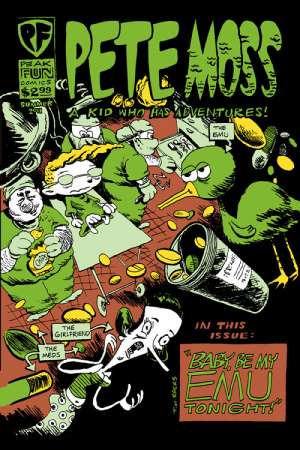
Pete Moss: A Kid Who Has Adventures, by Tim Rocks. This is a hyperexaggerated screwball comic somewhat in the vein of Peter Bagge, in terms of the frenetic quality of its storytelling. It's about a kid who mistakenly receives news that he's a terminal case, who then proceeds to try to get laid before he dies while tricking a variation on the Make-A-Wish foundation. Rocks gets across most of his humor with funny and/or grotesque drawings and over-the-top satire. The drawing is much more interesting than the writing, which aims for shocking and falls well short of shock or even pointed commentary. On the other hand, Rocks is unrelenting in the avalanche of gross and funny images he throws at the reader, making this comic interesting to flip through if not especially memorable otherwise.

Jay's Brain, by Jason Viola. Viola is best known for his webcomic gag strip Herman The Manatee, but I've often enjoyed his side projects more. This is a series of gags about Viola and his anthropomorphic brain, and what's most interesting about it is the obvious discomfort the artist feels from drawing these strips. For an artist who does pretty silly gags (even the ones that touch on despair still feel like shtick), Viola is surprisingly personal and even confessional in these strips that touch on panic attacks, saying horrible things to those he loves, a lack of inspiration and other issues not unfamiliar to readers of autobio comics. The difference is that his brain character turns every strip into a punchline, no matter how awful or uncomfortable the premise. Viola turns his social anxiety into some pretty fertile ground for humor (the page of tweets from his brain is especially amusing--it tells Viola things like "You shouldn't have said that" while wondering "Why don't they put flavor crystals in EVERYTHING?"), making this his single strongest work to date.

3-D Pete's Star Babe Invasion Comics, by Mike Fisher. This comic/zine is exactly what it claims to be--a celebration and examination of sexy women in science fiction films. What makes it enjoyable is the light tone Fisher employs throughout, deemphasizing prurience and playing up humor. It helps that he has rock-solid fundamentals as a cartoonist, capturing the naturalistic essence of a figure without losing the cartoony quality of his compositions. Speaking through his mouthpiece character 3-D Pete, Fisher discusses Jane Fonda in Barbarella and which Star Trek guest actress was most appealing, as well as silly strips where Pete encounters less-than-sharp aliens and tries to get on a space ark. The interview with a model from a sci-fi themed beer commercial is entirely gratuitous; it doesn't really add much to the comic other than letting us know that he managed to interview a model. While the comic is entirely disposable, Fisher's line is wonderfully fluid and expressive. A full length genre story from Fisher would be quite pleasant to read.


 Posts
Posts


