Showing posts with label malachi ward. Show all posts

Wednesday, August 9, 2017

Malachi Ward, Part 2: From Now On

Concluding a two-week look at Malachi Ward, here's a review of his collection of sci-fi/fantasy short stories, From Now On. 


This is a surprisingly coherent collection of stories. Some of that is intentional, as a particular story is told from the point of view of three different characters. One of them is the time traveler from "Top Five", which I reviewed last week. Adding texture and context to that story are "The Oviraptor" and "Disconnect", which follow the stories of the two other time travelers. We learn, for example, that the group badly overshot their goal of going back to watch early humans and neanderthals interact, instead going back to a much earlier era where dinosaurs were still active. One of the travelers permanently exiled herself from her only remaining compatriot, and "The Oviraptor" offers a touching attempt by the other traveler to reach her when he came across a bird-like dinosaur, after she had earlier mourned that she would never see a bird again. "Disconnect" is one of the best stories in the whole book, as it follows the arc of another traveler, as she faced a lifetime of alienation and loneliness before she went on the mission. She wound up getting there about forty years before the rest of her group, and the year-by-year narrative (including being visited and living with aliens, and then fleeing when some more aliens came along to attack them) that runs panel-by-panel is an effective and clever device. She spends the whole time trying to find her compatriots, not knowing that they weren't there yet, and there's a heartbreaking ending when she sees them after they've just arrived--still young. The deeply muted colors and naturalistic style reflect that sense of loneliness, and the color does a lot of the narrative work when Ward starts cramming panels on each page.

In terms of Ward displaying sheer drawing chops, nothing beats one of his earliest stories, "Utu". It established a number of Ward's favorite techniques. There's a double genre-flip, as it starts out as a fantasy story, then it's revealed to really be a sci-fi story, and then that turns into a sad-boy comic. There's the colonial urge shown by its main character, who uses his position of being from the future in an effort to change the past, thinking he knows better than the savages of yore. There's that sense of dystopian ennui, as all the advantages of the future don't make it any easier for the time-fiddler to escape his own sense of loneliness and inability to relate to women. Ward also shows off his drawing and design chops, especially in the way he transitions from light to darkness and drops a variety of revelations on the reader. "Hero Of Science" is simultaneously a more refined and more visceral version of these concepts in a manner similar to Jesse Moynihan's Forming comics. The character design is a tad cartoonier, but the commentary is more pointed. The story is about a yet another time traveler who has "gone native" with a primitive tribe, and he stages a murderous attack on other travelers from the future who are looking for him. It's in many ways not unlike a Mr. Kurtz situation from Joseph Conrad's Heart of Darkness, where it's not so much that a colonizer goes mad with power so much as it is the painful revelation that colonization is in and of itself an act of violence. What the traveler does here is just a logical extension of that premise.

Stories like "Henix", "Beasts of Kay-7" and "The Scout" all have double-twists after the initial premise seems obvious. Or rather, the consequences of the twist are unexpected. In "Henix", the High Protectorate (aka the queen) is visited by an elf that tells her that there was a prisoner in her dungeon that she needed to see. When the prisoner, half-elf and half-human, tells her that his father was a member of her court and put him in prison, she accepts his service in exchange for his service in perpetuity. The twist in the story is not the identify of his father, but rather her reaction when she finds out. This story is comparatively spare for Ward, focusing more on character than world-building.
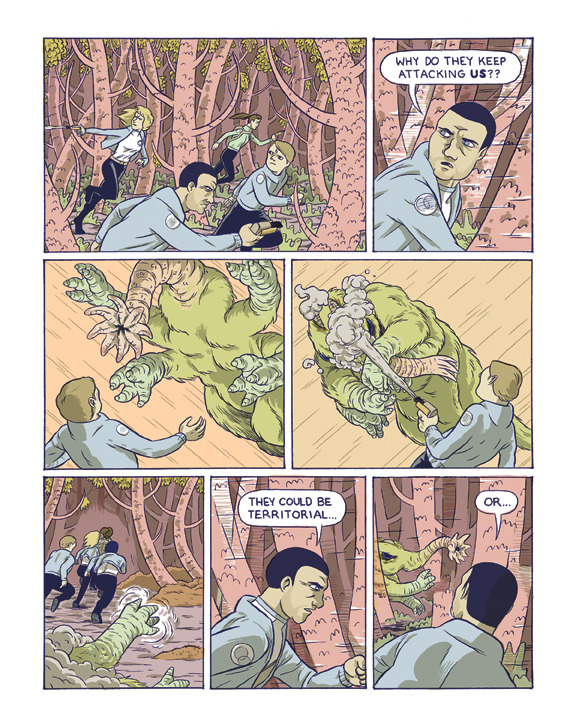
"Beasts of Kay-7" features a scientist whose flexibility of thinking prevents him and his crew from being turned into food by a group of monstrous aliens on the planet they're exploring. Notably, the scientist is one of the few characters in the book who's pure of motive. He doesn't want to conquer or colonize; rather, he simply wants to understand the life that's on the planet for the sheer sake of learning. He's an abrasive and insensitive character at times, but his dedication to science and the mission at hand give him a purity that the other characters in the volume don't possess. Once again, Ward's skill as a draftsman is on full display, as the bizarre half animal/half plant creatures on the planet are terrifying. The punchline of the story--that the mere act of observation and recording is a kind of intervention on its own--is clever and well-designed, especially in the way it shows how easy it is to not only become dependent on technology, but to take its existence entirely for granted.

"The Scout" is about the way in which colonization leads to inevitable violence, told through incredibly clever trope of an explorer's clone being repeatedly sent to a cave that looks promising for annexing. What keeps killing the clones? The originals, one after another, coming to the conclusion that what it's doing is wrong. Here, the genre doesn't flip as much as the story's point of view does. It's a neat trick and part of Ward's career-long exploration of when people should leave well enough alone but choose not to. Ward is always careful to come up with a premise and then carry it out in an entirely logical way. It's not quite so-called "hard" science-fiction, but rather, science-fiction that comes with a set of rules that it must follow and carry the structure of the narrative within that set of rules. Character is still more important than world-building, because the latter is just the scaffolding that the ugly human emotions at the heart of each story reside. Ward's mastery of that scaffolding allows him to craft increasingly intricate stories that explore the edge of morality and ethics.

Tuesday, August 1, 2017

Malachi Ward: Vile Decay and Top Five/Sweet Dreams

Malachi Ward is one of the preeminent science fiction cartoonists working today. Though his work is unabashedly genre-oriented, its attitude and inspirations clearly come from the world of alternative comics. This week and next, I'll take a look at some of his comics.

Sweet Dreams/Top Five. This is an interesting flip book that's about science-fiction tropes, sleep and fantasy. Sweet Dreams is a first-person narrative about a man with a slightly oddly-shaped head who doesn't dream that he was abducted by aliens; instead, he dreamed he was the alien abducting people! With just one or two panels per page and an all-black background, it would seem that the comic might be frightening. Far from it, as it ends with the man (now in classic alien "grey" form) kissing his former abductee on the forehead. What's funny about the story is that despite being the alien and going through his process, there's still no explanation as to his goals or reasoning behind probing and examining humans. It's every bit as opaque in this fantasy as it is for those who claim to remember being kidnapped.

Top Five, the other story in the flip book, is a story about grim survival with a first-person narrative that tries to take the protagonist's mind off his situation. He's an explorer on another planet who thinks about Star Trek minutiae in order to pass the time and deal with grueling physical labor as he struggles to make it through each day. There's an urgency to his fantasy life that goes into details about things like the top five time travel episodes of Star Trek that supersedes the urgency of his dull but frightening everyday life. Whereas the man in the first story has the luxury of pretending he's an alien, the spaceman in the second story retreats into fiction as a means of keeping his sanity. Both men dream of a different life for different reasons. This story has a rigid four panel grid that de-emphasizes the exotic nature of a foreign planet, instead putting the reader right into the heart of the man's boring work rituals, again and again. While the images tell the story, they do little to tell the story of the man's inner life, which is told almost entirely through text. In both stories, the actual drawings serve to tell the story in a mostly naturalistic style, but in neither case are they designed to draw a lot of attention. It's the page composition and panel set-up that do all the heavy work here.


Ritual #3: Vile Decay is the latest issue in Ward's running series with Revival House. The approach is radically different in this comic, as the reddish pinks dominate everything, including line. The story is indeed about decay, the decay of time and narrative, and the fragility of the line contributes greatly to the way the story works. Using a simple 2 x 3 grid, the story starts with a father and son walking around the beautiful canyons of a desert, with the father telling a story of a family going to visit a city. When they approached the city, a mob overtook them and did horrible things to the man's family. The moral of the story is that there was no moral; "Everything just gets worse" and "That's why you don't go into the fucking city, boy." Then the whole environment was revealed to be a hologram. Flash back to the man remembering being in a political protest with his girlfriend that turned into a riot, and then the boy is revealed to be a hologram as well. Then theres's another flashback to a few years after the riot, when everyone there talks about the incident. The political urgency of the moment is replaced by one of intimacy rotting away, as the couple is no longer together in the future, and they're with different partners. The former girlfriend of the protagonist in particular seems resentful of this in the sense that she created this powerful narrative with her former boyfriend, but it wasn't enough to keep their relationship a living, vital thing. Seeing the sun come up, the last few pages are all about her thinking about the sun, a seeming constant but also in a state of decay. She literally thinks about past sunsets and time passing, as she seems lonely and isolated. Whether in the past or in the future, Ward seems to suggest, the characters in this story all die alone.


Friday, August 2, 2013

Out With A Bang: Mome #22

The final issue of Mome is understandably all over the place, as Eric Reynolds wanted to encourage as many of its contributors as possible to submit a piece for the finale but also had a gaggle of new cartoonists he wanted to include as well. Given the new roster of cartoonists he published in this issue, I could have easily seen Mome go on for another dozen issues, replenishing its talent pool as older artists bowed out. I hope that Reynolds sees fit to do an occasional "Mome Annual" in the future, especially since Fantagraphics doesn't have a flagship anthology at the moment.

The last issue sees several more episodes of serials, many of which unfortunately did not get a chance to finish up. Kurt Wolfgang hilariously addresses that problem head on with his latest installment of "Nothing Eve." Right in the middle of this episode, Wolfgang (inexplicably depicted as a talking dog) yells "cut" and sends his characters home since Mome is ending. It goes on from there: dog-editor Reynolds informing Wolfgang that Mome was being cancelled because no one likes his comics, dog-publisher Gary Groth demanding zombies and hookers to liven up the series, and (best of all) Jordan Crane being brought in to write exactly the ending that Groth wants. Wolfgang is finishing up the real ending now for a Fantagraphics book, but this ending reminded me a bit of his Low-Jinx days, when he would cleverly savage everyone in comics (especially himself).

I don't have much to say about the other serials in this issue, like the Michael Jada/Derek von Gieson "Devil Doll", Ted Stearn's latest Fuzz 'n Pluck epic "The Moolah Tree", T. Edward Bak's "Wild Man" or Josh Simmons/Shaun Partridge's "The White Rhinoceros". I've discussed each of these at length in prior reviews. Bak completely reworked "Wild Man" into a book that will be out in the fall of 2013, and he notes that "it's a completely different work." I really hope someone picks up the demented Simmons/Partridge story. Speaking of Simmons, he also contributes a lovely one-pager that's essentially a series of happy endings about a group of friends meeting their maker.

At nearly 250 pages, Mome 22 must have been an enormous challenge for Reynolds to whip into something that had any kind of flow. Thanks to its size and variety of material, this issue indeed lurches back and forth, with some of the serials providing particular screeching halts. Reynolds clever gets around this to an extent by using a series of Steven Weissman strips as interstital material, giving the anthology a number of rest stops to cleanse one's aesthetic palate. These strips, featuring the members of Guns N Roses working in a deli, are some of the funniest comics I've ever seen by Weissman. With titles like "Chinese Chicken Salad Democracy" and "Appetite For Delicatessen", Weissman piles on the crazy in strip after strip, especially with his star character, the guitarist Slash. I could read a book's worth of these.

Many of the returning regulars turned in some of their best work for this volume. Eleanor Davis' "Nita Goes Home" stands as one of the best five or ten stories published in Mome. It fits snugly into most of her themes, involving family and the ways in which women relate to each other, transplanted to a futuristic setting. The colors are bright and deliberately stylized, reflecting a future where the air is toxic but family relationships are still a matter of push-and-pull. There's a wistfulness to this story that reflects a woman coming back to where she was raised after having rejected it for a life as an artist and natural farmer, a bittersweet quality that reflects the experience of dealing with her father dying. The scene where the titular Nita and her sister, each wearing a cocoon-like anti-toxicity suit, spread their father's ashes out across the land and then weep wracking sobs into each other's arms. It's both absurd and totally heartfelt, a reflection of the way humanity can trump technology. I'm hoping this and her other excellent Mome contributions will make it into her upcoming Fantagraphics collection.

The other top-notch submissions by returning artists included stories by Joseph Lambert, Laura Park and Tom Kaczynski. I reviewed the Kaczynski story, "Music For Neanderthals", elsewhere. Lambert's "Lists of Lasts" continues his considerable leap as a storyteller, taking the intensely detailed and hyperkinetic stories about kids and once again transplanting that concept into a darker, deeper setting. In this story, two young boys suddenly have total freedom in their house and decide to make lists of things they have, as Lambert slowly reveals the apocalyptic reasons why they have this freedom. Lambert's creative use of lettering takes on an especially crucial role in the story telling. Park's "George" is a delightfully creepy little noir story about an unassuming man who secretly blows up movie theaters as a sociopathic way of lodging his protest against modern civilization. As always, her character design and sheer drawing skill are impeccable.

There were nearly a dozen other stories by past and recent Mome regulars that were also quite good. The always dependable Nate Neal's "Death" was his cheerfully morbid take on the end, focusing on the absurdity and inevitability of it all through the use of randomly named characters. Sara Edward-Corbett's "The Fanciful Companion" was typical of her melding of childhood whimsy and cruelty, drawn with her delicate line. Lilli Carre's "Into The Night" is another of her mysteries; she loves spinning yarns about unexplained and strange compulsions that appear without warning; This time, it was a sound in the middle of the night that had a slightly different effect on everyone, but it was something that could not be entirely ignored. There's a delicacy to her line as well, though it's put to slightly more abstract ends. Tim Hensley's "Sir Alfred" is a series of hilarious strips about the late, great film director Alfred Hitchcock. Hensley really gets after the gossipy side of Hitchcock and his many sexual obsessions, along with his impotence. I could have read a book's worth of these, and I was delighted to see Hensley return after finishing up his amazing "Wally Gropius" serial. When Noah Van Sciver was first published in Mome, he was just starting to build up steam as a cartoonist. Now he's entered into a more mature phase of his career, and it's remarkable to see how assured and funny his "Roommates" is. Van Sciver loves depicting toxic, disgusting and generally reprehensible relationships, and this short & sweet story really gets at that essence. Joe Kimball's story was another bizarre and immaculately drawn bit of visceral weirdness, while Sergio Ponchione provided another of his rubbery and fun Dr Hackensack adventures. Tim Lane's "Belly Gunner" abandoned his usual interest in life on the American road and instead flashed back to the possibility of instant death as a plane gunner in World War II, drawn in his usual naturalistic but fluid style.

Three of the original Mome artists returned for the finale (along with Wolfgang, who never stopped contributing): Gabrielle Bell, Anders Nilsen and Paul Hornschemeier. Hornschemeier's main contribution to Mome was his serial "Life With Mr Dangerous", which was later collected. In #22, he contributes an interview with Amy, the main character from that story, revealing influences and generally finding ways to talk about the story. It's a little gift for long-time readers of his. Nilsen contributes one of his funny and philosophical photo comics, the kind that make up his "Monologue" books. Bell, who was another MVP of this series, contributes a funny fantasy comic called "Unlucky", which sees her unable to get into a club where a party held in her honor was being staged. Things just get worse from there, as her evening and fortunes unravel bit by bit. It's a fitting final story for the anthology, as she was on the cover of the very first issue.

Eight artists made their debuts in this issue of Mome. Chuck Forsman's story "Francis", about a young man dealing with his own insecurities and his inability to cope with the fact that his mother was dying, was typically excellent. It's in turns crude, heartfelt and bubbling over with barely-contained and confusing emotions for its main character, who doesn't quite know how to express them. Forsman nails that feeling of being close to losing a close family member where that relationship is strained. Most of the newer artists worked in a more fantastic fashion, like Jesse Moynihan's excellent "Simon Magus". Moynihan has a knack for staging big, dumb battles between godlike beings who nonetheless have all the emotions and frailties of a human, but does it in a deliberately stiff and color-drenched manner. Malachi Ward's approach is a bit more restrained, but he also likes to use science-fiction settings to depict man's essential savagery, showing that the line between man and savage is a thin one indeed. James Romberger's "Loving Bin Laden" is reality based tale that quickly veers into fantasy, as a woman dreams of having an affair with the notorious terrorist after 9/11. Romberger is an incredible artist who makes great use of color in this bracing, bizarre story. Finally, Victor Kerlow's "Oh Man" is one of his fantastical stories of a man being devoured by invading vines, Nick Drnaso' "Keith or Steve" is a curiously flat story about a nobody who nonetheless takes on great significance for the narrator, while Jim Rugg's one-pager pokes gentle fun at serials by being an "original page" from a comic called "Suburban Love Tales".

Eric Reynolds managed to publish over 2,600 pages of comics in six years, and he did a fine job of recruiting new talent and shaping each issue in order to keep it coming out on time. For any serial publication, even one aimed at bookstores like Mome, keeping a regular schedule is key to it lasting any length of time. I think the key to Mome surviving was the combination of Reynolds' singular taste as an editor and flexibility. I know that the comics by David B and Lewis Trondheim may not have been in his particular wheelhouse as a reader, but he listened to the advice of Kim Thompson and published them in Mome because they would draw in readers and provide a home to material that would not otherwise appear anywhere else in English. He was a tough editor who could demand that young artists step up their game when submitting material, though there were times that some of his veteran artists didn't always submit their best stuff. I found Sophie Crumb's presence in Mome to be especially frustrating when she half-assed a story, or when Jeffrey Brown didn't seem to be saving his good stuff for Mome. On the other hand, he greatly nurtured the careers of Gabrielle Bell, Eleanor Davis, Dash Shaw, Lilli Carre', Tim Hensley and many other cartoonists who made it a point to really do their best for each issue. Mome wasn't necessarily avant-garde in the way that Kramer's Ergot is, but it reflected the rise of the alt-comics scene from its new blossoming around 2000 to the explosion of young talent present today. Reynolds was the steward of much of this talent, as so many cartoonists aspired to be in Mome, and the comics scene now lacks a similar guidepost for young artists. That's why I hope Reynolds will consider going back to producing a new anthology that returns to Mome's roots and rotates in the best of the younger cartoonists on the scene today. Even if he doesn't, he produced a body of work that is lasting and produced some of the best short stories of the past decade.

Monday, February 25, 2013

Bleak Futures: Romberger, Ward

Let's look at two comics that answer what happens after the end of the world.


Post York, by James Romberger & Crosby. This is another recent release from Tom Kaczynski's excellent Uncivilized Books. It's not so much a complete story as it is a snippet of a day in the life of a few people living in a New York that is almost completely underwater. There are a few different storytelling methods at work here. First, Romberger's line is pleasantly loose and sketchy, inviting the reader to fill in details as it hints at the total devastation of the city. Instead of using a standard panel grid on each page, Romberger instead keeps each panel fairly separate. On some pages, the panels cascade across, as though they were flowing water. On other pages, we get a few rows where there is direct movement across the page and others where the panels are stacked on top of each other because the action is going up or down. Romberger controls mood and tone with the size of each panel, depicting claustrophobia with tiny panels and awestruck terror in larger panels. The hows and why of how the world was devastated are less important than the struggles of the nameless main character, who putters around the city looking for useful supplies. When he enters a building and is attacked by its sole occupant (a young woman), the protagonist finds himself fighting for his life, even if it's the last thing he wanted to do. Romberger seems interested in how small actions can lead to larger events in a frequently deadly chain, perhaps a reduction of how the world got to be destroyed. After "ending" the story with the young man accidentally killing the young woman, we immediately see an "or" signalling another possible ending, one where the young man escapes, frees a trapped whale and otherwise draws the fascination of the young woman. Accompanying the comic is a flexi-disc (!) by Romberger's son Crosby, who is also less interested in the apocalypse than what life is like afterwards. At just forty pages, this little taste of a story is more than enough for me as a reader to understand exactly what Romberger was driving at without beating details into the ground. It's an interesting and even brave approach to storytelling, as it risks slightness in lieu of risking bloat. It's a decision that makes sense, because I didn't feel the need to spend more time in this world by the end, especially when Romberger showed the reader a couple of different ways how life could continue to diverge.

Ritual #2: The Reverie, by Malachi Ward. Every one of Ward's stories that I've read to date has a science-fiction element, but the genre portion of the story only serves to act as a device for Ward's exploration of human relationships. The second issue of his Revival House series is a carefully-crafted set of dated vignettes that start in the present and move slowly into the future, as a family starts to disintegrate over time, with the mother dying and the father slowly losing his grip on reality. We get snapshots of times both loving and stressful with the children (a brother and sister) and their father, and we're also given the sense that their own lives haven't exactly worked out as they had hoped. When their father disappears into a powerful, drug-induced state called The Reverie, the reasons why the kids go after him in order to retrieve him are deliberately left muddy by Ward.

Indeed, the son desperately wants him back in the "real world", but is it to be a father or someone whose presence could simply fix their lives? The daughter, drawn perpetually young and even immature-looking, has similar motives. The reunion is heartbreaking and heartwarming at the same time, as Ward asks which is more important: things that happen in the "real" world, or the reassuring warmth of a beloved lie? In the end, one child chooses to stay and the other chooses to leave, and it's left as ambiguous as to which made the "right" decision--if there was one to be made. In terms of the visuals, Ward keeps things very simple and clear with his character design and only real injects any detail when the siblings enter the dream world. In terms of the story, even those images are ephemeral; they're distractions from the real drama of the story. It's a clever ploy on the part of Ward's that pays off because of the ambiguity of the ending, which simply ends in a dark room.