Showing posts with label jessica campbell. Show all posts

Monday, May 16, 2022

Cool Jesus: Jessica Campbell's Rave

The genius of Jessica Campbell's work is her fastidious attention to detail. Her first two books were broad satires of gender, culture, and art that landed hard precisely because of how much she knows about art institutions and how easy it was to write a funny bit of feminist sci-fi. With Rave, however, Campbell moved into more serious territory in exploring how evangelical Christianity, by design, controls every aspect of its parishioners' lives and creates trauma and dysfunction. Campbell's attention to detail with regard to the church in this story is almost painful to read; it's the sort of thing that only an insider could have explained. 
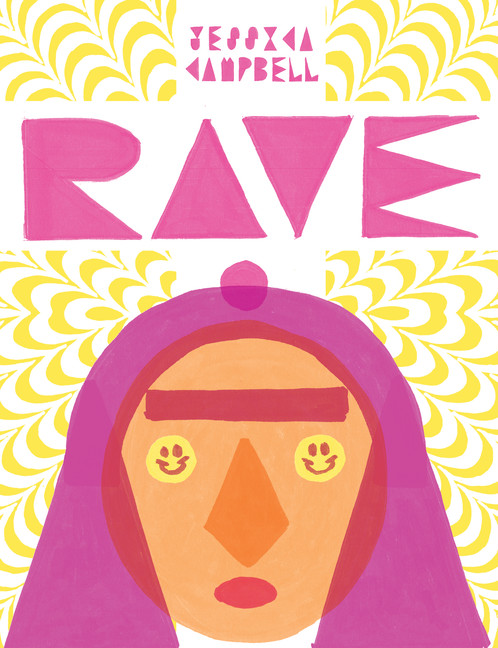


Rave is the story of two teenage girls, Lauren and Mariah. Lauren is a good-natured, church-going girl who attends a fairly big evangelical church in what seems to be a suburb or smallish town. It's the kind of community where people tend to know each other--like it or not. Mariah is her classmate, a "bad girl" reputed to be a witch. When they are paired together on a school project on evolution, they decide to do a sleepover at Mariah's place, since Lauren's parents are offended by the very concept of evolution. Lauren's drawn to Mariah's devil-may-care attitude, and Mariah is drawn to Lauren's hidden potential. They slowly fall in love, the kind of romance that crosses naturally from close friendship into something physical. At a certain point, Lauren hears a sermon condemning same-sex marriage and starts to feel the kind of cognitive dissonance only a believer confronted with ideology that runs contrary to their lived experience can understand. She distances herself from Mariah and immediately regrets it, but it's too late. 

In the book's superb climatic sequence, Lauren attends a Christian "rave" (which is hilarious in any number of ways, but more on that later) while Mariah hangs out with a creepy guy in the forest. In both instances, the girls receive forced and unwanted sexual advances from guys they trusted. In Lauren's case, she simply runs away from the dull boy who's hitting on her; it's implied she only agreed to go with him to the rave as a nod to trying to fulfill the role the church wanted for her. In Mariah's case, she runs off into the woods and accidentally drowns in the river; it's implied that she was not just drunk, but drunk from something the guy brought and had drugged. Lauren eventually sees through all of the hypocrisy and storms out of church, smoking a cigarette from a pack she found in the garbage--a small tribute to her friend. 


It's the astounding verisimilitude of the cloying, manipulative quality of the church that makes this such an unsettling read. Christianity's ace in the hole has long been its ability to co-opt local religions and customs throughout history, repurposing these familiar mores and stripping of their original meaning while retaining the trappings. This viral quality can be seen in modern iterations of worship in churches using lingo and tropes familiar to kids while using the latest technology, like headset microphones. The core of the ideology remains unchanged for evangelical Christianity in particular: salvation can only come through Jesus, same-sex relationships and pre-marital sex are evil, Satan is actively trying to get you to stray off the path, etc. This played out in the DJ who ran the Christian rave, saying that Jesus was the first raver and wants people to dance and move--but not have sex. The use of lingo like "Can we talk?" in an attempt to dress up the archaic and repressive nature of these beliefs is the essence of this playbook, and Campbell just nails painful detail after painful detail. It would all feel like an exaggeration if it wasn't 100% true.

There's a scene early in the book that reveals just how much the church was simply theater. The daughter of the pastor (who of course revealed his struggle with masturbation that he supposedly conquered) got knocked up and was forced to go through the pregnancy. She was called onstage to repent and talk about God's love. When Lauren said hello to her at school the next day, the girl (smoking a cigarette while pregnant) simply said, "Fuck you." It was all a charade, all for show. Love, mercy, and compassion were stage dressing for controlling the lives of the believers. Lauren didn't truly understand this until the end of the book, and who can blame her? 

Campbell has her limitations as a draftsman, but it doesn't matter much because her skills as a cartoonist are so sharp. Her use of gesture is top-notch; there's a scene where Lauren is talking to Mariah on the phone, sitting in a plush chair, moving in different positions. Her relaxed poses in each panel reveal just how comfortable she was feeling with her best friend in ways that felt natural until the authority of the church told her otherwise. Similarly, the plastic quality of the pastor and rave DJ are reflected in the way they have their hair sculpted. Her satire is as trenchant as ever in Rave, but its surprising emotional depths point to her evolution as a cartoonist. 


Thursday, July 4, 2019

Minis: Jessica Campbell's Chicago Works

Jessica Campbell is a cartoonist who's interested in a number of different kinds of media. She's a talented writer and thinker about comics, but she also just had a multimedia show at the Museum of Contemporary Art in Chicago. It was taken from the diary of artist Emily Carr, who lived in British Columbia in the early twentieth century. This minicomic, Chicago Works, is the print version of that show, minus color and with the addition of rearranging the paintings/pieces into a steady six-panel (2x3) grid. It seems as though Campbell knew that something would be lost in translation by making the images so small, which is why publishing the works in black & white (her usual style in comics) made sense. To be sure, however, reading this comic is a different experience than going to see the show. There's less detail, everything is a bit tiny and cramped, and there's more of an emphasis on the writing than the power of the visuals.

That said, there's plenty to look at here. The cover is clever; the main character is seen in profile on both the front and back covers, but if you lie the whole book flat, it turns into a full-face drawing. It's a subtle way of letting the reader know not to take anything for granted in this comic, that things aren't as they seem at face value. Indeed, Carr's text, which is used as captions for each panel, are often at odds with the visuals. This is not a direct adaption of that text, but rather a comic that uses it as inspiration. 

There are times when some of the scenes seem inspired by Carr, although often in an ironic or directly contradictory manner. For example, when we are introduced to the narrator, she talks about her fine manners and English bearing and how that gained her favor in the boarding house she lived in. Campbell instead shows a near-feral young woman who takes a shit on the floor and idly lays on the couch watching television. There's a lot of flirting with this taking place in the past and present, including an extended appearance by Campbell herself. This is a comic about discovery and new experiences, and for Campbell, it seems to include references to moving to Chicago as well as discovering comics for the first time. This is also a comic about loneliness, independence, isolation, and female friendships and how they can be strained. Campbell's inky line and heavy use of black give the comic weight and power, especially in the funnier scenes. The reader is thrown into the middle of all of this with no explanations, but none is really needed thanks to the way Campbell guides the reader through the page. This is a strange, funny project that continues Campbell's project of exploring feminist ideas through deep irony, juxtapositions, and brutal but hilarious truths.    

Thursday, May 17, 2018

Koyama Press: Jessica Campbell's XTC69

In Jessica Campbell's first book, Hot or Not?, she took on sexism and the male gaze in the art world by judging artists by their looks and overall sex appeal. It was a blunt-force object of satire, taking its premise to its limits and beyond by actually making the satire funny and a willingness to stay in character the entire time. Her new book, XTC69, is a brutal take-down of the kind of science fiction novel that's sexist to the point of misogyny. The way she drew the cover (a woman in another woman's arms, a crew member fighting a zombie, a spaceship whooshing by) was meant to evoke those sort of books from the 1960s and 1970s. Robert Heinlein in particular is a target, both his simpler books like S Is For Space and his more "mature" work like Stranger In A Strange Land.

Those books tend to be power fantasies, with the handsome, brave space captain as a stand-in for the author, who inevitably has sex with whatever female character or characters whom might be introduced. Campbell does that one better: the protagonist of the story is Captain Jessica Campbell from another planet, and the female love interest also turns out to be Jessica Campbell, frozen in a cryo-chamber on earth for seven hundred years. Captain Campbell and her crew are looking for mates to help repopulate their all-female planet. Despite all the silliness in the book, Campbell plays fair and has her trio of alien women act very seriously, and the slow reveal of the plot also reflects a carefully assembled bit of scaffolding that surrounds the commentary.

After they take earth Jessica (whom they dub JC2, since the name "Jessica Campbell" was a title won through bloody combat on her planet) with them on their search, they find the last planet that can save them: Mxpx. Along the way, Campbell subtly sets up romance between the book's Jessicas, with a detour into a gag where the captain asks JC2 about the Hadron Collider and quantum physics (getting no results) and then asks about "Harry Potter, Boy Lizard", setting up a twelve hour lecture from JC2. That's a bit of silliness, along with the food available to eat and the aliens' preferred cuisine, "glug glug", which turns out to be pizza. When they find their destination, Campbell goes back to the blunt-force object approach, as the main continent on the planet of only men is shaped like a giant penis and there is some kind of football-like object at its north pole.

When after a period of trial and error that resembled an all-male version of the film Idiocracy, they meet President Chad, who helpfully tells the reader that women long ago abandoned the planet, "because those ingrate bitches wouldn't give us nice guys a chance." They get ordered around a bit, and JC2 gets bombarded with questions like "Why aren't females funny?", "Could you smile? You have resting bitch face" and simply "Blowjob?" The commander is so enraged that she orders the planet to be destroyed, seemingly dooming her planet until a deux ex machina of sorts pops up, albeit one that's totally consistent with the plot and its clues. The two Jessicas kiss in triumph at the very end, in the way the hero usually gets the girl but all the mushy stuff is left for the very end.

Perhaps the funniest part of the book came on the acknowledgements page, where she did a strip where someone asked her if the book was "misogynist against men" (in itself a hilarious turn of phrase). Campbell replied that "A man read it and said it was fine" and that "...some of my best friends are men." That was a rhetorical extra point after the touchdown that was the rest of the book, crushing the kind of arguments men have used for justifying sexism, racism, homophobia, etc. in their own work. Campbell's critique is pointed, even as she dresses it up with gags and sci-fi tropes. For example, she makes a sharp rebuke of transphobia when she has Captain Campbell relate that on her planet, people chose their genders based on their own personal revolution, and to force someone to be a man (because of course everyone would want to lean toward being a woman), to go against their own construction of gender, would be an act of cruelty.

Visually, Campbell keeps her pages simple, with a 2 x 3 grid and a thick, expressive line. Her self-caricature (in her trademark striped shirt and bushy hair) is one of my favorite in comics. Her character design is distinctive, with the page full of asshole guys questioning her containing hilarious and various "bro" types. Campbell's comedic timing is sharp, as she uses panel beats to heighten the awkwardness of a situation, like when Jessica first appears out of the cryogenic tube. The book is also breezily paced despite the occasional info-dump, especially such instances were usually incorporated with some bit of silliness. What Campbell has achieved in this book is a delightful balance of satire, absurdity and sharply-observed witticisms. That she achieved this with a plot that makes far more sense than most science fiction stories was just icing on the cake (or if you prefer, more cheese on the glug glug).

Tuesday, June 27, 2017

Minis From CAKE: S.Roberts, C.Hannah, M.Galloway, J.Campbell

The Chicago Alternative Comics Expo (CAKE) was one of the better shows I've ever attended. Here are a few minis I picked up, with this batch from locals.

Body Magik, by Scott Roberts. I reviewed an earlier comic by Roberts (Chemtrails), but I get the sense that this new comic is much more closely related to his real project as an artist. I was fortunate enough to talk extensively with him about his artistic interest and methods, and a lot of that conversation revolved around Gary Panter as an inspiration. Roberts is definitely in that "mark-making" school of cartooning, where the imperfection of the line itself is an important part of the aesthetic--much more so than its pure representational value. It's an aesthetic that borrows some aspects from abstract expressionism in that the line is an expression of emotion, but it's one where narrative is still a key aspect of that expression.

In the case of this comic, it's about a group of old friends who visit their now ultra-rich and somewhat spaced-out friend who created some kind of life-changing app. Printed on a Risograph, Roberts uses a two-color approach (blue and orange) as well as decorative effects that affect the actual narrative. There's an interesting tension between form & figure and environment, especially with regard to depicting hallucinogenic effects that warp perception and reality. Roberts starts the reader off on shifting sands when introducing them into the rich man's home: it's strange and almost alien in character. Then things get even stranger when he introduces them to an app that reads one's desires and creates a new, 3D-printed, perfected body.

The rest of the comic explores these new bodies: a centaur, a lumpy but masculine mass, a furry bear, a couple sharing the same body in the most intimate ways possible, etc. Roberts naturally explores the downside of this app. The couple sharing the body has become completely cut off from the outside world. The centaur runs away from intimacy. The man who became the bear did it only for his lover, whose near appearance as male is distressing to him. That leads to an interesting debate: "Did you love me or my body?", with the remarkably honest answer being "I don't know...both?" Throughout this series of explorations, Roberts is careful to continue to focus on the figures while providing decorative subtext that push themselves into text, like the character who becomes a caterpillar suddenly bursting into life as a butterfly. It's the ultimate symbol of unambiguously joyous transformation, and to see it juxtaposed against someone regretting their own change was an interesting narrative strategy. It also points to the idea that subconscious desires may not match up with one's own conscious narrative.


My Erotic Life, by Jessica Campbell. Humor comics are something I take very seriously, if I may venture into contradictory territory. I can enjoy something that's a humor comic even if I don't laugh out loud; I can generally enjoy them on a more conceptual level, even if it's tough to make me laugh like that. Of course, when I do find a cartoonist that elicits that reaction (Ivan Brunetti, Michael Kupperman, Lisa Hanawalt, Gina Wynbrandt, Lauren Weinstein, Peter Bagge), they become instant favorites. So is it also the case with Jessica Campbell. Her Hot or Not was a brilliant work of satire, and I've enjoyed her other illustrated minis that were mostly not entirely comics. But this collection of four-panel strips (the building block of humor) shows the artist going strictly for punchlines--and a lot of them land hard. The great thing about the strip titled "Oh, this old thing? It's just..." is not that she escalated the absurdity to build to a crescendo, but rather that she immediately elevated the absurdity and kept it a high level. From "Cheetos sprinkled on my feet" to "A trash bag with nipple holes" (with hilarious accompanying illustrations, this was the best gag in the mini.

Not all of her gags are conceptual. A drawing of her own tongue writhing in her mouth begins with the question "How hard is it to swallow your own tongue?" and ends with the statement "I smoked a little pot", giving perfect context to the prior four panels, especially since that kind of pointless tangent and staring off into space is precisely what happens when getting stoned. Campbell has clearly been working on her cartooning and drawing, as it is way more confident than it was even in her book. A side effect of that work provided another strong gag, where she starts off wanting to learn how to draw a nude man. She opens up a Google rabbit hole, simply saying "Huh!" for the next eight hours. As Campbell continues to refine her line, she has the opportunity to continue to clearly merge the visual aspects of her humor with the already razor-sharp wit that she possesses.

Nest, by Marnie Galloway. Rarely do I encounter cartoonists with a high degree of technical illustrating skill who also possess an intuitive, humane approach to art the way that Marnie Galloway does. Her Burrow was a personal meditation on motherhood (though not an autobiographical one) that explored the relationship between early motherhood, sleep deprivation, and the dream-like state (bordering on psychosis) that often occurs as a result of that lack of sleep. Nest is a non-narrative companion piece, juxtaposing drawings against Galloway writing out the Sophie Jewett poem "To A Child" on pages opposite the drawings. The drawings are similar to her Burrow style: Megan Kelso-esque in the use of a clear line, the bulky bodies with a powerful presence, the pastoral imagery of mothers and infants asleep together. It was printed on a Risograph, with green (of course) being the single color at work here. The most beautiful thing about this comic is its stillness: mothers and children asleep together: safe, becoming rested and rejuvenated, and sheltered. There's a sense of beautiful dreams chasing away the confusion of Burrow, if only for a little while.


Chicago In The Fall, by Cathy Hannah. Hannah's being doing memoir comics for a long time,but with her recent Springtime In Chicago and its sequel, she's really started to hit a new stride. Each daily strip is just four panels long, and she is careful with regard to what she chooses to talk about each day. This volume is a raw, honest look at her love life, as she still pines for one co-worker while sleeping with another one, a man whom some of her friends worry about with regard to his temper. Hannah has found her stride in part because she's found a way to simplify her line without sacrificing coherency or emotional content. Working with what looks like a fine-line marker, she's also attained a level of panel-to-panel consistency that resonates with the reader--especially her own self-caricature. With a few lines for bangs, dots for eyes, and a prominent nose, her profile pops on the page.

Hannah switches subject matter from her current job, to job interviews, to therapy sessions (mostly talking about jobs, the guy she's sleeping with, and the guy she's still obsessed with), time alone with her ailing cats, and eventually anxiety over the 2016 presidential election. There's a strip where she turns away from sex because her partner is drunk; initially she thinks to do it just to get over with then realizes that's precisely the wrong thing to do. This later leads to a fight, which leads her to question why she's even in this arrangement, other than for sex: "Trust me, it's not that glamorous". Strips like that are balanced with Hannah experiencing delight with regard to things coming in the mail or getting goofy with friends, as it's clear that personal connections are a big part of her happiness, even as she tends to be a homebody by nature. Hannah goes round and round a bit and even cops to it at the end: there's no conclusion to this comic because her life wasn't wrapping up neatly either. There's a sense that this comic is one long holding pattern, waiting for other shoes to drop: Trump, the health of her cats, her job, the guy she's dating, and the guy she's in love with. The fact that none of the shoes other than Trump dropped, so to speak, add a certain amount of tension to her life, but it's clear by the tone of the strips that simply writing about these events is therapeutic in its own way.

Tuesday, September 27, 2016

Koyama: Jessica Campbell


Hot Or Not: 20th Century Male Artists, by Jessica Campbell. This is first-rate, layered satire that delves into some pretty rich territory. Campbell's heavy use of shtick belies the ways in which she lands strike after strike on the art world, art criticism, and the sexist nature of both. Starting with the cover, which is a masculine version of Pablo Picasso's Les Demoiselles d'Avignon, complete with six pack abs, Campbell mirthfully takes on the male gaze and the dominance of men in relating the history of art. Perhaps unsurprisingly, there was some pushback in Canada about depicting penises on the cover of this book, so some silvery UV ink (the kind used on scratch-off tickets) was added to create thongs, banana hammocks and shorts that covered up the offending naughty bits. The introduction, which is a nearly incoherent bit of art-crit speak, is appropriately pompous and sets up the on-a-dime tonal shift when the actual narrative begins.

That narrative is of Campbell as a docent leading a tour in an art museum, initiating a ridiculous q&a with the crowd. She elides the damning truth that the works in the museum were all by men and asks a far more important question: were the artists hot? In one stroke, she turns back not just the idea of the male gaze, but the inevitable sexualization of women who enter traditionally male spheres (like fine art). Or rather, the institutionalization of museums helps rewrite history and remove the historical involvement of many women. Campbell doesn't mention any of these facts, because what's the point? By objectifying men in precisely the same way women are objectified, she creates comedy gold on page after page, especially as she tries to guess whether or not an artist is hot based on his work. Campbell is an exceptionally witty writer, and her scratchy reproductions of famous works of art as well as drawings of the artists themselves complement her gags in a deadpan manner.

The more brutal Campbell gets in evaluating the attractiveness of the artists, the funnier she gets. She at first guesses the Canadian artist P.E. Borduas is the type to "toss you up against a bear and make rough sex to you", but the next-page reveal dismisses the severe-looking man by saying "Edgar Allen Poe cosplay was big in 20th Century Quebec." Malevich was described as having "the face of an adult baby" but Cy Twombly, whose paintings she guessed were made by "a fat guy in a bowtie", surprisingly made it to the Hot category. Of Modigliani, Campbell decrees him to be Hot and says "Paint me like one of your mangled Italian girls, Amedeo." Paul Gauguin is referred to as a child molester and Henri Matisse's lack of hotness is "probably why Picasso used him as a wingman." The book's punchline, where Campbell and the members of the tour weep over the unknown hotness of artists from antiquity, reduces the works to something totally unrelated to the quality of the work, which of course is something female artists deal with all the time. At a tidy 62 pages, this book doesn't outstay its welcome, making every gag count. Ultimately, the book succeeds because it fully embraces the vapidity of the internet-style snap judgments of physical attractiveness as the totality of worth. Campbell understands that the stinging critiques she's offering up are only effective as long as she works to serve up nasty, hilarious comments.

Tuesday, August 9, 2016

Foxing Reprints #15: Oily Comics-- Stein, Zettwoch, Campbell, Runk

[Editor's note: this column first appeared two years ago, and the information about the grant below is no longer relevant.] 

In a bit of neat synchronicity, Chuck Forsman is seeking out a grant from Mission Main Street at precisely the same time I decided to write about his Oily Comics publishing concern for Mini-Sweep. This grant apparently gets decided by popular vote, so please click here (https://www.missionmainstreetgrants.com/business/detail/43895) to vote. Aside from being a talented cartoonist, Forsman has done impressive things with Oily. Most individual issues are just a dollar and are twelve pages long in traditional minicomics format. He's published a combination of well-known names and up-and-coming cartoonists, as well as more obscure favorites he deemed worthy of getting greater exposure.  October will be dedicated to taking a look at a number of Oily Comics.

Cut-Away Comics #1 and #2, by Dan Zettwoch. Zettwoch is a great example of a well-established cartoonist who was curious to take advantage of the Oily format for a short series. It's also fitting for Zettwoch, given his long history of self-publishing and a DIY point of view. A student of history and 19th century American history in particular, this comic follows a particular episode in the life of (as Zettwoch describes him) "woodsman/dandy/ornithologist" John James Audubon. He was fascinated in particular by a bird called the Chimney Swallow, and he discovered a huge, dead tree that served as the nest for hundreds of the birds. As always, Zettwoch is drawn to peculiar details of eccentric and inventive personalities, and Audubon certainly fit that bill on both counts. Zettwoch mixes his cartoony and exaggerated character design with his wonderfully precise cut-away diagrams of trees, the digestive system of swallows and lots of other information. It's a delightful examination of both a legendary figure in the field of ornithology as well as a clever series of solutions to finding out just how swallows lived in that tree. 

My Sincerest Apologies and Mrs. Connie Dutton, by Jessica Campbell. Campbell is a former employee of Drawn & Quarterly, and Forsman told me that she had a fantastic sense of humor. That's certainly on display in these two comics. My Sincerest Apologies is more a zine with pictures than a comic, but the lushness of her cursive script gives the zine a strong decorative quality with killer story-punchlines like "I'm sorry I told everyone that your new girlfriend is a child bride that you ordered off of the internet". The accompanying illustration is a google page with someone typing out the word "loneliness" on the screen. The "apologies" go ever further over the top in terms of both cruelty and ridiculousness.

Mrs. Connie Dutton's subtitle is "an adaptation of Spam". It's about a woman who goes to Nigeria after getting swindled out of money by a spammer and receives 1.5 million dollars from "Barrister George Alex of the Compensating Committee". Campbell's lettering her is a sort of fake digital font; it's all hand-lettered by made to look like a computer put it together. The writing has that same cadence, and her illustrations are wonderfully stiff. Once again, the Oily format is perfect for a short, punchy set of ideas that work best as individual objects. 

The Desk, by Leslie Stein. Stein is one of my favorite cartoonists, and I'm especially enjoying her more explicitly autobiographical stories about her childhood. The Desk is more of a brief, funny anecdote than something that evokes her usual themes of attempts at connection and continuous alienation. Yet, this story of her young autobio stand-in "Larry" building a reception desk in front of her room's doorway at home is just the sort of odd thing that young Larry is shown doing in Stein's other comics, especially as she cheerily says "Hello! Larry's room! Can I help you?" when someone approaches. This is all scuttled when she has to rush to the bathroom, though she puts away her components with a shrug and a smile. The tiny, three panel back-up strips featuring "Normal Folks" and "Weird Kid" are every bit as good, depicting the horror of banality and the wonders of kids being allowed to dance to the beats of their own drummers. Stein's character design is, as always, unique; her stippling technique is used sparingly but her eye for detail is astounding and key to establishing mood. 

Not A Horse Girl, by Marian Runk. ​It's hard to believe that this dense, warm and multi-layered comic is only twelve pages. The comic revolves around music and Runk's growing love of singing and playing the guitar, but she touches on her childhood, her personal relationships, her sexuality, her friendships, her attempts at songwriting and even throws in several funny anecdotes for good measure. She does more in twelve pages of memoir than most cartoonists do in a hundred. The repeated use of the phrase "buttery-soft" to describe chaps and later lingerie is both evocative and amusingly uncomfortable, especially with the wistful looks on the faces of the women recalling their items of clothing. Runk's line is simple but marvelously expressive, focusing mostly on facial expressions and the use of gesture. Runk's memories of her father (a symphony musician) not listening to any music around the house, going to weekly concerts and such as a force that shaped her relationship to music is recalled with no resentment but rather a sense of bemusement. The comic concludes with Runk writing her own song and sharing it with a fellow music-loving friend, with a URL provided to listen to it.