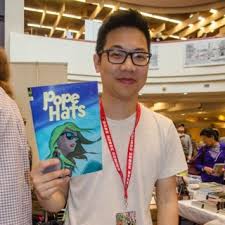
I've reviewed all three issues of Ethan Rilly's Pope Hats series that featured the stories that make up the Young Frances collection. so rather than a formal review, I thought I'd make a few comments about it, bullet-point style.
* Rilly is actually the pen name of Hartley Lin (an impressive anagram), which was revealed for collecting the original stories into a single volume. Lin is a superb illustrator who can tell a story with a single image. The covers of the original issues were striking, and the book is every bit as well designed. Frances is centered perfectly in a type pose: mousy appearance with hair in ponytail, shoulders slightly stooped, a neutral expression on her face. It's as though she wants to disturb the equilibrium of the surrounding environment so little that she doesn't want to do anything to draw attention to herself.
Her best friend, Vickie, displays her naturally flamboyant personality by posing like a model, while their friend (and occasional romantic interest) Peter, has dropped out of the foreground where the other characters are and sunk into the background, reading a newspaper. It's fitting for a character lacking in pretension, and whose role helps keep Frances balanced and sane.
* One of my favorite characters is the unnamed spiritual adviser of Vickie whom Frances decides to see toward the end of the story. She's a classic scam artist who at the same time believes some of her own hype. Frances is such an unrelenting cynic that she can't help but be a smart-ass when she meets her ("So how do we do this? Do you give me a spiritual plan to work on or something?"), while at the same time the adviser notes that her redecorated place will "be a write-off". The adviser realizes that Frances is not going to fall for any of this and so gives her simple advice: diet, exercise, sleep, someone to be with. It really is the advice she needed to hear. The adviser really is a con woman in the best sense of the word; she figures out ways to boost the confidence of the people she advises. That's why she worked so well with Vickie, who was waiting for that kind of prompt.
* There are a number of appealing supporting characters, the best of which is Marcel Castonguay. He's the massive, hulking genius lawyer who's always one step ahead of everyone else, resembling a cross between Daddy Warbucks and Wilson Fisk. He's eccentric in a way the powerful can afford to be. He lives in a hotel across the street from his office. he apparently never eats in front of anyone else, he doesn't use a computer but instead dictates all of his thoughts to his three assistants and tends to talk in terms of enigmatic riddles. However, when your pants fall down in the middle of a filmed speech about a major new acquisition, it still means you're human.
* A major theme of the comic is what it means to be successful, along with the masks and identities we must adopt in order to achieve success. When the book begins, Frances fears success. She's a college drop-out who apparently left despite being a brilliant student. She took a drone job as a law clerk and began to slowly realize that she was so good at it that she kept succeeding and being noticed despite not trying to do so. The fact that she didn't try to perform or put on a mask made her extremely valuable but also confused a number of people around her. On the other hand, Vickie wants to be a star more than anything, but once she achieves her dream, she learns that the games and masks have only begun.
* Lin does something very smart and reminiscent of something from the Jaime Hernandez playbook when he separates the two friends for more than half of the story. Hernandez found he was able to really play up the tense friendship between Maggie and Hopey by frequently separating them. The absence of one in a story was always strongly felt, and the reunions were that much more intense. Vickie and Frances had a relationship that was symbiotic in some ways, but it was also starting to become codependent. Their separation led them to really think about what the other meant to them. Vickie in particular told Frances that she was remembering to be cautious in ways that she never was as a survival mechanism in Hollywood. Frances needed to hear what Vickie told her about herself, that she wasn't a fucked up person. More to the point, she needed to hear that Peter really was in love with Frances.
* Lin's portrayal of office dynamics is something I've never seen in comics before, and he nails the eccentricities of being in this kind of setting. There's the tiny boardroom that means you're going to be fired if you go there. There's the balance between ruthless treatment of employees and figuring out that morale has to be boosted in order to keep the machine working. It's no accident that the most cartoonish characters are the heads of the firm; they are larger than life but absurd people.
* Despite the subject matter being familiar overall, and one that could perhaps be told in a variety of media, Lin takes full advantage of the comics form in telling this story. The aforementioned cartoonish characters, for example, only work in their absurd glory because they're juxtaposed against more naturalistically drawn characters. But even those latter characters are still very much done in a clear-line style, so the juxtaposition doesn't take the reader out of the story; they make sense next to each other. This wouldn't be effective in another medium. Also, Lin does things with pace and panel-to-panel transitions that slow up time in ways that are not only clever, but give real insight into Frances' personality. Stillness is a crucial aspect of this comic: gazing out of windows, looking at nature, conveying the feel of cold, crisp night air.
* Something that's clear is that Lin has a lot of affection for all of his characters, even some of the slimier ones. Vickie may seem flighty, but she's far sharper than she acts. Frances may seem overly tightly wound, but she's trying hard to relax into being affectionate toward others. Even the lawyers are treated with a certain bemused sense of humor. For the most part, the conflicts in the story are internal ones. Or rather, the conflicts that concern Vickie and Frances are internal. There are conflicts in the firm that play out with some people getting fired and some people getting promoted, with every move and gesture made part of the conflict. It's absurd in the same way the conflicts of subcultures are difficult to understand unless you're immersed in it. Lin is interested in giving an outsider's perspective for both this law firm and for Hollywood and draws a clear parallel as to the made-up rules, performative nature of all interactions, and the way both take over the lives of the participants.
* This is a very funny book, filled with tiny moments of humor rather than uproariously hilarious scenes. Lin is great at visual humor as well as witty dialogue, but it's all in service of the characters. It's a snapshot of a transitional period for the two friends who had been living together for some time, and there's a quote from Castonguay that sums it up: "There are no final outcomes. There are only developments." The end of the book is not the end of Frances or Vickie's story. It's simply a significant development for Frances, one that she that finally embraced in the way that Vickie embraced her development. The difference is that an outcome implies finality, whereas a development reveals a fluid situation. In this case, that fluidity is important because it's what allows Frances and Vickie's friendship to not only survive, but thrive.
Showing posts with label ethan rilly. Show all posts
Thursday, June 21, 2018
Tuesday, June 6, 2017
Ten Artists To Seek Out At CAKE 2017
I will be attending the Chicago Alternative Comics Expo (CAKE) this Saturday and Sunday, June 9th & 10th. I'm excited to meet a number of Chicago-area artists for the first time, and of course will be looking for comics for review. On Sunday at 3pm, I will be moderating a panel titled "Place As Character", featuring the artists Emil Ferris, Laura Knetzger, Sophie Goldstein and Mita Mahato. All panels will take place on the third floor of the Hoover-Leppen Theatre. CAKE has a tremendous amount of talent, perhaps the most per capita of any American art festival. This is a show with special guests like Gary Panter, the explosively popular Emil Ferris, Simon Hanselmann, Kevin Budnik and many more. Here are ten artists you might be less familiar with that you should consider visiting if you attend the show.
1. Haleigh Buck (Table 315). This autobiographical cartoonist from Baltimore is making some of the rawest, densest comics about dealing with mental illness as part of everyday life, including how she dealt with an enormous breakdown. Her naturalistic style has a surreal edge to it and she maintains a wicked sense of humor throughout.
2. Chris Cilla (Table 205). His book The Heavy Hand is one of my favorite comics of all time, fusing a variety of styles together seamlessly to create a psychedelic, hilarious journey that defies all of the genre conventions that the book explores. His minis are also excellent, creating his own brand of underground comics that acknowledge all of their forebears without being beholden to any one in particular.
3. Cathy Hannah (Table 410). Hannah is another autobio cartoonist who writes about the intersection of the personal and political in interesting ways. She spills a lot of ink in delving deep into her own mental illness issues, her feelings about relationships and documenting her own therapeutic breakthroughs in real time. She uses an inviting, cartoony style to tell her stories.
4. Sophie McMahan (Table 403). Ever since one of her comics appeared in my mailbox, I've been astounded by the sophistication of her critiques of beauty, image and the male gaze through the use of body horror and distorted versions of 1950s-style advertising illustrations. Every one of her comics is both aesthetically beautiful and thematically challenging.
5. Carolyn Nowak (Table 505). She's doing some fantastically funny comics about sex, gender identity, culture and intimacy, with her recent Diana's Electric Tongue especially notable. A winner of the Ignatz award last year, her comics have a sense of lived-in warmth that's part of her sharp critiques. Her work is questing, curious, warm, funny and extremely smart.
6. Ben Passmore (Table 307). He just earned an Eisner nomination for his breakthrough short comic Your Black Friend, a pointed meditation on racial alienation. However, his other comics, like his postapocalyptic-autobio series Daygloayhole, are every bit as provocative, dealing with issues like addiction, isolation and connection, told with a weary sense of humor and razor-sharp intellect.
7. Ethan Rilly (Table 405). Rilly's Pope Hats series is one of the best things going in comics. Its serialized storyline about a law clerk named Frances features characterizations that rarely found in comics, gorgeous character design and an unerring ability to use stillness and pauses as a key part of his storytelling. His comics are subtle, beautiful and immensely satisfying.
8. Yumi Sakugawa (Table 220). This is an artist whose sharply-observed observations about art and gender dovetail beautifully with her sense of composition that makes extensive use of negative space. There's also a slightly exaggerated sense of reality to be found in her comics, often mediated through her frequent use of a reserved or deadpan narrative voice. UPDATE: Yumi Sakugawa has cancelled.
9. Eric Kostiuk Williams (Table 510). Williams' gained a lot of notice with his Hungry Bottom Comics series, a comic that mixed autobiographical essays about being young and queer in Toronto with surreal dreamscapes. Williams' potent mix of incredibly fluid draftsmanship and a probing mind helped get an Eisner nomination with his recent Babybel Wax Bodysuit, and his recent Heartbreak Condo Disco from Koyama Press.
10. Jenny Zervakis (Table 105). It's a conflict of interest to suggest that her debut collection of Strange Growths could very well be the book of the show, given the fact that I interviewed her for a section at the end of it. However, I'm not the only one eagerly awaiting this book that collects the first 13 issues of her minicomic, mostly from the 90s when she was a publishing mainstay. That John Porcellino had been planning to do this kind of collection for years speaks to the respect he has for her work. Her thin, penciled line tells stories that are poetic, still, funny and sharply observed.
1. Haleigh Buck (Table 315). This autobiographical cartoonist from Baltimore is making some of the rawest, densest comics about dealing with mental illness as part of everyday life, including how she dealt with an enormous breakdown. Her naturalistic style has a surreal edge to it and she maintains a wicked sense of humor throughout.
2. Chris Cilla (Table 205). His book The Heavy Hand is one of my favorite comics of all time, fusing a variety of styles together seamlessly to create a psychedelic, hilarious journey that defies all of the genre conventions that the book explores. His minis are also excellent, creating his own brand of underground comics that acknowledge all of their forebears without being beholden to any one in particular.
3. Cathy Hannah (Table 410). Hannah is another autobio cartoonist who writes about the intersection of the personal and political in interesting ways. She spills a lot of ink in delving deep into her own mental illness issues, her feelings about relationships and documenting her own therapeutic breakthroughs in real time. She uses an inviting, cartoony style to tell her stories.
4. Sophie McMahan (Table 403). Ever since one of her comics appeared in my mailbox, I've been astounded by the sophistication of her critiques of beauty, image and the male gaze through the use of body horror and distorted versions of 1950s-style advertising illustrations. Every one of her comics is both aesthetically beautiful and thematically challenging.
5. Carolyn Nowak (Table 505). She's doing some fantastically funny comics about sex, gender identity, culture and intimacy, with her recent Diana's Electric Tongue especially notable. A winner of the Ignatz award last year, her comics have a sense of lived-in warmth that's part of her sharp critiques. Her work is questing, curious, warm, funny and extremely smart.
6. Ben Passmore (Table 307). He just earned an Eisner nomination for his breakthrough short comic Your Black Friend, a pointed meditation on racial alienation. However, his other comics, like his postapocalyptic-autobio series Daygloayhole, are every bit as provocative, dealing with issues like addiction, isolation and connection, told with a weary sense of humor and razor-sharp intellect.
7. Ethan Rilly (Table 405). Rilly's Pope Hats series is one of the best things going in comics. Its serialized storyline about a law clerk named Frances features characterizations that rarely found in comics, gorgeous character design and an unerring ability to use stillness and pauses as a key part of his storytelling. His comics are subtle, beautiful and immensely satisfying.
8. Yumi Sakugawa (Table 220). This is an artist whose sharply-observed observations about art and gender dovetail beautifully with her sense of composition that makes extensive use of negative space. There's also a slightly exaggerated sense of reality to be found in her comics, often mediated through her frequent use of a reserved or deadpan narrative voice. UPDATE: Yumi Sakugawa has cancelled.
9. Eric Kostiuk Williams (Table 510). Williams' gained a lot of notice with his Hungry Bottom Comics series, a comic that mixed autobiographical essays about being young and queer in Toronto with surreal dreamscapes. Williams' potent mix of incredibly fluid draftsmanship and a probing mind helped get an Eisner nomination with his recent Babybel Wax Bodysuit, and his recent Heartbreak Condo Disco from Koyama Press.
10. Jenny Zervakis (Table 105). It's a conflict of interest to suggest that her debut collection of Strange Growths could very well be the book of the show, given the fact that I interviewed her for a section at the end of it. However, I'm not the only one eagerly awaiting this book that collects the first 13 issues of her minicomic, mostly from the 90s when she was a publishing mainstay. That John Porcellino had been planning to do this kind of collection for years speaks to the respect he has for her work. Her thin, penciled line tells stories that are poetic, still, funny and sharply observed.
Thursday, June 16, 2016
Heavy Hitters Part 1: Rilly, Galloway
Pope Hats #4, by Ethan Rilly. In a format reminiscent of 80s alt-comics, Rilly continues to defy conventions by publishing his work in serial format. This issue is a collection of short stories published elsewhere, some of which are related. Indeed, the front cover features several key characters from the issue in one scene. Interestingly, none of the characters are looking at each other, which makes sense considering none of them interact within the context of the issue either. The back cover features mostly silent images from the stories, or rather images suggested by the stories that we didn't actually see. It's a clever idea that helps frame the entire issue.
"All In" connects to "The Nest", a story seen later in the issue. It's a small character moment: a young woman ignores going to bed for the siren call of playing poker on her phone. The steady march of panels in the 3x4 grid gives the story a deliberate, uneasy quality. "The Hollow", done in a yellow and blue wash, is about a disgruntled member of a colony on another planet. It's not just that he's disgruntled with the conditions, but that his mind has become wrapped up in conspiracy theories and paranoia, unable to see the point of view of any others. When he takes a drug that allows him to read the thoughts of others, it's too much to bear the actual thoughts and feelings of others. Rilly's takedown of an egocentric, Clowes-style misanthrope was extremely clever.
"Stained Glass" is a strip that really shows off Rilly's incredible understanding of how to convey gesture with just a minimum of lines. It's a story about the way vanity and ego, especially an artists's vanity, can have horrific real-life repercussions. Gesture is crucial to the story because the artist, who created stained glass windows for a church, noted a slightly unimpressed expression on the face of the sponsor, which drove him crazy. Rilly's simple and subtle use of gesture here was key to making the story work. "New Friend", which has a homey, brown wash, is all about trying to reconnect with one's past and the ways in which the choices of people we thought we knew can confound us. Once again, Rilly uses gesture and body language to tell the story even without dialogue.
"The Nest" is a multipart serial about the heartbreak of parenting and mental illness. Clement, a middle-aged dad drawn with a huge, bigfoot-style nose and a mustache (he looks like a slimmer version of Mr. Wilson from Dennis the Menace), discovers his grad student daughter sitting in her car behind his house when she should have been in school. Marie, his daughter, developed schizophrenia and no longer recognized her parents as such, thinking them impostors. This is the only story in this issue that features women as primary characters with their own agency, which I imagine is coincidence since women feature prominently in the usual Pope Hats narrative. Rilly navigates Marie's point of view, Clement's point of view, and the point of view of various other characters with a great deal of empathy, especially since Marie's mother is so obsessed with the idea of being judged for Marie's mental illness. The story ends with the father of two neighborhood vandals talking to him about how difficult it is for him, and without saying a word, it's clear that Clement does. The character design in this story is particularly clever, mixing a naturalistic setting with exaggerated facial characteristics. That combination creates a shorthand that allows for fluid panel-to-panel transitions, slightly rubbery movements and immediate clues as to the characters' emotional states.
"Bitter Drummer" is the most straightforward story in the book, as it talks about a famous but defunct band deciding to get back together, from the point of view of the drummer. He's the most grounded and domesticated member of the band, and his eventual fate (hinted at in the first couple of panels of the story) made sense because one got the sense that this was really no longer his life. There are few other gags in the issue that round it out that remind me of the sillier things Dan Clowes used to do in Eightball. Clowes and Adrian Tomine are Rilly's most obvious peers, but Rilly's line differs in important ways, as does the overall emotional tone of his comics. Certainly, there are sometimes desperate, obsessed people in his stories, but Rilly's take on them is to give them a fair shake rather than use them as either an emotional stand-in expressing frustration or as subjects of pure derision. While his comics are usually subtle and restrained, there's a remarkable sense of warmth to be found.
In The Sounds and Seas Volume 2, by Marnie Galloway. The second volume of three silent volumes about the creative journey is much more straightforward than the first, but no less filled with deeper meaning. The first chapter of this book is about the three creators we met in the first book working on building a ship for their journey. It opens with a crow flying into their workshop (in the middle of winter, no less) and perching at the top of the mast, becoming a sort of living good luck token. The woman with the longest hair is chosen for a special task: having all of the ship's ropes woven into her hair. Weaving is a repeating image in the comic, as there have been visual representations of weaving together songs and weaving in groups of three. While the task of being at the center of the ship's operations clearly wears on the woman, she accepts it without complaint. The fourth chapter describes the first part of their ship's passage. It's a joyful journey, full of fishing, diving, sketching, and bioluminescent squid. When the ship's crow is discovered dead, the crew reacts with horror, and a violent storm envelops the ship as the chapter ends. As always, Galloway's skill as a draftsman and cartoonist is impeccable. The density and precision of her hatching is a sight to behold. Her use of blacks adds perfect balance to every page. Her nature drawings are incredibly lifelike, indicative of her ability to reproduce patterns in a matter that's entirely organic. The fact that she's also an excellent cartoonist on top of a great illustrator is what makes this such an absorbing reading experience. Rather than one's eye falling off the page, the reader instead is sucked into each panel as the characters react to each other with fluid gestures and vivid expressions. All that said, this is still just a story fragment, and I eagerly await the finished product when it arrives.
Friday, March 8, 2013
Learning Curve: Pope Hats #3
Ethan Rilly's first issue of Pope Hats came out in 2007. Since that time, his improvement as a storyteller has been remarkable. I thought the second issue of the series was one of the best comics of 2011. It's interesting to see how he's evolved this story of two lifelong friends: a mousy, insomniac and highly competent law clerk named Frances and a flighty, talented alcoholic actress named Vicki. Now Rilly has found a great home with Chris Pitzer's AdHouse books, a publishing house dedicated to impeccable design. Simply put, everything about his work as a cartoonist has become more restrained and subtle, allowing him to really get across big emotions and themes without resorting to storytelling histrionics. The first issue is an example of a young cartoonist who doesn't yet have the confidence in his line or figure drawing to keep things simple; Rilly relies too much on over-rendering and adding intrusive blacks to flesh out his page. Moreover, Rilly drew his characters in a fairly naturalistic style; it wasn't until he went to a more iconic style that he was able to bring their qualities to the surface in a more direct manner.
Rilly also abandoned a slightly cutesy trope of Frances being haunted by an incompetent ghost, one that accidentally killed the neighbor's cat though he was intent on frightening her. Rilly left it open to interpretation as to whether the ghost was "real" or not, but the device was dropped after the first issue. Instead, he furthers a number of storylines that he began in the second issue. There are parallel plots in the comic, as Frances finds herself inadvertently rising in status at the law firm and Vicki finds herself being flown to Hollywood for an audition. Success for both of these fuck-up friends seems like an odd phenomenon, something that's happening in spite of themselves or like something that's happening to other people. Both Frances and Vicki are "out of body" types who are all too aware of the disconnect in their lives, and both have strategies for dealing with this sensation. Vicki does it with alcohol and sex, while Frances tries to fight her crushing insomnia with work, booze and running. In neither case are they ever able to get away from themselves.
Rilly's detailed account of the machinations and politics of a law firm are riveting. A hypercompetent, efficient and hard-working clerk like Frances is a greatly desired tool in a law firm, because it means that cheap labor will be doing a lot of heavy lifting. Of course, the fact that there's a game that everyone but Frances seems to be playing in order to become successful is what makes her successful: her superiors can see that she's not playing that game, which is why she's so valuable. In a profession filled with sharks, Frances represents someone working for the sake of work, trying to find some kind of peace or purpose in the moment. The fact that she's also so tightly wound (especially regarding her emotions) allows her to blankly interact with those in authority, something that also gains their favor. The whole issue is about her continuing to draw attention from new sources, being rewarded with an office (something met with intense jealousy by others) but constantly feeling like garbage. Her refrain throughout is "Today I'm crap, but tomorrow I'll be good", magically hoping for that one good night of sleep that will transform her entire world.
On Vicki's end, every gesture she makes is a dramatic one. She throws a huge going-away party after she gets the lead role in a new TV show (about a vigilante DA, a concept worthy of Michael Kupperman), showing up late and absurdly, in a giant bird outfit. Rlily's dialogue simply sings in this comic, as she asks someone to wet her beak when she takes off the giant bird head, or when Frances struggles to explain how not everyone likes her to yet another partner in the firm who's trying to woo her to his field. It's interesting that the most emotion Frances can muster is anger at the parasites and hangers-on at the party who don't really care about her friend. She can't bring herself to cry that her childhood friend is about to leave her (indeed, Vicki seems more despondent); everything is too bottled up, including her obvious feelings for Peter, a fling of Vicki's.
His presence in the issue ties together the issue's main theme: work as a central part of our identities. Peter, a construction worker, pointedly tells Frances that his work doesn't define him. For Vicki, acting is both her passion and her meal ticket, but she has a sense that things are going to change because "I'm famous people now." As Frances' star rises at the firm, the issue zeroes in on the story of Nina, an struggling associate who is being subtly sabotaged by fellow associates and is called upon to do an impossible job in court the next day. Frances offers to tell her everything she knows about the case but is rebuffed, as Nina says "I know my place now." She fails spectacularly in court and is then called into the dreaded boardroom 25H--the only one small enough for just three people and so the room where everyone is fired. Various lawyers tell Frances of the things that keep them grounded, with some claims more dubious than others. Frances isn't quite sure what to make of her situation; she dropped out of law school and feels like a failure treading water in a nonprofessional job, but her influence becomes greater simply by not acting like a shark. As I've noted before, these are not typical themes in a slice-of-life comic. The most important relationship in the book is between Frances and Vicki as a friendship that defies logic; love relationships are very much sidelined. While quotidian details are part of the scenery, they do not dominate the comic in a way they might have in a more typical title. When you add Rilly's fully-formed, mature art style that doesn't lose an ounce of its expressiveness despite its clarity, you have a book that puts the lie to the notion that alternative comic books are dead.
Rilly also abandoned a slightly cutesy trope of Frances being haunted by an incompetent ghost, one that accidentally killed the neighbor's cat though he was intent on frightening her. Rilly left it open to interpretation as to whether the ghost was "real" or not, but the device was dropped after the first issue. Instead, he furthers a number of storylines that he began in the second issue. There are parallel plots in the comic, as Frances finds herself inadvertently rising in status at the law firm and Vicki finds herself being flown to Hollywood for an audition. Success for both of these fuck-up friends seems like an odd phenomenon, something that's happening in spite of themselves or like something that's happening to other people. Both Frances and Vicki are "out of body" types who are all too aware of the disconnect in their lives, and both have strategies for dealing with this sensation. Vicki does it with alcohol and sex, while Frances tries to fight her crushing insomnia with work, booze and running. In neither case are they ever able to get away from themselves.
Rilly's detailed account of the machinations and politics of a law firm are riveting. A hypercompetent, efficient and hard-working clerk like Frances is a greatly desired tool in a law firm, because it means that cheap labor will be doing a lot of heavy lifting. Of course, the fact that there's a game that everyone but Frances seems to be playing in order to become successful is what makes her successful: her superiors can see that she's not playing that game, which is why she's so valuable. In a profession filled with sharks, Frances represents someone working for the sake of work, trying to find some kind of peace or purpose in the moment. The fact that she's also so tightly wound (especially regarding her emotions) allows her to blankly interact with those in authority, something that also gains their favor. The whole issue is about her continuing to draw attention from new sources, being rewarded with an office (something met with intense jealousy by others) but constantly feeling like garbage. Her refrain throughout is "Today I'm crap, but tomorrow I'll be good", magically hoping for that one good night of sleep that will transform her entire world.
On Vicki's end, every gesture she makes is a dramatic one. She throws a huge going-away party after she gets the lead role in a new TV show (about a vigilante DA, a concept worthy of Michael Kupperman), showing up late and absurdly, in a giant bird outfit. Rlily's dialogue simply sings in this comic, as she asks someone to wet her beak when she takes off the giant bird head, or when Frances struggles to explain how not everyone likes her to yet another partner in the firm who's trying to woo her to his field. It's interesting that the most emotion Frances can muster is anger at the parasites and hangers-on at the party who don't really care about her friend. She can't bring herself to cry that her childhood friend is about to leave her (indeed, Vicki seems more despondent); everything is too bottled up, including her obvious feelings for Peter, a fling of Vicki's.
His presence in the issue ties together the issue's main theme: work as a central part of our identities. Peter, a construction worker, pointedly tells Frances that his work doesn't define him. For Vicki, acting is both her passion and her meal ticket, but she has a sense that things are going to change because "I'm famous people now." As Frances' star rises at the firm, the issue zeroes in on the story of Nina, an struggling associate who is being subtly sabotaged by fellow associates and is called upon to do an impossible job in court the next day. Frances offers to tell her everything she knows about the case but is rebuffed, as Nina says "I know my place now." She fails spectacularly in court and is then called into the dreaded boardroom 25H--the only one small enough for just three people and so the room where everyone is fired. Various lawyers tell Frances of the things that keep them grounded, with some claims more dubious than others. Frances isn't quite sure what to make of her situation; she dropped out of law school and feels like a failure treading water in a nonprofessional job, but her influence becomes greater simply by not acting like a shark. As I've noted before, these are not typical themes in a slice-of-life comic. The most important relationship in the book is between Frances and Vicki as a friendship that defies logic; love relationships are very much sidelined. While quotidian details are part of the scenery, they do not dominate the comic in a way they might have in a more typical title. When you add Rilly's fully-formed, mature art style that doesn't lose an ounce of its expressiveness despite its clarity, you have a book that puts the lie to the notion that alternative comic books are dead.
Subscribe to:
Posts (Atom)